Volume 2006, Article ID 25686, Pages1–12 DOI 10.1155/WCN/2006/25686
Low Complexity Turbo Equalization for High Data Rate
Wireless Communications
Dimitris Ampeliotis and Kostas Berberidis
Computer Engineering and Informatics Department and CTI/R&D, University of Patras, 26500 Rio-Patras, Greece
Received 21 December 2005; Revised 3 July 2006; Accepted 21 July 2006
Recommended for Publication by Huaiyu Dai
Soft interference cancellers (SICs) have been proposed in the literature as a means for reducing the computational complexity of the so-called turbo equalization receiver architecture. Soft-input-soft output (SISO) equalization algorithms based on linear filters have a tremendous complexity advantage over trellis-diagram-based SISO equalizers, especially for high-order modulations and long-delay spread frequency selective channels. In this paper, we modify the way in which the SIC incorporates soft information. In existing literature the input to the cancellation filter is the expectation of the symbols based solely on the apriori probabilities coming from the decoder, whereas here we propose to use the conditional expectation of those symbols, given both the apriori probabilities and the received sequence. This modification results in performance gains at the expense of increased computational complexity, as compared to previous SIC-based schemes. However, by introducing an approximation to the aforementioned algo-rithm a linear complexity SISO equalizer can be derived. Simulation results for an 8-PSK constellation and hostile radio channels have shown the effectiveness of the proposed algorithms in mitigating the intersymbol interference (ISI).
Copyright © 2006 D. Ampeliotis and K. Berberidis. This is an open access article distributed under the Creative Commons Attribution License, which permits unrestricted use, distribution, and reproduction in any medium, provided the original work is properly cited.
1. INTRODUCTION
Turbo equalization [1] was motivated by the breakthrough of turbo codes [2] and has emerged as a promising technique for drastic reduction of the intersymbol interference in fre-quency selective wireless channels. Unfortunately, the trellis-diagram-based turbo equalizer of [1] can be a heavy com-putational burden to wireless systems with limited process-ing power, especially in cases the wireless channel has long-delay spread. Thus, a number of alternative, low complexity, equalization methods that can be properly incorporated in the generic turbo equalization scheme have been proposed, offering good complexity/performance trade-offs.
In this context, it was proposed in [3] to replace the trellis-diagram-based equalizer by an adaptive SIC of linear complexity. In [4], an improved extension of the algorithm of [3] was presented. In [5], an MMSE SIC for the receiver of a coded CDMA system was suggested. In [6] an MMSE-optimal equalizer based on linear filters was derived and it was proven that several other algorithms (such as the one in [3]) could be viewed as approximations of this one. In [7], the MMSE-optimal equalizer of [6] was used as a start-ing point for the derivation of two approximate equalizers.
Binary source
bi Convolutional encoder
cj
Π cm Conversionto symbols xn
ISI channel
+ wn zn
bi
L(eE)(cj) Decoder
L(D)(cj)
Π 1
Π
L(eE)(cm)
L(D)(cm) Equalizer
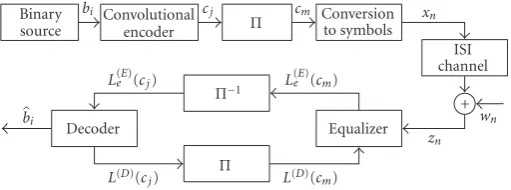
Figure1: The model of transmission.
In the proposed turbo equalizer, we split the problem of a priori probabilities-based equalization into two distinct MMSE optimization problems. The first problem consists in the estimation of past and future symbols using a priori probabilities and channel output information, while the sec-ond problem is the estimation of the current symbol based on past and future symbols. The solution to the first prob-lem is to use an MMSE equalizer similar to the one devel-oped in [11], but modified appropriately so as to provide all the required symbols instead of computing only the current symbol estimate. For the second problem we suggest using an MMSE SIC which has been designed under the assump-tion that its input symbols are actually correct symbols (in practice they are provided by the aforementioned equalizer). As shown experimentally, the proposed approach, so-called conditional expectation-soft interference canceller (CE-SIC), exhibits similar performance to the exact MMSE solution of [11], at a similar computational cost. Although the exact im-plementation of the CE-SIC does not enjoy any advantage over the exact equalizer of [11], it leads to the derivation of an approximate version, so-called approximate conditional expectation-soft interference canceller (ACE-SIC), which has linear complexity. Simulation results have shown that the proposed algorithm exhibits very good performance charac-teristics that make it suitable for high data rate wireless com-munications.
The rest of this paper is organized as follows: inSection 2, the communication system model is formulated. InSection 3, the CE-SIC algorithm is derived. Then, an approximation to the exact algorithm is introduced and the ACE-SIC al-gorithm is formulated inSection 4. In Section 5, for com-parison reasons, various SISO equalizers that are suitable for turbo equalization are categorized according to their compu-tational complexity. Finally, inSection 6, simulation results verifying the performance of the proposed equalizers are pro-vided and the work is concluded inSection 7.
2. SYSTEM MODEL
Let us consider the communication system depicted on
Figure 1. A discrete memoryless source generates binary data bi,i = 1,. . .,S. These data, in blocks of lengthS, enter a convolutional encoder of rateR, so that new blocks of S/R bits (cj, j = 1,. . .,S/R) are created, whereS/Ris assumed integer and no trellis termination is assumed. The output of the convolutional encoder is then permuted by an
inter-leaver, denoted asΠ, so as to form the corresponding block of bitscm,m=1,. . .,S/R. The output of the interleaver is then grouped into groups ofqbits each (withS/Rqalso assumed integer) and each group is mapped into a 2q-ary symbol from the alphabetA= {α1,α2,. . .,α2q}. The resulting symbolsxn,
n=1,. . .,S/Rq, are finally transmitted through the channel. We assume that the communication channel is frequency selective and constant during the packet transmission, so that the output of the channel (and input to the receiver) can be modeled as
zn=
L2
i=−L1
hixn−i+wn, (1)
where L1, L2 + 1 denote the lengths of the anticausal and causal parts, respectively, of the channel impulse re-sponse. The output of the multipath channel is corrupted by complex-valued additive white Gaussian noise (AWGN)wn.
At the receiver, we employ an equalizer to compute soft estimates of the transmitted symbols. As a part of the equal-izer is also a scheme that transforms the soft estimates of the symbols into soft estimates of the bits that correspond to those symbols. The output of the equalizer is the log-likelihood L(eE)(cm), m = 1,. . .,S/R, where the subscript stands for “extrinsic” and the superscript denotes that this log-likelihood ratio comes from the equalizer. The operator L(·) applied to a binary random variableyis defined as
L(y)=ln
Pr(y=1) Pr(y=0)
. (2)
zn Matched filterp
Cancellation filterq
Conditional expectation computation
+ sn Demapper L (E) e (cm)
L(D)(cm)
Figure2: The proposed CE-SIC equalizer.
receiver. These stoping criteria consist in (a) using the cross entropy, (b) monitoring the hard decisions at the output of the decoder (whether they remain the same as in the previous iteration), and (c) evaluating a risk function that measures the reliability of the decisions at the output of the decoder. In any case, at the last iteration, the decoder operates on the information bitsbi and provides the hard estimatesbi. Al-though in our experiments we have used a fixed number of iterations, the above-mentioned stoping criteria could apply to our method as well.
It is interesting to note that, as it was also the case in [10,14,15], we observed that if the output of the MAP de-coder is extrinsic then nonnegligible performance degrada-tion occurs for high-order moduladegrada-tions. Thus, in this work we use the entire a posteriori probability information at the output of the decoder as input to the equalizer.
3. THE CONDITIONAL EXPECTATION SIC (CE-SIC)
The CE-SIC shown inFigure 2is a device consisting of three distinct units, namely, an MMSE soft interference canceller, a conditional expectation computation unit that delivers sym-bol estimates to the cancellation filter of the SIC, and a Demapper. The conditional expectation computation unit provides estimates of the transmitted symbols given the a pri-ori information coming from the decoder and the output of the channel. Based on these estimates the SIC forms an es-timatesnof the current symbol. Finally, the Demapper ex-ploits the output of the SIC and the a priori bit probabilities to compute the corresponding a posteriori bit probabilities. In the following, we describe in detail each of these units.
3.1. MMSE soft interference cancellation
The SIC [3,6] consists of two filters, that is, the matched filter
p=p−k· · ·p0· · ·pl T
, M=k+l+ 1 (3)
and the cancellation filter
q=q−K· · ·q−1 0 q1· · ·qN T
. (4)
The input to the filterpis the sampled output of the channel at the symbol rate, whereas the input to the cancellation filter consists of past and future symbols. The outputsnof the SIC is the sum of the outputs of the two filters, that is,
sn=pHz
n+qHxn, (5)
wherezn=[zn+k· · ·zn· · ·zn−l]Tandxn=[xn+K· · ·xn · · ·
xn−N]T. Minimizing the mean squared errorE[|sn−xn|2] and assuming that the cancellation filter contains correct sym-bols, then the involved filters are given by the equations (see the appendix):
p= 1
σ2 w+Eh
Hd,
q= −HHp+ddTHHp,
(6)
whereN=l+L2,K=L1+k,Eh=dTHHHdis the energy of the channel andHis theM×(K+N+1) channel convolution matrix.Handdare defined as
H=
⎡ ⎢ ⎢ ⎢ ⎢ ⎢ ⎣
h−L1 · · · hL2 0 · · · 0
0 . .. hL2−1 hL2 · · · 0
..
. . .. ... . .. ... ...
0 · · · 0 h−L1 · · · hL2
⎤ ⎥ ⎥ ⎥ ⎥ ⎥ ⎦,
d=01×K 1 01×N T
,
(7)
respectively. From the above equations it is clear that the out-putsnof the canceller does not depend on the symbol esti-matexn since the central tap (q0) of the cancellation filter has been set to zero. At this point, it is convenient to define a functionT(v,L,C) which transforms the row vectorvinto a L×CToeplitz matrix as
Tv1v2· · ·vd
,L,C
=
⎡ ⎢ ⎢ ⎢ ⎢ ⎢ ⎣
v1 · · · vd 0 · · · 0
0 . .. vd−1 vd · · · 0
..
. . .. ... ... ... ...
0 · · · 0 v1 · · · vd
⎤ ⎥ ⎥ ⎥ ⎥ ⎥ ⎦
Ccolumns
Lrows. (8)
Thus, according to (8), the convolution matrixHcan be writ-ten as
H=ThT,M,K+N+ 1, (9)
whereh=[h−L1· · ·h0· · ·hL2]T.
3.2. Conditional expectation computation
probabilities. If we define the function that maps the bits into leaver. Based on the assumption that these bits are mutually independent, we have
where the latter probabilities come from the decoder after converting the log-likelihood ratios to bit probabilities. Based on the above symbol probabilities we have
xn=Exn= denotes the complex conjugate operation. It should be made clear at this point that the operatorE[·] is computed taking into account the a priori probabilities Pr{xn=αi}at the out-put of the channel decoder. Thus,xnis conditioned on the output of the decoder.
The conditional expectation computation unit sets the input to the cancellation filter of the SIC equal to
xn=Exn|zn (14)
instead ofxn=E[xn] as proposed in [3], which is only con-ditioned on the a priori probabilities at the output of the de-coder. Vectorznis defined as
zn=zn+k+K· · ·zn· · ·zn−l−N T
(15)
and its length is selected so that all elements ofxnuse infor-mation from a window of at leastM=k+l+ 1 samples of the sequencezn. We may express vectorznin matrix form as
zn=Hxn+wn, (16)
where xn = [xn+2K· · ·xn· · ·xn−2N]T, vector wn contains the corresponding noise samples, andHis the (M =K+ M+N)×(2(K+N) + 1) channel convolution matrix defined similarly to matrixH. Thus, [16, Theorem 10.3] concerning the Bayesian general linear model may be applied assuming that the symbolsxnhave a prior p.d.fN(xn,Cx
is the diagonal covariance matrix of the symbols based solely on a priori probabilities, andxn=E[xn]. Thus, simply keeping only theK+N+ 1 required elements. At this point, it is interesting to mention that (18) is simply a “block” version of the linear MMSE equalizer proposed in [11], in the sense that instead of computing only one symbol estimate, it estimates a vector of symbols.
Now let us impose the extrinsic-information constraint onxnwhich implies that this quantity should not depend on the a priori probabilities about symbolxn. This modification yields feed the cancellation filter of the SIC, we have
denotes a matrix consisting of the “central”K+ 1 +Nrows ofF(ne)(from rowK+ 1 to 2K+ 1 +N) andD=ddT. Sub-stituting the above relation into (5), and taking into account thatqHd=0, we finally get
From the above relation it is interesting to note that the sug-gested solution is, in fact, a soft interference canceller (con-sisting of the first two terms of (23)) plus a “correction” term to compensate for the fact that the cancellation filter of the SIC does not contain the correct symbols. Furthermore, for perfect a priori information (σ2
xn → 0), the third term of
Input:h,L1,L2,σw2,L(D)(cm),zn,k,l n=1,. . .,S/(Rq),m=1,. . .,S/R
Algorithm1: The CE-SIC equalizer.
the other hand, when a priori information is null, the lin-ear MMSE equalizer of [11] reduces to a conventional linear equalizer and the CE-SIC reduces to an MMSE SIC whose cancellation filter is fed by the output of a conventional lin-ear equalizer.
In order to transform the output of the CE-SIC into log-likelihood ratios, the mean and variance ofsn, given that a particular symbol αi has been transmitted, must be com-puted. For these statistics, we get
μi,n=E The computational complexity of this algorithm is O(M3) since the most demanding operation is the matrix inversion involved in the computation of matrix F(ne). A time recursive algorithm similar to the one developed in [6] can reduce this toO(M2) by exploiting structural similari-ties between subsequent matrices. Moreover, inSection 4the
CE-SIC algorithm is used as a starting point to derive an O(M) complexity algorithm.
3.3. Demapper
The required soft information for the output bits of the SIC, is computed as
where the termp(sn) can be eliminated from nominator and denominator. Note that when computing Pr{xn=ai}in the nominator and denominator we must set the probability of bit jequal to unity. Also,p(sn | xn =ai)=N(μi,n,σi2,n)|sn,
withμi,nandσi2,ngiven from (24). The CE-SIC equalizer, as described in this section, is summarized inAlgorithm 1.
4. APPROXIMATE IMPLEMENTATION
expectation of the transmitted symbols. Our design goal is to find an approximation that is well suited for low a priori information. The soft interference canceller that combines symbol estimates is left unchanged. The overall approximate equalizer will thus consist of a device optimized for low a pri-ori information, and the SIC which is optimal for perfect a priori probabilities. Because these units cooperate, we expect that the overall scheme will have good performance for quite general a priori information.
In order to reduce complexity, we approximate matrix
F(e)
ori information is available. It should be noted that such an approximation has also been used in [7]. Furthermore, if we inspect the rows of matrixF(e), we can easily verify that each one corresponds to an MMSE linear equalizer designed for a corresponding output delay. In the previous section, we used only theK+N+ 1 “central” rows of matrixF(ne). These rows correspond to linear equalizers estimating the symbols fed to the cancellation filter of the SIC. Each of these equalizer fil-ters is designed to process a window of at leastlpast samples andkfuture samples of{z}, relatively to the corresponding output symbol. If the equalizer lengthM=k+l+ 1 is suffi -ciently long, then any further increase of its length does not affect the existing taps while all new taps are equal to zero. In this case, the associated matrixFis given by
is an approximation of matrixF(ne), where the last matrix is defined by (22). This approximation is valid when the linear equalizer filter length is adequately large, so that two linear equalizers of equal lengthK+M+N > M, designed to provide estimates of symbolsxnandxn−i, respectively, have equal taps but shifted byiplaces.
The above-suggested approximation of matrixF(ne)byFis expected to affect the performance of the ACE-SIC algorithm compared to the performance of its exact counterpart, the CE-SIC. In particular, the third term of (23) becomes subop-timal and thus, the past and future symbol estimates in the cancellation filter are not equal to their MMSE estimates. As a remedy to this performance degradation, we allow the (past and future) symbol estimates contained in the cancellation filter to depend on the a priori information about the current symbolxn. Using the a priori information aboutxnimproves the computed past and future symbol estimates. On the other hand, as these estimates are subsequently combined for the computation of the output of the ACE-SIC, it turns out that the extrinsic information restriction has been relaxed. How-ever, the output of the ACE-SIC depends only implicitly on the a priori information aboutxnvia the past and future esti-mates that use this information. This modification yields the
following filtering equation:
sn=pHzn+qHxn+qHCxnF
zn−Hxn (30)
in which the vector multiplyingFdoes not include the term xnHd, as opposed to (23). Simulation results verified that this modification leads to noticeable performance improve-ment.
Similarly to the CE-SIC, in order to transform the out-put of the algorithm into log-likelihood ratios the mean and variance of the outputsnmust be estimated. For complexity reasons we assume that the required mean and variance re-main fixed during each iteration, that is, they are computed once prior to each iteration. This can be achieved by keeping all symbol variances equal toσ2assuming all symbols to be equally reliable. It is interesting to note that a similar approx-imation has also been used in [7]. By using relations (24), which comply with the extrinsic information restriction, we get
Concerning now the required parameterσ2, in contrast to [7] where a time average over allσ2
xn was used, here we suggest
using
This approximation is valid whenever all symbol variances are equal. We use the maximum symbol variance (i.e., the variance of the least reliable symbol), in place of the time av-erage previously proposed, in order to assure that none of the symbols is treated as more reliable than it actually is, during the demapping operation.
At this point it is interesting to note that the ACE-SIC equalizer has a very attractive feature compared to other ap-proaches. Apart from the Toeplitz-matrix approximation of (29), the ACE-SIC is identical to its exact counterpart (CE-SIC) both for perfect a priori information (i.e., σ2
xn → 0)
and for no a priori information (i.e.,σ2
xn → 1). Note that
similar approximations in [6] resulted in equalizers satisfy-ing only one of these two conditions, leadsatisfy-ing the authors to propose suitable decision criteria for selecting one out of two approximate algorithms (one designed forσ2
xn →0, and the
other forσ2
xn → 1) prior to each iteration [6,7]. The
per-formance of the ACE-SIC demonstrated in Section 6 jus-tifies to some extend the approximations suggested above.
Input:h,L1,L2,σw2,L(D)(cm),zn,k,l n=1,. . .,S/(Rq),m=1,. . .,S/R Output:L(eE)(cm) m=1,. . .,S/R
Computexnandσx2nfrom (13) n=1,. . .,S/(Rq)
M=k+l+ 1,N=l+L2,K=L1+k For the first Iteration
H=T{hT,M,K+N+ 1},d=[01×
K 1 01×N]T,D=ddT
f=(HHH+σ2 wIM)−1Hd
p= 1
σ2 w+Eh
Hd(Eh=dTHHHd)
q= −HHp+DHHp
Compute and store all terms of (31) usingσ2=1 FORn=1,. . .,S/(Rq)
zn=[zn+k· · ·zn· · ·zn−l]T
xn=[xn+K· · ·xn· · ·xn−N]T
xn=xn+σx2nfH(zn−Hxn)
END σ2=max{σ2
x1,σx22,. . .,σx2S/(Rq)}
Computeμiandσi2from (31) using the stored terms FORn=1,. . .,S/(Rq)
zn=[zn+k· · ·zn· · ·zn−l]T
xn=[xn+K· · ·xn· · ·xn−N]T
sn=pHzn+qHxn FORj=1,. . .,q
ComputeL(eE)(c(n−1)q+j) from (26) usingμiandσi2 END
END
Algorithm2: The ACE-SIC equalizer.
For the sake of simplicity, the algorithm demonstrated inAlgorithm 2appears to have two distinct filtering loops. The first one computes the input to the cancellation filter of the SIC while the second loop uses these estimates to cancel the interference. It should be noted however that these two loops could be combined to one: after the initialization phase where the first loop computesK estimatesx1,. . .,xK (of fu-ture symbols needed for cancellation of the interference), the two loops can run simultaneously, that is, at each time in-stantnan estimate ofxn+K is first computed and then used for cancellation. This remark could be useful in applications with output delay restrictions.
5. COMPLEXITY ISSUES
Over the past decade, after turbo equalization was first pro-posed in [1], several attempts have been made towards re-ducing the computational complexity of the equalization al-gorithm involved in such a receiver architecture. As we have already mentioned, equalizers based on linear filters offer considerable complexity reduction as compared to equalizers based on trellis-diagrams. The various SISO equalizers that are based on linear filters can be classified into the following three categories in terms of their computational complexity.
(1) Time-varying-filter algorithms.This category includes algorithms whose filters are being updated each time a new output symbol is computed. Usually, a matrix
inversion has to be computed, requiring a complex-ity order ofO(M3) which can be reduced toO(M2) by using a time-recursive algorithm which exploits struc-tural similarities between subsequent matrices. Typi-cal examples of algorithms falling into this category are the MMSE exact algorithm of [11], the CE-SIC devel-oped here and the algorithms presented in [8,9]. (2) Reoptimized prior every iteration. This category
in-cludes algorithms whose filters are being updated prior to each iteration, but are kept fixed during the subse-quent processing of the current data burst. This op-timization involves only one matrix inversion before each iteration, and the required complexity is of order O(M2) when the involved channel convolution ma-trix has a Toeplitz structure. Typical examples of such algorithms are the approximate MMSE LE (I) devel-oped in [11] and the equivalent IC LE developed in [10]. In the latter approach the complexity is reduced toO(Mlog2(M)) by approximating a Toeplitz matrix by a circulant matrix.
Table1: Complexity order comparison of various SISO equalizers for the initialization phase (e.g., prior to filtering).
Filter Computation Statistics Computation
Approach First Iteration Next Iterations First Iteration Next Iterations
CE-SIC OM2 OM3† OM2 —
MMSE LE [11] OM2 OM3† O(M) —
IC-LE [10] OMlog2(M)
OMlog2(M)
OM2 OM2
MMSE-LE (I) [11] OM2 OM2 OM2 OM2
SWITCHED [7] OM2 — OM2 O(1)
ACE-SIC OM2 — OM2 O(1)
†We assume no “bootstrap” procedure as described in [11].
Equalizers of the third category, beyond their significant complexity savings, can be easily modified to derive adap-tive counterparts that still have linear complexity. Since the filters of those equalizers are set equal to their conventional MMSE counterparts (computed without using a priori prob-abilities), a decision directed approach utilizing tentative de-cisions can be used in the update recursion. For example, in [3] the LMS algorithm was used to update the filters of a can-celler whose initial estimates where obtained using a training sequence.Table 1summarizes the complexity orders for the initialization phase of various SISO equalizers. It should be stressed that comparison of complexities is meaningful if the systems under comparison perform the same number of it-erations.
6. SIMULATION RESULTS
To test the performance of the proposed equalizers we per-formed some typical experiments. Information bits were generated in bursts ofS = 6144 bits. Then an R.S.C. code with generator matrix G(D) = [1((1 +D2)/(1 +D+D2))] of rateR= 1/2 was applied, and the resulting bits were in-terleaved using aS-random interleaver (S = 23) [17]. The interleaved bits were mapped to an 8-PSK (q = 3) sym-bol alphabet using Gray code mapping. The 4096 symsym-bols per burst were transmitted over a channel whose impulse re-sponse was set eitherh−1 =0.407,h0 = 0.815,h1 =0.407 (channel B of [18]) orh−2 =0.227,h−1=0.46,h0=0.688, h1 =0.46,h2 =0.227 (channel C of [18]). Figures3and4 demonstrate the performance of various receivers perform-ing turbo equalization for the aforementioned channels. The cases shown correspond to (a) conventional equalization and decoding executed once, and (b), (c), and (d) to 1, 2, and 8 turbo iterations, respectively. For all simulations, the filter lengths were computed usingk = l = 10. The SNR of the system used in the simulations is defined as
Eb N0 =
Es q·R·N0
, (34)
whereEsdenotes the average energy per transmitted symbol andN0=σw2.
FromFigure 3, we notice that all equalizers exhibit sim-ilar performance. The MMSE equalizer of [6] has
supe-rior performance followed by the CE-SIC, the SWITCHED equalizer of [7] and the ACE-SIC. The performance of all algorithms is almost the same after eight iterations, and all algorithms have reached the performance bound that corre-sponds to the AWGN channel. Using a high complexity al-gorithm for the channel B does not seem very practical since the same performance can be obtained by the low complexity solutions.
OnFigure 4, we notice that the ISI caused by the chan-nel is quite severe so that none of the examined algo-rithms reaches the performance bound after eight itera-tions. The MMSE equalizer of [6], and the CE-SIC have al-most the same performance. The MMSE I equalizer, pro-posed in [11] as a low cost alternative to the exact algo-rithm, offers better performance than the ACE-SIC equal-izer but at a higher computational complexity, since its fil-ters are reoptimized before every turbo iteration. It is in-teresting to note that the ACE-SIC equalizer exhibits bet-ter performance than the SWITCHED equalizer of [7] (ap-proximately 1 dB less SNR is needed to achieve a BER of 10−3). Therefore, for hostile channels, switching between equalizers optimized for the two extreme cases (no a pri-ori and perfect a pripri-ori information) is a less efficient tech-nique than using an algorithm that can smoothly adapt to the quality of the a priori information (such as the ACE-SIC). Also, the ACE-SIC equalizer, at medium SNRs, achieves a performance close to the performance of its exact counter-part.
7. CONCLUSION
In this work, a novel SISO equalizer of linear complexity was presented. This algorithm was derived as an approxi-mate implementation (ACE-SIC) of a new two-step mini-mization algorithm (CE-SIC) which in turn was developed for the problem of equalization using a priori probabilities. Simulation results indicated that (a) the exact implementa-tion has almost identical performance to the MMSE equal-izer of [11], and (b) the approximate implementation offers
100
10 1
10 2
10 3
10 4
10 5
Bi
t
er
ror
ra
te
3 3.5 4 4.5 5 5.5 6 6.5 7 7.5 8 8.5 9 9.5 10 10.5 11 Eb/N0(dB)
No ISI + coding ACE SIC SWITCHED [7]
CE SIC MMSE [11] (a)
100
10 1
10 2
10 3
10 4
10 5
Bi
t
er
ror
ra
te
3 3.5 4 4.5 5 5.5 6 6.5 7 7.5 8 8.5 9 9.5 10 10.5 11 Eb/N0(dB)
No ISI + coding ACE SIC SWITCHED [7]
CE SIC MMSE [11] (b)
100
10 1
10 2
10 3
10 4
10 5
Bi
t
er
ror
ra
te
3 3.5 4 4.5 5 5.5 6 6.5 7 7.5 8 8.5 9 9.5 10 10.5 11 Eb/N0(dB)
No ISI + coding ACE SIC SWITCHED [7]
CE SIC MMSE [11] (c)
100
10 1
10 2
10 3
10 4
10 5
Bi
t
er
ror
ra
te
3 3.5 4 4.5 5 5.5 6 6.5 7 7.5 8 8.5 9 9.5 10 10.5 11 Eb/N0(dB)
No ISI + coding ACE SIC SWITCHED [7]
CE SIC MMSE [11] (d)
Figure3: Bit error rate performance of various iterative receivers for channel B. (a) Equalization and decoding executed once, (b) one turbo
iteration, (c) two turbo iterations, and (d) 8 turbo iterations.
APPENDIX
DERIVATION OF(6)
Let us define filterpof the soft interference canceller as in (3) and partition filterqas
q=q−K· · ·q−1 0 q1· · ·qN T =
qT(f) 0 qT(p). (A.1)
Let us now define a vectorθcontaining the coefficients of the above filters asθ=[pT qT
(f) qT(p)]Tand the vector un=
zn+k· · ·zn· · · zn−l xn+K · · · xn+1 xn−1· · ·xn−N T
(A.2)
so that the output of the canceller at time indexnis given by sn =θHu
n. The vectorθothat minimizes the mean squared errorE[|sn−xn|2] will then satisfy
Rθo=r, (A.3)
whereR=E[unuHn] andr=E[xnun]. We can now split ma-trixRinto 9 submatrices as follows:
R=EunuHn
=
⎡ ⎢ ⎢ ⎢ ⎢ ⎣
Rzz R(zxf) R(zxp) Rxz(f) Rxx(f) Rxx(f,p) Rxz(p) Rxx(p,f) R(xxp)
⎤ ⎥ ⎥ ⎥ ⎥
100
10 1
10 2
10 3
10 4
10 5
Bi
t
er
ror
ra
te
3 4 5 6 7 8 9 10 11 12 13 14 15 Eb/N0(dB)
No ISI + coding ACE SIC SWITCHED [7]
CE SIC MMSE [11] MMSE I [11] (a)
100
10 1
10 2
10 3
10 4
10 5
Bi
t
er
ror
ra
te
3 4 5 6 7 8 9 10 11 12 13 14 15 Eb/N0(dB)
No ISI + coding ACE SIC SWITCHED [7]
CE SIC MMSE [11] MMSE I [11] (b)
100
10 1
10 2
10 3
10 4
10 5
Bi
t
er
ror
ra
te
3 4 5 6 7 8 9 10 11 12 13 14 15 Eb/N0(dB)
No ISI + coding ACE SIC SWITCHED [7]
CE SIC MMSE [11] MMSE I [11] (c)
100
10 1
10 2
10 3
10 4
10 5
Bi
t
er
ror
ra
te
3 4 5 6 7 8 9 10 11 12 13 14 15 Eb/N0(dB)
No ISI + coding ACE SIC SWITCHED [7]
CE SIC MMSE [11] MMSE I [11] (d)
Figure4: Bit error rate performance of various iterative receivers for channel C. (a) Equalization and decoding executed once, (b) one turbo
iteration, (c) two turbo iterations, and (d) 8 turbo iterations.
where by using the fact that the symbolsxnare uncorrelated we have that
⎡ ⎣R
(f) xx R(xxf,p) R(xxp,f) R(xxp)
⎤ ⎦=
⎡
⎣ IK 0K×N 0N×K IN
⎤
⎦, r=
⎡ ⎢ ⎢ ⎣
rxz 0K×1 0N×1 ⎤ ⎥ ⎥ ⎦.
(A.5)
Now, it is possible to express the statistical quantities in the above expressions in terms of the channel impulse response. If we define asHtheM×(K+ 1 +N) channel convolution matrix, asHAthe matrix consisting of the firstKcolumns of
H, and asHBthe matrix consisting of the lastNcolumns of H, it is easy to verify that
Rzz=HHH+σw2IM, R(zxf)=HA, R
(f) xz =HHA,
R(zxp)=HB, R(xzp)=HHB, rxz=Hd, d=
01×k+L1 1 01×l+L2 T
,
(A.6)
canceller as matrix inversion lemma, we finally get
po= 1 σ2
w+Eh
Hd. (A.8)
Finally, vectorqocan be expressed more compactly as
qo=
where the last term is used to make the central coefficient ofqoequal to zero. Equations (A.8) and (A.9) conclude the proof.
Note at this point that the above equations are equivalent to equation (11) of [6] after proper manipulations. To verify this, let us first reproduce equation (11) of [6]:
xn=cHMFzn−Hxn+xns
, (A.10)
wherecMFis the involved matched filter ands=Hd. Then,
Therefore the involved filters are equivalent, sincecMF de-fined in [6] is equal to filter p0. Thus, it follows that for perfect a priori information the CE-SIC equalizer becomes equivalent to the MMSE linear equalizer of [6,11].
REFERENCES
[1] C. Douillard, M. Jezequel, C. Berrou, A. Picart, P. Didier, and A. Glavieux, “Iterative correction of intersymbol interference: turbo-equalization,”European Transactions on Telecommuni-cations and Related Technologies, vol. 6, no. 5, pp. 507–511, 1995.
[2] C. Berrou, A. Glavieux, and P. Thitimajshima, “Near Shannon limit errorcorrecting coding and decoding: turbo codes,” in
Proceedings of the IEEE International Conference on Commu-nications (ICC ’93), pp. 1064–1070, Geneva, Switzerland, May 1993.
[3] C. Laot, A. Glavieux, and J. Labat, “Turbo equalization: adap-tive equalization and channel decoding jointly optimized,”
IEEE Journal on Selected Areas in Communications, vol. 19, no. 9, pp. 1744–1752, 2001.
[4] I. Fijalkow, A. Roumy, S. Ronger, D. Pirez, and P. Vila, “Improved interference cancellation for turbo-equalization,” inProceedings of IEEE International Conference on Acoustics, Speech and Signal Processing (ICASSP ’00), vol. 1, pp. 416–419, Istanbul, Turkey, June 2000.
[5] X. Wang and H. V. Poor, “Iterative (turbo) soft interference cancellation and decoding for coded CDMA,”IEEE Transac-tions on CommunicaTransac-tions, vol. 47, no. 7, pp. 1046–1061, 1999. [6] M. T¨uchler, R. Koetter, and A. C. Singer, “Turbo equalization:
principles and new results,”IEEE Transactions on Communica-tions, vol. 50, no. 5, pp. 754–767, 2002.
[7] M. T¨uchler and J. Hagenauer, “Linear time and frequency do-main turbo equalization,” inProceedings of IEEE 53rd Vehic-ular Technology Conference (VTC ’01), vol. 2, pp. 1449–1453, Rhodes, Greece, May 2001.
[8] L. Liu and L. Ping, “An extending window MMSE turbo equalization algorithm,”IEEE Signal Processing Letters, vol. 11, no. 11, pp. 891–894, 2004.
[9] S. Jiang, L. Ping, H. Sun, and C. S. Leung, “Modified LMMSE turbo equalization,” IEEE Communications Letters, vol. 8, no. 3, pp. 174–176, 2004.
[10] C. Laot, R. Le Bidan, and D. Leroux, “Low-complexity MMSE turbo equalization: a possible solution for EDGE,”IEEE Trans-actions on Wireless Communications, vol. 4, no. 3, pp. 965–974, 2005.
[11] M. T¨uchler, A. C. Singer, and R. Koetter, “Minimum mean squared error equalization using a priori information,”IEEE Transactions on Signal Processing, vol. 50, no. 3, pp. 673–683, 2002.
[12] D. Ampeliotis and K. Berberidis, “A new turbo equalizer with linear complexity,” inProceedings of 13th European Signal Pro-cessing Conference (EUSIPCO ’05), Antalya, Turkey, September 2005.
[13] G. Bauch, H. Khorram, and J. Hagenauer, “Iterative equal-ization and decoding in mobile communications systems,” inProceedings of 2nd European Personal Mobile Communica-tions Conference (EPMCC ’97), pp. 307–312, Bonn, German, September-October 1997.
[14] F. Vogelbruch and S. Haar, “Improved soft ISI cancellation for turbo equalization using full soft output channel decoder’s information,” inProceedings of IEEE Global Telecommunica-tions Conference (GLOBECOM ’03), vol. 3, pp. 1736–1740, San Francisco, Calif, USA, December 2003.
[15] M. Witzke, S. B¨aro, F. Schreckenbach, and J. Hagenauer, “It-erative detection of MIMO signals with linear detectors,” in
Proceedings of 36th Asilomar Conference on Signals Systems and Computers, vol. 1, pp. 289–293, Pacific Groove, Calif, USA, November 2002.
[16] S. M. Kay,Fundamentals of Statistical Signal Processing: Esti-mation Theory, Prentice-Hall, Upper Saddle River, NJ, USA, 1993.
[17] C. Heegard and S. Wicker,Turbo Coding, Kluwer Academic, Boston, Mass, USA, 1999.
[18] J. Proakis,Digital Communications, McGraw-Hill, New York, NY, USA, 3rd edition, 1995.
Dimitris Ampeliotis was born in Athens, Greece, in 1979. He received the Diploma degree in computer engineering and infor-matics, and the Masters degree in signal processing from the University of Patras, Greece, in 2002 and 2004, respectively. He is currently pursuing the Ph.D. degree in sig-nal processing and communications at the University of Patras. His research interests lie in the area of signal processing for
Kostas Berberidisreceived the Diploma de-gree in electrical engineering from DUTH, Greece, in 1985, and the Ph.D. degree in signal processing and communications from the University of Patras, Greece, in 1990. From 1986 to 1990, he was a Re-search Assistant at the ReRe-search Academic Computer Technology Institute (RACTI), Patras, Greece, and a Teaching Assistant at the Computer Engineering and Informatics