Volume 2006, Article ID 98564, Pages1–15 DOI 10.1155/WCN/2006/98564
On-Off Frequency-Shift Keying for Wideband Fading Channels
Mustafa Cenk Gursoy,1, 2H. Vincent Poor,1and Sergio Verd ´u1
1Department of Electrical Engineering, Princeton University, Princeton, NJ 08544, USA 2Department of Electrical Engineering, University of Nebraska-Lincoln, Lincoln, NE 68588, USA
Received 9 March 2005; Revised 20 August 2005; Accepted 15 September 2005
Recommended for Publication by Richard Kozick
M-ary on-offfrequency-shift keying (OOFSK) is a digital modulation format in whichM-ary FSK signaling is overlaid on on/off keying. This paper investigates the potential of this modulation format in the context of wideband fading channels. First, it is assumed that the receiver uses energy detection for the reception of OOFSK signals. Capacity expressions are obtained for the cases in which the receiver has perfect and imperfect fading side information. Power efficiency is investigated when the transmitter is subject to a peak-to-average power ratio (PAR) limitation or a peak power limitation. It is shown that under a PAR limitation, it is extremely power inefficient to operate in the very-low-SNR regime. On the other hand, if there is only a peak power limitation, it is demonstrated that power efficiency improves as one operates with smaller SNR and vanishing duty factor. Also studied are the capacity improvements that accrue when the receiver can track phase shifts in the channel or if the received signal has a specular component. To take advantage of those features, the phase of the modulation is also allowed to carry information.
Copyright © 2006 M. C. Gursoy et al. This is an open access article distributed under the Creative Commons Attribution License, which permits unrestricted use, distribution, and reproduction in any medium, provided the original work is properly cited.
1. INTRODUCTION
A wide range of digital communication systems in wireless, deep space, and sensor networks operate in the low-power regime where power consumption rather than bandwidth is the limiting factor. For such systems, power-efficient trans-mission schemes are required for effective use of scarce en-ergy resources. For example, in sensor networks [1], nodes that are densely deployed in a region may be equipped with only a limited power source and in some cases replenishment of these resources may not be possible. Therefore, energy-efficient operation is vital in these systems. Recently, there has also been much interest in ultra-wideband systems in which low-power pulses of very short duration are used for communication over short distances. These wideband pulses must satisfy strict peak power requirements in order not to interfere with existing systems.
The power efficiency of a communication system can be measured by the energy required for reliable communica-tion of one bit. When communicating at rate Rbps with powerP, the transmitted energy per bit isEb = P/R. Since
the maximum rate is given by the channel capacity,C, the least amount of bit energy required for reliable communica-tion isEb =P/C. In [2], Shannon showed that the capacity
of an ideal bandlimited additive white Gaussian noise chan-nel is C = Blog2(1 +P/BN0) bps, whereP is the received
power,Bis the channel bandwidth, andN0is the one-sided noise spectral level. As the bandwidth grows to infinity, the capacity monotonically increases to (P/N0) log2ebps, there-fore decreasing the required received bit energy normalized to the noise power to
Er b N0 =
P/N0
C B−→→∞loge2= −1.59 dB. (1)
and M´edard [10] have shown that FSK with small duty cy-cle can achieve rates of the order of capacity in ultrawide-band systems with limits on ultrawide-bandwidth and peak power. Ref-erence [11] shows, in wider generality than was previously known, that the minimum received bit energy normalized to the noise level in a Gaussian channel is−1.59 dB, regardless of the knowledge of the fading at the receiver and/or trans-mitter. It is also shown in [11] that if the receiver does not have perfect knowledge of the fading, flash signaling is re-quired to achieve the minimum bit energy. The performance degradation in the wideband regime incurred by using sig-nals with limited peakedness is discussed in [9,12,13]. The error performance of FSK signals used with a duty cycle is analyzed in [14,15].
Besides approaching the minimum energy per bit, FSK modulation is particularly suitable for noncoherent commu-nications. Butman et al.[16] studied the performance ofM -ary FSK, which has unit peak-to-average power ratio, over noncoherent Gaussian channels by computing the capacity and computational cutoffrate. Stark [17] analyzed the ca-pacity and cutoffrate ofM-ary FSK signaling with both hard and soft decisions in the presence of Rician fading and noted that there exists an optimal code rate for which the required bit energy is minimized.
In this paper, we study the power efficiency of M-ary on/offFSK (OOFSK) signaling in whichM-ary FSK signaling is overlaid on top of on/offkeying, enabling us to introduce peakedness in both time and frequency. Our main focus will be on cases in which the peakedness of input signals is lim-ited. The organization of the paper is as follows.Section 2 in-troduces the channel model. InSection 3, we find the capac-ity ofM-ary orthogonal OOFSK signaling with energy detec-tion at the receiver and investigate the power efficiency in two cases: limited peak-to-average power ratio and limited peak power. InSection 4, we consider joint frequency and phase modulation and analyze the capacity and power efficiency of M-ary OOFPSK signaling in which the phase of FSK signals also convey information. Finally,Section 5includes our con-clusions.
2. CHANNEL MODEL
In this section, we present the system model. We assume that M-ary orthogonal OOFSK signaling, in which FSK signal-ing is combined with on/offkeying with a fixed duty factor,
ν ≤ 1, is employed at the transmitter for communication over a fading channel. In this signaling scheme, over the time interval of [0,T], the transmitter either sends no signal with probability 1−νor sends one ofM orthogonal sinusoidal signals,
si(t)=
P
νej(ωit+θi), 0≤t≤T, 1≤i≤M, (2)
with probability ν. To ensure orthogonality, adjacent fre-quency slots satisfy|ωi+1−ωi| =2π/T. Choosingν=1, we
obtain ordinary FSK signaling. If the channel input isX=i for 1≤i≤M, the transmitter sends the sine wavesi(t), while
no transmission is denoted by X = 0. Note that OOFSK
signaling has average powerP, and peak powerP/ν. We as-sume that the transmitted signal undergoes stationary and ergodic fading and that the delay spread of the fading is much less than the symbol duration. Under these assumptions, the fading has a multiplicative effect on the transmitted signal and the received signal can be modeled as follows:
r(t)=h(t)sXk
t−(k−1)T+n(t),
(k−1)T≤t≤kT, fork=1, 2,. . ., (3)
where {Xk}∞k=1 is the input sequence with Xk ∈ {0, 1,
2,. . .,M},h(t) is a proper1complex stationary ergodic fad-ing process withE{h(t)} = dand var(h(t)) = γ2, andn(t) is a zero-mean circularly symmetric complex white Gaussian noise process with single-sided spectral densityN0. Note that s0(t)=0. If we further assume that the symbol durationT is less than the coherence time of the fading, then the fad-ing stays constant over the symbol duration and the channel model now becomes
r(t)=hksXk
t−(k−1)T+n(t), (k−1)T≤t≤kT.
(4)
At the receiver, a bank of correlators is employed in each symbol interval to obtain theM-dimensional vectorYk =
(Yk,1,. . .,Yk,M), where
Yk,i= 1 N0T
kT
(k−1)Tr(t)e
−jωitdt, i=1, 2,. . .,M. (5)
It is easily seen that, given the symbolXk =i, phaseθiand
fading coefficienthk,Yk,jis a proper complex Gaussian
ran-dom variable with
EYk,j|Xk=i,θi,hk
=αhkejθiδi j,
varYk,j|Xk=i,θi,hk
=1, (6)
where δi j = 1 ifi = j and is zero otherwise, and α2 = PT/νN0=SNR/νwith SNR denoting the signal-to-noise ra-tio per symbol.
3. CAPACITY OFM-ARY ORTHOGONAL OOFSK SIGNALING WITH ENERGY DETECTION
In this section, we analyze the capacity ofM-ary orthogonal OOFSK signaling when in every symbol interval, the non-coherent receiver measures the energy at each of theM fre-quencies, that is, computes
Rk,i= Yk,i 2= 1
N0T
kT
(k−1)Tr(t)e
−jωitdt
2 ,
1≤i≤M, fork=1, 2,. . .,
(7)
and the decoder sees the vectorRk = (Rk,1,. . .,Rk,M). With
this structure, the receiver does not need to track phase
changes in the channel. We consider the cases where the re-ceiver has either perfect or imperfect fading side informa-tion, while the transmitter has no knowledge of the fading coefficients. Besides providing the ultimate limits on the rate of communication, capacity results also offer insight into the power efficiency of OOFSK signaling by enabling us to obtain the energy required to send one bit of information reliably.
In the low-power regime, the spectral-effi ciency/bit-energy tradeoff reflects the fundamental tradeoff between bandwidth and power. Assuming that the bandwidth ofM -ary OOFSK modulation isM/T, whereTis the symbol du-ration, the maximum achievable spectral efficiency is
C
whereC(SNR) is the capacity in bits/symbol, and
Eb N0 =
SNR
C(SNR) (9)
is the bit energy normalized to the noise power. For average-power-limited channels, the bit energy required for re-liable communications decreases monotonically with de-creasing spectral efficiency, and the minimum bit energy is achieved at zero spectral efficiency, that is,Eb/N0min = limSNR→0(SNR/C(SNR)) = loge2/C˙(0), where ˙C(0) is the
first derivative of the capacity in nats. Hence, for fixed rate transmission, reduction in the required power comes only at the expense of increased bandwidth. Reference [11] ana-lyzes the spectral-efficiency/bit-energy function in the low-power regime for a general class of average-low-power-limited fading channels and shows that the minimum bit energy is loge2= −1.59 dB as long as the additive background noise is Gaussian. This minimum bit energy is achieved only in the asymptotic regime of infinite bandwidth. If one is willing to spend more power, then reliable communication over a fi-nite bandwidth is possible. Hence, achieving the minimum bit energy is not a sufficient criterion for finite bandwidth analysis. The wideband slope [11], defined as the slope of the spectral efficiency curve C(Eb/N0) in bps/Hz/3dB at zero spectral efficiency, is given by
S0
where ˙C(0) and ¨C(0) denote the first and second derivatives of the capacity in nats. Note that differing from the origi-nal definition in [11], normalization byM is introduced in (10) due to the scaling in (8). The wideband slope closely ap-proximates the growth of the spectral-efficiency curve in the power-limited regime and hence is a useful tool providing insightful results when bandwidth is a resource to be con-served.
3.1. Perfect receiver side information
We first assume that the receiver has perfect knowledge of the magnitude of the fading,|h|. For this case, the capacity as a function of SNR = PT/N0 of M-ary OOFSK signal-ing with energy detection is given by the followsignal-ing proposi-tion. Throughout the paper, we denote the probability den-sity function and distribution function of a random vari-ableZ by pZ andFZ, respectively, with arguments omitted
in equations in order to avoid cumbersome expressions.
Proposition 1. Consider the fading channel model (4) and assume that the receiver knows the magnitude but not the phase of the fading coefficients{hk, k = 1, 2,. . .}. Further
assume that the transmitter has no fading side information. Then the capacity of M-ary orthogonal OOFSK signaling with a fixed duty factorν≤1 with energy detection is
CMp(SNR)=E|h|
For the proof, seeAppendix A.
Formula (11) must be evaluated numerically, and com-putational complexity imposes a burden on numerical tech-niques for largeM. Fortunately, a simpler expression is ob-tained in the limitM→ ∞.
Proposition 2. The capacity expression (11) for M-ary OOFSK signaling in the limit asM↑ ∞becomes
C∞p(SNR)=DpR|˜x,|h|pR|˜x=0,|h| F|h|Fx˜
xis a two-mass-point discrete random variable with the fol-lowing mass-point locations and probabilities,
˜
andnis zero-mean circularly symmetric complex Gaussian random variable withE{|n|2} =1. Therefore,
3.2. Imperfect receiver side information
In this section, we assume that neither the receiver nor the transmitter has any side information about the fading. Un-like the previous section, here we consider a more special fading process: memoryless Rician fading where each of the i.i.d.hk’s is a proper complex Gaussian random variable with E{hk} = dand var(hk) = γ2. Note that the unknown
Ri-cian fading channel can also be regarded as an imperfectly known fading channel where the specular component is the channel estimate and the fading component is the Gaussian-distributed error in the estimate. As argued in [19], the Bayesian least-squares estimation over the Rayleigh channel leads to such a channel model. However, we want to empha-size that no explicit channel estimation method is considered in this section.
The following result gives the maximum rate at which reliable communication is possible with OOFSK signaling using energy detection over the memoryless Rician fading channel. As noted inSection 1, the capacity of the special case ofM-ary FSK signaling (ν=1) was previously obtained by Stark [17].
Proposition 3. Consider the fading channel (4), and assume that the fading process {hk} is a sequence of i.i.d. proper
complex Gaussian random variables withE{hk} = d and
var(hk)=γ2, which are not known at either the receiver or
the transmitter. Further, assume that energy detection is per-formed at the receiver. Then the capacity ofM-ary orthog-onal OOFSK signaling with fixed duty factorν≤1 is given by
Proof. With the memoryless assumption, the capacity of the M-ary OOFSK signaling can be formulated as the maximum mutual information between the channel inputXkand
out-put vectorRkfor anyk. Thus, considering a generic symbol
interval, and dropping the time indexk, we have
C=max
Similarly as in the proof ofProposition 1, due to the symme-try of the channel, an input distribution equiprobable over nonzero input values, that is,P(X=i)=ν/Mfor 1≤i≤M, whereP(X=0)=1−νachieves the capacity, and we easily obtain (20) by noting that conditioned onX=i,Rj= |Yj|2
is a chi-square random variable with two degrees of freedom, or more generally, thogonality of signaling, the vectorRhas independent com-ponents and we denote SNR=PT/N0.
Similarly toProposition 2, we can find the infinite band-width capacity achieved as the number of orthogonal fre-quencies increases without bound. The proof is omitted as it follows along the same lines as in the proof ofProposition 2.
Proposition 4. The capacity expression (20) ofM-ary OOFSK signaling in the limit asM↑ ∞becomes
Cip∞(SNR)=DpR|x˜pR|x˜=0 Fx˜
xis a two-point discrete random variable with mass-point locations and probabilities given in (18), and n is a zero-mean circularly symmetric complex Gaussian random variable withE{|n|2} =1. Therefore,
The following remarks are given for the asymptotic case in whichMgrows to infinity.
Remark 1. Assume that in the case of perfect receiver side in-formation,{hk}is a sequence of i.i.d. proper complex
Gaus-sian random variables. Then the asymptotic loss in capacity incurred by not knowing the fading is
Remark 2. Consider the case of imperfect receiver side infor-mation, where
Cip∞=DpR|˜xpR|x˜=0 Px˜)=
γ2+|d|2SNR
−νlog
γ2SNRν + 1
− 2 SNR|d|2
γ2SNR/ν+ 1
+νER
logI0
2(SNR/ν)|d|2R γ2(SNR/ν) + 1
(31)
with SNR = PT/N0. From (31), we can easily see that for fixed symbol intervalT,
lim
ν↓0
1 TC
ip
∞(SNR)=1
T
γ2+|d|2SNR=γ2+|d|2 P N0
nats/s,
(32)
and for fixed duty factorν,
lim
T↑∞ 1 TC
ip
∞(SNR)=γ2+|d|2 P
N0
nats/s. (33)
Note that right-hand sides of (32) and (33) are equal to the infinite bandwidth capacity of the unfaded Gaussian chan-nel with the same received signal power. Hence, these results agree with previous results [5–7], where it has been shown that the capacity ofM-ary FSK signaling over noncoherent fading channels approaches the infinite bandwidth capacity of the unfaded Gaussian channel for largeMand large sym-bol durationTor small duty factorν.
3.3. Limited peak-to-average power ratio
The peak-to-average power ratio (PAR) of OOFSK signaling is equal to the inverse of the duty factor, 1/ν. In this section, we examine the low-SNR behavior when we keep the duty factor fixed, while the average power P vanishes. We show that under this limited PAR condition, OOFSK communi-cation with energy detection at low SNR values is extremely power inefficient even in the unfaded Gaussian channel.
Proposition 5. The first derivative of the capacity at zero SNR achieved byM-ary OOFSK signaling with a fixed duty fac-torν≤1 over the unfaded Gaussian channel is zero, that is,
˙
CgM(0)=0 and hence the bit energy required at zero spectral
efficiency is infinite,
Eb N0
C=0
= lim SNR→0
SNR CgM(SNR)
loge2= log˙ e2 CMg (0)
= ∞. (34)
Proof. Since we consider the unfaded Gaussian channel, we set the fading variance γ2 = 0 in the capacity expression (20). Note that the only term in (20) that depends on the signal-to-noise ratio is f(Ri, SNR) =
exp(−|d|2SNR)I 0(2
SNR|d|2Ri) in (24). Using the fact that limx→0(I1(a√x)/√x)=a/2 fora≥0, one can show that the derivative at SNR=0 is ˙f(Ri, 0)= |d|2(−1 +Ri). The result
then follows by taking the derivative of the capacity (20) and evaluating it at SNR=0.
0 0.1 0.2 0.3 0.4 0.5 0.6 0.7
−1 0 1 2 3 4 5 6 7 8 9 10
ν=0.001
ν=0.0001
ν=0.01
ν=0.1
ν=0.5
ν=0.8
ν=1
Rate (bps) Eb
/N0
(dB)
Figure1:Eb/N0 (dB) versus rate (bps) for the unfaded Gaussian
channel.M=2.
Since the presence of fading that is unknown at the trans-mitter does not increase the capacity, fromProposition 5, we immediately conclude that ˙C(0)=0 for fading channels, re-gardless of receiver side information as long asνis fixed and hence the peak-to-average power ratio is limited. This result indicates that operating at very low SNR is power inefficient, and the minimum bit energy ofM-ary OOFSK signaling is achieved at a nonzero spectral efficiency.Proposition 5stems from the nonconcavity of the capacity-cost function under peak-to-average constraints (see [11]). The minimum energy per bit must be computed numerically.
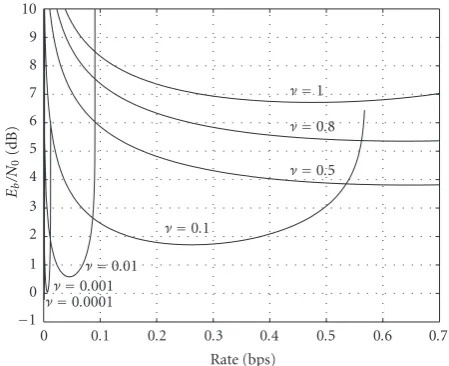
Figure 1 plots bit-energy curves as a function of rate in (bps) achieved in the unfaded Gaussian channel by 2-OOFSK signaling for different values of fixed duty factorν. Notice that for all cases minimum bit-energy values are ob-tained at a nonzero rate and as the duty factor is decreased, the required minimum bit energy is also decreased. With
ν=0.0001, the minimum bit energy is about−0.2 dB. Note that this is a significant improvement over the caseν = 1, where the minimum bit energy is about 6.7 dB. However, this gain is obtained at the cost of a considerable increase in the peak-to-average ratio. Figure 2 plots the bit-energy curves in the unknown Rician channel with Rician factor K=0.5.
3.4. Limited peak power
0 0.1 0.2 0.3 0.4 0.5 0.6
Figure 2:Eb/N0 (dB) versus rate (bps) for the unknown Rician
channel with K=0.5.M=2.
Proposition 6. Assume that the transmitter is limited in peak power,P/ν ≤ A, and the symbol durationT is fixed. Then
the capacity achieved byM-ary OOFSK signaling, with fixed peak powerA, is a concave function ofP. For the perfect re-ceiver side information case, the minimum received bit en-ergy and the wideband slope are
Er
respectively, whereRis a noncentral chi-square random vari-able with perfect receiver side information case, the minimum received bit energy and the wideband slope are
Erb
respectively, whereRis a noncentral chi-square random vari-able with
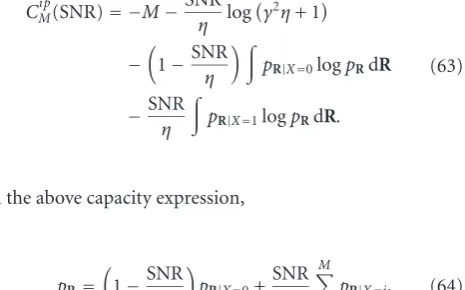
Proof. Since perfect and imperfect receiver side information cases are similar, for brevity we prove only the latter case. When we fix the peak powerA=P/v, we havev=SNR/η, and the capacity becomes
CipM(SNR)=
η is a constant. Concavity of the capacityfollows from the
concavity of −xlogxand the fact that pRis a linear func-tion of SNR. Since the capacity curve is concave, the min-imum received bit energy is achieved at zero spectral effi -ciency,Erb/N0min=E{|h|2}loge2/C˙(0). The wideband slope
is given by (10), and depends on both the first and second derivatives of the capacity. Hence the expressions in (37) and (38) are easily obtained by evaluating
0 0.02 0.04 0.06 0.08 0.1 0.12 0.14 0.16 0.18 0.2
−1 0 1 2 3 4 5 6 7
A=10
A=2
A=1
C(Eb/N0) (bps/Hz) Eb
/N
0
(dB)
Figure3:Eb/N0(dB) versus spectral efficiency C(Eb/N0) (bps/Hz)
for the unfaded Gaussian channel.M=2.
Similarly, for the perfect receiver side information case, we note that
˙ CMp(0)=
E|h|ER
logI0
2η|h|2R
η −
γ2+|d|2,
¨ CMp(0)=
1−E|h|I0(2η|h|2)
η2M .
(43)
In contrast to the limited PAR case, the minimum bit energy is achieved at zero spectral efficiency, and hence the power efficiency of the system improves if one operates at smaller SNR and vanishing duty factor. Note in this case that, although the average power P is decreasing, the energy of FSK signals,PT/ν, is kept fixed, and the average power con-straint is satisfied by sending these signals less frequently. In the imperfectly known channel, this type of peakedness in-troduced in time proves useful in avoiding adverse channel conditions. On the other hand, in the PAR limited case, the decreasing average power constraint is satisfied by decreasing the energy of FSK signals. Note that in the above result, for both perfect and imperfect side information cases, the min-imum bit energy and the wideband slope do not depend on M. Therefore, on/offsignaling with vanishing duty cycle is optimally power efficient at very low spectral-efficiency val-ues, and there is no need for frequency modulation. Further note that in the imperfect receiver side information case, if ηγ2 ≥1, thenS
0=0, and hence approaching the minimum bit energy is extremely slow. If we relax the peak power limi-tation and letη↑ ∞, then it is easily seen that even in the im-perfect receiver side information case,Ebr/N0min →loge2 = −1.59 dB. Indeed, [11] shows in a more general setting that flash signaling with increasingly high peak power is required to achieve the minimum bit energy of−1.59 dB if the fading is not perfectly known at the receiver.
Figure 3 plots the bit-energy curves achieved by 2-OOFSK signaling in the unfaded Gaussian channel for
different peak power valuesA. Notice that for all cases the minimum bit energy is achieved in the limit as the spectral ef-ficiency goes to zero and this energy monotonically decreases to−1.59 dB asA→ ∞.
4. CAPACITY OFM-ARY OOFPSK SIGNALING
In this section, we consider joint frequency and phase mod-ulation to improve the power efficiency of communication with OOFSK signaling. Combining phase and frequency modulation techniques has been proposed in the literature (see, e.g., [20–23]). As we have seen in the previous sec-tion, if the receiver employs energy detection and the peak-to-average power ratio is limited, then operating at very low SNR is extremely power inefficient. The peak-to-average power ratio constraint puts a restriction on the energy con-centration in a fraction of time. Hence, for low average power values, the power of FSK signals is also low, and depend-ing solely on energy detection leads to severe degradation in the performance. On the other hand, if the receiver can track phase shifts in the channel or if the received signal has a specular component as in the Rician channel, then the per-formance is improved at low spectral-efficiency values if in-formation is conveyed in not only the amplitude but also the phase of each orthogonal frequency. Hence we propose em-ploying phase modulation in OOFSK signaling. Therefore, in this section, we assume that the phaseθiof the FSK signal,
si,θi(t)=
P
νej(wit+θi), 0≤t≤T, (44)
is a random variable carrying information. Henceforth this new signaling scheme is referred to as OOFPSK signaling. The channel input can now be represented by the pair (X,θ). IfX=ifor 1≤i≤M, andθ=θi, the transmitter sends the
sine wavesi,θi(t), while no transmission is denoted byX=0,
and hences0(t) = 0. As another difference fromSection 3, the decoder directly uses the matched filtered output vector
Y=(Y1,. . .,YM) instead of the energy measurements in each
frequency component.
4.1. Perfect receiver side information
We first consider the case where the receiver has perfect knowledge of the instantaneous realization of fading coeffi -cients{hk}, and obtain the capacity results both for fixedM
and asMgoes to infinity.
Proposition 7. Consider the fading channel model (4) and as-sume that the receiver perfectly knows the instantaneous val-ues of the fading,hk,k =1, 2,. . ., while the transmitter has
no fading side information. Then the capacity ofM-ary or-thogonal OOFPSK signaling, with a fixed duty factorν≤1, is
CMp(SNR)= −M−E|h|
(1−ν)
pR|X=0logpR||h|dR
+ν
pR|X=1,|h|logpR||h|dR
,
where pR||h|, pR|X=0, pR|X=i,|h|, and f(Ri,|h|, SNR) for 1 ≤ i≤Mare defined in (12), (13), (14), and (15), respectively.
For the Proof, seeAppendix C.
Proposition 8. The capacity expression (45) ofM-ary OOF-PSK signaling in the limit asM↑ ∞becomes
C∞p(SNR)=DPy|x˜,hPy|x˜=0,h Fx˜Fh
=E{|h|2}SNR
=γ2+|d|2SNR,
(46)
where y = hx˜+n, ˜xis a two-mass-point discrete random variable with mass-point locations and probabilities given in (18), andnis zero-mean circularly symmetric Gaussian ran-dom variable withE{|n|2} =1.
Note that 1/TC∞p(SNR)=(γ2+|d|2)P/N0nats/s is equal to the infinite bandwidth capacity of the unfaded Gaussian channel with the same received power. Hence, in the per-fect side information case, ordinary FPSK signaling with duty factorν=1 is enough to achieve this capacity.
4.2. Imperfect receiver side information
Similarly as inSection 3.2, we now assume that neither the receiver nor the transmitter has any fading side information and consider a more special fading process: memoryless Ri-cian fading where each of the i.i.d.hk’s is a proper complex
Gaussian random variable withE{hk} =dand var(hk)=γ2.
The capacity of OOFPSK signaling is given by the following result.
Proposition 9. Consider the fading channel (4) and assume that the fading process {hk} is a sequence of i.i.d. proper
complex Gaussian random variables withE{hk} = d and
var(hk) = γ2, which are not known at either the receiver
or the transmitter. Then the capacity ofM-ary orthogonal OOFPSK signaling, with a duty factorν≤1, is given by
CipM(SNR)= −M−νlog
γ2SNR
ν + 1
−(1−ν)
pR|X=0logpRdR
−ν
pR|X=1logpRdR,
(47)
wherepR,pR|X=0,pR|X=i, and f(Ri, SNR) for 1≤i≤Mare
defined in (21), (22), (23), and (24), respectively.
Proof. The proof is almost identical to that ofProposition 7. Due to the symmetry of the channel, capacity is achieved by equiprobable FSK signals with uniform phases. Note that in this case,
CipM(SNR)=(1−ν)
pY|X=0,θlogpY|X=0,θ pY
dY 1
2πdθ
+ν
pY|X=1,θlogpY|X=1,θ pY
dY 1
2πdθ,
(48)
where
pY|X=i,θi
= ⎧ ⎪ ⎪ ⎪ ⎪ ⎪ ⎨ ⎪ ⎪ ⎪ ⎪ ⎪ ⎩
1 πM−1e
−j=i|Yj|2 1
π(γ2α2+ 1)e−|Yi−αde
jθi|2/(γ2α2+1)
,
1≤i≤M, 1
πMe
−M
j=1 Yj 2
, i=0.
(49)
The capacity expression in (47) is then obtained by first inte-grating with respect toθ, and then making a change of vari-ables,Rj= |Yj|2.
Proposition 10. The capacity expression (47) ofM-ary OOF-PSK signaling in the limit asM↑ ∞becomes
C∞ip(SNR)=DPy|x˜Py|˜x=0 F˜x
=γ2+|d|2SNR−νlog
γ2SNR
ν + 1
, (50)
where y =hx˜+n,his a proper Gaussian random variable withE{h} =dand var(h)=γ2, ˜xis a two-mass-point dis-crete random variable with mass-point locations and prob-abilities given in (18), andnis a zero-mean circularly sym-metric complex Gaussian random variable withE{|n|2} =1.
Similarly as before, the remarks below are given for the asymptotic case in whichM→ ∞.
Remark 3. Assume that in the case of perfect receiver side in-formation,{hk}is a sequence of i.i.d. proper complex
Gaus-sian random variables. Then the asymptotic loss in capacity incurred by not knowing the fading is
C∞p(SNR)−Cip∞(SNR)=Dpy|x˜,hpy|x˜=0,h FhFx˜
−Dpy|x˜py|x˜=0 Fx˜
=Ih;y x˜.
(51)
Remark 4. Consider the case of imperfect receiver side infor-mation. For unit duty factorν=1, the capacity expression (50) is a special case of the result by Viterbi [24]. From (50), we can also see that for fixed symbol intervalT,
lim
ν↓0
1 TC
ip
∞(SNR)=1
T
γ2+|d|2SNR=γ2+|d|2 P N0
nats/s,
(52)
and for fixed duty factorν,
lim
T↑∞ 1 TC
ip
∞(SNR)=γ2+|d|2 P
N0
nats/s. (53)
Note that right-hand sides of (52) and (53) are equal to the infinite bandwidth capacity of the unfaded Gaussian channel with the same received signal power.
4.3. Limited peak-to-average power ratio
duty factorνis kept fixed, while the average power varies. The power efficiency in the low-power regime is characterized by the following result.
Proposition 11. Assume that the transmitter is constrained to have limited peak-to-average power ratio and the PAR of M-ary OOFPSK signaling, 1/ν, is kept fixed at its maximum level. Then, for the perfect receiver side information case, the minimum received bit energy and the wideband slope are
Erb
respectively, whereκ(|h|) is the kurtosis of the fading mag-nitude. For the imperfect receiver side information case, the received bit energy required at zero spectral efficiency and the wideband slope are
Proof. For brevity, we show the result only for the imper-fect receiver side information case. Note that in the capac-ity expression (47), the only term that depends on SNR is
f(Ri, SNR). Using
one can easily show that the first and second derivatives with respect to SNR of f(Ri, SNR) at zero SNR are
respectively. Then, differentiating the capacity (47) with re-spect to SNR, we have
˙
The received bit energy required at zero spectral efficiency is obtained from the formula
Er
and the wideband slope is found by inserting the derivative expressions in (58) into (10). Similarly, for the perfect re-ceiver side information case, we have
˙
for the unknown Rayleigh channel (K=0), unknown Rician chan-nels (K=0.25, 0.5, 1, 2), and the unfaded Gaussian channel (K = ∞) whenM=2 andν=1.
Notice that in the perfect side information case, the min-imum bit energy is−1.59 dB, and the wideband slope does not depend on M and ν. In fact, Verd ´u has obtained the same bit energy and wideband slope expression in [11] for discrete-time fading channels when the receiver knows the fading coefficients, and proved that QPSK modulation is op-timally efficient achieving these values. More interesting is the imperfect receiver side information case, where the min-imum bit energy is not necessarily achieved at zero spectral efficiency. Note that unlike the bit-energy expression in (55), the wideband slope is a function ofMandν, and is negative ifM/ν> (1 + K)2in which case the minimum bit energy is achieved at a nonzero spectral efficiency.
Figure 4plots the bit-energy curves as a function of spec-tral efficiency in bps/Hz for 2-FPSK signaling (ν=1). Note that for K=0.25, the wideband slope is negative, and hence the minimum bit energy is achieved at a nonzero spectral efficiency. On the other hand, forK = 0.5, 1, 2, the wide-band slope is positive, and hence higher power efficiency is achieved as one operates at lower spectral efficiency. Simi-lar observations are noted fromFigure 5, where bit-energy curves are plotted for 3-FPSK signaling. Figure 6plots the bit-energy curves for 2-OOFPSK signaling with different duty cycle parameters over the unknown Rician channel with K = 1. We observe that the required minimum bit energy is decreasing with decreasing duty cycle. For instance, when
ν=0.01, the minimum bit energy of∼0.46 dB is achieved at the cost of a peak-to-average ratio of 100. Note also that since the received bit energy at zero spectral efficiency (55) depends only on the Rician factor K, all the curves inFigure 6
meet at the same point on they-axis.
4.4. Limited peak power
ratio. We consider the power efficiency ofM-ary OOFPSK signaling when the peak power is kept fixed at the maximum allowed level,A=P/ν. Note that as the average powerP →
0, the duty factorνalso must vanish, thereby increasing the peak-to-average power ratio without bound. For this case, we have the following result.
Proposition 12. Assume that the transmitter is limited in peak power,P/ν ≤ A, and the symbol durationT is fixed. Then the capacity achieved byM-ary OOFPSK signaling with fixed peak powerAis a concave function of the SNR. For the case
of perfect receiver side information, the minimum received bit energy and the wideband slope are
Erb N0 min=
loge2, S0=
2η2E|h|22 EI0
2η|h|2−1, (61)
respectively, where η = A(T/N0) is the normalized peak power. For the case of imperfect receiver side information, the minimum received bit energy and the wideband slope are
Erb N0 min=
loge2
1−logγ2η+ 1/γ2+|d|2η,
S0=
⎧ ⎪ ⎪ ⎨ ⎪ ⎪ ⎩
2ηγ2+|d|2−logηγ2+ 12 1/1−η2γ4exp2η2γ2|d|2/1−η2γ4I
0
2η|d|2/1−η2γ4−1, ηγ 2<1,
0, ηγ2≥1,
(62)
respectively.
Proof. As before, we consider only the imperfect receiver side information case. When we fix the peak powerA=P/v, we havev=SNR/η, and the capacity becomes
CipM(SNR)= −M−
SNR
η log
γ2η+ 1
−
1−SNR
η pR|X=0logpRdR
−SNR
η
pR|X=1logpRdR.
(63)
In the above capacity expression,
pR=
1−SNR
η
pR|X=0+ SNR
Mη M
i=1
pR|X=i, (64)
where pR|X=0 andpR|X=ifor 1 ≤i ≤ Mdo not depend on
SNR because the ratio SNR/ν=ηis a constant. Concavity of the capacity follows from the concavity of−xlogxand the fact that pR is a linear function of SNR. Due to concavity of the capacity curve, the minimum bit energy is achieved at zero spectral efficiency. Differentiating the capacity with respect to SNR, we get
˙
CMip(0)=γ2+|d|2−
logγ2η+ 1
η , (65)
and ¨CipM(0) having the same expression as in (42). Then, (62)
is easily obtained using the aforementioned formulas for the minimum bit energy and the wideband slope. Similarly, we note for the perfect side information case that
˙
CMp(0)=E
|h|2=γ2+|d|2,
¨ CMp(0)=
1−EI0
2η|h|2
η2M .
(66)
Note that the results in (61) and (62) do not depend onM, and hence they can be achieved by pure on/off key-ing. Further, note that (I0(2η|h|2)−1)/η2 > |h|4forη > 0. Therefore, when the fading is perfectly known, the strategy of fixing the peak power and lettingν↓0 results in a wideband slope smaller than that of fixed duty factor and hence should not be preferred. In the imperfect receiver side information case, if the peak power limitation is relaxed, that is,η↑ ∞, the minimum bit energy approaches−1.59 dB.
0 0.05 0.1 0.15 0.2 0.25 0.3 0.35 0.4 0
1 2 3 4 5 6 7
K=2
K=1
K=0.5
K=0.25
C(Eb/N0) (bps/Hz) Eb
/N
0
(dB)
Figure5:Eb/N0(dB) versus spectral efficiencyC(Eb/N0) (bps/Hz)
for unknown Rician channels (K=0.25, 0.5, 1, 2) whenM=3 and
ν=1.
0 0.02 0.04 0.06 0.08 0.1 0.12 0.14 0.16 0.18 0.2 0
0.2 0.4 0.6 0.8 1 1.2 1.4 1.6 1.8 2
ν=0.01
ν=0.1
ν=0.5
ν=1
C(Eb/N0) (bps/Hz) Eb
/N
0
(dB)
Figure6:Eb/N0(dB) versus spectral efficiencyC(Eb/N0) (bps/Hz)
for the unknown Rician channel with K=1 forν=1, 0.5, 0.1, 0.01 whenM=2.
5. CONCLUSION
We have considered transmission of information over wide-band fading channels using M-ary orthogonal on/off FSK (OOFSK) signaling, in whichM-ary FSK signaling is over-laid on top of on/offkeying. We have first assumed that the receiver uses energy detection for the reception of OOFSK signals. We have obtained capacity expressions when the re-ceiver has perfect and imperfect fading side information both for fixedMand asMgoes to infinity. We have investigated power efficiency when the transmitter is subject to a peak-to-average power ratio (PAR) limitation or a peak power limi-tation. It is shown that under a PAR limitation, no matter how large the transmitted energy per information bit is, reli-able communication is impossible for small enough spectral
0 0.005 0.01 0.015 0.02 0.025 0.03 0.035 0.04
−2
−1.59
−1 0 1 2 3 4
K= ∞
K=2
K=1
K=0.5
K=0.25
K=0
C(Eb/N0) (bps/Hz) Eb
/N
0
(dB)
Figure7:Eb/N0(dB) versus spectral efficiencyC(Eb/N0) (bps/Hz)
for the unknown Rayleigh channel (K=0), unknown Rician chan-nels (K=0.25, 0.5, 1, 2), and the unfaded Gaussian channel (K = ∞) whenM=2 and fixed peak limitη=1.
0 1 2 3 4 5 6 7 8 9 10
−5 0 5 10 15 20
Phase mod. No phase mod.
η
Eb
/N
0m
in
Figure8:Eb/N0minversus normalized peak power limitηin the
un-known Rician channel with K=1.
efficiency even in the unfaded Gaussian channel, and hence it is extremely power inefficient to operate in the very low SNR regime. On the other hand, if there is only a peak power limitation, we have demonstrated that power efficiency im-proves as one operates with smaller SNR and vanishing duty factor. We note that, in this case, on/offkeying (OOK) is an optimally efficient signaling in the low-power regime achiev-ing the minimum bit energy and the wideband slope in both perfect and imperfect channel side information cases, while combined OOK and FSK signaling is required to improve en-ergy efficiency when a constraint is imposed on the PAR.
0 0.5 1 1.5 2 2.5 3 0
0.1 0.2 0.3 0.4 0.5
Phase mod.
No phase mod.
η
W
ideband
slop
e
Figure9: Wideband slopeS0versus normalized peak power limitη
in the unknown Rician channel with K=1.
perfect channel knowledge at the receiver, we have obtained the minimum bit-energy and wideband slope expressions. In this case, it is shown that FSK signaling is not required for optimum power efficiency in the low-power regime as pure phase modulation in the PAR limited case and OOK in the peak power limited case achieve both the minimum bit en-ergy and the optimal wideband slope. For the case in which the receiver has imperfect channel side information and the input is subject to PAR constraints, we have shown that if M/ν > (1 + K)2, then the wideband slope is negative, and hence the minimum bit energy is achieved at a nonzero spec-tral efficiency, C∗ > 0. It is concluded that, in these cases, operating in the region, where C < C∗, should be avoided. We also note that, in general, the combined OOK and FSK signaling performs better and indeed if the number of or-thogonal frequencies, that is,M, is increased, then a smaller minimum bit-energy value is achieved. Furthermore, for the case in which only the peak power is limited with no con-straints on the peak-to-average ratio, we have investigated the spectral-efficiency/bit-energy tradeoffin the low-power regime by obtaining both the minimum bit energy (attained at zero spectral efficiency) and the wideband slope which can be achieved by pure OOK signaling.
APPENDIX
A. PROOF OFPROPOSITION 1
Since the fading coefficients form a stationary ergodic pro-cess, the capacity of OOFSK signaling can be formulated as follows:
C(SNR)=lim
n→∞maxXn
1 nI
Xn;Rn |h|n, (A.1)
where Xn = (X
1,. . .,Xn), Rn = (R1,. . .,Rn), and |h|n =
(|h1|,. . .,|hn|). As the additive Gaussian noisesamples are
independent for each symbol interval, the conditional out-put density satisfies
pRn|Xn,|h|n= n
k=1
pRk|Xk,|hk|, (A.2)
where
pRk|Xk=i,|hk|
= ⎧ ⎨ ⎩e
−M
j=1Rk je−α2|h k|2I
0
2Rkiα2|hk|2
, 1≤i≤M,
e−Mj=1Rk j, i=0,
(A.3)
withα2 =PT/νN
0 =SNR/ν. From the above fact, one can easily show that
IXn;Rn |h|n= n
k=1
IXk;Rk |hk|
−D
pRn||h|n n
k=1 pRk||hk|
F|h|n
≤ n
k=1
IXk;Rk |hk|
,
(A.4)
whereD(·|| ·F|h|n) denotes the conditional divergence. The
above upper bound is achieved if the input vector Xn =
(X1,. . .,Xn) has independent components. Due to the
sym-metry of the channel, an input distribution equiprobable over nonzero input values, that is,P(Xk =i)=ν/Mfor 1≤ i≤M, whereP(Xk=0)=1−ν, maximizesI(Xk;Rk| |hk|)
for eachk. To see this, note that since the mutual informa-tion is a concave funcinforma-tion of the input vector, a sufficient and necessary condition for an input vector to be optimal is
∂ ∂Pi
IXk;Rk |hk|
−λ M
j=1 Pj−ν
=0, 1≤i≤M,
(A.5)
whereλis a Lagrange multiplier for the equality constraint
M
j=1Pj=ν, andPjdenotesP(Xk=j) for 1≤j≤M. Note
that the duty factor is fixed, and henceP(X = 0) = 1−ν is a predetermined constant. Evaluating the derivatives, the above condition can be reduced to
E|hk| pRk Xk=i,|hk|log
pRk|Xk=i,|hk|
pR
k |hk|
dRk
−1=λ,
1≤i≤M,
(A.6)
i.i.d. input sequence with the above distribution achieves the capacity. The capacity expression in (11) is easily obtained by evaluating the mutual information achieved by the optimal input, considering a generic symbol interval, and dropping the time indexk.
B. PROOF OFPROPOSITION 2
The method of proof follows primarily from [25], where martingale theory is used to establish a similar result forM -ary FSK signaling over the noncoherent Gaussian channel. The capacity expression in (11) can be rewritten as
CMp(SNR)=νE|h| e−R−(SNR/ν)|h|
where the first term on the right-hand side can be recognized as the conditional divergence D(pR|x˜,|h|pR|x˜=0,|h||F|h|Fx˜),
is a sum of i.i.d. random variables. The following result is noted in [25].
which is convex and continuous on a convex set containing the range ofX1, and ifE{|g(X1)|}<∞, then{g(Sn/n)}∞is a
sub-martingale.
FromLemma 1, we conclude that
χM=g
is a submartingale, and hence from the martingale conver-gence theorem [26],χMconverges to a limitχ∞almost surely
Hence, we conclude that
lim
The first term on the right-hand side of (B.1) does not depend on M, and the second term can be expressed as E|h|ER{(SM(R)/M) log(SM(R)/M)}. The proof is completed
where the interchange of limit and expectation needs to be justified by invoking the Dominated Convergence Theorem. Note that since{(SM(R)/M) log(SM(R)/M)}is a submartin-fore, the Dominated Convergence Theorem applies using the integrable upper boundER{S1(R) logS1(R)}.
C. PROOF OFPROPOSITION 7
Similarly to the proof of Proposition 1, an i.i.d. input se-quence achieves the capacity and due to the symmetry of the channel, equiprobable FSK signals each having uniformly distributed phases are optimal. Now, the maximum input-output mutual information is
where
pY|X=i,θi,h
= ⎧ ⎪ ⎪ ⎨ ⎪ ⎪ ⎩
1 πM−1e
−j=i|Yj|2
1 π
e−|Yi−αhejθi|2, 1≤i≤M,
1 πM
e−Mj=1|Yj|2, i=0.
(C.2)
In the above formulation,α2 =PT/νN
0=SNR/ν. It can be easily seen that
pY|X=i,θlogpY|X=i,θdY 1
2πdθ= −log(πe)
M, 0≤i≤M.
(C.3)
The capacity expression in (45) is then obtained by first inte-grating
pY|X=0,θlogpYdY 1 2πdθ,
pY|X=1,θlogpYdY 1 2πdθ,
(C.4)
with respect toθand then making a change of variables,Rj= |Yj|2.
ACKNOWLEDGMENTS
This paper was prepared through collaborative participation in the Communications and Networks Consortium spon-sored by the US Army Research Laboratory under the Col-laborative Technology Alliance Program, Cooperative Agree-ment DAAD19-01-2-0011. The material in this paper was presented in part at the IEEE Vehicular Technology Confer-ence (VTC), Los Angeles, Calif, September 26–29 2004, and the IEEE Global Telecommunications Conference (Globe-com), Dallas, Tex, 29 November–3 December 2004.
DISCLAIMER
The US Government is authorized to reproduce and dis-tribute reprints for Government purposes notwithstanding any copyright notation thereon.
REFERENCES
[1] I. F. Akyildiz, W. Su, Y. Sankarasubramaniam, and E. Cayirci, “A survey on sensor networks,”IEEE Communications Maga-zine, vol. 40, no. 8, pp. 102–114, 2002.
[2] C. E. Shannon, “A mathematical theory of communication,” Bell System Technical Journal, vol. 27, pp. 379–423, 623–656, 1948.
[3] M. J. E. Golay, “Note on the theoretical efficiency of informa-tion recepinforma-tion with PPM,”Proceedings of the IRE, vol. 37, pp. 1031, 1949.
[4] G. L. Turin, “The asymptotic behavior of idealM-ary systems,” Proceedings of the IRE, vol. 47, pp. 93–94, 1959.
[5] I. Jacobs, “The asymptotic behavior of incoherentM-ary com-munications systems,”Proceedings of the IEEE, vol. 51, no. 1, pp. 251–252, 1963.
[6] J. R. Pierce, “Ultimate performance ofM-ary transmissions on fading channels,”IEEE Transactions on Information Theory, vol. 12, no. 1, pp. 2–5, 1966.
[7] R. G. Gallager,Information Theory and Reliable Communica-tion, John Wiley & Sons, New York, NY, USA, 1968.
[8] R. S. Kennedy,Fading Dispersive Communication Channels, John Wiley & Sons, New York, NY, USA, 1969.
[9] I. E. Telatar and D. N. C. Tse, “Capacity and mutual infor-mation of wideband multipath fading channels,”IEEE Trans-actions on Information Theory, vol. 46, no. 4, pp. 1384–1400, 2000.
[10] C. Luo and M. M´edard, “Frequency-shift keying for ultrawideband—achieving rates of the order of capacity,” in Proc. 40th Annual Allerton Conference on Communication, Control, and Computing, Monticello, Ill, USA, October 2002. [11] S. Verd ´u, “Spectral efficiency in the wideband regime,”IEEE
Transactions on Information Theory, vol. 48, no. 6, pp. 1319– 1343, 2002.
[12] M. M´edard and R. G. Gallager, “Bandwidth scaling for fading multipath channels,”IEEE Transactions on Information Theory, vol. 48, no. 4, pp. 840–852, 2002.
[13] M. C. Gursoy, H. V. Poor, and S. Verd ´u, “The noncoher-ent Rician fading channel—Part II: Spectral efficiency in the low-power regime,”IEEE Transactions on Wireless Communi-cations, vol. 4, no. 5, pp. 2207–2221, 2005.
[14] D. S. Lun, M. M´edard, and I. C. Abou-Faycal, “On the per-formance of peaky capacity-achieving signaling on multi-path fading channels,”IEEE Transactions on Communications, vol. 52, no. 6, pp. 931–938, 2004.
[15] C. Luo, M. M´edard, and L. Zheng, “Error exponents for multi-tone frequency shift keying on wideband Rayleigh fad-ing channels,” inProc. IEEE Global Telecommunications Con-ference (GLOBECOM ’03), vol. 2, pp. 779–783, San Francisco, Calif, USA, December 2003.
[16] S. A. Butman, I. Bar-David, B. K. Levitt, R. F. Lyon, and M. J. Klass, “Design criteria for noncoherent Gaussian channels with MFSK signaling and coding,”IEEE Transactions on Com-munications, vol. 24, no. 10, pp. 1078–1088, 1976.
[17] W. E. Stark, “Capacity and cutoffrate of noncoherent FSK with nonselective Rician fading,”IEEE Transactions on Communica-tions, vol. 33, no. 11, pp. 1153–1159, 1985.
[18] F. D. Neeser and J. L. Massey, “Proper complex random pro-cesses with applications to information theory,”IEEE Trans-actions on Information Theory, vol. 39, no. 4, pp. 1293–1302, 1993.
[19] I. C. Abou-Faycal, M. M´edard, and U. Madhow, “Binary adap-tive coded pilot symbol assisted modulation over Rayleigh fad-ing channels without feedback,”IEEE Transactions on Commu-nications, vol. 53, no. 6, pp. 1036–1046, 2005.
[20] R. Padovani and J. K. Wolf, “Coded phase/frequency modula-tion,”IEEE Transactions on Communications, vol. 34, no. 5, pp. 446–453, 1986.
[21] I. Ghareeb and A. Yongacoglu, “Performance of joint fre-quency phase modulation over Rayleigh fading channels,”IEE Proceedings. I, Communications, Speech and Vision, vol. 141, no. 4, pp. 241–247, 1994.
[22] R. A. Khalona, G. E. Atkin, and J. L. LoCicero, “On the per-formance of a hybrid frequency and phase shift keying mod-ulation technique,” IEEE Transactions on Communications, vol. 41, no. 5, pp. 655–659, 1993.
[24] A. J. Viterbi, “Performance of anM-ary orthogonal communi-cation system using stationary stochastic signals,”IEEE Trans-actions on Information Theory, vol. 13, no. 3, pp. 414–422, 1967.
[25] S. A. Butman and M. J. Klass, “Capacity of noncoherent channels,” Tech. Rep. 32-1526, Jet Propulsion Laboratory, Pasadena, Calif, USA, vol. 18, pp. 85–93, September 1973. [26] G. R. Grimmett and D. R. Stirzaker,Probability and Random
Processes, Oxford University Press, New York, NY, USA, 1998.
Mustafa Cenk Gursoyreceived the B.S. de-gree in electrical and electronic engineering from Bogazici University, Turkey, in 1999, and the Ph.D. degree in electrical engi-neering from Princeton University, Prince-ton, NJ, USA, in 2004. In the summer of 2000, he worked at Lucent Technolo-gies, Holmdel, NJ, where he conducted per-formance analysis of DSL modems. Since September 2004, he has been an Assistant
Professor in the Department of Electrical Engineering at the Uni-versity of Nebraska-Lincoln. His research interests are in the gen-eral areas of wireless communications, information theory, com-munication networks, and signal processing. Dr. Gursoy is a recipi-ent of Gordon Wu Graduate Fellowship from Princeton University.
H. Vincent Poorreceived the Ph.D. degree in electrical engineering and computer sci-ence from Princeton University in 1977. From 1977 until 1990, he was on the fac-ulty of the University of Illinois at Urbana-Champaign. Since 1990, he has been on the faculty at Princeton, where he is the Michael Henry Strater University Professor of Elec-trical Engineering. He has also held visiting appointments at a number of universities,
including recently Imperial College, Stanford, and Harvard. Dr. Poor’s research interests are in the areas of advanced signal process-ing, wireless networks, and related fields. Among his publications in these areas is the recent bookWireless Networks: Multiuser Detec-tion in Cross-Layer Design(Springer, 2005). Dr. Poor is a Member of the National Academy of Engineering and the American Academy of Arts & Sciences, and is a Fellow of the IEEE, the Institute of Mathematical Statistics, the Optical Society of America, and other organizations. He is a past President of the IEEE Information The-ory Society, and is the current Editor-in-Chief of theIEEE Trans-actions on Information Theory. Recent recognition of his work in-cludes the Joint Paper Award of the IEEE Communications and In-formation Theory Societies (2001), the NSF Director’s Award for Distinguished Teaching Scholars (2002), a Guggenheim Fellowship (2002-2003), and the IEEE Education Medal (2005).
Sergio Verd ´u received the Telecommuni-cations Engineering degree from the Poly-technic University of Catalonia, Barcelona, Spain, in 1980, and the Ph.D. degree in electrical engineering from the University of Illinois at Urbana-Champaign in 1984. He is a Professor of electrical engineering at Princeton University, Princeton, NJ. Pro-fessor Verd ´u is a recipient of several paper awards, including the IEEE Donald Fink
Pa-per Award, a Golden Jubilee PaPa-per Award from the Information