R E S E A R C H
Open Access
Integrated optimization of urban
agglomeration passenger transport hub
location and network design
Bofeng Fan
1,2*, Yuling Yang
2and Liang Li
3Abstract
Because of the influence of comprehensive hub construction on network flow, this paper adopts the bi-level programming model (BPM) to solve the problem about the integrated optimization of multi-hub location and network layout. The upper level model is designed to minimize the network operating cost, network transformation cost, and hub construction cost; the lower level is the user equilibrium distribution model at fixed demands. Besides, this paper designs the improved genetic algorithm to solve the bi-level programming model and validates the model validity and algorithm feasibility through the computing example. The model has a high application value for solving the problem of comprehensive optimization of intercity passenger transport hub location and intercity passenger transport network design in the process of urban agglomeration development.
Keywords:Integrated optimization, Improved genetic algorithm, Passenger transport hub location, Traffic network design, Urban agglomeration
1 Introduction
Passenger transport hub, as the one key node of intercity passenger transport network, is the important place for passenger gathering, distributing ETC in transit. Besides, the transport location advantage of passenger hub has an obvious positive effect on the population, industry accumulation, and resource allocation. The rational distribution of hub and network cannot only improve the transport system function in urban agglomeration and transport efficiency but also promote the harmonious development of urban regional economy significantly.
1.1 Methods/experimental
The issues of transportation network design have generally divided into discrete network design problems (DNDP), con-tinuous network design questions (CNDP), and mixed net-work design problems (MNDP) according to the types of decision variables. For the urban intercity passenger trans-port network, which is generally composed of high-grade
highways, intercity railways, or high-speed rails, the intercity rapid passenger transport network is in the process of rapid development, and mostly, new lines update the network. This paper adopts a discrete net-work design model. To simulate the rapid growth of line construction requirements, a bi-level planning method has adopted to establish a model for simultan-eous optimization of multi-hub site selection and net-work layout. The upper model aims at minimizing the total cost of network operation and construction. The lower model is a user-balanced assignment model with fixed requirements. This paper uses MATLAB software to design an improved genetic algorithm to solve the bi-level planning model, considering the impact of the integrated hub construction on network traffic. We make comprehensive decisions on the layout of the line and the layout of the hub.
2 Literature review
Transportation hub location and transportation network design are the main subjects of transportation planning, for which the scholars have made many studies: in terms of hub location optimization, Ebery established the mixed-integer programming model and offered the related
* Correspondence:[email protected] 1
School of Transportation and Logistics, Southwest Jiaotong University, Chengdu 610031, China
2School of Environment and Resources, Southwest University of Science and Technology, Mianyang 621010, China
Full list of author information is available at the end of the article
algorithm to solve the multi-hub location issue with cap-acity limitation [1]. Topcuoglu has studied non-capacity single hub selection mode and then designed the genetic algorithm accordingly [2]. Liu qiang et al. have based on network stochastic traffic distribution [3], and Zhang Bing et al. have adopted the niche genetic annealing algorithm to solve the optimization of network multi-hub location [4]. Li Daikun et al. have targeted at minimization of total demands, took the hub coverage area into consideration, and adopted the adaptive immune clone algorithm to solve the layout optimization of regional urban nodes [5]; Li Tingting et al. built the optimization model of passen-ger transport hub hierarchical layout [6]. These studies above mainly proposed the model and algorithm of multi-hub location optimization, but without considering the influence of hub construction on network. Once the hub is built, the rapid development of hub city would in-crease certain amount of traffic demands, the hub func-tion can change the network transportafunc-tion mode, and then, the network flow distribution accordingly. Hence, it is to fulfill the harmonious and high-efficient network operation in the transportation network of urban ag-glomeration, the hub and network should be inte-grated. Liu Canqi has studied the integration of hub selection and continuous network optimization and
applied the iterative optimal algorithm [7]. Sun Yang
constructed a model and applied the immune clone algorithm to solve the integrated optimization issue of
multi-hub location and mixed network design [8].
Therefore, this paper, based on the existing researches on the hub planning and network design problem, studies the integrated configuration model of intercity transport hub and network in urban agglomeration.
3 Model construction
3.1 Model symbol definition
The related symbols in the model are defined as follows.
Nis the number of nodes in transportation network;M
is the number of hubs to be built;A1is the sum of
exist-ing roads or railway sections (section) in intercity trans-portation network;A2is the sum of sections to be added
in the network; A is the sum of all sections in the
net-work, and A=A1∪A2; R is the sum of origin in the
transportation networkr∈R;Sis the sum of destination,
s∈S; xa is the traffic flow of any section a; ta(x) is the travel time of section a, as function of link flow; Krs is the path set of OD pair: rand s; frsk is the flow of the pathkbetweenrand s;qrsis the traffic volume between
r and s; ca is the traffic capacity of section a; ga( ya) means cost of new linea.λis the unit conversion factor between time and currency value;yais the decision vari-able of the alternative section a, ya∈{0, 1}; bmn is the construction cost of the hub;zmnis the decision variable
of hub location, and when the hubmis located atn, it is 1, otherwise 0; δrsa;k is the decision variable related to a
and k, and when a is located in the path k between r
ands,δrsa;k is 1, otherwise 0.
3.2 Bi-level programming model
Based on the existing research findings, this paper adopts the administrator-dominant and user-following bi-level mathematical programming model to describe the problem. This bi-level programming model consists of upper level and lower level: the upper level is for the complicated optimization problem, including optimal decision variable of lower level, while the lower level is programming problem with decision variable parameter of the upper level.
To make comprehensive decision of urban intercity passenger hub and network, the transportation ation department would consider the network oper-ation efficiency to ensure smooth network operoper-ation, and then, in the model, the minimum of total system impedance in the transportation network is applied to describe this demand. The traffic infrastructure construc-tion and capital management department also prefer the minimization of total investment, including costs of road reconstruction and expansion, new-built lines, and hub construction. Therefore, the upper level in this paper is designed as a network and hub programming plan, to be the multi-objective optimization with network operation cost (total network impedance) and network transform-ation cost. The lower level is to solve the traffic distribu-tion problems, which can be divided into determined traffic distribution problem and stochastic traffic distribu-tion problem according to the users’knowledge about the trip network information. Generally, the determined dis-tribution model is adopted for programming level, so this paper applies the user equilibrium traffic distribution model (determining demands) as the representation of the lower level model in the optimization model of this paper.
minT ¼X
Where the objective function (1) is the network and hub construction cost, (2) means only one hub can be built for each node, (3) means that every hub must be selected and built on one node, (4) is the range con-straint of new-built lines, (6) is the traffic flow between
any two travel points of the built hub, and in (6), dmr
anddmsare the decision variable, and when hubmis lo-cated atrands, it is 1, otherwise 0.
For the link impedance function in the model, the travel time formula proposed by Bureau of Public Road (BPR) is adopted as follows.
ta¼t0a 1þα
a is the free travel
time of section a; α and β are the retardation
coeffi-cients, and the specific values can be obtained by regres-sion analysis for actual data.
3.3 Solving algorithm
Firstly, the upper level programming administrator de-termined the hub and new-built lines, made traffic dis-tribution at lower level, then returned back to solve the cost at the higher level, and finally repeated so to acquire the optimal solution. For the holistic methods of lower programming, the stochastic equilibrium traffic distribu-tion has adopted, but the genetic algorithm was applied for iterative calculation to make optimization. The key items are described as follows.
3.3.1 Antibody coding
In the upper level programming model, population cod-ing was adopted for antibody. Based on the decision variable, set two antibodies A and B.
A= [a1,a2,…,ai],i∈n,nis the number of total nodes,
where ai is the numbering of built nodes, and
real-number encoding is used for node selection, to se-lect the node numbering according to the reservation number. The antibody B= [b1,b2,…,bi], i∈n, n is the
total of roads to be built, andbicoded in the binary cod-ing, is the road to be built; if it needs to be built, the value is 1, otherwise 0.
In the lower programming model, the antibody
encod-ing includes n antibody, and the number of antibody
equals to that of OD pairs. X= [x1,x2,…,xn], xn= [p1,
path1;p2, path2;…;pi, pathi], where i is the number of
times for OD pair incremental traffic distribution, p is the flow, and path means the path, traffic distribution flow, traffic distribution path (the total flow is divided
into n groups, andn is generated randomly at different
flows, then it is allocated to the shortest path) for n
times of traffic distribution randomly for corresponding OD pair, dynamic length, and real-number encoding.
3.3.2 Elitism selection and cataclysm
Our algorithm integrates the elitism and cataclysm. The elitism selection is, by duplicating the optimal solution of one generation to the next generation, to prevent the optimal solution generated in the evolving process from crossover and mutation damage. Cataclysm means that, by killing all or some outstanding individuals at the conver-gence of algorithm, the individuals far from the current extremal can have the chance to be evolved more suffi-ciently; this improvement can ensure the genetic algorithm to be jumped out of local extremum, when this algorithm falls in the local optimal. For these two seemingly contra-dictory improving strategies, this algorithm fulfills the inte-gration of cataclysm and elitism selection in the following way. When a new generation is created at each iteration cycle, the most outstanding individual should be duplicated to the next generation unconditionally. Nevertheless, if in the continuousNgenerations, there is no more outstanding individual or lower change of population diversity, the algo-rithm easily falls into local optimal, so the cataclysm strat-egy can be applied to kill one or more optimal individuals
of the population in the next one or multi-iterations and then help jump out of local extremum. The elitism strategy is followed with each generation, while the cataclysm strat-egy can be applied every several generations, to fulfill the integration of both strategies.
3.3.3 Adaptive crossover, mutation, and cataclysm probability
Adaptive crossover operator was used in the algorithm design, to ensure taking the evolution direction benefi-cial to algorithm convergence, by adjusting crossover probability according to the fitness function of individual in every generation. In the basic genetic algorithm, to se-lect the individual by setting constant crossover prob-ability and to make crossover operation by selecting crossover points randomly (roulette), it might lead to offspring individual inferior to parental individual, which should be avoided in our algorithm.
(1) Crossover operator
pi¼ðfmax−fiÞ=ðfmax−fminÞ ð10Þ
whereiis individual,fiis fitness of individual,piis cross-over probability, fmaxand fminare the max and min,
re-spectively, of population fitness.
(2) Crossover, mutation, and cataclysm probability
P tð Þ ¼p0 1þ
t maxGen
ð11Þ
P(t) is the corresponding probability of each iteration cycle, p0 is initial probability (different numbers for
crossover, mutation, and cataclysm),tis current iteration cycle, andmaxGenis max iteration cycle.
3.3.4 Algorithm flow
Step 1: Define initial network value;
Step 2: Initialize the antibody population; set the anti-body population size, maximum iteration time, stopping criterion, and calculate the fitness of every individual in the initial antibody population;
Step 3: Based on the given antibody population size, make cloning for every antibody (individual);
Step 4: Based on crossover probability and objective function value, make crossover operation for cloned antibody (individual);
Step 5: According to mutation probability, make muta-tion for cloned antibody (individual);
Step 6: According to cataclysm probability, make cata-clysm for cloned antibody (individual);
Step 7: Make the clone (individual) selection, to select new antibody (individual) population per the selection rule;
Step 8: Judge whether meeting the stopping criteria; if yes, stops the calculation and output the final plan; if not, go back to Step 3.
4 Model validation
4.1 Example design
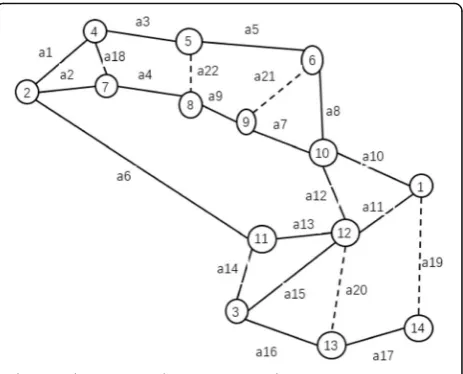
This paper took the highway network in urban ag-glomeration of one region, with the regional prefec-ture city as the network node. The simplified road
network is shown in Fig. 1, including 14 nodes, 22
road sections (18 are built lines, and 4 alternative
lines); a1–a18 are the existing built road sections,
and a19–a22 are alternative ones.
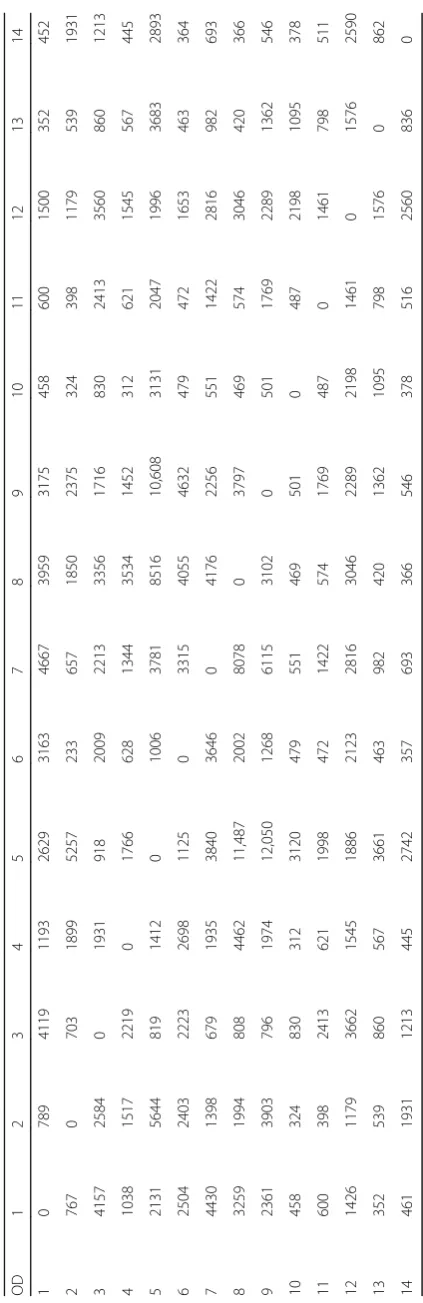
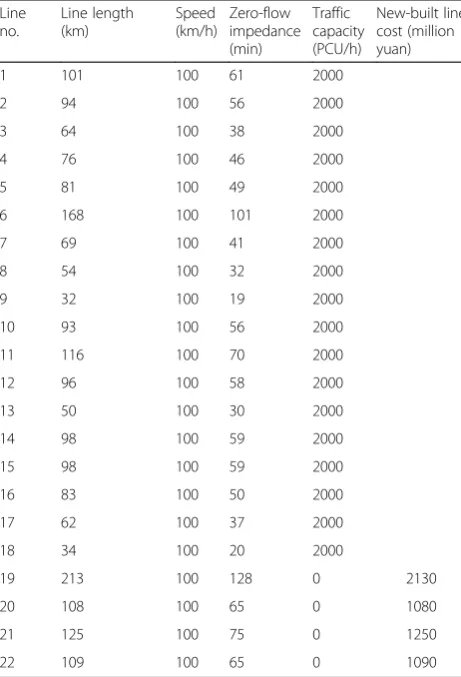
Tables1and 2 show OD demand matrix; Table3is
in-formation of road sections. Suppose the construction cost of single hub is 0.2 billion yuan,λis defined according to actual condition, and the impedance function coefficient isα= 0.15,β= 4; the cities 1, 2, and 3 are fixed hubs, and now it is required to select two more cities from other node cities as the comprehensive hub; so it is necessary to determine the hub location and whether the alternative road sections are built.
Based on the programming model above, this paper applies the improved genetic algorithm and MATLAB
programming. As shown in Fig. 2, the parameters have
given to calculate the selected nodes: 8 and 12, and the new-built road a19.
Optimization results and fitness curve are shown in Fig. 2 and 3, respectively. The program shows the opti-mal solution at 26th iteration, with better convergence.
4.2 Results and analysis
4.2.1 Calculation results
Combined with the above bi-level planning model and examples, this paper uses MATLAB software to write an improved genetic algorithm to get the solution; we can set the antibody population size 20, the maximum number of iterations is 50. The initial crossover probability, mutation
Table 2Absorbed traffic flow (PCU)
OD 1 2 3 4 5 6 7 8 9 10 11 12 13 14
Hub 1 103 150 205 77 174 87 138 326 152 48 59 164 71 45
probability, and catastrophe probability are set to 0.1, 0.2, and 0.1, respectively, the value ofλis 0.0001. The calcula-tion results are shown in Fig.2, and fitness curve is shown in Fig.3. In addition to the established hubs, node 8 and node 12 have selected as new hubs. At the same time, the new highway has selected as a19.
4.2.2 Analysis of results
(1) It can be seen from the fitness curve that as the number of iterations increases, the affinity of the antigen and antibody increases, and the optimal fitness value and the average fitness value both tend to decrease. The results show that the entire antibody population is continuous. The optimal solution converges to verify the feasibility
of the algorithm. At the same time, Fig. 3 shows
that the program achieves an optimal solution when it is iterating 26 times, and the
convergence is good. The results show that this algorithm uses the combination of elite selection and catastrophe methods and the setting of
adaptive crossover operator to enhance the effectiveness of the algorithm.
(2) Different from the commonly used Frank-Wolf assignment algorithm, this paper uses a genetic algorithm to optimize the stochastic equilibrium flow assignment iteratively. In this way, the upper and lower layer models are all iteratively optimized using the genetic algorithm, and the programming is easier under the same conditions using MATLAB software. Its adaptability is stronger.
(3) Due to limited data, the models and algorithms involved in this paper need to combine with actual planning cases to further verify and improve. At the same time, we can also try other ways to improve the efficiency of calculations further for the method of lower level distribution and the selection of programming languages.
5 Conclusions
The practice indicates the following: the expansion of intercity passenger transportation network in urban
Fig. 3Fitness curve Fig. 2Optimization results
Table 3Road section information in road network
Line no.
Line length (km)
Speed (km/h)
Zero-flow impedance (min)
Traffic capacity (PCU/h)
New-built line cost (million yuan)
1 101 100 61 2000
2 94 100 56 2000
3 64 100 38 2000
4 76 100 46 2000
5 81 100 49 2000
6 168 100 101 2000
7 69 100 41 2000
8 54 100 32 2000
9 32 100 19 2000
10 93 100 56 2000
11 116 100 70 2000
12 96 100 58 2000
13 50 100 30 2000
14 98 100 59 2000
15 98 100 59 2000
16 83 100 50 2000
17 62 100 37 2000
18 34 100 20 2000
19 213 100 128 0 2130
20 108 100 65 0 1080
21 125 100 75 0 1250
agglomeration can attract more and more intercity pas-senger flow, and comprehensive paspas-senger transport hub construction is the inevitable demand. The passenger transport hub construction will certainly attract new travel demands, producing a greater influence on net-work layout. In the netnet-work planning of rapidly develop-ing intercity transportation, it is important to take both the hub location and network layout into consideration.
Because of the current situation of line planning one by one in intercity passenger transport network develop-ment, disjunction of comprehensive hub location, and network layout, this paper adopts the bi-level program-ming model for simultaneous optimization of both discrete network design and hub selection, designs the improved genetic algorithm to optimize the cost object-ive at the upper level and network traffic distribution at lower level. The example above shows our model, and algorithm is of great practicality and efficiency, which can be a feasible method to solve the simultaneous optimization of intercity transport multi-hub selection and network layout.
The future research directions are as follows: further study on the prediction method of the traffic volume and the transfer traffic volume induced by the new pas-senger transport hub, design other algorithms of this model and compare them, research on the development and application of this model for a comprehensive traffic network composed of various traffic modes.
Abbreviations
BPM:Bi-level programming model; CNDP: Continuous network design
questions; DNDP: Discrete network design problems; MNDP: Mixed network design problems
Acknowledgements
The research presented in this paper was supported by the School of Transportation and Logistics, Southwest Jiaotong University, Chengdu 610031, China; School of Environment and Resource, Southwest University of Science and Technology, Mianyang 621010, China; School of Economics and Management, Southwest Jiaotong University, Chengdu 610031, China.
Availability of data and materials
Data sharing not applicable to this article as no datasets were generated or analyzed during the current study.
Authors’contributions
BF is the main author of this paper who puts forward the main method, designs the model, and uses the improved genetic algorithm to verify the example. YY provides effective help to the feasibility and efficiency of the model algorithm. LL puts forward some important suggestions for the establishment of the model. All the authors read and approved the final manuscript.
Authors’information
Bofeng Fan is pursuing his Ph.D. degree in Department of Railway Transportation Engineering, School of Transportation and Logistics, Southwest Jiaotong University (SWJTU). He is currently a lecturer in the Department of Traffic Engineering, Southwest University of Science and Technology, China. His research interests include comprehensive transportation and traffic planning.
Yuling Yang received her M.S. degree in the Department of Traffic Engineering, School of Transportation and Logistics, Southwest Jiaotong
University (SWJTU). She is currently a lecturer in the Department of Traffic Engineering, Southwest University of Science and Technology, China. Her research interests include logistics system planning, complex network. Liang Li received his Ph.D. degree in the School of Economics and Management (SEM), Southwest Jiaotong University. He is now an associate professor in the School of Economics and Management, Southwest Jiaotong University, China. His research interests include ethical decision making behaviors and optimal allocation of resources.
Competing interests
The authors declare that they have no competing interests.
Publisher’s Note
Springer Nature remains neutral with regard to jurisdictional claims in published maps and institutional affiliations.
Author details
1School of Transportation and Logistics, Southwest Jiaotong University, Chengdu 610031, China.2School of Environment and Resources, Southwest University of Science and Technology, Mianyang 621010, China.3School of Economics and Management, Southwest Jiaotong University, Chengdu 610031, China.
Received: 14 May 2018 Accepted: 18 June 2018
References
1. J Ebery, M Krishnamoorthy, A Ernst, The capacitated multiple allocation hub
location problem: formulations and algorithms. Eur. J. Oper. Res.120(3),
614–631 (2000)
2. H Topcuoglu, F Corut, M Ermis, Solving the uncapacitated hub
location problem using genetic algorithms. Comput. Oper. Res.
32(4), 967–984 (2005)
3. Q Liu, HP Lu, QY Wang, Bi-level programming model for regional
integrated transportation hub layout. J.Southeast Univ.: Nat. Sci.Ed.
40(6), 1358–1363 (2010)
4. B Zhang, W Deng, Location model of transport junction in economic circle
and its algorithm. J. Transp. Syst. Eng. Inf. Technol.10(4), 1358–1363 (2010)
5. DK Li, SW He, YS Shen, Layout optimization of comprehensive
transportation hub based on immune clone algorithm. J. Wuhan Univ.
Techno.: Transpor. Sci. Eng.36(2), 382–386 (2012)
6. TT Li, R Song, SW He, HD Li, Regional passenger hub layout optimization
based on hierarchical location model. J. Transp. Syst. Eng. Inf. Technol.
14(6), 37–41 (2014)
7. CQ Liu, Model of simultaneously optimizing the transport pivot siting and
network design and its algorithm. J. Highway .Transport. Res. Dev.20(3),
113–116 (2003)
8. Y Sun, R Song, SW He, HB Wang, Integrated optimization of multiple hubs
location and mixed network design based on immune clone algorithm. J.