L E T T E R
Open Access
Effect of stress state on slow rupture propagation
in synthetic fault gouges
Ken-ichi Hirauchi
1*and Jun Muto
2Abstract
Slow slip events (SSEs) in subduction zones are known to proceed so sluggishly that the associated slow ruptures do not generate any detectable radiating seismic waves. Moreover, they propagate at speeds at least four orders of magnitude slower than regular earthquakes. However, the underlying physics of slow slip generation has yet to be understood. Here, we carry out laboratory studies of unstable slip along simulated fault zones of lizardite/chrysotile (liz/ctl) and antigorite (i.e., low- and high-temperature serpentine phases, respectively) and olivine, under varying conditions of normal stress, with the aim of better understanding the influence of stress state on the process of slow rupture along the plate interface. During a single unstable slip, we clearly observe a slow rupture phase that is often followed by an unstable, high-speed rupture. We find that lower fault-zone friction coefficients (μvalues from 0.7 down to 0.5) lead to increasing degree of the slow rupture mode, and also that the slow rupture velocities (Vr= 0.07 to 5.43 m/s) are largely consistent with those of short-term SSEs observed in nature. Our findings suggest that the generation of SSEs is facilitated by conditions of low normal stress and low fault-zone strength along the plate interface, which may be weakened by metamorphic reactions that result in the production of hydrous phases (e.g., serpentine) and/or the direct involvement of fluid itself, leading to a reduction in effective normal stress.
Keywords:Fault gouge; Rupture velocity; Serpentine; Slow slip; Subduction zone; Unstable slip
Findings
Introduction
In the last decade, a variety of unusual earthquakes have been observed in circum-Pacific subduction zones, in-cluding non-volcanic tremors, low-frequency earthquakes (LFEs), and slow slip events (SSEs) (e.g., Dragert et al. 2001; Obara 2002; Shelly et al. 2006; Peng and Gomberg 2010; Beroza and Ide 2011). All of these seismic phenom-ena appear to be related to shear slip along and/or near the plate interface and occur at the same time and place (e.g., Rogers and Dragert 2003; Ito et al. 2007). The co-existence of anomalously high Poisson’s ratios (approxi-mately 0.4) with the source regions for tremors and LFEs suggests that aqueous fluids in these areas, released from dehydration reactions in the subducting oceanic crust, are present under conditions of elevated pore pressure (Audet et al. 2009; Peacock et al. 2011). As a direct consequence,
such elevated pore-fluid pressure acts to reduce the effect-ive normal stress on the plate interface.
An individual SSE represents a transient release of strain that occurs in the transition zone between locked and stable sliding zones, characterized by low rupture velocity (approximately 1 to 10 km/day), long duration (days to years), and no measurable radiating seismic en-ergy (e.g., Ide et al. 2007). In southwest Japan, short-term SSEs and tremors have been observed to occur preferen-tially along the plate interface directly beneath the hy-drated mantle wedge (Kato et al. 2010). This is attributed to the regional development of a substantially weak shear zone (101to 103m thick) along this portion of the plate interface caused by the presence of hydrous minerals such as serpentines and talc (Hirauchi et al. 2010b; Kawano et al. 2011; Hirauchi et al. 2013). These geophysical obser-vations seem to suggest that fluids play an important role in facilitating slow slip under low stress conditions (Shelly et al. 2006), although the physical mechanisms lying the generation of SSEs are not yet fully under-stood (Rubinstein et al. 2004; Ben-David et al. 2010a). * Correspondence:[email protected]
1
Department of Geosciences, Graduate School of Science, Shizuoka University, 836 Ohya, Suruga-ku, Shizuoka 422-8529, Japan Full list of author information is available at the end of the article
The stick-slip (or unstable slip) frictional instability on preexisting faults is widely regarded as a possible mecha-nism for the generation of earthquakes. Recent numerical and experimental studies have shown that, depending on friction and stress conditions, slow rupture modes occur either as isolated events or in conjunction with much fas-ter modes (Rubinstein et al. 2004; Ben-David et al. 2010a; Nielsen et al. 2010; Kaneko and Ampuero 2011; Bar Sinai et al. 2012). However, previous laboratory experiments on rocks have focused on stick-slip events for bare surfaces of granite and dunite under a relatively narrow range of nor-mal stress conditions (equivalent to less than approxi-mately 10 MPa) (e.g., Johnson and Scholz 1976; Okubo and Dieterich 1984; Kato et al. 1992; Ohnaka and Shen 1999), although the values of duration and propagation velocity for the SSEs (Gao et al. 2012) may be influenced by variations in effective normal stress on the plate inter-face. In the present study, we report observations of un-stable slip events generated in synthetic fault zones, each of which represents a suitable analog for studying slow slip regions (Kato et al. 2010) through triaxial loading at confining pressures ranging from 60 to 170 MPa in order to explore how the properties of slow rupture change across a much wider range of physical conditions. All measurements were carried out under dry conditions, assuming that the fluids only act to reduce the effective confining pressure. Specifically, we investigate the ef-fects of normal stress and frictional strength on the emergence of the slow rupture phase within various fault zone materials.
Experimental approach
Starting materials
The starting materials used for the low-T type (lizardite/ chrysotile) and high-T type (antigorite) serpentines were natural serpentinites collected from the Mineoka ophio-lite, central Japan, and from the Nagasaki metamorphic rocks, southwest Japan, respectively. These serpentinite samples are from the same stocks used by Hirauchi et al. (2010a) and Hirauchi and Katayama (2013) in their high-pressure deformation experiments. The rock samples used in the production of the low-T type serpentine mineral powders show mesh texture (Wicks and Whittaker, 1977), consisting of polyhedral, isotropic ‘cores’ (a mixture of chrysotile nanotubes and magnetite dust) enclosed by fi-brous ‘rims’ (stacks of lizardite crystals) (Hirauchi et al. 2010a). The rock samples used in the production of the high-Ttype serpentine mineral powders exhibit interpene-trating textures (Wicks and Whittaker 1977), comprising ‘almost randomly’ oriented, platy, or acicular antigorite grains that range from 10 to 150μm in length, as well as finely disseminated magnetite. The starting materials used in the production of the olivine mineral powders were prepared from a sample of San Carlos olivine (Fo90). All
mineral powder samples in this study were pulverized, cleaned, sieved to <100 μm, then air dried at approxi-mately 70°C for several days before being used in each experiment.
Experimental procedure
Unstable slip experiments were conducted in a gas-medium apparatus at room temperature (approximately 25°C), confining pressures (Pc) of 60, 100, 140, 160, and
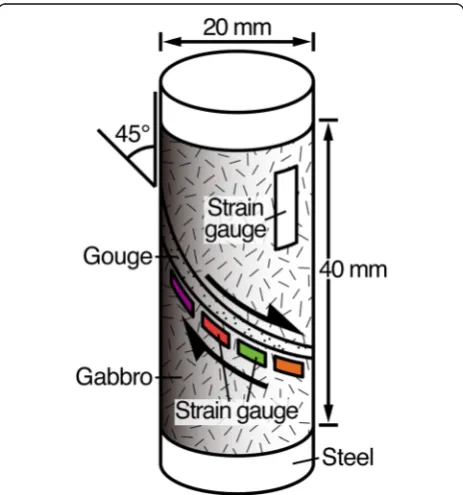
170 MPa, and a nominal strain rate of 1 × 10⁻³s−1. Argon gas was used as the confining pressure medium. Cylin-drical samples of gabbro, 20 mm in diameter and 40 mm in length, were cut in half along a plane oriented at an angle of 45° to the cylindrical axis (Figure 1). The pre-cut surfaces were first ground flat and then brought to a fine polish using a 3-μm diamond paste. For each experiment, 0.3 g of mineral powder was placed between the pre-cut, polished gabbro surfaces to produce a approximately 0.7-mm-thick layer of simulated fault gouge. Steel spacers were then placed at each end of the cylindrical sample as-sembly. In addition, a thin layer of Teflon was placed at the end of the piston to accommodate lateral slip of the sample assembly during deformation. The entire sample
assembly was jacketed in a Teflon tube with 0.5-mm-thick walls, in order to isolate the sample from the confining medium.
Four strain gauges, each with an active gauge length of 1 mm, were mounted on the lower gabbro cylinder at 3-mm intervals along the saw-cut. The gauges were situated at a distance of 1 mm from the fault to directly monitor the fault-surface-parallel component of the strain field during each experiment (Figure 1). Note that the gauges at these four locations measure only one com-ponent of the strain tensor, parallel to the fault surface. Another strain gauge (with an active gauge length of 6 mm) was mounted to the upper gabbro cylinder, parallel to the cylindrical axis, in order to measure the axial strain of the sample (Figure 1). For each deformation experi-ment, the rupture velocity was calculated by measuring the time taken by the rupture to pass from one strain gauge to another (for the gauges situated adjacent to the saw-cut). It is important to note that since the rupture is most likely to propagate at an angle to the edge of the cy-linder, the calculated velocity is an apparent velocity and is an upper bound for the rupture velocity.
At the start of each experimental run, the confining pressure was first raised to the desired value, after which an axial load was applied to the sample assembly at a loading velocity of 40μm/s. Axial stress was determined by multiplying the axial strain by the Young’s modulus of gabbro (E approximately 87.2 GPa). During these ex-periments, an increase in axial stress leads to a concomi-tant increase in both the shear stress and normal stress acting on the saw-cut. Note that the values of confining pressure investigated are equal to those of the initial normal stress before deformation.
All signals were amplified using signal conditioners (model CDV 700A, Kyowa Co., Ltd., Tokyo, Japan) with an input impedance of 107Ω and a frequency limit of
500 kHz. The amplified signals were recorded on a com-puter at a sampling rate of 1 to 2 MHz for all seven channels, synchronously and continuously, using the Simultaneous-Sampling Multifunction DAQ NI-6110 and LabVIEW 2009 (National Instrument Co., Ltd., Austin, USA). Additional information on the details of data acqui-sition in this study can be found in Onuma et al. (2011).
Results
Mechanical data
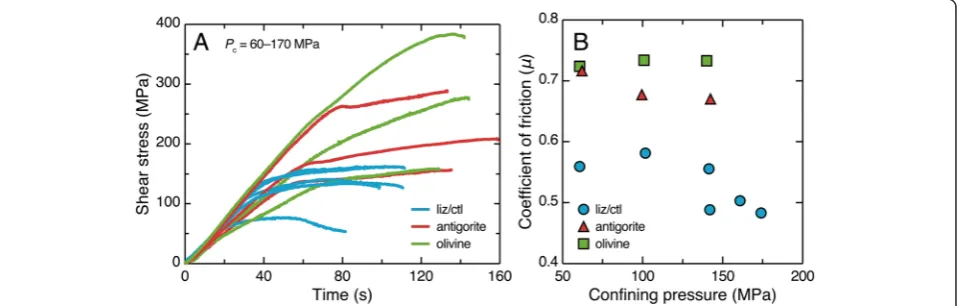
Shear stress versus time (i.e., strain) curves for the samples deformed atPc= 60 to 170 MPa initially exhibit a phase of
linear elastic behavior, followed by a span of strain harden-ing, during which stress increases with strain and, finally, a third stage in which the stress levels off or drops until one sudden, large unstable slip occurs (Figure 2A). This type of sliding behavior is similar to that observed for dry gouge subjected to triaxial friction experiments at room temperature (e.g., Morrow et al., 1982). Furthermore, note that for low- and high-temperature serpentine gouges, the loading velocity of 40μm/s carried out in this study lies in the velocity-weakening regime, where the slip potentially may be unstable (Reinen et al., 1994; Moore et al. 2004). The coefficient of friction,μ, which is defined as the ratio of shear stress to effective normal stress, was 0.48 to 0.58 for liz/ctl and 0.67 to 0.72 for antigorite (Figure 2B). This is in good agreement with the values reported from previ-ous rock-on-rock friction experiments on liz/ctl and anti-gorite under similar conditions (Dengo and Logan, 1981; Reinen et al., 1994). This major difference in strength observed between liz/ctl and antigorite can be attribu-ted to the corresponding differences in (001) bond strength for these two phyllosilicate varieties (e.g., Moore and Lockner, 2004). Olivine, on the other hand, yields a slightly higher and narrower range of μ values of 0.72 to 0.73 (Figure 2B).
Unstable slip event
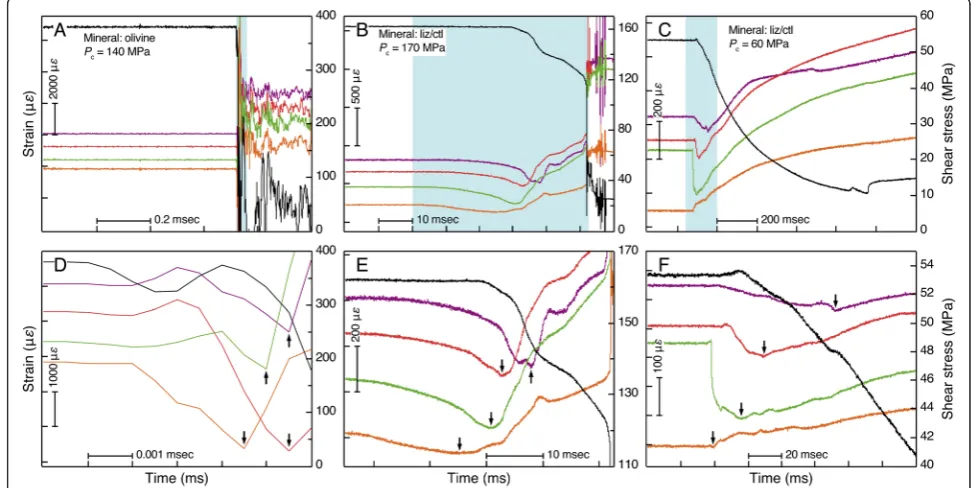
Figure 3 shows three representative experimental data-sets, each comprising four plots of localized strain along the saw-cut versus time, and a single plot of mean shear stress versus time, throughout an unstable slip event. For most of the unstable slip experiments carried out in this study, a rupture event nucleated at one end of the fault in the shear direction and propagated to the other, as shown in Figure 3. In the experiments carried out at Pc= 100 and 140 MPa for antigorite and olivine, shear
stress was observed to drop rapidly to a residual value during a brief period lasting only about 50 μs or less (Figures 3A,D and 4). In Figure 3D, it is also clear that the orange gauge placed at the lower edge of the saw-cut (Figure 1) first started to record compression just before the onset of this drop in shear stress, at which point the mode of deformation switches from a compressional to an extensional phase. This compression followed by ex-tension is interpreted to reflect the propagation of the rupture along the simulated gouge layer (e.g., Johnson and Scholz 1976; Dieterich 1978; Okubo and Dieterich
1984). Accordingly, we used this criterion to identify the peak compressional event recorded by each gauge as the rupture front propagated through each localized region (see arrows in Figure 3D-F), which then enabled us to calculate the apparent rupture velocity. Based on these calculations, the induced ruptures appear to have pro-pagated laterally along the 45° angle simulated faults (gouges) at speeds of roughly a few kilometers per second. After the observed large stress drop, all strain gauges then recorded a series of large oscillations, which we interpret as possible resonances of the sample and load-ing machine due to the radiation of seismic energy.
In the experiments conducted atPc= 140 to 170 MPa for
liz/ctl andPc= 60 MPa for antigorite and olivine, the shear
stress was observed to initially decrease at a relatively slow rate during an approximately 10- to 385-ms time period, followed by a second, comparatively rapid drop in the space of approximately 50μs or less (Figures 3B,E and 4). The plots of localized strain shown in Figure 3E indicate that rupture initiation took place at the lower edge of the saw-cut (orange gauge) and then propagated slowly
Figure 3Three representative examples of experimental datasets.Three representative examples of experimental datasets showing, on the left axes, the evolution (with time) of local strains (purple, red, green, and orange) parallel to the fault, and, on the right axes, mean shear stress (black), during an unstable slip event. The strain versus time curves are offset vertically from each other for clarity. Note that the strain values reported correspond to theεttcomponent of the strain tensor, wheretis the direction tangential to the fault, and that positive and negative strains correspond to extension and compression parallel to the pre-cut surface, respectively. The colors associated with local strains correspond to the colors assigned to the strain gauges shown in Figure 1. The blue regions shown inA,B, andCdemarcate the locations on these plots that correspond to the close-ups shown inD,E, andF, respectively. The arrows in D to F indicate the time of peak compression recorded by each strain gauge, reflecting the passage of a rupture front through that region of the sample assembly.(A and D)Olivine gouge (Pc= 140 MPa). During this experimental run, the shear stress dropped within approximately 50μs, with fast rupture propagation taking place at speeds of a few kilometers per second.(B and E)Liz/ctl gouge (Pc= 170 MPa). During this experimental run, a slow stress drop associated with multiple slow rupture propagation events persisted for approximately 20 ms, after which a fast drop in stress (as shown inAandD) occurred at seismic speeds.
upwards at speeds in the range of 0.5 to 1.6 m/s. In the experiments conducted at Pc= 60 to 140 MPa for
liz/ctl, the shear stress decreased very slowly toward a residual value over a protracted time period lasting ap-proximately 1 s, with none of the aforementioned ‘ sub-sequent rapid drops’ in shear stress or large oscillations (Figures 3C,F and 4). Furthermore, the measurements of local strain atPc= 60 MPa show that a rupture seems to
have nucleated at a location close to the lower edge of the saw-cut (orange gauge) just before the onset of the long approximately 1-s drop in shear stress (Figure 3F), and that it then propagated upward (toward the purple gauge) at speeds ranging from 0.07 to 0.22 m/s. Slow stick-slip behavior has been reported in recent friction experiments on lizardite-rich gouge conducted at room temperature (Kaproth and Marone 2013).
Note that the apparent velocities of fast rupture pro-pagation determined in this study are not constrained to a high degree of accuracy, largely because of the rela-tively small-scale nature of the sample assembly. In some cases, the time difference between the arrival of a rup-ture front at two neighboring strain gauges could not be determined (e.g., the red and purple gauges in Figure 3D) because of the small size of the test sample and the lim-ited sampling rate. However, they do provide reasonable first-order estimates of around 1.5 to 6.0 km/s based on the rough values calculated from our experimental data. For the three types of synthetic fault gouge studied, the apparent velocities of slow rupture propagation between all possible sets of any two neighboring strain gauges ranged from 0.07 to 5.43 m/s (Figure 5). The apparent rupture velocities seem to decrease with decreasing nor-mal stress, at least from 268 to 114 MPa, but a large scatter is present in the data (Figure 5A). We estimated the slow rupture duration for each experiment based on the time interval during which the shear stress decreased at a slow rate. In addition, although the data are limited, the duration of a stage of slow rupture propagation ap-pears to increase exponentially with decreasing normal stress (Figure 5B).
Microstructures
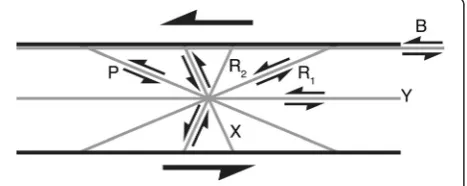
Polished thin sections were prepared from the experi-mentally deformed liz/ctl samples for petrographic ana-lysis using an optical microscope. The jacketed samples were impregnated with epoxy resin before being sliced parallel to the shear direction and normal to the pre-cut surface. In the present paper, the labeling scheme for lo-calized shears developed within gouge layers is adapted from Logan et al. (1992) (Figure 6).
Figure 4Summary of rupture propagation process observed in this study.Summary of rupture propagation process observed in this study, as a function of gouge material and confining pressure. Crosses: fast propagation. Triangles: slow to fast propagation. Circles: slow propagation.
The liz/ctl fault gouges deformed at 60, 100, 140, 160, and 170 MPa all contain narrow (10 to 50μm), localized shear zones that occur directly adjacent to the gabbro cy-linder on both sides of the gouge (referred to as B shears), which exhibit shear-zone-parallel planar fabrics defined by a preferred crystallographic orientation (Figure 7A-D). In detail, however, the liz/ctl fault gouge deformed at Pc=
60 MPa is also characterized by a series of regularly spaced, localized shear zones that are oriented oblique (approximately 10° to 15°) to the pre-cut surface (referred to as R1 shears) (Figure 7A). Note that the total dis-placements before an unstable slip event takes place are smallest in the liz/ctl gouge deformed at Pc= 60 MPa.
In contrast, the liz/ctl gouges deformed at Pc= 100 to
170 MPa contain a number of anastomosing shear zones that are oriented subparallel to the gouge-rock interface (referred to as Y shears) and that are separated by inter-vening lenticular regions in which the grains are found to be more massive, sub-equant, and less deformed overall (Figure 7C). The most well-developed Y shears often ex-hibit a wavy appearance and are in some cases associated with the formation of kink bands that are oriented parallel to the X- and R2-shear directions (Figure 7B,D).
Discussion and conclusions
Frictional behavior and microstructural evolution of fault gouges
All the liz/ctl gouges show grain size reduction by cata-clasis, possibly resulting in strain hardening with the com-paction and interlocking of the grains (e.g., Morrow et al. 1982). Previous laboratory experiments on gouge layers have shown that localization of deformation parallel to or along the gouge-rock interface (Y and B shears, re-spectively) with increasing displacement leads to rate-weakening friction or stick-slip instability (e.g., Logan et al. 1992; Beeler et al. 1996; Scruggs and Tullis 1998; Niemeijer et al. 2010; Ikari et al. 2011; Onuma et al. 2011). All liz/ctl gouges show the formation of obvious B shears, showing the strong preferred crystallographic orientation of serpentine, the width of which tends to increase with increasing confining pressure (i.e.,
compaction rate) and displacement, that is, an increase in shear strain. Furthermore, the R1 shears that extend across the liz/ctl gouge layer in the lowestPcexperiments
are not observed in the higher Pc experiments;
alterna-tively, there are through-going Y shears in the gouge in the higherPcexperiments. These microstructural
observa-tions are in good agreement with those of Niemeijer et al. (2010), who found that increased shear strain leads to a reorientation of R1shears toward Y shears, resulting from the kinematic constraint of rigid forcing blocks on the gouge material (e.g., Mandl et al. 1977). We thus con-clude that the fault gouges in this study evolved with strain from distributed deformation (cataclasis, grain rotation, and/or grain sliding) accompanied by faulting (through Riedel shears) in the strain-hardening range, to strain localization by the development of the B and Y shears in the strain-weakening range, which eventu-ally leads to the unstable slip event.
Slow rupture process within gouge layers
Previous stick-slip experiments have been conducted on rocks to monitor the evolution of local shear stresses on bare surfaces (e.g., Johnson and Scholz 1976; Dieterich 1978; Okubo and Dieterich 1984; Ohnaka and Shen 1999). The individual stick-slip events occur in three distinct phases. In phase I, stable sliding begins to occur locally and then propagates laterally at a slow rate that is driven by the external loading. This local stable sliding corre-sponds to a slight decrease in the local shear stress. In phase II, the rupture propagates slowly and produces an instantaneous increase in the local shear stress in the vicinity of the propagating tip, clearly identifying the rup-ture front. The shear stress subsequently decreases con-siderably during the remainder of this phase. During phase III, unstable slip results in sharp stress drops and rapid rupture propagation at speeds comparable to the shear wave velocity of the sample. The similarity between phase I stable sliding and creep patch development was recently reported in the context of a numerical model (Bar-Sinai et al. 2013). Both stable sliding and creep patch development are influenced by the loading rate, but they are clearly differentiated from phase II slow rupture propagation.
Recent friction experiments on polymethyl-methacrylate (PMMA) have also shown that under various loading conditions, different modes of rupture may occur along the interface during a single stick-slip event (Rubinstein et al. 2004; Ben-David et al. 2010a, b; Nielsen et al. 2010). Rubinstein et al. (2004) observed a sharp transi-tion from unstable, rapid sub-Rayleigh (limited by the Rayleigh wave speed) rupture to stable, slow (approxi-mately 5% ofVs) rupture modes. Ben-David et al. (2010a)
found that such rupture modes, ranging from slow (ap-proximately 5% of Vs) to supershear velocity (>Vs), vary
according to local differences in the ratio of shear stress to normal stress. In addition, Passelègue et al. (2013) per-formed stick-slip experiments on granite under a range of pressure conditions (Pc= 10 to 150 MPa), confirming
that the transition between sub-Rayleigh and supershear ruptures depends on the ratio of initial shear stress to normal stress.
Here, our unstable slip experiments on synthetic gouge layers demonstrate a succession of different modes of rupture (Figure 4), consisting of a phase with nucleation/ propagation events that take place at a slow velocity (approximately 0.1% of Vs), often followed by an
un-stable phase that eventually leads to the onset of high-speed rupture propagation (comparable in velocity toVs).
The shearing of simulated gouge layers in our experiments resulted in an unstable slip event that followed up to ap-proximately 8 mm of stable sliding. During this stable slid-ing, we observed no instantaneous increases in the local shear stress (such as a clear bump to compression and subsequent extension) that would have indicated the pro-pagation of a rupture tip. This indicates that the slow rup-tures observed in this study (e.g., Figure 3) are neither the phase I events observed in previous rock-on-rock experi-ments nor creep patches reported in recent numerical modeling studies (Bar-Sinai et al., 2013).
We find that for the high-μ fault zone materials (i.e., antigorite and olivine), the slow rupture mode is too short to be detected by our experimental assembly (with strain gauges spaced at 3-mm intervals along the fault) at relatively high confining pressures (e.g., Figure 3A). In contrast, for the low-μ fault zone material (i.e., liz/ctl), we clearly observe consistent increases in the degree of development of the slow rupture mode with decreasing confining pressure; that is, a slow drop in shear stress predominates over a fast drop in shear stress with de-creasing initial normal stress (e.g., compare the mean shear stress curve for liz/ctl in Figure 3B at 170 MPa with that in Figure 3C at 60 MPa). These observations suggest that sustained slow shear failure arises as a conse-quence of both low values of normal stress and low values of intrinsic gouge hardness (i.e., frictional strength).
Numerical simulations on the basis of rate- and state-dependent friction laws have succeeded in reproducing slow slip behavior with recurrence intervals similar to those of SSEs (e.g., Liu and Rice 2007, 2009; Rubin 2008). The simulations showed that the emergence of SSEs depends primarily on the parameter W/h*, whereW is the size of the unstable region and h* is the nucleation size, and revealed that the propagation speed or dur-ation of SSEs decreases or increases, respectively, with Figure 7Optical photomicrographs of experimentally deformed liz/ctl, antigorite, and olivine synthetic fault gouges.Optical
photomicrographs of experimentally deformed liz/ctl, antigorite, and olivine synthetic fault gouges observed in(A and B)cross-polarized light and(C and D)plane-polarized light. The shear sense along each fault gouge inAandBis indicated by the large white arrows.(A)Liz/ctl gouge (Pc= 60 MPa), highlighting the development of regularly spaced R1shears that curve in a listric fashion into the B shears present on either side of
decreasing W/h*. From the theoretical estimate given by Rice (1993),h* is inversely proportional toσn(b−a), whereσnis the effective normal stress, and aandb are the rate and state friction parameters, respectively, mean-ing that lower effective normal stress leads to a largerh* (hence smallerW/h*).
This finding is qualitatively consistent with our experi-ments in which the velocity and duration of slow rupture propagation events become lower and longer, respect-ively, with decreasing normal stress (at least from 268 to 114 MPa) (Figure 5). In addition, fault gouges with lower friction coefficients tend to have lower (b−a) values, hence smaller W/h* (e.g., Ikari et al. 2011). This scenario may help to explain why the slow rupture mode observed in this study is facilitated in the fault zone that exhibits lower friction. We also note that if the sample diameter used in our experiments were in-creased above 20 mm, the commensurate increase in the rate-and-state friction parameter,W, defined as the length of the fault surface (i.e., approximately 28 mm) in this study, would restrict slow rupture modes to con-ditions of lower normal stress.
Implications for slow slip events in subduction zones
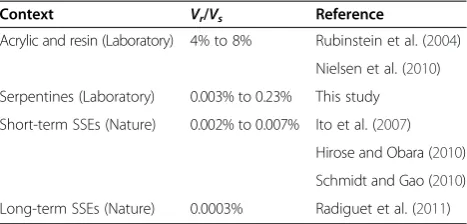
It remains unclear whether all series of slow slip events, as seen in the laboratory (acrylic/analog and rock mate-rials), nature (i.e., SSEs), and numerical simulations (based on rate and state friction), can be represented by a single friction law. Nevertheless, the apparent velocities of slow rupture propagation within the liz/ctl fault gouges, which range from 0.07 to 5.43 m/s at effective normal stresses of 114 to 268 MPa (Figure 5), are largely consistent with those documented for short-term SSEs in Japan and Cascadia (Table 1) (e.g., Hirose and Obara 2010; Gao et al. 2012). It is important to note that the hydra-tion of the mantle wedge in subduchydra-tion zones is expec-ted to form antigorite rather than liz/ctl (e.g., Hirauchi et al. 2010b). Nevertheless, our observations lead us to conclude that long-term slip events (i.e., those with Vr
much less than approximately 0.1 m/s) (e.g., Radiguet et al., 2011; Kobayashi, 2014) probably occur within a region of much lower effective normal stress, even if liz/ctl is assumed to be present along the slab-mantle interface. Indeed, models of rate-and-state friction as-sume an effective normal stress of only a few to sev-eral tens of MPa, in order to reproduce slow slip events with recurrence intervals consistent with those of SSEs (e.g., Liu and Rice 2007, 2009).
Our experiments were conducted under dry condi-tions, in order to eliminate the effect of pore fluids, such as fluid flow, thermal pressurization, and fluid-assisted chemical processes, on unstable slip behavior in this series of experiments (e.g., Moore and Lockner 2004;
Mitchell and Faulkner 2008; Brantut and Sulem 2012). Despite the dry conditions, we still observed slow slip events during our experiments on the low-μ fault zone material (i.e., liz/ctl) at low confining pressure (i.e., 60 to 140 MPa; Figure 3C). This suggests that variations in the duration and propagation velocity of SSEs (Gao et al. 2012) are primarily controlled by the balance between the effective normal stress conditions and the intrinsic properties of the fault zone material. However, we can-not exclude the possibility that other factors, such as dilatancy, neutral velocity dependence of (a−b), and non-monotonic dependence of steady state friction on slip velocity, also contribute to the emergence of SSEs in sub-duction zones (e.g., Liu and Rice 2009; Rubin 2008; Liu and Rubin 2010; Hawthorne and Rubin 2013).
Competing interests
Both authors declare that they have no competing interests.
Authors’contributions
KH carried out the experiments and drafted the manuscript. JM participated in the design of the study and helped to draft the manuscript. Both authors read and approved the final manuscript.
Acknowledgements
We appreciate Kenshiro Otsuki’s technical support while conducting the experiments. We thank Yoshihiro Ito, Yoshihiro Kaneko, Hiroyuki Noda, Jon Samuelson, and Bunichiro Shibazaki for helpful comments and discussions. We greatly appreciate constructive comments from two anonymous reviewers, as well as careful editorial handling by Tomomi Okada. This study was funded by a Grant-in-Aid for Young Scientists (B) (No. 25800279) and a Grant-in-Aid for Scientific Research (A) (No. 24244077) and was supported by the Observation and Research Program for Prediction of Earthquakes and Volcanic Eruptions, the Ministry of Education, Culture, Sports, Science and Technology, Japan.
Author details
1Department of Geosciences, Graduate School of Science, Shizuoka University, 836 Ohya, Suruga-ku, Shizuoka 422-8529, Japan.2Department of Earth Science, Graduate School of Science, Tohoku University, 6-3 Aramaki-Aza-Aoba, AobaSendai, Miyagi 980-8578, Japan.
Received: 17 September 2014 Accepted: 27 January 2015
Table 1 Slow-rupture velocity vs. shear wave velocity in different contexts
Context Vr/Vs Reference
Acrylic and resin (Laboratory) 4% to 8% Rubinstein et al. (2004)
Nielsen et al. (2010)
Serpentines (Laboratory) 0.003% to 0.23% This study
Short-term SSEs (Nature) 0.002% to 0.007% Ito et al. (2007)
Hirose and Obara (2010)
Schmidt and Gao (2010)
References
Audet P, Bostock MG, Christensen NI, Peacock SM (2009) Seismic evidence for overpressured subducted oceanic crust and megathrust fault sealing. Nature 457:76–78
Bar Sinai Y, Brener EA, Bouchbinder E (2012) Slow rupture of frictional interfaces. Geophys Res Lett 39, L03308
Bar-Sinai Y, Spatschek R, Brener EA, Bouchbinder E (2013) Instabilities at frictional interfaces: creep patches, nucleation, and rupture fronts. Phys Rev E 88:060403(R)
Beeler NM, Tullis TE, Blanpied ML, Weeks JD (1996) Frictional behavior of large displacement experimental faults. J Geophys Res 101:8697–8715
Ben-David O, Cohen G, Fineberg J (2010a) The dynamics of the onset of frictional slip. Science 330:211–214
Ben-David O, Rubinstein SM, Fineberg J (2010b) Slip-stick and the evolution of frictional strength. Nature 463:76–79
Beroza GC, Ide S (2011) Slow earthquakes and nonvolcanic tremor. Annu Rev Earth Planet Sci 39:271–296
Brantut N, Sulem J (2012) Strain localization and slip instability in a strain-rate hardening, chemically weakening material. J Appl Mech 79:031004 Dengo CA, Logan JM (1981) Implications of the mechanical and frictional
behavior of serpentinite to seismogenic faulting. J Geophys Res 86:10771–10782
Dieterich JH (1978) Preseismic fault slip and earthquake prediction. J Geophys Res 83:3940–3948
Dragert H, Wang K, James TS (2001) A silent slip event on the deeper Cascadia subduction interface. Science 292:1525–1528
Gao H, Schmidt DA, Weldon RJ II (2012) Scaling relationships of source parameters for slow slip events. Bull Seismol Soc Am 102:352–360 Hawthorne JC, Rubin AM (2013) Short-time scale correlation between slow slip
and tremor in Cascadia. J Geophys Res 118:1316–1329
Hirauchi K, den Hartog SAM, Spiers CJ (2013) Weakening of the slab-mantle wedge interface induced by metasomatic growth of talc. Geology 41:75–78 Hirauchi K, Katayama I (2013) Rheological contrast between serpentine species
and implications for slab-mantle wedge decoupling. Tectonophysics 608:545–551
Hirauchi K, Katayama I, Uehara S, Miyahara M, Takai Y (2010a) Inhibition of subduction thrust earthquakes by low-temperature plastic flow in serpentine. Earth Planet Sci Lett 295:349–357
Hirauchi K, Michibayashi K, Ueda H, Katayama I (2010b) Spatial variations in antigorite fabric across a serpentinite subduction channel: insights from the Ohmachi Seamount, Izu-Bonin frontal arc. Earth Planet Sci Lett 299:196–206 Hirose H, Obara K (2010) Recurrence behavior of short-term slow slip and
correlated nonvolcanic tremor episodes in western Shikoku, southwest Japan. J Geophys Res 115:B00A21
Ikari MJ, Marone C, Saffer DM (2011) On the relation between fault strength and frictional stability. Geology 39:8386
Ide S, Beroza GC, Shelly DR, Uchide T (2007) A scaling law for slow earthquakes. Nature 447:76–79
Ito Y, Obara K, Shiomi K, Sekine S, Hirose H (2007) Slow earthquakes coincident with episodic tremors and slow slip events. Science 315:503–506 Johnson TL, Scholz CH (1976) Dynamic properties of stick-slip friction of rock.
J Geophys Res 81:881–888
Kaneko Y, Ampuero J-P (2011) A mechanism for preseismic steady rupture fronts observed in laboratory experiments. Geophys Res Lett 38, L21307
Kaproth BM, Marone C (2013) Slow earthquakes, preseismic velocity changes, and the origin of slow frictional stick-slip. Science 341:1229–1232
Kato A, Iidaka T, Ikuta R, Yoshida Y, Katsumata K, Iwasaki T et al (2010) Variations of fluid pressure within the subducting oceanic crust and slow earthquakes. Geophys Res Lett 37, L14310
Kato N, Yamamoto K, Yamamoto H, Hirasawa T (1992) Strain-rate effect on frictional strength and the slip nucleation process. Tectonophysics 211:269–282 Kawano S, Katayama I, Okazaki K (2011) Permeability anisotropy of serpentinite
and fluid pathways in a subduction zone. Geology 39:939–942 Kobayashi A (2014) A long-term slow slip event from 1996 to 1997 in the Kii
Channel, Japan. Earth Planets Space 66:9
Liu Y, Rice JR (2007) Spontaneous and triggered aseismic deformation transients in a subduction fault model. J Geophys Res 112, B09404
Liu Y, Rice JR (2009) Slow slip predictions based on granite and gabbro friction data compared to GPS measurements in northern Cascadia. J Geophys Res 114, B09407
Liu Y, Rubin AM (2010) Role of fault gouge dilatancy on aseismic deformation transients. J Geophys Res 115, B10414
Logan JM, Dengo CA, Higgs NG, Wang ZZ (1992) Fabrics of experimental fault zones: their development and relationship to mechanical behavior. In: Evans B, Wong T-F (eds) Fault mechanics and transport properties of rock. Academic, London, pp 33–67
Mandl G, de Jong LNJ, Maltha A (1977) Shear zones in granular material. Rock Mech 9:95–144
Mitchell TM, Faulkner DR (2008) Experimental measurements of permeability evolution during triaxial compression of initially intact crystalline rocks and implications for fluid flow in fault zones. J Geophys Res 113, B11412 Moore DE, Lockner DA (2004) Crystallographic controls on the frictional behavior
of dry and water-saturated sheet structure minerals. J Geophys Res 109, B03401
Moore DE, Lockner DA, Tanaka H, Iwata K (2004) The coefficient of friction of Chrysotile gouge at seismogenic depth. Int Geol Rev 46:385–398 Morrow CA, Shi LQ, Byerlee JD (1982) Strain hardening and strength of clay-rich
fault gouges. J Geophys Res 87:6771–6780
Nielsen S, Taddeucci J, Vinciguerra S (2010) Experimental observation of stick-slip instability fronts. Geophys J Int 180:697–702
Niemeijer A, Marone C, Elsworth D (2010) Frictional strength and strain weakening in simulated fault gouge: competition between geometrical weakening and chemical strengthening. J Geophys Res 115, B10207 Obara K (2002) Nonvolcanic deep tremor associated with subduction in
southwest Japan. Science 296:1679–1681
Ohnaka M, Shen L (1999) Scaling of the shear rupture process from nucleation to dynamic propagation: implications of geometric irregularity of the rupturing surfaces. J Geophys Res 104:817–844
Okubo PG, Dieterich JH (1984) Effects of physical fault properties on frictional instabilities produced on simulated faults. J Geophys Res 89:5817–5827 Onuma K, Muto J, Nagahama H, Otsuki K (2011) Electric potential changes
associated with nucleation of stick–slip of simulated gouges. Tectonophysics 502:308–314
Passelègue FX, Schubnel A, Nielsen S, Bhat HS, Madariaga R (2013) From sub-rayleigh to supershear ruptures during stick-slip experiments on crustal rocks. Science 340:1208–1211
Peacock SM, Christensen NI, Bostock MG, Audet P (2011) High pore pressures and porosity at 35 km depth in the Cascadia subduction zone. Geology 39:471–474
Peng Z, Gomberg J (2010) An integrated perspective of the continuum between earthquakes and slow-slip phenomena. Nat Geosci 3:599–607
Radiguet M, Cotton F, Vergnolle M, Campillo M, Valette B, Kostoglodov V, Cotte N (2011) Spatial and temporal evolution of a long term slow slip event: the 2006 Guerrero Slow Slip Event. Geophysical Journal International 184:816–828 Reinen LA, Weeks JD, Tullis TE (1994) The frictional behavior of lizardite and
antigorite serpentinites: experiments, constitutive models, and implications for natural faults. Pure Appl Geophys 143:317–358
Rice JR (1993) Spatio-temporal complexity of slip on a fault. J Geophys Res 98:9885–9907
Rogers G, Dragert H (2003) Episodic tremor and slip on the Cascadia subduction zone: the chatter of silent slip. Science 300:1942–1943
Rubin AM (2008) Episodic slow slip events and rate-and-state friction. J Geophys Res 113, B11414
Rubinstein SM, Cohen G, Fineberg J (2004) Detachment fronts and the onset of dynamic friction. Nature 430:1005–1009
Schmidt DA, Gao H (2010) Source parameters and time-dependent slip distributions of slow slip events on the Cascadia subduction zone from 1998 to 2008. Journal of Geophysical Research 115:B00A18
Scruggs VJ, Tullis TE (1998) Correlation between velocity dependence of friction and strain localization in large displacement experiments on feldspar, muscovite and biotite gouge. Tectonophysics 295:15–40
Shelly DR, Beroza GC, Ide S, Nakamula S (2006) Low-frequency earthquakes in Shikoku, Japan, and their relationship to episodic tremor and slip. Nature 442:188–191