Interoperability of Dialogue Corpora through ISO 24617-2-based Querying
Volha Petukhova*, Andrei Malchanau* and Harry Bunt**
*Spoken Language Systems, Saarland University, Germany
** Tilburg Center for Cognition and Communication, Tilburg University, The Netherlands
{v.petukhova; andrei.malchanau}@lsv.uni-saarland.de; [email protected]
Abstract
The paper presents an approach to achieving interoperability of dialogue act annotations through developing a query format for accessing existing annotated corpora. The interpretation of expressions in the query format implements a mapping from ISO 24617-2 concepts to those of several existing annotation schemes. This approach is tested on two important types of existing dialogue corpora: spoken two-person dialogue corpora collected and annotated within the HCRC Map Task paradigm, and multiparty face-to-face dialogues of the AMI corpus. Additionally, we provide a mapping between ISO 24617-2 concepts and DAMSL-based taxonomies. We present the results and evaluate them with respect to accuracy and completeness trough statistical comparisons between retrieved and manually constructed reference annotations.
Keywords:semantic interoperability, international standards, dialogue act annotation
1.
Introduction
ISO standards for linguistic annotation aim to contribute to the interoperability of language resources. ISO 24617-2 “Semantic annotation framework, Part 2: Dialogue acts”, in particular aims to contribute to the interoperability of an-notated dialogue corpora.
An obvious way of achieving interoperability is to make sure that, whenever a new corpus is constructed, an annota-tion schema is used that is compatible with the one defined in the standard, e.g. using a subset of the annotation con-cepts defined in the standard, or using concon-cepts with a well-defined relation to those of the standard. The ISO dialogue act annotation scheme is quite well known and already em-ployed in some dialogue projects, e.g. in the ToMA project (Blache et al., 2009) where the Corpus of Interactional Data (CID) was labeled according ISO 24617-2; and a new corpus of DBOX dialogue gaming data (Petukhova et al., 2014) discussed in these proceedings.
Another way is to convert the annotations in existing cor-pora to annotations that are compatible with the ISO stan-dard; this approach has been applied to the SWBD-DAMSL annotations in the Switchboard corpus (Fang et al., 2012; Bunt et al., 2013).
This paper explores a third way of achieving interoperabil-ity: developing a query format for accessing existing anno-tated corpora whose expressions make use of the annotation language defined by the standard, where the interpretation of expressions in the query implements a mapping from ISO 24617-2 concepts to those of the annotation scheme used in the corpus. We explore this approach for two impor-tant types of existing dialogue corpora: spoken two-person dialogue corpora collected and annotated for a variety of languages according to the HCRC Map Task paradigm, and multiparty face-to-face dialogues of the AMI corpus. The paper is structured as follows. Section 2 introduces the AMI and MapTask corpora. Section 3 discusses the map-ping between dialogue act concepts defined in the AMI and Map Task schemes and those in the ISO standard. Section 4 introduces the Dialogue Act Markup Language (DiAML) defined in the ISO standard, on which the query format is
based and discusses the querying of annotated corpora us-ing DiAML. Section 5 presents the results and evaluates them with respect to accuracy and completeness through statistical comparisons between retrieved and manually an-notated corpus data. Conclusions and indications for future work make up the final Section 6.
2.
Annotated dialogue corpora
Recent years have witnessed a growing interest in tating linguistic data at the semantic level including anno-tation of dialogue corpus data with dialogue act informa-tion. Over the years a number of dialogue act annotation schemes has been developed, such as those of the TRAINS project in the US (Allen et al., 1994), the MapTask studies in the UK (Carletta et al., 1996), the Verbmobil project in Germany (Alexandersson et al., 1998). Within these and many other projects several annotated dialogue corpora are constructed that are widely used for analysing and mod-elling human dialogue behaviour and designing of human-machine natural language based dialogue systems. How-ever, such corpora are not easy to re-use for purposes and domains other than they were originally developed for. One of the best known and most widely used dialogue act annotation schemes is DAMSL. There are several vari-ants of this scheme, such as Switchboard-DAMSL (Juraf-sky, 1997) and Coconut (Di Eugenio et al., 1998). Sev-eral dialogue corpora have been annotated using DAMSL scheme and are available for research purposes. First of
all, theMonroecorpus1, a collection of task-oriented
spo-ken dialogues. The tasks involved are complex and
in-clude a variety of types of problem-solving tasks. The
corpus consists of 20 dialogues with 4794 speaker turns in total. Annotations of the Monroe corpus are available in the Standard Generalized Markup Language (SGML;
ISO 8879:1986). Second, the dialogue act annotated
Switchboard corpus consists of telephone conversations between speakers of American English and contains 650
1http://www.cs.rochester.edu/research/
fully spontaneous conversations. This corpus and the Switchboard-DAMSL annotations are now available in
NXT format (see (Calhoun et al., 2010)). Third, the
Co-conut dialogue corpus2 is a collection of two-party
ne-gotiation typed computer-mediated dialogues. The
cor-pus consists of 35 dialogues annotated with Coconut-DRI
(DAMSL variant) dialogue act annotation scheme.
Di-alogue act annotations are inline annotations of the
for-mat: < Tag Number > Text < /Tag Number >or <
Tag Number=”Identi f ier”>Text< /Tag Number>.
Another big collection of dialogues constitutes theHCRC
MapTask3corpus, consisting of 128 dialogues where one participant plays the role of an instruction-giver while the other participant, the instruction-follower, navigates through the map. The dialogues are transcribed and
an-notated for a wide range of behaviours, e.g. prosodic
and syntactic units, gaze direction, conversational moves, etc. The HCRC MapTask annotated corpus is available in NXT format. Moreover, MapTask’s underlying idea was so successful that dialogues for a comparable task (map-searching) has been collected in many languages other than
English: German MapTask (Hamburg MapTask corpus4,
French MapTask corpus5(MAPTASK-AIX) , Italian
Map-Task (Grice and Savino, 2003), and many others.
The AMI corpus6, collected in a large-scale EU project,
contains 100 hours of transcribed and annotated meeting conversations (in English) where the participants (usually four) play different roles in a fictitious design team. The annotated corpus is also available in NXT format.
The above mentioned dialogue corpora differ in (1) un-derlying task (instructing a map search, decision mak-ing, selling-buying negotiations and a collaborative de-sign task); (2) number of dialogue participants (two- or multy-party); (3) communication channels and modali-ties (computer-mediated typed, face-to-face spoken inter-actions, and spoken interaction without visual contact); and (4) annotated phenomena and annotation scheme used.
3.
Mapping
Analysing annotation schemes and data representations, and their compatibility with ISO 24617-2, at least four very important issues need to be taken into consideration: (1) the multifunctionality of dialogue utterances; (2) the way a di-alogue is segmented into meaningful units; (3) the relations between segments; and (4) the qualification of communica-tive functions. Existing annotation schemes take different points of view on these issues. For the purpose of querying we largely ignore differences in segmentation, and use the segmentation used in the corpus.
Previous mapping initiatives, such as the MATE project (Klein et al., 1998), noticed that the use of hierarchies or multidimensional meta-schemes makes mappings better
2http://www.pitt.edu/˜coconut/
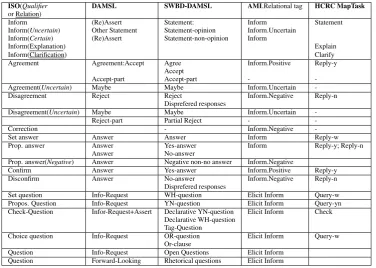
feasible and more accurate. The ISO-compatibility of an annotation scheme can be considered at many levels (Bunt et al., 2013). One possibility is to take the communicative function tags used in a given annotated corpus and replace them by ISO tags. Since there is no one-to-one correspon-dence between tags, this is mostly not a simple matter, but in fact requires the re-expression of the information that is captured by the corpus annotations in terms of concepts de-fined in the ISO standard. Table 1 shows how the functional tags for information-giving and information-seeking acts in the DAMSL, SWBD-DAMSL, AMI, HCRC Map Task, and ISO 24617-2 annotation schemes are related.
We systematically compared the MapTask, AMI and ISO 24617-2 annotation schemes by inspecting the definitions as well as examples in annotation guidelines and annotated corpus data. Additionally, four AMI dialogues (3,897 ut-terances) and eight MapTask dialogues (1,728 utut-terances) were re-annotated according to ISO 24617-2.
3.1. Multifunctionality and multidimensionality
The ISO 24617-2 annotation scheme is highly multidimen-sional, supporting multifunctional analysis by allowing the assignment of multiple dialogue act tags to a dialogue seg-ment. In this respect it is comparable to DAMSL, and
it includes the most important insights behind it.7 The
ISO 24617-2 taxonomy of communicative functions
dis-tinguishes 9 dimensions, taken from the DIT++
taxon-omy (Bunt, 2009), in which dialogue acts address
infor-mation about a certain task (theTaskdimension); the
pro-cessing of utterances by the speaker (Auto-feedback) or by
the addressee (Allo-feedback); the management of
diffi-culties in the speaker’s production of contributions (
Own-Communication Management) or that of the addressee
(Partner Communication Management); the speaker’s need
for time to continue the dialogue (Time Management); the
allocation of the speaker role (Turn Management); the
structuring of the dialogue (Dialogue Structuring); and
the management of social obligations (Social Obligations
Management). There are 41 dimension-specific and 26
general-purpose communicative functions.
Other schemes propose tagsets which as a rule are fairly simple, and are mostly used to code dialogue utterances with a single tag. HCRC MapTask defines such a one-dimensional scheme with 12 mutually exclusive dialogue act tags (Carletta et al., 1996).
Again other schemes, while allowing a single dialogue act label to be assigned to each dialogue segment, have addi-tional tags that can be added to the main label in order to describe the meaning more accurately. AMI is one such scheme which has additional layers and relational tags. For instance, an additional layer of so-called ‘reflexive’ acts al-lows labelling the type of semantic content by specifying whether a dialogue contribution is about the meeting task or about managing the task. Further, the AMI annotation scheme has relational tags to indicate relations between di-alogue units. For example, INFORM which can be com-bined with 4 relation tags: POSitive, NEGative, PARTial and UNCertain. This allows to annotate several types of
7The ISO 24617-2 scheme is based on an analysis of 18
ISO(Qualifier DAMSL SWBD-DAMSL AMI.Relational tag HCRC MapTask
or Relation)
Inform (Re)Assert Statement: Inform Statement
Inform(Uncertain) Other Statement Statement-opinion Inform.Uncertain Inform(Certain) (Re)Assert Statement-non-opinion Inform
Inform(Explanation) Explain
Inform(Clarification) Clarify
Agreement Agreement:Accept Agree Inform.Positive Reply-y Accept
Accept-part Accept-part -
-Agreement(Uncertain) Maybe Maybe Inform.Uncertain
-Disagreement Reject Reject Inform.Negative Reply-n
Disprefered responses
Disagreement(Uncertain) Maybe Maybe Inform.Uncertain
-Reject-part Partial Reject -
-Correction - Inform.Negative
-Set answer Answer Answer Inform Reply-w
Prop. answer Answer Yes-answer Inform Reply-y; Reply-n
Answer No-answer
Prop. answer(Negative) Answer Negative non-no answer Inform.Negative
Confirm Answer Yes-answer Inform.Positive Reply-y
Disconfirm Answer No-answer Inform.Negative Reply-n
Disprefered responses
Set question Info-Request WH-question Elicit Inform Query-w Propos. Question Info-Request YN-question Elicit Inform Query-yn Check-Question Infor-Request+Assert Declarative YN-question Elicit Inform Check
Declarative WH-question Tag-Question
Choice question Info-Request OR-question Elicit Inform Query-w Or-clause
Question Info-Request Open Questions Elicit Inform Question Forward-Looking Rhetorical questions Elicit Inform
Table 1: Information transfer (providing and seeking) communicative functions in the ISO24617-2, DAMSL, SWBD-DAMSL, AMI and
HCRC MapTask annotation schemes.
answers, e.g. positive or negative answer, or positive un-certain answer, etc. It does not allow, however, to differen-tiate between, for example, a confirm, an agreement and a positive propositional answer, or between those of ac-cept request, acac-cept suggestion and acac-cept offer, which are not concerned with the exchange of information in propo-sitional form, but address the performance of actions.
3.2. Relations between dialogue units
ISO 24617-2 distinguishes three types of relations between dialogue units: functional relations (like question-answer), feedback relations and rhetorical relations, as described in Section 4. In AMI, annotators should consider whether a unit expresses a response to something, and so, indicate that by adding a link. For instance, an answer is linked to a question (as ‘source’ of the link; the answer as ‘target’). As for rhetorical relations, AMI has a separate scheme to capture argumentation structure, however, not relating dia-logue acts but segments.
HCRC MapTask does not explicitly mark any relations
be-tween dialogue units. The functional labels Explain and
Clarify are defined to say that the current speech act
ex-plains or clarifies something.
3.3. Communicative function qualifiers
ISO 24617-2 defines a set of qualifiers to enable more precise description of the speaker’s intention with respect to certainty, conditionality and sentiment. Some dialogue act taxonomies pay attention to these phenomena. For in-stance, DAMSL and DAMSL-based schemes distinguish such functions as Maybe, Reject-Part or Accept-Part. AMI uses the relational tags POSitive, NEGative, PARTial, or UNCertain to classify the type of a relationship. Emotions are also annotated in AMI, however these labels are
as-signed directly to the (verbal or nonverbal) behaviour of a participant and are not tied with dialogue act annotation. HCRC MapTask does not capture these phenomena.
3.4. Tag correspondences
In this section we present the mappings, based on both the-oretical and empirical considerations, between the AMI, HCRC Map Task, and ISO 24617-2 annotation schemes. A first observation is that there are very few one-to-one cor-respondences between function tags. ‘Instruct’ in HCRC MapTask and ISO 24617-2 is an example. There are even fewer many-to-one functional tag correspondences from AMI or MapTask to ISO 24617-2, also if we chose a more general ISO tag. For example, AMI’s Inform, Assessment, Comment-Understanding and Elicit-Offer-or-Suggestion may be mapped to ISO’s general Question tag. Upon analysis and re-annotation it turns out that of the dialogue acts with these functions, Elicit-Inform and Elicit-Offer-or-Suggestion mostly address the Task di-mension, while Elicit-Assessment and Elicit-Comment-Understanding are mostly concerned with feedback elici-tation. The remaining Elicit-Offer-or-Suggestion maps in about 50% of the cases to the ISO tag ‘Question’ and in 50% to ‘Request’.
AMI ontologies
AMI DA annotations
AMI DA dependencies
AMI primary data: transcriptions
Retrieved results: tab separated
Mapping
time End time Utterance AMI DA type Relation type:source/target:DAid ISO DA type
ES2002b.C.dialog-act.dharshi.62 C 651.783 653.29 Do you want to switch places? Elicit-Inform none Question
ES2002b.D.dialog-act.dharshi.181 D 1096.23 1098.905 Any um comments on all of that?
Elicit-Assessment Support/Possitive
Assessment:target:ES2002b.B.dialog-act.dharshi.140 Question
ES2002b.B.dialog-act.dharshi.163 B 1194.97 1197.56
so do you think we're we're aiming at a fairly young market then?
Elicit-Offer-Or-Suggestion Support/Possitive
Assessment:target:ES2002b.A.dialog-act.dharshi.44 Question
dialogueAct(communicativeFunction="question")
<adjacency-pair nite:id="ES2002b.adjacency-pairs.dharshi.90"> <nite:pointer role="type" href="ap-types.xml#id(apt_1)"/>
<nite:pointer role="source" href="ES2002b.D.dialog-act.xml#id(ES2002b.D.dialog-act.dharshi.181)"/> <nite:pointer role="target" href="ES2002b.B.dialog-act.xml#id(ES2002b.B.dialog-act.dharshi.140)"/> </adjacency-pair>
<adjacency-pair nite:id="ES2002b.adjacency-pairs.dharshi.102"> <nite:pointer role="type" href="ap-types.xml#id(apt_1)"/>
<nite:pointer role="source" href="ES2002b.B.dialog-act.xml#id(ES2002b.B.dialog-act.dharshi.163)"/> <nite:pointer role="target" href="ES2002b.A.dialog-act.xml#id(ES2002b.A.dialog-act.dharshi.44)"/> </adjacency-pair>
ES2002b.adjacency-pairs.xml
<da-type nite:id="ami_daclass_2" name="elicit" gloss="Elicit"> <da-type nite:id="ami_da_5" name="el.inf" gloss="Elicit-Inform"/> <da-type nite:id="ami_da_8" name="el.sug" gloss="Elicit-Offer-Or-Suggestion"/> <da-type nite:id="ami_da_11" name="el.ass" gloss="Elicit-Assessment"/> <da-type nite:id="ami_da_13" name="el.und" gloss="Elicit-Comment-Understanding"/> </da-type> <profileDescr> <particDescr> <person xml:id="A"> <p>the first participant</p> </person>
<person xml:id="B"> <p>the second participant</p> </person>
<person xml:id="C">
<p>the third participant</p> </person>
<person xml:id="D">
<p>the fourth participant</p> </person>
</particDescr> </profileDescr> </teiHeader>
<div>
<head>Identification of functional segments</head>
<spanGrp type="functionalVerbalSegment" xml:id="ves1"> <span type="textStretch" xml:id="ts1"
from=" ES2002b.C.words649" to=" ES2002b.C.words655" /> </spanGrp>
<spanGrp type="functionalVerbalSegment" xml:id="ves2"> <span type="textStretch" xml:id="ts2"
from=" ES2002b.D.words1755" to=" ES2002b.D.words1760" /> </spanGrp>
<spanGrp type="functionalVerbalSegment" xml:id="ves3"> <span type="textStretch" xml:id="ts3"
from="ES2002b.B.words1332" to="ES2002b.B.words1345" /> </spanGrp>
<fs type="functionalSegment" xml:id="fs1">
<f name="verbalComponent" fVal="#ves1"/> </f> </fs> <fs type="functionalSegment" xml:id="fs2">
<f name="verbalComponent" fVal="#ves2"/> </f> </fs> <fs type="functionalSegment" xml:id="fs3">
<f name="verbalComponent" fVal="#ves3"/> </f> </fs>
</div>
<diaml xmlns:"http://www.iso.org/diaml/"> .
.
<dialogueAct xml:id=" ES2002b.C.dialog-act.dharshi.62"
sender="#C" addressee="#?" target="#fs1" communicativeFunction="Question" dimension="?"/> .
.
<dialogueAct xml:id=" ES2002b.D.dialog-act.dharshi.181"
sender="#D" addressee="#?" target="#fs2" communicativeFunction="Question" dimension="AlloFeedback"/> .
.
<dialogueAct xml:id=" ES2002b.B.dialog-act.dharshi.163"
sender="#B" addressee="#?" target="#fs3" communicativeFunction="Question" dimension="?"/>
<nite:pointer role="da-aspect" href="da-types.xml#id(ami_da_8)"/> <nite:child
href="ES2002b.B.words.xml#id(ES2002b.B.words1332)..id(ES2002b.B.words1345)"/> </dact>
ES2002b.B.dialog-act.xml
<dact nite:id="ES2002b.C.dialog-act.dharshi.62">
<nite:pointer role="da-aspect" href="da-types.xml#id(ami_da_5)"/> <nite:child
href="ES2002b.C.words.xml#id(ES2002b.C.words649)..id(ES2002b.C.words655)"/> </dact>
ES2002b.C.dialog-act.xml
<dact nite:id="ES2002b.D.dialog-act.dharshi.181">
<nite:pointer role="da-aspect" href="da-types.xml#id(ami_da_11)"/> <nite:child
href="ES2002b.D.words.xml#id(ES2002b.D.words1753)..id(ES2002b.D.words1761)"/> </dact>
ES2002b.D.dialog-act.xml
<w nite:id="ES2002b.B.words1332" starttime="1194.97" endtime="1195.18">so</w> <w nite:id="ES2002b.B.words1333" starttime="1195.18" endtime="1195.26">do</w> <w nite:id="ES2002b.B.words1334" starttime="1195.26" endtime="1195.33">you</w> <w nite:id="ES2002b.B.words1335" starttime="1195.33" endtime="1195.54">think</w> <w nite:id="ES2002b.B.words1336" starttime="1195.54" endtime="1195.81">we’re</w> <w nite:id="ES2002b.B.words1337" starttime="1195.81" endtime="1195.98">we’re</w> <w nite:id="ES2002b.B.words1338" starttime="1195.98" endtime="1196.24">aiming</w> <w nite:id="ES2002b.B.words1339" starttime="1196.24" endtime="1196.34">at</w> <w nite:id="ES2002b.B.words1340" starttime="1196.34" endtime="1196.39">a</w> <w nite:id="ES2002b.B.words1341" starttime="1196.39" endtime="1196.71">fairly</w> <w nite:id="ES2002b.B.words1342" starttime="1196.71" endtime="1196.93">young</w> <w nite:id="ES2002b.B.words1343" starttime="1196.93" endtime="1197.29">market</w> <w nite:id="ES2002b.B.words1344" starttime="1197.29" endtime="1197.56">then</w> <w nite:id="ES2002b.B.words1345" starttime="1197.56" endtime="1197.56" punc="true">?</w>
ES2002b.C.words.xml ES2002b.B.words.xml
<w nite:id="ES2002b.C.words649" starttime="651.95" endtime="652.03">Do</w> <w nite:id="ES2002b.C.words650" starttime="652.03" endtime="652.23">you</w> <w nite:id="ES2002b.C.words651" starttime="652.23" endtime="652.35">want</w> <w nite:id="ES2002b.C.words652" starttime="652.35" endtime="652.61">to</w> <w nite:id="ES2002b.C.words653" starttime="652.61" endtime="652.77">switch</w> <w nite:id="ES2002b.C.words654" starttime="652.77" endtime="653.29">places</w> <w nite:id="ES2002b.C.words655" starttime="653.29" endtime="653.29" punc="true">?</w>
<w nite:id="ES2002b.D.words1753" starttime="1096.23" endtime="1096.73">Any</w> <w nite:id="ES2002b.D.words1754" starttime="1096.73" endtime="1097.77">um</w> <w nite:id="ES2002b.D.words1755" starttime="1097.77" endtime="1098.23">comments</w> <w nite:id="ES2002b.D.words1756" starttime="1098.23" endtime="1098.36">on</w> <w nite:id="ES2002b.D.words1757" starttime="1098.36" endtime="1098.53">all</w> <w nite:id="ES2002b.D.words1758" starttime="1098.53" endtime="1098.61">of</w> <w nite:id="ES2002b.D.words1759" starttime="1098.61" endtime="1098.86">that</w> <w nite:id="ES2002b.D.words1760" starttime="1098.86" endtime="1098.86" punc="true">?</w>
ES2002b.D.words.xml
AMI Previous AMI tag AMI relational tag ISO functional tag
Inform
Elicit Inform POSitive or NEGative Answer
Inform POSitive Agreement
Elicit-Comment-Understanding POSitive Positive AutoFeedback NEGative Negative AutoFeedback
Elicit-Assessment POSitive Positive AutoFeedback NEGative Negative AutoFeedback
Table 2:One-to-many mapping between AMI Inform and corresponding ISO functional tags.
relational tag into account. If the previous tag was Elicit Inform, then the AMI Inform is mapped to Answer, if the AMI preceding tag was Inform, we map to Agreement if a POSitive relation tag was assigned, and to Disagreement if a NEGative tag was assigned (see Table 2).
4.
Querying corpora through DiAML
4.1. Annotation representations in ISO 24617-2
The representation of annotations in the ISO Dialogue Act Markup Language (DiAML) relies on a three-level archi-tecture:
1. a primary source, which may correspond to a speech recording, textual transcription or any low-level anno-tation thereof, e.g. a tokenisation;
2. the marking of functional segments from the primary source;
3. the actual dialogue act annotation associated with a functional segment.
The representation of a dialogue act annotation makes use
of the XML element<dialogueAct>. This element has
the following attributes:
• @target, whose value is a functional segment iden-tified at the second level;
• @sender,@addressee,@otherParticipant;
• @communicativeFunction,@dimension;
• @certainty, @conditionality, and
@sentimentqualifiers;
• @functionalDependence and @feedback
Dependence, which have <dialogueAct>
elements and functional segments as values.
Additionally, rhetorical relations among dialogue acts are
represented by means of<rhetoLink>elements. Figure
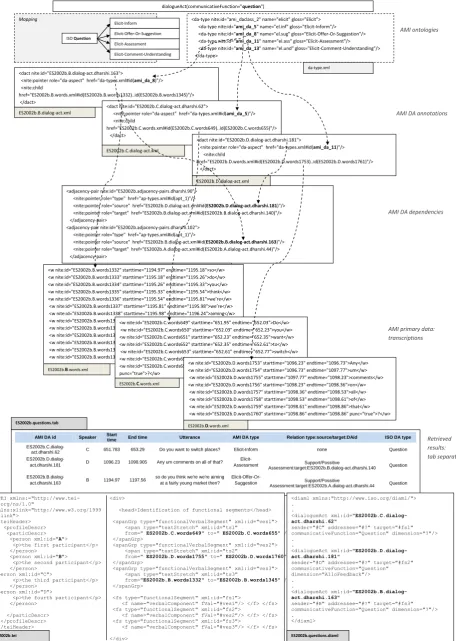
1 contains a concrete example of the use of DiAML.
4.2. Dialogue act information retrieval
AMI, HCRC MapTask and ISO 24617-2 annotations are in stand-off form, i.e. the representations are stored in separate files, linked to the primary data, typically
using separate files per dialogue and per speaker. If a
specific dialogue act (or type of dialogue act) is to be retrieved, we go through multiple annotation files and collect the relevant information. For example, to extract all instances of Question acts in AMI corpus data, the query will be searching for matches for the tags Elicit Inform,
Elicit-Assessment, Elicit-Comment-Understanding and
Elicit-Offer-or-Suggestion. Figure 1 illustrates the query
processing and the retrieval workflow. The dialogue
act types da-type are specified in AMI ontology files
(da-type.xml for dialogue acts) where the unique identifier
that is the value of @nite:id is assigned to each of
them, e.g. ami da 5 for Elicit-Inform, ami da 8 for
Elicit-Offer-or-Suggestion, etc. Having this
informa-tion, we search the dialogue act annotation files, e.g. ES2002b.B.dialogue-act.xml, where ES2002 is a meeting id, b means that it was the second dialogue with these participants, B stands for the speaker who plays the
project leader role). Each dialogue act has a unique
@nite:ididentifier as well, which helps to find all other information in AMI data that points to this dialogue act, e.g. adjacency pairs. We collect the primary data that the
annotation is attached to. Each identified<dact>element
is linked to words produced by the corresponding speaker. The start and end words are indicated, for example, as
href="ES2002b.D.words.xml#id(ES2002b.D. words1753)..id(ES2002b.D.words1761)". Since we know that AMI does not allow dialogue segments to be discontinuous, we compile the wording of the corresponding utterance by taking every word between start and end token including the former and the later ones, e.g. ‘Any um comments on all of that?’ for the example in
Fig. 1. Each word element<w>in the transcription files
has@starttimeand@endtimeas attributes. The start time of the first token and the end time of the last token of the corresponding dialogue act are then used to compute the utterance time stamps. The figure also shows how the metadata and the primary data can be represented in TEI format and the dialogue act annotation in DiAML.
Some annotations in AMI bypass dialogue act annotations, e.g. rhetorical relation for argumentation structure, disflu-encies, etc., and are attached directly to the primary data. To retrieve this information, the workflow would be slightly different. For instance, we need to start with those
annota-tion files, e.g. ES2002a.A.argumentstructs.xml
with a word span as @nite:child. Subsequently, we
check whether the same word segments are marked for di-alogue acts, and compute rhetorical relations between the identified dialogue acts.
DiAML query for Percentage of instances retrieved per query
Table 3:Retrieval performance on HCRC MapTask data.
There are at least two possible ways of query existing an-notated corpora using DiAML. One way is to transform corpora which are in XML format into DiAML compliant format, and subsequently query these data using XQuery or XPath designed to query XML data. For example, the XPath query to retrieve all Questions from the AMI data would be:
(1) /AMI-data/*.diaml/ dialogueAct/
[communicativeFunction="question"]
or XQuery
(2) for $x in doc("*.diaml)/AMI-data where
$x/communicativeFunction="question" order by $x/starttime
return $x/dialogueAct
To define a query in the ways shown above, knowledge of the corpus specific annotation scheme and its translation into ISO 24671-2, as well as of DiAML structure is re-quired.
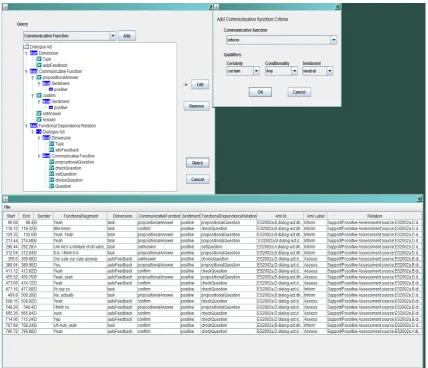
The second approach is to define a DiAML query format and provided a good (100% can not be achieved) mapping to ISO 24617-2 exists can be directly used to retrieve de-sired information from annotated data. Both approaches are valid. The first one presents a standard way of query-ing XML data. The second approach is a more straightfor-ward and flexible way of DiAML oriented querying of dia-logue act annotated data. Since it closely relates to DiAML specification, there is no need to know details of different annotation schemes and their annotation formats. For the DiAML-oriented querying we designed an interface pre-sented in Figure 2.
5.
Results and their validation
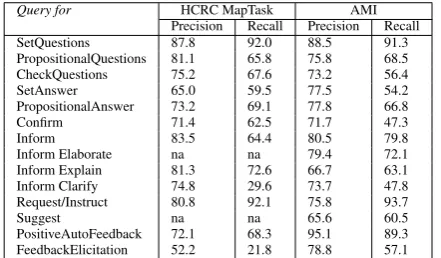
Table 3 presents the retrieval results when querying HCRC MapTask and AMI corpora (per ISO functional tag) in terms of relative frequency in the given corpus data. The results have been evaluated in terms of precision and recall. While precision is the fraction of retrieved instances (i.e. utterances with the queried tag) that are relevant to the query and indicates the correctness of the retrieved results, recall is the fraction of the instances that are relevant to the query that are successfully retrieved and indicates the completeness of the retrieved results (i.e. the lower recall the more relevant instances are missed by the query). For this, we compared the retrieved results for each dialogue act
Query for HCRC MapTask AMI
Precision Recall Precision Recall SetQuestions 87.8 92.0 88.5 91.3 PropositionalQuestions 81.1 65.8 75.8 68.5 CheckQuestions 75.2 67.6 73.2 56.4
SetAnswer 65.0 59.5 77.5 54.2
PropositionalAnswer 73.2 69.1 77.8 66.8
Confirm 71.4 62.5 71.7 47.3
Inform 83.5 64.4 80.5 79.8
Inform Elaborate na na 79.4 72.1 Inform Explain 81.3 72.6 66.7 63.1 Inform Clarify 74.8 29.6 73.7 47.8 Request/Instruct 80.8 92.1 75.8 93.7
Suggest na na 65.6 60.5
PositiveAutoFeedback 72.1 68.3 95.1 89.3 FeedbackElicitation 52.2 21.8 78.8 57.1
Table 4: Retrieval performance for HCRC MapTask and AMI
data per query.
type with manually produced reference annotations. Table 4 presents the evaluation results for HCRC MapTask and AMI data for each ISO dialogue act type occurring in the corpus data.
The results show reasonably high precision and recall for all types of dialogue acts, except for Feedback Elicitation utterances in case of HCRC MapTask corpus which can-not be easy mapped. Such utterances correspond to most of HCRC MapTask ‘aligns’ and ‘ready’ utterances, and sometimes to ‘query-w’ and ‘query-yn’ utterances, where no clear-cut distinction can be made without taking more complex dialogue properties into account (e.g. larger dia-logue history in combination with the wording of diadia-logue contributions from the left context, where the latter was ig-nored in the experiments reported here).
6.
Conclusions and Outlook
In this paper we briefly discussed three approaches to in-teroperability of annotated dialogue corpora (1) creation of new annotated corpora using ISO 24617-2; (2) conversion of existing annotated data into annotations that are compat-ible with the ISO standard; and (3) development of a query format for accessing existing annotated corpora through mapping to annotation language defined by the standard. We applied the third approach to two different dialogue corpora, annotated with different dialogue act annotation schemes. This demonstrates the portability of the approach. The used query format based on DiAML provides an attrac-tive solution, since it can be applied to query many different annotated dialogue resources provided a good mapping be-tween tagsets is achieved.
There are other annotated dialogue resources that are in-teresting to be added to the collection of interoperable re-sources. 18 existing dialogue act annotation schemes have been mapped to ISO 24617-2 (see informative Appendix F of the standard). For the most widely used schemes cor-pus data exists and new annotations based on variations of such schemes may be produced in the future. For instance, DAMSL with all its existing variants such as Coconut-DAMSL, SWBD-DAMSL and MRDA should be added to this pool. Moreover, dialogue resources for other languages than English should be explored.
7.
References
Figure 2:Interface for DiAML-based querying of annotated dialogue corpus (example on AMI data).
building a conversational planning agent. TRAINS
Tech-nical Note 94-3. University of Rochester.
Alexandersson, J., et al. 1998 Dialogue acts in
Verbmobil-2. Second edition. Report 226. DFKI Saarbr¨ucken,
Uni-versity of Stuttgart; TU Berlin; UniUni-versity of Saarland.
AMI-Consortium 2005 Guidelines for Dialogue Act and
Addressee Annotation Version 1.0, available at http:
//www.amiproject.org/
Blache, P., Bertrand, R.m and Ferr, G. 2009. Creating and Exploiting Multimodal Annotated Corpora: The ToMA Project. In Multimodal Corpora, Springer-Verlag.
Bunt,H., 2009 The DIT++ taxonomy for functional
dia-logue markup. In Proceedings of AAMAS 2009 Work-shop “Towards a Standard Markup Language for Embod-ied Dialogue Acts”, Budapest.
Bunt,H., Fang, A., Cao, J., Liu, X., and Petukhova, V. 2013 Issues in the addition of ISO standard annotations
to the Switchboard corpus. In Proceedings 9th Joint
ISO-ACLWorkshop on Interoperable Semantic
Annota-tion (ISA-9), Potsdam.
Calhoun, S., Carletta, J., Brenier, J., Mayo, N., Jurafsky, D., Steedman, M. and Beaver, D. 2010 The NXT-format Switchboard Corpus: A Rich Resource for Investigating the Syntax, Semantics, Pragmatics and Prosody of
Dia-logue. Language Resources and Evaluation44(4),
387-419.
Carletta, J. C., Isard, A., Isard, S., Kowtko, J.,
Doherty-Sneddon, G. and Anderson, A. 1996 HCRC Dialogue
Structure Coding Manual. Human Communication
Re-search Centre HCRC TR-82, University of Edinburgh. Cohen, J. 1960 A coefficient of agreement for
nomi-nal scales. Education and Psychological Measurement
20:37.
Di Eugenio, B. Jordan, P.W., and Pylkkaenen, L. 1998 The
COCONUT project: dialogue annotation manual. ISP
Technical Report 98-1.
Fang, A., Cao, J., Bunt, H., and Liu, X. 2012 The anno-tation of the Switchboard corpus with the new ISO
stan-dard for Dialogue Act Analysis. InProceedings 8th Joint
ISO-ACL Workshop on Interoperable Semantic
Annota-tion (ISA-8), Pisa.
Grice, M. and Savino, M. 2003 Map Tasks in Italian: Ask-ing Questions about Given, Accessible and New
Infor-mation. Catalan Journal of Linguistics, 2, pp. 153-180.
Jurafsky, D., Schriberg, E., and Biasca, D. 1997
Switch-board SWBD-DAMSL Shallow-Discourse-Function
An-notation: Coders Manual, Draft 13. University of
Col-orado.
ISO. 2012 Language resource management – Semantic
24617-2, Geneva, ISO, Geneva.
Klein, M., et al. 1998 Supported Coding Schemes. MATE
Deliverable D1.1