Numerical simulation and FRAP experiments show
that the plasma membrane binding protein PH-EFA6
does not exhibit anomalous sub-diffusion in cells.
Cyril Favard1,∗ ID
1 Membrane Domains and Viral Assembly, IRIM, UMR 9004 CNRS - Université Montpellier, 1919, route de Mende, 34 000 Montpellier, France; [email protected]
* Correspondence: [email protected]
Abstract:FRAP technique have been used for decades to measure movements of molecules in 2D. Data obtained by FRAP experiments in cell plasma membranes are assumed to be described through means of two parameters, a diffusion coefficient D (as defined in a pure Brownian model) and a mobile fraction M. Nevertheless, it has also been shown that recoveries can be nicely fit using anomalous sub-diffusion. FRAP at variable radii has been developed using the Brownian diffusion model to access geometrical characteristics of the surrounding landscape of the molecule. Here we performed numerical simulations of continuous time random walk (CTRW) anomalous subdiffusion and interpreted them in the context of variable radii FRAP. These simulations were compared to experimental data obtained at variable radii on living cells using the PH domain of the membrane binding protein EFA6 (exchange factor for ARF6, a small G protein). This protein domain is an excellent candidate to explore the structure of the interface between cytosol and plasma membrane in cells. By direct comparison of our numerical simulations to the experiments, we show that this protein does not exhibit anomalous diffusion in BHK cells. The non Brownian PH-EFA6 dynamics observed here is more related to spatial heterogeneities such as cytoskeleton fences effects.
Keywords:Anomalous diffusion; FRAP; Numerical Simulations; PH - Domain, Membrane Binding
1. Introduction
16
Early models of the plasma membrane, notably the fluid mosaic model [1] postulated that
17
transmembrane proteins were freely diffusing in a sea of lipids. During these two last decades, it
18
has become apparent that cell surface membranes are far from being homogeneous mixture of their
19
lipid and protein components. They are compartmented into domains whose composition, physical
20
properties and function are different. Numerous studies on transmembrane proteins and plasma
21
membrane lipids by means of single particle tracking (SPT), Fluorescence Correlation Spectroscopy
22
(FCS) or fluorescence recovery after photobleaching (FRAP) has shown the existence of micrometer and
23
nanometer size domains on both model membrane [2,3] and living cells[4–6]. In the plasma membrane
24
of living cells, these domains can come from different origins, but are generally classified into two
25
main groups :
26
• "rafts" model where lipid/lipid phase separation drives the lateral partitioning of transmembrane
27
proteins. [7]
28
• "cytoskeleton fence" model in which transmembrane proteins are coralled by a fence of
29
cytoskeleton just beneath the plasma membrane. [8,9]
30
Variable radii FRAP first [5,6], then spot variation FCS [10–12] helped in discriminate amongst
31
these two models the nature of the deviation to pure Brownian diffusion of membrane components in
32
living cells.
33
FRAP experiments have been used for determination of long-range molecular diffusion of proteins
34
and lipids on both model system and cells for more than 30 years [13,14]. Briefly, fluorescently labelled
35
molecules localized within a predefined area are irreversibly photo-destructed by a short and intense
36
laser pulse. The recovery of the fluorescence in this area is then measured against time. Since
37
no reversible photoreaction occurs, recovery of the fluorescence in the photobleached area is due
38
to diffusion. FRAP data are generally interpreted by assuming classical Brownian diffusion. Two
39
parameters can then be obtained : D, the lateral diffusion coefficient and M, the mobile fraction of the
40
diffusing molecule. When the radius of the photobleached area is small compared to the diffusion area,
41
M must be equal to 1 for freely diffusing species. In fact, most of the data reported so far in biological
42
membranes for transmembrane proteins shows a value of M < 1. This lack in total fluorescence
43
recovery can be interpreted as a restriction to free-diffusion behaviour. Parameters obtained have then
44
to be re-evaluated to recognize the effect of time-dependent interactions in a field of random energy
45
barriers.
46
An experimental approach to that question has been proposed by Federet al.[15] by introducing
47
anomalous (sub)diffusion in the motion of transmembrane proteins. Many sources of motion restriction
48
can lead to anomalous diffusion (for review see [16] and [17]. Saxton has performed extensive
49
numerical simulations to help in identifying the sources of anomalous diffusion (obstacles, binding...)
50
using SPT measurements [18,19] and he declined this more recently to FRAP experiments [20] using
51
fractional Brownian motion (fBm) or continuous time random walk (CTRW) models as sources of
52
anomalous diffusion.
53
Membrane bound proteins should also be submitted to several interactions with their surrounding
54
environment that should account for an anomalous subdiffusion behaviour. Sources of deviation from
55
Brownian motion in their lateral diffusion may include lipid domains trapping, binding to immobile
56
proteins and/or obstruction by cytoskeletal elements. This different possible interactions can exhibit
57
different characteristic times, or different distributions of characteristic times. Here, diffusion of an
58
intracellular membrane-bound protein domain (pleckstrin homology domain of EFA6, the ARF6
59
exchange factor) has been analysed inside living cells by FRAP experiments. Previous studies have
60
shown that these proteins are linked to the polar head ofPI(4, 5)P2lipids by means of electrostatic
61
interactions[21]. Furthermore, the protein used in this study appears to have a functional requirement
62
to be associated to the plasma membrane within cells [22,23]
63
In this paper, numerical simulation of the CTRW model of anomalous sub-diffusion were first
64
performed at a single spot size. Based on the quality of the fit using different analytical expression,
65
we tested the ability to retrieve this anomalous diffusion in the simulated recovery curves first and in
66
the experimental one afterwards. We showed that performing FRAP experiments at a single spot size
67
did not allow to discriminate between the CTRW induced anomalous diffusion case and the empirical
68
classical approach using mobile and immobile fraction.
69
We then computed and performed experimental FRAP at variable radii. By plotting changes in
70
the anomality of the diffusion or in the mobile fraction as a function of the inverse of the bleached
71
radius, as in Saloméet al.[5] we showed that it was possible to discriminate between the two models.
72
Interestingly we observed that the restriction to the mobility of the PH-EFA6 domain is not due to
73
CTRW anomalous sub diffusion, but more certainly to the sub cortical actin fences.
2.1. Anomalous sub-diffusion Modeling
A way to describe the continuous time random walk sub-diffusion is to start from a two dimensional random diffusion process. A particle walks from trap to trap and spend a certain (random) time in each trap. It is characterized by the following operation :
r→r+∆;t→t+τ (1)
randtare respectively the two dimensional position and the age of the particle, where∆is a two
77
dimensional random (Gaussian) variable with variancev=2D, andτis the (random) time the particle
78
spend into the trap.
79
In our model, the particle is supposed to diffuse very rapidly between two traps. This travel time
80
is therefore neglected (this, because it was not experimentally accessible). The timeτthe particle stays
81
in a trap is supposed to have very strong fluctuations, this give rise to anomalous diffusion pattern.
82
As an example a generic distribution is used which leads, after a while, to a standard Levy law in time :
P0(τ) = α
(1+τ)α+1 (2)
This distribution have been used in the same type of context by Naggle [24].
83
The Levy exponentαis the characteristic exponent of subdiffusive behaviour. For long times we
have :
<r2(t)>∝tα (3)
Whenα<1 a spatio-temporal Fourier (Laplace) analysis leads to the following asymptotic (ω,k
84
→0) Green function :
85
˜
g(k,ω) = 1
ω(Dαk2ω−α+1)
;Dα=D/Γ(1−α) (4)
whereωandkare respectively the conjugate variables of positionrand timet, wherek=|k|.
86
Notice that the solution of the inverse Laplace transform is a function of the variablek2tα. It follows
87
that the Green function is a function of the variablex=r2/tα. Whenxis high enough one can perform
88
an approximate inverse transformation via a saddle point method :
89
g(r,t) ∝ exp(−cst xν) ; ν= 1
2−α, cst: a known constant (5)
Notice that the exponent ν interpolate nicely between the gaussian case (α = 1) and the
exponential case. The general solution of this type of anomalous diffusion process is then :
ρ(r,t) = Z
ρ0(r0−r)g(x(r0,t))d2r0 (6)
whereρis the probability density to find the particle at the pointrat instanttandρ0is the initial
90
state.
91
As the Green function is a bell-shaped fast decreasing function, one approximate it by a Gaussian
92
shape with the exact dispersion,Dα = Dsin(πα)/(πα), which can be calculated from eq.4. This
93
permits to construct an analytical expression of the fluorescence recovery using standard properties of
94
Gaussian functions.
95
Starting from Axelrod [13] initial density as it is immediately after a Gaussian laser beam profile extinction indeed :
ρ0(r) =exp(−Kexp(−2
r2
(K=photobleaching constant, depending on experimental conditions [13]) and using the standard
96
properties of the Gaussian shape in the convolution operation, one can obtain the time evolved result
97
as a series.
98
Once integrated upon a disk of radiusR, and, after normalization to the surface of the disk, one
99
obtain the FRAP signal :
100
IR(t) = 1+
∞
∑
1
(−K)n n!
1 2n
1−exp
− 2nR
2
R2+4nD
αtα
(8)
This function will be used to fit experimental data.
101 102
Systematic corrections of this procedure are determined using numerical Monte-Carlo simulations
103
of the fluorescence recoveries, using knownαandD=Dα
(πα)
sin(πα)
104
In order to keep in our calculation the finite size effects, the simulation were made in a ring of a
105
radius of 30 arbitrary unit (a.u.) length explored by 107particles for each recovery. Radii varying from
106
0.5 to 3 a.u. were photo-destructed during the simulation. Reflective type of boundary conditions
107
were used. This means that when a particle gets out of the 30 a.u. radius it is re-introduced in the
108
same direction at a small distance of the boundary. See AppendixAfor examples of recovery curves
109
generated numerically by this approach.
110
2.2. Validating numerical simulation and analytical models
111
In order to verify the validity of our analytical model, a set of numerically simulated recovery
112
curves using anomalous diffusion as a model has been fitted with equation8. Each parameter (αand
113
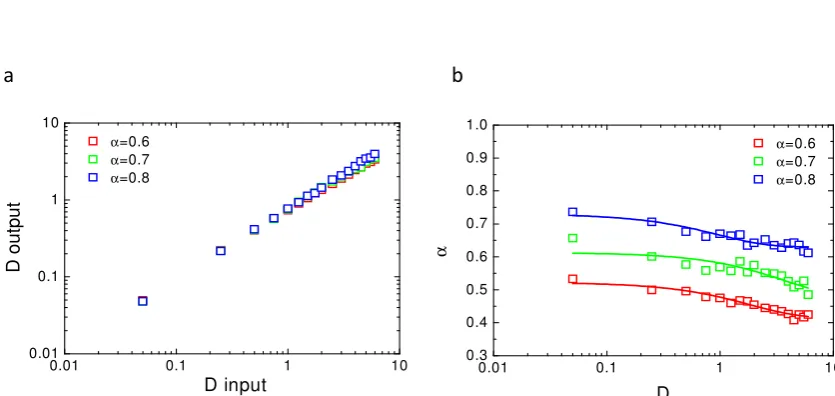
D) were tested. Figure1a shows the value ofDobtained after fit of the numerical (Doutput) simulation
114
using givenD(Dinput) for the three differentαtested above. Figure1b illustrates the variation of fitted
115
αas a function ofDused in the simulation, forα=0.6 (red);α=0.7 (green);α=0.8 (blue). This clearly
116
shows that both parameters (α,D) are always underestimated when fitting with an analytical model
117
the numerically simulated fluorescence recoveries.
0.01 0.1 1 10 0.01
0.1 1 10
α=0.6 α=0.7 α=0.8
D
o
u
tp
u
t
D input
a
b
0.01 0.1 1 10
0.3 0.4 0.5 0.6 0.7 0.8 0.9 1.0
α=0.6 α=0.7 α=0.8
α
D
Figure 1. Values of the parameters (D,α) obtained from the fit of the simulated recoveriesa- D values obtained after fit of the fluorescence recovery with eq.8(Doutput) as a function of D values used
in the numerical simulation (Dinput) for differentα. Note that the slope is always less than 1 b- Values
ofαobtained after fit of the simulated curves with eq.8for differentαused in the simulation and as a function of the D values used in the simulation. Note that the originalαvalue used in the simulation is never reached by fit of the simulated recoveries.
This is mainly due to the finite size and finite time effect of our numerical simulations and
119
paradoxically is also nicely mimicking what could occur experimentally in a finite size cell reservoir.
120
2.3. Challenging analytical models to identify numerically simulated anomalous diffusion fluorescence recoveries
121
Fluorescence recoveries have been numerically simulated using CTRW anomalous diffusion as
122
the model of molecular motion. These curves were then fitted with three different analytical expression
123
of FRAP recoveries, each being specific of a diffusion model :
124
• Anomalous diffusion motion (aDm): see eq.8in section2.1
125
• Free Brownian motion (Bm) :
126
IR(t) =
∞
∑
1
(−K)n n!
1 1+n+8nDt
R2
(9)
• Restricted Brownian motion (rBm) :
IR(t) = (1−M)1
−e−K
K +M
∞
∑
1
(−K)n n!
1
1+n+8nDtR2 (10)
where M accounts for the mobile fraction.
0.1 1 10 100 0.8 0.9 1 L o g (N o rm. F lu o . R e co v e ry)
Log t (s)
1 10 100 0.3 0.4 0.5 L o g (N o rm . F lu o . R e co ve ry)
Log t (s)
0 20 40 60 80 100
0.8 0.9 1.0 N o rma lize d F lu o re sce n ce R e co ve ry t(s)
0 20 40 60 80 100
0.3 0.4 0.5 N o rma lize d F lu o re sce n ce R e c o ve ry t(s)
a
b
c
d
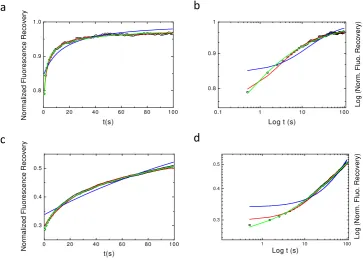
Figure 2. Best fits using the different models of Normal and Log-Log plots of simulated CTRW anomalous sub-diffusion recoveries.α=0.6 is the value used for the simulation in the four plots. In blue, Bm model (eq.9), in red rBM model (eq.10) and in green aDm (eq.8) fits. Ina & bD=2 and inc & dD=0.1.a & care the normal plots whileb & dare the log-log plots. From these graph it can be seen that one can hardly distinguish between the rBm model (red) and the aDm model (green) fits of the simulated recovery.
Figure2shows the obtained results for the three tested models (aDm in green, fBm in blue, rBm
128
in red) with two different values ofDαand withα=0.6. It can easily be seen that the fBm does not
129
fit to the curve, as expected, but surprisingly it can also be seen that aDm and RBm models fit quasi
130
equivalently the numerical simulation. Even log-log plot (Fig. 2b and d) hardly allows to directly
131
separate the two-models. Still log-log plots show that these models can be discriminated at short times
132
(t«τc,τcbeing the characteristic half-time of the recovery) and at very long times( t»τc).
133
2.4. Single spot FRAP does not allow to identify the nature of PH-EFA6 diffusion in cells.
134
FRAP experiments have been performed on 15 different BHK cells (3 recoveries per cells on
135
average) expressing the PH domain of EFA6 linked to the GFP. These data have been acquired at a
136
given radius using the 63x objective (see experimental section for explanation). EFA 6, an exchange
137
factor for ARF 6 (a small G protein) has recently been described as being located on the internal part of
138
the plasma membrane, with its PH domain responsible for the interaction with lipids [23].
0.1 1 10
0.5 1
L
o
g
(
N
o
rm
.
F
lu
o
.
R
e
c
o
v
e
ry
)
Log t(s)
0 20 40 60 80
0.0 0.2 0.4 0.6 0.8 1.0
N
o
rm
a
liz
e
d
F
lu
o
re
s
c
e
n
c
e
R
e
c
o
v
e
ry
t(s)
a
b
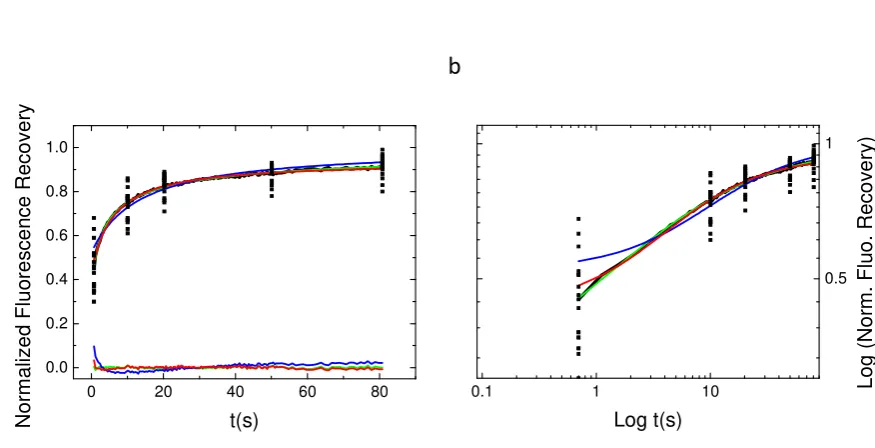
Figure 3. Average experimental recovery curve fitted by the three diffusion models. The three models (bM, rBm and aDm) were used to fit the average recovery curve obtained from 45 different experiments. The normal (parta) plot shows the residual from the fit of the different models. Note that only the bM model fit is inaccurate. The Log-Log plot (partb) illustrate again the difficulty to discriminate between the aDm and the rBm model in the goodness of the fit.
Figure3shows the average fluorescence recovery (black line, mean of the 45 recoveries) as well as
140
some points extracted from of the 45 different recoveries in order to illustrate the discrepancy observed
141
when working with cells. This mean fluorescence recovery has been fitted by the three different models
142
used in the previous section. On the bottom of Fig.3a is depicted the differences between the fit and the
143
observed fluorescence (Ff−Fo) in order to illustrate the quality of the fit. From figure3a (normal plot)
144
and figure3b (log-log plot) it can easily be seen that except for the free Brownian motion model(Bm),
145
the nature of the diffusion of PH-EFA6 cannot be discriminated between restricted Brownian motion
146
(rBm) and anomalous diffusion (aDm). This is confirmed by aχ2statistical test to probe the quality
147
of the fit as shown in table1. Table1also summarized the average values of the set of parameters
148
(D,M,Dα,α) that can be extracted from the different fits.
149
Table 1.Parameters values obtained by the fit of the average experimental recovery with the different analytical models
Model D(µm.s−1) M α Dα(µm.s−α) χ2
Bm 0.12±0.06 1 - - 5.7±0.5
rBm 0.22±0.01 0.92±0.01 - - 3.8±1.6
aDm - - 0.65±0.02 1.48±0.05 2.9±1.6
2.5. Variable radii FRAP allows correct estimation of the anomalous sub-diffusion exponentα
150
Previous results using direct analysis on both numerically simulated recoveries and experimental
151
recoveries clearly showed that : i) ParametersαandDα) of the aDm model were always underestimated
152
ii) aDm and rBm models could only be discriminated at short and long times. Nevertheless, since time
153
and space are correlated in diffusion and since experimental time-scale is finite, variable radii FRAP
154
experiments were firstly numerically simulated and performed after on cells (see experimental section
for explanation). Each parameter (αandDα) were estimated again, by fitting simulated recoveries at
156
different radius (see Monte-Carlo simulation section for explanation) with our analytical model (eq.8).
157
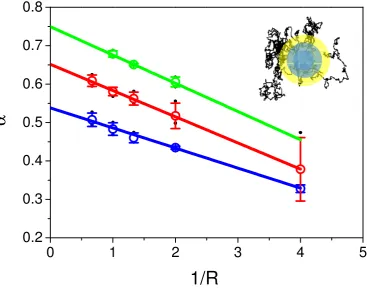
Figure4shows the behaviour of fitted a as a function of 1/R. Theory of anomalous diffusion processes
158
predicts that a is space-invariant in a “homogeneously heterogeneous” environment. It can be directly
159
seen on the plot that this is not what our data suggest, but on the opposite they showed that a linear
160
dependence ofαas a function of 1/R (at least for R > 1 a.u.) with a negative slope is observed for the
161
three tested values of a (α=0.6 in blue,α=0.7 in green,α=0.8 in red). Intercept of this linear regression
162
(R→∞) leads to values closed to the inputαin the numerical simulation.
163
0
1
2
3
4
5
0.2
0.3
0.4
0.5
0.6
0.7
0.8
α
1/R
Figure 4. Values ofαobtained from the fit of CTRW simulated recoveries as a function of1/R. Values ofαintroduced in the fit were respectively 0.6 (in blue), 0.7 (in red), 0.8 (in green). Dots represent the mean±s.d. values ofαobtained with the fit using eq. 8of simulated recoveries for a set of D values (0.01, 0.05, 0.1, 0.5, 1, 2, 3, black dots in the graph). Extrapolation at 1/R=0 of the linear fit of the differental phaobtained from the fits of recoveries at different radius givesal phavalues close to the one used for the simulations.
Similar results were obtained when plottingDfitted as a function of 1/R . Therefore, in order to
164
test the hypothesis thatαandDcould be correctly determined by performing linear regressions of
165
fitted values of both parameters as a function of 1/R, a set of numerical simulation were performed
166
using differentD,αand R. Values ofαandDat 1/R=0 intercepts are resumed in Appendix fig.A2.
167
Fig.A2a andA2b show that, except for few values, when using this approach,αandDcan be estimated
168
with an error of less than 5 % of their real values. With regards to the discrepancy of the experiments
169
on cells, this uncertainty seems enough accurate for correct determination of both parameters in case
170
of anomalous diffusion processes using variable radii.
domains in cells [5]. They found both by numerical simulation and by experimental approaches that
174
fitting recovery curves using the rBm model lead to a linear regression of the mobile fraction (M) as a
175
function of 1/R with a positive slope. In this study our results show that the same approach is valid
176
with aDm model and that plotting of a as a function of 1/R led to a linear regression with a negative
177
slope. Therefore several experiments (n<30) has been performed on cells expressing the PH domain
178
of EFA6 at variable radii of photodestruction. Experimental recoveries were fitted with both models
179
(aDm and fBm).
180
0 1 2 3 4 5
0.2 0.3 0.4 0.5 0.6 0.7 0.8
α
1/R (µm
-1)
0 1 2 3 4 5
0.6 0.7 0.8 0.9 1.0
M
ob
ile
F
rac
ti
o
n
(M
)
1/R (µm
-1)
a
b
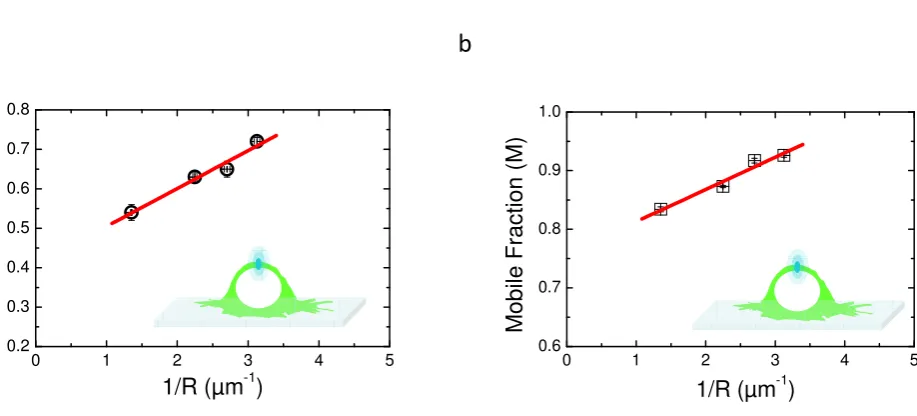
Figure 5. Comparison of the two models aDm and rBm using vrFRAP in the case of PH-EFA6 diffusion at the plasma membrane of BHK cells a: Plot of α values obtained by fitting the experimental recoveries with eq.8as a function of 1/R. The plot exhibit a positive slot in opposite to the one observed in Fig.4, suggesting an absence of a CTRW anomalous sub-diffusion in the motion of PH-EFA6.b: Plot of M value obtained by fitting the experimental recoveries with eq.10as a function of 1/R. The plot exhibit a positive slope as obsreved in [25] and [5], suggesting a diffusion with trapping in spatial domains.
Figure5shows the behaviour of the characteristic parameters of each model (αfor aDM and M for
181
rBm) as a function of 1/R. In Fig.5a is depicted the linear dependence of experimentalαas a function
182
of 1/R. This results clearly show a positive slope for the regression, suggesting that the aDm model is
183
not the correct model for the analysis of diffusion in the case of PH-EFA6 in this experimental time and
184
length scale. On the opposite, Fig.5b, where M is plotted as a function of 1/R clearly shows a positive
185
slope as already observed in Salomé’s work [5]. This shows that, in the case of PH-EFA6 diffusion at
186
the plasma membrane of BHK cells, the rBm is the more appropriate model to describe the restriction
187
of diffusion observed in FRAP experiments.
Schramet al.empiricaly determined a relationship between the size of the trapping domains (L) and the variation of the mobile fraction (M) [25] :
M=Mp+0.63.L
R ;L<R (11)
Using eq.11, we could determine that 75% of PH-EFA6 molecules exhibit free diffusion while the
189
25 % left are confined in domains of approximately 90 nm radius.
190
3. Discussion
191
This work has been initiated to characterize the nature of the diffusion of molecules binding
192
the inner leaflet of the cell plasma membranes by means of FRAP experiments. In a first attempt,
193
we decided to compare experimental data obtained with the PH domain of EFA6 expressed in BHK
194
cells to FRAP curves generated from anomalous sub-diffusive particles numerically simulated. Then,
195
we analyzed the recoveries with three different diffusion models, namely the pure Brownian motion
196
(Bm), the restricted Brownian motion (rBm) and the CTRW anomalous subdiffusion (aDm). Four
197
parameters can be extracted from these diffusion models. The Brownian diffusion coefficientDand
198
the mobile fraction M (M=1 in the case of Bm) on one side, and the anomalous subdiffusion exponent
199
αand its related anomalous diffusion coefficent Dα on the other side. The aDm model has been
200
extensively studied by numerical simulations. Direct analysis of numerically simulated curves lead to
201
an underestimation ofDαandα. This was already observed by Federet al.whom proposed, in order to
202
circumvent this underestimation, to add a mobile fraction (M) as a new parameter [15]. On a physical
203
point of view this is incorrect since the phenomenological parameter “mobile fraction” is indeed a part
204
ofαas discussed by Nagleet al.[24]. This underestimation ofDαandαis mainly due to finite size effect
205
(space and time) that cannot be easily overcome neither in simulations nor in experiments. We directly
206
tested for anomalous sub-diffusion in the simulated and experimental curves by fitting the recovery
207
curves with normal and anomalous equations and look for systematic deviations of the fit, both in
208
linear plots to see the fit at large times and log-log plots to see the fit at short times. From this approach
209
we could see that the Bm can be immediately discarded. The difference between the aDm and the fBm
210
could only be observed at very short times (log-log plots) and very long times. Unfortunately, these
211
two extrema times are hardly easy to analyse in experiments. Indeed, at short times the curve may be
212
distorted by diffusion during the bleach pulse [26] and limits in the frequency of data collection. At
213
long times, motion of the membrane or photobleaching of the fluorescent probe might appear. This is
214
illustrated here in our experimental data. Fits of single spot fluorescence recoveries did not allow to
215
determine without uncertainties which of the aDm or the rBm model reflect the nature of PH-EFA6
216
diffusion at the plasma membrane of BHK cells. Although underestimated, theαvalue we found here,
217
when fitting with the aDm model, reflect a strong deviation from the Brownian motion and suggest
218
that PH-EFA6 explores a strongly compartmentalized landscape while travelling at the inner leaflet of
219
the plasma membrane. Nevertheless, thisαvalue, as well as the M value in the case of the rBm model
220
are higher than the one found for IgE receptor transmembrane protein in RBL cells (α=0.46±0.22)
221
[15]. Using single particle tracking experiments, other transmembrane proteins such as MHC class I in
222
HeLa cells has also been shown to exhibit anomalous subdiffusion with anαvalue close to 0.5 [27]. On
223
the opposite, other transmembrane proteins exhibit highαvalues (α=0.8) (Kv2.1 potassium channel
224
in HEK293T cells [28]) or pure Brownian motion (MHC class II in CHO cells [29] or aquaporin-1 in
225
MDCK cells [30].
226
The inability of FRAP to cover several time decades as SPT or FCS techniques can be overcome
227
by probing the environment at different space scale using variable radii FRAP [5,6]. Here we have
228
simulated recoveries in the case of CTRW anomalous subdiffusion at different space scales and fit them
229
with the aDm model in order to extract the set of parameters (α,D). By monitoring the change of fitted
230
(α,D) parameters as a function of space (1/R) we observed that the fitted values ofαdecreased with
231
decreasing radius of observation. We showed that the correct values ofαandDcould be determined
anomalous subdiffusion is not the correct model to describe the motion of PH-EFA6 in BHK cells. On
236
the opposite, when monitoring the change of the mobile fraction obtained by fitting the experimental
237
recoveries with the rBm model, we observed the same tendency as the one described in [5] and [31], i.e.,
238
an increase of the mobile fraction with a decreasing radius. Using this approach, we could determine
239
that 25% of PH-EFA6 molecules are confined in domains of 90 nm radius.
240
CTRW is not the only source of anomalous sub-diffusion. The experimental increase ofαwith
241
decreasing radius can also be an apparent consequence of a cross over regime with two different
242
diffusion coefficient as it is described by the rBm model in this study. Using FCS experiments and
243
simulations at different radii of a two phases two component lipid mixtures at different temperature,
244
Favardet al. showed that changes in anomalous sub-diffusion exponentαcould nicely predict the
245
phase transitions temperatures but failed in determining the average size of domains coexisting in
246
the two-phases [2]. On the opposite by monitoring the change in diffusion regimes, they could nicely
247
determine the mean size of the gel-phase domains. If we extend this approach to oural phaplot as
248
a function of the probes radius, we see that the transition from anomalous sub-diffusion (α<1) to
249
normal diffusion (α=1) occurs at radius of 160 nm, i.e., not far from the values obtained with the rBm
250
model.
251
The range of domain sizes observed here (90 to 160 nm radius), independently of the model used
252
to describe the dynamics of PH-EFA6, is likely to be due to subcortical actin cytoskeleton. Equivalent
253
sizes has been observed in NRK cells [32] using electron microscopy, and recently in several cell lines,
254
by monitoring membrane lipids dynamics using STED-FCS [33]. Interestingly, Krapfet al.described
255
that this meshwork has a fractal dimension and could therefore lead to anomalous sub-diffusion [34].
256
Therefore, further investigations and numerical simulations using a meshwork with fractal dimension
257
as the origin of the anomalous sub-diffusion are likely to be conducted in order to understand the
258
origin of ourα= f(1/R)behaviour in our vrFRAP experiments.
259
In conclusion, by performing FRAP at variable radii, we found a way to discriminate CTRW
260
induces anomalous sub-diffusion from other restricted motion at the plasma membrane of living
261
cells. We also show that, while travelling at the inner leaflet of the plasma membrane, PH-EFA6 is not
262
stopped in various traps with different residence times but on the opposite is mainly freely diffusing
263
with on average 25% of the molecules confined in 90-160 nm radius open domains most probably due
264
to the actin cortical cytoskeleton.
265
4. Materials and Methods
266
4.1. Monte Carlo Simulation
267
In order to keep in our calculation the finite size effects, the simulation were made in a ring of
268
a radius of 30 arbitrary unit (a.u.) length explored by 106 particles for each run. Radii varying from
269
0.5 to 3 a.u. were photo-destructed. Reflective type of boundary conditions were used. This means
270
that when a particle gets out of the 30 a.u. radius it is re-introduced in the same direction at a small
271
distance of the boundary.
272
4.2. Cell culture and transfection
273
Baby hamster kidney cells (BHK) were grown on a coverslip in BHK-21 medium (Gibco-BRL),
274
containing 5% FCS, 10% Tryptose phosphate broth, 100U/ml penicillin, 100µg/ml stretomycin and
275
2mM L-Glutamine. Cells were transfected using Fugene 36 hours before the FRAP experiments with a
276
pC1EGFPPHEFA6 plasmid. Fugene containing medium was replaced 12 h before the experiments by
277
fresh medium. pC1EGFPPHEFA6 contains the sequence for both PH-EFA6 domain and EGFP as a
fluorescent label, linked to the N-terminus of the PH-EFA6 domain in order to avoid any perturbation
279
to the membrane linkage.
280
4.3. FRAP experiments
281
FRAP measurements were made with a commercially available confocal microscope, Leica
282
TCS-SP1 (Leica Microsystems, Germany). Prebleached images were firstly acquired to ensure for the
283
lack of photo-destruction during the observation. A brief laser pulse (200 ms) was then delivered to the
284
cell on a given and fixed position. Images were thereafter recorded at given intervals (440 ms) using a
285
spectral window for fluorescence emission between 500 and 600 nm. The intensity ratio between the
286
extinction laser beam and the monitoring laser beam was fixed to 106. Each fluorescence recovery was
287
recorded for 100 s at 25◦C, containing 150 experimental values (Recovery curve was sampled every
288
0.44 s in the beginning and 1 s in the end to avoid photobleaching during the monitoring). Focusing
289
the laser by the microscope objectives produced a Gaussian intensity distribution of the beam in the
290
object plane. This distribution was monitored using NBD-PC labelled DPPC multilamellar preparation
291
at 25◦C (T<Tm). Since no diffusion occurs at this temperature, the image obtained immediately after
292
the end of the bleaching pulse shows a "hole" in the fluorescent preparation that allow measurement of
293
the laser waist and determination of the intensity profile in the x,y plane. These measurements were
294
confirmed by the use of fluorescent beads with a maximum wavelength of emission at 500 nm [35].
295
The following values were obtained for the waist as a function of the objective used :
296
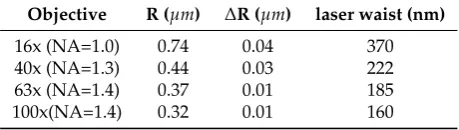
Table 2.Size of the different radius measured with the objectives used in this work.
Objective R (µm) ∆R (µm) laser waist (nm)
16x (NA=1.0) 0.74 0.04 370
40x (NA=1.3) 0.44 0.03 222
63x (NA=1.4) 0.37 0.01 185
100x(NA=1.4) 0.32 0.01 160
Funding:‘This research received no external funding”
297
Acknowledgments: Author would like to acknowledge M. Franco for the gift of the PH-EFA6 plamsid and
298
discussion. I am indebted to JL Meunier for the numerical simulations of the FRAP recoveries. The author
299
also thank A. Lopez and N. Olivi-Tran for fruitful discussions. THe author is a member of the IMABIO CNRS
300
consortium. Most of this work has been realized during the author stay at the IPMC CNRS UMR 7275.
301
Conflicts of Interest:“The authors declare no conflict of interest.”
302
Abbreviations
303
The following abbreviations are used in this manuscript:
304 305
FRAP Fluorescence Recovery After Photobleaching
vrFRAP variable radii Fluorescence Recovery After Photobleaching FCS Fluorescence Coreelation Spectroscopy
SPT Single Particle Tracking
CTRW Continuous-Time Random Walk aDm anomalous subdiffusion motion
Bm Brownian motion
rBm restricted Brownian motion
PH-EFA6 Pleckstrin Homology domain of Exchange Factor for ARF-6
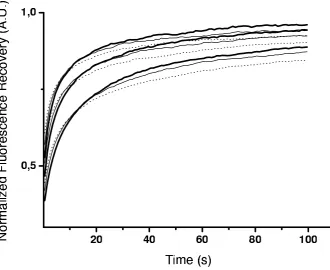
Figure A1. Monte-Carlo simulation of normalized fluorescence recoveries in the case of CTRW anomalous subdiffusion . Different values ofDandαhave been tested in the simulations. Here, values ofD=0.5; 1; 1.5 are represented from bottom to top with differentαin each case : 0.6 (dots) ; 0.7 (thin line) ; 0.8 (thick line). The Monte Carlo has been constructed with 107individual trajectories
Appendix A. Examples of Numerical Generated Fluorescence Recovery Curves
307
FigureA1depicts some fluorescence recovery curves obtained with our numerical simulations
308
for different D andαinserted in the simulation.
0.5 0.6 0.7 0.8 0.9 0.01
0.1 1 10
D=0.05 D=0.1 D=0.5 D=1 D=2 D=3
D(1
/R
=
0
)
(
R
2 .s
-α )
α
0.01 0.1 1 10
0.2 0.3 0.4 0.5 0.6 0.7 0.8 0.9
α=0.6
α=0.7
α=0.8
α (1
/R
=
0
)
D (R2.s-α)
a b
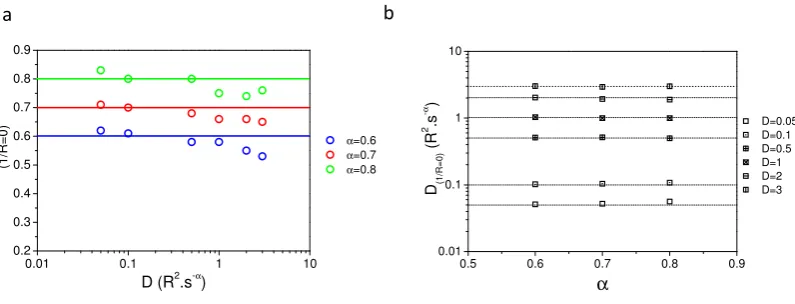
Figure A2. Values ofα(fig.A2a) andD(fig.A2b) at1/R=0intercepts.
Appendix B. Comparison of input and fitted D andαat variable radii
310
In figureA2are plotted values ofα(fig.A2a) andD(fig.A2b) at 1/R=0 intercepts. Fig.A2a
311
andA2b show that extrapolatedα(1/R=0)and extrapolatedD(1/R=0)are found to be with an error of
312
less than 5 % of their simulation inserted values.
175, 720–731. doi:10.1126/science.175.4023.720.
316
2. Favard, C.; Wenger, J.; Lenne, P.F.; Rigneault, H. FCS diffusion laws in two-phase lipid membranes:
317
determination of domain mean size by experiments and Monte Carlo simulations. Biophysical journal2011,
318
100, 1242–1251. doi:10.1016/j.bpj.2010.12.3738.
319
3. Hac, A.E.; Seeger, H.M.; Fidorra, M.; Heimburg, T. Diffusion in two-component lipid membranes–a
320
fluorescence correlation spectroscopy and monte carlo simulation study. Biophys. J.2005,88, 317–333.
321
doi:10.1529/biophysj.104.040444.
322
4. Edidin, M.; Kuo, S.C.; Sheetz, M.P. Lateral movements of membrane glycoproteins restricted by dynamic
323
cytoplasmic barriers. Science1991,254, 1379–1382. doi:10.1126/science.1835798.
324
5. Salomé, L.; Cazeils, J.L.; Lopez, A.; Tocanne, J.F. Characterization of membrane domains by frap
325
experiments at variable observation areas. Eur Biophys J1998,27, 391–402. doi:10.1007/s002490050146.
326
6. Yechiel, E.; Edidin, M. Micrometer-scale domains in fibroblast plasma membranes. The Journal of Cell
327
Biology1987,105, 755–760. doi:10.1083/jcb.105.2.755.
328
7. Lingwood, D.; Simons, K. Lipid rafts as a membrane-organizing principle. Science2010,327, 46–50.
329
doi:10.1126/science.1174621.
330
8. Kusumi, A.; Sako, Y.; Yamamoto, M. Confined lateral diffusion of membrane receptors as studied by single
331
particle tracking (nanovid microscopy). Effects of calcium-induced differentiation in cultured epithelial
332
cells. Biophysical Journal1993,65, 2021–2040. doi:10.1016/S0006-3495(93)81253-0.
333
9. Sako, Y.; Kusumi, A. Compartmentalized structure of the plasma membrane for receptor movements as
334
revealed by a nanometer-level motion analysis. J. Cell Biol.1994,125, 1251–1264.
335
10. Wawrezinieck, L.; Rigneault, H.; Marguet, D.; Lenne, P.F. Fluorescence correlation spectroscopy
336
diffusion laws to probe the submicron cell membrane organization. Biophys. J.2005,89, 4029–4042.
337
doi:10.1529/biophysj.105.067959.
338
11. Lenne, P.F.; Wawrezinieck, L.; Conchonaud, F.; Wurtz, O.; Boned, A.; Guo, X.J.; Rigneault, H.; He,
339
H.T.; Marguet, D. Dynamic molecular confinement in the plasma membrane by microdomains and the
340
cytoskeleton meshwork.EMBO J.2006,25, 3245–3256. doi:10.1038/sj.emboj.7601214.
341
12. Eggeling, C.; Ringemann, C.; Medda, R.; Schwarzmann, G.; Sandhoff, K.; Polyakova, S.; Belov, V.N.; Hein,
342
B.; von Middendorff, C.; Schönle, A.; Hell, S.W. Direct observation of the nanoscale dynamics of membrane
343
lipids in a living cell. Nature2009,457, 1159–1162. doi:10.1038/nature07596.
344
13. Axelrod, D.; Koppel, D.E.; Schlessinger, J.; Elson, E.; Webb, W.W. Mobility measurement by
345
analysis of fluorescence photobleaching recovery kinetics. Biophysical Journal1976, 16, 1055–1069.
346
doi:10.1016/S0006-3495(76)85755-4.
347
14. Soumpasis, D.M. Theoretical analysis of fluorescence photobleaching recovery experiments. Biophysical
348
Journal1983,41, 95–97. doi:10.1016/S0006-3495(83)84410-5.
349
15. Feder, T.J.; Brust-Mascher, I.; Slattery, J.P.; Baird, B.; Webb, W.W. Constrained diffusion or
350
immobile fraction on cell surfaces: a new interpretation. Biophysical Journal 1996, 70, 2767–2773.
351
doi:10.1016/S0006-3495(96)79846-6.
352
16. Bouchaud, J.P.; Georges, A. Anomalous diffusion in disordered media: Statistical mechanisms, models and
353
physical applications.Physics Reports1990,195, 127–293. doi:10.1016/0370-1573(90)90099-N.
354
17. Hoefling, F.; Franosch, T. Anomalous transport in the crowded world of biological cells. Rep. Prog. Phys.
355
2013,76, 046602. WOS:000317032800007, doi:10.1088/0034-4885/76/4/046602.
356
18. Saxton, M.J. Anomalous diffusion due to obstacles: a Monte Carlo study. Biophysical Journal1994,
357
66, 394–401. doi:10.1016/S0006-3495(94)80789-1.
358
19. Saxton, M.J. Anomalous diffusion due to binding: a Monte Carlo study. Biophysical Journal1996,
359
70, 1250–1262. doi:10.1016/S0006-3495(96)79682-0.
360
20. Saxton, M.J. Anomalous Subdiffusion in Fluorescence Photobleaching Recovery: A Monte Carlo Study.
361
Biophysical Journal2001,81, 2226–2240. doi:10.1016/S0006-3495(01)75870-5.
362
21. Hyvönen, M.; Macias, M.J.; Nilges, M.; Oschkinat, H.; Saraste, M.; Wilmanns, M. Structure
363
of the binding site for inositol phosphates in a PH domain. The EMBO Journal, 14, 4676–4685.
364
doi:10.1002/j.1460-2075.1995.tb00149.x.
22. Franco, M.; Peters, P.J.; Boretto, J.; Donselaar, E.v.; Neri, A.; D’Souza-Schorey, C.; Chavrier, P. EFA6, a sec7
366
domain-containing exchange factor for ARF6, coordinates membrane recycling and actin cytoskeleton
367
organization.The EMBO Journal1999,18, 1480–1491. doi:10.1093/emboj/18.6.1480.
368
23. Macia, E.; Partisani, M.; Favard, C.; Mortier, E.; Zimmermann, P.; Carlier, M.F.; Gounon, P.; Luton, F.;
369
Franco, M. The pleckstrin homology domain of the Arf6-specific exchange factor EFA6 localizes to the
370
plasma membrane by interacting with phosphatidylinositol 4,5-bisphosphate and F-actin.The Journal of
371
biological chemistry2008,283, 19836–19844. doi:10.1074/jbc.M800781200.
372
24. Nagle, J.F. Long tail kinetics in biophysics? Biophysical Journal 1992, 63, 366–370.
373
doi:10.1016/S0006-3495(92)81602-8.
374
25. Schram, V.; Tocanne, J.F.; Lopez, A. Influence of obstacles on lipid lateral diffusion: computer simulation of
375
FRAP experiments and application to proteoliposomes and biomembranes.Eur Biophys J1994,23, 337–348.
376
doi:10.1007/BF00188657.
377
26. Waharte, F.; Brown, C.M.; Coscoy, S.; Coudrier, E.; Amblard, F. A two-photon FRAP analysis of
378
the cytoskeleton dynamics in the microvilli of intestinal cells. Biophys. J. 2005, 88, 1467–1478.
379
doi:10.1529/biophysj.104.049619.
380
27. Smith, P.R.; Morrison, I.E.; Wilson, K.M.; Fernández, N.; Cherry, R.J. Anomalous diffusion of major
381
histocompatibility complex class I molecules on HeLa cells determined by single particle tracking. Biophys.
382
J.1999,76, 3331–3344. doi:10.1016/S0006-3495(99)77486-2.
383
28. Weigel, A.V.; Simon, B.; Tamkun, M.M.; Krapf, D. Ergodic and nonergodic processes coexist in the plasma
384
membrane as observed by single-molecule tracking. Proc. Natl. Acad. Sci. U.S.A.2011,108, 6438–6443.
385
doi:10.1073/pnas.1016325108.
386
29. Vrljic, M.; Nishimura, S.Y.; Brasselet, S.; Moerner, W.E.; McConnell, H.M. Translational diffusion
387
of individual class II MHC membrane proteins in cells. Biophys. J. 2002, 83, 2681–2692.
388
doi:10.1016/S0006-3495(02)75277-6.
389
30. Crane, J.M.; Verkman, A.S. Long-range nonanomalous diffusion of quantum dot-labeled aquaporin-1 water
390
channels in the cell plasma membrane. Biophys. J.2008,94, 702–713. doi:10.1529/biophysj.107.115121.
391
31. Baker, A.M.; Saulière, A.; Gaibelet, G.; Lagane, B.; Mazères, S.; Fourage, M.; Bachelerie, F.; Salomé, L.; Lopez,
392
A.; Dumas, F. CD4 interacts constitutively with multiple CCR5 at the plasma membrane of living cells. A
393
fluorescence recovery after photobleaching at variable radii approach. J. Biol. Chem.2007,282, 35163–35168.
394
doi:10.1074/jbc.M705617200.
395
32. Morone, N.; Fujiwara, T.; Murase, K.; Kasai, R.S.; Ike, H.; Yuasa, S.; Usukura, J.; Kusumi, A.
396
Three-dimensional reconstruction of the membrane skeleton at the plasma membrane interface by electron
397
tomography.J. Cell Biol.2006,174, 851–862. doi:10.1083/jcb.200606007.
398
33. Andrade, D.M.; Clausen, M.P.; Keller, J.; Mueller, V.; Wu, C.; Bear, J.E.; Hell, S.W.; Lagerholm, B.C.; Eggeling,
399
C. Cortical actin networks induce spatio-temporal confinement of phospholipids in the plasma membrane
400
– a minimally invasive investigation by STED-FCS.Scientific Reports2015,5, 11454. doi:10.1038/srep11454.
401
34. Sadegh, S.; Higgins, J.L.; Mannion, P.C.; Tamkun, M.M.; Krapf, D. Plasma Membrane is Compartmentalized
402
by a Self-Similar Cortical Actin Meshwork. Phys. Rev. X2017,7, 011031. doi:10.1103/PhysRevX.7.011031.
403
35. Schneider, M.B.; Webb, W.W. Measurement of submicron laser beam radii. Appl Opt1981,20, 1382–1388.