MENTAL MECHANISMS, CONTEXTUAL EFFECTS AND THE PROCESSING OF WORD-ATTRIBUTES
John Jessel PhD University of London Institute of Education
BIBL LONDIN.
ACKNOWLEDGEMENT
ABSTRACT
It is known that the presence of information related to, but not necessary
for the completion of a speeded experimental task can affect
performance. Previous studies involving such 'contextual' effects with
information in verbal and nonverbal form have produced mixed results
which have been attributed to differing underlying processing
mechanisms. The present work examines the extent to which some
possible mechanisms could, in common, account for within- and
cross-modality contextual effects. 'Priming' information relating to
typographic case was presented over time intervals varying up to
480 msec before, and up to 480 msec after, a target to which a speeded
category-decision was indicated by a left- or right-hand key-press.
Within-attribute' case-priming was effected using a letter string printed
either in upper- or lower-case (e.g., `dghej', or 'YFLRB') paired with a
similar target for case-decision. Within-attribute name-priming upon
name-decision was similarly achieved using the case-denoting words
`upper' and 'lower'. 'Cross-attribute' priming was possible through name
information priming case-decisions (e.g., `upper-YFLRB'), or, case
information priming name-decisions (e.g., 'YFLRB-upper'). The
combined effects of case- and name-priming upon case-decision were
also investigated using case-denoting words printed in either one or other
of the two typographic cases (e.g., `upper-yflrb', or `UPPER-yflrb').
Relatively short decision latencies accompanied by relatively low error
rates occurred when targets were preceded by congruent within-attribute
primes. Incongruent priming led to slower responses with higher error
rates. Similar effects were obtained with name-priming of case-decisions
although, in comparison to within-attribute priming, these occurred after
longer prime pre-exposures. Case-priming effects upon name-decisions
were obtained for simultaneous as well as pre-exposed primes, however,
decision latencies and higher error rates. Combined congruent case and
name information speeded case-decisions in comparison to congruent
case information alone. However the converse did not occur; increase in
case-decision latency with incongruent case and name information
combined was no greater than with incongruent case information alone.
It has been argued that the results are consistent with models which
propose that input is initially subject to encoding where 'activation' may
spread automatically among interconnected verbal or nonverbal
representations. In particular, this could partly account for speeded
responses obtained with congruent primes. Relatively shorter decision
latencies can also be attributed to subsequent decision processes and the
generation of responses. The results also suggest that relatively longer
latencies could arise from competing incompatible responses having to
be suppressed. It has been further argued that relative speed of processing
different stimulus attributes and the form of experimental task can be
CONTENTS
ABSTRACT 3
CHAPTER 1
11INTRODUCTION AND HISTORICAL OVERVIEW 11
MECHANISMS AND MODELS 17
Early processing and the notion of levels 17
Pandemonium 21
Mary's model of object recognition 21
Models concerned specifically with word-recognition 23
Letter mediation 23
Phonological mediation 25
Access to lexical entries 26
Parallel coding systems models 26
Lexical instance models 27
Logogen models 28
Lexical search models and verification models 29
Spreading-activation 30
Semantic networks 31
Schema theory 33
Parallel distributed processing 34
The Interactive Activation Model 36
McClelland's model 38
The modular nature of mental processing 42
Word and picture processing 45
Single-encoding 47
The Sensory-Semantic Model of picture and word-encoding 49
Dual-coding 52
Analogue versus propositional representations 55
Mental mechanisms: Some main themes 56
INVESTIGATING MENTAL MECHANISMS 57
Priming 58
CHAPTER 2
62DEVELOPMENT OF RESEARCH IDEAS 62
CHAPTER 3
73PRIMING EFFECTS ARISING FROM THE PROCESSING OF VERBAL AND NONVERBAL ATTRIBUTES OF WORD
STIMULI 73
Automatic and attentional priming effects 74 Differentiating automatic and attentional priming effects 74 Time-course of automatic and attentional priming effects 78 Automatic and attentional semantic-priming effects 79
Discrete processing stages 86
Taylor's (1977) study 88
General and specific effects 89
Automatic and attentional effects 92
Locating automatic facilitation and inhibition 93
Reinterpreting Taylor's findings 97
CROSS-ATTRIBUTE PRIMING EFFECTS 103
S troop interference 104
The Stroop Effect as an example of a general phenomenon 106
Accounting for the Stroop effect 107
Early processing 107
Response-competition 108
Semantic-encoding 109
Processing macrostructures and Stroop interference 111 Single-encoding models and Stroop interference 112 Dual-coding models and S troop interference 114 Relative speed of processing different stimulus attributes 116
CHAPTER 4
129CASE-PRIMING EXPERIMENTS 129
GENERAL DESIGN CONSIDERATIONS 134
Individual letters or letter strings 134
Distinguishing between prime and target stimuli 134
The time-course of priming effects 135
Choice of subjects 136
Bias and practice effects 137
EXPERIMENT 1: Case-Priming of Case-Decision 138
PREDICTED PRIMING EFFECTS 139
Encoding effects 139
Responding effects 140
Resultant effects 141
Predicted time-course of encoding and responding effects 143 Other factors that may affect response latencies 144
Summary 144
METHOD 145
Apparatus and stimuli 145
Procedure 147
RESULTS 149
Response latencies 153
Error rates
Additional-subject data 155
DISCUSSION 156
General effect of the presence of a prime 156
Case-congruency effects 157
Facilitation and inhibition 159
EXPERIMENT 2: Name-Priming of Name-Decision 164
PREDICTED PRIMING EFFECTS 165
METHOD 167
Apparatus and stimuli 167
Procedure 167
RESULTS 168
Response latencies 168
Error rates 172
Additional-subject data 173
DISCUSSION 175
EXPERIMENT 3: Name-Priming of Case-Decision 178 Relationship between prime and target information 179
PREDICTED PRIMING EFFECTS 179
Encoding and responding effects 179
Predicted time-course of encoding and responding effects 180
Summary 183
METHOD 183
Apparatus and stimuli 183
Procedure 184
RESULTS 186
Response latencies 186
Error rates 189
Additional-subject data 191
EXPERIMENT 4: Case- and Name-Priming of Case-Decision 197
PREDICTED PRIMING EFFECTS 198
Encoding processes: Case- and name-priming effects combined 198 Encoding processes: Inter-attribute dominance effects 199
Responding processes 203
Resultant effects 205
METHOD 210
Apparatus and stimuli 210
Procedure 210
RESULTS 212
Response latencies 212
Error rates 219
Additional-subject data 222
DISCUSSION 224
General effect of the presence of a prime 224
Time-course of congruency effects 225
Facilitation and Inhibition 225
EXPERIMENT 5: Case-Priming of Name-Decision 232
PREDICTED PRIMING EFFECTS 232
Encoding effects 233
Responding effects 233
Predicted time-course of encoding and responding effects 234
METHOD 235
Apparatus and stimuli 235
Procedure 236
RESULTS 237
Response latencies 237
Error rates 241
Additional-subject data 243
DISCUSSION 244
CHAPTER 5
251GENERAL DISCUSSION 251
Summary of the main results 252
General observations 252
Comparison of case- and name-response latencies 253
Selective effects 253
Case priming of case-decision 253
Name priming of name-decision 255
Name priming of case-decision 256
Case and name priming of case-decision 256
Case priming of name-decision 257
PROCESSING MECHANISMS 258
Expectancy 258
Spreading activation 261
Decision making 267
Relative speed of processing and response competition 269 Processing mechanisms: A collective summary 275
WITHIN- AND CROSS-ATTRIBUTE PRIMING SIMILARITIES: THE PRESENT RESULTS AND OTHER WORK 280
Some concluding remarks 289
APPENDIX 1: The psychological refractory effect 290
APPENDIX 2: Alertness effects 295
APPENDIX 3: Additional-subject data 299
CHAPTER
INTRODUCTION AND HISTORICAL OVERVIEW
One of the concerns within psychology today is the nature of the mental
processes which underlie our perceptions and actions, and the nature of
the mechanisms which might support these processes. What lies within,
however, may also depend upon what lies without. In general our
environment provides a context within which we operate. That context
may be described in terms of what is presently around us or in terms of
past events. One way that we may attempt to discover the nature of what
lies within is to manipulate what lies without and then make inferences
on the basis of any effects that may be detected. This approach, of
course, is by no means new and most of the activities of psychologists
may be interpretable in terms of the study of contextual effects. It can
thus be argued that the study of contextual effects is potentially very
broad and before a focus is attempted some of the approaches that have
been adopted in the past to the description and investigation of context
and its effects will be briefly examined.
That the mind is an arena where past experiences may affect present and
succeeding experiences is a notion that has been with us at least since the
early Greek philosophers. For Aristotle the contents of the mind
consisted essentially of images derived from previous sensations; mental
organisation and functioning were considered to be largely determined
by the order in which those images were presented. One way in which
this was expressed was through a principle of 'association by contiguity'.
This principle could, for example, be used to account for the way that
one thought may arise from another and for the observation that items
previously presented together were more likely to be recalled together.
influential position in post-Renaissance philosophy with such figures as
Hobbes, Locke, Hartley and Brown providing modifications. For
example, Brown (c. 1820) expanded upon the theories available at the
time through considering the observation that while on one occasion a
bell may remind one, say, of a church service on another occasion it may
remind one of a farmyard. In order to explain the strength, life-span and
occurrence of such associations the concepts of frequency, recency and
vividness were applied.
Although association had accounted for many common mental
phenomena limitations in its explanatory potential were also evident. In
the mid nineteenth century it was noted by Bain that although on some
occasions experiences that had a degree of contiguity became associated
there were also occasions when association was not apparent. It appeared
that association was influenced by such factors as cause-effect, likeness
and difference. However for such influences to occur it could be argued
that some form of selectivity might operate prior to association. By the
end of the nineteenth century, then, the explanation of present
experiences in terms of past experiences had become complicated not
only by virtue of a variety of factors concerning the history or form of
their exposure but also because of the possibility of other mental
activities that had yet to be explored.
Although an associationist account of the mind remained dominant
within Western philosophy almost until the beginning of the twentieth
century any developments were bounded by a single method of study
that had been adopted. This method can also be traced back to Aristotle
who believed that while thoughts could be the material of science they
enjoyed a 'subjective' existence which was quite distinct from an
`objective' one. The mind was thus considered to be an entity which was
only capable of being studied introspectively rather than through external
observation. On this basis over the late nineteenth and early twentieth
centuries psychologists in the Wundtian tradition developed methods of
major limitation of this introspective approach was opined by
Galton (1883) who regarded the window on the mind afforded by the
mental experience of which we were conscious to be but a small one in a
vast array of automatic brain work. Galton, however, arrived at this
conclusion through the use of introspective techniques; other
experimental techniques which might have enabled him to explore new
areas were not available.
A method that was to supersede introspection emerged initially as a
result of what was essentially a contextual or priming effect arising
within the course of physiological work. In 1902 Pavlov, while studying
the salivary responses of dogs to food, noticed that if a dog saw a feeding
bowl or heard the sound of the footsteps of an attendant who would
normally deliver food then an increase in salivation would result
regardless of whether food was presented or not. The finding from
further investigations that salivation was predictable and even
controllable from a variety of contextual events that were associated with
the presentation of food led to the development of a science that was
based upon behaviours that were observable. One of the early developers
and popularizers of such a behaviourist approach was Watson who also
demonstrated that the prediction and control of behaviour that was
obtainable with animals was also obtainable with humans. As opposed to
the data from introspections which were not generally available the data
from the experimental studies that characterised behaviourism had an
appeal because they were regarded as objective and available to all
observers. The implications of behaviourism for contemporary
psychology were profound: the notion of thought as a complex form of
behaviour began to take root and psychology became defined as a
science of behaviour rather than as a science of consciousness.
In spite of the radical change in method, then, the behaviourists were
studying another facet of a contextual phenomenon which had occupied
the associationists, namely, the effect of past events. Through
might become associated as a result of the control of the spatial and
temporal contiguity of external events. In the same way that only the
conscious products of mental processing were considered by the
introspectionists only the observable behaviours were considered by
behaviourists.
A major question left unanswered both by introspectionists and
behaviourists, however, concerns why contextual, or, associative effects
might occur. If one is to attempt to consider the nature of the
mechanisms that may underlie what we are conscious of or how we act
then one has to look beyond the psychological work so far identified. An
approach to psychology that was concerned with the description of
underlying mechanisms emerged in Europe in the early part of this
century as a result of attempts to study mental illness. The idea that
mental activity could take place unconsciously was being developed by
psychoanalysts who argued that much of human behaviour resulted from
unconscious motives. The psychoanalytic theories which became
established were concerned largely with how human feelings and
emotion could be related to previous experience.
At about the same time as psychoanalytic theory was emerging there was
a group of people in Germany who were concerned with the analysis of
the conditions that gave rise to particular perceptions. This 'Gestalt'
movement was concerned with the way that sensations were organized
and made into patterns which could be recognized and manipulated. To
this end a series of 'laws of context' or perceptual organization were
formulated which drew attention to the more microscopic elements of
our experience. The 'law of proximity', for example, described the
grouping of items in terms of their spatial or temporal nearness while the
`law of good continuation' refers to the way we may predict ahead or
simply to 'fill a gap' in an existing spatial or temporal array.
Buhler (1908) emphasised the importance of a 'field' or activated
knowledge base available to the perceiver; the relationship between field
how different aspects of our experience may be related, Gestalt
psychology was concerned with the active nature of the mind; this
contrasted with the reactive portrait that was being offered by the
behaviourists. Kohler (1925), for example, in his study of chimpanzees
used the term 'insight' to imply that the animals were capable of
organizing their perceptions of the environment so that problem-solving
behaviour of an active and purposeful nature was possible. Although
Gestalt psychologists managed to formulate laws such as those of
perceptual organization their overall theoretical approach was not clearly
defined and a precise scientific method of investigation was not
developed within this context. This, coupled with the effects of Nazism
in Germany, has led largely to the decline of Gestalt psychology.
The behaviourist and the psychoanalytic movement have continued to be
influential, and further work relating to Gestalt principles has been
carried out by those such as Gibson (1979). However more recently
much of the activity of psychologists has been marked by the
development of a so-called 'cognitive' approach. As with the earlier
approaches the effects of context have a place within cognitive
psychology. However before context in particular is focused upon the
nature of cognitive psychology itself will first be introduced.
Although 'cognition' may simply refer to knowledge a central tenet in
cognitive psychology is that the mind is an active agent, and the aim has
been to try to establish what kind of mechanisms underlie our thoughts,
perceptions and behaviours. One of the pioneers in this field was Neisser
who in the 'sixties was using vocabulary and concepts that were not
unfamiliar to the world of computing; these, for example, included
`information', 'processing', 'system', 'subroutine', 'input', and 'coding'.
In particular it was also noted by Neisser (1976) that computers accept
and classify input, manipulate symbols, recognise patterns, and store and
retrieve items from a memory, and that these activities seemed to bear
some resemblance to cognitive processes. Although it was not
way as the mind the importance of the reference to computers was that
they provided a concrete manifestation of some putative mental
processes. Such concrete manifestations provided a focus strong enough
to withstand extended study applicable to the psychological domain. An
information-processing metaphor, then, provides the basis for a general
theoretical framework within which cognitive psychologists hope to
account for the activities of the mind.
In order to investigate internal mental mechanisms cognitive
psychologists have adopted a scientific approach in the sense that the
importance of testable theories and observable data is acknowledged. In
this respect the mental events occurring within an individual while not
being generally observable must be inferred indirectly from objective
data. Since one form of objective data is observable behaviour cognitive
psychology is at least in part a behavioural psychology in terms of its
method although, of course, it remains distinct from behaviourism in
terms of its content. In comparison to Gestalt psychology cognitive
psychology addresses similar questions in terms of content but has the
advantage of analytical tools, of which the notion of an information
processing system is an example, and, experimental techniques which
were not available to Gestalt psychologists.
At this stage it should, however, be remembered that the mind is a
witness to what we do as well as to what we experience mentally. On this
basis it may be argued that any method based solely on behaviour or on
introspection will be an impoverished one. If one is to further develop an
eclectic approach then it may also be argued that a study of the brain is
relevant. This argument may be evidenced by the fact that many
psychological texts contain information on the physical and chemical
structure of the brain together with techniques correlating perceptions
and behaviours with electrical activity, physical impairment or the
presence of certain chemicals. That both physiological and
phenomenological approaches have a place within cognitive psychology
processing metaphor as one which is capable of accommodating mental
phenomena as the output of a specialized processing system while a
consideration of the progress of information through different stages of a
system is not out of keeping with physiological analyses.
The cognitive approach remains an active one with many variations on
the information-processing metaphor being offered in conjunction with a
variety of investigative techniques and the implications for the effects of
context are many. In the next section some processing mechanisms and
concepts that have been developed by cognitive psychologists are
outlined. In view of the theme that has already been introduced some
pointers regarding contextual effects in relation to the mechanisms
outlined are also included. However it should be noted that at this stage
the intention is only to introduce some possible mental structures and the
main issues relating to them. On this basis a comprehensive justification
of the mechanisms both in conceptual and empirical terms is not
attempted; the empirical detail that is included is intended mainly to
illustrate rather than justify the issues concerned. A more focused and
rigorous discussion follows in Chapter 3.
MECHANISMS AND MODELS
Early Processing and the Notion of Levels
It is a fairly well-established neurophysiological notion that input to the
perceptual system is processed at different levels. Within the visual
sensory system dominant structural features exist such as the retina, the
lateral geniculate nucleus (LGN) and the visual cortex. The visual cortex
itself is arranged anatomically in layers represented by the location of
successive synapses and the well-known findings by Hubel and
Wiesel (1962), for example, suggest a certain hierarchy: at the layer
where incoming fibres from the LGN terminate there exist 'simple' cells
particular parts of the visual field. At the next level there are 'complex'
cells which respond maximally when more abstract conditions are met;
position in the visual field for example becomes less important.
`Hypercomplex' cells at the next level respond with further conditions
relating to such factors as line length or direction of motion. From this it
has been argued that visual input is processed initially in small steps;
each step using information provided by previous steps. However it
should also be noted that further physiological studies in this area (see,
for example, a review by Van Essen, 1979) suggest that the topography
is a complex one which is characterised by many interconnections among
visual areas which are not arranged in a straightforward way.
Hubel and Weisel's work is confined only to relatively basic neural
mechanisms and it is tempting to extend the principle and postulate the
existence of detectors of such complexity that they might respond only to
a particular person or object. Konorski (1967) for example has developed
this idea to include cells or 'gnostic units' which play a role in the
recognition of relatively highly abstracted units of visual pattern. Hubel
and Wiesel, however, used cell depolarization as an index and their work
is essentially physiological.
Within the psychological domain similar ideas about processing stages
abound. For example Craik and Lockhart (1972) have adopted the levels
of processing concept. When applied to language relatively low levels of
processing are said to correspond to simple graphemic or phonic
features, these are then combined so that letters and word-names form
intermediate stages while associations, categorizations and other
semantic features form the substance of the higher levels. This approach
also has implications for memory as it is assumed that information that is
processed to a higher level, or more 'deeply', is also encoded more
extensively and forgotten less easily. The work by Craik &
Tulving (1975) lends empirical support to this view. Interpreted in an
extreme form this approach also suggests that information-processing is
stages our perceptions and our actions may be based on more abstract or
semantic representations.
If elementary features or primitives are assumed to exist, then within the
visual domain Hubel and Wiesel's work may lead to the suggestion that
lines and angles are among the basic units of our perceptual processes.
Many attempts at an analysis of the nature of the processing of words
assume the existence of an initial stage where the contours of parts of a
word or letter are considered as elementary distinctive features. It is
assumed in this distinctive features approach (e.g., Massaro and
Schmuller, 1975) that letters can be resolved into a set of graphemic
entities upon which the categorization of input is based. Elementary
features have not only been described in terms of lines and angles;
among other suggestions is the idea that spatial frequencies may serve as
a basis (e.g., Kinchla, 1977). The above theories have not been the
subject of extensive exploration and the same is generally true of the
early processing of letters and words. Henderson (1982) has pointed out
that this may be due to a widespread tacit assumption regarding
distinctive features along with a further assumption that the goal of initial
processing is to identify each of the letters comprising a word-form. In
this latter case it is thought that little would be lost when attempting to
understand the later stages in word processing which in some ways are
easier to investigate.
In general, then, the theoretical approaches that prevail either state
explicitly or merely imply that incoming sensory data are processed first
in terms of basic physical features from where they may be processed to
varying degrees or levels of abstraction. In some ways it may appear
logical to consider the course of processing as one beginning with input
at a sensory receptor such as the eye. Here one may imagine sensory
information providing the 'driving force' so that it is progressively built
upon in a hierarchical fashion, gradually taking on some mental shape
until a percept is arrived at. The terms 'bottom-up' or 'data-driven' have
approach, however, may be illustrated by those pictures where a
camouflaged or disguised object is not readily perceived unless a clue is
given as to its identity. Thereafter the difficulty is generally not
experienced upon subsequent presentation of the same pictures. Such an
effect suggests the possibility that information already available at higher
levels actively influences the outcome of processing initiated at
lower-levels. The terms 'top-down' or 'conceptually driven' processing have
thus been used; input is at least partly analysed in terms of what is
expected, the expectations arising from existing stored high-level
representations. The notion of top-down processing is of importance to
the general idea, expressed by those such as Gregory (1980), that
perceptions are hypotheses. With this in mind it may be regarded as
essential that any mechanisms that are suggested allow for the provision
of top-down processing.
If it is assumed for the moment that the starting point of the visual
process is the detection of features then a question which arises concerns
how featural information may be used to allow the recognition of larger
units of information including whole object shapes. A number of models
have been developed which suggest in some detail the mechanisms that
might be responsible for the processing of input from the earlier stages.
A 'template' model which relies on detectors which are finely tuned to
respond to the shapes of particular objects may be one possibility,
however there is an obvious problem regarding the number of detectors
necessary to deal with the many possible variations of both object and
viewpoint. In view of the problems regarding the plausibility of template
models the recent focus has been on models which have a number of
intermediate stages and methods of abstraction. Some of these are now
briefly discussed. However since the immediate emphasis is on the
different types of model detailed justifications have been avoided; any
Pandemonium
An early model characterised by a series of processing stages that may
underlie object recognition was the 'Pandemonium model' proposed by
Selfridge (1959). The existence of detectors known as 'demons' was
posited; they 'shout' when they detect a particular item. Demons are
arranged hierarchically, the lowest-level 'image demons' record the
arrival of an external signal. 'Feature demons' detect such basic features
as certain types of line and angle while 'cognitive demons' are
responsible for detecting more complex patterns; a letter for example.
Demons listen to shouts from lower-levels and, according to how much
information is relevant to their pattern of interest, they shout to the upper
levels (hence `pandemonium'). Eventually a 'decision demon' listening
to the cognitive demons decides which is shouting the loudest and selects
the corresponding pattern as the one most likely to correspond best to the
input. This kind of model has been used to illustrate the process of letter
recognition; cognitive demons being responsible for individual letter
patterns. In principle, since a letter can be likened to any other object this
model should also be applicable to the recognition of whole words and
other types of object. The effects of context may also be included by the
addition of contextual demons, however this is essentially an add-on
feature to a model where the progress of recognition is determined by the
activity of level demons. The effects that may give rise to
lower-level activity being influenced by such top-down factors as expectancy or
perceptual set do not fall easily within its compass. Although the
pandemonium model is an interesting metaphor it has not been
rigorously developed in relation to empirical work.
Marr's model of Object Recognition
More recently, work carried out by Marr and his colleagues has received
widespread attention. While Marr was initially concerned with the
computations that may occur within neural structures this concern gave
As a result of this he worked within the field of artificial intelligence and
developed a model representing processes underlying object recognition.
Man- (1982) attempts to account in some detail for the processes linking
a retinal image to the production of a semantic statement relating the
image to specific knowledge of known objects. The retinal image or
`grey-level array' is analysed in terms of transitions in intensity, the
result being a 'primal sketch' which is effectively a representation of
image contours. The next stage of analysis attempts to sort out which of
the contours represent the object outline and which contours represent
the form of the object (or background) in terms of the orientation of
surfaces in space. Up to this point no specific knowledge of particular
objects is necessary; the resulting 'two-and-a-half-dimensional sketch'
representing figure and ground is achieved through fundamental
assumptions concerning the properties of matter such as that objects are
relatively immutable and exist in one place at any one time and,
appealing to various general perceptual processes, utilising depth cues
such as motion parallax, stereopsis, perspective and shadow. At this
stage only one view of the external scene is represented and this view
may not link directly with existing knowledge which may have been
modelled from other views of the world. In order for this link to take
place the existing 'viewer-centred' analysis has to be generalised so that
an 'object-centred' description, or model, is formed. This is achieved
through deriving from the two-and-a-half-dimensional sketch a set of,
what Man calls, three-dimensional 'generalized cones'. The cones may
be of varying size, with a major axis and may be linked. At this point the
set of cones may be compared with a stored set of three-dimensional
models representing the stored specific knowledge of the viewer.
Comparison can take place at varying levels of detail implying a
hierarchy in terms of description, for example a human being may
register in terms of anything from 'upright object' to 'Aunt Mary'.
Since the work of Man and his colleagues has been expressed principally
functioning is, of course, open to question. Additionally, while Marr's
work may have contributed to an understanding of what a visual analysis
may be trying to achieve the model is one that is essentially driven by
input. If it were not for Man's untimely death it is possible that top-down
mechanisms might have been incorporated more fully into the model; the
paper by Man and Nishihara (1978), for example, is suggestive of this.
Models Concerned Specifically with Word-Recognition
The prominent position enjoyed by verbal language within western
culture has had implications for mental models. This is evident in so far
that many cognitive psychologists have concerned themselves
specifically with the processing of language. The recognition of words
has in turn received much attention and models relating to this abound.
Since such models are numerous a comprehensive coverage will not be
attempted. Instead a summary of the main mechanisms and types of
word-recognition model is provided. A general issue relevant to the
analysis of the process of word-recognition is concerned with the
existence of mediating perceptual units. Such units may, for example,
include whole words, parts of words or letters. Any mediating units may
also vary in form as well as in size as is evidenced in the interest that has
been paid to the notion of phonological mediation as an alternative to
visual access.
Letter Mediation
If, as with objects, one were to develop a model of word-recognition in
terms of perceptual units of varying complexity it might seem natural to
envisage processing of individual letters as a mediating factor. This is of
course an issue, even if letter units did act as mediators this does not
necessarily mean that the identification of individual letters is an
independent operation that always precedes the recognition of a
point is the occurrence of 'kV in 'THE' and 'CAT' (Selfridge, 1955). The
fact that words composed of incomplete or half letters can still be read
provides further support. Even if it is not argued that attributes such as
word-names may be recognised independently of letter elements the
effects of context still need to be understood. Letter identification, and
also the recognition of many word-attributes, may depend upon
interactions among various levels of processing, each level providing a
context for the other.
It is also a possibility that within the representing world letters may not
necessarily exist as physical letter forms but instead in terms of abstract
graphemes. This has been suggested by McClelland (1976) who found
that subjects' performance at reporting the typographic case of correctly
identified words presented at threshold was poor. However these results
require careful interpretation. Although McClelland required a report on
case this attribute was not relevant to the experimental task. It is thus
possible that the physical form of a letter might have been represented
but not have been recoverable in those terms. Coltheart (1981) has
suggested a model where units responsible for recognising the
letter-form of an incoming stimulus output into an 'abstract letter identity unit'
before a word-representation is activated. The existence of an abstract
letter identity unit is supported by Evett and Humphreys (1981). Here it
was found that when a word such as 'point' was briefly presented and
followed by a mask consisting of randomly arranged letter fragments, so
that subjects were not aware of its presence, then identification of the
word 'POINT' similarly obscured, but to a lesser extent, was
significantly more accurate than if it had been preceded by 'gravy' which
is graphemically dissimilar. The word 'paint' and the nonword `pair' ,
which have letters in common with 'POINT', similarly led to improved
identification. An important aspect of the results in support of the notion
of abstract letter units rather than mere similarities in graphical form was
that the degree of improvement in performance was not significantly
as `s' and `S' were compared with the effects of letters such as 'a' and
`A' which have greater differences in visual form.
Should abstract letter identity units exist a further question arises
regarding the nature of the information that is required for a string of
letters to be recognised as a particular word. Categorizing input in terms
of abstract letter units may be insufficient for word-recognition without
further information relating to positions of letters within a string. It is
here, perhaps, that a major difficulty arises when trying to formulate a
mechanism that will cater for all the possible letter positions occurring
within words ranging in length from one to a dozen or more letters. A
further issue relevant to the mediation of abstract letter units within
word-recognition concerns the role of word-shape. The overall 'outline'
or 'envelope' of a word has been considered to be an important factor in
the identification of words; with reference to this the difficulty of reading
upper-case text has been compared to reading lower-case text. On this
basis it has been argued that a model incorporating abstract letter identity
units would have problems since word-shape information would soon be
lost. However the importance of a physical feature such as word-shape
upon word-recognition may be questioned by the findings from some
experiments where normal word-shape was disrupted by the use of letters
printed in alternating cases. Here it was found that both word-recognition
(Besner, 1980) and reading aloud (Cohen and Freeman, 1979) were not
significantly affected in comparison to normally printed words.
Phonological Mediation
Models which consider phonological coding to be necessarily involved
in the recognition of printed words have been suggested by those such as
Gough (1972), and Spoehr and Smith (1973). Generally such models are
based upon rules governing the conversion of graphemes to phonemes.
Among the difficulties that arise with such models is their inability to
deal with homophones and irregular pronunciations. Evidence of such
found that phrases which were phonologically meaningful but visually
meaningless (e.g., tie the not) were judged as meaningless just as quickly
as strings of words which were both visually and phonologically
meaningless (e.g., eat the walk). Models where phonological mediation
is assumed to be both necessary and sufficient for word-recognition are
generally not of current interest as it is now assumed that recognition and
access to meaning can be carried out independently of phonological
coding when words are presented visually. This of course does not deny
that phonological recoding can have a role in the process of
word-recognition.
Access to Lexical Entries
Given that the essential nature of the role of such mediating elements as
letters, word-shape and sound is not easy to determine another approach
to visual word-recognition that has been explored is one where whole
words are considered as perceptual units. Within this approach the
concern is how a particular item of input accesses a unique lexical entry,
that is, one of a collection of many word-representations inside the head.
Recently Can and Pollatsek (1985) have attempted to categorise such
models of word-recognition. Their groupings distinguish 'lexical
instance models', where recognition depends directly upon a database of
word examples, from 'parallel coding systems' models which are based
upon the deployment of rules relating to various aspects of word
structure.
Parallel Coding Systems Models
With Parallel coding systems models two mechanisms are basically at
work; a lexicon which is directly visually addressable and rule-based
phonological coding which may be deployed in the case of new or
unfamiliar words. The progress of input through these different
within this group of models concerns the role of phonological recoding
when familiar words are encountered. Of particular interest is how such
models can deal with the possibility of conflicting output from the
different mechanisms which may arise with familiar words which have
an irregular pronunciation (e.g., done, two). One suggestion that has been
offered far as conflict avoidance is concerned is simply to assume that
the phonological system only attempts to deal with input that is
unfamiliar to the visual system and vice-versa. This, however, requires
some form of precognition or, at least, some method of pre-checking. If
pre-checking is adopted then it may be argued that the recognition
problem is subject to an infinite regression. The problem of conflict may
be accommodated by assuming that the visual system operates more
rapidly and conflict only occurs infrequently where input is either
unfamiliar or in the face of certain unusual situations such as with
experimental tasks in a laboratory (Coltheart, Davelaar, Jonasson, &
Besner, 1977). In the case of conflict output from the phonological
system has time to have an effect on further processing. A further
possibility with parallel coding systems models is to assume that both
direct visual access and phonological encoding occur regardless, and,
that conflicts are somehow dealt with. However within this domain
procedures for dealing with conflicts do not appear to have been
articulated in any precise detail.
The discussion of parallel coding systems models has focused on conflict
that may occur between visual access and phonological recoding. So far,
however, little has been said about the mechanism of visual access itself.
This will now be considered within the category of lexical instance
models identified by Carr and Pollatsek (1985).
Lexical Instance Models
Rather than operating according to rules the main feature of lexical
instance models is that direct visual access to a storage system
recognition. Rule-like behaviour, however, may result from the use of
exemplars or instances. Although 'instances' may refer to specific
occurrences of inputs (e.g., Jacoby & Brooks, 1984; Whittlesea, 1983)
and may be regarded as analogous to the templates discussed earlier, the
term has a different meaning in the class of models identified by Carr
and Pollatsek. In this latter context a 'lexical instance' may be equated
with the notion of a 'prototype' as developed by Posner (1969). A
prototype may be thought of as representing the mean of a number of
variations; in this way the identity of 'lexical instances' is independent of
variations in such properties as print size, ink colour or type face.
Although the lexical instances comprising a mental database may refer to
words the reference may also include letter clusters or subword units
containing a meaning or 'morphemic' element.
Lexical instance models have been subcategorised by Can and Pollatsek
into `logogen models', 'lexical search models' and 'verification models'.
Each has a similar storage base but each has a different mechanism by
which the representational elements within that base are accessed. These
are now briefly described.
Logogen Models
The idea of the logogen was developed by Morton (1969) and is based
on the assumption that direct auditory or visual access can be made to a
mental storage system where individual words are represented. A
logogen exists for each known word or morphemic unit; essentially it is
an evidence collector for auditory or graphemic features. Each logogen is
in direct communication with a 'sensory surface' to which incoming
auditory or visual stimulus attributes are fed; if the input sufficiently
matches the conditions specified for a particular logogen then that
logogen reaches threshold and 'fires'. Since each logogen only represents
prototypical properties for any given word the matching process rather
than being dichotomous is one where evidence is built up. The
surface is in contact with all logogens and a given input may result in
`evidence' for the existence of more than one lexical instance being built
up. However as the process continues it is assumed that instances that
have more in common with the input approach their firing thresholds
faster that those with fewer similarities. Each logogen has an adjustable
threshold, this is affected by such contextual factors as word frequency
and recency of usage. Once a logogen fires it outputs to a 'cognitive
system' which in turn feeds back to the logogen system. One function of
the cognitive system is that it may provide a semantic context, that is, the
feedback lowers the threshold of logogens of associate words. When a
logogen fires the corresponding word is made available for output from
the system. Without input the evidence-level of a logogen decays over a
short period of time to zero.
Models which have similarities to that proposed by Morton have also
been developed by Glushko (1979), and McClelland and
Rumelhart (1981). In particular, McClelland and Rumelhart's work will
used as a basis for further discussion.
Lexical search models and verification models
In contrast to logogen models which allow simultaneous or parallel
access of input to all lexical entries, input with lexical search models is
compared serially on an entry-by-entry basis. If a whole lexicon were to
be searched in this way for each incoming stimulus the process would
undoubtedly be very time consuming. Because of this, most search
models that have been proposed incorporate some mechanism whereby
the set of items to be searched is first reduced. The method of reduction
for example might be by initial letter or sound, as is implied in
Forster's (1976, 1979) search model. Input is first constructed in terms of
a complete visual or auditory representation of a word (rather than
individual features as with the logogen model). This representation is
then compared with the contents of either an orthographic access file
access file. Access files duplicate some of the information contained in a
master file which is essentially a lexicon. Each access file is divided into
`bins' containing subsets of the total word population, each subset being
delineated according to various auditory or visual qualities of words such
as initial letter or sound and organized within each bin according to such
factors as frequency of usage.
A further difference between logogen models and lexical search models
is that while logogen models are concerned mainly with word units,
lexical search models are based on morphemic representation. Another
distinguishing feature is that lexical search models use a checking
process; once one of the words on offer from the lexicon has been
matched then the sensory input is accessed directly by the activated
lexical representation as a final check or verification. This contrasts with
the logogen model which depends on the output across a range of
detectors effectively in competition. The precise mechanisms which
allow for the possibility of final checking has in some models been seen
as a major defining factor and as a result an identifiable subgroup of
`verification models' has been developed (e.g., Becker, 1976, 1979,
1980; Paap, Newsome, McDonald & Schvaneveldt, 1982).
Spreading-Activation
Many of the above processing models are based upon the existence of a
large number of units representing elements of known information. This
is applicable both with regard to letters or words as well as objects in
general as already illustrated by Marr's model. Encoding mechanisms
based upon such processing units have been further developed in the
context of 'spreading-activation' models. Here the processing units are
often referred to as 'nodes'. The nodes are interconnected and capable of
assuming a level of excitement or 'activation'. Activation is assumed to
spread from one node to another. The level of activation at a given node
is also subject to decay (e.g. Anderson, 1983; Grossberg, 1980), this
activation spreads. The notion of activation is consistent with a range of
processes relating to stored representations of concepts and has been
used to explain the rate at which processing information may proceed
(Anderson, 1983), or, to explain the availability of information to
decision processes (Collins & Loftus, 1975; Anderson, 1976).
The concept of spreading-activation may be seen as central in relation to
contextual effects. This has been widely acknowledged (e.g.,
Anderson, 1976; Collins & Loftus, 1975; Meyer & Schvaneveldt, 1976;
Posner & Snyder, 1975). For example the finite amount of time that
activation is thought to persist has been used to explain the facilitation
effect obtained when, after the presentation of a given input, a similar
input subsequently presented within a short period of time is processed
faster than dissimilar input. One notable study of this effect was carried
out by Meyer and Schvaneveldt (1971) using word-pairs varying in
semantic relatedness.
Although the range of spreading-activation models may be potentially
varied most have been concerned with the representation of information
at a semantic level only. On this basis contextual effects have been
described in relation to differing semantic structures. One example of the
way that our knowledge may be structured in terms of concepts has been
considered by Quillian (1968). His 'semantic network' was developed as
a model underlying human performance.
Semantic Networks
A semantic network consists of a collection of 'nodes' or locations
containing information representing individual concepts. Nodes may
correspond to words in a natural language but this is not a requirement.
The nodes may be related by virtue of some form of association among
the concepts they represent. The relations within the network determine
its overall structure. With regard to this Collins and Quillian (1969) have
specific to birds are stored with birds while those relating more generally
to animals are stored with animals. In what is now a well-known
experiment they found that a statement such as 'A canary eats food' took
longer to be classified as true than the classification for 'A canary has
feathers'. Collins and Quillian saw the essential difference between the
two statements in terms of such phrases as 'eats food' being
superordinate to such phrases as 'has feathers' in terms of a presumed
hierarchy regarding animal properties. However although the 'eats food/
has feathers' contrast may suggest a hierarchy with regard to 'bird' and
`canary' it is easy to foresee problems when using other descriptive
attributes to resolve objects which may be considered to be at the same
level. For example even if low-level descriptive terms may suffice in the
differentiation between, say, a shark and a herring it as also tempting to
consider the possibility that higher-level concepts such as 'is dangerous'
may enter into the comparison, and in some instances this may be
necessarily implicated.
The above strictly hierarchical arrangement has been frequently
questioned. For example Rips, Shoben and Smith (1973) found that 'A
penguin is a bird' took longer to classify than 'A robin is a bird'. This
suggests that mental organization exists in terms of prototypicality as
well as, if not rather than, hierarchy. There is also the possibility that
such findings are simply representative of the degree of association
between words (Wilkins, 1971). A revised account of the semantic
organisation proposed by Collins and Quillian (1969) has been suggested
by Collins and Loftus (1975). Their model was organised in terms of
semantic-relatedness rather than hierarchy. Semantic-relatedness is
indicated by the links between concepts. Input that relates to a given
concept results in the corresponding node being activated. Activation
also spreads to other concepts that are linked and stronger links between
associated concepts may result. Although the Collins and Loftus (1975)
model overcomes some of the shortcomings of its precursors another
approach to the organisation of concepts has also for some time been
Schema Theory
In his 'Critique of Pure Reason', Kant (1787) used the word 'schema' in
relation to the way we actively organize experience. Bartlett (1932) has
also used the term with reference to a central cognitive structure that is
involved in our perceptual processes. More recently schema theorists
have attempted to provide precise elaborations on the basic idea, often
for the purpose of the development of computerised representations of
knowledge. Rumelhart and Ortony (1977), for example, postulate the
existence of a set of interacting knowledge structures which they call
`schemata'. Concepts are represented prototypically within this
framework and a schema is thought of as a particular instance which is
represented by a network of interrelations specific to it. As in the case of
nodal structures, schemata can become activated so that contextual
effects, or processing in terms of a particular attribute or category may
result. One schema can embed within another and although this suggests
a hierarchy, the nature of that hierarchy may be considered to be more
general than that suggested, for example, by Collins and Quillian (1969)
which is seen simply to be an order of inclusions. The generality results
from the principle that one schema may make reference to a subset from
a range of other schemata according to context and purpose. In this sense
a schema may effectively consist of information relating to a variety of
levels of abstraction. In spite of this, various workers have tended to
concentrate within relatively narrow ranges. For example the
representation of plots or stories has been studied by Charniak (1972),
and Schank and Abelson (1975) while the representation of words has
been examined by Anderson and Bower (1973), and Kintsch (1972)
among others.
It may be argued that the degree down to which the abstraction of
various levels of schemata are assumed to range inevitably reaches a
point where some schemata have no subschemata from which to refer.
Norman, Rumelhart, and LNR (1975) refer to the lowest-level units as
`primitives' which represent components of experience which can be
features these components may also include basic sensory-motor
procedures and 'causal-connection' (Rumelhart & Ortony, 1977),
The above models relating to spreading-activation have primarily been
concerned with semantic structures rather than with the nature of
processing leading to semantic representation. This latter concern is to
some extent addressed by a group of recent models that have been
referred to under the term 'parallel distributed processing' (PDP).
Although these models are typically nodal and involve the spread of
activation they may be contrasted with the earlier spreading-activation
models. Rather than the emphasis being on semantic structure, the focus
is broader so that processing at a variety of levels of representation may
be considered. A further characteristic of PDP models is that they may
contain inhibitory as well as facilitatory mechanisms; this differs from
those earlier spreading-activation models where contextual effects have
been described only in facilitatory terms. Since the ideas relevant to
parallel distributed processing are pervasive with regard to encoding in
general and also are becoming of widespread interest they will now be
introduced in some detail.
Parallel Distributed Processing
Models grouped collectively as parallel distributed processing models
(e.g., Rumelhart, McClelland & the PDP Research Group, 1986), while
exhibiting different forms, are generally based on a set of processing
units which are subject to varying states of activation. In some models
such as McClelland and Rumelhart's (1985) distributed model of
memory the units may represent abstract elements or feature-like entities
and any concept or meaningful representation exists as a pattern of
connectivity among the units. The `connectionistic' approach has also
been developed by Seidenberg and McClelland (1989). Here word
representation is characterised by the activation of a group of distributed
units and neural elements or collections of neural elements (e.g.,
Anderson, Silverstein, Ritz & Jones, 1977; Grossberg, 1981). By way of
contrast in another group of PDP models the units represent concepts as
nodes in a network. The concepts may range from features and letters
through to words and other larger meaningful entities. In both types of
model the idea is that a large network of simple operations exists where
each unit receives input from a number of other units from which it
generates an output which is in turn fed back or communicated to a
number of other units. Concurrent activity involving many simple
processing elements underlies complex mental phenomena; there is no
overall controlling or executive system. Such a situation may be
perceived as essentially passive: to some extent this is acknowledged, for
example solutions of problems may be settled into rather than calculated
(Rumelhart & McClelland, 1986). However it is also argued that goals,
or intentions, may themselves be considered to be stored patterns of
activation. (Rumelhart, Smolensky, McClelland & Hinton, 1986). This
issue concerning volition, however, appears to require further
development.
The concept of activation is central to all PDP models and the levels of
activation allowed for a unit vary from one model to another; levels may
be both discrete and continuous, they may vary both positively and
negatively and may also include a zero-level. The level of activation may
also be subject to 'addition' rules so that the state of activity for each unit
over the system may be determined. Most important to the nature of the
system is the pattern of connectivity among the units. This pattern
determines what each unit represents and additionally determines what
can be stored within the system as well as how it will respond to input.
Whether or not the system behaves in a hierarchical, top-down or
bottom-up fashion is also a function of the pattern of connectivity. In
general, then, PDP models may assume a number of forms. Two
examples which are both relevant to the processing of words as well as
being representative of the class of models where the units represent
The Interactive Activation Model
The 'Interactive Activation Model' was developed by McClelland and
Rumelhart (1981) in order to explain a range of empirical observations
on word perception and also to relate in detail to the results of computer
simulations. Figure 1.1 provides a simplified overall description. The
VISUAL INPUT
FIGURE 1.1 A simplified overall representation of McClelland and Rumelhart's (1981) interactive activation model of word-recognition. Excitatory connections are represented by lines ending with arrows and inhibitory connections by lines ending with circles.
model consists of 'detectors' or 'nodes' grouped into levels. Each level is
responsible for the recognition of such entities as elementary visual
features of letters, letters and words. There are nodes representing each
item that is known to the system. At one level, for example, a node may
exist for a particular letter of the alphabet in a particular position within a
word while at another level a node may exist for a particular word. The
existence of word nodes may allow this model to be classified as a
logogen model. Each node is connected to a limited number of other
adjacent levels. The connections can carry excitatory or inhibitory
signals. Excitatory signals increase the level of activation of recipient
nodes while inhibitory signals decrease the level. A tonic level for a node
in a quiescent state lies between the fully inhibited state and the fully
excited state. A given node remains active only momentarily as
activation is subject to a decaying process. Excitatory and inhibitory
signals are transmitted to neighbouring nodes. The resultant activation of
any one node is determined by the combined input from its neighbours.
Connections within the same level are inhibitory as here the nodes are
effectively competing so that a resultant single interpretation of any input
to that unit is produced. Connections to adjacent units can either activate
or inhibit nodes within those units. Input is initially processed at
feature-level and excitatory and inhibitory connections may then be made to the
letter recognition unit. Similarly excitatory and inhibitory links are made
between the letter recognition unit and the word-recognition unit.
However as far as these latter two units are concerned inhibitory and
excitatory connections can be made in either direction, that is,
information at word-level will in turn influence processing at letter-level.
In this way processing is both top-down and bottom-up; this is
significant in relation to the term 'interactive' being applicable to the
model. Some details of the process of the recognition of a word may be
understood through the example given in Figure 1.2. Here the letter 'H'
occurring within the context of the word `HAT' raises the level of
activation of nodes representing letters which are consistent at a featural
level and inhibits those that are inconsistent. Nodes representing words
beginning with `H' are then activated and in turn activation is fed back to
consistent letter nodes. Words not beginning with `H' are inconsistent
and activation is inhibited. Similarly the remaining letters and word are
recognised rapidly through both positive and negative feedback.
Processing is continuous in the sense that no one stage of processing
needs to be completed before another one can begin.
The Interactive Activation model has been used to account for the
FIGURE 1.2 An example showing how excitatory and inhibitory connections may be involved in the course of word-recognition in McClelland and Rumelhart's (1981) interactive activation model. Excitatory connections are represented by lines ending with arrows and inhibitory connections by lines ending with circles. (Adapted from Rumelhart & McClelland, 1981.)
memory is that it is possible to recall a word on the basis of one or more
of the variety of its attributes. A number of PDP models have been
developed to account for this phenomenon and one developed by
McClelland (1981) may be used to illustrate the main underlying
principles.
McClelland's Model
McClelland's (1981) model consists of a network where 'instance units',
each representing a particular object in memory, are linked to elements
within groupings of units representing the properties of objects. The links
as in the case of an instance unit and its related properties. However
mutually inhibitory links also exist for example between property units
whose values are incompatible and also between instance units so that
there is not an overload of activated memories. This model has been
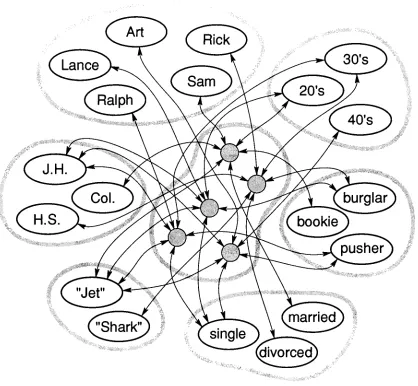
illustrated by imagining two gangs; the 'Jets' and the 'Sharks'. The
objects are individual members of the gangs who are each assigned a
value for a given property along the lines shown in Table 1.1. Figure 1.3
Table 1.1 A sample of the individuals belonging to two gangs together with their hypothetical characteristics. (Adapted from McClelland, 1981.)
Name Gang Age Education Marital Status Occupation
Art Jets 40's J.H. Sing. Pusher
Lance Jets 20's J.H. Mar. Burglar
Ralph Jets 30's J.H. Sing. Pusher
Sam Jets 20's COL. Sing. Bookie
Rick Sharks 30's H.S. Div. Burglar
shows how information relating to the sample of individuals specified in
Table 1.1 is represented as a network. Each of the individuals is
represented by an instance unit (centre) which is linked to its respective
property units. The links consisting of mutually excitatory connections
(shown by double-headed arrows) allow the activation of one unit to lead
to a pattern of activation across the other units. If, for example, the name
unit "Art" is activated then a pattern of activation corresponding to Art's
properties is produced. This pattern of activation effectively amounts to a
representation for Art. It is worth considering a further example; the
activation of the property units "40's" and "pusher". "40's" activates the
instance unit for the individual "Art" while "pusher" activates two
instance units; those for the individuals "Ralph" and "Art". Of the two
"Art" is activated more strongly and in turn the name unit "Art" most
strongly activated. By extending this reasoning it is possible to consider
FIGURE 1.3 A network containing instance units and property units. Mutually excitatory connections (shown by double-headed arrows) occur between some units in different groups while all units within the same group are mutually inhibitory. (Adapted from McClelland, 1981.)
matches a particular object but contains some misleading properties.
Rather than the misleading properties necessarily leading to a total
failure in recall the instance unit or nodes best matching the input will be
activated most strongly, although probably by a smaller margin in
comparison to a situation where there are no misleading cues. The
important point to be drawn from this is that no special mechanisms are
required to deal with erroneous cues or even incomplete cues during the
process of recall.
A further consequence of this network arrangement is that stored