ISSN(P): 2304-1455/ ISSN(E): 2224-4433
Volume 5(4), 88-102
ANALYSING THE ROBUSTNESS OF SPICE CHAINS IN NEPAL FROM A
SMALLHOLDER PERSPECTIVE
Salil Bhattarai
PhD Candidate; Faculty of Agribusiness and Commerce, Lincoln University, New Zealand
Michael C. Lyne
Associate Professor; Faculty of Agribusiness and Commerce, Lincoln University, New Zealand, and Honorary Professor, University of KwaZulu-Natal, South Africa
Sandra K. Martin
Adjunct Researcher; Lincoln University Centre for International Development, New Zealand
Abstract
This study assesses the performance of supply chains for ginger and large cardamom, two major export crops produced in Nepal. In particular, it aims to identify factors that constrain marketing choices available to smallholders, so limiting the chain’s robustness from their perspective. A qualitative case study method was used to gather and analyse data on farmer-buyer dyads in the ginger and cardamom chains. These case studies were informed by a conceptual model based on Transaction Cost Economics. The analysis included a cross-case comparison to identify the effects of external attributes on the modes of engagement available to smallholders. Informal market trading was the only mode of smallholder engagement observed in both chains. However, there was evidence that smallholders had previously engaged in relational contracts in the ginger chain, and in ‘captive’ relational contracts in the cardamom chain. The analysis suggests that access to other modes of engagement is constrained mainly by under-investment in value-adding assets. Traditional cooperatives can and do help to resolve problems of asymmetric information and high unit transaction costs, but more innovative cooperative models are required to encourage the investment needed to finance value-adding assets and activities.
Keywords: Large cardamom, ginger, transaction cost, collective marketing, case study
1. INTRODUCTION
1Linkages between producers and markets are becoming increasingly coordinated to meet growing demands for high quality, safe food (Reardon et al., 2005; Shepherd, 2007; Woods, 2004). However, such shifts are seldom beneficial to smallholders who struggle to meet the costs imposed by these demands (Markelova et al., 2009; Pingali et al., 2005; Poulton et al., 2006; Shepherd, 2007; Vorley et al., 2009). This is cause for concern as agriculture remains a major source of livelihood for most of the rural poor in developing countries (World Bank, 2007), and linking them to markets will be crucial in sustaining their livelihoods and promoting both rural and urban food security (Wheatley and Peters, 2004). It is therefore important to identify ways of maintaining and promoting smallholder engagement in food supply chains.
Corresponding author’s
Name: Michael C. Lyne
Email address: [email protected]
Asian Journal of Agriculture and Rural Development
Literature relating to chain performance tends to focus on whole chain issues and seldom considers performance from a smallholder perspective (Aramyan et al., 2006; Cadilhon et al., 2006; Chan and Qi, 2003; Gunasekaran et al., 2004; Lohman et al., 2004). This study takes a smallholder view and specifically examines the ability of supply chains to sustain smallholder engagement. The study focuses on the dyad between growers and their immediate buyers. A chain is defined as robust if it has one or more modes of engagement that sustain smallholder participation in the farmer-buyer dyad. A chain that offers smallholders a range of such modes, each with its own risk-reward profile, is considered to be more robust than one that offers smallholders few marketing choices. This study draws on a conceptual model based on Transaction Cost Economics (Williamson, 1979; 1985) to analyse information gathered in case studies of supply chains for ginger and large cardamom in Nepal. Large cardamom and ginger are Nepal’s second and fourth most important agricultural export crops respectively (Trade and Enterprise Promotion Centre, 2012). Both crops are suited to production on small farms, and government policy recognises the need to commercialise such high value crops to raise smallholder incomes and to promote rural development in Nepal (APROSC and JMA, 1995; Joshi et al., 2004). The purpose of this paper is to understand why certain modes of engagement are (or are not) used by smallholders in order to identify effective ways of improving their access to markets.
2. THE CONCEPTUAL MODEL
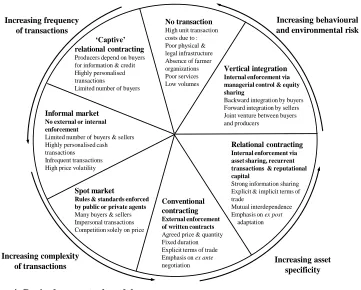
The conceptual employed in this study extends the traditional vertical coordination continuum to incorporate missing transactions and informal market transactions (Bhattarai et al., 2013) The model is illustrated in Figure 1 where The segments of the pie represent different modes of producer-buyer engagement in the vertical coordination continuum. These modes of engagement are distinct from dyads which are the interface between two exchange partners. Multiple dyads do not necessarily mean multiple modes of engagement. The model distinguishes between informal markets and spot markets. Spot markets tend to be characterised by rigorous trading rules and product standards that support frequent and impersonal transactions based on prices. Informal markets, on the other hand, lack rules and standards. Transactions conducted in these markets tend to be personalised and cash-based to mitigate behavioural risk. Transactions via conventional contracts usually involve relatively simple terms that can be expressed in writing and enforced by a court of law. Relational contracts involve complex, recurring transactions with implicit terms that require internal enforcement. Vertical integration shifts coordination decisions and their enforcement to managers.
of engagement could provide all farmers with a superior outcome, empirical study would be required to check this proposition.
Increasing frequency of transactions
Increasing complexity of transactions
Increasing behavioural and environmental risk
Increasing asset specificity No transaction
High unit transaction costs due to : Poor physical & legal infrastructure Poor services Low volumes Absence of farmer organizations Informal market
No external or internal enforcement
Limited number of buyers & sellers Highly personalised cash transactions
Infrequent transactions High price volatility
Spot market
Rules & standards enforced by public or private agents
Many buyers & sellers Impersonal transactions Competition solely on price
Conventional contracting
External enforcement of written contracts
Agreed price & quantity Fixed duration Explicit terms of trade Emphasis on ex ante negotiation
Relational contracting
Internal enforcement via asset sharing, recurrent transactions & reputational capital
Strong information sharing Explicit & implicit terms of trade
Mutual interdependence Emphasis on ex post
adaptation Vertical integration
Internal enforcement via managerial control & equity sharing
Backward integration by buyers Forward integration by sellers Joint venture between buyers and producers
Figure 1: Modes of engagement between farmers and buyers Source:Bhattarai et al. (2013)
3. DATA COLLECTION AND ANALYSIS
A qualitative, case study research strategy was adopted as the intention was to generalise the findings of the study to propositions rather than to a population, and the propositions address ‘how’ and ‘why’ questions about smallholder participation in supply chains (Yin, 2009). Selection of the supply chains for case study was therefore purposive to ensure both theoretical and literal replication of the conceptual model’s propositions. In each case, the primary unit of analysis was the farmer-buyer dyad. Producers and buyers, including potential buyers, were treated as sub-units in the embedded, multiple-case design.
4. OVERVIEW OF THE CHAINS
This section provides a brief overview of the chains studied. The aim is not to provide comprehensive information about these chains but to understand the nature of relationships between producers and their buyers. The terms ‘producers’ and ‘buyers’ refer only to case study respondents.
4.1. Ginger
The first case study was conducted with the Bhairab Ginger Producers’ Cooperative in the Palpa district, a major ginger producing district of Nepal. Interviews were conducted with five farmers, the manager of the Cooperative, two executives of the district federal cooperative, three traders (including a potential buyer) and three officials of government and non-government agencies. Ginger production in the case study area intensified in the early 2000s when an NGO implemented a donor funded project in the district. The cooperative was established in 2004 with 109 small ginger growers, and operates a collection depot in Bhairabsthan village. Volumes sold increased from 15 to 77 tons between 2004 and 2011.
Table 1 summarizes the characteristics of observed and recent dyads. In previous years, the producers’ marketing cooperative sold both fresh ginger and processed (dried and sliced) ginger. However, at the time of the study, only fresh ginger was still being sold (dyad 3b in Table 1). A potential dyad for dried ginger failed to materialize when negotiations between the cooperative and an Exporter broke down. Another potential marketing channel also failed to materialize when talks between a federal cooperative and a local noodle factory failed to produce a trading relationship. These potential dyads are omitted from Table 1.
Table 1: Characteristics of observed farmer-buyer ginger dyads
Dyad characteristics Local trader dyad (1) Federal Cooperative dyad (2) Exporter 1 dyad (3a) Wholesale trader dyad (3b)
Contract Verbal Written Written Verbal
Contract with Trader Federal
Cooperative Cooperative Cooperative
Product Fresh Fresh Sliced and dried Fresh
Price Prevailing
market price
Negotiated price valid for a week
Fixed price negotiated for a
year
Negotiated for each transaction
Payment At the time of transaction
Part advance and final payments settled monthly
Part advance and full payment on
delivery Part advance and full payment before dispatch Extension advice
from buyer No No No No
Financed by buyer No No No No
Asset specific investment by seller
None
In building and equipment through grant
funding
In building and equipment through grant
funding
In building and equipment through grant funding Asset specific investment by buyer
None None
Investment in organic certification, drying equipment None
exchange requirement, delivery schedule
quantity during negotiation
Next buyer Wholesalers Indian traders Importers in US
and Austria Indian traders
4.2. Large cardamom
The second case study was conducted in Ilam district in eastern Nepal, a major cardamom producing district bordering India. Interviews were conducted with six farmers, three immediate buyers and four key informants working for government and non-government agencies involved in large cardamom promotion. There was no evidence of collective marketing in the cardamom chain. Small cardamom growers sell to district traders based in market centres along the highway. They also sell to exporters in Birtamod (a major cardamom trading hub in the southern plains) and village traders. Nepalese exporters sell to traders based in various Indian cities. However, all three dyads exhibited very similar relationship characteristics (Table 2). Potential export links to countries other than India had not materialized.
Farmers and traders used to engage in a practice known as Dahadani. In terms of this practice, forward purchase was negotiated at an agreed price or a promise to buy at a prevailing market price, and buyers would advance cash or foodstuffs to farmers on credit. However, this practice no longer exists and buyers no longer finance producers. Farmers stated that Dahadani exposed them to opportunistic pricing, both in selling cardamom and in purchasing foodstuffs from the buyers.
Table 2: Characteristics of observed farmer-buyer cardamom dyads
Characteristics
Exporter dyad District trader dyad Village trader dyad
Contract Verbal
Contract with Trader
Price Negotiated for each transaction
Payment At the time of transaction
Extension advice from buyer No
Financed by buyer No
Asset specific investment by producers Low for most farmers but high for those who grow cardamom in their arable lands
Asset specific investment by the buyer Limited in processing by exporters, none by other buyers
Information exchange Price and quantity at the time of negotiation Next buyer
Indian traders for exporters, Exporters for district traders
District traders and exporters for village traders
5. CHAIN ANALYSIS AND DISCUSSION
5.1. Ginger
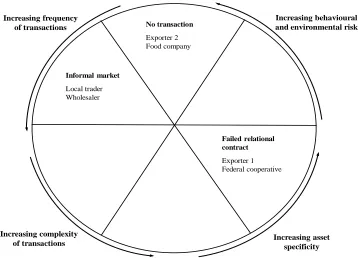
Prior to the donor-funded project in the early 2000s, low yields and the absence of collective marketing obliged small farmers to sell fresh ginger to local traders. The farmers lacked market information and their exposure to opportunistic behavior grew as the project increased both the size and frequency of their transactions in this informal market. In 2004, the project established the Bhairab Ginger Producers’ Cooperative (a marketing cooperative) and linked it to a district-level federal cooperative. The federal cooperative aggregated the output of several marketing cooperatives and negotiated a relational contract with a large wholesaler attracted by the sizeable crop and low unit transaction costs. The relational contract required the buyer to make payments in advance of delivery. This shifted risk from growers to the buyer, suggesting that collective marketing via cooperatives afforded the growers more bargaining power. Repeat transactions and
ex post price renegotiation when prices were bullish provided some internal enforcement measures to encourage contract compliance.
Increasing frequency of transactions
Increasing complexity of transactions
Increasing behavioural and environmental risk
Increasing asset specificity No transaction
Exporter 2 Food company
Informal market
Local trader Wholesaler
Failed relational contract
Exporter 1 Federal cooperative
Figure 2: Observed and failed modes of engagement and their drivers in the ginger chain
However, inadequate internal enforcement, high costs of collective action (that were not financially viable without project support) and high levels of environmental risk (caused by frequent policy changes affecting the importation of fresh ginger into India) led to the demise of this dyad after just three years. The marketing cooperative resorted to trading its (smaller) volumes directly with wholesalers. In addition, grant funding enabled the cooperative to purchase driers and to negotiate a relational contract with Exporter 1 to sell sliced dry ginger. This relational contract was driven by the complexity of transactions as the importers specified stringent quality, volume and schedule requirements. Asset specific investment in organic certification by Exporter 1 also encouraged relational contracting. This dyad certainly offered growers a more stable pricing regime than did the volatile fresh ginger market.
product. In addition, bullish prices in the fresh ginger market encouraged opportunistic behavior on the part of producers who shifted their deliveries to wholesale traders in the fresh market, thus exposing the buyer (Exporter 1) to a hold-up problem. The cooperative sacrificed the long-term benefits of relational contracting in the dried ginger market for short-term gains in the informal fresh ginger market. This behavior may also explain why the cooperative was not enthusiastic about supplying the new ginger exporter 2.
Producer opportunism during periods of rising prices and under-investment in value-adding assets are predictable problems in traditional marketing cooperatives as their institutional arrangements encourage members to maximize profits in the short-term and to avoid investments that yield superior returns in the long-term (Chaddad & Cook, 2004; Cook, 1995; Harris et al., 1996). Nepal’s ginger cooperatives were established along traditional lines and are therefore prone to the horizon problem described by Cook (1995). The flawed institutional arrangements of these cooperatives appear to have contributed to the demise of relational contracts and loss of robustness in the ginger chain as the only investment made by the Bhairab Ginger Producers’ Cooperative was financed from external grants and the evidence points strongly to opportunism by the cooperative during periods of rising prices.
When the cooperative’s relational contracts collapsed, it was left with no choice but to trade informally with wholesalers. Spot markets do not exist as there are no grades and standards to differentiate produce - fresh ginger is traded in Nepal without even removing soil from the rhizome. The behavioral and environmental risk that undermined relational contracts also constrained conventional contracting in the absence of cost-effective external enforcement. Collective marketing and the low complexity of transactions in the informal market help to keep transaction costs low even though the frequency of transactions is high.
5.2. Large cardamom
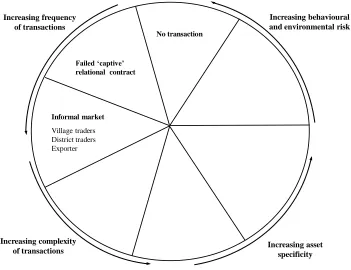
All three of the dyads observed in the cardamom chain were characterised by the attributes of an informal market where product standards and trading rules are poorly specified, goods are traded for cash, and transactions are independent of previous or subsequent transactions. There was little evidence of a spot market, conventional contracting or relational contracting. Prior to the advent of mobile telephones, however, the cardamom chain was dominated by Dahadani - a dyad omitted from the conceptual model. Although Dahadani represented a form of relational contracting, the evidence suggested that the relationship was built on asymmetric information and was not fair to farmers. Figure 3 illustrates observed dyads in the cardamom chain.
Increasing frequency of transactions
Increasing complexity of transactions
Increasing behavioural and environmental risk
Increasing asset specificity Informal market
Village traders District traders Exporter
Failed ‘captive’ relational contract
No transaction
Figure 3: Observed and failed modes of engagement and their drivers in the large cardamom chain
When this happened, farmers switched to informal market trading that offered them better terms. A true relational contract did not develop due to the absence of asset specific investment amongst buyers, and high levels of environmental risk in production due to crop diseases and price volatility caused by shifts in production and demand in India (and possibly in other countries). Production and price uncertainty also make it harder to anticipate contingencies and therefore raise the cost of both relational and conventional contracting.
Lack of confidence in the prices offered by exporters may also have contributed to the absence of well-defined grades and standards (as they would be of little value) and, consequently, to the absence of spot markets. Following the demise of captive relational contracts, cardamom farmers in Ilam were left with informal trading as their only marketing channel.
5.3. Conceptual model revisited
The cardamom case study revealed a mode of engagement omitted from the conceptual model illustrated in Figure 1, Dahadani – a ‘captive’ form of relational contracting. This mode of engagement was associated with buyer opportunism to take advantage of asymmetric information and the absence of alternative sources of credit. The captive relational contract observed in the cardamom chain differs from the captive supply contract described by Gereffi et al. (2005) which was aimed at adding value by strengthening the capacity of small producers to meet rigorous product specifications. In the case of Dahadani, the captive relationship fits the lower end of the vertical coordination continuum as the risk-reward profile of the informal market was preferred to that of Dahadani. Figure 4 offers a revised version of the conceptual model.
Increasing frequency of transactions
Increasing complexity of transactions
Increasing behavioural and environmental risk
Increasing asset specificity ‘Captive’
relational contracting Producers depend on buyers for information & credit Highly personalised transactions
Limited number of buyers
Vertical integration
Internal enforcement via managerial control & equity sharing
Backward integration by buyers Forward integration by sellers Joint venture between buyers and producers
No transaction High unit transaction costs due to : Poor physical & legal infrastructure Absence of farmer organizations Poor services Low volumes
Informal market
No external or internal enforcement
Limited number of buyers & sellers Highly personalised cash transactions
Infrequent transactions High price volatility
Spot market
Rules & standards enforced by public or private agents
Many buyers & sellers Impersonal transactions Competition solely on price
Conventional contracting
External enforcement of written contracts
Agreed price & quantity Fixed duration Explicit terms of trade Emphasis on ex ante negotiation
Relational contracting
Internal enforcement via asset sharing, recurrent transactions & reputational capital
Strong information sharing Explicit & implicit terms of trade
Mutual interdependence Emphasis on ex post
adaptation
Figure 4: Revised conceptual model
6. CROSS-CASE COMPARISON
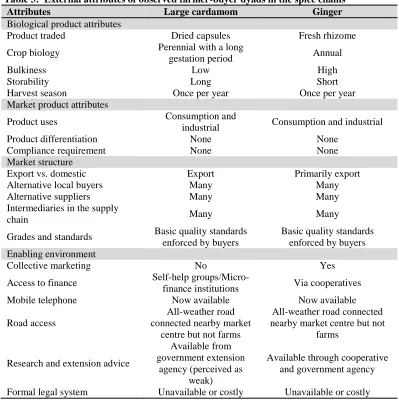
Table 3: External attributes of observed farmer-buyer dyads in the spice chains
Attributes Large cardamom Ginger
Biological product attributes
Product traded Dried capsules Fresh rhizome
Crop biology Perennial with a long
gestation period Annual
Bulkiness Low High
Storability Long Short
Harvest season Once per year Once per year
Market product attributes
Product uses Consumption and
industrial Consumption and industrial
Product differentiation None None
Compliance requirement None None
Market structure
Export vs. domestic Export Primarily export
Alternative local buyers Many Many
Alternative suppliers Many Many
Intermediaries in the supply
chain Many Many
Grades and standards Basic quality standards enforced by buyers
Basic quality standards enforced by buyers Enabling environment
Collective marketing No Yes
Access to finance Self-help
groups/Micro-finance institutions Via cooperatives
Mobile telephone Now available Now available
Road access
All-weather road connected nearby market
centre but not farms
All-weather road connected nearby market centre but not
farms
Research and extension advice
Available from government extension
agency (perceived as weak)
Available through cooperative and government agency Formal legal system Unavailable or costly Unavailable or costly
6.1. Biological product attributes
Large cardamom is a perennial crop that takes at least four years to produce its first economic harvest. Farmers dry the fruit capsules to reduce their volume and to improve their storability. Ginger, on the other hand, is an annual crop. Its rhizomes are bulky and cannot be stored for a long once harvested. However, farmers can postpone harvesting if they expect prices to rise. Although drying techniques are available, drying is not common. Both cardamom and ginger are harvested once a year and trading is seasonal.
Cardamom’s long gestation period increases the level of asset specific investment made by farmers who grow the crop on land suited to annual crops. However, cardamom is easy to store, allowing farmers to wait for favourable prices and so reduce their risk of hold-up. Likewise, the ability to delay harvesting helps ginger farmers to avoid hold-up problems even though the crop is perishable. This alleviates the need to develop complex contractual arrangements in the spice chains. Ultimately, differences in crop biology, bulkiness and storability between cardamom and ginger did not alter the way producers and buyers engage in these supply chains.
6.2. Market product attributes
Large cardamom and ginger are either consumed directly or as a minor input in a manufactured end product (such as spice blends). Even in direct consumption, they constitute a small fraction of the consumer’s food basket. The markets served by the surviving dyads observed in this study do not require a differentiated product and therefore do not impose high levels of compliance on farmers. India’s recent introduction of pest risk analysis (PRA) had not affected production or postharvest practices observed in the case studies. Interestingly, ginger is still exported without basic cleaning.
In the absence of product differentiation and rigorous compliance requirements, it is easy for buyers and suppliers to find alternative trading partners and to transact without negotiating complex contractual terms. However, evidence from the ginger supply chain indicates that some markets do value a differentiated product (dried ginger slices). Attempts to exploit this market failed, apparently due to flaws in the model adopted for collective marketing.
6.3. Market structure
The observed spice chains are long, primarily serving Indian markets and involving many intermediaries. Cardamom prices are perceived to vary with quality (size, colour and aroma), but buyer-enforced quality standards are highly subjective and premiums are trivial. In the ginger chain, quality standards are limited to sorting and removing insect infested and rotten rhizomes.
Collective marketing and mobile telephone services alleviated the problem of asymmetric information in the farmer-buyer dyads. However, the flow of information from export markets is constrained by long chains with many intermediaries that span international borders, and farmers were not convinced that prices offered by exporters were market related.
Cardamom exporters add value by tail-clipping and grading capsules by size and colour, and ginger rhizomes are cleaned in India before they are sent to markets. This suggests that grades and standards exist further down the chain. It is not clear why grades and standards do not characterise upstream transactions. It may be that downstream buyers are able to capture more value by appropriating this function or that it is costly to enforce quality standards in small transactions with many suppliers. In either case, the absence of well-defined grades and standards at the farm gate serves to heighten concerns about the credibility of prices offered by exporters.
The absence of well-defined grades and standards could also explain the absence of spot markets despite the presence of many suppliers and local buyers in the chain. In addition, perceptions of asymmetric information discourage farmers from investing in value-adding activities, which may have constrained the emergence of more complex contractual arrangements.
6.4. Enabling environment
farmer investment in value-adding assets, but also denied farmers the opportunity to bulk up supplies, reduce unit transaction costs and attract a preferred buyer.
Cardamom producers were locked into credit relationships with buyers until micro-finance institutions and local saving groups emerged and provided alternative sources of credit. Likewise, reliable and affordable price information was unavailable before the expansion of mobile phone services. Access to alternative sources of credit and information helped to reduce producers’ dependency on buyers and was instrumental in releasing them from a captive relationship in the cardamom chain.
All-weather roads link market centres, in these spice chains. Road access has improved following recent public works aimed connecting interior villages. Better access to roads should reduce transport costs for both producers and buyers, but is unlikely to alter the mode of engagement while there is under-investment in value-adding assets or a perception that prices offered by exporters lack credibility.
Farmers received extension advice from government extension agencies in both chains, and –in the case of the ginger chain – from local advisors trained by the cooperative with support from a donor funded project. Extension advice was perceived to be weak in the cardamom chain and was considered to be a major reason for production uncertainty. This poor perception of extension advice may reflect the severity of production problems encountered by cardamom farmers. Research that resolves production problems combined with an improved extension service should improve yields and quality. However, such improvements are unlikely to create new modes of engagement for smallholders unless they reduce production uncertainty.
There was no evidence of parties relying on the legal system to enforce contracts in either chain. This could reflect the absence of an efficient and affordable legal system. Improvements to the legal system may do little to encourage conventional contracting while crop yields and export markets are so uncertain. In this situation, product quality, research, extension and market information are first required to reduce environmental risk.
In sum, the prevalence of informal market transactions appears to be the result of market product attributes, market structure and the cooperative model adopted for collective marketing. Collective marketing does help to attract large buyers and to strengthen producers’ bargaining power, but the traditional model of the cooperative does not appear to be very useful in sustaining more complex modes of engagement that could be more beneficial to producers. Interventions that improved producer access to credit and information created a superior mode of engagement in the farmer-buyer dyad. While biological product attributes, road infrastructure, research and extension, and the formal legal system are expected to influence levels of risk and reward in existing modes of engagement, they appear to be less significant in altering the portfolio of modes observed in the spice chains.
7. CONCLUSIONS
While it is true that a single mode of engagement does not necessarily imply a lack of robustness, it is unlikely that any mode of engagement will be optimal for all farmers as they face different transaction costs and risks, and have different levels of risk aversion. The key issues are risk-reward outcomes offered by the available modes, and whether or not the chain allows smallholders to choose an alternative mode of engagement, or a mix of modes, that best maximizes their utility. Interventions aimed at improving the robustness of supply chains should therefore seek not only to expand the modes of engagement available to stallholders but, as a first step, to make existing modes more sustainable by improving their risk-reward outcomes for small farmers.
The case studies suggest that other modes of engagement are unlikely to develop while farmers perceive that prices are manipulated by exporters. In this situation, farmers see little point in adding value or establishing and complying with grades and standards. Reducing information asymmetry in chains serving Indian markets and complementing this information with well-defined grades and standards could promote local spot markets, but a substantive improvement in the performance of these chains from a smallholder perspective will require investment in value-adding assets and activities. However, value-adding requires collective marketing to spread fixed processing, marketing and transaction costs. It is unfortunate that Nepal adopted a traditional cooperative model to promote collective marketing as traditional cooperatives do not generate strong incentives for investment. Instead, they create incentives for producers to take advantage of high prices in spot and informal markets at the expense of relational contracts with long-term benefits. Such an outcome is entirely inconsistent with the notion of value adding, especially when contracts are complex and external enforcement via the legal system is not a viable alternative to internal enforcement. The government should consider supporting hybrid cooperative models like New Generation Cooperatives and investor-share cooperatives to promote collective marketing amongst smallholders.
Restructured cooperatives might not only attract investment in value-adding assets to differentiate their product and operate in a premium market, but might also help to capture additional value in the existing chain by integrating some downstream value-adding functions and by engaging with large buyers further down the chain. In both cases, these cooperatives would have to collaborate with buyers to determine their quality requirements and work with their members to meet these standards. Asset specificity inherent in such investments would encourage cooperatives to seek contractual relationships with buyers. If the investments made by the cooperative (in value adding assets) and its members (in on-farm production technology) serve to reduce levels of environmental risk, and if the quality standards are easy to define and monitor, then conventional contracting may provide an alternative to relational contracting. Research, extension and information that reduce high levels of yield risk would also encourage conventional and relational contracting, so promoting chain robustness.
Acknowledgement
This paper is drawn from PhD research undertaken by the principal author. The principal author gratefully acknowledges the New Zealand Aid Programme for financial support to pursue PhD studies at Lincoln University.
References
APROSC & JMA (1995). Nepal agriculture perspective plan, final report: Main document. National planning commission, Government of Nepal: Kathmandu, Nepal.
Aramyan, L. H., Ondersteijn, C., Oude Lansink, A., & Van Kooten, O. (2006). Performance indicators in agri-food production chains. In Quantifying theAgri-food Supply Chain by C. Ondersteijn, J. Wijnands, R. Huirne and O. V. Kooten (Eds.), Springer: Dordrecth, The Netherlands, pp. 47-64.
Bhattarai, S., Lyne, M. C., & Martin, S. K. (2013). Assessing the performance of a supply chain for organic vegetables from a smallholder perspective. Journal of Agribusiness in Developing and Emerging Economies, 3(2), 101-118.
Cadilhon, J. J., Fearne, A. P., Giac Tam, P. T., Moustier, P., & Poole, N. D. (2006). Business-to-business relationships in parallel vegetable supply chains of Ho Chi Minh City (Viet Nam): reaching for better performance. In Proceedings of the international symposium on fresh produce supply chain management by P. J. Batt and J. J. Cadilhon, (Eds.), Agricultural and Food Marketing Association of Asia and Pacific, Curtin University of Technology, Department of Agriculture, Thailand Ministry of Agriculture and Cooperatives, and FAO Regional Office for Asia and Pacific: Bangkok, Thailand, pp. 135-147.
Chaddad, F. R., & Cook, M. L. (2004). Understanding new cooperative models: An ownership– control rights typology. Applied Economic Perspectives and Policy, 26(3), 348-360. Chan, F. T. S., & Qi, H. J. (2003). An innovative performance measurement method for supply
chain management. Supply Chain Management: An International Journal, 8(3), 209-223. Cook, M. L. (1995). The future of US agricultural cooperatives: A neo-institutional approach.
American Journal of Agricultural Economics, 77(5), 1153-1159.
Gereffi, G., Humphrey, J., & Sturgeon, T. (2005). The governance of global value chains. Review of International Political Economy, 12(1), 78-104.
Gunasekaran, A., Patel, C., & McGaughey, R. E. (2004). A framework for supply chain performance measurement. International Journal of Production Economics, 87(3), 333-347.
Harris, A., Stefanson, B., & Fulton, M. (1996). New generation cooperatives and cooperative theory. Journal of Cooperatives, 11, 15-28.
Joshi, P. K., Gulati, A., Birthal, P. S., & Tewari, L. (2004). Agriculture diversification in South Asia: Patterns, determinants and policy implications. Economic and Political Weekly, 39(24), 2457-2467.
Lohman, C., Fortuin, L., & Wouters, M. (2004). Designing a performance measurement system: A case study. European Journal of Operational Research, 156(2), 267-286.
Markelova, H., Meinzen-Dick, R., Hellin, J., & Dohrn, S. (2009). Collective action for smallholder market access. Food Policy, 34(1), 1-7.
Pingali, P., Khwaja, Y., & Meijer, M. (2005). Commercializing small farms: Reducing transaction costs. In The future of small farms: Proceedings of a research workshop, June 26-29, 2005, Wye, UK, International Food Policy Research Institute: Washington, DC, 61-74. Poulton, C., Kydd, J., & Dorward, A. (2006). Overcoming market constraints on pro-poor
agricultural growth in sub-Saharan Africa. Development Policy Review, 24(3), 243-277. Reardon, T., Timmer, C., & Berdegue, J. (2005). Supermarket expansion in Latin America and
Asia: Implications for food marketing systems. In New directions in global food markets. Agriculture information bulletin, number 794 by A. Regmi and M. Gehlhar (Eds.), United States Department of Agriculture: Washington, DC, pp. 47–61.
Shepherd, A. W. (2007). Approaches to linking producers to market. Rome, Italy: FAO.
Truong, C. H. (2012). Shrimp supply chains, common property and pollution management at Tam Giang Cau Hai Lagoon, Vietnam (Unpublished doctoral thesis). Lincoln University, Lincoln, New Zealand. Accessed October 23, 2012, from http://researcharchive.lincoln.ac.nz/dspace /bitstream/10182/5056/3/Hieu_phd.pdf. Vorley, B., Lundy, M., & MacGregor, J. (2009). Business models that are inclusive of small
farmers. In Agro-industries for development by C. A. da Silva, D. Baker, A. W. Shepherd, J. Chakib and S. Miranda-da-Cruz, (Eds.), FAO and UNIDO: Rome and Vienna, pp. 186-222.
Wheatley, C., & Peters, D. (2004). Who benefits from enhanced management of agri-food Supply chain. In Agriproduct supply-chain management in developing countries. Proceedings of the workshop, August 19-22 2003, Bali, Indonesia by G. I. Johnson and P. J. Hofman, (Eds.), Australian Centre for International Agricultural Research: Canberra, Australia, pp. 113-123.
Williamson, O. E. (1979). Transaction-cost economics: the governance of contractual relations. The Journal of Law and Economics, 22(2), 233-261.
Williamson, O. E. (1985). The economic institutions of capitalism. New York, NY: The Free Press. Woods, E. J. (2004). Supply chain management: understanding the concept and its implications in developing countries. In Agriproduct supply-chain management in developing countries. Proceedings of the workshop, August 19-22 2003, Bali, Indonesia by G. I. Johnson and P. J. Hofman, (Eds.), Australian Centre for International Agricultural Research: Canberra, Australia, pp. 19-26.
World Bank. (2007). World Development Report 2008: Agriculture for development. Washington, DC: The World Bank.