IJEDR1601098
International Journal of Engineering Development and Research (www.ijedr.org)577
Study and investigation of influence of process
parameters for selective laser melting - a Review
M.D.Viramgama, M.C.Karia PG Student, Asst. Professor,
V .V. P Engineering College, Gujarat Technological University
________________________________________________________________________________________________________
Abstract - Additive manufacturing process of joining materials to make object 3D model data, usually layer upon layer, as opposed to subtractive manufacturing technologies. There are so many challenges in the AM process like process control, surface finish, tolerance, validation .Selective laser melting process starts by numerically slicing 3D CAD model in to number of finite layers. The process of selective laser melting involves the moving of a laser beam across a powder bed to melt material type layer by layer, from the stand point of modelling. This process is complicated as it is characterized by high temperature gradients caused in non-equilibrium, conditions during solidification. This causes various effects on microstructure features properties, dimensional accuracy, and surface finish. The material properties such as yield strength, elongation, ductility are highly affected by the microstructure features. Additives manufacturing process are extensively used in automotive, aerospace, bio medical, industries. For selecting laser melting process is most significant joining process in the automobile industries due to high speed and suitable for complex geometries. Strength, hardness and micro structure and surface finish of AM parts are focus of the researchers since last two decades. To get better components that can be used as full functional parts with better process control with full density with various types conventional and new developed materials is the need of modern age.
Keywords - additive manufacturing process, selective laser melting, process parameters numerical modelling, simulation ________________________________________________________________________________________________________
I. INTRODUCTION
Additive manufacturing technologies build near-net shape components layer by layer using 3D model data. The process of joining materials to make objects from 3D model data, usually layer upon layer, as opposed to subtractive manufacturing technologies. There are many related terms used to describe AM and common synonyms include: additive fabrication, additive processes, additive techniques, additive layer manufacturing, layer manufacturing, and freeform fabrication.
Additive manufacturing (AM) is the process of joining materials to make objects from Computer Aided Design (CAD) model data, usually layer upon layer, as opposed to subtractive manufacturing methods. Additive manufacturing is also called as 3D printing, additive fabrication, or freeform fabrication. These new techniques, while still evolving, are projected to exert a profound impact on manufacturing. They can give industry new design flexibility, reduce energy use, and shorten time to market. Selective laser melting (SLM) is an additive manufacturing process that can be used for many different applications. The SLM process starts by numerically slicing a 3D CAD model into a number of finite layers. For each sliced layer a laser scan path is calculated which defines both the boundary contour and some form of fill sequence, often a raster pattern SLM has been effectively used for actual manufacturing of engineering components. New products are entering into the marketplace at a fraction of the product development time, as compared to conventional techniques, and the life cycle costs of existing products are minimized. The introduction of SLM also changes the manufacturing practice from a resource base to a knowledge base, reflecting the manufacturing segments move from mass-produced, single-use products, to new mass-customized, high-value, life-cycle products.
SLM allows for better product development meaning reduced time to design test and more time for iterative design evolution. Low-volume fabrication is possible due to the ability to bypass the need for expensive tooling. Functionally graded structures are possible allowing new possible design routes for components, this enables a combination for example low cost parts with high wear.
AM technologies are emerging technologies. It can be very useful for manufacturing components in aerospace, automobile and biomedical applications. Selective laser melting process is new development for manufacturing field. The proposed research can be useful for obtaining components with better properties that can be used as full functional parts and that can challenge the conventional manufacturing processes.
Hardness and greater strength of automotive body is the need of modern age which is not satisfied today so we consider the improvement parameter of material for selecting laser melting and get the better conclusion.
No model has been previously available to describe this phenomenon with the help of experimental prediction and software base analysis.
II. REVIEW OF INVESTIGATION OF INFLUENCE OF PROCESS PARAMETERS FOR SELECTIVE LASER MELTING
KUL-© 2016 IJEDR | Volume 4, Issue 1 | ISSN: 2321-9939
IJEDR1601098
International Journal of Engineering Development and Research (www.ijedr.org)578
PMA, and galvanic scanner. They proposed a system for monitoring of the melt pool during L.L.M and a data processing algorithm to map the measured melt pool data in space. The result that detection of deformation due to thermal stresses and overheating at overhang structures and they suggested that this system and data processing method can be used as start point for automated melt pool inspection in L.L.M process. [1]Detection of deformation due to thermal stresses
Fig.1 mapping of the melt pool area signal. The dark zone on the right side of the part is due to the deformation of the part.
In 2014,R.bohler,P.cakir,O.benes, had explained the high temperature phase transition of mixed (puo2+Tho2) investigated by laser melting consider with some temperatures effect and surface temperatures process parameter by using scanning electron microscopy,enrgy-dispersive X-ray spectroscopy-ray diffraction, and Raman spectroscopy. And the melting temperatures result are different as well as that using different experiment. and the result that the high temperatures phase diagram of mixed(puo2+Tho2) dioxide melting by Sem,Raman spectroscopy, and XRD.the material analyses performed here support this interpretation by yielding signs of oxygen losses for several compositions. [2]
Raman spectroscopy
Fig.2 A secondary electron image of a (Pu0.85Th0.15)O2 sample after several heating/cooling cycles
IJEDR1601098
International Journal of Engineering Development and Research (www.ijedr.org)579
Fig.3 Spot diagrams (left) and FFT MTF diagrams (right) for a magnification of 3.5 and an object size of 1.5 mm x 1.5 mm fordifferent object positions
In 2012, Miranda Fateri, jan-steffen hotter,and Andreas gebhardt investigated that experimental and theoretical investigation of buckling deformation of fabricated object by selective laser melting. They studied deformation and thermal stress with some mechanical properties of fabricated object using SLM-50 desktop from Realized and Yb-YAG fibre laser for building the part. They studied surface deformation in build up direction with spiral, linear, random scanning strategies. They also presented mathematical model for the same and analysed using FEM model with ANSYS software and calculated deformation in object. They found that that the different scanning strategies temperature result and deformation same as well as FEM result. The results show that FEM can be successfully applied in order to compare the temperature distribution ad deflection of scanning strategies. [4]
Fig.4 Surface deformation top view: (A) spiral scanning strategy; (B) linear scanning strategy; (C) Random scanning strategy [4]
In 2010,Yu.chivel and Smurov suggested by on line temperatures monitoring in selective laser sintering or melting with some process parameter like as temperatures monitoring, surface temperature, spatial distribution, porosity of powder, size of melt etc.by using some accessories like pyrometer and visualizing by CCD camera and SLS machines. They also used industrial laser machines for system monitoring. Finally they found and concluded that this system is optical measurement of temperature distribution in sintering zone by various equipment for control temperature and its possibility to optimize SLS of the powder body with a high range of porosity. [5]
© 2016 IJEDR | Volume 4, Issue 1 | ISSN: 2321-9939
IJEDR1601098
International Journal of Engineering Development and Research (www.ijedr.org)580
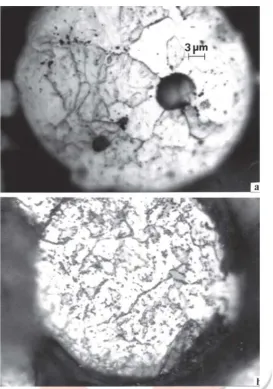
process parameter like as hardness of material, laser deposited zone, heat affected zone, fracture surface etc. These parameters found by different equipment and accessories used like as optical microscope, scanning electron microscope, process chamber, etc. and they found that good metallurgical bonding between the laser deposited zone and the wrought substrate without metallurgical defect such as gas porosities, lack of porosities etc. and last concluded that the micro hardness of the laser deposited zone and the HAZ of the wrought substrate is higher than that of the wrought substrate zone and room temperature tensile properties of the hybrid fabricated steel sample of those of wrought bar.[6]Fig.5 Microstructure of fabricated part with SLM [6]
In 2014, Miranda Fateri, Andreas Gebhardt, Stefan Thumper. Had studied on investigation on selective laser melting of glass in international conference by using various parameters consider of glasslike dimensional accuracy, surface quality, and density of glass part.SLM machines equipped with Yb: YAG fibber laser used in process. They experiment that the particle size distribution has a substantial effect on the sintering behaviour as well as the characteristics of the final product using both conventional and AM methods of glass. Finally they explained that the high intensity causes deformation bad bulging while low energy intensity leads to a weak bond between particle which reduce the dimensional accuracy as well and it shown that the using optimum process parameters parts which could have better dimensional accuracy.[7]
IJEDR1601098
International Journal of Engineering Development and Research (www.ijedr.org)581
Fig.6 (b) SEM pictures of a part with laser re-melting with dendrites structure [8]In 2012 E.Yasa and J-P Kruth had described on microstructure investigation of selective laser melting 316L stainless steel part exposed to laser re-melting. They used 316Lstainless steel and its process parameter like roughness, surface distribution, wear behaviour, corrosion résistance. by using different equipment like concept laser M3 linear machine which employs Nd:YAG laser and SLM machines. They conducted experiments with laser re-melting to improve the surface quality and reduce the porosity for AISI 316L and the density improvement. They found that the effect of laser re-melting enhances the surface quality with better microstructure and porosity in order to achieve better quality of laser fabricated parts by SLM. They found that laser re-melting after every layer that the pores formed in between neighbouring melt pools disappear [8]
In 2014,R,S Khmyrov, S.N Grigoriev investigated that on the possibility of laser melting of quartz glass like TU-21-RSFSR-644-83.They consider process parameter like that porosity of powder, thickness ,mechanical properties like tensile stress, etc.by using laser engraving qulitech 203 mini ,moving mirror .they used numerical modelling and experimental method and investigated that thickness of powder and thermal conductivity. They experiment was conducted for quartz glass powder which is completely re-melted. They found that as result of heat transfer and evaporation of mass and energy lose with re melting with increase in layer thickness, reduced porosity of specimen.[9]
Fig. 7. Bead from fused quartz glass powder on the substrate of the same material
© 2016 IJEDR | Volume 4, Issue 1 | ISSN: 2321-9939
IJEDR1601098
International Journal of Engineering Development and Research (www.ijedr.org)582
Fig. 8 OM section views of (a) Ar-atomized and (b) N2-atomized 17-4 PH stainless steel powdersIn 2013,Dr.T.Nancharaiah,M.Ngabhushanam investigated that process parameters optimization in SLS process using design experiments by using various process parameters like effect of slice thickness and part orientation. They used SLS equipment like roller, powder bed, laser etc. and they investigated the effect of operating process parameters with design of experiment. They finally concluded that from the results, the slice thickness in inversely proportional to the total laser energy building the part. This significance is further strengthened by analysis and the result conducted to verifying the optimal parameter.[11]
IJEDR1601098
International Journal of Engineering Development and Research (www.ijedr.org)583
Fig.9 SLM Model Used For AnalysisIn 2014R. Ganeriwala , Tire i.zohdi explained about the metaphysics and simulation of selective laser sintering manufacturing process and they used process parameters like temperature and ultimately, its change from phase a solid to illiquid and possibly even to gas .they also used equipment like laser sources, powder melt, roller, scanning system. They also investigated simulation result to study the mechanical properties and finally they get main conclude that These papers conclude that residual stresses that will be present in the part are also being investigated. Once these are completed, parameter studies can be performed to optimize, parameter for a certain application and the last perhaps most importantly, there remains the need for experimental validation of this model.[13]
In 2014 Laurent VAN belle, jean –clause boyer searching topic on comparisons modelling of the selective laser melting .they used process parameter is residual stress .the influence of the mesh size is analysed with element as small as the powder layer thickness for geometry part .They used various process equipment like hot drilling machine, powder bed, laser source,etc. they have presented a numerical model for thermal analysis. They studied the influence of temperature and they get final result that in order to analyse the influence of metallurgical phenomena on the residual stress, 2D analysis with generalized plane strain condition seems and any optimization of the manufacturing process, 3D analysis remain absolutely necessary.[14]
In 2015 m.fette,p.sander,j.wulfsberg,h.zierk,n.stoess are explained about that optimized and cost-efficient compression moulds manufactured by selective laser melting for the production of thermo set fibre reinforced plastic aircraft components .they are using many and various process parameters like Temperatures distribution ,surface finish, residual stress, etc. and they investigation about research by using Deflecting mirror, powder distributor, build chamber, MI concept laser and they using pressing test and last they conclude ALM technologies is the rising development and it reduce industrial cost, cost of material, cost of metal powder, cost of machinery, and development of more efficient SLM machine.[15].
© 2016 IJEDR | Volume 4, Issue 1 | ISSN: 2321-9939
IJEDR1601098
International Journal of Engineering Development and Research (www.ijedr.org)584
Fig. Simulation of balling process in fixed light field of the laser source: (a, b, d) - calculation; (c)- experiments photo Tolochko etal.(2004).
In 2015 Maulana arifin, bambang wahono, endro junianto, ari darmawan pasek experimented about that Process manufacture rotor radial turbo expander for small scale organic cycle using selective laser melting machines by using various process parameters Build volume, build steel, heating unit. They used experimental process based on any materials .they also used various equipment like CNC machines, SLM 280HL, industrials machines. And last they investigated and conclude that This process give more advantages compare than other process and the process manufactures are used to considerably enhance and to minimize potential disadvantages by CNC machines.[17]
In 2014 Rishi Ganeriwalaa, Tarek I. Zohdib presented simulation of the laser beam melting process approaches for an efficient modelling of beam material interaction. They also find various process parameters like Effect of temperatures fields, temperatures gradients. they used FEA ansys and various equipment like Micrometer,millimeter,FEA software ANSYS. And finally they conclude that Modular simulation process and modelling are available to perform in depth studies on suitable strategic for heat input modelling and not only gives better result and thermal solution but also calculation time.[18].
IJEDR1601098
International Journal of Engineering Development and Research (www.ijedr.org)585
III. CONCLUSIONSLM additive process is whole light path is modelled and analyzed in MTF diagram by simulation and include colour corrected. Soda lime glass material is not stable against the cooling process and thermal shock in SLM and result the 100% dimensional accuracy, low surface roughness. The result of FEM analysis and different scanning strategic match closely and conclude that FEM can successfully applied compare than scanning strategies. The result that the heat transfer and mass and energy loss consider and thickness of powder improve and it powder use favourable to reduce porosity. From the results, it can be explain that the slice thickness in inversely proportional to the total laser energy building the part. This significance is further strengthened by analysis and the result conducted to verifying the optimal parameter.
The analysis it is observed that temperature effect, velocity of scan with mathematical model of variation of temperature in the SLM process can be estimated for the variation of levels of different factors. Investigation for surface finish, residual stresses .That will be present in the part are also being investigated. Once these are completed, parameter studies can be performed to optimize, parameter for a certain application and the last perhaps most importantly, there remains the need for experimental validation of this model.
IV. REFERENCES
[1] Tom craeghs, stijin clijsters, jean-Pierre kruth, florian Bachmann, marie-christin Ebert,“Detection of process failure in layer wise laser melting with optical process monitoring”2012 in Physics Procedia 39 ( 2012 ) 753 – 759.
[2] R. Bohler , P. Cakır , O. Beneš , H. Hein , R.J.M. Konings , D. Manara ,“High temperature phase transition of mixed(Puo2+Tho2) ”2014 in J. Chem. Thermodynamics 81 (2015) 245–252.
[3] Philipp Lotta, Hen rich Schleifenbauma Wilhelm Meinersa, Christian Honked, JanBültmannc,“Design of an optical for the in situ process monitoring for selective laser melting”2011 in Physics Procedia 12 (2011) 683–690
[4] Miranda Fateri*, Jan-Steffen Hötter , Andreas Gebhardt, “Experimental and theoretical investigation of buckling deformation of fabricated object by selective laser melting’’.2012 in Physics Procedia 39 ( 2012 ) 464 – 470
[5] Yu. Chivel a, I. Smurov b “On line temperatures monitoring in selective laser sintering /melting’’.2010 in Physics Procedia 5 (2010) 515–521.
[6] Wang Yudai, Tang Haibo, Fang Yanli, Wang Huaming, “Microstructure and mechanical properties of hybrid fabricated 1cr12ni2wmovnb steel by laser melting deposition’’2012 in Chinese JournalofAeronautics,2013,26(2): 481–486.
[7] Miranda Fateria,, Andreas Gebhardta, Stefan Thuemmlera,Laura Thurn “Experimental investigation on selective laser melting of glass’’.2014 in Physics Procedia 56 ( 2014 ) 357 – 364
[8] E. Yasa J.P. Krutch “Micro structural investigation of selective laser melting 316l stainless steel parts exposed to laser re-melting”2012 in Procedia Engineering 19 (2011) 389 – 395.
[9] R.S. Khmyrova, S.N. Grigorieva, A.A. Okunkovaa, A.V. Gusarovb “On the possibility of selective laser melting of quartz glass”2014 in Physics Procedia 56 ( 2014 ) 345 – 356
[10]Lawrence E. Murr1, Edwin Martinez1, Jennifer Hernandez1 Shane Collins2, Krista N. Amato1 Sara M. Gaytan1, Patrick W. Shindo1 “Microstructures and properties of 17-4 ph stainless steel fabricated by selective laser melting”2012 in Journal of Materials Research and Technology.
[11]Dr. T. Nancharaiah , M. Nagabhushanam, B. Amar Nagendram, “Process parameters optimization in SLS process using design of experiments”.2013 in Journal Impact Factor (2013): 5.7731 (Calculated by GISI)
[12] Vijay and Dr. C. Srinivasa Rao, “Simulated optimum temperature distribution of selective laser melting process using design of experiment”2012
[13]Rishi Ganeriwalaa, Tarek I. Zohdib,* “Metaphysics modeling and simulation of selective laser sintering manufacturing processes’’.2014 in Procedia CIRP 14 ( 2014 ) 299 – 304
[14] L. V. Bllle Jean, J.C.Boyer“ Comparision numerical modeling of selective laser melting’’.2014
[15]M.Fette,P. Sander, J Wulfsberg, , “Optimized and cost-efficient compression moulds manufactured by selective laser melting for the production of thermo set fibre reinforced plastic aircraft components’’2015 in Procedia CIRP 35 ( 2015 ) 25 – 30 [16]I Kvalev,o.kovalev,i.smurov“Model of heat and mass transfer in random packing layer of powder particles in selective laser
melting’’.2014 in Physics Procedia 56 ( 2014 ) 400 – 410
[17]Maulana arifin, bambang wahono,endro junianto,ari darmawan pase“process manufacture rotor radial turbo expander for small scale organic cycle using selective laser melting machines’’.2015 in Energy Procedia 68 ( 2015 ) 305 – 310.