In-situ synthesize of graphene-Mn3O4 nanocomposites for high-rate
pseduocapacitive electrodes
Danfeng Qiu1,*, Xiao Ma1, Jingdong Zhang1, Bin Zhao2, Zixia Lin2
1 Key Laboratory of Radar Imaging and Microwave Photonics (Nanjing Univ. Aeronaut. Astronaut.), Ministry of Education, College of Electronic and Information Engineering, Nanjing University of Aeronautics and Astronautics, Nanjing, 210016, China;
[email protected] (D.Q.); [email protected] (X.M.); [email protected] (J.Z.) 2 National Laboratory of Microstructures and School of Electronic Science and
Engineering, Nanjing University, Nanjing, China;
[email protected] (B.Z.); [email protected] (Z.L.) * Correspondence: [email protected];
Abstract:Mn3O4 /graphene nanosheets (GNS) composites serve as very excellent electrode materials for supercapacitors. They can fully combine the advantages of two
materials such as graphene and metal oxide. Meanwhile, they can improve not only
the specific energy and specific power of the materials, but also the cyclic stability of
the materials.The results of the cyclic voltammetry and constant current charge
discharge test on the composite electrode material have shown that the Mn3O4 /GNS
powder sample has good capacitive performance. When the scanning rate is 5~50mV,
the specific capacity retention rate of the composite electrode is 80.3% and 88%
respectively. Mn3O4 nanoparticles, with the highest ratio of network coated GNS,
exhibit a specific capacitance value of 957.6 F g−1 at a current density of 2 A g−1 in 1
M Na2SO4 solution. Besides, its network structure demonstrates high specific capacity
and multiplying performance.
Keywords: Graphene; Mn3O4; Nanocomposites; Energy storage and conversion; Supercapacitors
1. Introduction:
Due to the shortage of mineral energy and the increasingly serious environmental
problems, scholars start to attach more attention on high performance energy storage
and conversion functional materials and devices [1-3].Supercapacitor, as a new type
of energy storage element, has large capacity, high energy, wide working temperature
range and long service life, can generate large current within a short term and has
become a research hotspot in recent years [4-7]. Metal oxide electrodes have been
paid more and more attention because the rapid reversible redox reaction can
penetrate into the electrode while the energy can be stored in the three-dimensional
space to improve the energy density [8-10]. At present, the promising metal oxide
electrode materials are mainly MnOx (x =1, 2, 3/2, 4/3) [11-15], NiO[16], Co3O4[17],
V2O5[18] and RuO2[19].
In all kinds of pseudopotential electrode materials, ruthenium oxide (RuO2) has
been widely studied because of its good conductivity, rapid reversible redox reaction
and high specific capacity [20, 21]. However, due to its price price and toxic features,
it has not been widely applied. Therefore, finding a cheap alternative material
becomes rather urgent. Manganese oxide enjoys multiple advantages, such as high
theoretical specific capacity (1370 F g−1 [22, 23]), good environmental compatibility,
good oxidation-reduction and charge storage characteristics, high chemical, thermal
stability, and low price. It is expected to replace RuO2 in some fields. Meanwhile,
MnOx also enjoys some advantages, such as rich material, low cost and friendly
environment. However, its electrical conductivity (10−7 ~10−8 S cm−1) is quite low,
which limits its application in the field of supercapacitor. As the cycle life of a single
MnOx is still not ideal yet, there are many carbon materials, such as activated carbon、
carbon nanotube, carbon aerogels and graphene etc. have been widely applied to
combine with the metal oxides and hence to increase the conductivity of manganese
oxide.
Graphene has a unique two-dimensional structure with a single atomic thickness,
high specific surface area, excellent electrical and mechanical properties. Therefore,
the combination of graphene and Mn3O4 can not only improve the electrical and
mechanical strength of Mn3O4, but also bring greater surface/boundary area to the
composite. More electrochemical active sites, therefore, are provided in this way.
Manganese oxide loaded with graphene has a good application prospect as the
electrode material of supercapacitor. However, the preparation of manganese oxide is
very complex. Currently, it is mainly constrained by two aspects, including the
In this paper, Mn3O4/GNS nanocomposites were prepared by thermal
decomposition of graphene and manganese nitrate complex. The organic combination
of graphene and manganese oxide nanoparticles can fully realize the synergistic effect
of double capacitance and pseudo capacitance.The pore structure of electrode
materials is an important factor affecting the capacitance performance. Three
dimensional porous Mn3O4/GNS composites were constructed by thermal
decomposition of manganese oxide nanoparticles in situ by three-dimensional porous
graphene paper. The three-electrode system exhibits a specific capacitance value of
987.6 F g−1 at a current density of 2 A g−1 in 1 M Na2SO4 solution. Such composite
exhibits good cyclic stability with a small loss of 5.2% of maximum capacitance over
2000 consecutive cycles.
2. Experimental
GO was synthesized from natural graphite powders (universal grade, 99.985%)
based on the Hummers’ method with slight modifications [24, 25]. The as-prepared
GO was stripped for 3 minutes in air at 300 °C, and then treated for 3 hours in Ar
protection at 900 °C. Then, GNS was obtained. In the synthesis of typical
Mn3O4/GNS nanocomposites, 537 mg of Mn (NO3)2 aqueous solution (50%) was
mixed with 50 ml ethanol. Besides, 28 mg of GNS was added to the solution for 15
minutes. The suspension is mixed with a magnetic stirrer in the hood combined with
the continuous evaporation of the ethanol in the solution. Dry Mn (NO3)2 / GNS
composites were collected and treated at 200 °C for 10 h, and Mn (NO3)2 was
converted to Mn3O4. The relevant mechanisms can be explained as follows:
3Mn(NO3)2⇄3Mn3O4+6NO (1)
Based on weight, there is about 80% of Mn3O4/GNS is Mn3O4. During the
control experiments, a Mn(NO3)2 aqueous solution (50%) was heated in the air under
200 °C for 10 h to prepare the simplex Mn3O4 sample. The obtained samples were
explored via TEM, namely transmission electron microscopy, SEM, namely scanning
electron microscopy and XRD, namely X-ray diffraction. Base materials (10 wt.%),
the Mn3O4/GNS electrode. Afterwards, the final mixture obtained was stirred under
the room temperature for around 24h using a magnetic stirrer (1200 rpm).
Subsequently, a think graphite sheet (specific area of 1 × 1 cm2) was used to coat the
final product. The electrodes being prepared later got dried under 60 °C in the hot air
oven for around 3h. For the fabricated electrodes, there was around 1.2 mg cm−2 mass
loading of active materials over the graphite sheet. The same electrochemically active
material/binder (PVDF)/conductive carbon ratio (80:10:10) was also used for the
preparation of pure Mn3O4 and GNS for the control experiment and hence to make an
accurate electrochemical properties of the resultant electrodes.
3. Results and Discussion
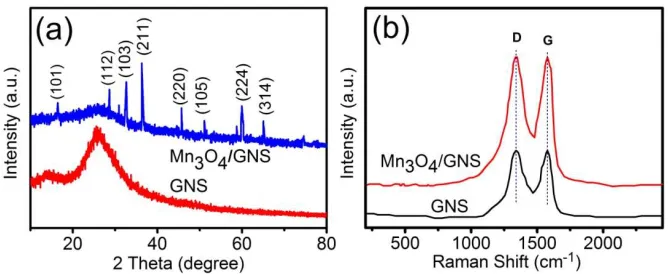
Fig.1 . (a) XRD and b) Raman characterizations of GNS and Mn3O4/GNS samples.
It can be seen from the XRD analysis chart of the composite powder in Fig. 1a
that the major components of graphene and GNS/ Mn3O4 have low crystallinity. The
diffraction peaks occurring on the all the reflections of the samples are consistent with
the standard pattern of the tetragonal Mn3O4 (JCPDS file no. 80-0382). There was
none other impurity or phase being found in these patterns. For the multiplayer
graphene of the GNS sample, the broad peak at around 25 °C was a kind of diffraction
peak. There are two typical peaks of both samples which are at around 1350 and 1585
cm−1 being assigned to D and G brands of graphene correspondingly, suggesting that
there were a multitude of defects in the GNS.
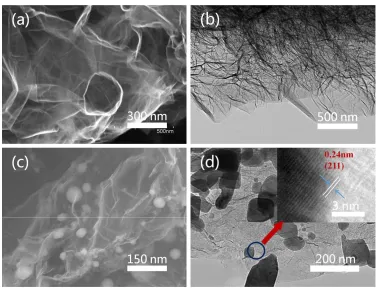
Fig. 2a and 2b show that there are obvious lamellar structures and wrinkles at the
edge of the graphene sheet.The natural flexural lamellar structure of graphene and the
dimensional channel interworking material, providing a good condition for the load of
Mn3O4 nanoparticles.
Fig. 2. SEM (a) and TEM (b) images GNS; SEM (c) and TEM (d) images of Mn3O4/GNS.
Besides, according to fig. 2c and 2d, it can be seen that the size of Mn3O4 is
around 20-100 nm. Mn3O4 nanoparticles are dispersed on the surface of the graphene
to form an interconnected junction. Meanwhile, for the trip of manganese oxide
crystals, the graphene is of great importance. The pore structure of the 3D network
skeleton effectively limits the size of the manganese oxide nanoparticles. At the same
time, the pore of the graphene has been further expanded through the gas generated
from the decomposition of manganese nitrate. The synergistic effect between
graphene and manganese oxide was obvious. This not only improves the conductivity
of materials, but also accelerates the diffusion of anion and cation.
Fig. 3a shows the cyclic voltammetry (CV) curves of as prepared samples of
Mn3O4/GNS nanocomposites. The redox peaks appear in the cyclic voltammetry
curves of Mn3O4/GNS are near O.23 and 0.45 V, indicating that the capacitor is
two-dimensional Faraday reaction on the surface of the electrode. There is a weak
redox peak in the cyclic voltammetry curve of Mn3O4/GNS. The current response
becomes faster when there is a change occurring over the potential of the end
potential, indicating that the reversibility of the material is better. The size of the area
enclosed by the cyclic voltammetry curves of the Mn3O4/GNS materials shows the
maximum capacitance of Mn3O4/GNS, indicating that the manganese and nickel
oxide in the composite have a direct effect on the capacitance.
Fig. 3. (a) CV curves of Mn3O4/GNS with different scan rates; (b) charge/discharge curves of Mn3O4/GNS at various current densities; (c) the specific capacitance of composites with different current densities; (d) cycling performances of composites at current density of 20 mA g−1.
The specific capacitance of Mn3O4/GNS nanocomposites is larger and reversible.
Fig. 3b presents the charging and discharging curves of Mn3O4/GNS nanocomposites.
The calculated specific capacitance at is 957.6, 905.2, 854.6, 802.3,765.2 F g−1 at the
current density of 2, 5, 10, 20, 50 A g−1 respectively, which are proved by a large
number of cyclic tests (Fig. 3c). After 1000 cycles of charge and discharge under
current density of 20 A g−1, the specific capacitance did not fail significantly, which
was still 763.8 F g−1. That suggests that it retained 95.2% of the original activity. This
is due to the synergistic effect of Mn3O4 and graphene during the electrochemical
crystallization of the other side. In light of this, regardless of the increase of specific
capacitance or the prolongation of cycle life, thecombination of Mn3O4 and graphene
has played a good role during the promotion.
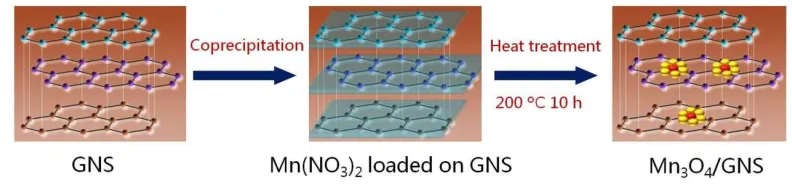
Fig. 4. Schematic illustration of the Mn3O4/GNS nanocomposite material.
From Fig. 3d, the sample Mn3O4/GNS has a second-highest capacity retention
rate in 3 samples while the capacity of the sample is the highest. The sample of
graphene has the highest capacity retention rate. However, the capacity is far lower
than that of the Mn3O4/GNS sample. This is due to the supporting effect of graphene
on the overall morphology of the powder, making the composite powder form a good
network structure, and the specific surface area and mesoporousporous content of the
powder are greatly improved.
The synthesis mechanism of Mn3O4/GNS nanocomposites is shown in Fig. 4. By
means of solution coprecipitation, manganese nitrate can uniformly adhere to the
surface of graphene. Then, the thermal decomposition was conducted, decomposing
the manganese nitrate into Mn3O4 nanocomposites.This method of in-situ thermal
decomposition ensures that Mn3O4 nanoparticles can be firmly embedded in the
surface and channel of graphene to achieve good electrical contact and thus to
improve the electrochemical properties of manganese oxide in the process of charge
and discharge.
4. Conclusions
Mn3O4/GNS nanocomposites were synthesized by liquid phase codeposition.
Afterwards, the thermal decomposition was conducted. It can be found through the
SEM and XRD analysis that the obtained compound is rather complex. It has been
shown from the electrochemical tests that graphene and Mn3O4 composite electrodes
discharge test, the specific capacitance of the composite material is about 760 F g−1
under the high current charge while the discharge is up to 20 A g−1. Meanwhile, the
specific capacitance retention rate of the 2000 cycles is as high as 95%. The CV curve
of the composites were approximately rectangular, indicating that the composites had
good reversibility.
Acknowledgments: This work was supported by the National Key R&D Program of China under Grant 2017YFB0502700, the National
Natural Science Foundation of China (No. 61471195), and the Fundamental Research
Funds for the Central Universities (Nos. NZ2016105, NJ20150017 and NS2014040),
partially by the National Defense Pre-Research Foundation of China
(No.6140413020116HK02001).
Author Contributions: Danfeng Qiu and Jingdong Zhang conceived and designed the experiments; Xiao Ma performed the experiments; Danfeng Qiu and Bin Zhao
analyzed the data, reviewed and edited this manuscript; Zixia Lin contributed
reagents/materials/analysis tools; Danfeng Qiu and Xiao Ma wrote the paper.
Conflicts of Interest: The authors declare no conflict of interest.
References
1. Gu,W.; Yushin, G. Review of nanostructured carbon materials for electrochemical
capacitor applications: Advantages and limitations of activated carbon,
carbide-derived carbon, zeolite-templated carbon, carbon aerogels, carbon
nanotubes, onion-like carbon, and graphene. Wiley Interdiscip. Rev. Energy
Environ. 2014, 3, 424–473.
2. Armand, M.; Tarascon, J.M.; Building better batteries, Nature. 2008, 451, 652–657.
3. Peng, X.; Peng, L.; Wu, C.; Xie, Y. Two dimensional nanomaterials for flexible
Supercapacitors. Chem. Soc. Rev. 2014, 43, 3303–3323.
5. Winter, M.; Brodd, R.J. What are batteries, fuel cells, and supercapacitors? Chem. Rev. 2004, 104, 4245–4269.
6. Yu, G.; Xie, X.; Pan, L.; Bao, Z.; Cui, Y. Hybrid nanostructured materials for high-performance electrochemical capacitors. Nano Energy 2013, 2, 213–234. 7. Jang, H.; Park, Y.J.; Chen, X.; Das, T.; Kim, M.-S.; Ahn, J.-H. Graphene-based
flexible and stretchable electronics. Adv. Mater. 2016, 28, 4184–4202. 8. Wei,W.; Cui, X.; Chen,W.; Ivey, D.G. Manganese oxide-based materials as
electrochemical supercapacitor electrodes. Chem. Soc. Rev. 2011, 40, 1697–1721. 9. Xiong, P.; Ma, R.; Sakai, N.; Bai, X.; Li, S.; Sasaki, T. Redox Active Cation
Intercalation/Deintercalation in Two-dimensional layered MnO2 nanostructures for high-rate electrochemical energy storage. ACS Appl. Mater. Interfaces 2017, 9, 6282–6291.
10.Devaraj, S.; Munichandraiah, N. Effect of crystallographic structure of MnO2 on its electrochemical capacitance properties. J. Phys. Chem. C 2008, 112,
4406–4417.
11.Omomo, Y.; Sasaki, T.; Zhou, L.; Watanabe, M. Redoxable nanosheet crystallites of MnO2 derived via delamination of a layered manganese oxide. J. Am. Chem. Soc. 2003, 125, 3568–3575.
12.Huang, W.X.; Li, Jun. ; Xu. Y.H. Nucleation/Growth Mechanisms and Morphological Evolution of Porous MnO2 Coating Deposited on Graphite for Supercapacitor. Materials 2017, 10, 1205.
13.Xiong, P.; Ma, R.; Sakai, N.; Bai, X.; Li, S.; Sasaki, T. Redox Active Cation Intercalation/Deintercalation in Two-dimensional layered MnO2 nanostructures for high-rate electrochemical energy storage. ACS Appl. Mater. Interfaces 2017, 9, 6282–6291.
14.Devaraj, S.; Munichandraiah, N. Effect of crystallographic structure of MnO2 on its electrochemical capacitance properties. J. Phys. Chem. C 2008, 112,
4406–4417.
15.Shao, J.; Zhou, X.; Liu, Q.; Zou, R.; Li, W.; Yang, J.; Hu, J. Mechanism analysis of the capacitance contributions and ultralong cycling-stability of the isomorphous MnO2@MnO2 core/shell nanostructures for supercapacitors. J. Mater. Chem. A
2015, 3, 6168–6176.
16.Wang, Y.G.; Xia, Y.Y. Electrochemical capacitance characterization of NiO with ordered mesoporous structure synthesized by template SBA-15. Electrochim. Acta
2006, 51, 3223–3227.
18.Saravanakumar, B.; Purushothaman, K.K.; Muralidharan, G. Fabrication of two-dimensional reduced graphene oxide supported V2O5 networks and their application in supercapacitors. Mater. Chem. Phys. 2016, 170 (Suppl. C), 266–275.
19.Gigot, A.; Fontana, M.; Pirri, C.F.; Rivolo, Paola, Graphene/Ruthenium Active Species Aerogel as Electrode for Supercapacitor Applications. Materials 2018, 11, 57.
20.Kim, Y.L.; Choi, H.A.; Lee, N.S.; Son, B.; Kim, H.J.; Baik, J.M.; Lee, Y.; Lee, C.; Kim, M.H. RuO2-ReO3 composite nanofibers for efficient electrocatalytic
responses. Phys. Chem. Chem. Phys. 2015, 17, 7435–7442.
21.Wu, Z.S.;Wang, D.W.; Ren,W.; Zhao, J.; Zhou, G.; Li, F.; Cheng, H.M. Anchoring hydrous RuO2 on graphene sheets for high-performance electrochemical capacitors. Adv. Funct. Mater. 2010, 20, 3595–3602.
22.Tian, Y.Y.; Li, D.W.; Liu, J.L.; Wang, H.; Zhang, J.F.; Zheng, Y.Q.; Liu, T.H.; Hou, S.F. Facile Synthesis of Mn3O4 Nanoplates-Anchored Graphene
Microspheres and Their Applications for Supercapacitors. Electrochim. Acta 2017, 257, 155–164.
23.Shah, H.U.; Wang,, F.P.; Javed, M.S.; Shaheen, Nu.; Saleem, M. Li, Y.
Hydrothermal synthesis of reduced graphene oxide-Mn3O4 nanocomposite as an efficent electrode materials for supercapacitors.Ceramics International 2018, 44, 3580–3584.
24.Hummers, W.S.; Offeman, R.E. Preparation of graphitic oxide. J. Am. Chem. Soc.
1958, 80, 1339–1339.