1.
STUDIES IN CHILTERN FIELD SYSTEMS
Thesis submitted for the
degree of Doctor of Philosophy in the University of Londonby David Roden
2
ABSTRACT
H.L.Gray, writing in 1915, stressed the fact that the Chiltern Hills lay in a transition area between Midland England, with its more regular open field arrangements, and the Southeast, with less regular sjatems. Basing his conclusions largely on sixteenth and early seventeenth century surveys, he showed that field systems within the Hills were different and distinctive from those on either side. The present study is the first comprehensive account of these distinctive systems. The medieval field arrangements of four
parishes are examined in detail, and evidence for the whole region before
1850
is summarised.The most important features of the Chiltern field systems were: (1) the high proportion of enclosed arabic land, particularly in the southwest; and (2) the existence of numerous, relatively small, common fields within the individual township. A three-course
rotation had appeared as early as the twelfth century, and was later widely followed; but this does not imply the presence of a simple
two- or three-field system. Farm holdings were concentrated in one part of a township, while the individual common arabic holding was distributed irregularly between only a few of the many common fads. There was little meadow or grassland pasture, apart from that in parks, but woods and wastes were important elements, except in the northeast. The settlement pattern combined elements of both nucleation and
dispersal.
CONTENTS
3
11 15Ilk
159
206
236
271
302
36k 373376
377 378 379380
383391
k08
Page
List of Maps and Diagrams.
5List of Tables.
7
Acknowledgements.
9
Abbreviations.
10
INTRODUCTIONS.
CHAPTER I.
FIELD
SYSTEMSIN THE CHILTERNS: o.155O-c.1i5O.
CHAPTER II.
FIELD
SYSTEMSIN KING'S WALDEN: c.1250-c.1600.
CHAPTER III. FIELD SYSTEMS IN CODICOTE: c.1250 - c.1550.
CHAPTER IV.
FIELD SYSTEMS IN BERKHANSTED: c • 1300 - c • 1650.
CHAPTER V.
FIELD SYSTEMS IN IBSTONE: c.1250 - c.1500..
CHAPTER VI.
FIELD
SYSTEMS INTHE CHILTERNS: c.1200 - c.1550,
1. THE SETTING
CHAPTER VII. FIELD
SYSTEMSIN THE CHILTERNS: c.1200 - c.1550,
2. THE FIELD SYSTEMS AND ASSOCIATED FEATURES.
CHAPTER VIII. CONJECTURES, CONCLUSIONS AND SUMMARIES.
Appendix
A. (i)Crops in some sixteenth and seventeenth
century probate inventories.
(ii) Livestock in some sixteenth and
seventeenth century probate inventories.
Appendix B.
(i) Alist of parishes that contained common
arabic land after 1550.
(ii) A
list of parishes where common arabic
was enclosed by Act of Parliament.
Appendix C.
Appendix D.
A list of references to common pasturing on
the common arabic.
Cropping in the common fields of Little
Gadde eden as indicated by manorial court
orders concerning fences.
Appendix E. Society and the land market
in King's Waldenc.1250 - c.1600.
Appendix F.
Society and the land market in Codicote in the
thirteenth and fourteenth centuries.
Appendix G. Succession to land
in
some villein families in
Codicote in the thirteenth and early fourteenth
4
Page Appendix H. A list of the references that suggest a
reduction of settlement in Codicote, 1250-1415. Z20 Appendix I. Society, the land market and economic change
in Ibstone in the thirteenth, fourteenth and
fifteenth centuries. 424
Appendix J. A summary of manorial income at Ibstone in the
years for which detailed accounts survive.
430
Appendix K. (i) Crops on the Ibstone demeane.
439
(ii) Livestock on the Ibstone demeans. 440 Appendix L. Cropping on the Ibstone demesne. 441 Appendix 14. Crop acreagee on some demesne farms, 1152-1408. 444. Appendix N. Livestock on some demeene aad tenant farms,1152-1413. 4.47
Appendix 0. Cropping on some arabic demesnee, 1282-1407. 4.50
5
LIST OF MAPS AND DIAGRAMS
Page
1. Little Gaddesden
c.i800.
18
2. Common arabic land within and around the Chilterns c.1800.
20
3.
Parishes with common fields c.1600 and parishes where common arabic was enclosed by Act of Parliament.24
4.
Flamatead - relief and common arablec.1600
and in1838.
27
5.
The Hampdens - relief and land-usec.1800.
30
6.
The manor of Great Hanipdenin 1741.
32
7.
Two areas of common arabic in the central Chilternsc.1650.
34
8.
Fiametead:- a. the common fields in1838,
b. Market Street Farm in
1756.
38
9.
The enclosure of Lye field inRedbourne:-a. Lye field
c.1770,
b. Lye field in
1841.
54
10. Three enclosed farms in Great Gaddesden.
61
11. Three enclosed farms in Redbourne and Heme]. Hempetead.63
12.
The distribution of individual common arabic holdingsbetween common fields.
70
13.
Three holdings in Great Hampden,1653.
75
14.
Six holdings in Little Gaddesden,1609.
78
15.
Seven holdings in Great Gaddesden, c.1600.81
17. Six holdings in Redbourne,
1692.
84
18. Chamberlins Farm in Welwyn and Ayot,
1710.
86
19. Annables Manor Farmin
Harpenden, c.181e0.89
20. Common waste within and around the Chilternsc.1800.
95
21. Settlement in the southwest Chilterns and the adjoininglowland
c.1830.
106
22. Settlement in the central Chilterns
c.1830.
108
23. Settlement in the northeast Chilterne and on the LowerChalk dip-elope
o.1830.
11024. King's Walden - relief.
116
6
Page 26. King's Walden - subdivision of an assart. 126 27. King's Walden - common arab].e land
o.1585
and in1805.
lkO
28. King's Walden - nine holdings,1568.
153 29. King's Walden - a reconstruction of fields and land use158
c • 1600.
30. Codicote - relief. 160
31. Codicote - settlement. 177
32. Codicote - the parish at the end of the eighteenth century.
187
33. Codicote - common arable landc.1600
andc.1800.
1933k. Codicote - five holdings,
i5k6.
202
35. Codicote - a reconstruction of fields and land use
c.i600. 205
36. Berkhamsted - relief.
207
37. Ber1rhmted - settlement.
209
38. Berkhn,Rted - common arable land
c.1600
andc.18L 0.
225
39. Berkhamsted - eight holdings,
c.1600.
230
40. Berkhamsted - the distribution of individual common arable
holdings between common fields.
232
kl.
Berkhamsted - a reconstruction of fields and land use 0.1600.235
k2. Ibstone - settlement.
26k
k3. Ibstone - the parish.
270
u
k. The tenant land market in Codicote,1255-1 1+15.
398
1
i5. The Chilterne - the location of parishes.'+76
I.
II. III. 'V. V. VI. VII. VIII. IX. X. XI. XII. XIII. XIV. XV. XVI. XVII. XVIII.7
LIST OF TABLES
Page
29
6k
69
71
72
7k
77
80
83
85
119
151
173
17k
175
200
220
229
Proportions of enclosed and common field land in somesixteenth and seventeenth century surveys.
The average size of tenant and demesne closes in some sixteenth and seventeenth century surveys.
Sown acreages on some sixteenth and seventeenth century holdings.
The importance of common arable land in the holdings of common arable tenants named in some sixteenth and seventeenth century surveys.
Some holdings with common arable land in Bix and Swyncombe,
1609.
Holdings with common arabia land in the manor of Great Hampden,
1653.
Holdings with common arable land in the manors of Little Gaddesden, 1609.
Holdings with common field land in the manor of Great Gaddesden, c.1600.
Holdings with common arabia land in the manor of Redbourne,
1692.
Arabia land and crops on Redpits Farm, Bix, April
1613.
Crops and livestock on the demesne of the manor of King's Walden.Some holdings with common arabia land in King' a Walden. The division of Bromeoroft by John le Reveson.
The division of Crawley croft.
Enclosed and common field laud in some fourteenth century Codicote holdings.
Some holdings with common field land in Codicote. Crop acreagee on the Berkhamsted demesne.
8
Page242
244
278
388
L41f
406
412
415
417
419
XIX. Crop yields on the Ibetone demesne,1281-1358.
XX. Grain exports and imports on the Ibstone demeene,
1281-1358.
XXI. Crop yields on some demesne farms.
XXII. The activity of Richard de la Corner on the land market.
XXIII. The holding built-up by Roger le Helder and his activity in the land market.
XXIV. The holding built-up by Roger May and his activity on the land market.
XXV. The holding of Reginald Kyne composed largely of land held on lease.
XXVI. Alienation of land from his holding by Thomas le Driver. XXVII. Succession to property in the family of Juliana atte
Pirye and her eon Thomas and their activity on the land market.
XXVIII. Succession to property in the family of Henry de Cokreth and their activity on the land market. XXIX. SuccesBion to property in the family of Osbert the
Miller and their activity on the land market. XXX. Succession to property in the family of Zdward ].e
9
ACKNOWLEDGEMENTS
I wish to thank various members of the Department of Geography at University College, London, for their help, in particular
Professor H.C. Darby for his supervision, Dr. A.R.H. Baker for many fruitful discussions and suggestions, and Mr. M.J. Harrison for
access to his work on ridge and furrow in Bedfordshire and Oxfordshire. Thanks are also due to the staff at the record offices ana repositories that were visited, especially to Mr. J. Whituield at Hertford, to
Mr. E.J. Davies and Mr. G. Vesey at the Buckinghamshire Record Office, to Mrs. E.M. Elvey of the Buckinghamahire County Museum, to
10
ABBREVIATIONS
Among the abbreviations and short titles used the following may require elucidation:
-Agricultural History Review. Antiquity.
BdRO Bedfordshire Record Office.
BHRS Publications of the Bedfordshire Historical Record Society BM British Museum.
Bod. Bodleian Library.
BRS Publications of the Buckinghamshire Record Society. BuCM Buckinghamehire County Museum.
BuRO Buckinghamshire Record Office.
CCA Chichester Chapter Archives (West Sussex Record Office). Economic History Review.
Eng.HR English Historical Review. Geografisker Annaler. GJ Geographical Journal. HeRO Hampshire Record Office. BRO Hertfordshire Record Office. 120 Lincoinshire Record Office.
OHS Publications of the Oxford Historical Society. ORO Oxfordshire Record Office.
ORB Oxfordshire Record Series. PRO Public Record Office.
RB Records of Buckinghanishire.
RBBAS Publications of the Records Branch of the Buckinghamshire Archaeological Society.
Register "Register of Edward the Black Prince".
Sidney Sussex Library of Sidney Sussex College, Cambridge. St. Paule Library of the Dean and Chapter of St. Paul's.
11
IN'0DUCTI0N
Ever since the publication of H.L. Gray's survey of English field systems, in
1915,1
the importance of the Chiltern Hills, and the distinctiveness of their field arrangements had been recognised, but has never been analysed in detail over the whole region. The Chalk escarpment of the Chilterns extends from the Goring gap inthe southwest to the Hitchin gap in the northeast (Fig.
k5).
Its dip.-slope descends from a steep northwestward-facing escarpment, whichin parts rises more than 800 feet above sea-level, to the gravels of the Thames terraces and the Vale of St. Albans at about
350
feet. Gray considered that this area formed an important divide betweenthe regular two and three-field systems of Midland England and the
irregular systems of the Southeast, in particular of Kent.
3
Subsequent studies have confirmed the signi±icance of the Chilterns as a break in English field systemtypes.k
The great open fields that charac-tensed the lowlands to the north and west, extended in parts to the very crest of the Chalk outcrop, where they ended abruptly. South of the Hills, this pattern was repeated in only a few scattered areasGray also recognised that the Chiltern region possessed a
distinctive field system of its own, the most marked feature of which
(1) E.L. Gray, "English Field Systems",
(1915).
(2) Gray's definition of "field system" - namely "the manner in
which the inhabitants of a township subdivided and tilled their arable meadow and pasture land" - has been accepted without modification, ibid.,
3.
(3) Ibid.,
63,
'+01, '+18.
('+)
e.g. LW. Beresford, "Glebe terriers and open-field Buckingham-shire", RB, 15(1951-2 ), 283-98
and 16(1953-k), 5-28;
and the parish studies in VCH Oxon.,8, (196k).
(5)
e.g. In a few townships in south Middlesex, G.B.G. Bull, "The •changing landscape of rural Middlesex, 1500-1850", unpublished1
was the predominance of enclosed arable land. 1 There were open field areas on the Hills, particularly in Hertfordshire, but, according to Gray, it was unlikely that there was ever a simple two or three-field system. The open fields were very irregular in character, and parcels were not evenly distributed among them. Two more detailed studies, by A.E. Levett of the Hertfordshire manors of the Abbey of St. Albans 3 and by E.C. Vollans of }issenden Abbey land in Buckinghamshire ,k have since confirmed and elaborated the general pattern outlined by Gray. They have also revealed two important differences from the earlier account. Levett has suggested that in Hertfordshire there was, in the grouping of fields into a
rough three-field division for cropping purposes, "either the breakdown or the unsuccessful imitation of the orthodox three-field system;5
while in Buckingharnshire "open arable" was found to be more extensive on the Hills than Gray imagined.6
All three accounts have stressed the importance of the hilly and thickly wooded nature of the country as a factor influencing the development of field systems. Gray thought that most of the cultivated land had been enclosed into severalty direct from the waste. 7 f a regular two or three-field system had once existed
(1) H.L. Gray, op. cit., 119-20. (2) Ibid., 371-2, 381, +O1, '+17.
(3) A.E. Levett, "Studies in Manorial History", (1938), especially 179-90.
(Lf) E.C. Vollans, "The evolution of farmlands in the central Chilterns in the twelfth and thirteenth centuries' t , Transactions and Papers of the Institute of British Geopraphers, 26 (1959), 197_2Lfl.
13
this was subsequently modified beyond al]. recognition by the addition of assart land. 1 He concluded that "the only thing that is clear is the development of arable fields through the assarting of waste in such a mer that the tenants' holdings came to comprise a certain amount of unenclosed land lying scattered strips". 2 The two detailed studies tend to support this suggestion. Both in Hertfordshire and in Buckinghamshire, direct enclosure from the waste was thought to be a significant feature. In the area around Missenden, there may even have been a sequence of development by which recently cleared land passed into severalty or became subdivided into strips. 3 On the St. Albans manors, therly growth of the peasant land market was also a factor
of some importance, leading to the break-up of customary holdings and compaction of farm lands.1+
The scope of this study is essentially two-fold, first to describe field systems in the Chilterns, and then to show lines of development and suggest origins. In doing this, it has been found necessary to analyse features not normally included within an account of field arrangements. Woodland, for example, was so bound up with the field pattern that it is difficult to consider one without reference to the other. The nature of the field systems and associated features in the Hills between
1550
andi8o
is first described, 5 and changes in this period are discussed, an account which forms a basis for the entire study. The period1530-1850
was chosen for three reasons: namely that more detailed information is available for these three centuries than for any other time; by 1830 the traditional field systems had all but disappeared; and finally this was a period of rapid and remarkable change, with the disintegration of a medieval(1) Ibid., 1+01. (2) Ibid.,
1+18.
(3) E.G. Vollans, op. cit., 220-2, 228-30, 232. (1+) A.E. Levett, op. cit.,
i8k-.
:14
pattern that had survived more or less intact wefl into the first half of the sixteenth century. The second part of the study is devoted to field systems between about 1200 and about 1600, first in four detailed accounts of individual parishes, and then with
reference to the Chilterns as a whole. In each case various factors,
such as the structure of society and customs of inheritance, which are often considered to have influenced medieval field patterns, are described, and their role in Chiltern field arrangements is assessed. Finally, some suggestions are made as to the origins and early
15
CHAPTER I
FIELD SYSTEMS IN THE CHILTENS: c.15O - c.1850
The Setting The Land
The Chiltern dip-slope is a gently sloping plateau surface scored by numerous dry valleys and by troughs cut across the Hills, and now occupied by the principal streams
(Fig.k6).
The majorvalleys divide the region into a series of blocks. From the central Chilterns (the area between the Wye and the Gade) the plateau surface descends to the southwest and the northeast, while the depth to which this surface has been dissected decreases from the southwest towards the northeast. East of the Gade valley in particular, slopes become gentler and surface remnants more extensive. Conversely, west of the Wye the plateau relicts are limited to the ridge-tops, and outcrops of Chalk on the steep valley slopes are relatively greater. The plateau is everywhere mantled by superficial deposits - mainly Clay-with-flints but also including Plateau Gravels and, in the northeast, Brickearths and glacial deposits - and by scattered outliers of Eocene sands and gravels 1 together providing a considerable variety of soils. Generally, the soils of the lower, eastern Chilterns are more loamy and less stony than those of the higher, more dissected west. Throughout the region some of the most easily worked soils are those that have accumulated along the lower slopes of the valleys. Large lowland embayments
penetrate the scarp-face where this has been breached by the major valleys across the Hills. The soarp-face, too, is most prominent in the central Chulterns. It falls in height towards the southwest, becoming broader and more gently sloping, while at the other end of the Hills northeast of Totternhoe, the Lower Chalk forms a well-marked secondary escarpment, quite distinct from that of the Middle and Upper Chalk.1
Crops and Livestock
The Chilterns was an area of mixed farming where the emphasis was on arable production. Apart from parkiand, amounts of meadow and pasture were srnalJ.. 1 Sixteenth and seventeenth century terriers and surveys, the statements of eighteenth century agricultural writers and topographers, 2 arid the nineteenth century Tithe Naps all confirm
this •
During the sixteenth and seventeenth centuries wheat, oats, barley, rye and pease were the main crops. Wheat was the chief winter-sown crop - on many farms it was the only winter crop - and land sown with wheat is mentioned in all but two of 33 sample invent-ories (Appendix A). Rye, the other winter crop, occurs in 15 of these inventories, and on some farms acreages of rye approximated to or even exceeded those of wheat. Of the spring-sown crops, oats was grown universally in the Hills, although acreages of barley were occasionally larger. Barley occurs in twenty of the 33 inventories. It seems that it was sometimes sown in autumn and sometimes in spring. Acreages of pease and vetch are difficult to arrive at, while beans are mentioned in only one inventory. These were the traditional Chultern crops. They had been the staples of farming there for centuries, and during the sixteenth century, with the growth of London, there was increased
4
demand for them, in particular for wheat. Produce from the
south-evolution of the London Basin", Geography 17 (1932), 99-116, and S.W. Wooldridge arid D.L. Linton, "Structure, Surface and Drainage in Southeast npland", (1955).
(1) See belov4p.87.
(2) This evidence has been summarised by F.D. Hartley, "The agricultural geography of the Chilterns, c.18 1 O", unpub. University of London LA. thesis, (1953).
(3) Ibid.. food
(4) F.J. Fisher "The development of th London/market, 1540-1640", ERR,
west was shipped down river from Hen].ey, 1 while the High Wycombe
market was an important centre for London grain buyers. 2 Turnips
and clover, the main crops of the "new husbandry", were not
introduced into the region until the last quarter of the seventeenth
century. By the end of the following century they were widely grown.3
Compared with the average Leicestershire farm in the sixteenth
and seventeenth centuries livestock numbers in the Chilterns,
especially sheep, were low. The emphasis in farming was on crop
production. Sheep were kept on most farms - 92% of a sample number
in Buckinghamshire and Hertfordshire had sheep (Appendix A). The
largest flocks comprised more than 300 beasts and were to be found at
Lille? and West Wycombe 6 , but the median flock contained no more than
16 sheep. By the end of the eighteenth century, however, sheep folding
on the arable was a prominent feature of Chiltern farming, particularly
in
Hertfordshire .
Cattle are mentioned in 80% of the Buckinghamshire
and Hertfordshire inventories for Chiltern parishes 8 , and in a similar
proportion of those for Oxfordsbire. 9 The number of cattle on individual
holdings varied from the single cow of the labourer, to 19 on a Lilley
10
11
farm in the northeast, and
21
on a West Wycombe farm to the southwest.
The median herd consisted of four beasts. Livestock on about two-thirds
of the farms included pigs, while horses were kept on slightly less than
half the farms.
(1) M.A. Havinden, "The rural economy of Oxfordshire,
1580-1730",
unpub. University of Oxford B.Litt. thesis,
(1961), iii, 28,
133.
(2) L.J. Ashford, "The History of the Borough of High Wycombe from its
Orgins to
1880", (1960), 125.
(3) Pehr Kaim, on his visit to the Chilterns in 17k8, noted that at
Little Gaddesden sheep were grazed on turnips, rather than leaving land
fallow, J.Lucas (ed.), "Kaim's Account of his Visit to England on his
Way to America in
17k8", (1892), 282.
(k) The number of animals on the median farm in Leicestershire during
the sixteenth and early seventeenth centuries was about nine head of
cattle and. 30 to
52
sheep, W.G. Hoskins, "The Leicestershire farmer in the
sixteenth century", in W.G. Hoskins (ed.), "Studies in Leicestershire
Agrarian History",(19k9),
175.
(5) LRO
mv.
108/105
(6) LRO
mv.
108/81.
(7) e.g. A. Young, "General View of the Agriculture of Hertfordshire",
(180k),
26.
(8) Op. cit.
(9) M.A. Havinden, op. cit., ik5, Table 17.
(10)Op. cit.
ELD
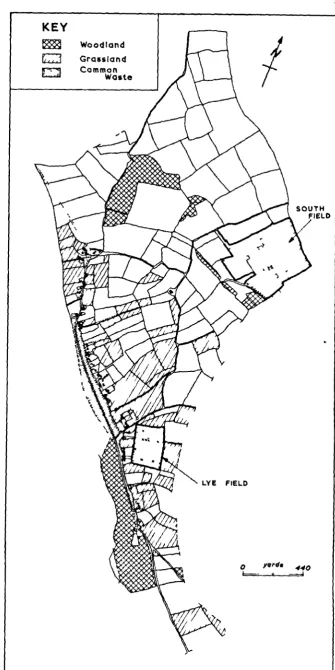
FIG. 1.
Little Ga4deeden
c.1800.
Soui'cea
19
The Arable Fields
Distribution of Enclosed and Common Arable
c.i8oci:—
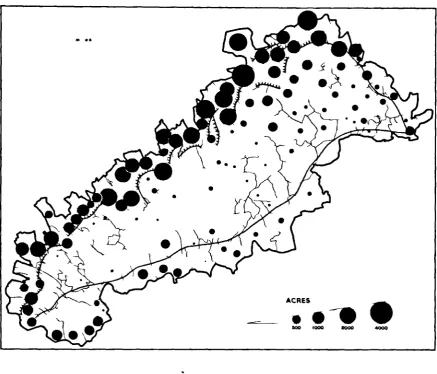
Throughout the Chilterns arable land was of two types. On the one hand, there were enclosed fields held in severalty, while on the other, there were the common arable fields that were divided , into a large number of open strips over which rights of commongrazing extended. Location of common arable land within and around the Chilterns about 1800 is summarised in Fig.2. 1 This is the only time for which a complete quantie distribution can be reconstructed. Two features of the resulting pattern are particularly distinctive, namely the contrast between the Chiltern dip-slope and the lowlands to the north and south, and the contrast within the Chilterns between the northeast and the southwest.
The Vale at the foot of the Chalk escarpment was an area of extensive open fields. 2 In comparison, the area of common arable land on the Chalk dip-slope was small. Within the strip parishes which encompassed Vale and Chiltern land, and which extended along the northwestern edge of the Chalk, much of that part of the township in the Vale was usually divided between large open fields, while the arable on the Hills was almost always enclosed in fields held in severalty.3. At the end of the eighteenth century, only two strip parishes, Crowell and Eflesborough, 5 included smaU common fields. on the Chiltern dip-slope. Where lowland embayments penetrate the escarpment, there were (1) Figure 2 is based on the Tithe Maps or, where enclosure preceded the Tithe Survey, on enclosure maps, supplemented by earlier estate maps. Most estate maps date from the eighteenth or early nineteenth century.
(2) The term "Vale" is used to describe all the lowland northwest of the chalk escarpment, both the Ickneild zone of loamy soils at the base of the scarp and the clay lands beyond.
(3) Pre-enclosure patterns in some Oxfordshire strip parishes have
recently been summarised in map form, VCH Oxon.,
7
(1962), 102;8
(196k),30,
67, 8i,
215.(1.) Tithe Map
Cal].
Tithe Maps referred to are deposited in the Tithe Redemption Office).• w
S
•••
L
..p
.4\
20
•
z.
ACRES
-500 1000 000 4000
2]
also large areas of open field land.
1
A few parishes in the northeast Chilterns which were mainly located on the dip-slope,but which also jncided the scarp face and a small area at the foot of the scarp, held. common fields on the Ickneild zone there.
2
In the northeast, the dip-slope of the Lower Chalk cuesta was an area of great strip fields which differed little from those of the Vale.3 Here the important break in field system types was the escarpmentformed by the Middle and Upper Chalk, Common arable land was also more extensive along the Thames terraces south of the Hills than within the Chilterns. There, most parishes combined the better soils of the river terraces with the more varied conditions of the lower edge of the dip-slope, the open arable land of the former contrasting with the predominantly enclosed arable of the latter.k
Within the Chilterns 1 the most significant difference was between the very small areas of common arable southwest of the Gade and the more extensive areas to the northeast. In general, the amount of common arable in the Hills about 1800, and the proportion o the arable land of the individual parish that lay in common fields, increased from southwest to northeast, a variation that corresponded with the topo-graphical differences already noted. The greater area of common arable in the northeast reflected more favourable conditions for settlement and cultivation.
On a more detailed scale, eighteenth and early nineteenth century maps show that common fields were often situated on some of the best farming land in a township. To the southwest, where a local relief of more than 300 feet is not uncommon, this was on the drift-covered ridge-tops and on the downwash zone along the lower valley slopes and bottoms, where reasonable depths of the loainier soils are mostly found.
(1) e.g. Princes Risborough, BuCM uncatalogued; Saunderton, BuRO
IR/61;
Wendover, BuRO IR/26; Aldbury, HRO 56 Lf76_7; Edlesborouh, BuRO
Ma/69/1-2;
and Luton, Tithe Map, BdRO MDD.1000, 1102, 1103.(2) e.g. Studbam,Tithe Maps, BdRO X3
03/1, X303/4 , X303/6-7,
MDD. BW1028-S
MDD.B1
977B,
NDD.BW98k;
Kensworth, BdRO enclosure Mar; and Caddington, BdRO MA6.
(3) e.g. Houghton Regis, Bd0 Enclosure Map; and Streatley, Tithe Map.
2
In Swyncombe and Stokenchurch, 1 two parishes that extend to the crest of the chalk outcrop and that include considerable areas over 500 feet above sea level, the common arable lay as single
blocks on the gently sloping surfaces above 700 feet. In Bix parish,2 at a lower general altitude but with an even more broken relief, the single common field was on a spur between two dry valleys. In contrast, at Hamble den3 and Bradenhanlk common arable land was situated along the lower slope 8 of the main valleys.
One of the main features of the relief of the area between the valleys of the Wye and the Gade is the relatively large area of plateau surface that remains there. Heavier soils, developed from the mantle of Clay-with-flints, are therefore more extensive in this part of the Chilterns. Here common fields were mostly on the lighter soils of the Chalk outcrop along valley slopes below the plateau remnants. Such was the site of the common arable of Great and Little Hampden (Fig.5), of Borsemoor field in Penn 5 , and of the four common fields around ColeshiJ.J. in Amershazn parish. 6 Some of the small common fields of the hamlets that made up Chesham parish were on ridge-tops between the valleys that converge at Chesham, but most were situated along the slopes. 7 Another distinctive feature of the central Chilterns is the large overdeepened valleys which have been cut right across the-dip..
slope. In all these troughs the location of common arable, and of other types of land use, followed the same basic pattern. As at Berkhamsted, common fields stretched from riverside meadows up the valley slopes, sometimes to the clays of the plateau surface above (Figs.36,
38,
ki).
East of the Gade there was no marked local pattern to the dist-ribution of common arable land at the end of the eighteenth century. Relief becomes more subdued and the loamy Brickeai-th soils become more
extensive, In some
townships
common fields were situated on the (1) Tithe Maps.(2) Tithe Naps. (3) Tithe Maps. (Lf) Tithe Map. (5) BuRO IR/77. (6) BuRO IR/12a. (7) Tithe Map.
Cl I
gentle slopes and low ridges of the lowest land in the parish -at Flam-atead they stretched up both sides of the Ver valley onto
two loam capped spurs between the main valley and two tributary dry valley
CFig.k). At King's Walden, on the other hand, strip fields were located in all parts of the township, on ridges and valley bottoms alike (Figs.
2k, 27, 29).
Local conditions of soil and relief were therefore reflected in the siting of common arable fields in the Chulterns about 1800. In the southwest, with its highly dissected topography, the main sites
were on the down.wash zone below the thin chalk soils of the valley slopes or on the gently sloping plateau surface above • Between the Wye and the Gade, on the other hand, the soils of the valley slopes were preferred to the heavier clays of the plateau, while east of the Gade
there was no real limit to the location of the common fields.
c.1600:- Eighteenth and early nineteenth century maps are the only source on which a complete distribution of common arable land within and around the Chilterns can be based. But the maps portray a system
in decay. Widespread piecemeal enclosure was taking place within the cznon fields, most of which were soon to disappear entirely. Through-out the Eills extensive areas of common arable land had already been enclosed by 1800. Sixteenth and seventeenth century rentals and surveys show that enclosure had been in progress for at least two and a half centuries. More than 700 acres of arable land lay in the common fields of Berkh1mRted and Northchurch at the beginning of the seventeenth century. 1 By the early nineteenth century, there was not more than 100 acres of common arable in the two parishes(Fig.38)2. Similarly, the common fields of Little Gaddesden contained at least 200 acres in 1609, but by 1802 only 14 acres of this remained unenclosed,4 while the 220 acres of common arable in Great Gaddesden at the
beginn-ing of the seventeenth century 5 had been reduced to 45 acres by 1729.6
(1) BM Lansd. MS.905, ff.95-124d. (2) Tithe Maps.
(3) imo 851.
(4) ERO 2858, 57310.
24
/0 MIeN
\Q
A.,' x
0
0 x
xx
0
x
x
xx
O
Par s.s wb.r. ornmen arabl. and was enc osed by A t of Por am.ntX
Parishes w th common arab.n the Ch terns c rca 6 0
71G.
3.
Parishes with common fields c.1600 and parishes where common arabic was enclosed b7 Act of Parliament.2
To the southwest, in Chesham where, as in many other parishes, even approximate acreages are difficult to arrive at, the greater number of common fields in the seventeenth century than in the nineteenth is sufficient to indicate the greater extent of common arable land there. Early seventeenth century manorial rentals name at least thirty common fields,1 whereas only scattered common pieces2 are shown on the nineteenth century Tithe Map, together totalling no more than 150 acres.3 The same pattern was repeated in the northeast. The manor of King's Langley included five or six common arable fields in
1555k
and again in 1619, which together containedat least forty acres. By
i8
ti.O, there were none in the parish.6 The i6o acres of common arable in the manor of Redbourne in 1692 was nearly150
acres more than in the parish ini8
1+i,° while in Kernel Hempatead, Plaunden and Bovingdon, the combined evidence of a survey of 1623 and various court documents and rentals forCi)
G. Eland, "The Shardeloes Muniments", RB, 1k (19k1-k6),210-33;
BuCM 76a/48, 13/60, 23/60.
(2) A "common piece s' consisted of a small group of unenclosed strips, all that remained after piecemeal enclosure of a former common field.
(3) Similarly, Penn glebe terriers for the years between 163k and. 1706 include "an acre of land in West field" in addition to land in Horsemoor field, BuRO D/A/GT Box 7. By
i8
LfO, West field had been enclosed, Tithe Map. Again, only one of the ten or more common fields named in a Great Missenden survey ofi6o6
was still unenclosed by the early nineteenth century, cf. PRO 122/210, if.243-87 and the Tithe Map; seventeenth century Hambleden contained at least five strip fields (BuCM 85/21; 397/22, Nos. 13-17, +i) but the Tithe Mapshows only
isolated common pieces; and three seventeenth century common fields in Bix (PRO 122/196, if. 186-7) and a common field in Fingest
(BURO D/A/GT Box k) were enclosed by the nineteenth century (Tithe Naps).
(k) HRO uncatalogued (1963). (5) I0 20108.
(6) Tithe Map. (7) HRO k1333. (8) Tithe Nap.
2
the manors of Westwick, Gorhambury and Pre, and HemeJ. Hempstead1
suggests the existence in the early seventeenth century of at least nine common fields. Although the total area of these nine fields was not very ar, it was certainly greater than the
22
acres of the few unenclosed strips shown on the Tithe Maps for these parishes. Similarly, Bramfield with at least seven common fields at the end of the sixteenth century2
and none in1838;
Sandridge with probably four coimnon fields at the beginning of the seventeenth century4
and none in18kk;
and Vlelwyn with at least six common fields in the seventeenth century6
and only two at the time of enclosure ini8o4,
all show that the area of common arable had diminished considerably by the nineteenth century. Even in Flamatead and King's Walden, both parishes with a relatively high proportion of arable in common at the end of the eighteenth century, a number of sixteenth and seventeenth century fields had been enclosed entirely, while the areas of those that survived were often much smaller (Fig.4
and27).
Clearly, during the three centuries after
1550,
the extent of common arable land in the Chilterns was greatly reduced. Thedistribution of land in common fields as shown on the eighteenth and nineteenth century maps was very different in amount to the dist-tribution of common arabia land at the end of the sixteenth century. Nonetheless the two main features apparent in the early nineteenth
cen-tury pattern of distribution were just as distinct at the end of the sixteenth century. The area of, common arable in Chilterns parishes was always much less than that in the Vale below the escarpment. This was so even in the northeast where amounts of common field land were greatest. Although common arable land was much more extensive about
1600,
it never dominated the landscape in the same way as the great open fields of the Vale did. Again, an increase in the area of common arable land in the Hills from southwest to northeast was equally apparent in1600
as in1800.
In fact the• (1) I0
13602-3, 13999-14008,
14011, 14015.
(2)
imo 40750, 40768, 40774-5, 40821, 40824.
(3) Tithe Map.
(4) ERO
40967, 41211.
(5) Tithe Map.(6) ifl0
411332, 46655B, 491 51 , 49427, 59091 ,
59150 , 59155,
60918, 60927.
27
Liuvat on In f••t
5 44
2
contrast was probably greater at the earlier date, because the effects of enclosure during the intervening two centuries were more marked in the northeast, where there was more arable to enclose. Even in the sixteenth century many townships west of the Wye valley contained little or no common arable land. But, although two main features of the distribution of common arable did not change between i600 and 1800, the widespread enclosure that was taking place must have had a profound influence on the nature of field systems in the Chilterns during this period. The possible effects of enclosure is a recurring theme in the following discussion of field systems and, in fact, poses the important problem of how far field systems after 1550 were continuations of earlier features, and how far they represented degeneration of earlier forms under the impact of enclosure.
The Importance of Common Arable Land
Common arable land was much more extensive in the Chilterns at the end of the sixteenth century than at the end of the
eighteenth century, and in the northeast Chilterns than it was in the southwest; but at all times and in every part of the Hills during the three centuries after
1550
a large part of the arable of every township was enclosed and held in severalty (Table I and Figs. 1,5,
6,29, 35, 41, 44).
Even in townships of the northeast, where the common arable was at its mostextensive, there were substantial amounts of enclosed arable land, while some townships in the southwest were enclosed entirely (Fig.
3).
Local variations were often considerable(Table 1). At the beginning of the seventeenth century, 18% of the arable at Berithamated lay in common fields, ccnpared with less than 1% in the neighbouring parishes of Hemel Hempstead, Bovingdon and Flaunden. Similarly,
9%
of the arable in the manor of Great Gaddesden about 1600 was common 1 whereas 29% of the Little Gaddesden arable lay in common field 5 . To the southwest, the proportion of common arable in the manor of Great Hampden in2
1653
was greater than that in the manors of Hyde and Holmer in the
Iissendens in 1606. In all ChiJ.tern manors, except some in the far
northeast, amounts of enclosed arable were greater than those of
common arable land in the sixteenth and seventeenth centuries. By
the nineteenth century, proportions of arabia in severalty had increased
further in every township as common fields and common wastes were
enclosed, and as private woods were grubbed-up for cultivation. There
were still wide local variations, however, arid the proportion of several
arable still decreased towards the northeast.
TABLE I
Proportions of enclosed arid common field land in some sixteenth and
seventeenth century surveys.
Location of area surveyed 1 Date
I
II
III
IV
Bix Swyncombe & Nuffield
1609
768
122
14
45
Great Hampden
1653
1154256
18
25
Gt. & Little Nissenden
01550 & 1606
1209
203
11+
16
Chesham
1652
793
202
20
28
Berkhamsted
ci600
3382
716
18
Great Gaddesden
oi600
2116
220
9
60
Little Gaddesden
1609
570
227
29
47
Hemel Hcmpstead
1622
7212
70
1
7
King's Langley
1619
1252
595
22
Redbourne
1692
2382
170
7
King's Walden
1568
370
730
66
91
Codicote
i546&1594
+69266
36
85
I.
Area of enclosed land in acres (enclosed wood excluded).
II,
Area of common field land in acres.
III.
Percentage of total land in common fields.
2
IV.
Percentage of tenants with common field holdings.
Sources:- Bix, Swyncombe and Nuffield, PRO E3 1 5/388 ff.5,
7,
47, 55...65:
Great Hanipden, BuRO D/MH 28/2: Great and Little Missenden, PRO E315/406
ff.9-13; LR2/210, ff.150-69, 243-87; Chesham, BuCM 76a/48; Berkhamsted,
BM Lansd. Ns .905, ff.95- 1 24d ; Great Gaddesden, IO 1162, 1434,
Little Gaddesden, imo 851; Hemel Hempstead, PRO U2/216, £f.39-70;
King's Langley, imO 20108; Redbourne, ERO 41333; King's Walden,
BM Add. R.
35853,35996; Codicote, BM Add. Ms. 40735, PRO c1k2/236/97.
(1) The sequence is from southwest to northeast.
PIG.
5.
The Hampdene -relief and land uae c.180( Source.:- a map of the manor of Great Hampden,17k1, in the Hanpden Eatate Office; BM Me. drawing. let. ed. 0.S. One-Inch Map; and the Tithe Map.
ommon Arobe mm wastej
Wood and
Wooded Parkiond ONEMILE
PorkInd
30
0
MILES
Elevation tfl feet 600 - 650
over 750 550-600 700-750 500-550 650-700 under 500
3
The significance of common arable land in the field arrange-ments of Chiltern townships cannot, however, be judged from the amount and proportion of this land alone. The extent to which the common arable was apportioned amongst the landholders in a township was also important. Common fields were a more significant feature of the field system where a large number of tenants shared land in them, than where strip holding was confined to a few men. A small area of common arable shared by a large number of tenants might be just as important as a larger area shared by fewer men. The percent .-age of the total number of arable tenants in a parish or manor who had a common arable holding can, therei'ore, also suggest the relative importance of the common fields in that area.
On this basis, it is clear that in the Chilterns, in the sixteenth and seventeenth centuries, the significance of the common arable in the local farm economy was greater than its actual extent would imply. The proportion of tenants mentioned in a rental or survey as holding land in the common fields, was usually higher than .ne proportion of the cultivated land that lay in common (Table I). In BerIchamsted, for example, 56% of those tenants with more than one acre of land held strips in the common fields, although these fields accounted for less than 18% of ail cultivated land named in the survey. At Great Gaddesden nearby, the difference was even greater. There 60% of the tenants of the manor held land in common fields which occupied less than 10% of the cultivated acreage. Similar variations occurred at Codicote and King's Walden in the northeast, and at the Hampdens to the southwest. But although common field holdings were more important than the total amount of common field land alone suggests, and although there were wide local variations, the general pattern was still the same in that
33
The Nature of the Common Arable
The Strips:- The basic unit of cultivation in the common arable was the individual strip, piece and headland. There was greater uniformity of strip size in the Chilterns during the sixteenth century than in the early nineteenth century, but in many townships the later pattern of numerous large pieces1 had already begun to appear as a result of he consolidation of holdings. Average seventeenth century strips ranged from one rood to three acres, varying from parish to parish. In
Berkhamsted 2 and in Cheshain, 3 the commonest sizes for individual strips and pieces were combinations of acres and half acres to form a unit rarely larger than three acres - there were a few pieces as big as ten acres and as small as half a rood. Elsewhere, strips were often smaller and the range of variation was less. A survey of the Great Gaddesden demesne
lists 21 common arable pieces, of which ten were one acre or more, but none was larger than 14 acres. Similarly, in Little Gaddesden the customary acre and half acre were the commonest units. A survey made at the end of the sixteenth century includes ninety common field pieces. 5 Eighteen of these exceeded one acre, but there were also more than forty customary half acres.
In King's Walden, on the other hand, there were signs, by the second half of the sixteenth century, that many strips had been
enlarged through the consolidation of holdings. Customary acres and half acres were still by far the most numerous - the copyhold of John Sibley in 1568, for example, lay in 39 pieces of which over half were single acre strips6 - but combinations of these frequently occurred to form larger pieces. Thus, although 17 of the 25 strips of the copy-hold of John Campkyn were half acre units in 1568, eleven of the 17 lay
together in four blocks.7
(1) "Piece" is used here to describe open units of land within the common fields formed by the consolidation of a number of strips.
(2) PRo E315/36, ff.1-66; E315/366, ff.1-78; BM Lansd. Ms.905, ff.9512LId. (3) BuCH ST69-76/k8, 76a/k8, 77/48, 1-18/56, Li_31+/60, AS, CS.
(Lf) ERO 116k, 111.3k.
(5) RO 896.
34
LAN F OR RMER - AN
MA S
w.t
F.d
:e
a.
b.
BuAc.oft
r..-th,.
I
Bothon, .SetP.op . p.
D CHEQUER S LAN
I P. Pa ii End Fid • I.J
P ' r
.
-& 120?E$
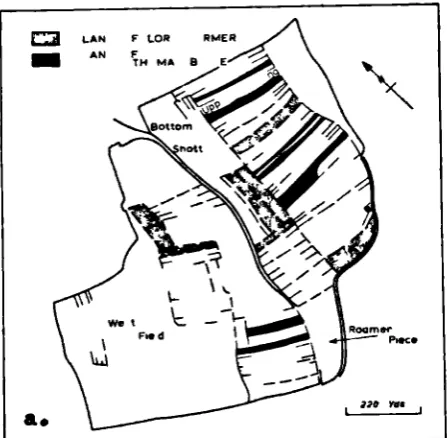
FIG. 7. Two areas of common arabli in the central Chilterns c.1650. a. in Great Kaiupden b. in upper Ellesborough.
.) ,.J I
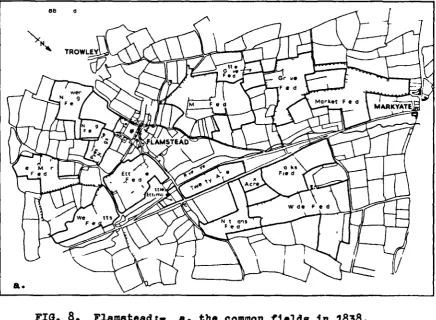
The eighteenth and early nineteenth century maps show this process ofstrip enlargement at a more advanced stage throughout the Hills. Strip sizes in the Hanipdens, in 17k1, ranged from a quarter acre to 13/2 acres (Fig. 6). A century later there were 19 acre and 20 acre pieces in the common fields of Flamstead2 (Fig. 8) and Studham respectively, while a range similar to that at the Hampdens is shown on the Tithe Maps, among the nine pieces of the single common field in Bix, and among the seven pieces of Stokenchurch field. Furlongs and Shots:- In many of those Chiltern parishes where common arable land was fairly extensive and the common fields were relatively large, individual strips and pieces were often grouped into furlongs or shots. The evidence for Little Gaddesden is particularly clear in this respect. There the furlongs are
referred to in xrianorial documents 3 as stadia, guarentena or cultura. There were at least 21 furlongs in North field, eleven in South field and five in Church field. Often culturae only existed in the larger fields. In Little Gaddesden no furlongs are named in Lye field, while in Great Gaddesden only North field, with a minimum of four
furlongs, and Mill field, were described as being subdivided thus.k Similarly, at High Wycornbe, furlongs are referred to in only six of the 19 or more common fields; 5 at the manor of Redbourne in 1692, culturae are described only for Ley field; while at Chesham7 and at Berkhanisted where common fields were numerous although fairly small, there is no reference to furlongs within them. But the fact that furlongs are not mentioned in descriptions of common arable land does not necessarily mean that strips were not grouped
(1) Map in the Hampden Estate Office. (2) Tithe Map.
(3) O 896
(k) imo 1162
(5) CCA Cap.1/29/1,3,6. They were Hawfield, Combes, Great and Little Asheridge, West field and Rye field (at least five furlongs).
(6) HRO k1333.
(7) BuCM 69-76/8, 765/k8, 77/L f8, 1-18/56, k.3Li./6O, AS, C5.
(8) PRO E3 1 5/365, ff.1-66; E315/366, ff.1-78; BM Lanad.
3(
in this way. It may be that, because common fields in the Chilterns were small, assignation of land to the field alone was sufficient to locate it precisely. In the open field townships of the Vale, on the other hand, descriptions of land in terms of one of three or four great fields was not enough, and the furlong in which the land lay was usually also referred to.1
In the northeast, the term "shot" was used more widely than the "furlong" that was preferred further west, and there, too, shots and furlongs were mentioned far more frequently than in common arable land southwest of' the LeaIn general, the more extensive the common arabia and the larger the common fields, the more frequently do shots and furlongs occur in descriptions of land within them. In a few town-ships in the northeast, in fact, the 'urlong appears to have been more important than the field as a common arable unit. At Offley,2 Lille? and Kensworth holdings were frequently described in terms of furlongs alone, although between twenty and thirty common fields were also referred to from time to time in each of the three parishes. Sometimes the land of a single holding was detailed in court roll, survey or terrier partly in terms of furlongs alone and partly in terms of furlongs within the fields. The pattern was very confused, but clearly the furlong was at least as significant as the field there.
Another factor tending to confuse was an occasional ambiguity in the use of terms to describe common arabJ.e land. A furlong or a shot was sometimes a complete common field rather than a subdivision • within a field. Elmore Land shot in Weiwyn and Much Furlong in.
Berkhamsted (Figs.
18
and ki) were both common fields in their own right in the seventeenth century, while many of the common arablernits in Lilley, Offley and Kensworth were sometimes described as furlongs and sometimes as fields. But use of the terms "furlong" and "shot" was not confined to descriptions of common arable land.
(1) e.g. in a terrier of land in Pitstone of
1555,
BuCM P30/2. (2) IIROk8407-29, 72351, DE2952, DE2659-702;
BM EgertonMs.1938,
.F.52d et seq.(3)
I0 k7552-900.
3,
They were also sometimes enclosed fields held in severalty, ranging in size from nine acres to more than thirty acres. The two closes called Sheepcoat Furlong and Heaton Furlong, in Great Hampden in 17k1, contained 1i4 acres and ten acres respectively (Fig.6); Saunse Furlong in Eerkhainsted was two closes that together contained thirty
I
acres; ?Iead Furlong in Hemel Rempatead was three closes of 23 acres, and another three closes there in 1622-23 were also called furlongs.2 The origin of enclosed furlongs is not clear from seventeenth century evidence. Some may have been taken from the common fields as
furlong blocks, which may for a time have continued as a unit of strips. This procedure can be followed at a later date in Stevenage, where by i85i Winding Balk and Folly Shot were named as individual common arable pieces rather than as the subdivisions of Chalk Dell field that they clearly were in Alternatively, some furlongs held in severalty may have been enclosed directly from the waste as single units, and, although they may at first have been divided into strips, they remained separate from larger blocks o± common arable land. Whatever their origin, the existence of enclosed furlongs and shots in the Chilterns after 1550 emphasises the danger of assuming the existence of common fields from the occurence of terms usually associated with common field land.
The Fields:- It has been suggested that in Midland townships "th iit of cropping, especially in the corn field proper, was the furlong and not the whole field, so making cropping far more flexible than
one could otherwise have got".
5
This was not the case in the Chilterns. (1) EM Lansd. Ms. 905, f.101.(2) PRO LR2/216, ff.39-70. Some other examples of enclosed furlongs were a lOa. close in Little Missenden in 160k, PRO LR2/210, ff.150-169; two closes which together contained 15a. in King's Langley in 1618, HRO
20108; and two closes of 16a. and ha, in Nuffield, Bod. Ms. Maps Oxon. a.2.. (3) Tithe Map.
(k)
io k
665, 7258-9.(5) W.G. Hoskins, "The Midland PeasantV
(1957),
156. The suggestionthat the furlong was the most significant unit of common arable cropping was first made by N.S.B. Gras, "The Economic and Social Structure of
an English Village", (1930), 31; and subsequent1y stressed by R.H. Hilton, "The econonic dev1opment of some Leicestershire estates in the fourteenth and fifteenth centuries", University of Oxford D. Phil. thesis (19k0),
38
FIG.
8.
Flamstead:- a. the common fields in1838.
Source:- the Tithe Map. b. Market Street Farm in1756.
Source:- ERO 173Of.
b.
K
M F.4
220 r.
3
There the field was usually the most important grouping of common arable strips and pLeces. The evidence of communal cropping
arrangements and of the organisation of common pasturing on the arable is that the field was the unit of enforcement. A variety of crops might be grown in a single common field at any one time, but they were all crops of the same season, sown and harvested at approximately the same time . Even at Offley and Kensworth, shots were grouped
into fields, each of which lay fallow every third year, 2 and in Little Gaddesde; regulation of common pasturing and of the three-course
rotation was always by fields. 3 The importance of the field in the Chilterns can be explained partly by the presence of large areas of enclosed arable - it was only rarely that an entire farm holding consisted of common arable, and so cropping on the holding was not tied to the common arable routine to the same extent as in the Midland open field township - and partly by the character of Chiltern common fields, which was such as to allow flexible cropping and pasturing between them.
The common fields of a typical Chiltern parish were small and numerous, numbers varying at the end of the sixteenth century from the four fields of Bix4 in the southwest, to over thirty fields in the Cheshaxn hamlets, 5 and more than forty in the two Berkhamsted parishes. 6 In general, the greater the area of common arable the
more numerous the fields into which it was divided. The average number of common fields in townships of the central and northeast Chilterns --usually between twenty and thirty fields - was therefore larger than that of the southwest. Twenty four were named in a Codicote survey
of i,1 67 and in the manor of Redbourne in 1692. There were at
(1) See below, p.66. (2) See below, p.67-8. (3) See below, p.67.
(4) PRO LR2/196, ff.185-90.
(5) BuCM 69-76/48, 76a/48, 77/48, 1-18/56, 4-34/60, AS, CS.
(6) PRO E3 1 5/365, ff.1-66; E315/366, ff.1-78; BM lamed. Ms.905,
ff.95-124d.
4
least 26 fields in King's Walden in 1568, and still as many as 18
two hundred years later on the eve of parliamentary enclosure •
But there was considerable local variation. The manor of Kings
Langley, with common amble land in eight fields in 1555,2 and the
manor of Hemel Hempstead, with nine common fields in 1622-23, although
in the eastern Chulterns, were more typical of manors further west.
To the southwest, common fields, although fewer in number than
wasgeneral east of the Chess, were still relatively prolific. Thirteen
are named in the 1606 survey of the manor of Missenden Magna Hyde;4
the parishes of Great and Little Haxnpden shared five in 1653
;5while
there is evidence for the existence of at least three common. fields
in Penn6 in the seventeenth century. ' Strip fields were still
numerous in many townships, particulariy in the northeast, at the
beginning of the nineteenth century, even although many fields had.
already been enclosed completely.
Such a surfeit of common fields was linked to some extent with
the disintegration of an earlier pattern. Fields were being
broken-up into smaller units, which were still cultivated in common, and
which were sometimes the shots, furlongs and pièces of the former
fields. At Great Missenden, Heavon field had been divided into
Great, Middle and Little Heavon field by the beginning of the
seven-teenth century, while Little and Middle Wide Field were distinguished
(1)
o
40591-2, 51440-572.(2) ERO tlncatalogued (1963).
(3) PRO 122/216, ff.39-70.
(4) At least three of these common fields were in Chesham parish
and not in the township of Great Missenden, PRO 1R2/210, ff.243-88.
Other descriptions of common field land in Great Missenden are the
former holdings of Missenden Abbey, PRO 1315/405; E315/kO6.
(5) BuRO D/MH 28/2.
(6) J.G. Jenkins, "A History of the Parish of Penn", (1935), 78-90.
(7) 1'urther examples of the maximum number of common arable fields in
a township after 1550 include (starting in the southwest):- at least
7
in Hambleden, BuCM 85-89/2 1,
397/22
No's 13-17, 41: one in Fingest,
BuRO D/A/GT Box 1+: 19 in High Wycombe, CCA Cap. 1/29/1, 3,
6:
3 in
Hughenden, BuRO D/MH 15/10: 5 in Little Gaddesden, hO 8i: 15 in
Studham, BdRO DD.BW 966-9; 16 in Great Gaddesden, iO 11-66,
1162:
24 in Flamstead, BM Add. Ms.6035: 14 in Caddington, PRO SC 12/28/6;
HRO 1 1992-3; St. Paul's Press No.12, wc
6;
more than 40 in
41
from the rest of aide Field. 1 Similarly, Nil], field in Great Gaddesden was, by the end of the sixteenth century, subdivided into three smaller units and. at least three common fields in Berkhaxnsted had been broken up in this way. 3 A century later, two Redbourne fields had disintegrated into six smaller groups of strips, that were still called fields. The breakdown of common fields was associated with piecemeal enclosure from them. Seventeenth century rentals for Chesham mention Town field, Hither Town field and Further Town field.5 By mid-century, two closes had been taken from Town field, 6 and by
169i.,
four one acre closes were described as "before parcels of land called Town field and Dungrove fjt•7 Disintegration and enclosure were complementary; but the nature of the link between the two is not clear. Tt has been suggested that the breakdown of common fields resulted from enclosure. Gray's study of the later history of his Midland system implies that piecemeal enclosure and consolidation led to an increase in the number of open fields, 8 whilst F.G. Eminison has tried to show that the large number of fields in the Bedfordshire parish of Colmworth in 1838 was theiesult of the disintegration of an earlier organisation through private enclosure and consolidation.9 No firm conclusion can be reached from the Chiltern evidence. It may be that, in fact, subdivision of common fields sometimes preceded enclosure of land from them, perhaps to allow greater fleDdbility in cropping and grazing arrangements, and that this subdivision encouraged and facilitated enclosure. On the other hand, the two procedures were often continuing side by side. One did not necessarily precede the (1) PRO LR2/210, ff.2k3-88; E315/O6.(2) BRO 1162.
(3) They were Salmons field, Mill field and Abingdon field, PRO E315/366, ff. 1-78.
(k) These were Spencers field and Booth field, }1RO k1333. (5) BuCM 76a/48, c5.
(6) BuCM 76a/k8,
13/60, lk/6o,
23/60. (7) BuRO SZ/9I/1.(8) H.L. Gray, op.cit, 127-57.
(9) F.G. Emmison, "ypes of Open Field Parishes in the MidlandsV
4; other. Some fields in which piecemeal enclosure was widespread did
not break-up into smaller units.
1
Conversely, there is somtimes no evidence of enclosure in fields that had been subdivided. Subdivision and enclosure were two symptoms of a single process, the break-up of an earlier pattern of common fields, and, whatever the nature of the link bet'ieen the two, they .'ere clearly closely associated.At the sar.e time as the extent of common arable land was being reduced by enclosure, an enclosure often of complete strip fields, the large number of common fields in a tovnship was often maintained, at least for a time, by the acconpanjing division of the surviving fields. TIe 13 common fields of King's Walden at the end of the eighteenth century
3
were only six fewer than at the end of the sixteenth century, although the area of common ar-a ble land in the township had been more than halved (Fig.27).
Between1568
and about 1790, a number of small searate common arable units appeared. These, like White Piece Common, Stile Piece Common and Two Piece Conimon, had formerly been part of larger fields, but they were now themselves referred to as common fields.Within individual townships there was wide variation in common field sizes (Figs. 1,
6, 8, 29, 35,
ki).
In the manor of Redbourne in1692,
with land in2k
common fields, one quarter of the common arable holdings vtere in Ley field, which was twice as large as any other single field (Table Ix). The rei-ttive sizes of common fields also varied, as some fields were reduced by piecemeal enclosure more than others. At King's Walden, by the end of the eighteenth century, less land had been enclosed from Wooden field than Leggats field (Figs.27, 29).
Tenurial subdivision was also greater in some fields than in others. The number of holdings in fields ofapproximately the same size might vary considerably. At Great
(1) e.g. Royden field in King's Walden. Cf. BM Add. R.
35853x
andF0
51k79,
51k89-528.
Gaddesden about 1600, 13)4 acres in Mill field was divided between 1k tenants, whereas the same amount of land in Dunn field was shared by seven tenants - the average holding in Dunn field was almost twice as large as that in Mill field (Table Viii).
Similarly, in Kings' Walden the 51+ acres in Wooden field, listed in surveys of
1568,
was farmed by seven men, whereas the same number of tenants held only 191/2 acres in Wandoza field (Table XII). Differences in the average holding size from field to field were characteristic in varying degrees of every Chiltern parish with common arable land; a difference which may to some extent have reflected the consolidation of holdings that was taking place.- The distribution of common arable holdings between common fields suggests that in many townships there were distinct groups of common fields. Although these groups were not necessarily isolated from each other physically, the common arable land was divided into a
number of portions within which holdings were concentrated. Common arable at Berkhamsted lay in an almost continuous belt along the
slopes of the valley of the Bulbourne (pig.4l), but the location of individual holdings sho'zs that within this area the fields were in three groups, namely those around Northchurch, those around the town of Berkhamsted, and those around Bourne End and Little Heath (Table XVIII). The main distinction at Great Gaddesden was between common
fields north of the village and those to the south, although here too, common arable land extended in a fairly continuous tract along both slopes of the Gade valley (Table VIII). in King's Walden, the single area of common arable was divided between three main groups of common fields, one each in the north, centre and south of the parish (Fig.28 and Table xii). Again there were two groups of
Thus there were two comion field areas in Knebworth in 1732;1 one consisting of seven fields lay in the west of the parish, the other comprising three fields, was to the south of the village. No tenant held land in both. 2 There were also tvio distinct sets of common fields at Studharn. One lay on the Chiltern plateau, while the other was in the gap vhich breaches the Chalk scarp there. 3 As late as 18 1+9_53 no Studham landholder had pieces in both groups.
Balks, Hedges and Ley Pieces:- Balks, that is pieces of uncultivated land, existed in common arable throughout the Chilterns, as the constant reference in court rolls to encroachment on common field balks, 5 and frequent regulations for their maintenance show.° At Great Gaddesden in 1727, almost of a common arable holding was in balks.7
In general they had three main functions. The most obvious of these was as a boundary within the common arable. The 1602 glebe terrier of Bix, for example, describes glebe land in Bix common field as "divided by meare baulka from the rest of the fjl10 and it was noted at Offley, in 1673, that a series of old orders forbade the keeping of any cattle "between any baulka in any come field" during the growing season. 9 It is
difficult to judge, from these chance entries, the nature of the pieces within the common fields that were separated by baulks, whether in fact they were shots and furlongs, or were smaller units of land. The latter seems to have been the case at Wheathampstead. An account of land in Pickford field in 17k3 mentions that "there were nine pieces in Pickford corilmon but my father exchanged one piece with Coawel]. Farm, which piece that he had from Coswell lay next to one of the above pieces, and so the
(1) E0 k7258-9. (2) HRO Li6655B.
(3) BdRO X303/1, k, 6-7, MDD.BW 1028-9, MDD.B111 98k; Tithe Maps. (Li) Tithe Apportionments.
(5) e.g. a tenant of Little Hampden was said to have encroach$ "on that Bawe in Corte feld gayng up the hyll", BuCN k15/39, 21st. Jan. lOEliz.
(6) e.g. in 1605, all tenants of common field land in Flamstead were ordered to "mend or reform their several mounds there", BM Add. Ms.6035. (7) Ploughed land totalled k 1i-a.Or.17p. while balks were la.3r.7p, HRO 13221. (8) Bod. b.LIO, 1.51; c.lkl, f.9; Ms. Top. Oxon. C.55, 1.192.