Factors Predicting the Physical Activity Behavior based on Theory of Reasoned
Action among Chronic Low Back Pain of the Patients Referring to
Comprehensive Health Service Centers in the Shahid Beheshti University of
Medical Sciences in Tehran, Iran.
Short running: Physical Activity behavior of Chronic Low Back Pain prediction
Mohammad Hossein Delshad1, Alireza Hidarnia2*, Fatemeh Pourhaji3
1. Postdoctoral Fellow/ Assistant Research of Health Education and Health Promotion Department,
Faculty of Medical Sciences, Tarbiat Modares University, Tehran, Iran. ([email protected])
2. Professor of Health Education and Health Promotion Department, Faculty of Medical Sciences, Tarbiat
Modares University,Tehran,Iran.( [email protected])
3. Postdoctoral Fellow / Assistant Research of Health Education and Health Promotion Department,
Faculty of Medical Sciences, Tarbiat Modares University, Tehran, Iran.
Corresponding author:
* Alireza Hidarnia
Department of Health Education and Health Promotion, Faculty of Medical Sciences, Tarbiat Modares
University, Tehran, Iran.
No 215, Department of Health Education and Health Promotion, Faculty of Medical Sciences, Tarbiat Modares University, Ghisa st., Jalae Ale Ahmd Ave , Tehran, Iran .
P.O. BOX: 14115-111
Tel:+98 (21) 82883817
Fax: +98 (21) 82883817
E-mail:[email protected]
Abstract
Background: Low-level physical activity (PA) among Chronic Low Back Pain (cLBP) is associated with
various biopsychosocial factors, and PA is effective in the domains of quality of life (QoL).
Objectives: This research aimed to study the predictors of physical activity behavior among cLBP
patients referred to comprehensive health service centers in the Shahid Beheshti University of Medical
Sciences (SBUMS) in Tehran, Iran.
Methods: In the present study 280 eligible patients with cLBP who referred to comprehensive health
service centers in the SBUMS in Tehran, Iran from 13 January to 11 March 2019 were random selected.
To diagnose the predictors of PA behavior, all the Theory of Reasoned Action (TRA) constructs were
examined as risk factors to see if they influence on the probability of PA behavior occurrence and were
interpreted through odds ratio (OR). SPSS version 21 was used to analyze the data.
Results: Totally 280 cLBP patients with mean age of 57.07 ±13.09 years old participated in the study.
This study showed that intention was significant predictor for perform the PA behavior OR (%95CI):
1.431(1.148-1.714), p-value <0.001), behavior beliefs could predictor for attitude OR (%95CI):
1.276(1.112-1.427), p-value= <0.001). attitude, normative beliefs, subjective norm ,and evaluation
outcome behavior could predictors the cLBP patients for intention to perform the PA behavior OR
(%95CI): 1.189(1.033-1.367), p-value=0.016)., OR (%95CI): 1.158(1.08-2.208), p-value<0.001) ., OR
(%95CI):1.104(1.08-1.128), p-value=0.003) ., OR (%95CI): 0.814(0.74-1.554), p-value<0.001), but
motivation to comply could predict the cLBP patients for subjective norm OR (%95CI):
1.077(0.891-1.263), p-value=0.093).
Conclusion: This study showed that the cLBP patients who were normative beliefs and evaluation
regarding PA behavior could effect on the intention to engage in greater PA than those with other
constructs.
Key words: Exercise, Health Behavior, Attitudes, Referral, Quality of Life, Low Back Pain, Health
Services, Models, Outcome Assessment (Health Care).
Introduction
A lot of the population suffers from Chronic Low Back Pain (cLBP). cLBP is a costly and
prevalent condition could want to physical disabilities, social and mental health
engagement1, cLBP is determined through a complicated interaction among pain,
behavior and biopsychosocial factors2.
Although, there are several treatment procedures to improve cLBP, cLBP control and
management programs to be more effective than others support to change behavior2.
Physical Activity (PA) is observed as an effective intervention in the management of
cLBP patients3. Clinical guidelines presented that PA is an integral component of pain
rehabilitation services in physiotherapy exercise that is aimed a helping a patient
recover from health difficulties4. Although PA education have been shown to benefit
cLBP patients. Physical inactivity is one of the most crucial factors in worldwide5.
Theory of Reasoned Action (TRA) is one of theory for prediction a significant amount of
variance for intentions, investigates that individuals health behaviors are decided by
their attitudes toward the behaviors and other its’ constructs6. This theory claims that
individuals consider the implications of their actions before deciding to engage or
disengage in any given behavior. They confirm the role of thoughts in decision making
about engaging in behaviors7.
The individuals who have positive beliefs and evaluation regarding outcomes of PA
behavior are much more likely to do healthy behavior8. this theory check that healthy
behaviors will be predicted by the subjective norm9.
PA Behavior and predicted effective factors should be observed 8. evidence showed
that patients' perceptions of the social cognition and social environment effected on
PA10.
Social cognitive concept (SCT) proposed that patients' behavior occurred even as each
individual-level cognitive factors interacted with the environmental factors11.
In this regard, the present study aimed at the predictors of physical activity behavior
among cLBP patients referred to comprehensive health service centers in the Shahid
Beheshti University of Medical Sciences (SBUMS) in Tehran, Iran.
Materials and methods
Gemini Study and participants:
This study was done among the patients who referred to comprehensive health service
centers in the three health networks of North, East and Shemiranat area of Tehran and
were affiliated to Shahid Beheshti University of Medical Sciences (SBUMS) in Tehran,
Iran, from 13 January to 11 March 2019. All ethical subjects were considered. After
describing the aims and methods, all patients were satisfied to be studied and
voluntarily signed the written consent form. Research Ethics Committee of Tarbiat
Modares University approved the study on July 2019 with ID: IR.TMU.REC.1398.581
and Trial Identification Number in Thai Clinical Trials Registry was TCTR20190728001.
In the present study 400 patients with cLBP who were visited by the physician 280
eligible patients with cLBP eligible for the study were randomly selected. Figure 1 shows
writing ability in Persian language /Patients with chronic low back pain for at least 12
weeks/ having mental health. Excluding criteria were as Patients who are mentally
retarded/ patients with acute or proprioceptive low back pain/ patients with a history of
surgery, fracture and inflammation in their spine/ patients suffering from congenital
tumors or congenital anomalies, rheumatoid diseases and constriction history in the
spine/ Psychological Problems/ Pregnancy/ Infection/ Depression. To identification the
predictors of PA behavior(Figure 2), all the Theory of Reasoned Action (TRA) constructs
were examined as risk factors to see if they influence on the probability of PA behavior
occurrence and were interpreted through odds ratio (OR). SPSS version 21 was used to
analyze the data. The odds ratio was used to determine whether particular exposures
like TRA constructs could be risk factors for occurrence of the outcome like PA14. The
sample size was calculated based on following formula (Figure 3) with the parameter
from previous document that has been conducted in Iran, were used.
Study Design
In this cross section study, the demographic questionnaire, questionnaires based on
TRA regarding PA behaviors were used. TRA constructs questionnaire consist of 8
subscales according to TRA constructs (Figure 2). The PA behavior questionnaire was
discerned using a 14-item questionnaire. Sufficient PA behaviors were defined as 3
times per week more than half an hour.
Qualitative and quantitative approaches were applied by 15 patients with cLBP to
assess facial validity of TRA constructs questionnaire through which all their
recommendations were inserted into the questionnaire. To confirm the content validity
education, health psychologist, psychometric, physical medicine, and pain experts
checked all the survey items by which The CVI value of ≥0.79 was observed acceptable
for each item. The reliability was determined through Cranach's alpha coefficient that
was in acceptable range of 0.70 to 0.88 in 8 subscales according to TRA constructs.
Cranach's alpha was obtained as 0. 78. The study questionnaire questions with 7-point
scale according to Heidari's study12.
Statistical analyses
To determine the relationship between different TRA constructs with each other and
with PA behavior, R Spearman was apply because K-S test displayed the data were
non parametric. To predict the factors influencing PA behaviors logistic regression
analysis was applied. Lower odds of PA (P <0.05) was considered statistically
significant.
Results
Socio-Demographic Variables
Totally 400 patients with cLBP recruited of which 280 persons who were visited by the
physician and they had inclusion criteria of the study, took part in the study and filled the
questionnaires. The means age of the patients was 57.7 years (SD=13.09) and most of
them were between 40 and 49 years old (33.2%). Overall, 38.2% of the patients with
cLBP (N=145) were housewives. Table 1 show all socio demographic data as well as
the Mean (SD) of all studied variables based on TRA.
Logistics’ correlation tests were used to evaluate the relevance between the constructs
table shows, there were a direct significant correlation between behavior beliefs and
attitude with intention. So that the patients who normative beliefs were more likely to
the predictor for subjective norms significantly (p-value < 0.001).
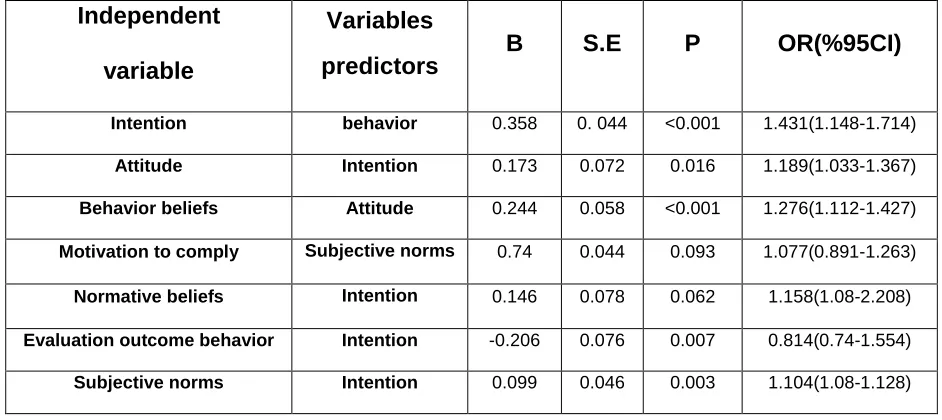
As Table 3 shows, this study showed that intention was significant predictor for perform the
PA behavior OR (%95CI): 1.431(1.148-1.714), p-value <0.001), behavior beliefs could
predictor for attitude OR (%95CI): 1.276(1.112-1.427), p-value= <0.001). attitude, normative
beliefs, subjective norm and evaluation outcome behavior could predictors the cLBP patients for
intention to perform the PA behavior OR (%95CI): 1.189(1.033-1.367), p-value=0.016)., OR
(%95CI): 1.158(1.08-2.208), p-value<0.001) ., OR (%95CI):1.104(1.08-1.128), p-value=0.003) .,
OR (%95CI): 0.814(0.74-1.554), p-value<0.001), but motivation to comply could predict the
cLBP patients for subjective norm OR (%95CI): 1.077(0.891-1.263), p-value=0.093).
Discussion
To better understand why adult individuals do not engage in PA is currently guaranteed
for researchers and professionals 13.This study was carried out to address this
challenge through predicting factors of PA behavior among Iranian patients with cLBP
Referring to Comprehensive Health Service Centers of SBUMS. According to the
results of this study, Subjective norm was the most important predictors of PA behavior
among patients with cLBP. Subjective norm refers to one’s belief that most of the
significant others in one’s life think one should or should not perform the PA
behavior7.On the other hand, Attitude means the overall feeling of like or dislike toward
any given PA behavior7.
The results of this study are in the line of results protected from previous study12 as well
as the role of subjective norm and attitude were determined as influencing factors for
theoretical assumptions of the theory of reasoned action14. In Carvalho's study, people
who did not have a good attitude toward physical activity prevented their physical
activity15. Moreover, in accordance with the present study, numerous studies have
revealed that subjective norm has been as the best predictor variable for actual PA16-17.
Therefore, strategies for raising subjective norm, such as strengthening subjective norm
through Role Playing and focus groups discussion could lead to more effective health
promotion programs for Iranian cLBP patients and should be considered in future
intervention18.Motivation to comply was as the predictor variable for subjective norm but
hidari study Motivation to comply was as the predictor variable for actual intention12.
Normative beliefs means How a person thinks that other people beliefs who are
significant in his or her life would like him or her to behave7 and Motivation Degree
means to which a person wants to act to comply in accordance with the perceived
wishes of those significant in his or her life7. These programs could propose that highly
individuals has normative beliefs and evaluation outcome behavior exert greater efforts
to master PA behaviors and persist longer in the face of obstacles to such the intention
of doing PA behavior and PA behavior. Alison in their study showed that normative
beliefs are predictors of persistence of physical activity19. Thus, studies have shown that
positive social life is a good predictor of PA20.
Behavioral Beliefs means that performing a given PA behavior beliefs leads to certain
outcomes7. Behavioral beliefs with higher human self-concept are more engaged in
PA21. Furthermore, in the present study, it was verified that the patients' behavior beliefs
could be a predictor of patients' towards PA likes Kirks study22. Ajzen noted that
This finding is supported by many preceding researches which found that individuals
who more patients' beliefs about PA and they're self- evaluation regarding the outcome
of PA to the performance of PA are more likely to do this behavior24-25.
Outcome evaluations means Value a person places on each outcome resulting from
performance of the PA behavior7. Outcome evaluation emphasizes that; encouraging
patients with cLBP to do preventive behaviors of chronic low back pain, it is better to
highlight the benefits and positive outcomes of doing preventive PA behaviors to
improve chronic low back pain. Previous evidence verified that preventive behaviors of
chronic low back pain behavior could influence CLBP improvement 26.
This study showed that the patients who were positive beliefs and evaluation regarding
outcomes of PA behavior were more like to perform this behavior. Therefore, Cognitive,
behavioral, and psychological factors can contribute to the experience of pain among
patients with cLBP. One of the psychotherapy interventions is cognitive-behavioral
therapy (CBT), which is an effective treatment for chronic general pain, especially low
back pain27. Cognitive-behavioral interventions are very useful in modifying health
beliefs and behaviors as well as eliminating risk factors28. Consequently, there is a need
for cognitive-behavioral educational intervention based on the theory of reasoned action
on changing the beliefs and preventive behaviors of chronic low back pain.
Behavioral intention means the thought to perform the behavior, which is an immediate
decide and determinant of the given PA behavior7. But behavioral intentions are
interpreted as a key predictor of action in several health behavior theories29. Somehow
health-related intentions could inhibit habits. Consistent this study prediction, the Carroll
intentions of cLBP patients with low back pain prevention behaviors30. So the final
structure of the above theory is Behavior. Behavior means Single, observable action
performed by an cLBP patient, or a class and category of actions with a characteristic of
a target, action, context, and time (TACO)7.
Limitations
In this study, there are several limitations. First, the data used were collected through
self-report that might interfere this study results. The cLBP patients were randomly
selected from one university. However a number of key factors like large sample size
and the diversity of the subgroups were considered to ensure the representation of the
population under study but precaution should be applied if the results of this study could
be extended to other patients with cLBP who work in other locations. Psychological
tests for the studied cLBP patients were not done. So, it is proposed to consider this
evaluation in future studies to see if there would be some correlations with the
prediction of the PA behavior. Despite the above limitations, this study has the potent
points to display the factors that could influence on PA among patients with cLBP in
Iran.
Conclusions
Findings of this study revealed that normative beliefs and evaluation regarding PA
behavior could effect on the intention to engage in greater PA than those with another
constructs. Therefore, it is proposed latter studies should be done to confirm these
findings and consequently, proper interventions based on these predictors be designed
may promotion those from engaging in PA intention while being their behavior beliefs
cause in the attitude of doing PA behavior.
Acknowledgement
The authors would like to thank all the patients who took part in the study. The authors
also thank research deputy of Iran National Science Foundation (INSF) and Tarbiat
Modares University for its financial support for this study.
Author contribution
M H D conducted whole study and had full access to all data for analysis. AH,
supervised the study and also she was involved in drafting the article
FP verified the data analysis. All authors confirmed the final version of the manuscript.
Finance/Disclosure
None declared.
Conflict of Interest
"The authors acclaimed that they have no rivaling interests".
References
1. Brooks, J.M., et al. Relationships between self-determination theory and theory of planned behavior applied to physical activity and exercise behavior in chronic pain. Psychology, health & medicine. 22, 814-822 (2017).
2. Gardner, T., et al. Combined education and patient-led goal setting intervention reduced chronic low back pain disability and intensity at 12 months: a randomised controlled trial. Br J Sports Med. bjsports-2018-100080 (2019).
3. Gao, C., et al. Relative effectiveness of different forms of exercises for treatment of chronic low back pain: protocol for a systematic review incorporating Bayesian network meta-analysis. BMJ open. 9, e025971 (2019).
5. Sequin, E., Joseph, J. & Cowen, V.S. A Review of the Addition of Cognitive Behavioral Therapy to Physical Rehabilitation for Chronic Nonspecific Low Back Pain. JBJS Journal of Orthopaedics for Physician Assistants. 7, e1 (2019).
6. Abraham, C. & Sheeran, P. Implications of goal theories for the theories of reasoned action and planned behavior. In Planned Behavior 101-122 (Routledge, 2017).
7. Sharma, M. Theoretical foundations of health education and health promotion (Jones & Bartlett Publishers, 2016).
8. Montano, D.E. & Kasprzyk, D. Theory of reasoned action, theory of planned behavior, and the integrated behavioral model. Health behavior: Theory, research and practice. 70, 231 (2015). 9. Kautonen, T., van Gelderen, M. & Fink, M. Robustness of the theory of planned behavior in
predicting entrepreneurial intentions and actions. Entrepreneurship Theory and Practice. 39, 655-674 (2015).
10. Bosch, S.J. & Lorusso, L.N. Promoting patient and family engagement through healthcare facility design: A systematic literature review. Journal of Environmental Psychology. (2019).
11. Hoke, A.M., Francis, E.B., Lehman, E.B., Hwang, G.W. & Kraschnewski, J.L. Training teachers to implement physical activity: Applying social cognitive theory. (2019).
12. Heidari, G. & Tavafian, S.S. A Theory Based Study Predicting Factors of Physical Activity Behavior among Chronic Low Back Pain Patients Referred to Pain Clinic in Yazd, Iran. International Journal of Musculoskeletal Pain Prevention. 2, 339-345 (2017).
13. McEachan, R.R.C., Conner, M., Taylor, N.J. & Lawton, R.J. Prospective prediction of health-related behaviours with the theory of planned behaviour: A meta-analysis. Health Psychology Review. 5, 97-144 (2011).
14. Ajzen, I. The theory of planned behaviour: reactions and reflections. 2011.
15. Carvalho, F.A., et al. Fear of movement is not associated with objective and subjective physical activity levels in chronic nonspecific low back pain. Archives of physical medicine and rehabilitation. 98, 96-104 (2017).
16. Kim, J., Eys, M., Robertson-Wilson, J., Dunn, E. & Rellinger, K. Subjective norms matter for physical activity intentions more than previously thought: Reconsidering measurement and analytical approaches. Psychology of Sport and Exercise. 43, 359-367 (2019).
17. Úbeda-Colomer, J., Ginis, K.A.M., Monforte, J., Pérez-Samaniego, V. & Devís-Devís, J. Predicting physical activity in university students with disabilities: the role of social ecological barriers in the Theory of Planned Behaviour. Disability and Health Journal. (2019).
18. Wyer Jr, R.S. Cognitive organization and change: An information-processing approach (Psychology Press, 2019).
19. Sweeney, A.M., Wilson, D.K. & Van Horn, M.L. Longitudinal relationships between self-concept for physical activity and neighborhood social life as predictors of physical activity among older African American adults. International Journal of Behavioral Nutrition and Physical Activity. 14, 67 (2017).
20. Frey, A.-L., Frank, M. & McCabe, C. Social Reinforcement Learning as a Predictor of Real-Life Experiences in Individuals with High and Low Depressive Symptomatology. (2019).
21. Garn, A.C., et al. Reciprocal effects model of Children’s physical activity, physical self-concept, and enjoyment. Psychology of Sport and Exercise. 101568 (2019).
22. Kirk, T.N. & Haegele, J.A. Theory of Planned Behavior in Research Examining Physical Activity Factors Among Individuals With Disabilities: A Review. Adapted Physical Activity Quarterly.
36, 164-182 (2019).
23. Ajzen, I. The theory of planned behavior. Organizational behavior and human decision processes. 50, 179-211 (1991).
25. Lang, C., et al. Adolescents’ personal beliefs about sufficient physical activity are more closely related to sleep and psychological functioning than self-reported physical activity: A prospective study. Journal of sport and health science. 8, 280-288 (2019).
26. Hein, V., Koka, A., Tilga, H., Kalajas, H. & Raudsepp, L. HOW OBJECTIVELY MEASURED PHYSICAL ACTIVITY IS RELATED TO PSYCHOLOGICAL CONSTRUCTS: A PILOT STUDY AMONG ESTONIAN STUDENTS. LASE JOURNAL OF SPORT SCIENCE is a Scientific Journal published two times per year in Sport Science LASE Journal for sport scientists and sport experts/specialists. 28.
27. Gromisch, E.S., et al. Cognitive behavioral therapy for the management of multiple sclerosis– related pain: a randomized clinical trial. International Journal of MS Care. (2019).
28. Rahimian Boogar, I. & Tabatabaeian, M. Effect of cognitive-behavioral group therapy on depression of the patients with chronic low back pain: A 4-months follow up. Koomesh. 13, 209-217 (2012).
29. Sheeran, P. & Conner, M. Degree of reasoned action predicts. (2019).
30. Carroll, L. & Whyte, A. Predicting chronic back pain sufferers' intention to exercise. 2003.
Table1. Socio-demographic characteristics of the studied the Patients
Mean (SD): Mean (Standard Deviation)
Studied variables and
Constructs Sufficient N (%) Mean (SD)
Age 30-39 40-49 50-59 60-69 70-79 80 and above
40(10.5) 126(33.2) 112(29.5) 59(15.5) 32(8.4) 11(2.9) 57.07 ±13.09
Years of education
12years 14 years 16years(Bachelor) 18 years(Master) 70(18.4) 125(32.9) 136(35.8) 49(12.9) 12.08±10.87 Marital status Single Married Widow Divorced 90(23.7) 247(65) 25(6.6) 18(4.7) - occupation Housewife` Manager Employed Non-employed Farmer Worker Retired Others 145(38.2) 9(2.4) 64(16.9) 68(17.8) 18(4.7) 43(11.3) 11(2.9) 22(5.8) -
Intention 7.80±1.18
Attitude 32.62±10.22
Behavior beliefs 10.38±2.42
Evaluation outcome behavior 8.26±2.46
Normative beliefs 10.39±2.87
Motivation to comply 12.34±12.84
Table 2. Correlation matrix of the constructs of Theory of Reasoned Action in Physical
Activity in the Patients Referring.
7 6 5 4 3 2 1 Variables 1.000 1.Intention 1.000 r =0.728
2.Attitude
1.000 r =0.635
r =0.718 3.Behavior beliefs
1.000 r =0.057
r =0.696 r =0.486
4.Evaluation outcome behavior
1.000 r =0.112
r =0.013 r =0.024
r =0.413 5.Subjective norms
1.000 r =0.714
r =0.053 r =0.082
r =0.021 r =0.566
6.Normative beliefs
1.000 r =0.554
r =0.514 r =0.062
r =0.133 r =0.011
r =0.212 7.Motivation to comply
Spearman's** Correlation is meaningful at 0.01 levels (2-sided). * Correlation is meaningful at the 0.05 level (2-sided).
Table 3. Predictors of Physical Activity behavior based on Theory of Reasoned Action through logistic regression analysis.
OR(%95CI) P S.E B Variables predictors Independent variable 1.431(1.148-1.714) <0.001 0. 044 0.358 behavior Intention 1.189(1.033-1.367) 0.016 0.072 0.173 Intention Attitude 1.276(1.112-1.427) <0.001 0.058 0.244 Attitude Behavior beliefs 1.077(0.891-1.263) 0.093 0.044 0.74 Subjective norms Motivation to comply
1.158(1.08-2.208) 0.062 0.078 0.146 Intention Normative beliefs 0.814(0.74-1.554) 0.007 0.076 -0.206 Intention Evaluation outcome behavior
Fig.1. Flow diagram of participation sampling among the Patients Referring to
Comprehensive Health Service Centers of Tehran, Iran.
Total North From 25 Health centers
78 Health centers Total East
From 23 Health centers 80 Health centers Total Shemiranat
From 9 Health centers 21 Health centers
Assessed (N=280)
From 9 Health centers 21 Health centers selected
Assessed (N=140) Not accessible (N=13) From 9 Health centers
21 Health centers selected Assessed (N=140) Not accessible (N=12)
From 9 Health centers 21 Health centers selected
Assessed (N=140) Not accessible (N=15)
Visited by the physician and selected
(N=97) Visited by the
physician and selected (N=93)
Visited by the physician and selected
(N=90) Health Networks SBUMS
Fig.2. Schematic representation of Theory of Reasoned Action (Ajzen, 2015).
Fig. 3. Sample size formula
n= (Z
1- α2 / 2.p.q)/d
2α = 0.05 /
d= 0.05
p=0.47 / q= 0.53 / n= 382
(
)
2 2
1
) 2 1 (