Students’Perceived Challenges in an Online
Collaborative Learning Environment: A Case of
Higher Learning Institutions in Nairobi, Kenya
Maina Elizaphan Muuro1, Waiganjo Peter Wagacha2, Robert Oboko2 , and John Kihoro3
1Kenyatta University, Kenya, 2University of Nairobi, Kenya, 3Co-operative University College, Kenya
Abstract
literature.These key challenges identified in this study should provide insight to educators on the areas of collaborative learning that should be improved in order to provide access to quality education that supports effective online collaborative learning in HLIs in Kenya.
Keywords: Social interaction; Web 2.0; online collaborative learning; perceived challenges; collaborative tools; HLIs in Kenya
Introduction
With the increased demand of higher education in Kenya, e-learning in Kenya has gained popularity. To meet the growing demand most of the Kenyan universities have set up an e-learning portal to tap the many students who do not have time to attend physical classes but have time to study online. For example to address the increased demand for e-learning programs in Kenya, recently Kenyatta University (KU) launched a digital school. According to KU website, the digital school offers over 100 courses through blended learning. The students taking these courses can access notes and assignments on the e-learning portal and later they attend four hour face-to-face tutorials for every course before they sit for the final exam. Consequently, other universities in Kenya have followed the same suite and now have e-learning portals for blended learning.
National Open University of Kenya by December 2014, in an effort to expand enrolment through distance and e-learning. With all this information at hand, there is need to explore other elements in e-learning like collaborative learning which has pedagogical advantages such as development of critical thinking skills, co-creation of knowledge and meaning, reflection and transformative learning (Palloff & Pratt, 2005).
Table 1
Demographic Data and Internet Availability for 17 Universities in Kenya From 2008-2013
Year of survey
Total
students Total PCs owned by students Total bandwidth (Mb/s) Bandwidth per 1,000 students PCs per 100 students
% of students with PC access at home
2008 162,319 8,907 70.8 0.436 5.5 27
2013 339,418 13,815 1,431.5 4.22 4.07 30.4
Source: KENET e-readiness data in 2008 and 2013
Some universities in Kenya have embraced the use of technology in teaching and they have established institutes like Open, Distance and e-Learning (ODeL) which co-ordinate distance learning programmes, develop content and build capacity in e-learning through training staff on e-e-learning pedagogies and establishing centers which have computer labs where distance learners can access learning materials and the same time they can do collaborative learning online. The government of Kenya has also established policies to guide ODeL in HLIs which recommends the establishment of an open university as contained in Sessional Paper No. 1 of 2005 (Republic of Kenya, 2005). This is further indication of the government initiative to support ODeL programs to meet the increased educational demand in HLIs in Kenya. Despite this support, previous research in two Kenyan universities (University of Nairobi [UoN] and KU) has identified some key challenges in delivery of ODeL like lack of e-learning resources, higher level of students’ dissatisfaction (90.8%) and lecturers’ dissatisfaction (85.6%) with the programme organization and delivery (Nyerere, Gravenir & Mse, 2012). Given these two universities are pioneers in ODeL, these challenges could also be hindering effective implementation of ODeL programs in other HLIs in Kenya. However, this research did not address the use of collaborative tools in e-learning platforms and the related challenges which should go in line with the effective implementation of ODeL programs to realize the full potential of e-learning.
collaborative tools. Using these e-learning platforms, learners are able to follow lectures online, interact with lecturers, start online discussions through various collaborative tools, submit assignments and check on their academic progress online. Despite the potential benefits of collaborative learning, like development of critical thinking skills, co-creation of knowledge and meaning, reflection and transformative learning, these collaborative tools are yet to be put into full utilization as according to Nyerere et al. (2012), most of the instructors use the e-learning platforms to communicate to their students, for instance posting course notes or sending them assignments. However some private universities in Kenya such as Strathmore University and Australian University Study Institute (AUSI) have adopted the use of e-learning in more than 80% of their courses through the Moodle platform while public universities such as KU has only managed to offer about 25% of their courses through the Moodle platform. This information is found on the universities’ websites. This information shows that private universities have been utilizing e-learning platforms more than public universities. Therefore there is need to consider both public and private universities when investigating the key challenges associated with online collaborative learning in order to get concrete data which can be useful in both cases.
Previously, research has been carried out to investigate the learners’ satisfaction (Singh, 2005), perceived usefulness and challenges (Song, Singleton, Hill & Koh, 2004; Kim, Liu & Bonk, 2005), and factors leading to unsuccessful group collaboration (Roberts & McInnerney, 2007; Liu, Joy, & Griffiths, 2010) in a collaborative online learning environment. However, results have shown that perceived challenges are likely to vary depending on type of e-learning technology used, infrastructure availability (internet and computers) and the use of different learner activity management systems (LAMSs) in HLIs. Furthermore, in Kenya no empirical evidence has been gathered to establish the perceived challenges in an online collaborative learning environment. The purpose of this study is to investigate students’ satisfaction and perceived challenges in an online collaborative learning environment with specific attention to those LAMSs being utilized by HLIs in Kenya and more specifically in Nairobi, where e-learning infrastructure is more established in terms of network access due to fiber optic network and education demand being higher as compared with other regions in Kenya.
This study was conducted to investigate the components of online collaborative learning which learners perceive as challenging, hence hindering the effective collaboration process in their online group activities. These three primary questions guided this research design:
1. To what extent do students collaborate online while doing group work in HLIs in Kenya?
3. Is there any significance relationship between university type (public or private) and the perceived challenges in using an online collaborative learning environment?
Literature Review
Like any other educational idea collaborative learning is an overloaded term with different meanings being given by different scholars. In our research study we adopt Dillenbourg’s (1999) definition where collaborative learning is defined as a situation in which two or more people learn or attempt to learn something together. The situation is termed collaborative if peers are more or less at the same level, can perform the same actions, have a common goal and work together. In the pedagogy of teaching, teachers are encouraged to assign group work that gives students the freedom to learn from one another. The idea of group work in learning finds its root in work from the Russian psychologist Vygotsky (1978) who explored the causal relationships that exists between social interaction and individual learning providing a foundation of the social constructivist theory of learning.
Constructivist psychologists advocate the use of collaborative tools such as discussion forums in e-learning as they support the argument that cognitive development is a result of social interaction (Vygotsky, 1978; Siemens, 2005). Other researchers have also explored how constructivism and connectivism learning theories can be adequately used in education technology for the digital age (Mattar, 2010). A commonly used collaborative learning technique is the use of group work to learn a task and researchers have demonstrated that learning is more effective if peers collaborate and share ideas when solving a task as a group rather than as individuals (Johnson and Johnson, 1989). They also demonstrated that construction and synthesis of knowledge through group work outperforms individual learning (Brindley, Blaschke & Walti, 2009; Moller, 1998). In their book, Harasim, Hiltz, Teles, and Turoff (1995) have fully demonstrated the potential of collaborative learning in distance education through learning networks which are used to create learning communities at a distance in which learners construct knowledge through active participation with peers and from experts wherever they are located. Learning in groups in an online context gives the students the opportunity to express their own ideas, negotiate meaning, and develop key professional skills like listening, presenting ideas, persuasion, self-direction, self-monitoring and team working (Jaques & Salmon, 2007).
students are not passive but they actively enter into the online classroom and post their thoughts and ideas to the online discussion (Palloff & Pratt, 2007). Moreover, constructivism theory of learning can be supported in ODeL through a variety of technologies which support constructive learning like computer-mediated communication, computer supported collaborative work, case-based learning environments and computer-based cognitive tools (Jonassen, Davidson, Collins, Campbell & Hagg, 1995). However, social interaction experienced in an online learning environment lacks the aspect of face-to-face interaction experienced in a classroom environment and there do exist notable differences like communication limitations due to lack of interaction support tools in real time, and absence of challenge and explain cycles of interaction that characterize face-to-face tutorials (Curtis & Lawson, 2001). This gives online learning a major disadvantage even though its demand continues to rise. Consequently online collaborative learning becomes more challenging than face to face prompting the need to carry out more empirical research to identify the key challenges and provide mechanisms to address them in order to realize the same benefits as in face to face collaborative learning.
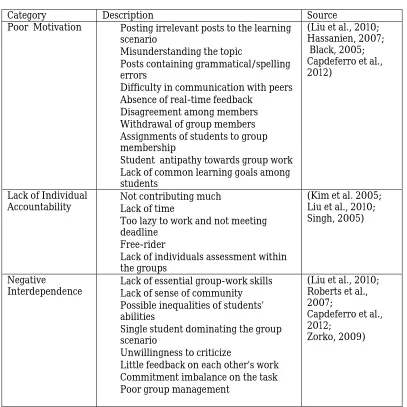
Table 2
Perceived Challenges in Online Collaborative Learning Environment
Category Description Source
Poor Motivation • Posting irrelevant posts to the learning scenario
• Misunderstanding the topic
• Posts containing grammatical/spelling errors
• Difficulty in communication with peers • Absence of real-time feedback
• Disagreement among members • Withdrawal of group members • Assignments of students to group
membership
• Student antipathy towards group work • Lack of common learning goals among
students
(Liu et al., 2010; Hassanien, 2007; Black, 2005; Capdeferro et al., 2012)
Lack of Individual
Accountability •• Not contributing much Lack of time
• Too lazy to work and not meeting deadline
• Free-rider
• Lack of individuals assessment within the groups
(Kim et al. 2005; Liu et al., 2010; Singh, 2005)
Negative
Interdependence •• Lack of essential group-work skills Lack of sense of community • Possible inequalities of students’
abilities
• Single student dominating the group scenario
• Unwillingness to criticize
• Little feedback on each other’s work • Commitment imbalance on the task • Poor group management
(Liu et al., 2010; Roberts et al., 2007;
Capdeferro et al., 2012;
Zorko, 2009)
existing challenges. This also provides an opportunity to researchers to find relevant solutions to these challenges when paying particular attention to Kenya. This study comes at a time when HLIs in Kenya have witnessed increased enrollment within constrained physical resources; consequently, they have adopted blended e-learning through ODeL programs to complement the scarce physical resources (Nyerere et al., 2012). Status on collaborative learning in HLIs in Kenya is yet to be established definitely; this research provides an opportunity to inform instructors and learners with concrete data on the status and the associated key challenges in an online collaborative learning environment in HLIs in Kenya.
Methodology
Research Design
A cross-sectional study using descriptive survey was used to investigate students’ collaboration level in group work and identify students’ perceived challenges in an online collaborative learning environment. A descriptive survey was adopted as it could examine the situation the way it is and provide quantitative information that was summarized through statistical analyses, thus providing the basis to answer our research questions (Engelhart, 1972). This survey was conducted by administering questionnaires using a web-based tool (Lime survey). This approach was preferred because it enabled a faster collection of responses and the ease of exporting the data to our Statistical Package for Social Sciences (SPSS) for analysis.
Sample and Sampling Procedures
Purposive sampling was adopted to select two public universities namely KU and Jomo Kenyatta University of Science and Technology (JKUAT), and two private universities namely United State International University (USIU) and AUSI, which have adopted the use of online collaborative learning tools in their e-learning modules and they are within Nairobi. Purposive sampling was also used to select students who were engaged in group activities online. With the help of instructors a total of two hundred and ten students were identified within the four universities. These were students who were undertaking at least one course or a module online on an e-learning platform. The sampled students were informed by their instructors of the purpose of the study, and responding to the questionnaire items was voluntary.
Research Instruments
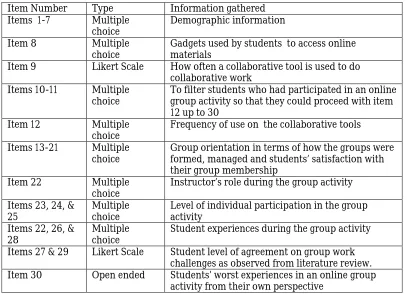
the questionnaire. Twenty nine items in the questionnaire were close ended while one item was open ended. Table 3 summarizes the different categories for the questionnaire items. To ensure validity, content related evidence was used and two experts in e-learning were requested to review the content and the format of the instrument. From their comments some items were rephrased, some content in group orientation added and reformatting done as recommended. Content-related evidence was adopted to ensure the instrument contained an adequate sample of the key challenges related to online collaborative learning (Fraenkel, Wallen & Hyun, 2012).
Table 3
Summary of the Questionnaire Items
Item Number Type Information gathered
Items 1-7 Multiple
choice Demographic information
Item 8 Multiple
choice Gadgets used by students to access online materials Item 9 Likert Scale How often a collaborative tool is used to do
collaborative work Items 10-11 Multiple
choice To filter students who had participated in an online group activity so that they could proceed with item 12 up to 30
Item 12 Multiple
choice Frequency of use on the collaborative tools Items 13-21 Multiple
choice Group orientation in terms of how the groups were formed, managed and students’ satisfaction with their group membership
Item 22 Multiple
choice Instructor’s role during the group activity Items 23, 24, &
25 Multiple choice Level of individual participation in the group activity Items 22, 26, &
28 Multiple choice Student experiences during the group activity Items 27 & 29 Likert Scale Student level of agreement on group work
challenges as observed from literature review. Item 30 Open ended Students’ worst experiences in an online group
activity from their own perspective
Data Collection and Analysis
collected data was exported to SPSS version 14 and coded as per the research objective. A quantitative analysis was carried out, such as frequencies and percentages on: demographic information, collaboration tools, level of access on group activity and students’ perceptions on various aspects of group activity. Since the questionnaire items were meant for a bigger study, not all analysis has been included in this paper.
Results
Participants’ Demographic Information
A total of 183 students responded out of 210, with 44.9% from a private university and 53.5% from a public university while three respondents (1.6%) did not provide university names. One respondent did not provide any demographic information including age and gender. Table 4 summarizes the demographic information.
Table 4
Demographic Information of the Sample (N=183)
Characteristic Frequency Percentage
1. Age in bracket(at the time of survey)
15-25 years 108 59.0%
26-35 years 59 32.2%
36-45 years 13 7.1%
46-55 years 2 1.1%
N/A 1 0.5%
2 Gender
Male 116 63.4%
Female 66 36.1%
N/A 1 0.5%
3 University
AUSI (Private) 14 7.7%
JKUAT (Public) 50 27.3%
KU (Public) 48 26.2%
USIU (Private) 68 37.2%
No Answer 3 1.6%
4 Level of Study
Certificate 14 7.7%
Diploma 5 2.7%
Postgraduate 21 11.5%
Undergraduate 142 77.6%
No Answer 1 0.5%
5. Modules Studied online
2-3 modules 35 19.1%
4-5 modules 27 14.8%
One module 68 37.2%
No Answer 2 1.1%
6 Internet Skills1
Excellent 138 75.4%
Good 32 17.5%
Moderate 11 6.0%
No Answer 2 1.1%
Group Characteristics
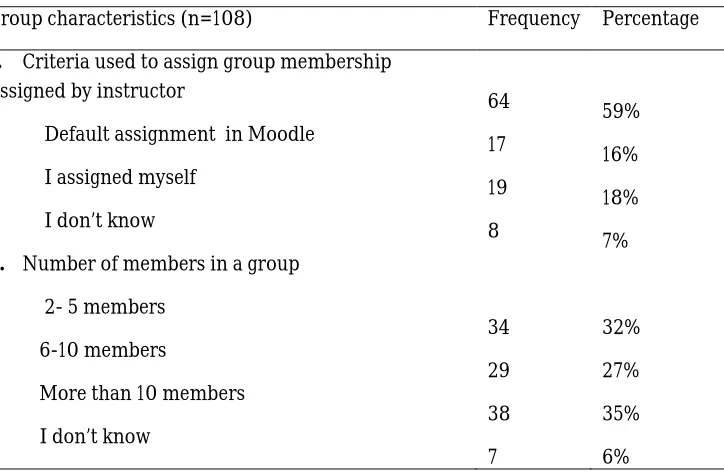
Two group characteristics were collected to determine how the students were assigned to group membership and the group sizes. As shown in Table 5, students were assigned to group membership in different ways and group sizes were also different. Out of 108 students who responded a higher percentage was done by the instructor (59%), 16% at random through default assignment in Moodle, 18% self assignment and 7% were not aware how the assignment was done. The number of students in a group ranged from 2 to 5 (32%), 6 to 10 (27%) and more than 10 students (35%). While 6% were not aware of the number of students in their group. This shows that more than 50% of students discussed in groups of more than five students which is contrary to the recommended small group sizes of 2 to 5 students for effective group learning which enables each group member to express his/her own ideas and increases group cohesion (North, Linley, & Hargreaves, 2000; Schellenberg, 1959; Forsyth, 2009)
1 The level of access to internet services like emails, Chats, Facebook, Twitter, Telnet,
Table 5
Frequency on Group Assignment Method and Group Sizes
Group characteristics (n=108) Frequency Percentage
1. Criteria used to assign group membership
Assigned by instructor 64
59% Default assignment in Moodle 17
16%
I assigned myself 19
18%
I don’t know 8
7% 2. Number of members in a group
2- 5 members
34 32%
6-10 members
29 27%
More than 10 members
38 35%
I don’t know
7 6%
Popularity of Various Collaborative Tools
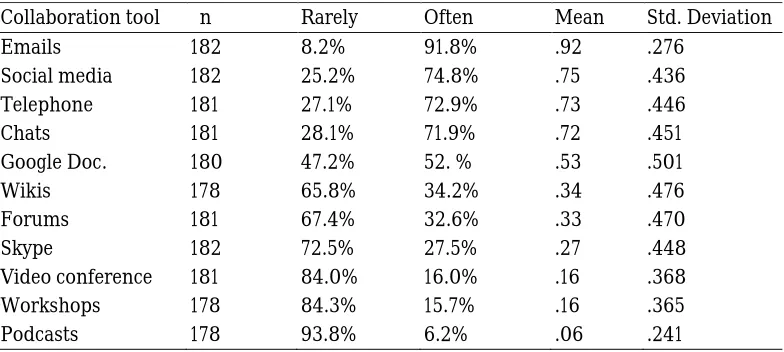
As shown in Table 6 of all the respondents, 91.8%, 74.8%, 72.9% and 71.9% frequently use email, social media (Facebook and Twitter), telephone (mainly mobile phones), and chats respectively. Tools like Skype, video conference, workshops2 and podcasts3 had the lowest frequency of use, which is an indication that these tools are rarely used by students to collaborate online. Table 6 shows the percentage, mean ranking and standard deviation on the frequency of use on various collaboration tools.
2 P
eer assessment activity in Moodle
3
Table 6
Frequency of Use on Various Collaborative Tools
Collaboration tool n Rarely Often Mean Std. Deviation
Emails 182 8.2% 91.8% .92 .276
Social media 182 25.2% 74.8% .75 .436
Telephone 181 27.1% 72.9% .73 .446
Chats 181 28.1% 71.9% .72 .451
Google Doc. 180 47.2% 52. % .53 .501
Wikis 178 65.8% 34.2% .34 .476
Forums 181 67.4% 32.6% .33 .470
Skype 182 72.5% 27.5% .27 .448
Video conference 181 84.0% 16.0% .16 .368
Workshops 178 84.3% 15.7% .16 .365
Podcasts 178 93.8% 6.2% .06 .241
Level of Collaboration in Various Collaborative Tasks
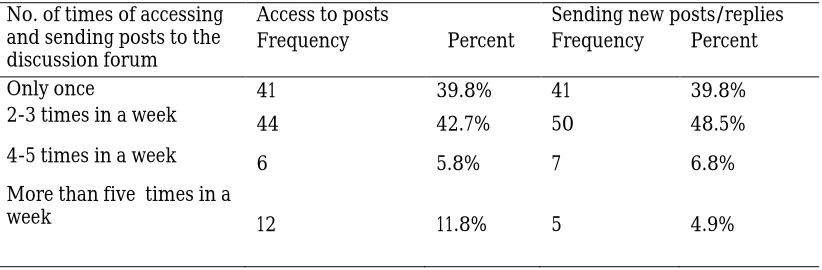
Out of 183 students who responded only 108 students (59%) indicated that they had done some group work online in their e-learning modules. The rest of the respondents (41%) were not involved in an online group work for reasons which included: instructor not providing an online group activity (41.3%), lack of time (29.3%), lack of skills to participate in online discussion (12%) and not enrolling to a group (17.3%).
Table 7
Students’ Level of Access and Reply to Post in an Online Group Activity (N=108)
No. of times of accessing and sending posts to the discussion forum
Access to posts Sending new posts/replies
Frequency Percent Frequency Percent
Only once 41 39.8% 41 39.8%
2-3 times in a week 44 42.7% 50 48.5%
4-5 times in a week 6 5.8% 7 6.8%
More than five times in a
week 12 11.8% 5 4.9%
Perceived Challenges
The questionnaire item on the perceived challenges had nine key challenges which respondents were required to rate with a yes or no response. The study revealed that the majority of respondents (54%) perceived that lack of participation by other members was a big challenge as most students lacked time to participate (53%). The difference in skills or knowledge level among group members was not perceived as a big challenge (19%). Table 8 shows the distribution of responses on the nine key challenges from 108 respondents. In addition to these nine key challenges, slow internet connectivity (30%), disruptions from incompetent peers (3%), lack of clarity on the posted work (2%), free-riders (2%), no consensus on the discussions (3%) and no original ideas posted (5%) were also mentioned by respondents as some of their worst experiences during their group work. For example, participant number 9 stated: “My worst experience was when the internet was not consistent and it kept on logging users ON and OFF; and we ended up wasting almost one hour without active participation”.
Table 8
Mean Ranking and Standard Deviation for the Nine Key Challenges as Perceived by the Respondents (N=108)
Challenges
Mean Std. Deviation Low or no participation of other group
members .54 .501
Lack of time to participate .53 .502
Lack of feedback from instructor .47 .502
Lack of feedback from peers .43 .497
Off-topic posts in the discussion .31 .463
Work load not shared equally .27 .445
Lack of group mentor .25 .435
Single student dominating .25 .435
Difference in skill/knowledge level among
group members .19 .390
Note. The mean is equivalent to the proportion of yes responses in the above table.
Table 9
Associations Between University Type (Private or Public) and the Perceived Challenges in Using Online Collaborative Learning Environment
Perceived Challenge
𝑥P2 𝑝
Low or no participation of other group members 0.255 0.613
Lack of time to participate 0.400 0.527
Lack of feedback from instructor 4.176 0.041*
Lack of feedback from peers 0.844 0.358
Off-topic posts in the discussion 0.000 0.990
Work load not shared equally 12.802 0.000*
Lack of group mentor 1.913 0.167
Single student dominating 0.004 0.947
Difference in skill/knowledge level among group members 0.179 0.672
Discussion
First, the study aimed to investigate how often students collaborate online while engaging in group work in HLIs in Kenya. The findings indicate that out of 183 respondents who were doing a module/unit through e-learning, only 108 students (59%) were engaged in an online group activity, while 75 students (41%) were not involved in an online group work. The study found that failure of the instructor to provide an online group activity contributed highly to non participation in collaborative learning. Moreover, for those who participated in group work, 47% mentioned that they perceived lack of feedback from the instructor as a big challenge. This was an indication online instructors were not fully engaging students in collaborative learning in blended e-learning programs. This could be due to the known situation that in most HLIs in Kenya, instructors use e-learning platforms to send notes and assignments, are heavily burdened with many duties and lack skills in e-pedagogy (Nyerere et al., 2012). The study also found that for those who were engaged in collaborative work the level of collaboration was very low as most of the respondents (90%) accessed the discussion forum less than two or three times in a week. Consequently the rate of posting to the discussion forum was found to be very low with only 11.7% of the respondents sending an average of 4 to 5 posts in a week. The findings revealed that students in these HLIs do not often collaborate online. Hence, there is a need to hire more trained instructors or train the current instructors who can engage students in an online collaborative work and create time to monitor their participation.
Thirdly, there was significant difference between the public and the private university in terms of lack of instructor feedback (p = 0.046) and workload not shared equally (p = 0.000). The study found that lack of instructor feedback as a challenge was reported more in public universities (31%) than in private universities (16%). This could be due to the big numbers of students enrolled per class in public universities which makes the instructor to student ratio higher than in private universities. Consequently, the instructors in public universities are overloaded with work and this could have affected the low level of feedback observed. The study also found that the challenge of workload not shared equally among the students in an online collaborative learning group was reported to be higher in private universities (20%) than in public universities (7%). This seems to support the perception that students in public universities are more independent, working with minimal instructor supervision, which probably gives them an advantage to work more cohesively in group work. This requires further investigation to establish why such a significant difference existed.
Conclusion
Despite the potential advantages in collaborative learning, this study reveals that lack of participation among group members and lack of feedback from instructors are major hindrances to effective online collaboration in HLIs in Nairobi, Kenya. This coincides with other studies in other regions(Liu et al., 2010; Capdeferro et al., 2012; Kim et al., 2005). Furthermore, some instructors did not include collaborative learning activities in their online courses and therefore 41% of the participants were not engaged in collaborative learning. Therefore, further research should also be carried out to investigate instructors’ level of awareness, utilization and perceived challenges of online collaborative learning tools which are available in e-learning platforms. This could also shed more light on how to improve the quality of online collaborative learning in HLIs in Kenya. We do also concur with Karshoda et al. (2014) that internet bandwidth should be increased in HLIs in Kenya in order to avoid the challenge of slow internet connectivity as reported by 30% of the participants in this study. In order to make collaborative learning more effective in these HLIs the researchers do recommend that institutions should:
• Ensure their instructors do engage students in collaborative activities in their online courses and instructor’s role is more emphasized during collaborative learning
• Find ways of motivating the students in order to increase their level of participation in collaborative learning
mechanisms of training instructors with e-pedagogy skills which can enhance collaborative learning
• Find ways of increasing internet bandwidth in order to avail more bandwidth to students who are studying online.
Future Work
Similar future studies should adopt large scale empirical approaches, within different universities or geographical regions in Kenya in order to confirm some of the findings observed here in other universities and also to be able to generalize the results to the larger population of Kenyan universities. Future studies could also consider examining the effectiveness of collaborative learning in enhancing students’ critical thinking skills and improving the level of knowledge constructed in blended e-learning platforms.
Acknowledgements
References
Black, A. (2005). The use of asynchronous discussion: Creating a text of talk. Contemporary Issues in Technology and Teacher Education, 5(1), 5-24. Retrieved on 20th August 2014, from
http://www.citejournal.org/articles/v5i1languagearts1.pdf
Brindley, J., Blaschke, L. M., & Walti, C. (2009). Creating effective collaborative learning groups in an online environment. The International Review of Research in Open and Distance Learning, 10(3). Retrieved on January 5th 2014, from http://www.irrodl.org/index.php/irrodl/article/view/675/1271
Capdeferro, N., & Romero, M. (2012). Are online learners frustrated with collaborative learning experiences? The International Review of Research in Open and Distance Learning, 13(2), 26-44. Retrieved on January 5th 2014, from http://www.irrodl.org/index.php/irrodl/article/view/1127
Curtis, D. D., & Lawson, M. J. (2001). Exploring collaborative online learning. Journal of Asynchronous Learning Networks, 5(1), 21-34. Retrieved on 20th August 2014, from
http://wikieducator.org/images/6/60/ALN_Collaborative_Learning.pdf
Dillenbourg, P. (1999). What do you mean by collaborative learning?. Collaborative-learning: Cognitive and Computational Approaches, 1-19.
Engelhart, M.D. (1972). Methods of educational research. Chicago: Rand McNally.
Forsyth, D. R. (2009). Group dynamics. Belmont, CA: Wadsworth Cengage Learning.
Harasim, L., Hiltz, S. R., Teles, L., & Turoff, M. (1998). Learning networks: A field guide to teaching and learning online. Cambridge, MA/London, England: The MIT Press.
Hassanien, A. (2007). A qualitative student evaluation of group learning in higher education. Higher Education in Europe, 32(2-3), 135-150. Retrieved on 30th July 2014 from
http://www.tandfonline.com/doi/pdf/10.1080/03797720701840633
Fraenkel, J. R., Wallen, N. E., & Hyun, H. H. (2012). How to design and evaluate research in education. New York, N.Y: McGraw-Hill Higher Education.
Johnson, D. W., & Johnson, R. T. (1989). Cooperation and competition: Theory and research. Edina, MN: Interaction Book Company. Retrieved on 15th August 2013, from http://www.co-operation.org/books-and-materials/
Jonassen, D., Davidson, M., Collins, M., Campbell, J., & Haag, B. (1995). Constructivism and computer mediated communication in distance education. American Journal of Distance Education, 9(2), 7-25. Retrieved on 20th August 2014, from http://www.c3l.uni-oldenburg.de/cde/media/readings/jonassen95.pdf
Kashorda, M., & Waema, T. (2014). E-readiness survey of Kenyan universities (2013) report. Nairobi: Kenya Education Network. Retrieved on 20th August 2014, from
http://ereadiness.kenet.or.ke:8080/ereadiness/2013/E-readiness%202013%20Survey%20of%20Kenyan%20Universities_FINAL.pdf
Kim, K. J., Liu, S., & Bonk, C. J. (2005). Online MBA students' perceptions of online learning: Benefits, challenges, and suggestions. The Internet and Higher Education, 8(4), 335-344.
Liu, S., Joy, M., & Griffiths, N. (2010, July). Students' perceptions of the factors leading to unsuccessful group collaboration. In Advanced Learning Technologies (ICALT), 2010 IEEE 10th International Conference on (pp. 565-569). Sousse, Tunisia, 5-7 July 2010.
Mattar, J. A. (2010). Constructivism and connectivism in education technology: Active, situated, authentic, experiential, and anchored learning. Technology, 1-16.
Moller, L. (1998). Designing communities of learners for asynchronous distance
education. Educational Technology Research and Development, 46(4), 115-122.
North, A. C., Linley, P. A., & Hargreaves, D. J. (2000). Social loafing in a co-operative classroom task. Educational Psychology, 20(4), 389-392. Retrieved on 30th July 2014 from
http://www.pgce.soton.ac.uk/IT/Research/Papers/Northetal2000SocialLoafin g.pdf
Nyerere, J. A., Gravenir, F. Q., & Mse, G. S. (2012). Delivery of open, distance, and e-learning in Kenya. The International Review of Research in Open and Distance Learning, 13(3), 185-205.
Palloff, R. M., & Pratt, K. (2005). Collaborating online: Learning together in community. San Francisco, CA: Jossey-Bass.
Republic of Kenya (2005). A policy framework for education, training and research: Meeting the challenges of education, training and research in Kenya in the 21st century. Nairobi: Government Printers.
Roberts, T. S., & McInnerney, J. M. (2007). Seven problems of online group learning (and their solutions). Educational Technology & Society, 10(4), 257-268.
Schellenberg, J. A. (1959). Group size as a factor in success of academic discussion groups. The Journal of Educational Sociology, 33(2), 73-79. Retrieved on 30th July 2014, from http://www.jstor.org/stable/2264459
Siemens, G. (2005). Connectivism: A learning theory for the digital age. International Journal of Instructional Technology and Distance Learning, 2(1), 3-10.
Singh, H. K. (2005). Learner satisfaction in a collaborative online learning environment. Retrieved on 26th January 2006, from
http://asiapacific-odl.oum.edu.my/C33/F239.pdf
Song, L., Singleton, E. S., Hill, J. R., & Koh, M. H. (2004). Improving online learning: Student perceptions of useful and challenging characteristics. The Internet and Higher Education, 7(1), 59-70.
Vygotsky, L. S. (1978). Mind in society: The development of higher psychological processes. Cambridge, UK: Harvard University Press.
Appendix
© Muuro,Wagacha, Kihoro, Oboko