An Efficient Zigbee-Based Enabled Smart Energy Meter
Shekar Boddupally & Kommu Renuka1
M.Tech VLSI System Design, Dept of Electronics & Communication Engineering 2
M.Tech (Embedded Systems), Dept of Electronics & Communication Engineering
ABSTRACT:Now-a-days technology has developed to a large extend. At the same time the need for systems withautomation and high security are favored. In view of this, the smart metering thought is attracted and adopted in global as a result of speedy development Demand Response (DR) process. The DR system managed the customer consumption of electrical power in keeping with altering provide conditions and balance between supply and demand. For such kind of administration the front and back end electronics is required. In this short form, we propose the hardware answer for DR system. The hardware solution that includes ZigBee transmitter and receiver which is communicated and managed with the aid of ARM. The ARM-11 can be used for controlling end devices utilising switching circuit. The front end VB and Microsoft SQL founded database are used to store end devices electricity consumption at regular interval.
Index Terms—Demand response system, smart
grid, smart meter, ZigBee protocol, ARM7
I. INTRODUCTION
Electrical power has become indispensable to human survivaland progress which leads to the enhancement of the people’sstandard of life by the introduction of automation in to energydistribution and management. With the constant developmentin technology, the need of automated meter reading systems isalso increasing. The technology of e-metering (ElectronicMetering) has gone through rapid technological advancementsand there is increased demand for a reliable and efficientAutomatic Meter Reading (AMR) system.The traditional meter reading process involves using theanalog meters to collect the data of the energy consumed anddisplay it either on a number dial or a digital display. Theservice provider person comes to the place of the meter andnotes down the reading at the end of every billing cycle. Butthe traditional meter reading process not only wastes laborhuman power, but also is error prone. The procedures ofsending the bills to customer are very laborious andcumbersome. The conventional process is time consuming aswell. Another major problem in this system is that thereadings cannot be taken if no one
is available at the home orwhere the meter is located. The current system does notprovide any scope for the user to conserve energy or does itprovide energy consumption predictions for near future thatenables the user to act in a more planned way. There are manysuch problems that cause inconvenience to the power provideras well as the consumers. Even though the conventionalmeters were replaced with more efficient electronic energymeters these problems still persists.
Automatic meter reading system is a technology which is usedto gather data from energy metering devices and transfer it toa central station in order to process it for billing purposes.Automatic meter reading system helps the customer andenergy provider to access the accurate and updated data fromthe meters. AMR system can fetch energy consumption in ahourly, monthly, yearly basis on request or even in Real Time.This Real time energy usage can be seen by the users tocontrol the use of power and be more economical. With thehelp of the collected data the service provider will be able tosend energy saving ideas to the users. This kind of real timedata collected from each of the individual houses is really aboon to data scientists, who use machine learning and datamining tools to build a predictive model over this valuabledata to predict the future energy demands starting from everysingle house, area, city to the entire planet. Thus leading tosophisticated and predictive energy production, conservationand management.
addressedin new ZigBee based sensor networks with additional sleep modechoices and dynamic multihop algorithms. The proposedapplication is for smartgrids, so with little auxiliary chargingcircuit sensor networks can also be made much less energy unbiased.
II. LITERATURE SURVEY
Automated Meter reading approach (AMR) regularly monitors the energy meter and sends data onrequest of service provider by means of SMS. That procedure used to be allowed to the customers to pay online billboth by credit card, debit card or by means of net banking is defined by the authorAbhinandan jain et al.[1] who hasdeveloped fully automated energy meter having the capabilities of remote monitoring and energymeter controlling.
In paper [2] (2007) H. G. Rodney Tan et al.introduced working prototype of GAPMR method whichis constructed to demonstrate the effectiveness and efficiency of computerized meter reading, billing andnotification by means of GSM network.
Ashna okay, Sudhish N Gorgre proposed
procedure [3] which routinely reads the power utilized and sends it to the service providerwith using the present short messaging service (SMS).
Tian yew lim and tat Wai chan [4] described a prototype automated meter studying system with use ofthe power traces and frequency shift keying modulation operated within the EN 50065-1 A Band. Theprocedure’s efficiency and reliability elements are presented by way of them.
M Popa describes an AMR system based on power
Line Communications [5]. Smart meters were related through a Lon Work kind industrial bus to the Gateway. In this The Gateway sends messages to meters and reads the accrued understanding. The communication was once, through GSM, witha data Acquisition center (DAC) the place data is processed. The data obtained from an energy meter has been stored in database server which located at electricity board station via SMS gate method for additional processing by using energy supplier, provider additional sends electricity charges either
Power lines[6] are without difficulty to be had andmaking the full use of them is most fascinating for the energy suppliers. These papers provided aninvestigation of the LV power line characteristics within the A Band of European Committee for Electromechanical Standardization European Norm (EN) 50065-1 commonplace for implementationof automatic meter reading in dense residential areas.
Ali et al.offered AMR utilizing radio frequency technology[7] supplies electrical utility provider company the possibility to develop operational efficiency, support client services, reduce data assortment costs and speedily collect important data that furnish perception to the organization resolution makers. The present digital electrical meter within the advertising and marketing is upgraded by using including RF module to provide remote communication capabilities.
Progress of an automatic meter reading method based on ZigBee [8], [9] is wireless electrical power administration and manage method. An automatic meter reading system specializing in the design for an energy meter implemented with ZigBee wi-ficonversation protocol conforming to IEEE 802.15.4standard [9]. The place microcontroller isused to manipulate energy data and ZigBee to permit communication between the power meter and datafacilities.
The comfortable mobile agent idea was provided in [10] which inform that energy meters can also beequipped in a group based upon the geographical region. In one region energy meters participate intheir jobs beneath a securitymanager. The thought of localmobile agent is proposed to prevent the visitof external mobile agent to power meters immediately. Local mobile agent consists of the acceptablequeries from security manager and visits energy meters. Embedded energy meter is developed inwhich [11] maximum demand of energy of a consumer will likely be indicated in the meter used by theclient. After exceeding the maximum demand, for that reason the connection will automatically bedisconnected via an embedded procedure inserted within the meter itself.
The smart meter basically consists of transmitter module and receiver module. Here, the two way communication between transmitter module and receiver module is established using ZigBee protocol.
Fig.1Basic block diagram of smart meter using ZigBee protocol.
ZigBee and IEEE 802.15.4 are standards-based protocols that provide the network infrastructure required for smart meter network applications.Fig.1 shows the basic block diagram of smart meterusing ZigBee protocol.Generally, the smart meter consists of electronic meterunit, communication unit and end device switching unit.Here, ZigBee transmitter and ZigBee receiver are usedfor communication between consumer and electricityprovider.
A. Raspberry Pi 3
The Raspberry Pi 3 Model B is the third generation Raspberry Pi. This powerful credit-card sized single board computer can be used for many applications and supersedes the original Raspberry Pi Model B+ and Raspberry Pi 2 Model B. Whilst maintaining the popular board format the Raspberry Pi 3 Model B brings you a more powerful processer, 10x faster than the first generation Raspberry Pi. Additionally it adds wireless LAN & Bluetooth connectivity making it the ideal solution for powerful connected designs.The main features of Raspberry pi 3 are[4]
Processor: Broadcom BCM2387 chipset.1.2GHz
Quad-Core ARM Cortex-A53 802.11 b/g/n Wireless LAN and Bluetooth 4.1 (Bluetooth Classic and LE)
GPU: Dual Core VideoCore IV® Multimedia CoProcessor. Provides Open GL ES 2.0, hardwareaccelerated OpenVG, and 1080p30 H.264 highprofile decode.
Operating System: Boots from Micro SD card, running a version of the Linux operating system or Windows 10 IoT.
GPIO Connector: 40-pin 2.54 mm (100 mil)
expansion header: 2x20 strip Providing 27 GPIO pins as well as +3.3 V, +5 V and GND supply lines.view
B. Zigbee:
It is the wireless device for transmitting and receiving purpose or simply it called as Transceiver. Zigbee is based on the IEEE802.15.4 protocol. The range of the Zigbee is covered as 100m. It range is 10 times better than bluetooth device so it can be more preferable one in wireless device. The data rate is very low for transmission while using this device.
Fig.2.Zigbee network overview
IV. RESULTS AND DISCUSSION
Fig. 3GUI for data collection
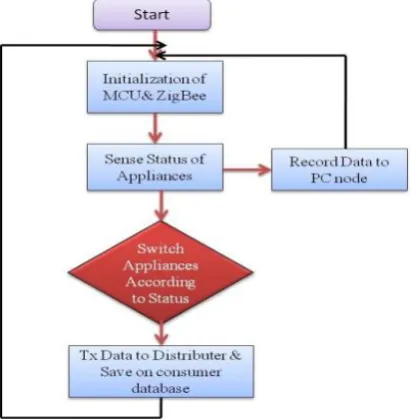
The current sensors are used to experience the online fameof home equipment i.e. Voltage and present, it presents knowledge tomicrocontroller for further manipulation. Microcontrollerwill stage-manage this information and calculate the currentutilization fame of home equipment. After this brief manipulation,the microcontroller will ship this information to laptop node,the place additional operation on this knowledge is carried out viaright algorithms. The front end GUI will manipulate thisinformation on their database. After large calculation, themicrocontroller will switch this data making use of ZigBeetransmitter to distributor database, where data is storedin unit interval of time.
Fig.4.System flow diagram of ZigBee enabled smart meter
The procedure flow is depicted in Fig.5. The
equipment. When peakdemand of electrical power is stated, then switching circuitroutinely reduce off the mains from home equipment. Thisworkflow will control the demand response of electrical energyusing ZigBee enabled smart meter. There is no droughtthat with suitable algorithm and supportive assets, the smart meter shall be handiest solution for next century smartergrid and smarter planet.
V. CONCLUSION
Based on all the systems surveyed, their advantages anddrawbacks, this paper presents the features that make up anideal AMR system and provides a overall insight of thevarious methodologies applied for AMR so far thus providinga base for further research in this area.Although the smart meter proposal is adopted global,however as per cost point of view, this form of low costARM-11 and ZigBee enabled smart meter platform canbe better resolution for traditional grid system.DR process benefits all electrical energy consumers and itchanges end-use consumer electricity consumption.This kind of process can grow to be the conventional gridprocess to smarter grid approach. Its advantages measurewhen, scale back the peak load and demand electricity.Aside from this precise transformation, the futureof sensible metering will closely rely on the energypolicy and the governmental bodies.
REFERENCES
[1]. Abhinandan Jain, Dilip Kumar, Jyoti Kedia, ―Smart and intelligent GSM based automatic meterreading system‖, International Journal of Engineering Research & Technology (IJERT), ISSN: 2278-0181, Vol 2, Issue 3, pp. 1-6, May 2012.
[2]. H. G. Rodney Tan, C. H. Lee and V. H. Mork, ―Automatic power meter reading systems using GSMnetwork‖, IEEE, 8th International Power Engineering Conference, pp. 465-469, 2007.
[4]. Tian yew lim and tat Wai chan,―Experimenting remote kilowatthour meter reading through lowvoltage power lines at dense housing estates‖, IEEE Transactions on Power Delivery vol. 17, Issue 3,pp. 708-711, Jul 2002.
[5]. M.Popa, ―Gateway design and implementation in an automatic meter reading system based onpower line communication‖, 7th International Conference on Networked Computing and AdvancedInformation Management (NCM), pp. 295-298, 2011.
[6]. G Thavasi Raja and T.D. Sudhakar, ―Electricity consumption and automatic billing through powerline‖, International Power Engineering Conference (IPEC), pp. 1411-1415, 2007.
[7]. A.Ali, N.A. Razali, N.H.Saad, N.Vitee, ―Implementation of Automatic meter reading using radiofrequency module‖, IEEE International Conference on Power and Energy (PEcon), pp. 876-879, Dec2012.
[8]. Guilin Zheng, Zhifu Zhang, ―Intelligent wireless electric power management and control system basedon ZigBee technology‖, International Conference on Transportation, Mechanical, and ElectricalEngineering (TMEE) Changchun, China, pp.1120-1124, December 16-18, 2011.
[9]. Champ Prapasawad, Kittitach pornprasitpol, Wanchalerm pora, ―Development of an automatic meterreading system based on ZigBee pro smart energy profile IEEE 802.15.4 standard‖, InternationalConference on Electronic Devices and Solid State Circuit (EDSSC), pp.1-3, Dec2012.
[10]. Najmus Saqib malik, Friedrich kupzog, Michael Sonntag, ―An approach to secure mobile agents inautomatic meter reading‖, IEEE, International Conference on Cyberworlds, computer society, pp. 187-193, 2010.
[11]. Subhashis Maitra, ―Embedded Energy Meter- A new concept to measure the energy consumed by aconsumer and to pay the bill‖, Power System Technology and IEEE Power India Conference, 2008.
[12] A. Ipakchi and F. Albuyeh, ―Grid of the future, IEEE Power EnergyMag., vol. 7, no. 2, pp. 52–62, Mar./Apr. 2009.
[13] F. Lobo, A. Cabello, A. Lopez, D. Mora, and R. Mora, ―DistributionNetwork as communication system,in Proc. SmartGridsDistrib.,CIRED Semin., Frankfurt, Germany, 2008, pp. 1–4.
[14] M. McGranaghan, D. von Dollen, P. Myrda, and E. Gunther, ―Utilityexperience with developing a smart grid roadmap, in Proc. PowerEnergySoc. Gen. Meeting—Conversion and Delivery of ElectricalEnergy in the 21st Century, Pittsburgh, PA, 2008, pp. 1–5.
[15] S. E. Collier, ―Ten steps to a smarter grid,in Proc. REPC, FortCollins, CO, 2009, pp. B2-1–B2-7
BIODATA
Shekar Boddupally completed M.Tech VLSI System Design.