Western University Western University
Scholarship@Western
Scholarship@Western
Electronic Thesis and Dissertation Repository
11-23-2015 12:00 AM
Wireless Device Authentication Techniques Using Physical-Layer
Wireless Device Authentication Techniques Using Physical-Layer
Device Fingerprint
Device Fingerprint
Peng Hao
The University of Western Ontario
Supervisor Dr. Xianbin Wang
The University of Western Ontario
Graduate Program in Electrical and Computer Engineering
A thesis submitted in partial fulfillment of the requirements for the degree in Doctor of Philosophy
© Peng Hao 2015
Follow this and additional works at: https://ir.lib.uwo.ca/etd
Part of the Signal Processing Commons, and the Systems and Communications Commons
Recommended Citation Recommended Citation
Hao, Peng, "Wireless Device Authentication Techniques Using Physical-Layer Device Fingerprint" (2015). Electronic Thesis and Dissertation Repository. 3440.
https://ir.lib.uwo.ca/etd/3440
This Dissertation/Thesis is brought to you for free and open access by Scholarship@Western. It has been accepted for inclusion in Electronic Thesis and Dissertation Repository by an authorized administrator of
WIRELESS DEVICE AUTHENTICATION TECHNIQUES USING
PHYSICAL-LAYER DEVICE FINGERPRINT
(Thesis format: Monograph)
by
Peng Hao
Graduate Program in Electrical and Computer Engineering
A thesis submitted in partial fulfillment
of the requirements for the degree of
Doctor of Philosophy
The School of Graduate and Postdoctoral Studies
The University of Western Ontario
London, Ontario, Canada
c
Abstract
Due to the open nature of the radio signal propagation medium, wireless communication is inherently more vulnerable to various attacks than wired communication. Consequently, communication security is always one of the critical concerns in wireless networks. Given that the sophisticated adversaries may cover up their malicious behaviors through impersonation of legitimate devices, reliable wireless authentication is becoming indispensable to prevent such impersonation-based attacks through verification of the claimed identities of wireless devices.
Conventional wireless authentication is achieved above the physical layer using upper-layer identities and key-based cryptography. As a result, user authenticity can even be validated for the malicious attackers using compromised security key. Recently, many studies have proven that wireless devices can be authenticated by exploiting unique physical-layer characteristics. Compared to the key-based approach, the possession of such physical-layer characteristics is directly associated with the transceiver’s unique radio-frequency hardware and corresponding communication environment, which are extremely difficult to forge in practice. However, the reliability of physical-layer authentication is not always high enough. Due to the popularity of cooperative communications, effective implementation of physical-layer authentication in wireless relay systems is urgently needed. On the other hand, the integration with existing upper-layer authentication protocols still has many challenges, e.g., end-to-end authentication. This dissertation is motivated to develop novel physical-layer authentication techniques in ad-dressing the aforementioned challenges.
In achieving enhanced wireless authentication, we first specifically identify the technique challenges in authenticating cooperative amplify-and-forward (AF) relay. Since AF relay only works at the physical layer, all of the existing upper-layer authentication protocols are ineff ec-tive in identifying AF relay nodes. To solve this problem, a novel device fingerprint of AF relay consisting of wireless channel gains and in-phase and quadrature imbalances (IQI) is proposed. Using this device fingerprint, satisfactory authentication accuracy is achieved when the signal-to-noise ratio is high enough. Besides, the optimal AF relay identification system is studied to maximize the performance of identifying multiple AF relays in the low signal-to-noise regime and small IQI. The optimal signals for quadrature amplitude modulation and phase shift keying modulations are derived to defend against the repeated access attempts made by some attackers
with specific IQIs.
Exploring effective authentication enhancement technique is another key objective of this dissertation. Due to the fast variation of channel-based fingerprints as well as the limited range of device-specific fingerprints, the performance of physical-layer authentication is not always reliable. In light of this, the physical-layer authentication is enhanced in two aspects. On the one hand, the device fingerprinting can be strengthened by considering multiple characteris-tics. The proper characteristics selection strategy, measurement method and optimal weighted combination of the selected characteristics are investigated. On the other hand, the accuracy of fingerprint estimation and differentiation can be improved by exploiting diversity techniques. To be specific, cooperative diversity in the form of involving multiple collaborative receivers is used in differentiating both frequency-dependent and frequency-independent device finger-prints. As a typical combining method of the space diversity techniques, the maximal-ratio combining is also applied in the receiver side to combat the channel degeneration effect and increase the fingerprint-to-noise ratio.
Given the inherent weaknesses of the widely utilized upper-layer authentication protocols, it is straightforward to consider physical-layer authentication as an effective complement to re-inforce existing authentication schemes. To this end, a cross-layer authentication is designed to seamlessly integrate the physical-layer authentication with existing infrastructures and proto-cols. The specific problems such as physical-layer key generation as well as the end-to-end au-thentication in networks are investigated. In addition, the auau-thentication complexity reduction is also studied. Through prediction, pre-sharing and reusing the physical-layer information, the authentication processing time can be significantly shortened.
Keywords:Wireless communications, physical-layer authentication, device identification, de-vice fingerprinting, diversity, amplify-and-forward relaying, cross-layer authentication.
To my parents.
Acknowledgments
Pursuing doctoral degree in The University of Western Ontario is a memorable experience for me. Many people supported and helped me during my four years study.
First of all, I would like to express my gratitude to my supervisor, Dr. Xianbin Wang, for his precious guidance and constant supervision as well as giving helpful advise in my graduate career. Without Dr. Wang’s inspiration and help, I am not able to complete this dissertation.
I would like to thank Dr. Ben Rubin for chairing my thesis defence exam. I also would like to thank the examiners Dr. Helen Tang, Dr. Evgueni Bordatchev, Dr. Anestis Dounavis and Dr. Vijay Parsa for reviewing and improving my dissertation.
I also would like to especially thank my friend Dr. Aydin Behnad, for his patient and selfless advise to my research projects. It is enjoyable to work and discuss the research problems with him. I would like to thank my “Big Friend”, Mr. Mohamed Abu Sharkh, who supported me in many aspects during my living in Canada. I really appreciate every conversation that relieves my stress and every suggestion from this trustable friend. Also, my deep thanks to all other colleagues and friends I met in Canada. It is my great pleasure to make friends or/and work with them.
Last but most importantly, I own my heartfelt gratitude to my dearest parents. Although they are thousands of miles away from me during the days I studied in Canada, I can always get the strongest support from them! There are no words sufficient enough to express my full gratitude to my parents.
Contents
Abstract ii
List of Figures x
List of Tables xiii
List of Abbreviations xiv
1 Introduction 1
1.1 Research Motivation . . . 1
1.2 Dissertation Contributions . . . 4
1.3 Dissertation Organization . . . 6
2 Background and Literature Review 8 2.1 Traditional Wireless Authentication Techniques . . . 8
2.2 Physical-Layer Authentication Techniques . . . 11
2.2.1 Device Fingerprinting Types . . . 13
2.2.2 Physical-Layer Authentications Related Techniques . . . 20
2.2.3 Related Works . . . 24
2.3 Problems and Challenging Issues in Current Wireless Authentication . . . 25
2.3.1 Implementation Limitations in Cooperative Wireless Systems . . . 26
2.3.2 Low Reliability Problem of Physical-Layer Authentication . . . 27
2.3.3 Challenges in Cross-Layer Authentication Implementation . . . 28
2.4 Summary . . . 30
3 Physical-Layer AF Relay Differentiation Technique 32
3.1 Introduction . . . 32
3.2 System Model . . . 34
3.3 Two-Parameter Hypothesis Testing . . . 37
3.4 AF Relay Authentication Method . . . 40
3.5 Simulation Results . . . 44
3.6 Summary . . . 47
4 Optimal Wireless AF Relay Identification System 49 4.1 Introduction . . . 49
4.2 System Model . . . 51
4.3 AF Relay IQI-based Device Fingerprinting Analysis . . . 55
4.3.1 Analysis for the received IQI distorted signals . . . 55
4.3.2 Analysis for the IQI parameters . . . 55
4.4 Generalized Likelihood Ratio Test (GLRT) Based AF Relay Differentiation . . 59
4.5 AF Relay Identification Algorithm . . . 66
4.6 Optimal Signal Design for Enhancing Device Identification Performance . . . . 66
4.6.1 Square QAM Modulation Case . . . 69
4.6.2 Circle PSK Modulation Case . . . 72
4.7 Evaluation Results . . . 74
4.7.1 Numerical Results for IQI Device Fingerprint . . . 74
4.7.2 Evaluation Results for Proposed AF Relay Identification Technique . . 75
4.8 Summary . . . 79
5 Enhanced Device Fingerprinting using Multiple Physical-Layer Characteristics 83 5.1 Introduction . . . 83
5.2 An Enhanced Device Fingerprinting using PER and RSSI . . . 85
5.2.1 Authentication Model . . . 85
5.2.2 Hypothesis Testing and Decision Rule . . . 87
5.2.3 Experiment and Simulation Results . . . 91
5.3 A General Device Fingerprinting using Multiple Weighted Device-Specific Char-acteristics . . . 97
5.3.1 Weighted Multi-Characteristics Device Authentication . . . 97
5.3.2 Optimal Weights Derivation for Maximizing Detection Probability . . . 100
5.3.3 Simulation Results . . . 102
5.4 Summary . . . 103
6 Physical-Layer Authentication Enhancement by Exploiting Diversity Techniques 107 6.1 Introduction . . . 107
6.2 Enhanced Physical-Layer Authentication through Collaboration of Multiple Receivers . . . 110
6.2.1 System Model . . . 110
6.2.2 Collaborative Authentication using Distributed and Centralized Methods 114 6.2.3 Simulation Results . . . 119
6.3 Enhanced Physical-Layer Authentication through Combining Diversity . . . 121
6.3.1 Device Fingerprint Estimation using MRC . . . 121
6.3.2 Authentication Methods . . . 128
6.3.3 Simulation Results . . . 129
6.4 Summary . . . 131
7 Cross-Layer Authentication Design in Wireless Networks 132 7.1 Introduction . . . 132
7.2 Problem Formulation . . . 134
7.2.1 Integration with Existing Cryptographic Infrastructures and Protocols . 134 7.2.2 Increasing Authentication Complexity in Complicated Heterogeneous Networks . . . 136
7.3 Proposed Solutions . . . 137
7.3.1 Seamless Integration with Existing Protocols using Physical-Layer Se-curity Key . . . 137
7.3.2 Authentication Procedure Simplification using Physical-Layer Security Information . . . 140
7.4 Case Study and Evaluation . . . 142
7.5 Summary . . . 146
8 Conclusions and Future Works 149
8.1 Conclusions . . . 149 8.2 Future Works . . . 152
Bibliography 154
Curriculum Vitae 161
List of Figures
1.1 “Alice-Bob-Eve” attacking scenario. . . 2
2.1 Block digram of encryption-based security. . . 10
2.2 Classifications of physical-layer device fingerprints and some examples. . . 14
2.3 Comparison of existing channel based and RF-AFE imperfection based physical-layer authentication techniques. . . 15
2.4 RF front-end block diagram for transmitter and receiver. . . 17
2.5 4QAM constellation with amplitude imbalance. . . 19
2.6 4QAM constellation with phase imbalance. . . 19
2.7 Physical-layer authentication models using (a) RF-AFE imperfection-based and (b) wireless channel-based fingerprinting techniques. . . 22
2.8 Decision regions by adjusting threshold in a binary hypothesis testing. . . 23
3.1 Rx/Tx IQI model of AF relay. . . 34
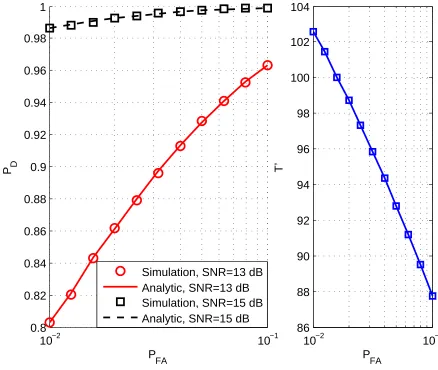
3.2 IQI distorted 4-QAM constellation patterns of 4 AF relays witha = 1 and (a) (αrx, θrx, αtx, θtx)=(0.03,5o,0.03,5o); (b) (αrx, θrx, αtx, θtx)= (−0.03,−5o,−0.03,−5o); (c) (αrx, θrx, αtx, θtx)=(0.05,3o,−0.05,−3o); (d) (αrx, θrx, αtx, θtx)=(0.04,−3o,−0.05,2o). 38 3.3 Simulation vs. Analytical results ofPD, and the corresponding threshold. . . 45
3.4 PDvs. PFA under 4 validated AF relay nodes and 1 illegitimate AF relay node. . 46
3.5 Performance comparison between GLRTL and DT. . . 47
4.1 Wireless AF relay system with the presence of impersonation attacker. . . 52
4.2 Block digram of identification implementation at destination. . . 52
4.3 The suboptimal signal design for PSK modulation case. . . 73
4.4 IQI parameters vs.αunderθrx= 5o, θtx =10o. . . 76
4.5 The range ofγ2vs. αunder differentθrxandθtx. . . 77
4.6 Analytical and simulated PD vs. PFA and corresponding T. The current AF relay has (αrx, θrx, αtx, θtx) = (−0.03,5o,0.05,4o), the validated AF relay owns (αrx, θrx, αtx, θtx)=(0.02,5o,−0.05,−4o) and N =14. . . 79
4.7 PDvs SNR under differentPFAsettings. . . 80
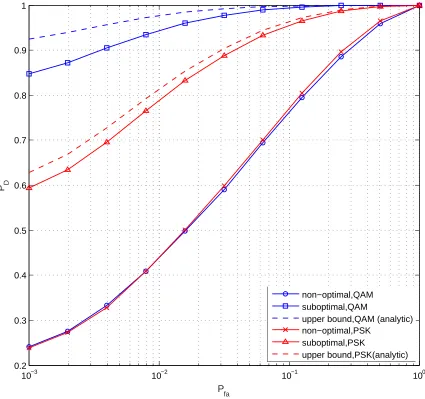
4.8 Detection probabilities comparison between suboptimal and non-optimal sig-nal design and the corresponding upper bounds. The current AF relay has (αrx, θrx, αtx, θtx)=(−0.03,3o,0.03,3o), the validated AF relay owns (αrx, θrx, αtx, θtx)= (0.02,5o,−0.05,−4o), SNR=16 dB,N =14. . . 81
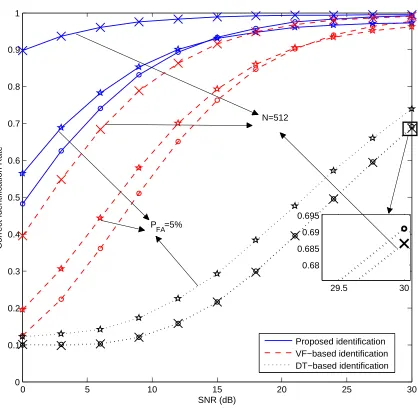
4.9 Identification performance comparisons between proposed methods and VF, DT based methods. The cross marker denotesN =512,PFA = 1%, star marker denotesN = 32,PFA =5%, circle marker denotesN = 32,PFA = 1%. . . 82
5.1 The experimental setup using IEEE 802.11g Atheros platform. . . 93
5.2 Simulation results vs. theoretical results underN = 50 and 100, respectively. . . 94
5.3 Probability of detection vs. probability of false alarm underN = 100. . . 95
5.4 Probability of detection using different number of samplings. . . 96
5.5 Simulation vs. analytic results ofPD, and the corresponding threshold. . . 104
5.6 Authentication performance with different number of characteristics. . . 105
5.7 Authentication performance comparison ofPDwith equal weights and optimal weights. . . 106
6.1 System model with FD and FI Tx IQI. . . 110
6.2 Threshold,PEFDandPEFAunder SNR =14 dB and NR = 8.DM=Distributed Method, CM=Centralized Method. . . 121
6.3 PEFAvs. SNR under differentPFA andNR. . . 122
6.4 PEDvs. PFAunder SNR=18 dB andNR =1,3,5. . . 123
6.5 PEDvs. SNR underPFA = 0.01 and NR =1,3,5. . . 124
6.6 PEDvs. SNR underRk = −13, -10, -7dB,NR =5 and PFA =0.01. . . 125
6.7 Authentication model using MRC technique. . . 126
6.8 Detection probability comparison between non-MRC and MRC with different
M. . . 130
7.1 Cross-layer design for end-to-end authentication. . . 138
7.2 The authentication simplification with prediction and reuse of physical-layer characteristics. . . 141
7.3 One-way hash digital signature using PHY-key generation. . . 143
7.4 Authentication using PHY-key generation. . . 145
7.5 Authentication handover delay performance. . . 147
List of Tables
4.1 Ranges of<{g1},={g1},<{g2}and={g2}. . . 56
List of Abbreviations
5G 5th Generation Mobile Networks or Wireless Systems
A/D Analog-to-Digital
AF Amplify-and-Forward
AFE Analog Front-End
AP Access Point
AWGN Additive White Gaussian Noise
BS Base Station
CBC-MAC Cipher Block Chaining Message Authentication Code
CFO Carrier Frequency Offset
CIR Channel Impulse Response
CSI Channel State Information
CSMA/CA Carrier Sense Multiplex Access with Collision Avoidance
D/A Digital-to-Analog
DF Decode-and-Forward
DOA Direction of Arrival
FA False Alarm
FD Frequency-Dependent
FI Frequency-Independent
GLRT Generalized Likelihood Ratio Test
GLRT-CLM Generalized Likelihood Ratio Test for Classic Linear Model
i.i.d. Independent and Identically Distributed
IP Internet Protocol
I/Q In-phase and Quadrature-phase
IQI In-phase and Quadrature-phase Imbalance
LO Local Oscillator
LPF Low-Pass Filter
LRT Likelihood Ratio Test
LS Least Square
MAC Medium Access Control
MD Miss Detection
mmWave Millimeter Wave
MRC Maximal-Ratio Combining
OFDM Orthogonal Frequency-Division Multiplexing
OSI Open System Interconnection
PDF Probability Density Function
PER Packet Error Rate
PHY Physical-Layer
PSK Phase Shift Keying
QAM Quadrature Amplitude Modulation
QPSK Quadrature Phase Shift Keying
RF Radio Frequency
RSSI Received Signal Strength Indicator
RTT Round-Trip Time
SINR Signal-to-Interference-plus-Noise Ratio
SNR Signal-to-Noise Ratio
Chapter 1
Introduction
1.1
Research Motivation
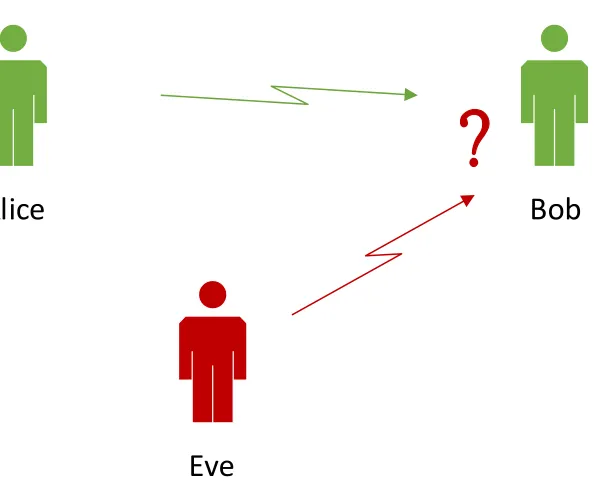
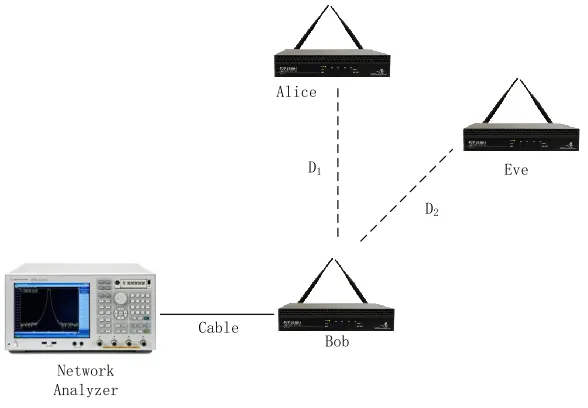
Although the shared nature of radio propagations enables convenient “anywhere” wireless ac-cess, it simultaneously introduces many security vulnerabilities to wireless systems. Compared to wired communication systems, the broadcast signals in wireless networks are accessible to both legitimate and illegitimate devices that are currently sharing the wireless medium. This feature becomes the root of security threats in wireless communications and it can be exploited for unauthorized access and even malicious attacks. Since the direct attacks are easy to detect, the sophisticated attacker usually covers its vicious behaviors through impersonating a legiti-mate entity. To clearly reveal this kind of attack scenario, Alice, Bob and Eve are introduced according to the terminologies of communication security [1]. As shown in Fig.1.1, Alice and Bob denote the intended wireless transmitter and receiver, respectively. Eve is the unautho-rized attacker. Eve’s objective is try to impersonate Alice and deceive Bob into bellieving that Bob is currently communicating with the legitimate Alice rather than Eve. Once the deceit is successful, the communication between Bob and Eve will be leaked and exposed to various malicious attacks.
In practice, authentication technique is used to protect the wireless systems from this kind of impersonation-based attacks. The concept of authentication is defined as [2]
“Verifying the identity of a user, process, or device, often as a prerequisite to allowing
access to resources in an information system.” — The Special Publication 800 series.
2 Chapter1. Introduction
Alice
Bob
Eve
Figure 1.1: “Alice-Bob-Eve” attacking scenario.
In wireless systems, the objective of authentication is to verify the authenticity of the iden-tities claimed by wireless devices. In the scenario of “Alice-Bob-Eve”, authentication tech-nique can be used to detect the presence of Eve. If the presence of an attacker is confirmed, the receiver is able to do some other actions for defending against Eve’s illegitimate access. Therefore, wireless authentication is the primary task in protecting wireless communications.
Traditionally, authentication processing is accomplished above the physical layer through checking the upper-layer identities of devices and using key-based cryptography. However, due to the upper-layer identity is not directly associated with the stable hardware components of devices, the sophisticated attacker can easily change its digital address to a legitimate one for the sake of being identified as a legitimate device. Regarding the method of using key-based cryptography, it inherently suffers from many problems in key management, high computa-tional cost of encryption algorithms and intolerable communication delay in wireless systems [3]. In light of this, the physical-layer authentication technique is emerging as a promising complement to the upper-layer methods.
trans-1.1. ResearchMotivation 3
mitter. These characteristics are used as the device fingerprint of wireless transmitters. Con-trary to upper-layer identity and key that can be possessed by any devices, the physical-layer device fingerprint is directly associated with the unique hardware of wireless devices and com-munication channel, which is extremely difficult to mimic. These characteristics can be typi-cally classified into two types, which are the wireless link attribute and radio-frequency analog front-end (RF-AFE) imperfection [4]. Specifically, the wireless channel reflects the unique communication environment between the intended transmitter and receiver. The RF-AFE im-perfection is a distinguishable hardware feature generated from the imperfect device fabrica-tion. These physical-layer characteristics, which represent the identity of the communicating transmitter, can automatically distort all transmitted signals. Also, the channel and RF-AFE imperfection estimation and compensation techniques are equipped in most present receivers so that the receiver can directly use these ready-made estimates for authentication without pos-ing high hardware implementation cost or communication throughput reduction.
Although physical-layer authentication is drawing more research attention, many challeng-ing issues remain for future works. We briefly summarize four main issues as follows.
fin-4 Chapter1. Introduction
gerprinting techniques and characteristic differentiation techniques are in high demand. Second, the fast emerging 5th generation (5G) related techniques, such as millimeter wave (mmWave) transmission, massive deployed small cells and vast heterogeneous devices, will po-tentially engender urgent technical problems in current physical-layer authentication schemes. For example, the authentication handover may become very frequently when mobile users are transferring between the shrunken cells. Therefore, it is also important to survey the impacts of the new physical-layer related techniques on the performance of authentication in 5G. Then, researchers can further consider corresponding solutions to mitigate the negative impacts.
Third, effective physical-layer authentication solutions are urgently demanded in some spe-cial scenarios, espespe-cially in wireless amplify-and-forward (AF) cooperative relaying systems. Specifically, AF relay nodes, also known as physical reflectors, only working in the physical-layer. Due to this working feature, all of the existing well-defined upper-layer involved au-thentication protocols cannot authenticate AF relays. Although the identification technique for another commonly used decode-and-forward relaying strategy has been investigated in [9], to the best knowledge of the author, there is no comprehensive work for the special case of AF re-laying. Consequently, the applicable physical-layer fingerprinting techniques for the AF relay system is worth studying.
Finally, the integration of physical-layer authentication techniques with existing upper-layer authentication protocols and standardized wireless infrastructure is another significant obstacle of applying this authentication technique into practice. Physical-layer authentication is expected to work as an important complement to the existing upper-layer security schemes and achieve better security performance. Therefore, it is valuable to study comprehensive cross-layer technique which can effectively integrate physical-layer method with existing upper-layer methods without causing any conflicts.
1.2
Dissertation Contributions
The main contributions of this dissertation are summarized as follows.
1.2. DissertationContributions 5
identify their weakness and strength, which points out the necessity of using layer authentication as a security enhancement. The main problems of current physical-layer authentication are discussed, which includes low reliability, effective and conflict-free integration with existing upper-layer security protocols and standard infrastructures, and the new impacts due to the upcoming 5G communication related techniques.
• A novel wireless relay identification specifically for AF systems is proposed. Relay identification is a useful technique to secure wireless cooperative systems. However, the identification of AF relay nodes is more challenging since AF relay only works in the physical layer, implying that all existing upper-layer identification protocols cannot handle this special case. A comprehensive AF relay identification is proposed through checking in-phase and quadrature imbalance (IQI) and wireless channel features. Satis-factory identification accuracy is achieved in the case of multiple AF relays.
• An enhanced device fingerprinting technique is proposed. Given the fact that the authen-tication performance using only one physical-layer characteristics is not always reliable, we propose choosing multiple proper characteristics according to the real communica-tion environment to generate more robust and applicable device fingerprints. Particularly, RSSI and PER are first considered together to create enhanced device fingerprints. Then, a general multi-characteristics-based fingerprinting method is investigated. Meanwhile, the optimal weights are derived for combining the multiple characteristics. Using our enhanced fingerprinting technique, the attacker detection probability can be significantly increased compared to using only one characteristic.
6 Chapter1. Introduction
• A seamless integration of the physical-layer and key-based upper-layer authentication scheme is proposed. Given that physical-layer authentication is an important comple-ment to existing key-based security schemes, the seamless integration technique is highly demanded. A cross-layer authentication design using a physical-layer key generation is proposed to achieve this goal. Furthermore, the authentication handover complexity can be significantly reduced by using our physical-layer key generation, which is especially valuable to the upcoming 5G communications.
1.3
Dissertation Organization
The remainder of this dissertation is organized as follows.
In Chapter 2, the literature survey regarding the fundamentals of traditional and physical-layer authentication techniques is discussed. The common attack types in wireless systems are reviewed. The current challenging issues and potential forthcoming problems in the wireless authentication research area are identified.
In Chapter 3 and 4, we address the problem of identifying AF relay solely in physical layer. Chapter 3 studies AF relay differentiation. According to the physical-layer working principle of AF relay nodes, the joint Rx/Tx IQI and wireless channel factors are used to generate a novel fingerprint to distinguish two AF relays nodes. The statistics of this fingerprint are analyzed and exploited in a hypothesis testing to verify the claimed identity of the current communicating AF relay node.
1.3. DissertationOrganization 7
Chapters 5 and 6 focus on enhancing the current physical-layer authentication performance. Chapter 5 investigates the combination of multiple physical-layer characteristics to generate en-hanced wireless device fingerprints. An 802.11 wireless WiFi device authentication is first pro-posed using two specific attributes, which are RSSI and PER. Then, a more general scheme us-ing a weighted combination of multiple RF-AFE imperfections is studied. The optimal weights for the best detection performance are also discussed in this chapter.
Diversity techniques including multiuser and space diversities are exploited as another ef-fective method to improve the reliability of physical-layer authentication in Chapter 6. Through involving in multiple receivers, two collaborative authentication schemes (distributed scheme and centralized scheme) are proposed. On the other hand, the maximal-ratio combining tech-nique is considered in a receiver equipping with multiple antennas to improve the estimation accuracy of the device fingerprints.
Chapter 7 focuses on the cross-layer authentication system design. Given the advantages of using physical-layer technique, the effective integration method of combining multi-layer methods are discussed. A novel physical-layer key using physical-layer attributes is proposed as an example to achieve this seamless integration. Furthermore, the complexity reduction of the authentication procedure is investigated through using our physical-layer key.
Chapter 2
Background and Literature Review
Wireless transmission makes “anytime” and “anywhere” communication a reality. However, it also induces more vulnerabilities in wireless systems, as the electromagnetic waves propagated in an open transmission medium can be easily heard by unintended adversaries. Thus, the authentication technique becomes a necessity to detect wireless adversaries. In this chapter, the traditional and physical-layer authentication schemes are surveyed in terms of working fundamentals, related works and current technically challenging issues. The requirements of the cross-layer authentication system are also discussed in details. The motivation of this chapter is to familiarize the readers with the wireless authentication-related issues and lay the foundation for the rest of the dissertation.
2.1
Traditional Wireless Authentication Techniques
In conventional wireless systems, the security issues of authentication, confidentiality and in-tegrity are handled above the physical layer by mainly relying on upper-layer identity verifica-tion and key-based cryptography.
Regarding the upper-layer identity, the most commonly employed identity for authentica-tion purpose is the media access control (MAC) address. For example, IEEE 802.15.4 protocol based wireless systems can define a device’s digital address in the MAC sublayer, which is laid over the physical layer. In an IEEE 802.15.4 network, the MAC address of devices can be inserted in the MAC header of the message packet in the packet encapsulating procedure.
2.1. TraditionalWirelessAuthenticationTechniques 9
Since MAC address is network-wide unique, the intended packet receiver can verify the MAC address of the transmitter to prevent unauthorized access.
However, this kind of authentication scheme is vulnerable to identity-based attacks. Here, we introduce two easily launched and harmful identity-based attacks, the spoofing attack [6] and the Sybil attack [10]. The spoofing attacker can mimic the identity of another device. For instance, when a spoofing attacker changes its MAC identity to an authorized one, this attacker has a high chance of bypassing the MAC address verification mechanism. In identity-based Sybil attacks, an attacker can create multiple faked identities and present as multiple devices. As a result of a successful Sybil attack, the routing performance can be significantly degraded since the deceived entity thinks multiple nodes rather than one node are utilized to create an optimal routing. Above all, identity-based attacks are based on changing the upper-layer iden-tity. Since upper-layer identity, typically a string of numbers, can be easily revised, this kind of attack can be conveniently launched again and again but hard to completely eradicate by upper-layer identity verification schemes.
Key-based cryptography is another widely used upper-layer security technique. Fig.2.1 shows the basic working principle of encryption in protecting wireless communication security. Alice first uses key K to encrypt messageM1 into codewordC. Then,C is decrypted by Bob
to generateM2. Ideally, it is expected that M1 = M2 if Bob knows K. Eve cannot decrypt the
10 Chapter2. Background andLiteratureReview
Encryptor
M1 Decryptor M2
C K
Alice Bob
Eve
Figure 2.1: Block digram of encryption-based security.
the public key is used to encrypt plaintext or to verify a digital signature and it is available for anyone. In the context of authentication, it is assumed that Alice writes a message for Bob and signs it by encrypting the message using her private key. In order to verify that the message was originally sent from Alice, Bob decrypts it using the public key. On the premise that only Alice owns the private key, the decrypted readable message means that it is Alice who wrote this message.
Although cryptography is an effective method to defend against identity-based attacks, its application in wireless systems still has many limitations. Five main limitations are summa-rized as follows.
• Secure and timely symmetric key sharing in highly dynamic and large-scale networks comprised of a large number of mobile and heterogeneous devices is becoming a chal-lenging task. More importantly, key management in such complex networks may require multiple hops transmission and involve many entities, as a result of which secure key exchange is hard to guarantee.
eco-2.2. Physical-LayerAuthenticationTechniques 11
nomic reasons. Therefore, the utilization of high complexity encryption algorithms in such wireless devices can result in long latency, which is intolerable for delay-sensitive communications.
• Upper-layer cryptography-based authentication is not suitable for all wireless device au-thentication cases. In practice, there are some wireless devices, such as AF relay nodes, only work in the physical layer. In this case, the complex cryptography is ineffective.
• Some new vulnerabilities may be introduced into the implementation of cryptographic systems. For example, the improper reuse of some random parameters or forgetting to destroy plaintext could be exploited by attackers to break the whole system [11].
• The premise that it is computationally infeasible to break the digital key is still mathe-matically unproven [3]. With the rapid growth of the processing power of attackers, the time spent on cracking a digital security key could be shortened remarkably. Once the digital key is obtained by an attacker, the cryptographic system is broken.
Based on the above discussion, it is clear that both upper-layer identity verification and cryptography-based authentication schemes have severe problems when applied in wireless systems. The root of these problems is that the upper-layer information is not directly associ-ated with the devices so that it can be easily modified. Given the fact that any user, including the attacker, who possesses the digital address or key can be identified as legitimate, the de-tection of this attacker is extremely difficult. Therefore, it is valuable to explore stable and unique physical-layer characteristics to generate device fingerprint and investigate correspond-ing physical-layer authentication techniques.
2.2
Physical-Layer Authentication Techniques
In this section, the physical-layer authentication techniques are reviewed in terms of RF finger-printing types, authentication model, related works and the related challenging issues.
12 Chapter2. Background andLiteratureReview
noiseless model using the concept of mutual information as
I(M;C)= 0 (2.1)
whereMandCdenote the original message and codeword, respectively. Equation (2.1) implies that an eavesdropper cannot obtain any information aboutMeven if it has the knowledge ofC. Thus, the best strategy to recover the original messageM is to guess its value randomly. Sub-sequently, the wiretap channel model was introduced and exploited by Wyner in [13]. Wyner showed that when a wiretapper’s (i.e., eavesdropper’s) channel is a degraded version of the main channel (Alice-Bob channel), Alice and Bob can exchange perfectly secure messages at a non-zero rate in the presence of the wiretapper.
However, the information-theoretic security mainly concentrates on securing the confiden-tiality of wireless communications through preventing passive eavesdropping/wiretapping. In practice, potential attackers may not always keep “silent” (i.e., passive eavesdropping), but also can actively launch malicious attacks on the legitimate devices located within their cov-erage at any time. Sophisticated adversaries can even impersonate another legitimate device (e.g., Alice) to disguise its identity. As a result, the adversary can freely eavesdrop the data transmission between Alice and Bob without being detected. Even worse, the adversary can directly communicate with Bob to corrupt the communication performance of Bob since Bob is beguiled into thinking he is currently communicating with Alice.
wire-2.2. Physical-LayerAuthenticationTechniques 13
less transmitter’s identity. Given that such attributes play the important role of fingerprinting wireless devices, a comprehensive review of their categories is given in the next subsection.
2.2.1
Device Fingerprinting Types
As early as the 1960s, the U.S. military applied specific emitter identification (SEI), a device-specific fingerprinting technique, to detect enemy radars [17]. After that, extensive research efforts were made to explore more applicable physical-layer characteristics for identifying wireless transceivers. In view of the significance of device fingerprinting, it is necessary to review the device fingerprinting types.
In light of our purpose is distinguishing the wireless devices, the eligible characteristics should reflect the differences between different devices. From the practice perspective, the characteristics selected as the device fingerprints should have the following features: 1)unique, 2)accessibleand 3)unforgeable.
The requirement of unique is to guarantee that the selected physical-layer characteristics are distinguishable from device to device. This requirement can be further classified as locally unique and globally unique. To be specific, the locally unique mainly ensures the fingerprint is unique within the scope of a network. Globally unique is stronger than locally unique, as its name implies, which means that the device fingerprint is distinguishable in any network comprised of a larger number of heterogeneous devices.
The accessible feature means that the eligible device fingerprint can be extracted at a low expense by the entity that needs to perform the authentication. For instance, the radio-frequency component related characteristics are good choices as these characteristics can au-tomatically tag their effects to the transmitted signals. These distorted signals can be thereby treated as the carrier of the transmitter’s fingerprint. In this case, the receiver is able to con-veniently extract the information of unique RF related characteristics through analyzing the received signals. In fact, most of the current receivers are equipped with the function to es-timate and compensate the RF impairment from the signal, which can potentially reduce the authentication implementation cost.
14 Chapter2. Background andLiteratureReview
RF-AFE Imperfection Based Fingerprints
IQI
Physcial-Layer Device Fingerprints
Wireless Channel Based Fingerprints
Clock
Skew CSI RSS
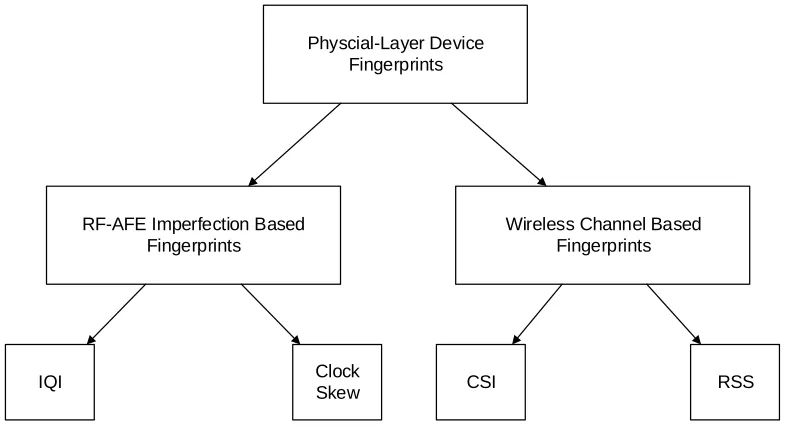
Figure 2.2: Classifications of physical-layer device fingerprints and some examples.
it is expected that the used device fingerprint cannot be forged at all. Similar to computational security, the 100% safety of using a device fingerprint is extremely hard to guarantee in prac-tice. The feasible requirement seeks to make sure the adversary cannot perfectly mimic the device fingerprint and the procedure of mimicking should cause a significantly high cost. For example, the time consumed on imitating a similar enough fingerprint is much longer than the time of an authentication session.
Based on present physical-layer authentication researches, many transmission related char-acteristics qualify for fingerprinting wireless devices. Typically, these charchar-acteristics can be classified into two categories [4, 18]: wireless channel based fingerprint and RF-AFE imper-fection based fingerprint. Fig.2.2 shows the classification and some typical examples. In the following, we describe both fingerprinting techniques and discuss their problems.
Wireless Channel-Based Fingerprint
2.2. Physical-LayerAuthenticationTechniques 15
Channel between device A and B
Channel based Physical-layer authentication
AFE imperfection based Physical-layer authentication
I/Q imbalance of device D (Modulation Domain) Signal Transient of device C
(Waveform Domain)
Device A
Device B
Device C
Device D
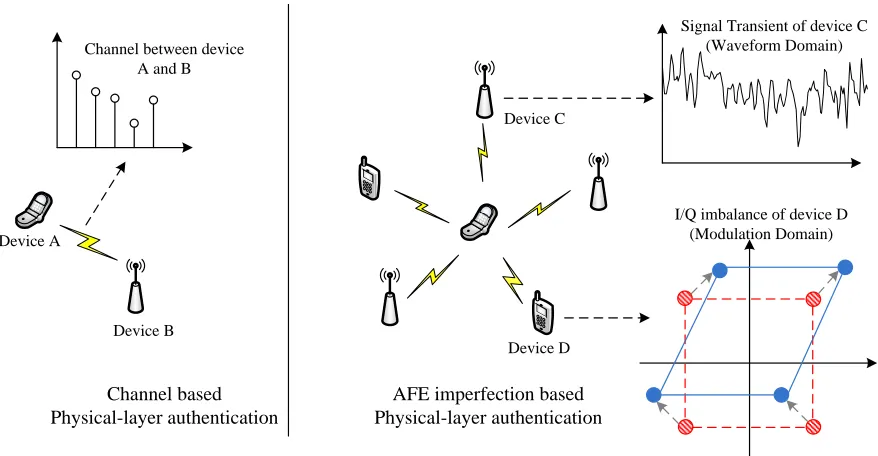
Figure 2.3: Comparison of existing channel based and RF-AFE imperfection based physical-layer authentication techniques.
by the transmitted signals cannot be controlled by any devices, the wireless channel related information is robust for uniquely identifying the transceiver pair (transmitter-receiver). Two typical examples of the wireless channel based fingerprint are channel state information (CSI) and received signal strength (RSS).
In wireless communications, CSI refers to the channel properties of a communication link. This information describes how a signal propagates from the transmitter to the receiver and represents the combined effect of, for example, scattering, fading and power decay with dis-tance. In practice, the spatial diversity and temporal property randomizes the radio channel between a transmitter and a receiver, which are deployed in two locations. Furthermore, in a rich multi-path indoor environment, the adversary-receiver channel states have been proved to be significantly different from the legitimate transmitter-receiver channel states if this adver-sary is locating in a wavelength away from the legitimate transmitter [19].
16 Chapter2. Background andLiteratureReview
at Bob is always different. It is because the transmitted signals are inevitably further distorted by complex communication environment factors, which are out of Eve’s control. Since RSS is an important metric for evaluating the receiving sensitivity of antenna and signal quality, RSS information is available in most of the current communication platforms. Therefore, it is easy to make use of RSS readings for implementing authentication systems. Some works are taking the advantages of using RSS to detect the malicious attackers such as proposed in [6, 20].
Although the randomness and fast variation features of the channel make the channel-based fingerprint unforgeable, this also results in many impractical limitations. In this fingerprinting approach, the receiver has to continuously estimate channel related attributes and compare them with the previous estimates before these attributes become temporally and spatially un-correlated. If the difference between the compared estimates is larger than a reasonable value, the current transmitter will be claimed as an attacker. Therefore, delays in the monitoring and estimating of attributes will result in severe authentication errors, for instance, legitimate de-vices will be detected as attackers by mistake. Unfortunately, the updating of attributes can be interrupted in most sleep mode enabled networks such as IEEE 802.15.4 networks. As a result, the first authentication cannot be performed since there is no previous fingerprint for comparison. It thereby has to rely on extra techniques, such as encryption, to solve this prob-lem [21]. We call this the first-time authentication probprob-lem. In practice, timely updating of the channel states becomes a challenge in highly dynamic environments (e.g., vehicle-to-vehicle communications), environments without rich multipath (e.g., open outdoor communications) and sleep mode enabled networks (e.g., IEEE 802.15.4 networks). Consequently, these factors limit the development of wireless channel-based authentication in practical applications.
RF-AFE Imperfection-Based Fingerprints
2.2. Physical-LayerAuthenticationTechniques 17
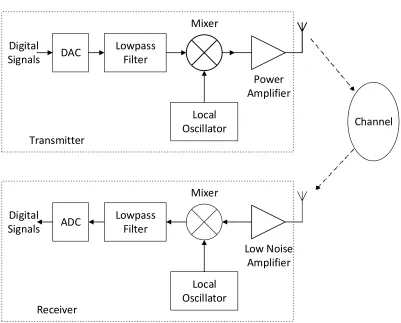
opposite processes are performed to recover the signals in the digital domain. Unfortunately, due to imperfect circuit manufacturing, the fabricated analog components are not ideal. To reduce the manufacturing costs, the manufacturer usually produces circuit components accord-ing to a criterion called tolerance/accuracy. This criterion indicates the maximal error ranges of the corresponding property values. In practice, the circuit components within the tolerance can meet most of the performance requirements. For example, a 2×10³ ohm resistor with 5%
tolerance means a dynamic error as high as 100 ohm.
DAC Lowpass
Filter
Local
Oscillator Channel
Power Amplifier Mixer
Digital Signals
Transmitter
ADC Lowpass
Filter
Local Oscillator
Low Noise Amplifier Mixer
Digital Signals
Receiver
Figure 2.4: RF front-end block diagram for transmitter and receiver.
18 Chapter2. Background andLiteratureReview
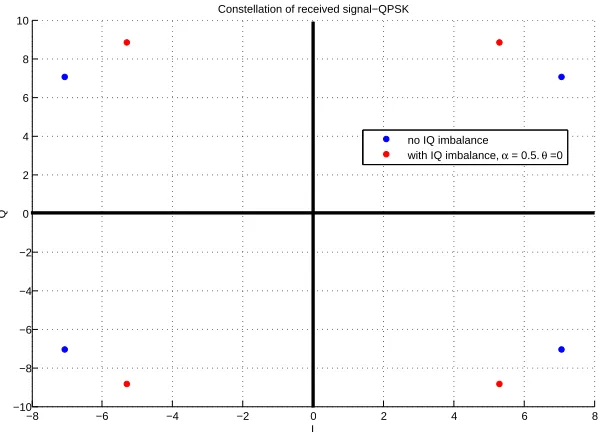
This can reduce the additional cost of generating fingerprints and make the fingerprints accessi-ble at the receiver. Further, this imperfection is hard to mimic since the hardware-level changes, especially in well-fabricated devices, are excessively difficult. Thus, many RF-AFE imperfec-tions are exploited for physical-layer authentication. The in-phase and quadrature imbalance (IQI) and clock skew are presented as two typical examples in the following.
IQI mainly refers to amplitude and phase mismatches between in-phase (I) and quadrature (Q) branches in a transceiver’s signal processing [22]. Ideally, the analog components in both I and Q branches would have exactly the same performance characteristics, but this rarely hap-pens in practice. The impairment of the local oscillator (LO) will cause frequency-independent (FI) IQI, which implies unequal gains as well as a not exact 90◦ phase shift between the I and Q (I/Q) branches. The impacts of amplitude mismatch and phase-shift mismatch on 4-QAM constellations in the I and Q plane are illustrated in Fig. 2.5 and Fig. 2.6, respectively. As one of the typical I/Q signal processing architecture based implementations, the direct conversion (also called the zero intermediate frequency) transceiver inherently suffers more from IQI [24]. In practice, the presence of IQI is especially pronounced in most of the orthogonal frequency division multiplexing (OFDM) based wireless communication systems. In addition, it is also acknowledged that IQI may become more severe and device-specific in multiple antennas sce-narios and millimeter wave transmission [67]. Consequently, IQI can be a good choice of fingerprint to identify wireless transceivers, such as reported in [25, 26, 27].
The basis of clock skew fingerprinting is that achieving exact synchronization of two clocks built in two different wireless devices is impossible. In fact, the most important part of clocks is the crystal oscillator, which is able to create an electrical signal with specific frequency. Although the frequency of the created signals is accurate enough to meet most of the applica-tion requirements, the minor error still exists due to the imperfect fabricaapplica-tion factor. Besides, another important factor is that the crystal oscillator will unavoidably age, which degenerates the frequency accuracy of the generated signal. For example, if a crystal oscillator has an ac-curacy of 20 ppm (parts-per-million, 10−6), which is typical for customer electronics, and the
2.2. Physical-LayerAuthenticationTechniques 19
−8 −6 −4 −2 0 2 4 6 8
−10 −8 −6 −4 −2 0 2 4 6 8 10
I
Q
Constellation of received signal−QPSK
no IQ imbalance
with IQ imbalance, α = 0.5. θ =0
Figure 2.5: 4QAM constellation with amplitude imbalance.
−10 −8 −6 −4 −2 0 2 4 6 8 10
−8 −6 −4 −2 0 2 4 6 8
I
Q
Constellation of received signal−QPSK
no IQ imbalance
with IQ imbalance, α = 0, θ = 20o
Figure 2.6: 4QAM constellation with phase imbalance.
20 Chapter2. Background andLiteratureReview
which is easy to intercept and mimic. Furthermore, the clock offset is not as stable as IQI in the mobile scenario due to the Doppler effect.
It is worth noting that there is another manmade hardware fingerprint which is called phys-ical unclonable function (PUF). PUF is a physphys-ical entity embodied in a physphys-ical structure. It works based on the unique device signatures that can be generated by specially designed com-plex integrated circuit (IC) [29, 30]. Take delay PUF for an instance, the physical signature of wireless devices can be yielded from the random variations in the delays of the specific part of circuits (e.g., wires and transistors). This means that if the same input is given to different PUFs, the corresponding delays of the outputs are different. Therefore, the PUF can implement the challenge-response authentication, where the challenge refers to the input of the PUF and the response is the corresponding output. The main disadvantage of using PUF is the high cost, as it always requires additional IC to produce the unclonable characteristic. Furthermore, these ICs have to be different from device to device for insuring their uniqueness.
In summary, the RF-AFE imperfection shows great advantages in providing stable and vast characteristics for device authentication compared with the wireless channel based fingerprint-ing method. Moreover, the RF-AFE imperfection is directly associated with the authentication target (i.e., wireless transmitter), rather than the communication environment. Thus, RF-AFE imperfection based device fingerprinting is more simply and effective. However, the main problem of this fingerprinting technique is that the distinction of the selected hardware-level imperfection between different devices is usually small. In practice, its observation and estima-tion would be further corrupted by noise and interference. All of these factors can degenerate the device differentiation accuracy.
2.2.2
Physical-Layer Authentications Related Techniques
It is fact that the physical layer is able to provide sufficient characteristics for authentication purpose. The corresponding characteristic processing technique is another key point that could significantly influence the authentication performance. This subsection focuses on introducing the authentication related techniques.
2.2. Physical-LayerAuthenticationTechniques 21
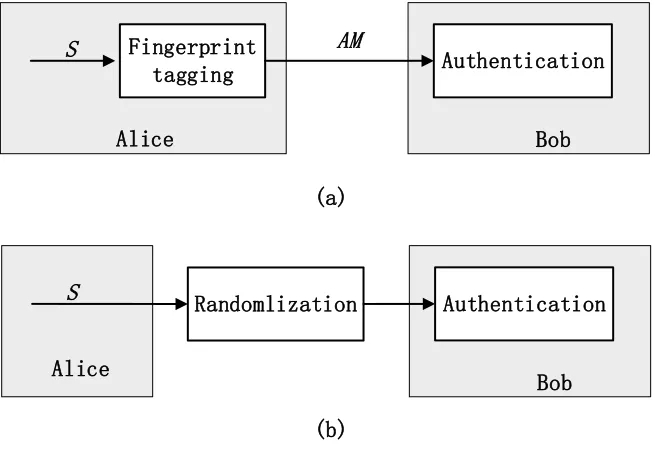
As above-mentioned, physical-layer fingerprints can be classified into wireless channel-based and RF-AFE imperfection-channel-based types. Correspondingly, two basic authentication mod-els for the two fingerprinting types are shown in Fig.2.7 .
Fig. 2.7(a) considers the case of using RF-AFE imperfection-based fingerprint. In this case, the signal S is tagged with the unique and unclonable hardware-level characteristic of Alice to create the authentication message AM. Bob should check the authentication tag from the receivedAMto verify the identity of the sender. It is worth mentioning that this fingerprint tagging usually can be accomplished without sacrificing data throughput. This is because the signal is inevitably and automatically distorted by RF-AFE imperfection, and we are interested in using the distortion information rather than the data contents for device authentication. As a contrary example, the authentication using watermarking [31, 32] generally requires additional bits to carry the authentication tag instead of carrying data, thereby the data throughput is penalized.
In Fig. 2.7(b), the transmitted signals are randomly affected by the communication environ-ment rather than by Alice, and become unique as a result. These randomized channel-related attributes in the transmitted signals are assumed to be known only by the authorized Alice and Bob. Consequently, Bob can verify the sender’s identity by checking these attributes.
Hypothesis Testing
In the authentication procedure, one major concern is deciding whether the current trans-mitter is legitimate Alice or illegitimate Eve. Herein, the hypothesis testing technique is intro-duced to model this decision step.
Hypothesis testing in the authentication theory is first proposed by Maurer in [16]. After this work, the binary hypothesis testing became a well-accepted model to determine the true identity of signal transmitter. Binary hypothesis testing has two hypotheses, the null hypothesis
H0and the alternative hypothesisH1. This can be mathematically represented as
H0: f belongs to Alice
H1: f belongs to Eve
, (2.2)
22 Chapter2. Background andLiteratureReview
Fingerprint tagging
S AM Authentication
Alice Bob
Randomlization
S Authentication
Alice
Bob (a)
(b)
Figure 2.7: Physical-layer authentication models using (a) RF-AFE imperfection-based and (b) wireless channel-based fingerprinting techniques.
is the fingerprint of Eve, implying an illegitimate attacker is detected.
However, it is possible to make incorrect decisions when judging the origin of device fin-gerprints. Wrong decisions may produce two types of errors, type I error and type II error. A type I error is also termed as a false alarm, and it refers to the incorrect rejection of a true null hypothesis. In authentication scenario, it means claiming Eve as the transmitter when Alice is the actual transmitter. A type II error is the failure to reject an alternative hypothesis which is also called a miss detection. In authentication, the accuracy of hypothesis testing results is very important. For example, once the miss detection error is made, the attacker can consequently obtain the authorized access to the network, which can likely result in severe information leak-age and data throughput decrease.
Neyman-Pearson Lemma
Neyman-Pearson lemma can be generally used to decide H0 and H1 in the hypothesis testing. Neyman-Pearson lemma can be given as [33, eq. 3.3]:
To maximize PDfor a given PFA= α, decideH1if
L(x)= p(x;H1)
2.2. Physical-LayerAuthenticationTechniques 23
0
H
H
1T
False Alarm
Miss Detection
Figure 2.8: Decision regions by adjusting threshold in a binary hypothesis testing.
where the threshold T can be calculated from
PFA=
Z
{x:L(x)>T}
p(x;H0)dx= α. (2.4)
Here,PFAis the false alarm probability, andPDdenotes the detection probability. In (2.3), the functionL(x) is termed as the likelihood ratio since it indicates for each value ofxthe likelihood of H1 divided by the likelihood of H0. In Fig.2.8, the hypothesis testing with the decision regions and threshold described in Neyman-Pearson lemma is illustrated as an example.
24 Chapter2. Background andLiteratureReview
2.2.3
Related Works
Thanks to the contributions of many research pioneers, the physical-layer authentication tech-nique experienced a period of rapid development.
Starting with the wiretap channel model proposed by Wyner, researchers started to con-sider security techniques to protect wireless communications from malicious wiretapping in the physical layer. In the preliminary stage of physical-layer security investigation, the researchers concentrated on the theoretical analysis of passive wiretapping. In [14, 34], the authors dis-cussed the presence of active eavesdroppers which gives rise to the demand of physical-layer authentication. Some authentication methods using additional bits to carry authentication tag were proposed. In [31], the embedded watermark based authentication system is analyzed and designed. The author of [35] proposed a stealthy physical-layer authentication tagging method that also occupies some payload to carry the authentication tags. Motivated by the working principles of encryption, some studies have tried to design light-weight and stealthy coding in the physical layer for authentication. For example, a continuous physical-layer authentica-tion technique using time-varying transmission parameters was investigated based on a novel adaptive OFDM system [36], where the novel adaptive OFDM system was proposed in [37]. In this authentication scheme, a precoded cyclic prefix (PCP) is used to replace general cyclic prefix to enhance the authentication accuracy. It is assumed that only legitimate users can suc-cessfully decode the PCP sequence in order to obtain necessary parameters for decoding the OFDM data.
2.3. Problems andChallengingIssues inCurrentWirelessAuthentication 25
noise and channel estimation errors. In [41], three CIR-based authentication schemes are pro-posed to enhance the authentication reliability. As another important channel related attribute, RSS is also widely studied in many researches to detect, localize and identify wireless trans-mitters [6, 20, 42]. In [20], the RSS is used to distinguish identity-based attackers in wireless sensor networks. Further, in [6], both detection and localization techniques of identity-based attacker are considered. The author in [42] applied RSS readings in authentication and local-ization in wireless local area networks.
To overcome the aforementioned impractical problems of using channel based fingerprint-ing, many research efforts have been made in exploiting more available RF-AFE imperfection based fingerprinting. In [43] and [7], wireless authentication using constant and time-varying CFO is proposed, respectively. The author of [4] considered imperfect input/output charac-teristics of the digital-to-analog converter and the power amplifier as device fingerprints. The IQI is also widely investigated in [44, 45, 26, 8, 27]. To be specific, the IQI in terms of I/Q origin offset, amplitude imbalance and phase imbalance is reported as device-specific charac-teristics in [44, 45]. In [26], the amount of active wireless users in a network is counted by checking the IQI feature. In [27], the multiple collaborative receivers are used to detect both frequency-dependent and independent IQIs. The author of [8] proposed using joint receiving and transmitting IQI to identify amplify-and-forward relay nodes.
2.3
Problems and Challenging Issues in Current Wireless
Authentication
26 Chapter2. Background andLiteratureReview
2.3.1
Implementation Limitations in Cooperative Wireless Systems
Wireless relaying is commonly utilized in communication networks to increase the communi-cation coverage, system throughput as well as prolong the battery life. However, as a draw-back of this approach, involving relay nodes can potentially introduces new security threats and challenges to the wireless systems. A sophisticated malicious relay can be selected for signal forwarding with a higher chance through impersonating an authorized relay and pre-tending to be the best one compared with other relays [9]. Once this impersonation succeeds, the communications between the deceived entities are exposed to various attacks launched by malicious relay, e.g., ghost-and-leech attack [52] or denial of service attack [9, 53]. As sum-marized in [54], a malicious relay node can send source node the faked helper ready-to-send control packet to block the source-destination link establishment via the legitimate relays. In general, malicious relay nodes can initiate cooperative relay and then avoid it or use on-off be-havior in transmission to slow down the communications. Even worse, the deceived terminals can even be viciously de-authorized and de-associated from the network [55]. Therefore, the relay identification process is emerging to become an inevitable part of the cooperative relaying systems to detect the unauthorized access attempts made by malicious relays. Especially, relay authentication is highly demanded in the scenarios where multiple trusted relays are required to cooperate in order to provide physical-layer security, e.g., to prevent the eavesdroppers from overhearing [56, 57].
2.3. Problems andChallengingIssues inCurrentWirelessAuthentication 27
2.3.2
Low Reliability Problem of Physical-Layer Authentication
Although the effectiveness of identifying wireless devices in the physical layer has been proved, its performance sometimes suffers from low reliability problem. As discussed above, both wireless channel-based fingerprinting and RF-AFE imperfection-based fingerprinting have their own shortcomings. Due to the dramatic variation of channel, the corresponding channel based fingerprint is featured as time-varying. This feature requires very frequent fingerprint estima-tion and comparison in practice. Failure to do so will significantly increase the unwelcome false alarm probability. The limited ranges of RF-AFE imperfection may result in two similar device-specific fingerprints, which are hard to differentiate. Even worse, with the consideration of noise corruption at the receiving procedure, the accurate fingerprint detection and diff eren-tiation will become extremely challenging. For these reasons, physical-layer authentication performance is not always reliable.
28 Chapter2. Background andLiteratureReview
be treated as a desired signal, we believe the desired signal detection can be improved through using diversity technique. In a cooperative system, the source usually covers multiple relays for optimal relay selection, which facilitates the collaborative authentication strategy. For instance, many relays may receive the authentication signal from the same source due to the broadcast nature of the wireless medium. Thus, multiple relays making use of cooperative observations can authenticate the transmitter together to achieve improved authenticity decision accuracy.
2.3.3
Challenges in Cross-Layer Authentication Implementation
It is well acknowledged that physical-layer authentication is complementary to the traditional upper-layer authentication schemes. Therefore, the effective cross-layer authentication design with the goal of enlarging the application scope and improving authentication performance is emerging as an urgent research topic in recent years.
2.3. Problems andChallengingIssues inCurrentWirelessAuthentication 29
MAC layer in IEEE 802.15.4 enabled networks [50].
Given the fact that most of the current networks rely on the upper-layer cryptography for authentication, the first problem of the cross-layer authentication design is the seamless inte-gration of physical-layer and upper-layer authentication schemes. The point of this cross-layer system implementation is that the physical-layer technique should be utilized by the existing upper-layer method to enhance the authentication performance rather than evoking conflicts.
Another potential obstacle of the practical integration development is the end-to-end au-thentication extension. In large-scale wireless networks, the auau-thentication and key exchange are often required between two devices that are not directly linked. But most of the current physical-layer authentications are confined to device-to-device authentication as they rely on the characteristics obtained from the directly received signals. Consequently, this method is hard to be used in network-wide end-to-end authentication.
Finally, the increasing implementation complexity is also an important problem of cross-layer authentication, especially in the 5G communication era. It is predictable that three timely challenges will correspondingly emerge.
Compatibility
In 5G, the devices need to be equipped with multiple radio access technologies (RTAs). A specific example is that the 5G-enabled devices ought to be backward compatible to support legacy 3G and 4G devices. Moreover, some functions of layers may be redefined, for example, the handoffs may no longer exist in layer 3 anymore [51]. Hence, correctly determining the authenticity of various devices operating in diverse upper-layer protocols will be more difficult. Hence, it is worth finding more ubiquitous physical-layer characteristics and process them to become suitable for different upper-layers’ authentication processing.
Cellular link establishment in mmWave communications
30 Chapter2. Background andLiteratureReview
is the adoption of millimeter level wave transmission to increase communication throughput. However, the mmWave cellular link establishment will be confronted with alignment difficulty.
Authentication handover latency
In 5G, the mobile users will be frequently moving from different base stations or access points covered cells, which results in frequent authentication handover processes. Tradition-ally, the authentication handover is based on specially designed cryptographic keys and multi-ple handshakes. In practice, the authentication handover has to involve multimulti-ple entities includ-ing users, APs, BSs and servers. The communications between those entities with complicated encryption algorithm are usually time-consuming. Therefore, the latency caused by a large number of handover processes will become an inevitable problem in 5G.
In brief, these new compatibility, mmWave link acquisition and latency problems of authen-tication handover primarily result from the gradual increase in complexity of the communica-tion condicommunica-tions in 5G. Therefore, the physical-layer authenticacommunica-tion technique is also expected to overcome these challenging issues, such as through simplifying the authentication procedure.
2.4
Summary
2.4. Summary 31
Chapter 3
Physical-Layer AF Relay Di
ff
erentiation
Technique
In this chapter, we start from the working principle of AF relay and consequently propose a novel AF relay fingerprint through analyzing the relayed signals at the destination node side for differentiating AF relay nodes. This differentiation technique is applied into the authentication application and show accepted authentication accuracy in our study.
3.1
Introduction
As discussed in Chapter 2, the differentiation of AF relay nodes is a special issue as all ex-isting upper-layer approaches are ineffective. Therefore, physical-layer method is necessary in authenticating AF relay in order to protect the security of cooperative wireless communica-tions. Besides security aspect, the applications of relay differentiation can also be extended to wireless device localization and tracing [58, 59].
To distinguish AF relays in layer, the primary point is finding appropriate physical-layer characteristics for fingerprinting AF relays. According to the AF relay’s working princi-ples, the received signals of AF relay should be down-converted from passband to baseband, amplified at the baseband, and then up-converted to passband for re-transmission. This is mainly because AF relays, specifically half-duplex relays, must buffer the received signals be-fore emitting them through RF front-end for the purpose of synchronization [60, 61]. Since
3.1. Introduction 33
the buffering operation can only be efficiently accomplished in digital domain and the high frequency passband signal is hard to digitally process, the signal down conversion becomes es-sential to the buffering operation [62]. Due to the down and up conversion operations at the RF components of AF relay, the relayed signals inevitably suffer from more several RF distortions than the signals transmitted by the regular transmitters. Consequently, RF-AFE imperfections are suitable for fingerprinting AF relay nodes.
In-phase and quadrature imbalance (IQI) is one of the most typical RF-AFE imperfections at AF relay nodes. The IQI can result in different deformations to constellation diagram in I/Q modulation systems. The impacts of IQI to the signal modulation performance of AF relaying system are widely analyzed in details in [63, 64, 65, 66]. In the perspective of authentication, IQI also has been studied for fingerprinting wireless devices by many authors [44, 45, 26, 8]. In [44, 45], the I/Q gain and phase-shift imbalances are reported as applicable features for device identification. Besides, the former one further experimentally validates the identification performance in the scenario of multiple 802.11n multiple-input multiple-output transmitters. In [26], the IQI distinctions of different devices is used to count the number of devices in a network, and it has shown satisfactory performance when the IQI is high enough.
In practice, the received signal at destination is affected by the device-specific IQI of AF relay as well as the unique channel gain between the relay and destination. Therefore, it is valuable to extract these unique effects through analyzing the received signal to identify AF relay nodes. In this chapter, a novel physical-layer relay differentiation scheme is proposed for authenticating the wireless AF relay nodes. We first study the unique joint Rx/Tx IQI nature of AF-based relay nodes and derive the AF relay fingerprint at destination node using IQI and channel related parameters. A two-parameter hypothesis testing is then adopted to differentiate the relay nodes based on this fingerprint. In order to maximize the capability of detecting minor difference between the IQI device fingerprints, the generalized likelihood ratio test (GLRT) for classical linear model is adopted to the hypothesis decision algorithm. Finally, the performance of the proposed authentication scheme are validated by numerical simulations. It is shown that by using the GLRT for classical linear model, our scheme outperforms a previous work, introduced in [26], in deciding true hypothesis.
34 Chapter3. Physical-LayerAF RelayDifferentiationTechnique
cos(
Z
t)tx tx
(1
D
) sin(Z T
t )cos(
Z
t)rx rx
(1
D
) sin(Z T
t )/2
rx rx
Rx IQI (
D T
, ) a Tx IQI (D T
tx, tx)( ) x t p( )
x t x td( ) y tp( )
a , I( )
x t
a , Q( )
x t
p( )
x t y tp( )
/3) /3)
/2
/3) /3)
Figure 3.1: Rx/Tx IQI model of AF relay.
model with IQI in AF relay. In Section 3.3, the IQI and channel gain-based device fingerprint of AF relay is analyzed and validated. Also, a two-parameter hypothesis testing model for relay differentiation is presented. In Section 3.4, the authentication method is proposed. Section 3.5 presents the numerical assessment results. Finally, this chapter is concluded in Section 3.6.
Notations: (·)∗ and (·)T denote complex conjugate and transpose operators, respectively.
Bold lowercase letters denote vectors. For vectora, thenth element is denoted bya[n]. <{x}
and={x}denote the real and imaginary part ofx, respectively.