© 2014, IJCSMC All Rights Reserved
932
Available Online at www.ijcsmc.com
International Journal of Computer Science and Mobile Computing
A Monthly Journal of Computer Science and Information Technology
ISSN 2320–088X
IJCSMC, Vol. 3, Issue. 10, October 2014, pg.932 – 943
RESEARCH ARTICLE
IMPROVISED CHANNEL ASSIGNMENT
TECHNIQUE FOR WIRELESS NETWORK
USING GENETIC ALGORITHM
1
Gunjan Lavaniya,
2Dheeraj Khatri
1
Research Scholar,
2Assistant Professor
Department of Electronics and Communication Engineering,
South Points Institute of Engineering & Technology, Sonipat
,
Haryana-131001(India)
Abstract: Wireless technology development is basically because of transformation of what has been largely a medium for supporting voice telephony into a medium for supporting other services, such as the transmission of video, images, text, and data. Thus, the demand for new wireless capacity is growing at a very rapid pace. Although there are, of course, still a great many technical problems to be solved in wireline communications. The traditional resources that have been used to add capacity to wireless systems are radio bandwidth and transmitter power. Unfortunately, these two resources are among the most severely limited in the deployment of modern wireless networks: radio bandwidth because of the very tight situation with regard to useful radio spectrum, and transmitter power because mobile and other portable services require the use of battery power, which is limited. These two resources are simply not growing or improving at rates that can support anticipated demands for wireless capacity. For efficient utilization of the radio spectrum, a frequency reuse scheme that is consistent with the objectives of increasing capacity and minimizing interference is required. Allocation of channels to a cellular system is important from a performance point of view. The allocation of a set of channels to each base station during the planning process i.e. Frequency Planning Process is a NP-complete optimization problem with constraints for which different approached have been proposed. Examples: Various attempts via graph coloring algorithms, neural networks, set theory and other methods via simulated annealing algorithms have been proposed to solve this problem.
However, this paper is to solve the channel assignment problem in wireless network using a Genetic Algorithm. The general purpose Simple Genetic Algorithm has been proved to cope up with varied channel demands in different wireless networks.
© 2014, IJCSMC All Rights Reserved
933
1.
Introduction
We propose a Search Technique based on evolution and survival similar to found in nature [1] [2] is being used to address the channel assignment problem (CAP) in cellular systems. A simple genetic algorithm is being examined which makes use of local search algorithm as mutation operation which shows of building a capable feasible channel assignment for different system scenarios as well as different traffic loads.
1.1 The Channel Assignment Problem
Let us consider N hexagonal cells each having one base station at the center transmitting with an omni-directional
antenna capable of tuning on any of the C available channels labeled as ck (k =1 , 2 ... C). Moreover, the
interference between any pair of cells is assumed to be known so that the frequency separation constraints may be estimated in order to avoid co-channel and adjacent channel interference. Such interference constraints are represented by an interference matrix X of the form:
Where elements xij (i,j = 1, 2, …… N) represent the frequency separation required between channels assigned to cells i and j respectively necessary to maintain interference below a certain threshold. Using this matrix it is possible to represent co-channel and adjacent channel interference constraints by choosing appropriated values for entries xij. In this work we will consider the co-channel interference case where elements in X are given by: xij ={ 1: if cell i and cell j cannot reuse a channel
0: otherwise
We refer to above requirements as hard interference requirements as they are considered to be inviolable. However soft constraints can also be desirable such as to reserve some channels for future network growth or hand-off purposes or to maintain an already predefined channel assignment the same as possible. Therefore it may be desirable to perform a channel assignment by trying to use the least number of channels or on the other hand, to produce the minimum number of channel reassignments. In order to perform a channel assignment it is necessary to know the number of channels required in each cell. Let λi be the call arrival rate at cell i and µ the mean call holding time for all calls. Then Erlang-B formula permits to determine the number ti of channels demanded at
cell i necessary to proportionate a grade of service equal to Pb. Let T be a channel demand vector with elements ti
(i= 1, 2, ….. , N ) representing the number of required channels at cell i. The channel assignment problem is then defined as:
© 2014, IJCSMC All Rights Reserved
934
With elements:
aik = { 1 : if cell i is assigned channel ck 0 : otherwise
A channel assignment is admissible if both traffic and interference constraints are fulfilled. This implies that:
C kti
aik
1For all I and j if ck and cal are two channels assigned to cell I and cell j, Then
│ Ck - cal│ ≥ in
2.
The Simple Genetic Algorithm
The algorithm is based upon coding solutions as binary strings. Using this coding scheme allows us to directly represent the channel assignment matrix A by placing all rows in a single string [3], [4]. Then a string is actually formed by concatenating N substrings of length C representing all channels in all cells. The fitness function used to evaluate the individuals in this algorithm is:
N i C k N j i j C l jl ik ij N i C k iki
a
x
a
a
t
F
1 1 1 1
2
1 1 ……….(1)
Where the first term is the number of conflicts produced for assigning a different rather than the required number of channels at each cell whereas the second term is the number of conflicts produced for interference constraint violations. The fitness function defined in such a way makes the genetic algorithm to look for solutions with zero conflicts; this is, with zero traffic and interference violations. The solution’s search is carried out using the tournament selection mechanism which consists in choosing the best individual between two randomly picked from the population. Also a crossover operator is employed in the search process. The crossover operator used is the l-point crossover which operation consists in selecting a random string position of two strings (called parents) and then building up two new strings with probability Pc (off- springs) by using one part of each parent. The mutation operator applied over every bit changes the bit value by its complement with probability Pm. Although the scope of this algorithm is quite general, it is shown that it is very useful in finding feasible frequency assignments for some scenarios of a cellular system. In this paper we have used the Genetic Algorithm and Direct Search Toolbox which is a collection of functions that extend the capabilities of the Optimization Toolbox and the MATLAB® numeric computing environment. The Genetic Algorithm and Direct Search Toolbox includes routines for solving optimization problems using Genetic algorithm Direct search These algorithms enable us to solve a variety of optimization problems that lie outside the scope of the standard Optimization Toolbox. All the toolbox functions are MATLAB M-files, made up of MATLAB statements that implement specialized optimization algorithms.
We can extend the capabilities of the Genetic Algorithm and Direct Search Toolbox by writing our own M-files, or by using the writing M-Files for Functions we want to optimize. To use the Genetic Algorithm and Direct Search Toolbox, we first write an M-file that computes the function we want to optimize. The M-file accept a row vector, whose length is the number of independent variables for the objective function, and return a scalar. This code written for this are available with authors.
3.
Uniform and Non-Uniform Condition
3.1 Uniform Traffic Condition
© 2014, IJCSMC All Rights Reserved
935
Fig. 1 Cellular Structure
Fig. 2 Interference Matrix
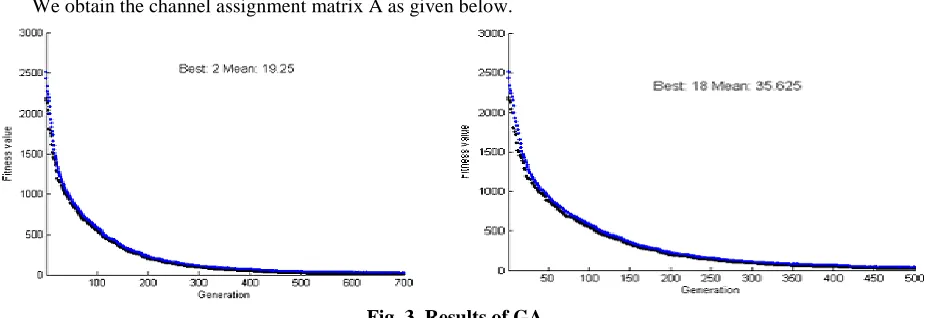
As from the figure 1 which is obtained from genetic algorithm, the number of conflicts produced for assigning a different rather than the required number of channels at each cell and the number of conflicts produced for interference constraint violations are 2 after 700 generation. For 500 generation we obtain total of 18 errors for the same conditions as shown in fig. 2.
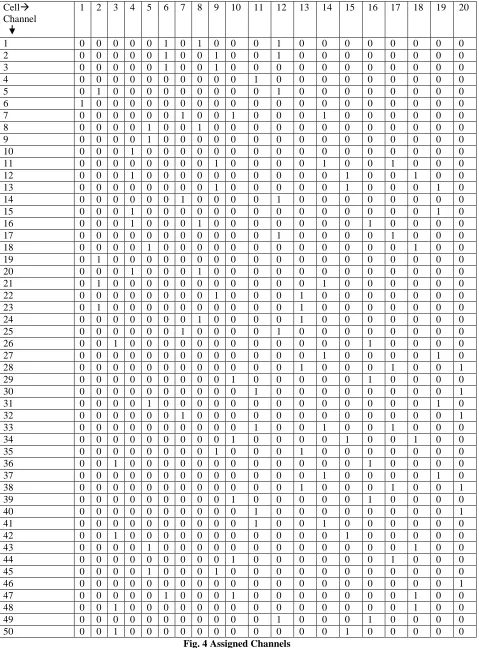
We obtain the channel assignment matrix A as given below.
Fig. 3 Results of GA
Cell 1 2 3 4 5 6 7 8 9 10 11 12 13 14 15 16 17 18 19 20
1 0 0 0 0 0 0 0 0 0 0 0 0 0 0 0 0 0 0 0 1
2 0 0 0 0 0 0 0 0 0 0 0 1 1 1 1 1 0 0 0 0
3 0 0 0 0 0 0 0 0 0 0 0 0 0 1 1 1 1 1 0 0
4 0 0 0 0 0 0 0 1 0 0 0 0 0 0 0 1 1 1 1 1
5 0 0 0 0 0 0 0 1 1 1 0 0 0 0 0 0 0 1 1 1
6 0 0 0 0 0 0 0 1 1 1 1 1 0 0 0 0 0 0 0 1
7 0 0 0 0 0 0 0 0 0 1 1 1 1 1 0 0 0 0 0 1
8 0 0 0 1 1 1 0 0 0 0 1 1 1 1 1 1 1 0 0 0
9 0 0 0 0 1 1 0 0 0 0 0 1 1 1 1 1 1 1 0 0
10 0 0 0 0 1 1 1 0 0 0 0 0 1 1 1 1 1 1 1 0
11 0 0 0 0 0 1 1 1 0 0 0 0 0 1 1 1 1 1 1 1
12 0 1 0 0 0 1 1 1 1 0 0 0 0 0 1 1 1 1 1 1
13 0 1 0 0 0 0 0 0 1 1 0 0 0 0 0 1 1 1 1 1
14 0 1 1 0 0 0 1 1 1 1 1 0 0 0 0 0 1 1 1 1
15 0 1 1 0 0 0 0 1 1 1 1 1 0 0 0 0 0 1 1 1
16 0 1 1 1 0 0 0 1 1 1 1 1 1 0 0 0 0 0 1 1
17 0 0 1 1 0 0 0 1 1 1 1 1 1 1 0 0 0 0 0 1
18 0 0 1 1 1 0 0 0 1 1 1 1 1 1 1 0 0 0 0 1
19 0 0 0 1 1 0 0 0 0 1 1 1 1 1 1 1 0 0 0 0
© 2014, IJCSMC All Rights Reserved
936
Cell
Channel
1 2 3 4 5 6 7 8 9 10 11 12 13 14 15 16 17 18 19 20
1 0 0 0 0 0 1 0 1 0 0 0 1 0 0 0 0 0 0 0 0
2 0 0 0 0 0 1 0 0 1 0 0 1 0 0 0 0 0 0 0 0
3 0 0 0 0 0 1 0 0 1 0 0 0 0 0 0 0 0 0 0 0
4 0 0 0 0 0 0 0 0 0 0 1 0 0 0 0 0 0 0 0 0
5 0 1 0 0 0 0 0 0 0 0 0 1 0 0 0 0 0 0 0 0
6 1 0 0 0 0 0 0 0 0 0 0 0 0 0 0 0 0 0 0 0
7 0 0 0 0 0 0 1 0 0 1 0 0 0 1 0 0 0 0 0 0
8 0 0 0 0 1 0 0 1 0 0 0 0 0 0 0 0 0 0 0 0
9 0 0 0 0 1 0 0 0 0 0 0 0 0 0 0 0 0 0 0 0
10 0 0 0 1 0 0 0 0 0 0 0 0 0 0 0 0 0 0 0 0
11 0 0 0 0 0 0 0 0 1 0 0 0 0 1 0 0 1 0 0 0
12 0 0 0 1 0 0 0 0 0 0 0 0 0 0 1 0 0 1 0 0
13 0 0 0 0 0 0 0 0 1 0 0 0 0 0 1 0 0 0 1 0
14 0 0 0 0 0 0 1 0 0 0 0 1 0 0 0 0 0 0 0 0
15 0 0 0 1 0 0 0 0 0 0 0 0 0 0 0 0 0 0 1 0
16 0 0 0 1 0 0 0 1 0 0 0 0 0 0 0 1 0 0 0 0
17 0 0 0 0 0 0 0 0 0 0 0 1 0 0 0 0 1 0 0 0
18 0 0 0 0 1 0 0 0 0 0 0 0 0 0 0 0 0 1 0 0
19 0 1 0 0 0 0 0 0 0 0 0 0 0 0 0 0 0 0 0 0
20 0 0 0 1 0 0 0 1 0 0 0 0 0 0 0 0 0 0 0 0
21 0 1 0 0 0 0 0 0 0 0 0 0 0 1 0 0 0 0 0 0
22 0 0 0 0 0 0 0 0 1 0 0 0 1 0 0 0 0 0 0 0
23 0 1 0 0 0 0 0 0 0 0 0 0 1 0 0 0 0 0 0 0
24 0 0 0 0 0 0 0 1 0 0 0 0 1 0 0 0 0 0 0 0
25 0 0 0 0 0 0 1 0 0 0 0 1 0 0 0 0 0 0 0 0
26 0 0 1 0 0 0 0 0 0 0 0 0 0 0 0 1 0 0 0 0
27 0 0 0 0 0 0 0 0 0 0 0 0 0 1 0 0 0 0 1 0
28 0 0 0 0 0 0 0 0 0 0 0 0 1 0 0 0 1 0 0 1
29 0 0 0 0 0 0 0 0 0 1 0 0 0 0 0 1 0 0 0 0
30 0 0 0 0 0 0 0 0 0 0 1 0 0 0 0 0 0 0 0 1
31 0 0 0 0 1 0 0 0 0 0 0 0 0 0 0 0 0 0 1 0
32 0 0 0 0 0 0 1 0 0 0 0 0 0 0 0 0 0 0 0 1
33 0 0 0 0 0 0 0 0 0 0 1 0 0 1 0 0 1 0 0 0
34 0 0 0 0 0 0 0 0 0 1 0 0 0 0 1 0 0 1 0 0
35 0 0 0 0 0 0 0 0 1 0 0 0 1 0 0 0 0 0 0 0
36 0 0 1 0 0 0 0 0 0 0 0 0 0 0 0 1 0 0 0 0
37 0 0 0 0 0 0 0 0 0 0 0 0 0 1 0 0 0 0 1 0
38 0 0 0 0 0 0 0 0 0 0 0 0 1 0 0 0 1 0 0 1
39 0 0 0 0 0 0 0 0 0 1 0 0 0 0 0 1 0 0 0 0
40 0 0 0 0 0 0 0 0 0 0 1 0 0 0 0 0 0 0 0 1
41 0 0 0 0 0 0 0 0 0 0 1 0 0 1 0 0 0 0 0 0
42 0 0 1 0 0 0 0 0 0 0 0 0 0 0 1 0 0 0 0 0
43 0 0 0 0 1 0 0 0 0 0 0 0 0 0 0 0 0 1 0 0
44 0 0 0 0 0 0 0 0 0 1 0 0 0 0 0 0 1 0 0 0
45 0 0 0 0 1 0 0 0 1 0 0 0 0 0 0 0 0 0 0 0
46 0 0 0 0 0 0 0 0 0 0 0 0 0 0 0 0 0 0 0 1
47 0 0 0 0 0 1 0 0 0 1 0 0 0 0 0 0 0 1 0 0
48 0 0 1 0 0 0 0 0 0 0 0 0 0 0 0 0 0 1 0 0
49 0 0 0 0 0 0 0 0 0 0 0 1 0 0 0 1 0 0 0 0
50 0 0 1 0 0 0 0 0 0 0 0 0 0 0 1 0 0 0 0 0
© 2014, IJCSMC All Rights Reserved
937
Fig.5 Percentage of fulfillment
3.2 Non-uniform Traffic Condition
In this we assume that the traffic condition is not uniform in all the cells. Let we consider ti= [3 4 5 6 7 8 9 10 11 12
13 14 12 11 10 8 7 5 9] for the ith cells. We consider hexagonal structure of cells as shown in the fig. a. which
consists of 20 cells and we have total of 30 channels. Then we find A Matrix as given below:
Cells Channels
1 2 3 4 5 6 7 8 9 10 11 12 13 14 15 16 17 18 19 20
1 1 0 0 0 0 0 0 0 0 0 0 0 0 0 0 0 0 0 0 1
2 0 0 0 0 0 0 1 0 0 0 1 0 1 0 0 0 0 0 0 1
3 0 0 0 0 1 0 0 1 0 0 0 0 0 0 0 0 0 0 0 0
4 0 0 0 0 0 0 0 0 0 0 0 1 0 0 0 1 0 0 0 1
5 0 0 0 0 0 0 1 0 0 0 0 1 0 0 0 0 0 0 0 1
6 0 0 0 0 0 0 0 0 1 0 0 0 1 0 0 0 0 1 1 0
7 0 0 0 0 0 0 1 1 0 0 1 0 0 1 0 0 0 0 1 0
8 0 1 0 0 0 0 0 0 0 0 0 1 0 0 1 0 0 0 0 0
9 0 1 0 0 0 0 0 0 0 0 0 1 0 0 0 1 0 0 0 0
10 0 0 0 0 0 1 0 0 0 0 1 0 0 0 0 0 0 0 0 1
11 0 0 0 0 0 0 0 1 0 0 0 1 0 0 0 0 1 0 0 0
12 0 0 0 0 0 0 0 0 0 0 0 0 1 1 0 0 1 0 0 1
13 0 0 1 0 0 0 0 0 0 0 0 0 0 0 0 1 0 0 0 0
14 0 0 0 0 0 1 0 1 0 0 1 0 0 0 0 0 0 0 0 0
15 0 0 0 0 0 0 0 0 0 0 1 0 0 1 0 0 1 0 0 1
16 0 0 0 0 0 0 0 0 0 0 1 0 0 0 0 0 0 1 0 1
17 0 0 0 0 1 0 0 0 0 0 0 0 0 0 0 0 0 1 0 1
18 0 0 0 0 0 0 0 0 1 0 0 1 0 0 0 0 1 0 0 0
19 0 0 0 0 0 0 0 0 0 1 0 0 0 1 0 0 0 0 1 0
20 0 0 0 0 0 0 0 1 0 0 1 0 0 0 1 0 0 0 0 0
21 0 0 0 0 0 0 1 0 0 1 0 0 1 0 0 0 0 0 0 0
22 0 0 0 0 0 1 0 0 1 0 0 1 0 0 0 0 0 0 0 0
23 0 0 0 0 0 0 0 0 0 0 0 1 0 0 1 0 0 0 1 0
24 0 0 0 0 0 0 0 0 1 0 0 1 0 0 1 0 0 0 1 0
25 0 0 0 0 0 0 0 0 0 1 0 0 0 0 1 0 0 0 1 0
26 0 0 0 0 0 0 0 0 0 1 0 0 1 0 0 1 0 0 1 0
27 0 0 0 0 0 0 0 1 0 0 0 1 0 0 0 1 0 0 0 0
28 0 0 0 0 0 0 0 0 1 0 0 0 1 0 0 0 0 1 0 0
29 0 0 0 0 0 0 1 0 0 0 0 1 0 0 0 0 0 0 0 0
30 0 0 0 1 0 0 0 0 0 0 0 0 0 0 0 0 0 1 0 1
© 2014, IJCSMC All Rights Reserved
938
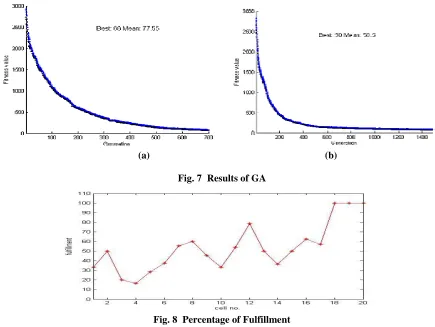
As we can see that total number of interference, in the non-uniform case, is 66 after 700 generation. We can now check our result for different traffic conditions. In other, for different traffic condition in which we got the number of conflicts equal to 30.
(a) (b)
Fig. 7 Results of GA
Fig. 8 Percentage of Fulfillment
4.
Channel Assignment using a Modified Fitness Function
In the previous fitness function adjacent channel interference is not considered and so it counts only the number of terms by which demand is not fulfilled and the co-channel interference [5,6,7,8,9]. So here a modified fitness function is used which also counts the adjacent channel interference. The modified fitness function is given by:
D
l
k
where
l
k
D
a
a
a
a
x
a
t
F
N i C k C l k l l i k i N i C k N j i j C l l j k i j i N i C k k i i
)
(
*
*
*
*
)
(
1 1 1
, ,
1 1 1 1
© 2014, IJCSMC All Rights Reserved
939
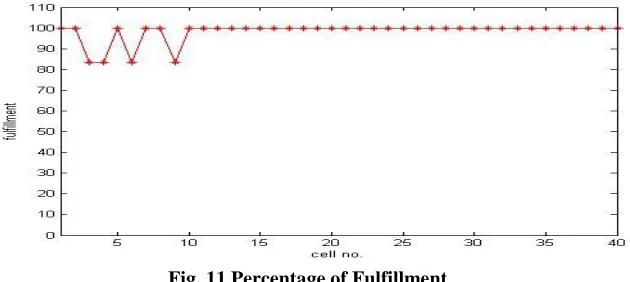
Where the first term is the number of conflicts produced for assigning a different rather than the required number of channels at each cell whereas the second term is the number of conflicts produced due to co- channel interference
constraints violation and the third term counts adjacent channel interference constraints violation.
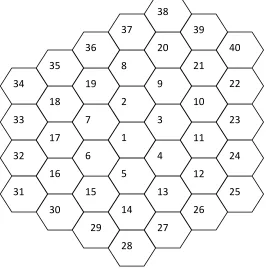
Fig. 9 Cellular Structure Considered
4.1
Uniform Condition 6-Channel in Each Cell
(a) (b) Fig. 10 Results of GA
4
11
3
5
1
9
10
16
14
15
7
2
6
19
18
33
32
31
29
30
17
23
12
13
25
26
34
27
24
28
8
20
21
22
40
38
37
36
35
© 2014, IJCSMC All Rights Reserved
940
Fig. 11 Percentage of Fulfillment4.2
Uniform Condition (7-Channels in Each Cell)
Cell Numbers Assigned Channels
1 16 19 22 31 38 39
2 5 9 30 31 34
3 1 11 12 15 26 28
4 11 12 15 26 28
5 15 18 23 30 37 38
6 4 6 8 20 24 33
7 3 4 10 13 32 35
8 2 24 26 28 32 36
9 5 9 10 25 27 29
10 18 21 23 29 37 40
11 3 6 14 32 33 36
12 9 12 13 26 34 35 40
13 2 5 23 25 28 29
14 4 9 27 32 33 35
15 3 8 18 23 39 40
16 5 7 12 15 25 34
17 2 3 12 21 29 36
18 8 9 13 14 18 20 38
19 1 7 11 15 23 33
20 3 4 5 16 18 20 22
21 7 17 21 22 36 39
22 2 10 12 19 26 38 40
23 1 4 5 8 28 31
24 3 10 20 24 25 27 39
25 6 17 19 20 30 34 36
26 1 4 12 13 16 18
27 1 21 22 24 29 37
28 3 7 9 10 14 17 20
29 12 13 16 17 25 31 36
30 5 19 22 25 26 40
31 7 9 10 24 26 27 28
32 1 2 11 30 31 35 40
33 19 20 21 30 36 39
34 5 6 10 16 26 28 29
35 1 17 22 27 34
36 2 14 17 19 24 30 39
© 2014, IJCSMC All Rights Reserved
941
38 6 11 13 18 23 31 40
39 1 8 17 27 30 34 37
40 13 15 24 26 32 33 35
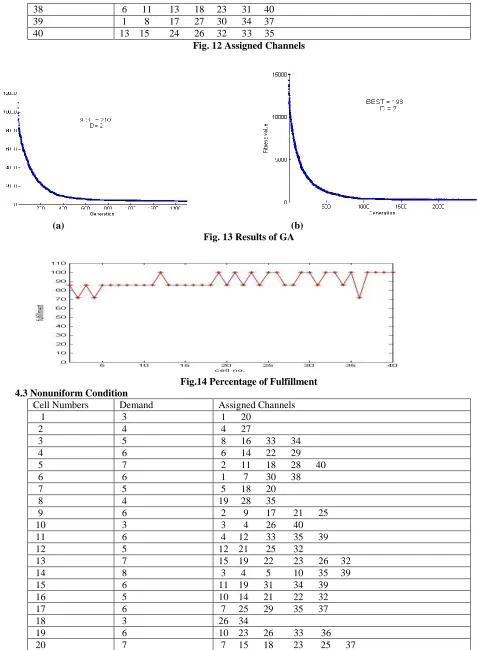
Fig. 12 Assigned Channels
(a) (b) Fig. 13 Results of GA
Fig.14 Percentage of Fulfillment 4.3 Nonuniform Condition
Cell Numbers Demand Assigned Channels
1 3 1 20
2 4 4 27
3 5 8 16 33 34
4 6 6 14 22 29
5 7 2 11 18 28 40
6 6 1 7 30 38
7 5 5 18 20
8 4 19 28 35
9 6 2 9 17 21 25
10 3 3 4 26 40
11 6 4 12 33 35 39
12 5 12 21 25 32
13 7 15 19 22 23 26 32
14 8 3 4 5 10 35 39
15 6 11 19 31 34 39
16 5 10 14 21 22 32
17 6 7 25 29 35 37
18 3 26 34
19 6 10 23 26 33 36
© 2014, IJCSMC All Rights Reserved
942
21 6 3 29 31 33 37
22 5 1 8 19 38
23 7 1 5 7 20 26 38
24 5 2 5 17 27
25 6 8 16 22 34 36
26 3 13 19 29
27 6 1 9 17 28
28 5 27 30 33 37
29 4 12 26 36
30 6 13 19 23 26 36
31 3 2 33
32 5 4 9 15 24 35
33 6 2 3 11 27 39 40
34 7 5 11 12 19 23 38
35 6 6 10 14 17
36 5 9 13 16 17 30 31
37 6 1 8 11 12 32
38 3 16 29
39 6 13 20 26 27 30
40 5 24 28 35 39
Fig.15 Assigned Channels
(a) (b)
Fig. 16 Results of GA
© 2014, IJCSMC All Rights Reserved
943
5.
Conclusion
In the proposed work we are aimed to compliment the traditional channel allocation method and Genetic Algorithm approach is used to solve the channel assignment problem in cellular telecommunication systems. Fixed channel assignment using genetic algorithm is developed in which more number of cells and less number of channels is taken and assignment is done in such a way that we obtain maximum channel utilization. We, also develop algorithm, in which we use Genetic Algorithm, to allocate the channels to the cells which takes very less number of channels and allocate them for more number of cells. Modified function is better as compared to previous one. In this research paper we have taken channel assignment for both uniform and non-uniform channels.
REFERENCES:
[1]. F. J. James-Romero and D. Munoz-Rodriguez, “Channel Assignment in Cellular Systems Using Genetic
Algorithms”, in Process IEEE Vehicular Technology Conference, 1996
[2]. A. Yener and C. Rose, “Genetic Algorithm Applied to Cellular Call Admission: Local Policies”, IEEE
Transaction on Vehicular Technology, Vol. 46, Feb. 1997
[3]. D. Beckmann, U. Killat, “ A New Strategy for the Application of Genetic Algorithms to the Channel
Assignment Problem”, IEEE Transaction on Vehicular Technology, Vol. 48, no.4, July 1999
[4]. G. Chakraborty and B. Chakraborty, “A genetic Algorithm Approach to Salve Channel Assignment Problem
in Cellular Radio Networks”, Proc. 1999 IEEE Midnight-Sun Workshop on Soft Computing Methods in Industrial Application, pp. 34-39, 1999
[5]. Seifipour N, “ A GA Based Algorithm with a Very Fast Rate of Convergence”, International Conference on
Computational Intelligence, Germany, 2001
[6]. G. Chakraborty, “An Efficient Heuristic Algorithm for Channel Assignment Problem in Cellular Radio
Networks”, IEEE Transaction on Vehicular Technology, Vol. 50, no. 6, pp. 1528-1539, Nov. 2001
[7]. Seifipour N, “ A GA Based Algorithm with a Very Fast Rate of Convergence”, International Conference on
Computational Intelligence, Germany, 2001
[8]. S. Sarkar and K.N. Sivarajan, “Channel Assignment Algorithm Satisfying Co-Channel and Adjacent Channel
Constraints in Cellular Mobile Networks”, IEEE Transaction on Vehicular Technology, Vol. 51, pp. 954-967, 2002
[9]. S. C. Ghosh, B. P. Sinha and N. Das, “Channel Assignment using Genetic Algorithm Based on Geometry