DOI : https://doi.org/10.32628/CSEIT195460
Prototype Survey of Different Energy Optimization and Routing Approaches
in Wireless Sensor Networks
G. Mohan Ram1, M.V. Subba Rao2, T. Kesava1
1Assistant Professor, Department of Computer Science and Engineering, Shri Vishnu Engineering College for
Women (SVECW), Kovvada, Andhra Pradesh, India
2Assistant Professor, Department of Information Technology, Vishnu Institute of Technology (VITB), Kovvada,
Andhra Pradesh, India
ABSTRACT
For personal, mobiles and sensor communications wireless sensor networking are an emerging concept in recent years. Normally wireless sensor network (WSN) is combined and integrated data relations for modern communication in infrastructure, energy efficiency; these are the main design parameters to improve network performance with respect to mitigate communication relations. This paper describes different types of energy optimization techniques/approaches and basic routing scenarios used for efficient communication in wireless sensor networks. We also give brief description about different routing protocols to support data communication in wireless sensor networks. And also define different routing algorithms used in data communication to increase network efficiency with respect to different network parameters. In this survey, discuss about energy optimization approaches in wireless sensor networks, and also define several techniques which aim energy consumption in wireless nodes in WSNs.
Keywords : Wireless Communication, Routing Algorithms, Routing Protocol Hierarchy, Energy Aware Routing, Wireless Sensor Networks And Energy Optimization.
I. INTRODUCTION
Among the different access organizing innovations, remote systems administration has developed as a financially savvy elective to different conventional wireless network approaches, e.g., Line for Digital Subscribers (DSL) and Modem Cable (CM). Being a related wireless medium, utilizing a remote system, wiring need not achieve the distance to the end clients; in this manner, wireless networks saves network maintenance cost with respect to client requirements. Local area wireless networks (WLAN) can work in network maintenance and self assisted mode. Wireless ad hoc networks, in which a decentralized system is where every hub (end-client hub) can forward
Wireless Sensors Networks (WSNs) is a combination of smaller than expected detecting gadgets, disseminated over an extensive zone for watching changes in the earth. The gadgets speak with each other in an on request through conventions that are particularly intended for independent correspondence. Sensors are constructed utilizing miniaturized scale electro mechanical frameworks which has prompted create restricted assets hubs. WSN discovers its application in differed fields like observation, natural surroundings and mechanical checking, wellbeing sciences, and so forth. Detecting gadgets frame the essential operational unit of the system that is self battery controlled with restricted life time. Sensor gadgets use vitality for transmission, gathering, directing and detecting data that is imparted to neighbors or a typical base station. Visit vitality usage prompts arrange correspondence corruption because of drop outs, dead hubs or connection disappointments and restricted vitality proficient courses and arrange lifetime hindering [1, 2]. The principal approach is done utilizing compelling directing strategies that depends on vitality limitation of the gadgets. Vitality compelled steering is considered to deal with vitality usage of the gadgets through ideal basic leadership process [3]. Numerous calculations have been proposed to regularize vitality use that eventually goes for drawing out system lifetime.
In this paper, we discuss about basic techniques/ approaches/algorithms used for efficient communication in wireless networks. We survey of different energy optimization methods via link failure/recovery approaches. Load balancing with distance constraints based energy optimization techniques.
II. REVIEW OF LITERATURE
In [1], looks into have given us an expansive study of different vitality preservation methods display in WSNs. They have given scientific categorization of
customary vitality productivity strategies and the work in progress vitality proficiency systems of WSNs. And no more key level, there are three vitality protection strategies obligation cycling, information driven methodologies and portability based methodologies. In obligation cycling strategy, a hub goes into off-state or rest state at whatever point a correspondence isn't required. Since correspondence is required infrequently so putting a hub in rest state spares heaps of vitality. In information driven methodologies, the significant center is the way the information is detected which additionally extensively impacts the vitality utilization of WSN. There are clusters of tests detected which are not in the slightest degree required. Likewise superfluous calculation in the power obliged WSN hub too impacts its battery life. Portability construct approaches center with respect to the versatility of WSN hubs. In the event that a sensor hub is portable at that point it center around how to gather its information, how it will transfer the message, how it will affect the general system and so on.
calculations, consistent assembly time calculations. Variable assembly time calculations are valuable when number of hubs in WSN is low while steady intermingling time calculations are helpful when number of hubs in WSNs is high.
A point by point execution assessment of information accumulation in clustering based WSNs is given by H.Huang and A. V. Savkin et al. in [4]. They have clustered sensor hubs in view of their entropy. Initially, hubs detecting comparative sort of information are set in unmistakable clusters. In the most pessimistic scenario if no more cluster can be shaped, at that point dissimilarity of a hub is ascertained as for each cluster then hubs are set in slightest disparate clusters. In conclusion they assessed execution of their plan in view of different parameters like intermingling rates, normal parcel drop, transmission cost and so forth utilizing NS2 test system. Their outcome exhibit that their proposed conspire outflanks different current vitality preservation plans of WSNs.
O. D. Jerew et al. [5], proposed one more plan for grouping in WSNs utilizing honey bee state calculation. In honey bee settlement calculation, we endeavor to mimic the conduct of nectar honey bee swarms. The scientists have proposed new calculations called ICWAQ to make group and select cluster heads. Their proposed ICWAQ calculation not just delays WSN lifetime yet additionally enhances quality of service (QoS) of the WSN. Their test results demonstrate that ICWAQ works respectably as for different calculations. A fuzzy rationale based clustering strategy is proposed by F. N. Huang et al. in [6]. They have expanded fuzzy rationale in LEACH calculation for WSNs. In their procedure called LEACH-ERE, the cluster head is chosen utilizing a fuzzy approach which centers around expected remaining vitality which is the lingering vitality left in a sensor hub in the event that it will be chosen as cluster head and finish its round. Accordingly the
overhead of turning into the group head is more suitably conveyed among the different hubs in a group. Their reenactment results demonstrate that the proposed plot is more proficient than a large portion of other appropriated calculations for WSNs including LEACH and CHEF.
In C. Cheng and C et.al [7], the scientists have proposed yet another fuzzy based plan for group head determination. Be that as it may, not at all like different plans, the determination of cluster heads will be done in the base station. The fuzzy sources of info picked by them are vitality level of sensor hubs and physical separation to base station. Their trial result demonstrate that their proposed conspire can decrease vitality utilization in First Node Dies (FND) round and in addition it has moreover expanded the throughput of the base station before FND.
III.ROUTING ALGORITHM HEIRARCHY
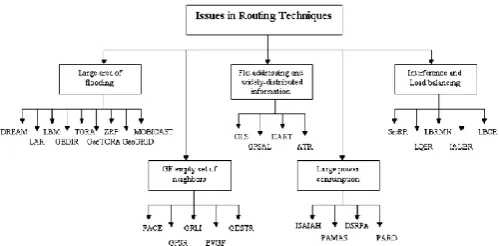
This review considers the delegate test of steering calculations recorded in Figure 1.
Figure 1. Routing hierarchy representation for wireless communication
Description of Figure 1 with different routing scenarios as follows:
Mobility Management based on Distance Routing Effect Algorithm (DREAM): DREAM [13] is a router based proactive topographical steering convention which lessens the flooding-region measure by constraining the quantity of neighbor node route request proactive calculation (RRQST). DREAM is likewise thought to be a disseminated, circle free, strong, and multi-way steering convention. In view of the separation impact and portability rate standards in a remote system, DREAM encounters steering refresh with lifetime of different nodes to limit the directing overhead. In separate impact, the separation between a couples of hubs is utilized to choose how essential this combine of hubs defines each node with other nodes present in wireless networks; for example, this separation between nodes, the development of these hubs has all the earmarks of being moderate regarding each other. In this manner, hubs that are situated intently get refreshes all the more every now and combine with each node. Portability rate of every hub decides the recurrence of publicizing the hub's new area; i.e., a hub sends different types of updates and goes with maximum capacity length since hub defines and changes its area all the more much of the time. This component enables DREAM to productively use
both data transfer capacity and vitality. DREAM utilizes area data to adjust versatility in a remote system. The accessible area data is put away and kept up in a hub's area table. While steering an information parcel, hubs situated toward the goal (which is used to define source node based on destination node sequences) are the main hubs forward packets of data to each other node. Henceforth, in DREAM, information parcels are somewhat overwhelmed to a sub group of the main-jump neighbors of different nodes.
Routing based on Aided Location (LAR) LAR [14] is a graphical routing calculation and an exchange on-request source-steering calculation, which confines the territory for finding another course to a littler ''demand zone'' by using the hub's area data. Along these lines, the quantity of course asks for data requests to all nodes to be decreased. LAR is an extension of flooding-construct convention utilized as a part of with respect to request calculations, for example, DSR [6] and AODV [2].
Multicast Routing Based on Location (LBM) LBM [15] is a direct greedy calculation just like LAR with respect to restricting and flooding-territory estimate. LBM has two plans:
Plan 1: Forwarding Zone (FZ) description is as per the following:
– If a hub in FZ gets a bundle, this hub advances the parcel neighbor nodes; and – if a hub outside architecture of FZ gets a parcel, this hub disposes of the parcel.
Plan 2: Forwarding Zone without express. This plan decides if a bundle ought to be sent in light of the relative separation between the hubs.
like AODV directing convention. The distinction amongst ISAIAH and AODV protocol is that ISAIAH chooses courses that go through energy consumption servers rather than through versatile hubs. This can spare the measure of intensity that may segmented by consecutive hubs. Be that as it may, the way chose by ISAIAH to be higher than the way chose by AODV routing protocol.
Also, ISAIAH enables hubs to enter a power-sparing mode for a brief timeframe which fundamentally lessens the power utilization contrasted with AODV.
Power-Aware Multi-Access with Signaling WSNs (PAMAS) PAMAS [20] is an self control directing convention that controls the battery utilization in view of the recurrence of a hub's exercises. PAMAS deals with the circulation of intensity at the system hubs to trade off between organize network and power utilization. This is accomplished by driving off hubs that are not taking part during the time spent transmitting or getting information parcels for a specific measure of time. It has been appeared in [12] that PAMAS, by fueling off hubs, does not influence the system execution.
Routing Power-Aware with Dynamic Source (DSRPA) DSRPA [19] is another energy aware convention. Like PAMAS, DSRPA exchanges between different network and power utilization by characterizing another steering metric. In DSRPA, capacity of each node is directing to accomplish network for the highest time frame. Thus, hubs with new node capacity chose to course information parcels around the system.
Optimization Protocol with Power-Aware Routing (PARO) PARO [21-22] is a energy oriented steering calculation that means to expand the way length to lessen the aggregate data transmission and data control. In PARO, new sending hubs (called re-simulated nodes ') are included the steering way to diminish the
transmission intensity of the middle of the road hubs along the first way. At the end of the day, PARO endeavors to decrease the individual jump's separation to lessen the general power utilization. The customary technique for transmitting information in a remote system is to utilize the most extreme transmission capacity to diminish the quantity of jumps along the way.
Steering conventions, for example, AODV [23], DSR [24], and TORA [25] depend on the customary directing techniques which limit the quantity of jumps along the way. Not at all like these directing conventions, has PARO scarified the way length to ration control.
IV.ENERGY OPTIMIZATION TECHNIQUES
We examine different methodologies towards vitality enhancement as for interface disappointment recuperation, stack adjusting and separate based steering. In all the three procedure, we mean to accomplish vitality effectiveness with a base exchange off co-joined with the other system measurements.
Energy-Link Failure Recovery Routing (E-LFRR) Algorithm
that don't get chance for transmission are moved to rest state so as to safeguard their vitality.
Monitored Energy Efficient Proactive Load balancing (ME2PLB) Algorithm
Load adjusting in WSNs require a traded off change of vitality or alive hubs in the system. To limit the tradeoff between stack adjusting and vitality advancement, the procedure of streamlining is reached out to work in a three-level directing procedure coordinated with stack taking care of what's more, vitality streamlining procedures. ME2PLB circulates the procedure of vitality advancement, information assembling and load adjusting in three levels of steering. It incorporates Energy Productive Transmission, Switch over Transmission and Adjusted Data Dissemination process. ME2PLB looks for the help of essential and auxiliary aggregator hubs and Checking Nodes (MN).
In Energy Efficient Transmission strategy, the Primary Aggregator starts information gathering from all the dynamic hubs. Essential Aggregator prescribes the sit without moving hubs to move to rest state to keep record-breaking alert state. Checking hubs watch the vitality of the essential aggregator and communicate the same to the optional aggregator that are available inside the transmission scope of MNs. MN holds a rundown of hub data that are to be supplanted because of lesser vitality at the time of vitality deplete. MN prescribes change of aggregator furthermore, hubs in light of their vitality levels and evaluated Time-to- Live [25-29]. At the point when a hub is supplanted by its neighbor or other transmission hub, the last transmission grouping is spared by the MN. It communicates the grouping data to the dynamic source hubs [23-26]. This limits duplication and re-transmission of same information to the aggregator hub. In the exchanged mode transmission, MN refreshes the new arrangement of neighbors and
aggregator data to the dynamic transmitting hubs in the organize.
Distance and Energy Aware Optimized Routing (DEAOR)
Separation and vitality improvement have dependably been tradeoffs approach that outcome in prior or fractional arrangement that can't hold on for quite a while. To decrease the connecting hole between separate based vitality protection, DEA-OR is proposed. DEA-OR works in two stages viz., Energy and Separation Effective Path Selection and Greedy based minimal effort way determination. In Distance based vitality compelling way determination, the source chooses neighbor with two countenances. At first, source considers separate factor for neighbor choice and transmission. Source starts another neighbor revelation when the vitality of the current way hub drops down to limit level in [28-29]. In the second neighbor revelation process, source considers vitality along with the separation metric for neighbor determination. For this situation, the source figures the heaviness of every hub wherein the weight is processed as a joint metric of separation and vitality. On the off chance that both the factors are considered for neighbor determination, it results in unequal arrangement. The heaviness of every hub is known to its coordinate neighbor from whom the neighbor can choose its next bounce neighbor. A hub with higher weight factor is favored for transmission.
V. COMPARISON OF DIFFERENT APPROACHES
Approach
Scenario of Broadcastin g
Concept underlyin g
Advantag es
TEEN [12] Routing
Clusterin g, Reactive Networks
applicatio
VI.SCOPE OF THE RESEARCH
Actually, due to characteristics of the wireless communication, an individual packet transmitting will result in multiple receptions. If such transmitting is used as back-up, the sturdiness of the redirecting method can be significantly enhanced. The idea of such multicast like routing strategy has already been confirmed in opportunistic routing. However, most of them use link state-style topology data source to choose and focus on the forwarding applicants. To be able to obtain the inter node loss prices; regular network-wide statistic is required, which is incorrect for cellular atmosphere. The batching used in these protocols also tends to wait for packets and is not recommended for many wait delicate programs. Lately, location aided opportunistic redirecting has been suggested which straight uses place details to assist packet forwarding. However, just like the other opportunistic routing methods, it is still made for fixed mesh networks and concentrates on system throughput while the robustness introduced upon by opportunistic forwarding has not been well utilized.
VII. CONCLUSION
VIII. REFERENCES
[1]. Oday Jerew 1 and Nizar Al Bassam,” Delay
Tolerance and Energy Saving in Wireless Sensor
Networks with a Mobile Base Station”, Hindawi
Wireless Communications and Mobile Computing Volume 2019, Article ID 3929876, 12 pages https://doi.org/10.1155/2019/3929876. [2]. Habib Mostafaei,"Energy-Efficient Algorithm
for Reliable Routing of Wireless Sensor Networks", Citation information: DOI 10.1109/TIE.2018.2869345, IEEE Transactions on Industrial Electronics.
[3]. ZHANGBING ZHOU1,2, JIABEI XU1, ZHENJIANG ZHANG3,4, FEI LEI5, AND WEI FANG1,"Energy-Efficient Optimization for Concurrent Compositions of WSN Service",
Digital Object Identifier
10.1109/ACCESS.2017.2752756.
[4]. H.Huang and A. V. Savkin,
“Optimalpathplanning for a vehicle collecting data in a wireless sensor network,” in
Proceedings of the Chinese Control Conference
(CCC ’16), pp. 8460–8463, IEEE, July 2016 [5]. O. D. Jerew and N. A. Bassam, “Energy aware
and delaytolerant data gathering in sensor
networks with a mobile sink,” in Proceedings of
the MEC International Conference on Big Data
and Smart City (ICBDSC ’16), pp. 1–5, IEEE, March 2016.
[6]. F. N. Huang, T. Y. Chen, S. H. Chen, H. W. Wei,
T. S. Hsu, and W. K. Shih, “ShareEnergy:
Configuring Mobile Relays to Extend Sensor
Networks Lifetime Based on Residual Power,” in
Proceedings of the International Conference on Collaboration Technologies and Systems (CTS
’16), pp. 478–484, IEEE, Oct 2016.
[7]. C. Cheng and C. Yu, “Mobile data gathering with bounded relay in wireless sensor network,”
IEEE Internet of Things Journal, pp. 1–16, 2018. [8]. M. Mishra, K. Nitesh, and P. K. Jana, “A delay
-bound efficient path design algorithm for mobile
sink in wireless sensor networks,” in
Proceedings of the 3rd International Conference on Recent Advances in Information Technology
(RAIT ’16), pp. 72– 77, IEEE, 2016
[9]. C. Zhu, S.Wu,G. Han, L. Shu, and H.Wu, “A
tree-cluster-based data-gathering algorithm for
industrial WSNs with a mobile sink,” IEEE
Access, vol. 3, no. 4, pp. 381–396, 2015.
[10]. J.-Y. Chang and T.-H. Shen, “An efficient tree -based power saving scheme for wireless sensor
networks with mobile sink,” IEEE Sensors
Journal, vol. 16, no. 20, pp. 7545–7557, 2016. [11]. A. Kaswan, P. K. Jana, and M. Azharuddin, “A
delay efficient path selection strategy for mobile
sink in wireless sensor networks,” in
Proceedings of the 2017 International Conference on Advances in Computing,
Communications and Informatics (ICACCI ’17),
pp. 168–173, IEEE, 2017.
[12]. E. M. Saad, M. H. Awadalla, M. A. Saleh, H.
Keshk, and R. R. Darwish, “Adata gathering
algorithm for a mobile sink in largescale sensor
networks,” in Proceedings of the 4th
International Conference on Wireless and
Mobile Communications (ICWMC ’08), pp. 207–
213, IEEE, 2008.
[13]. D. Zhang, X.Wang, X. Song, and D. Zhao, “A
novel approach to mapped correlation of id for rfid anti-collision,” IEEE Transactions on
Services Computing, vol. 7, no. 4, pp. 741–748, 2014.
[14]. L. Cheng, J. Niu, J. Cao, S. K. Das, and Y. Gu,
“Qos aware geographic opportunistic routing in wireless sensor networks,” IEEE Transactions on
Parallel and Distributed Systems, vol. 25, no. 7, pp. 1864–1875, July 2014.
[15]. J. Niu, L. Cheng, Y. Gu, L. Shu, and S. K. Das,
“R3e: Reliable reactive routing enhancement for wireless sensor networks,” IEEE Transactions on
Industrial Informatics, vol. 10, no. 1, pp. 784–
[16]. J. So and H. Byun, “Load-balanced opportunistic routing for duty-cycled wireless sensor
networks,” IEEE Transactions on Mobile
Computing, vol. 16, no. 7, pp. 1940–1955, 2017 [17]. X. Bai, L. Liu, M. Cao, J. Panneerselvam, Q. Sun,
and H.Wang, ``Collaborative actuation of wireless sensor and actuator networks for the agriculture industry,'' IEEE Access, vol. 5, pp. 1328613296, 2017
[18]. T. Qiu, A. Zhao, F. Xia,W. Si, and D. O.Wu, ``ROSE: Robustness strategy for scale-free wireless sensor networks,'' IEEE/ACM Trans.
Netw., to be published, doi:
10.1109/TNET.2017.2713530.
[19]. R. Morabito, I. Farris, A. Iera, and T. Taleb, ``Evaluating performance of containerized IoT services for clustered devices at the network edge,'' IEEE Internet Things J., vol. 4, no. 4, pp. 10191030, Aug. 2017.
[20]. S. N. Han, S. Park, G. M. Lee, and N. Crespi, ``Extending the devices prole for Web services standard using a REST proxy,'' IEEE Internet Comput., vol. 19, no. 1, pp. 1017, Jan. 2015. [21]. I.-Y. Ko, H.-G. Ko, A. J. Molina, and J.-H. Kwon,
``SoIoT: Toward a user-centric IoT-based service framework,'' ACM Trans. Internet Technol., vol. 16, no. 2, p. 8, 2016.
[22]. I.-R. Chen, J. Guo, and F. Bao, ``Trust management for SOA-based IoT and its application to service composition,'' IEEE Trans. Service Computing, vol. 9, no. 3, pp. 482495, May 2016.
[23]. A. Rahman, E. Hassanain, and M. S. Hossain, ``Towards a secure mobile edge computing framework for Hajj,'' IEEE Access, vol. 5, pp. 1176811781, 2017
[24]. C. Pham, N. H. Tran, S. Reny, W. Saad, and C. S. Hong, ``Trafc-aware and energy-efcient vNF placement for service chaining: Joint sampling and matching approach,'' IEEE Trans. Service Computing, to be published, doi: 10.1109/TSC.2017.2671867.
[25]. T. Wang, L. Cheng, K. Zhang, and J. Liu, ``Energy-aware service composition algorithms for service-oriented heterogeneous wireless sensor networks,'' Int. J. Distrib. Sensor Netw., vol. 46, no. 4, p. 217102, 2014.
[26]. T. Qiu, K. Zheng, H. Song, M. Han, and B. Kantarci, ``A local-optimization emergency scheduling scheme with self-recovery for smart grid,'' IEEE Trans. Ind. Informat., to be published, doi: 10.1109/TII.2017.2715844. [27]. J. Bellido and R. Alarcón, and C. Pautasso,
``Control-ow patterns for decentralized restful service composition,'' ACM Trans. Web, vol. 8, no. 1, pp. 5-15-30, 2013.
[28]. S. Y. Shah, B. K. Szymanski, P. Zerfos, and C. Gibson, ``Towards relevancy aware service oriented systems in WSNs,'' IEEE Trans. Service Computing, vol. 9, no. 2, pp. 304316, Mar. 2016. [29]. T. Qiu, R. Qiao, and D. Wu, “EABS: An event
-aware backpressure scheduling scheme for emergency Internet of Things,'' IEEE Trans.
Service Computing. doi:
10.1109/TMC.2017.2702670.
Cite this article as :
G. Mohan Ram, M. V. Subba Rao, T. Kesava, "Prototype Survey of Different Energy Optimization and Routing Approaches in Wireless Sensor Networks", International Journal of Scientific Research in Computer Science, Engineering and Information Technology (IJSRCSEIT), ISSN : 2456-3307, Volume 5 Issue 5, pp. 01-09, September-October 2019. Available at doi :
https://doi.org/10.32628/CSEIT195460