International Journal of Scientific Research in Computer Science, Engineering and Information Technology © 2018 IJSRCSEIT | Volume 3 | Issue 1 | ISSN : 2456-3307
A Method on Dynamic Kinematics in Detecting Objects and
Humans for the Visually Impaired and Disabled People
Dr. I. Lakshmi
Assistant Professor Department of Computer Science, Stella Maris College Chennai, Tamil Nadu, India
ABSTRACT
The human eye is the organ of vision. This essential organ of eyesight plays a predominant role not only in life but also the human body. People who have no vision feel very difficult to detect the objects. In addition to it, there are voice messages which are attached to any device and are provided to the blind people for more convenience such that they can hear the messages in real time. There are many other technologies available where a system can detect an obstacle. KINECT is a motion sensing device which helps the end users to interact conveniently with the computer or any console by using gestures and speech. XTION PRO is another device which calculates the depth information of real time objects and humans. There are many technologies which have been implemented especially for the blind. This paper briefs about how KINECT and XTION PRO is useful for the blind in detecting objects and humans. The two main approaches are detecting objects and human beings. Depth information have been applied for detecting objects and humans. The work is focused mainly to minimize the errors, to improve accuracy and also examines how Artificial Intelligence can be helpful for the blind.
Keywords : Artificial Intelligence; Kinect; Xtion PRO; RANSAC; RGB-D
I.
INTRODUCTION
People with various kinds of disabilities and with no supporting aids, were alienated by the community, until a few years back Many people, suffering from different kinds of disabilities were leading a miserable life, owing to the ignorance by their fellow beings leading a normal life. Disabilities can be categorised into mental and physical disability. One of the most painful physical disabilities is the loss of vision and this paper focuses mainly on the mechanisms for supporting visually impaired people. Blind people started using a white cane which helps to identify any obstacle. The white cane was invented by James Biggs. Some people use guide dogs for their safety. The problems with which people are mainly facing are while navigating near the stairs, door, work areas like kitchen, work desks, bathroom areas. While they are navigating near these areas
they tend to get injured. They often face many barriers [12] such as
Attitude
Communication
Physical
Policy
Programmatic
Social
Transportation
program for people with different types of deficiencies. Social barriers are associated to the circumstances in which people are born, grow, live, learn, work and age – or social determinants of health – that can subsidize to reduced working among people with disabilities. Transportation barriers are owing to an absence of sufficient transportation that hinders with a person’s ability to be self-determining and to function in society. So navigation becomes tough for the blind people both in the indoor and outdoor side since they feel difficult when they collide with unknown objects. If there are any staircases, then they tend to fall down. So, the authors Titus et al. [1] have proposed an algorithm using Kinect device. Kinect is a device which helps in calculating the depth information. The algorithm is written for detecting the staircase iteratively. It checks whether any staircase is present or not. It also gives information about the staircase if it is moving upward or downward. It also helps in counting the number of staircases. The Kinect gives information only when it is about 10 meters. So, it basically tells about the staircase detection using plane based approach. Kinect detects the steps count using RANSAC [1]. This approach helps in detecting the staircase also in 3D space. This algorithm also gives the minimal error and tracks about 16 frames per second.
The staircase detection [2] with the help of RGB-D [8] depth images is another approach where the algorithm uses RGB-D Camera to recognize the stairs with RGB-D images along with the depth information. The RGB-D camera proceeds with RGB-D image and depth image simultaneously. The depth sensor fixed on the RGB-D camera provides the distance information which is delivered by the depth image of shade and light. The camera comes in handy for a walking support. The algorithm is provided for identifying stairs and the descending steps. False discovery on RGB image is also analyzed. So the method uses Kinect and xtion pro for analyzing steps that can be picturized and find the
distance information. There are few parts which require improvisation. They are
Suppose the device, Kinect or Xtion is rotated from one side to another then the detection of the floor will not perform well.
The vision array is restricted.
Therefore, the system can be minimized and can be attached to a wearable device such as spectacles. In accumulation, the detection of small steps is inaccurate due to the dissimilarities between the large and the small steps.
The rest of the paper is organised into the following sections. Section II discusses the detection of obstacles with the help of depth information with more focus on indoor obstacle detection. Section III describes finding of the objects through the Kinect and Xtion pro device. Section IV elaborates the features of the proposed system. Section V concludes the study.
II.
DETECTING OBSTACLES WITH DEPTH
INFORMATION
As finding the obstacles is difficult for the blind people there are few methods which have been implemented, for addressing the concern. New algorithmic approaches [3] have been proposed to detect obstacles in the indoor platform. This approach also uses depth information as used by other systems. The structure of this system consists of scene detection, obstacle detection, and speech information. The study [3] briefs about the new method to reduce the problem of over-segmentation by taking off the edge of the obstacle and initial seed position problem with the help of connected component method. This system can capture both the static and dynamic obstacles.
disparity map, labelling, detection of stairs both upward and downward.
A. UV disparity map (obstacle detection algorithm) The UV disparity is the combination of U-disparity map and V-disparity map [3]. The UV represents the coordinates in (u,v) image coordinate system. The UV disparity map is comparable to a histogram. The system uses only V-disparity since the effect is better. The depth value and the image height is analysed by the result obtained.
B. Labelling
The usage of labelling makes the experiment of obstacle detection easy to observe [3]. The connected component method (CCM) and the region growth method are the two methods of labelling. The connected component method scans the image each pixel by pixel. It is mainly used for the 2D binary image. It recognizes pixels which are connected to each other. The region growth method is a region based on image segmentation method. It can perfectly disconnect the regions that contain similar properties. It can deliver original images with clear edges with good segmentation results.
There is also a confusion matrix which is used for experimenting the results. When there is a big size break in the depth map, the object is not identified. The left over parts when calculated gives a very minute result making it negligible. The shattered parts of the depth image cause some blocks to be flawed as obstacles.
The depth information is attained with the help of the infra-red sensor. This sensor is not damaged by the degree of illumination. This classification is effective because the system can detect the obstacle in low light environment. The result shows that the system is strong, effective and suitable in an indoor environment. The voice alarm is provided to the user about the distance and the kind of obstacle.
III.
DEVICE DETECTING OBJECTS
One of the very challenging tasks, in any environment is to detect human beings and the objects. A very common method of detecting humans can be with the help of CCTV cameras. But in the case of blind people, identifying human beings is a very complicated task. So there is advancement in the technologies for detecting human beings. Kinect is a device which was created mainly for gaming consoles. This device accepts motion sensing as input and processes output to the console. It permits users to interact very efficiently in the field of gaming without the need of gaming controller.
KinDectect [4], where a Kinect detects an obstacle or object in real time. The authors Atif et.al [4], have worked with depth information such that Kinect sensors and Xtion Pro Live offer to detect the humans and other objects for the blind. This system kinDectect performs in two modes.
Tracking of humans, objects and giving the information to the user.
Tactics which helps to avoid objects for a harmless navigation.
The aim of the system kinDectect is to produce a computerized system which plays an efficient role for supporting the blind people. Kinect has already been considered as object detecting device for the blind. Xtion Pro Live provided by Asus is a sensor able to provide RGB color image and also depth image. With the combination of RGB camera and depth sensor camera, Xtion Pro live provides different kinds of competencies like 3D mapping, voice recognition, facial recognition, motion recognition. Moreover, the system uses a USB power which outcomes as the best sensor for a wearable system. Thus, the device can be fixed in a belt used by the user.
A. Human identification
Open NI framework [7] is used to identify the humans. When the sensor is moving it becomes a tedious task for the functions used in Open NI framework to track the people. The usage of the Open NI framework present in the Xtion Pro Live recognizes the count of human beings in their present positions in millimeters. This framework is integrated with OpenCV [9], which is an open source library.
The program consists of components which are mentioned below.
Produce and display RGB data using the Open NI framework.
Depth value is taken and provided to the user for tracking people and evaluate the distances and locations in 3D space.
Human beings' depth information labeling and coloring for fixing.
Building Open NI data reachable and suitable with OpenCV.
Grounded by the result, the system identifies the number of people, the distance between them and their positions. So this information is carried by the user in the method of text to speech with the help of headphone.
B. Obstacle Identification
The object recognition algorithm [4] will focus mainly on the depth module of RGB-D data. The inventive array of 640(H) *480(V) is divided into chunks of 32(H)*40(V) pixels. An individual chunk contains 1280 pixels producing the total of 20*12 chunks of the complete field of vision. Average depth value is calculated. Then 20 *12 chunks are further combined into 5*3 areas with each area consisting of 4*4 chunks. Horizontally, five ways are represented. They are right, left, middle, far right, far left. Vertically, three ways are represented. They are bottom, middle, top. In each area, the average of 16 chunks is used in a metric such that an object is dodged. 16 average depths have been organized and also average (Z) of 10 in-between values is calculated.
Later the calculation, the biggest three metric data are allocated as an obstacle metric.
Two tactics which are used here:
The track of smallest possibility of the obstacle is used and also notifies the user to fit into other direction based on earlier one. This happens according to the order of direction like left, left, middle, right, far-right. When there is a frequent change of direction the fault is upraised signifying that the first direction is the safest one.
For a retrieval of the smooth path, a direction update method is used to produce current direction depending on the earlier one. Here the user is being told to move to the nearest direction for the safety purposes.
C. Design
The main constituents of the model of KinDectect are Bluetooth, Laptop, Xtion Pro Live. USB power cord is attached to the laptop for scanning. The laptop performs the depth information and also recognition algorithm while the blind person moves in the path. The computer identifies the object ahead of the person and signifies another path to reduce the collision. The laptop is configured in such a way that the user is notified in the speech format from the text format. The interaction between the user and computer is also available. The user can question whether any person is around. The user waits for a while until it figures out the count of persons present.
D. Results
The one-step method was introduced previously. The one-step method showed the result in one direction. The result of the Kindectect [4] model is direction update approach which shows good results than that of the one-step method in the field of object detection. The direction update approach gives the result in all directions.
detection [11] is very crucial for the blind. SAPI functions [10] which help in reduction of computational productivity of the output is used in KinDectect to allow speech applications.
Path planning [6] is another method where an object is identified easily with help of initialising the path. During the identification of an object, the path planning provides a collision-free result.
IV.
PROPOSED METHOD
KinDectect [4] gives only the depth information for detecting objects in real time. While detecting objects, RGB-D which is a multi-spectral image gives grey scale image by taking a single channel from it. The image outcome is represented in [8]. The first method is proposed here:
The color intensity along with the depth information will provide more clarity and better accuracy.
In obstacle identification, the window frame is divided into 16 blocks [4]. The average of 16 mean values is calculated. The window is divided into 16 blocks to avoid the obstacles in the particular region. This would create errors if there are smaller obstacles. The second method proposed here is:
To reduce the errors of obstacle detection, the window size can be modified into a smaller size. The image clarity can also be improvised using depth information.
While identifying the obstacle, the direction of movement has been planned. Different ways of direction have also been represented. The result also provides collision-free output [4]. But before the direction of movement, the path can be set. The third method proposed here is:
Initial path planning can be set for efficient navigation.
Artificial Intelligence plays a very crucial role in the development of computer field. Artificial
human beings. There are different kinds of algorithmic approaches in the field of Artificial Intelligence (AI) technology. The fourth method proposed here is:
Monte Carlo method can be applied for the path planning and direction usage.
This Monte Carlo method gives a number of different combinations of output. There is also a possibility of checking which combinations of parameters suit the possibility of the event. The event can be tracked based on the outcome.
A. Assumptions
This section briefs about assuming the window size can be reduced and how to reduce the errors of any obstacle detection.
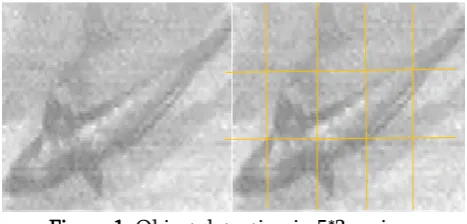
Figure 1. Object detection in 5*3 regions
Table 1. Matrix representation of the Object of 5*3 regions
205 201 200 206 212
203 196 197 206 213 213 210 207 209 211
Table 2. Error values for the image of 5*3 regions -0.93 -4.93 -5.93 0.07 6.07 -2.93 -9.93 -8.93 0.07 7.07 7.07 4.07 1.07 3.07 5.07
Table 1. The error values of Table 1 are given in Table 2.
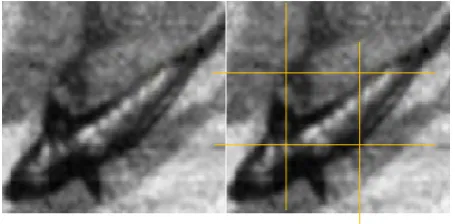
So, the proposed system says that the window size can be reduced to 3*3 regions which gives more clarity and less error detection Then, the average mean value is found for 3*3 matrix. The Fig. 2 Represents the image in 3*3 regions. The matrix values for Fig. 2 is given in Table 3. The error values of Table 3 are given in Table 4.
Figure 2. Object detection in 3*3 regions
Table 3. Matrix representation of the Object of 3*3 regions
178 178 174
180 179 175 183 182 178
Table 4. Error values for the image of 3*3 regions -0.55 -0.55 -4.55
1.45 0.45 -3.55
4.45 3.45 -0.55
Thus, when comparing the table 2 and table 4, the error value is reduced in 3*3 matrix when the size of the window in reduced to 3*3 regions. Thus, by the way of reducing the size of matrix, small errors can be avoided and image clarity is also increased.
V.
CONCLUSION
Thus the proposed system for KinDectect contains the concepts for reducing the errors of obstacle
detection for the blind people. The main goal of the paper is to provide an efficient, accurate and easy navigation for the visually impaired people by reducing the errors of obstacle detection. In this study it is shown how to reduce the errors and increase the efficiency by introducing initial path planning method.
VI.
REFERENCES
[1]. Titus Jia Jie Tang, Wen Lik Dennis Lui and Wai
Ho Li,"Plane-based detection of staircases using inverse depth", Proceedings of Australasian Conference on Robotics and Automation,3-5 Dec 2012.
[2]. Soichiro Murakami, Manabu Shimakawa,
Kimiyasu Kiyota, Takashi Katoc", Study on Stairs Detection using RGB-Depth Images", SCIS&ISIS, December 3-6, 2014,pp.1186-1191
[3]. Hsieh-Chang Huang, Ching-Tang Hsieh and
Cheng-Hsiang Yeh,"An Indoor Obstacle
Detection System Using Depth Information and Region Growth", Sensors 2015, 15, pp. 27116-27141
[4]. Atif Khan, Febin Moideen, Juan Lopez, Wai L.
Khoo, and Zhigang Zhu, "KinDectect: Kinect Detecting Objects", ICCHP 2012,pp.588–595
[5]. Xtion PRO,
https://www.asus.com/3D-Sensor/Xtion_PRO/
[6]. Using path planning functionality,
http://www.coppeliarobotics.com/helpFiles/en/pa thPlanningOperation.htm
[7]. Open NI framework,
https://www.heise.de/make/meldung/3D-Sensor-Framework-OpenNI-lebt-weiter-2176392.html
[8]. RGB-D Object Dataset,
https://rgbd-dataset.cs.washington.edu/
[9]. Opencv,
http://funvision.blogspot.in/2016/03/opencv-31-people-detection-at-13-fps-by.html
[10]. SAPI Functions, https://msdn.microsoft.com/en-us/library/aa911241.aspx
[11]. People Detection Documentation, http://wiki.ros.org/cob_people_detection