Bilingual Sentence Alignment Based on Punctuation Marks
Kevin C. Yeh [email protected] Department of Computer Science
National Tsing Hua University
Abstract
We present a new approach to aligning English and Chinese sentences in
parallel corpora based solely on punctuations. Although the length based approach
produces high accuracy rates of sentence alignment for clean parallel corpora written
in two Western languages such as French-English and German-English, it does not
fair as well for parallel corpora that are noisy or written in two distant languages such
as Chinese-English. It is possible to use cognates on top of length-based approach to
increase alignment accuracy. However, cognates do not exist between two distant
languages, therefore limiting the applicability of cognate-based approach. In this
paper, we examine the feasibility of using punctuations for high accuracy sentence
alignment. We have experimented with an implementation of the proposed method on
the parallel corpus of Chinese-English Sinorama Magazine Corpus with satisfactory
results. We also demonstrated that the method was applicable to other language pairs
such as English-Japanese with minimal additional effort.
1. Introduction
Recently, there are renewed interests in using bilingual corpus for building
systems for statistical machine translation (Brown et al. 1988, 1991), including
data-driven machine translation (Dolan, Pinkham, and Richardson 2002),
computer-assisted revision of translation (Jutras 2000) and cross-language
information retrieval (Kwok 2001). It is therefore useful for the bilingual corpus to be
aligned at the sentence level with very high precision (Moore 2002; Chuang, You and
Chang 2002, Kueng and Su 2002). After that, further analyses such as phrase and
word alignment, bilingual terminology extraction can be performed (Melamed 1997).
Much work has been reported in the literature of computational linguistics
studying how to align English-French and English-Germany sentences. While the
length-based approach (Church and Gale 1991; Brown et al. 1992) to sentence
alignment produces surprisingly good results for the language pair of French and
English at success rates well over 96% by sentence, it does not fair as well for
alignment of English and Chinese sentences. Work on sentence alignment of English
and Chinese texts (Wu 1994), indicates that the lengths of English and Chinese texts
are not as highly correlated as in French-English task, leading to lower success rate
using cognates on top of length-based approach to improve on accuracy. They use an
operational definition of cognates, which include digits, alphanumerical symbols,
punctuations and alphabetical words.
Simard, Foster, and Isabelle (1992) pointed out cognates in two close languages
such as English and French can be used to measure the likelihood of mutual
translation. Those cognates include alphabetic words, numeric expressions, and
punctuations that are almost identical and readily recognizable by the computer.
However, for distant language pairs such as Chinese and English, there are no
orthographic, phonetic or semantic cognates in existence, which are readily
recognizable by the computer. Therefore, the inexpensive cognate-based approach is
not applicable to the Chinese-English tasks. Since both of the length and
cognate-based methods do not present satisfactory alignment results for distant
bilingual pairs, we are motivated to find other alternative evidence that two blocks of
texts are mutual translation. It turns out that punctuations can be telling evidences, if
we do more than hard matching of punctuation and take into consideration of intrinsic
sequencing of punctuation in ordered comparison.
2. Punctuation and Sentence Alignment
We will show that punctuations in Chinese and English mark texts with similar
semantic properties, therefore, it is very effective to use them to measure the
likelihood of mutual translation for a pair of texts.
Punctuation Translation probability Punctuation Fertility probability
English
Punctuation
Chinese
Punctuation
Number
of counts Probability
) ) 4 0.9972
," 」, 6 0.9564
." 」, 3 0.9164
! ! 38 0.8835
In order to explore the relationship between
the punctuations in pairs of Chinese and English
sentences that are mutual translations, we
selected a small set of manually aligned texts
and investigated the characteristics and the
associated statistics between the punctuations. Following next a list of the number of
counts and the probability relating the Chinese punctuation and the English
punctuation was tallied. The information was then used to bootstrap on a larger corpus
where an unsupervised EM algorithm and Dynamic programming are used to
optimize the punctuation correspondence between a text and its translation
counterpart. The EM algorithm converges quickly after the second round of training.
Some of the results of the EM training are shown in the above tables.
The probability of the one-to-one match type is about 0.65, which implies that
there is a large discrepancy of the punctuation mappings between Chinese and English.
The punctuation compatibility is measured by using a relatively larger corpus –
around one thousand articles from the Sinorama magazine. Simard, Foster and
Isabelle proposed the cognate based approach as a new way of measuring how two
pieces of text are mutual translation. The punctuation compatibility as an indicator of
mutual translation is defined as
(
n m)
c, max
=
γ
where γ = punctuation compatibility,
c = number of cognate,
n = number of Chinese punctuations marks
m = number of English punctuation marks
We then took the aligned English-Chinese sentences that have same number of
punctuation count (that is the denominator of the equation), take ten counts for
example, in order to evaluate how well punctuations work as indicator of mutual
translation of English and Chinese sentences. We also took the same English
sentences and matched them up with randomly selected Chinese sentences to
calculate the compatibility of punctuation marks of unrelated texts. Punctuation
Type
Number of
Counts Probability
0-1 588.0005 0.225027
1-0 286.001 0.109452
1-1 1698.076 0.649852
1-2 2.466198 0.000944
2-1 0.965034 0.000369
2-2 37.19216 0.014233
possibilities of match types. Here we used the same probabilistic figures as proposed
in Chuang and Chang (2002). The following table shows all eight possibilities used in
our implementation.
Match type 1-1 1-0, 0-1 1-2 2-1 1-3 1-4 1-5
Probability 0.65 0.000197 0.0526 0.178 0.066 0.0013 0.00013
3.1. First Experiment and Evaluation
In the first experiment, we assessed the performance of punctuation-based
sentence alignment, we have randomly selected five bilingual articles from three
different bilingual corpora to test out to an implementation of the proposed method.
Evaluation of the experiment results were made by native Chinese college students
with good knowledge in English. Some experimental results of sentence alignment
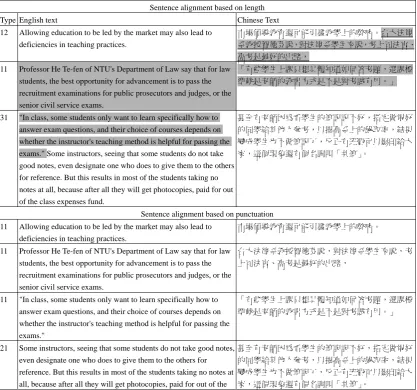
based on length and punctuation are shown in Appendix (Table A). Shaded parts
indicate imprecision in alignment results. We calculated the precision rates by
dividing the number of un-shaded sentences (counting both English and Chinese
sentences) by total number of sentences proposed. Since we did not exclude aligned
pair using a threshold, the recall rate should be the same as the precision rate. The
experimental results indicate that when non 1-1 matches next to each other tend to fail
the length-based aligner. However, the punctuation-based aligner appears to handle
such cases more successfully.
Precision Evaluation using punctuations
Articles Length-only Punctuation-only Improvement
World in a box* 91.5 98.8 7.3
What clones* 86.5 96.6 10.1
New University** 93.0 95.3 2.3
Book I-2 *** 96.5 98.9 2.4
Book II-8 *** 97.1 98.0 0.9
* Scientific American Magazine
** Sinorama Magazine
*** Harry Porter
3.2. Second Experiment and Evaluation
In the second experiment, we evaluated our method testing on a larger range of
corpus data. We used all the English and Chinese articles of Scientific American
Corpus from January 2003 to December 2003. There are 67 articles, 1523 English
sentences, and 1599 Chinese sentences. All the articles include both the English text
and their corresponding Chinese counterpart. Here are the results of the experiment:
Excluding partially incorrect and missing errors 95.8% 100.0%
Including partially incorrect and missing errors 93.0% 98.2%
4. Conclusion
We developed a very effective sentence alignment method based on punctuations.
The probability of the match between different punctuation marks between the source
and the target is calculated based on large bilingual corpora. The punctuation
alignment has the property of a binomial distribution. We have experimented with an
implementation of the proposed method on a large parallel corpus data. The
experiment results show that the punctuation- based approach outperforms the
length-based approach with precision rates approaching 93%.
We have explored ways of extending punctuation-based method. First, there is
possibility that we may want to interleave the matching of punctuations and regular
text segments between punctuations for sub-sentential alignment. We observed that
although word alignment links do cross one and other a lot, they general seem not to
cross the links between punctuations. Also since the method is quite general, it would
be interesting to see if one can adapt the method to handle other language pairs. We
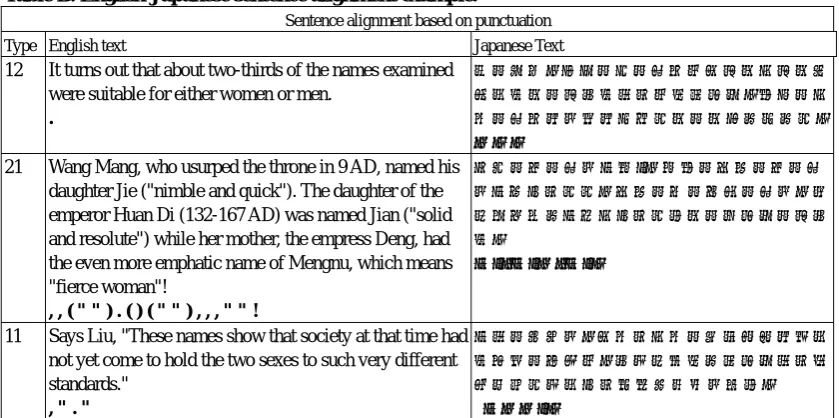
have hand-coded a small English-Japanese punctuation mapping table, and convert
our alignment program to handle Alignment of Japanese and English texts. It appears
that the adapted program works with compatible performance to the original one.
Please see example in Appendix (Table B).
A number of interesting future directions present themselves. First, punctuation
alignment can be exploited to constrain word alignment and reduce error rates.
Second, the punctuation alignment make possible a finer-grained level of bilingual
analysis and can provide a strikingly different translation memory and bilingual
concordance for more effective example-based machine translation (EBMT),
computer assisted translation and language learning (CAT and CALL).
References
Brown, P. F., J. C. Lai and R. L. Mercer (1991), 'Aligning sentences in parallel corpora', in 29th Annual Meeting
of the Association for Computational Linguistics, Berkeley, CA, USA. pp. 169-176.
Chuang, T., G.N. You, J.S. Chang (2002) Adaptive Bilingual Sentence Alignment, Lecture Notes in Artificial
Intelligence 2499, 21-30.
Dolan, William B., Jessie Pinkham & Stephen D. Richardson (2002) MSR-MT: The Microsoft Research Machine
Translation System, AMTA 2002, 237-239.
Gale, William A. & Kenneth W. Church (1993), A program for aligning sentences in bilingual corpus.
class expenses fund.
Table B. English-Japanese sentence alignment example. Sentence alignment based on punctuation
Type English text Japanese Text
12 It turns out that about two-thirds of the names examined were suitable for either women or men.
.
その結果、3分の2の名前が男でも女でも通 用するものであることがわかった。漢代の女 性の名前には実に力強いものも少なくない。 、。。
21 Wang Mang, who usurped the throne in 9 AD, named his daughter Jie ("nimble and quick"). The daughter of the emperor Huan Di (132-167 AD) was named Jian ("solid and resolute") while her mother, the empress Deng, had the even more emphatic name of Mengnu, which means "fierce woman"!
, , ( " " ) . ( ) ( " " ) , , , " " !
王莽の娘の名は「倢」、後漢の桓帝の娘の名
は「堅」といい、桓帝の時の皇后の名は、よ り直接的な「猛女」というものだったのであ る。
「」、「」、、「」。
11 Says Liu, "These names show that society at that time had not yet come to hold the two sexes to such very different standards."
, " . "