© 2018 IJSRCSEIT | Volume 4 | Issue 2 | ISSN : 2456-3307
Improving Security and energy efficiency in Ring clustered
WSN
Pooja Tekade, Prof. Nutan Dhande
Department of Computer Science and Engineering ACE Nagthana Wardha Maharashtra, India
ABSTRACT
Wireless sensor networks (WSNs) are increasingly used in many applications, such as volcano and fire monitoring, urban sensing, and perimeter surveillance. In a large WSN, in-network data aggregation (i.e., combining partial results at intermediate nodes during message routing) significantly reduces the amount of communication overhead and energy consumption. The research community proposed a loss-resilient aggregation framework called synopsis diffusion, which uses duplicate insensitive algorithms on top of multipath routing schemes to accurately compute aggregates (e.g., predicate count or sum). However, this aggregation framework does not address the problem of false sub-aggregate values contributed by compromised nodes. This attack may cause large errors in the aggregate computed at the base station, which is the root node in the aggregation hierarchy. In this paper, we make the synopsis diffusion approach secure against the above attack launched by compromised nodes. In particular, we present an algorithm to enable the base station to securely compute predicate count or sum even in the presence of such an attack. Our attack-resilient computation algorithm computes the true aggregate by filtering out the contributions of compromised nodes in the aggregation hierarchy. Extensive analysis and simulation study show that our algorithm outperforms other existing approaches.
Keywords: WSN, Data Aggregation,Attack Resilient
I.
INTRODUCTION
A wireless sensor network (WSN) consists of spatially distributed autonomous sensors to monitor physical or environmental conditions, such as temperature, sound, pressure, etc. and to cooperatively pass their data through the network to a main location. The more modern networks are bi-directional, also enabling control of sensor activity. The development of wireless sensor networks was motivated by military applications such as battlefield surveillance; today such networks are used in many industrial and consumer applications, such as industrial process monitoring and control, machine health monitoring, and so on.
The WSN is built of "nodes" – from a few to several hundreds or even thousands, where each node is
WSNs can vary from a simple star network to an advanced multi-hop wireless mesh network. The propagation technique between the hops of the network can be routing or flooding.
II.
PROPOSED METHODOLOGY
Setting up Network Model
We consider a large-scale, homogeneous sensor network consisting of resource-constrained sensor nodes. Analogous to previous distributed detection approaches; we assume that an identity-based public-key cryptography facility is available in the sensor network. Prior to deployment, each legitimate node is allocated a unique ID and a corresponding private key by a trusted third party. The public key of a node is its ID, which is the essence of an identity-based cryptosystem. Consequently, no node can lie to others about its identity. Moreover, anyone is able to verify messages signed by a node using the
identity-based key. Such network architecture is consistent with the design of storage centric sensor networks.
Falsifying the local value:
A compromised node C can falsify its own sensor reading with the goal of influencing the aggregate value. We assume that if a node is compromised, all the information it holds will be compromised. We conservatively consider that all malicious nodes can collude or can be under the control of a single attacker. We use a Byzantine fault model, where the adversary can inject any message through the compromised nodes. Compromised nodes may behave in arbitrarily malicious ways, which means that the sub-aggregate of a compromised node can be arbitrarily generated. However, we assume that the attacker does not launch DoS attacks, e.g., the multi-hop flooding attacks with the goal of making the whole system unavailable
Computing Sum Despite Attacks:
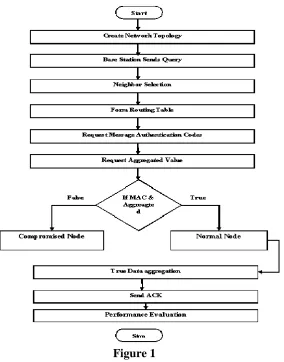
In this module, we develop an attack-resilient protocol which enables BS to compute the aggregate despite the presence of the attack. We observe that, in general, BS can verify the final synopsis if it receives one valid MAC for each ‘1’ bit in the synopsis. In fact, to verify a particular ‘1’ bit, say bit i ,
BS does not need to receive authentication messages from all of the nodes which contribute to bit i . As an example, more than half of the nodes are likely to contribute to the leftmost bit of the synopsis, while to verify this bit, BS needs to receive a MAC only from one of these nodes.
Simulation Output
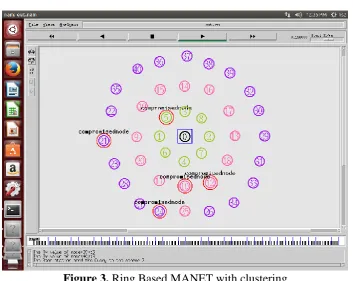
Figure 2.
Sender Selection
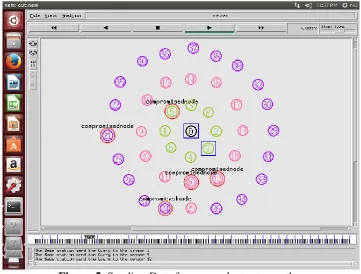
Figure 4.
Initiating Data Transfer
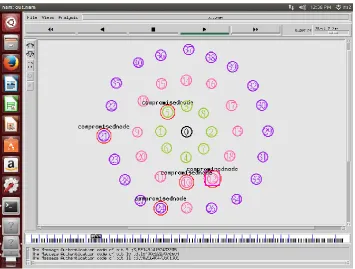
Figure 6.
MAC Authentication for Checking Compromised Node
III.
CONCLUSION
We discussed the security issues of in-network aggregation algorithms to compute aggregates such as predicate Count and Sum. In particular, we showed the falsified sub-aggregate attack launched by a few compromised nodes can inject arbitrary amount of error in the base station’s estimate of the aggregate. We presented an attack-resilient computation algorithm which would guarantee the successful computation of the aggregate even in the presence of the attack.
IV.
REFERENCES
[1]. A. Mishra, K. Nadkarni, A. Patcha, Intrusion detection in wireless Ad-hoc networks, IEEE Wirel. Commun. 11 (1) (2004) 48-60.
[2]. Y. Zhang, W. Lee, Y.-A. Huang, Intrusion detection techniques for mobile wireless networks, Wirel. Netw. 9 (5) (2003) 545-556. [3]. M. La Polla, F. Martinelli, D. Sgandurra, A
survey on security for mobile devices, IEEE Commun. Surv. Tutor. 15 (1) (2013) 446-471. [4]. F. Anjum, P. Mouchtaris, Intrusion Detection
Systems, John Wiley & Sons, Inc., 2006.
[5]. P. Brutch, C. Ko, Challenges in intrusion detection for wireless ad-hoc networks, in: Proceedings of Symposium on Applications and the Internet Workshops, 2003, pp. 368-373. [6]. Y.-C. Hu, A. Perrig, D. Johnson, Ariadne: a
secure on-demand routing protocol for ad-hoc networks, Wirel. Netw. 11 (1-2) (2005) 21-38. [7]. S. Bu, F. Yu, X. Liu, P. Mason, H. Tang,
Distributed combined authentication and intrusion detection with data fusion in high-security mobile ad hoc networks, IEEE Trans. Veh. Technol. 60 (3) (2011) 1025-1036.
[8]. Z. Fadlullah, H. Nishiyama, N. Kato, M. Fouda, Intrusion detection system (IDS) for combating attacks against cognitive radio networks, IEEE Netw. 27 (3) (2013) 51-56.
[9]. Y. Zhang, W. Lee, Intrusion detection in wireless ad-hoc networks, in: Proceedings of the 6th Annual International Conference on Mobile Computing and Networking, ACM, 2000, pp. 275-283.
[11]. A. Mitrokotsa, C. Dimitrakakis, Intrusion detection in MANET using classification algorithms: the effects of cost and model selection, Ad Hoc Netw. 11 (1) (2013) 226-237. [12]. C. Xenakis, C. Panos, I. Stavrakakis, A comparative evaluation of intrusion detection architectures for mobile ad hoc networks, Comput. Secur. 30 (1) (2011) 63-80.
[13]. I. Butun, S. Morgera, R. Sankar, A survey of intrusion detection systems in wireless sensor networks, IEEE Commun. Surv. Tutor. 16 (1) An intrusion detection and prevention system in cloud computing: a systematic review, J. Netw. Comput. Appl. 36 (1) (2013) 25-41. [16]. M. Ficco, L. Romano, A generic intrusion
detection and diagnoser system based on complex event processing, in: First International Conference on Data Compression, Communications and Processing, 2011, pp. 275-284.
[17]. K. Liu, J. Deng, P.K. Varshney, K. Balakrishnan, An acknowledgment-based approach for the detection of routing misbehavior in MANETs, IEEE Trans. Mob. Comput. 6 (5) (2007) 536-550.
[18]. E.M. Shakshuki, N. Kang, T.R. Sheltami, EAACK-a secure intrusion-detection system for MANETs, IEEE Trans. Ind. Electron. 60 (3) (2013) 1089-1098.
[19]. Y. Liu, C. Comaniciu, H. Man, A Bayesian game approach for intrusion detection in wireless ad hoc networks, in: Proceedings of the 2006 Workshop on Game Theory for Communications and Networks, ACM, 2006. [20]. A. Agah, S. Das, K. Basu, M. Asadi, Intrusion
detection in sensor networks: a non-cooperative game approach, in: Proceedings of
Third IEEE International Symposium on Network Computing and Applications, 2004, pp. 343-346.
[21]. T. Alpcan, T. Basar, A game theoretic approach to decision and analysis in network intrusion detection, in: Proceedings of 42nd IEEE Conference on Decision and Control, 2003, pp. 2595-2600.
[22]. Y. Huang, W. Lee, A cooperative intrusion detection system for ad hoc networks, in: Proceedings of the 1st ACM Workshop on Security of Ad Hoc and Sensor Networks, 2003, pp. 135-147.
[23]. M. Kodialam, T. Lakshman, Detecting network intrusions via sampling: a game theoretic approach, in: Twenty-Second Annual Joint Conference of the IEEE Computer and Communications, vol. 3, 2003, pp. 1880-1889. [24]. A. Mas-Colell, M. Whinston, J. Green,
Microeconomic Theory, New York, Oxford University Press, 1995.
[25]. T. Issariyakul, E. Hossain, Introduction to Network Simulator NS2, 1st ed., Springer Publishing Company, Incorporated, 2008. [26]. P. Barford, J. Kline, D. Plonka, A. Ron, A signal
analysis of network traffic anomalies, in: Proceedings of the 2nd ACM SIGCOMM Workshop on Internet Measurement, 2002, pp. 71-82.
[27]. A. Lakhina, M. Crovella, C. Diot, Mining anomalies using traffic feature distributions, Comput. Commun. Rev. 35 (4) (2005) 217-228. [28]. J. Dickerson, J. Dickerson, Fuzzy network profiling for intrusion detection, in: 19th International Conference of the North American Fuzzy Information Processing Society, 2000, pp. 301-306.
[29]. A. Valdes, K. Skinner, Adaptive, model-based monitoring for cyber attack detection, in: Recent Advances in Intrusion Detection, vol. 1907, 2000, pp. 80- 93.
13th USENIX Conference on System Administration, 1999, pp. 229-238.
[31]. R. Sekar, A. Gupta, J. Frullo, T. Shanbhag, A. Tiwari, H. Yang, et al., Specificationbased anomaly detection: a new approach for detecting network intrusions, in: Proceedings of the 9th ACM Conference on Computer and Communications Security, 2002, pp. 265-274. [32]. S. Marti, T.J. Giuli, K. Lai, M. Baker, Mitigating
routing misbehavior in mobile ad hoc networks, in: Proceedings of the 6th Annual International Conference on Mobile Computing and Networking, ACM, 2000, pp. 255- 265.
[33]. S. Misra, P. Krishna, K. Abraham, Energy efficient learning solution for intrusion detection in Wireless Sensor Networks, in: Second International Conference on Communication Systems and Networks, 2010, pp. 1-6.
[34]. F. Haddadi, M. Sarram, Wireless intrusion detection system using a lightweight agent, in: Second International Conference on Computer and Network Technology, 2010, pp. 84-87. [35]. M. Mohanapriya, I. Krishnamurthi, Modified