© 2018 IJSRCSEIT | Volume 3 | Issue 5 | ISSN : 2456-3307
High Energy and Spectral Efficiency Analysis For Crahn Based
Spectrum Aggregation
A. Vishnupriya*1, A. Indira Devi2
*1 PG Scholar & Computer Science and Engineering, Anna University/Sir ISSAC Newton college of Engineering and Technology, Nagapattinam, Tamilnadu, India
2Assistant Professor of Computer Science and Engineering, Anna University/Sir ISSAC Newton College of
Engineering and Technology, Nagapattinam, Tamilnadu, India
ABSTRACT
Cooperative routing and range spectrum aggregation are two promising methods for Cognitive Radio Ad-Hoc Networks. In this paper, we propose a range spectrum aggregation- based cooperative routing protocol, termed as SACRP, termed as SACRP, for CRAHNs. To the best of our insight, this is the first commitment on range accumulation based agreeable directing for CRAHNS. The essential target of SACRP is to give higher vitality productivity, enhance throughput, and reduces system delay for CRAHNS. In such manner, we plan the MAC and Physical layer, and proposed distinctive range total calculations for intellectual radio clients. We propose two distinctive classes of directing conventions Class A for accomplishing higher vitality productivity and throughput, and Class B for decreasing end-to-end dormancy. In light of stochastic geometry approach, we assemble a far-reaching systematic model for the proposed convention. In addition, the proposed convention is contrasted and the best in class helpful what's more, non-helpful steering calculations with range accumulation. Execution assessment exhibits the adequacy of SACRP as far as vitality effectiveness, throughput, and end-to-end delay.
Keywords: LTE, SACRP, CRAHNS, MAC.
I.
INTRODUCTION
The internetworking of different wireless technologies, particularly the long-term evolution networks and the IEEE 802.11-based wireless mesh networks, is one of the key opportunities in developing the next generation of wireless networks. The use of unlicensed frequency bands such as Wi-Fi with the LTE network increases the network capacity and reduces the cost of obtaining more LTE-licensed frequencies. LTE networks are used to avoid low-quality Wi-Fi links and connect island nodes if a link failure occurs. The design of heterogeneous systems is highly complex due to their dynamic nature and the diversity of the associated devices and resources. One possible way to simplify the
improves the heterogeneous system performance and creates an extendable middleware that allows more network types to be added in a dynamic, seamless fashion through the use of onto Logies and semantic rules. The proposed cognitive network framework contains an extendable middleware comprising a semantic knowledge base and a semantic inference engine. The semantic knowledge base uses onto Logies and a semantic rule base to express the relationships between cross-layer parameters from each network device and simplify the process of capturing these parameters. The reasoning system provides the mechanism to configure automatically different communication systems and to forward traffic demands through suitable transmission devices without the need to customize the software of the transmission devices or update the other layers of the Internet protocol stack. The use of a semantic inference engine enables each node in the heterogeneous network to be self-configured and aware of the surrounding environment and any additionally installed transmission devices. This work adapts the Ontology Web Language and Resource network without a centralized infrastructure in which some wireless nodes have a wired connection to the Internet Gateway . Other mesh nodes are used as relay nodes to propagate data to and from the Gateway. WMNs are an economical method of implementing a backbone network for a large area through a multi-hop wireless network. Wi-Fi is an economical choice for network operators as the cost of Wi-Fi chipsets continues to decrease and Wi-Fi hotspots are being installed in hotels, airports, and other public places. However, WMNs suffer from some drawbacks due to the multi-hop nature of the
network, such as the interference among the communicating and isolated island nodes, which are result of node failure. The IEEE 802.11p standard is part of the wireless access in vehicular environments (WAVE) that supports wireless access in VANETs. VANETs exchange and broadcast safety related and service application data between moving vehicles, or vehicle-to-vehicle (V2V), and between vehicles and roadside units, known as vehicle-to-infrastructure (V2I) communication. IEEE 802.11p operates in a dedicated short-range communication (DSRC) band of 5.85–5.92 GHz. In this band, one control channel (CCH) is used to transmit safety and control information, while up to six other service channels (SCH) are employed to exchange service information.
B. Cognitive and Intelligent Networks
networks and avoid interference due to the activation or deactivation of some services. The advantage of cognitive systems is that they allow relationships to be established between various wireless networks. In this paper, the current state-of-the-art is advanced through the introduction of a novel reasoning system capable of inferring optimal actions and configuring the heterogeneous network automatically using onto Logies. Furthermore, the use of semantic technologies and reasoning allows the management of the heterogeneous network to be separated from the data transmission. Ontology and semantic reasoning has been also used in cognitive radio communication to create wireless nodes that are capable of understanding the content of the information to be transferred as well as the abilities of the node itself, the destination, and the environment. For example, a node may utilize ontology instances to express its ability to satisfy the transmission needs, which helps to deduce the optimal operating parameters. This paper contributes to the body of knowledge in this area by proposing a cognitive network framework that can manage and optimize the use of heterogeneous networks. The semantic system developed allows more network architectures to be added with onto Logies and rules. Furthermore, an inference engine is proposed to optimize the heterogeneous networks with fuzzy reasoning, the relationships in the heterogeneous networks ontology, and a rule base.
III.
PROPOSED COGNITIVE NETWORK
FRAMEWORK
From a research perspective, the proposed cognitive network framework can be defined as a semantic-based system that collects QoS parameters from different layers in the network protocol stack and establishes an interface between different wireless network architectures. In other
words, this framework facilitates the process of using, managing, and combining different wireless network architectures by separating the
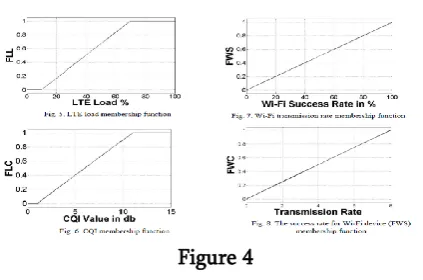
heterogeneous network infrastructure from the control system. Figure. 1 shows the block diagram of the proposed cognitive framework, which has three main parts: a QoS metrics management system, heterogeneous network management system, and routing decision system. The QoS metrics management system obtains node configuration parameters and various network characteristics, such as the load, quality of the communication channel, and transmission rate of the Wi-Fi device.
Figure 1
QoS metrics management system collects local parameters from the network protocol stack and passes these data to the heterogeneous network management system.
Proposed cognitive network framework
Figure 2
Urban heterogeneous network scenario
Figure 3
IV. SEMANTIC SYSTEM
The semantic system consists of a semantic knowledge base and a semantic inference engine. The semantic knowledge base is based on the recently proposed ontology of heterogeneous networks and a rule base. The novel semantic inference engine utilizes fuzzy logic to create instances of the ontology in the knowledge base that represent the QoS parameters of each RAN. The use of fuzzy logic is appropriate because of the uncertainty of the network QoS parameters, which may result in inaccurate information. Fuzzy membership functions are used to produce a fuzzy set of network parameters. Finally, a fuzzy-based
reasoned utilizes the rule base to autonomously control the various transmission technologies.
Figure 4
V. CONCLUSION
entire bandwidth which may be impossible for the cognitive radio, thus leading to false identification of empty spectrum.
IV.
REFERENCES
[1].Spectrum Assignment in Cognitive Radio Networks: A Comprehensive Survey" Elias Z. Tragos, SheraliZeadally, Alexandros G.
Fragkiadakis and Vasilios A.
SirisCommunications Surveys & Tutorials, IEEE (Volume:15 , Issue: 3 ) July 2013.
[2].Routing Metrics of Cognitive Radio Networks: A Survey" Moustafa Youssef, Mohamed Ibrahim, Mohamed Abdelatif, Lin Chen, and Athanasios V. VasilakosCommunications Surveys & Tutorials, IEEE (Volume:16 , Issue: 1 ).
[3].Spectrum-Map-Empowered Opportunistic Routing for Cognitive Radio Ad Hoc Networks" Shih-Chun Lin, Student Member, IEEE, and Kwang-Cheng Chen, Fellow, IEEEIEEE
TRANSACTIONS ON VEHICULAR
TECHNOLOGY, VOL. 63, NO. 6, JULY 2014 [4].Closed-Form Analysis of Relay-Based Cognitive
Radio Networks Over Nakagami-m Fading Channels" SattarHussain, Student Member, IEEE, and Xavier N. Fernando, Senior Member, IEEEIEEE transactions on vehicular technology, vol. 63, no. 3, MARCH 2014
[5].Spectrum Bonding and Aggregation With Guard-band Awareness in Cognitive Radio Networks "Mobile Computing, IEEE Transactions on (Volume:13 , Issue: 3 ) MARCH 2014
[6].Efficient Broadcast on Fragmented Spectrum in Cognitive Radio Networks", Pei Huang ; Dept. of Comput. Sci. & Eng., Michigan State Univ., East Lansing, MI, USA ; Chin-Jung Liu ; Xi Yang ; Li Xiao