Toward a Corpus of Cantonese Verbal Comments and their
Classification by Multi-dimensional Analysis
Oi Yee Kwong
Department of Translation
The Chinese University of Hong Kong
Shatin, N.T., Hong Kong
[email protected]
Abstract
The information explosion in modern days across various media calls for effective opinion mining for timely digestion of public views and appropriate follow-up actions. Current studies on sentiment analysis have primarily focused on uncovering aspects like subjectivity, sentiment and credibility from written data, while spoken data are less addressed. This paper reports on our pilot work on constructing a corpus of Cantonese verbal comments and making use of multi-dimensional analysis to characterise different opinion types therein. Preliminary findings on the dimensions identified and their association with various communicative functions are presented, with an outlook on their potential application in subjectivity analysis and opinion classification.
1
Introduction
Nowadays there are numerous channels for expressing personal opinions. Views expressed in written forms are no longer confined to newspapers and magazines but are found everywhere in social media on the almost boundless internet. Meanwhile, the boom in all kinds of talk shows and phone-in programmes on radio and television have allowed both experts and non-experts to voice their views on many different
subjects such as politics, finance, entertainment and leisure, just to name a few examples.
The challenge in such information explosion has to be met by effective opinion mining, which has so far focused on the subjectivity, sentiment, credibility, etc. from written data. Spoken data and the sub-types of opinions are relatively less addressed, which motivated our current work.
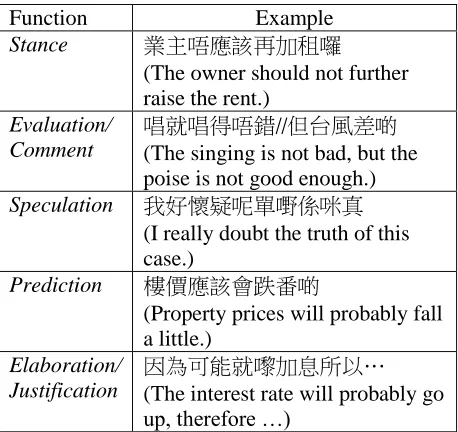
Opinionated utterances, or verbal comments, are likely to form a specific informal spoken genre as social media text has made a specific type of written language. They are distinct for utterance lengths, incompleteness, presence of speech errors, self-repairs, and speech planning evidence, amongst others. The comments may also be further categorised according to their communicative functions, such as presenting the speaker’s stance, giving advice to someone, providing information, making prediction, and evaluating or judging something. The effective classification of these different functions will be essential. This paper thus reports on a pilot study on the construction of a corpus of Cantonese verbal comments and the use of multi-dimensional analysis for characterising different types of opinions expressed therein, and discusses the potential application of the results in subsequent opinion mining work.
Section 2 reviews related work. Section 3 introduces our corpus of Cantonese verbal comments. Section 4 discusses the linguistic features used in the preliminary multi-dimensional analysis done in the current study and the initial results, while Section 5 concludes with future directions.
10
Domain Content and Programmes
Politics / Current Affairs
Interview programmes on TV/radio by host(s) with a guest, sometimes with phone-in sessions
星期六主場 (Face to Face): A one-to-one interview programme on TV, produced by RTHK
星期六問責 (Accountability): An interview programme (with two hosts and one guest) broadcasted on radio, containing phone-in sessions, produced by RTHK
講清講楚 (On the Record): A one-to-one interview programme on TV, produced by TVB
Economics / Finance
TV programmes with discussions between host and financial analysts, sometimes with phone-in sessions
理財博客 (Finance Blog): A financial analysis programme on TV, usually with one host and one guest analyst, plus phone-in sessions, produced by ATV
華爾街速遞 (Wall Street Express): A financial analysis programme on TV, with one host and one guest analyst, containing phone-in sessions, produced by Cable TV 樓盤傳真 (Property): A real estate commentary programme on TV, with two or more
hosts, reporters and interviewees, produced by Cable TV
Food / Entertainment
TV/radio programmes with critics on food/film, and singing contests on TV with judge comments
一粒鐘真人蘇 (One Hour So): An entertainment programme with a main host introducing food and restaurants with critics, sometimes with cooking demonstration, may have co-host in some episodes
超級巨聲/星夢傳奇 (The Voice): A series of singing contests on TV with instant comments from adjudicators, produced by TVB
亞洲星光大道 (Asian Million Star): A series of singing contests on TV with instant comments from adjudicators, produced by ATV
電影兩面睇 (Movie World): A film critics programme broadcasted on radio, usually with three hosts, produced by RTHK
Table 1: Data Sources
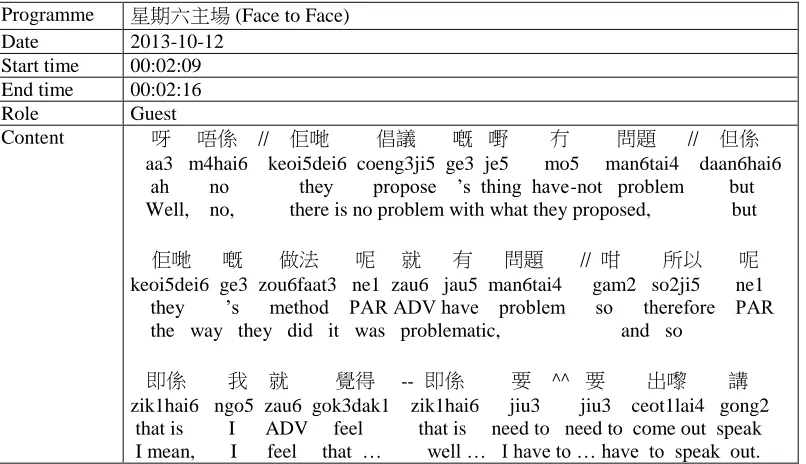
Programme 星期六主場 (Face to Face) Date 2013-10-12
Start time 00:02:09 End time 00:02:16
Role Guest
Content 呀 唔係 // 佢哋 倡議 嘅 嘢 冇 問題 // 但係 aa3 m4hai6 keoi5dei6 coeng3ji5 ge3 je5 mo5 man6tai4 daan6hai6 ah no they propose ’s thing have-not problem but Well, no, there is no problem with what they proposed, but
佢哋 嘅 做法 呢 就 有 問題 // 咁 所以 呢 keoi5dei6 ge3 zou6faat3 ne1 zau6 jau5 man6tai4 gam2 so2ji5 ne1 they ’s method PAR ADV have problem so therefore PAR the way they did it was problematic, and so
即係 我 就 覺得 -- 即係 要 ^^ 要 出嚟 講 zik1hai6 ngo5 zau6 gok3dak1 zik1hai6 jiu3 jiu3 ceot1lai4 gong2 that is I ADV feel that is need to need to come out speak I mean, I feel that … well … I have to … have to speak out.
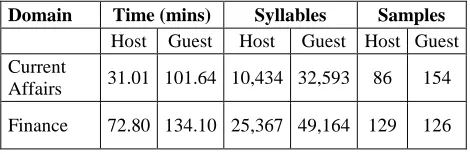
seconds were included. Each speaker turn was considered one speech sample. Drawn from about 150 minutes of transcribed speech from current affairs programmes and about 230 minutes of transcribed speech from finance programmes, a total of about 340 minutes of speech containing 495 samples with over 117K syllables were used in the analysis. The breakdown for individual domains and roles is shown in Table 4.
Domain Time (mins) Syllables Samples Host Guest Host Guest Host Guest Current
Affairs 31.01 101.64 10,434 32,593 86 154
Finance 72.80 134.10 25,367 49,164 129 126
Table 4: Data Size for Current Study
4
Multi-dimensional Analysis
4.1 Linguistic Features Used
The following linguistic features were extracted and counted from the annotated materials described above. The quantitative data were then used in the current pilot analysis:
Pronouns, including first person pronouns (我I, 我哋we), second person pronouns (你 you, 你哋 you), and third person pronouns (佢he/she, 佢哋they).
Modals, including modal verbs likes 可能 may, 應該should, 可以can, 會will, etc.
Private verbs, including verbs indicating private states such as 諗think, 覺得feel, 認 為think, 相信believe, etc.
Yes/No question words, including 有冇 have or have not, 係咪 did or did not, etc. and other A-not-A patterns.
Wh-question words, including what (乜, 咩 嘢…), why (點解, 為乜…), who (邊個…), when (幾時, 如何…), and how (點樣…).
Discourse connectives, including words indicating concession (雖然 although, 但係 but…), causal relation (因為 because, 所以 therefore…), conditions (除非 unless, 不論
whether…), and hypothetical situations (如 果if, 就算even if…).
Speech planning features, including common fillers like 即 係 that is, 其 實 actually, etc., as well as speed and number of self-repairs, hesitation, lengthening and pauses in a speech sample.
4.2 Procedures
The frequency data obtained for the above linguistic features were tabulated and subject to Factor Analysis, following the process of multi-dimensional analysis discussed in Biber (1988, 1993). Factor Analysis is a kind of multivariate analysis which reduces a large number of features to a smaller set of factors based on their co-occurring patterns. In this study, SPSS was used as the tool to do this. With reference to the factors identified and the loadings associated with their component features, dimensional scores were computed for each type of text (in this case, speech produced by a certain role in a certain type of programme) with respect to each factor/dimension. These scores were based on the average of the sum of normalized frequencies for positively loaded features less that for negatively loaded features under a particular dimension for a given text type.
4.3 Preliminary Results
Dimension Positive features Negative features D1:
Interaction, Involvement, Stance
Private verbs 1st person pronouns Wh-questions 2nd person pronouns D2:
Uncertainty, Prediction
Speed Speech fillers Modals
Yes/No questions D3:
Elaboration, Explanation
Speech planning features Causal connectives 1st person pronouns
2nd person pronouns Yes/No questions Concession words D4:
Argumentative
3rd person pronouns Concession connectives Hypothetical connectives Causal connectives
Table 5: Dimensions Identified
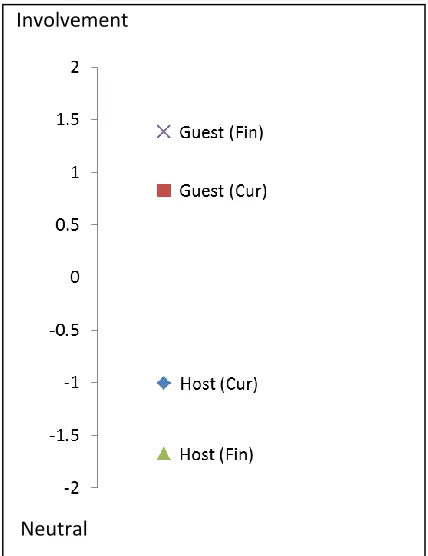
The speech samples were divided into four categories (or registers) by the two domains (current affairs and finance) and two roles (host and guest). The dimensional scores for each category along each dimension were computed. Figure 1 shows the comparison of the categories along the first dimension (D1) and Figure 2 shows their comparison along the second dimension (D2). In the figures, “Cur” stands for current affairs and “Fin” stands for finance.
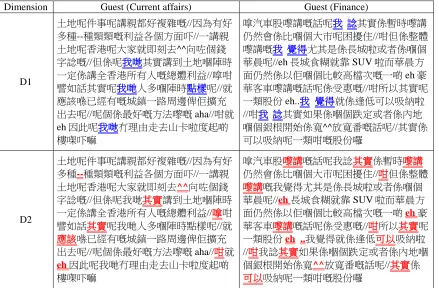
It can be seen that guests and hosts in both domains are quite clearly distinguished by D1, which is characterised by private verbs, first and second person pronouns, and wh-questions. These are indicative of interaction, involvement and stance. Guests in interview programmes are often asked for their views on certain subjects, while hosts are expected to remain as neutral as possible. D2, which is characterised by faster speed and abundance of speech fillers, modals and yes/no questions, reflects the uncertainty of the speakers and is likely to be associated with predictions rather than factual statements. This dimension thus singles out guests in financial programmes, who usually make predictions on financial matters and give investment advice. Table 6 shows a guest speaker turn from each domain of similar duration for a quick visualisation of the features found for D1 and D2. The relevant features are bolded and underlined.
Involvement
Neutral
Figure 1: Comparison along D1
Uncertain
Normal
Dimension Guest (Current affairs) Guest (Finance)
D1
土地呢件事呢講親都好複雜嘅//因為有好 多種--種類類嘅利益各個方面吓//一講親 土地呢香港呢大家就即刻去^^向咗個錢 字諗嘅//但係呢我哋其實講到土地嗰陣時 一定係講全香港所有人嘅總體利益//嗱咁 譬如話其實呢我哋人多嗰陣時點樣呢//就 應該喺已經有嘅城鎮一路周邊俾佢擴充 出去呢//呢個係最好嘅方法嚟嘅aha//咁就 eh因此呢我哋冇理由走去山卡啦度起啲 樓㗎吓嘛
嗱汽車股嚟講嘅話呢我 諗其實係暫時嚟講 仍然會係比嗰個大市呢困擾住//咁但係整體 嚟講嘅我 覺得尤其是係長城啦或者係嗰個 華晨呢//eh長城食糊就靠SUV啦而華晨方 面仍然係以佢嗰個比較高檔次嘅一啲eh豪 華客車嚟講嘅話呢係受惠嘅//咁所以其實呢 一類股份eh..我 覺得就係逢低可以吸納啦 //咁我 諗其實如果係嗰個跌定或者係內地 嗰個銀根開始係寬^^放寬番嘅話呢//其實係 可以吸納呢一類咁嘅股份囉
D2
土地呢件事呢講親都好複雜嘅//因為有好 多種--種類類嘅利益各個方面吓//一講親 土地呢香港呢大家就即刻去^^向咗個錢 字諗嘅//但係呢我哋其實講到土地嗰陣時 一定係講全香港所有人嘅總體利益//嗱咁 譬如話其實呢我哋人多嗰陣時點樣呢//就
應該喺已經有嘅城鎮一路周邊俾佢擴充 出去呢//呢個係最好嘅方法嚟嘅aha//咁就 eh因此呢我哋冇理由走去山卡啦度起啲 樓㗎吓嘛
嗱汽車股嚟講嘅話呢我諗其實係暫時嚟講
仍然會係比嗰個大市呢困擾住//咁但係整體
嚟講嘅我覺得尤其是係長城啦或者係嗰個 華晨呢//eh長城食糊就靠SUV啦而華晨方 面仍然係以佢嗰個比較高檔次嘅一啲eh豪 華客車嚟講嘅話呢係受惠嘅//咁所以其實呢 一類股份eh ..我覺得就係逢低可以吸納啦 //咁我諗其實如果係嗰個跌定或者係內地嗰 個銀根開始係寬^^放寬番嘅話呢//其實係
可以吸納呢一類咁嘅股份囉
Table 6: Comparison on D1 and D2 Features
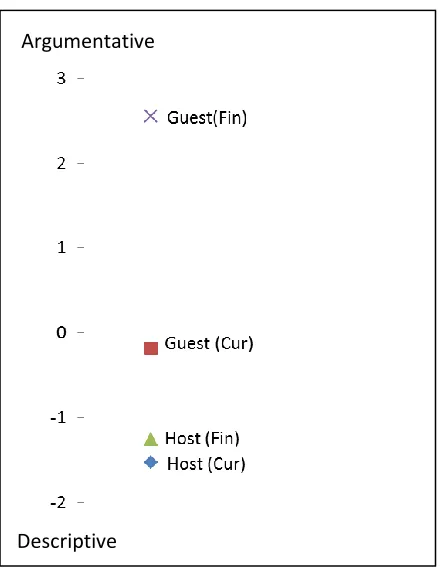
Figure 3 and Figure 4 show the comparison of the categories along the third and fourth dimensions (D3 and D4) respectively. D3, with the abundance of causal connectives and speech planning features, is characteristic of guests in both domains who often need to elaborate and explain the views, especially in current affairs discussions. Hosts in current affairs programmes often pose concise questions and let the guest respond, whereas those in financial programmes may pose more elaborated questions, or may even express some of their personal views with considerably more interaction with the guest. The differentiation of the categories along D4, for argumentation, suggests that guests tend to speak with more logical reasoning than hosts, and this is more evident for guests in financial programmes than those in current affairs programmes.
Elaboration
Conciseness
Argumentative
Descriptive
Figure 4: Comparison along D4
4.4 Potential Application
Given the feature co-occurrence patterns identified and their association with specific communicative functions, they can potentially be used as the features in a variety of approaches, including those based on rules or machine learning, for automatic subjectivity recognition and opinion type classification. Larger-scale data annotation is in progress, for opinions and other private states. The resulting annotated corpus is expected to provide more data as well as more variety of linguistic features for a more comprehensive multi-dimensional analysis. The relevant features for characterizing different categories of verbal comments will be applied in experiments on opinion mining.
5
Future Work and Conclusion
The preliminary study reported here suggested that multi-dimensional analysis is a promising approach to characterise opinionated speech samples and differentiate their sub-types based on communicative functions.
The immediate next step will expand the analysis to include more speech samples, possibly with a greater variety of domains and roles, to obtain more reliably distinguished dimensions, and to account for a wider range of opinion types and functions. So far we have relied mostly on lexical features, and more types of features will be necessary for a fuller picture of the genre characteristics of verbal comments. In particular, for lexical features we plan to add parts of speech, aspect markers, and sentence-final particles (which is very characteristic of Cantonese), and more importantly, for lexico-grammatical features we plan to include nominalisations, assertions, negation, and as far as possible, some discourse level features would be favoured. More tests on grouping and de-grouping the various features will be conducted and a more comprehensive analysis of the dimensions (with expanded datasets) will be done, for a descriptive account of Cantonese verbal comments as a specific spoken genre.
Another important direction will certainly be the application of the dimensions (and the features therein) and dimension scores for opinion mining. We have outlined their potential uses and experiments will be done when more annotated data for training and testing are ready. This future work is expected to showcase the synergy between corpus-based discourse analysis and opinion mining applications.
Reference
Banea, C., R. Mihalcea and J. Wiebe. 2010. Multilingual Subjectivity: Are More Languages Better? In Proceedings of the 23rd International Conference on Computational Linguistics (COLING 2010), Beijing, pp.28-36.
Biber, D. 1988. Variation across Speech and Writing. Cambridge University Press.
Biber, D. 1993. Using Register-Diversified Corpora for General Language Studies. Computational Linguistics, 19(2): 219-241.
Conrad, S. and D. Biber. 2001. Variation in English: Multi-Dimensional Studies. Longman.
Hu, M. and Liu, B. 2004. Mining and Summarizing Customer Reviews. In Proceedings of the ACM SIGKDD Conference on Knowledge Discovery and Data Mining (KDD), pp. 168-177.
Kaufer, D. and S. Ishizaki. 2006. A corpus study of canned letters: mining the latent rhetorical proficiencies marketed to writers in a hurry and non-writers. IEEE Transactions on Professional Communication, 49(3): 254-266.
Kim, S-M. and E. Hovy. 2006. Extracting Opinions, Opinion Holders, and Topics Expressed in Online News Media Text. In Proceedings of the Workshop on Sentiment and Subjectivity in Text, Sydney, pp.1-8.
Ku, L-W., Y-T. Liang and H-H. Chen. 2006. Opinion extraction, summarization and tracking in news and blog corpora. In Proceedings of AAAI.
Li, S., S. Ju, G. Zhou and X. Li. 2012. Active Learning for Imbalanced Sentiment Classification. In Proceedings of the 2012 Joint Conference on Empirical Methods in Natural Language Processing and Computational Natural Language Learning, Jeju Island, Korea, pp.139-148.
Liu, B. 2010. Sentiment Analysis and Subjectivity. In N. Indurkhya and F. J. Damerau (Eds.), Handbook of Natural Language Processing. Boca Raton, FL: Chapman & Hall.
Lu, B., B.K. Tsou and T. Jiang. 2010. Supervised Approaches and Dependency Parsing for Chinese Opinion Analysis at NTCIR-8. In Proceedings of the 8th NTCIR Workshop Meeting on Evaluation of Information Access Technologies: Information Retrieval, Question Answering, and Cross-Lingual Information Access, Tokyo, Japan, pp.234-240.
Pang, B. and L. Lee. 2008. Opinion Mining and Sentiment Analysis. Foundations and Trends in Information Retrieval, 2(1-2): 1-135.
Pang, B., L. Lee and S. Vaithyanathan. 2002. Thumbs up? Sentiment Classification Using Machine Learning Techniques. In Proceedings of the Conference on Empirical Methods in Natural Language Processing (EMNLP), pp. 79-86.
Polanyi, L. and A. Zaenen. 2006. Contextual Valence Shifters. In J.G. Shanahan, Y. Qu and J. Wiebe (Eds.) Computing Attitude and Affect in Text: Theory and Applications. Springer.
Somasundaran, S. and J. Wiebe. 2009. Recognizing Stances in Online Debates. In Proceedings of the 47th Annual Meeting of the ACL and the 4th International Joint Conference on Natural Language of the AFNLP, Singapore, pp.226-234.
Tsou, B.K., O.Y. Kwong, W.L. Wong and T.B.Y. Lai. 2005. Sentiment and Content Analysis of Chinese News Coverage. International Journal of Computer Processing of Oriental Languages, 18(2): 171-183.
Turney, P. 2002. Thumbs Up or Thumbs Down? Semantic Orientation Applied to Unsupervised Classification of Reviews. In Proceedings of ACL 2002, Philadelphia, pp.417-424.
Wiebe, J. and T. Wilson. 2002. Learning to disambiguate potentially subjective expressions. In Proceedings of the Conference on Natural Language Learning (CoNLL), pp. 112-118.
Wiebe, J., T. Wilson and C. Cardie. 2005. Annotating Expressions of Opinions and Emotions in Language. Language Resources and Evaluation, 39(2): 165-210.
Wilson, T., J. Wiebe and P. Hoffmann. 2005. Recognizing Contextual Polarity in Phrase-level Sentiment Analysis. In Proceedings of the Human Language Technology Conference and the Conference on Empirical Methods in Natural Language Processing (HLT/EMNLP), pp. 347-354.