A POMDP-based Multi
m
odal Interaction Syste
m
Using a Hu
m
anoid Robot
Sae Iijima Advanced Sciences,
Graduate School of Humanities and Sciences,
Ochanomizu University [email protected]
Ichiro Kobayashi Advanced Sciences,
Graduate School of Humanities and Sciences,
Ochanomizu University [email protected]
Abstract
In recent years, with the spread of the house-hold robots, the necessity to enhance the com-munication capabilities of those robot to peo-ple has been increasing. The objective of this study is to build a framework for a dialogue systemdealing with multimodal information that a robot observes. We have applied par-tially observable Markov Decision Process to modeling multimodal interaction between a human and a robot. Through the experiments, we have confirmed that our proposed frame-work functions properly and achieves effective multimodal interaction with a robot.
1 Introduction
In recent years, with the spread of the household robots, the necessity to enhance the comm unica-tion capabilities of those robot to people has been increasing. Furthermore, we expect those robots which can observe information from multimodal re-sources and performproper actions based on the ob-served information in interaction with people. In this context, the objective of our study is to achieve effective interaction with a robot using the m ulti-modal information observed by the sensors of the robot. As a concrete system, we have implemented a dialogue system with the framework of partially observable Markov decision process (POMDP) in a humanoid robot called “Pepper” which can observe variousmultimodal information by its own sensors. Through several experiments, we aimto confirmthat our systemcan assist Pepper to achieve flexiblem ul-timodal interaction with people.
2 Multimodal dialogue with a robot
2.1 Observation ofmultimodal information
In the experiments, we use a humanoid robot called “Pepper”1produced by SoftBank Co. Ltd. The
fig-ure of Pepper and its sensors are shown in Figfig-ure 1. We obtain multimodal information through the sensors of Pepper and aim to achieve multimodal interaction between Pepper and a user with those observed information. As for themultimodal infor-mation observed by the sensors equipped with Pep-per, we obtain visual information fromRGB camera, voice from microphone, contact information from touch sensor, and distance information from laser and sonar sensor. Pepper has face recognition func-tion and can estimate user’s age and identify five kinds of user’s emotion: i.e., neutral, happy, sur-prised, angry, andsad, fromuser’s facial expression.
Figure 1: Pepper and its sensors
1http://www.softbank.jp/robot/
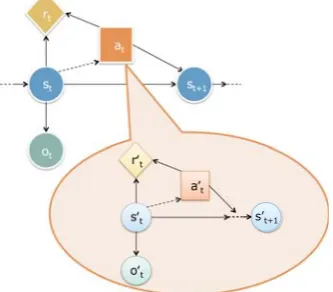
In this paper, we use a framework of partially ob-servable Markov decision process (POMDP) to rep-resent uncertain states of the Markov decision pro-cess as stochastic states. The graphical model of POMDP is illustrated in Figure2.
Figure 2: Graphicalmodel of POMDP
A POMDP can be represented in the form of the following n-tuple:{S, A, T, O, Z, R, b0}, where
s∈Sdenotes the state of a user,a∈Ais an action of the agent,o ∈ O denotes an observation at state
s. T is the probability of transitioning fromstates to states:P(s|s, a),Zis the probability of observ-ingofromstatesafter taking actiona:P(o|s, a), andr(s, a) ∈ Ris the reward signal received when executing actionain states.
The process of POMDP is as follows: at each time-step, the target world is expressed as some un-observed states. Because sis not known exactly, a distribution over states ismaintained. This distri-bution is called “belief state” expressed asb, and its initial state is expressed asb0. We representb(s)to indicate the probability of being in a particular state
s. At each step, the belief state distributionbis up-dated as shown in equation (1).
b(s) =k×P(o|s, a)
s
P(s|s, a)b(s) (1)
Here, k is regarded as a normalization constant to satisfysb(s) = 1.
2.3 Expansion tomultimodal states
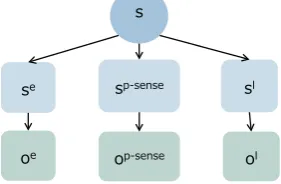
In the interaction between a user and an agent, we consider three states:se,spandslto represent user’s emotional state, user’s physical state, and user’s in-tention by words, respectively. Here, oe, op, ol are
relation between statessand observationso.
Figure 3: Graphicalmodel of the relation between states and their observations
Here, amore detail about themultimodal states is explained as follows:
• Emotional state se
This factor indicates the state of user’s emotion. We estimate this state based on the observation
oeobserved by user’s facial expression through
an image recognition function equipped with Pepper.
• Physical state sp(sp−dis, sp−sense)
In our study, the physical state can be divided into two states. One is the distance statesp−dis which represents the state of how far a user is from the agent, and the other is the state of sensing sp−sense which represents whether or not a user is touching the agent. We obtain ob-servationop−dis from the laser sensor and the sonar sensor andop−sense fromthe touch sen-sor equipped with Pepper.
• Linguistic state sl
This factor indicates the state of user’s inten-tion provided by user’s utterances. We obtain observation ol through voice recognition sys-temequipped with Pepper.
2.4 Stratified relation of states
de-cision process, a complex task is divided into sev-eral subtasks which correspond to each strata of the stratified interaction processes. The agent learns the local policy at each strata and then learns the global policy for the complex task by unifying those local policies (Yamada et al., 2015).
Figure 4: Stratified state in POMDP
2.5 Obtaining optimal policy by Q-learning
A plan to choose actionain statesis defined as pol-icyπ. Besides,π∗ is defined as the optimal policy to choose optimal actiona∗ in states. In POMDP, the states are represented in continuous states and therefore the number of states aremonotonically in-creasing as the process unfolds. Therefore, Pineau et al. (2002) developed point-based value iteration algorithm to reduce calculation cost by transform -ing continuous values into discrete values at some points. In this paper, however, we assume that states
sare regarded as being discrete for simplifying the model and then optimal policy π∗ is obtained by Q-learning. The Q-values are updated as shown in equation (2). Here,αandγindicate the learning rate and the discount rate, respectively.
Q(s, a)←Q(s, a)+α(r+γmax
a Q(s
, a)−Q(s, a))
(2) Figure 5 illustrates the introduction of Q-learning in the framework of POMDP to estimate the value of each state.
3 Experiments onmultimodal iteraction
We conducted experiments employing a dialogue scenario in which Pepper and a user interact with
Figure 5: Q-learning in the framework of POMDP
multimodal information – the interaction ismodeled by means of POMDP extended so as to be able to deal withmultimodal information and to have strat-ified organization to represent the interaction. In the scenario, the task is stratified in accordance to the priority of interaction – here, user’s location is the first priority to start interaction.
To build an interaction system, we improved the Python sample code2which implements a demo sys-tem for a spoken dialogue system with POMDP by (Williams et al., 2007) in the framework of PythonSDK3which is the software developer kit for Pepper.
3.1 The scenario ofmultimodal interaction
The scenario of multimodal interaction between Pepper and a user is shown in Table1.
Table 1: The scenario ofmultimodal interaction Speaker Interaction content Observation Action
User (Far) Distance
Pepper Come on, here! Call
User (Near) Distance
Pepper Let’s talk withme. Speak to
User Hello. Voice
Pepper Hello. Greet
User (Sad face) Picture
Pepper You look so sad! Cheer I will encourage you!
(Pepper dancing)
User Thank you. Voice (Patted head) Sensor
Pepper I amshy Shy
User (None) Distance
Pepper (End of dialogue) End
2https://github.com/mbforbes/py-pomdp
3http://doc.aldebaran.com/1-14/dev/python/index.html
As for the interaction, in this study we represent the whole interaction in two stratified structure. The first strata represents the transition states of the physical location between Pepper and a user, and the second strata represents the dialogue interaction.
We show the detail settings of POMDP in the fol-lowing – in this study, state transition probability, observed probability, reward, and the initial belief state aremanually provided in advance.
• S User’s states
Sp−dis : {None, Far, Near}
S : { Greet, Sad, Fun, Happy,
Unhappy}
• A Actions
Ap−dis : {None, End, Call, Speak to} A : {None, Greet, Cheer, Enjoy,
Shy, Get down}
Here,Ap−dis are the actions corresponding to
Sp−dis.
• T State transition probability,P(s|s, a) The probabilities of transitioning from a state
sto the next states for distance identification task and interaction task are shown in Table2 and 3, respectively.
Table 2: State transition probability for distance
sp−dis sp−dis None Far Near
None 0.2 0.15 0.15 Far 0.2 0.15 0.15 Near 0.3 0.2 0.2
Table 3: State transition probability for dialogue
s s Greet Sad Fun Happy Unhappy
Greet 0.2 0.25 0.25 0.15 0.15 Sad 0.2 0.15 0.15 0.25 0.25 Fun 0.2 0.15 0.15 0.25 0.25 Happy 0.3 0.2 0.2 0.15 0.15 Unhappy 0.3 0.2 0.2 0.15 0.15
• O: Observation information
tion from the facial expres-sion through image recogni-tion.
op−dis : Observation of distance
be-tween Pepper and a user.
op−sense : Observation of the sensing
information of touch.
ol : Observation of user’s voice.
• Z: Observation probability
In accordance with the stratified relation of states, we consider two observation probabili-ties: P(o|s, a)andP(op−dis|sp−dis, a). In the experiments, we set the observation probability of user’s voice as 0.8, and the other observation probability as 0.7.
• R reward,r(s, a)
The rewards given after every action for the identification of the distance to a user from Pepper and for the dialogue interaction are shown Figure4 and 5, respectively.
Table 4:Rp−dis reward for the identification of distance
sp−dis ap−dis None End Call Speak to
None -1 5 -10 -10
Far -1 -10 5 -10
Near -1 -10 -10 5
Table 5:R reward
s a None Greet Cheer Enjoy Shy Get down Greet -1 5 -10 -10 -10 -10
Sad -1 -10 5 -10 -10 -10 Fun -1 -10 -10 5 -10 -10 Happy -1 -10 -10 -10 5 -10 Unhappy -1 -10 -10 -10 -10 5
• b0p−disandb0: The initial belief states
b0p−dis indicates the initial belief state of the
distance between Pepper and a user, andb0 in-dicates the initial belief state of a user.
b0p−dis = (None: 0.2, F ar: 0.2, Near: 0.2)
b0 = (Greet : 0.3, Sad : 0.2, F un :
Table 6: Experimental result
Agent Interaction Contents Observation b(s) Action reward
User (Far) op−dis[Far]
Pepper (None) None -0.986
User (Far) op−dis[Far]
Pepper Come on, here! Call 1.100
User (Near) op−dis[Near]
Pepper Let’s talkme. Speak to 0.819
User Hello. ol[Greet]
Pepper Hello. Greet 2.541
User (Sad face) oe[Sad]
Pepper How are you?
Cheer 1.539
I encourage you.
User Thank you. ol[Happy]
(Patted head) op−sense[Touch head]
Pepper I amshy Shy 1.965
User (None) op−dis[None]
Pepper (None) None -0.989
User (None) op−dis[None]
Pepper (End of dialogue) None 1.964
• π∗: The optimal policy
The optimal policyπ∗shows the optimal action
a∗ in the belief stateb(s). It is represented in
equation (3) by Q-value.
π∗(b(s)) =Q(b(s), a) (3)
To find the optimal policy, we use -greedy method in Q-learning, and set the learning rateαas 0.2, and the discount rateγ as 0.9.
3.3 Experimental result
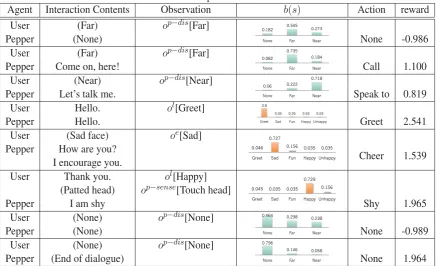
Table 6 shows an experimental result. Figure 6 shows the graphicalmodel of POMDP for the sce-nario.
3.4 Discussions
Through the experiment, we have confirmed that our proposedmultimodal interaction framework with a humanoid robot Pepper works well to interact with a user, and understood that the representation of the states in the interactive system tends to depend on the sensing functions and abilities of a robot. If each sensing function and ability is poor, it should be dif-ficult to establish the interaction.
Furthermore, in this study we have built an inter-action system with two strata in the framework of POMDP – we have set the first stratumso as it de-cides to start interaction based on the physical dis-tance between Pepper and a user, and set the second stratumto controlmultimodal interaction. We have confirmed that the stratification of the whole inter-action works well to reduce the dimension of states and then reduce calculation cost, and tomake a good organization of the interaction.
In the experiment, we obtained the optimal strat-egy assuming that the states on the interaction are observed as being definite in order to reduce calcu-lation cost. As a result, because the size of the sce-nario was short, there was not any problem in the interaction. However, we will have to take care of this problem, when we deal with a complicated and long interaction.
4 Related studies
As for employing POMDP in dialoguemanagement, the essential features, e.g., how tomodel the inher-ent uncertainty in spoken dialog systems, why ex-act optimization is intractable, and how to describe the hidden information statemodel which does scale
continuous states in the framework of POMDP em -ployingmultimodal information, andmake a good organization of stratified structure in the dialogue in-teraction.
Acknowledgments
We would like to express our appreciation for fi-nancial support by Tateishi Science and Technology Foundation.
References
B. Bonet 2002. An e-optimal grid-based algorithm for par- tially observable Markov decision processes In Proc. of ICML, pp. 51-58.
T.G. Dietterich 2000. An Overview of MAXQ Hierarchi-cal Reinforcement Learning, Lecture Notes in Com-puter Science, pp. 26-44.
Y Engel, S Mannor, and R Meir 2005. Reinforcement learning with Gaussian processes, In Proc. of the In-ternational Conference on Machine Learning.
M. Gasic, F. Jurcicek, S. Keizer, F. Mairesse, B. Thom-son, K. Yu and S. Young 2010. Gaussian Processes for Fast Policy Optimisation of POMDP-based Dia-logue Managers, In Proc. of SIGDIAL 2010: the 11th Annual Meeting of the Special Interest Group on Dis-course and Dialogue, pp. 201-204.
M. Gasic, C. Breslin, M. Henderson, D. Kim, M. Szum-mer, B. Thomson, P. Tsiakoulis and S. Young 2013.
POMDP-based dialogue manager adaptation to ex-tended domains In Proc. of the SIGDIAL 2013 Con-ference, pp. 214-222.
F Jurcicek, B Thomson, and S Young 2011. Natural actor and belief critic: Reinforcement algorithm for learning parameters of dialogue systems modelled as POMDPs, ACM Transactions on Speech and Lan-guage Processing.
O. Lemon, 2008. Adaptive natural language generation in dialogue using reinforcement learning, In Proc. of the Workshop on the Semantics and Pragmatics of Di-alogue (SEMDIAL), pp.141-148, London, UK. Sem-Dial.
O. Lemon, 2011. Learning what to say and how to say it:joint optimization of spoken dialogue management and natural language generation, Computer Speech and Language, 25(2):pp.210-221.
P. Lison 2010. Towards Relational POMDPs for Adap-tive Dialogue Management In Proc. of the ACL 2010 Student Research Workshop, pp. 7-12.
P. Lison 2011. Multi-Policy Dialogue Management In Proceedings of the SIGDIAL 2011 Conference, pp. 294-300
J. Pineau, G. Gordon, and S. Thrun 2002. Point-based value iteration: An anytime algorithm for pomdps In Proc. of the International Joint Conference on Artifi-cial Intelligence, pp. 1025-1032.
V. Rieser and O. Lemon 2008. Learning Effective Mul-timodal Dialogue Strategies from Wizard-of-Oz data: Bootstrapping and Evaluation, In Proc. of ACL-08: HLT, pp. 638-646.
V. Rieser and O. Lemon, 2009. Natural Language Gen-eration as Planning under Uncertainty for Spoken Di-alogue Systems, In Proc. of the Conference of the Eu-ropean Chapter of the Association for Computational Linguistics (EACL), pp.683-691, Athens, Greece. N. Roy, J. Pineau and S. Thrun 2000. Spoken Dialogue
Management Using Probabilistic Reasoning, In Proc. of the Association for Computational Linguistics. R. S. Sutton and A. G. Barto, 1998. Reinforcement
Learning: An Introduction, MIT Press, Cambridge, MA.
J. D. Williams. 2006. Partially Observable Markov De-cision Processes for Spoken Dialogue Management. Ph.D. thesis, University of Cambridge.
J. D. Williams, S. Young 2007. Partially observable Markov decision processes for spoken dialog systems, Computer Speech and Language, Volume 21 , Issue 2, pp. 393-422.
Y. Yamada, T. Takiguchi, and Y. Ariki, 2015. SPO-KEN DIALOGUE SYSTEM FOR PRODUCT
REC-OMMENDATION USING HIERARCHICAL POMDP,
2015 First International Workshop on Machine Learn-ing in Spoken Language ProcessLearn-ing (MLSLP), 6 pages.
S. Young. 2006. Using POMDPs for Dialog Manage-ment. In Proc. of IEEE/ACL SLT, PalmBeach, Aruba. J.Young, W. K. Schatzmann, and H. Ye. 2007. The Hid-den Information State Approach to Dialog Manage-ment. In Proc. of 2007 IEEE International Conference on Acoustics, Speech and Signal Processing - ICASSP ’07 (Volume:4 ), Honolulu, Hawaii.
S. Young, M. Gasic, S. Keizer, F. Mairesse, J. Schatz-mann, B. Thomson, and K. Yu 2010. The Hidden Information State model: A practical framework for POMDP-based spoken dialogue management, Com-puter Speech and Language, 24:pp. 150-174.