Machine-Guided Solution to Mathematical Word Problems
Bussaba Amnueypornsakul
University of Illinois,
Urbana-Champaign, USA
Suma Bhat
University of Illinois
Urbana-Champaign, USA
Abstract
Mathematical word problems (MWP) test crit-ical aspects of reading comprehension in con-junction with generating a solution that agrees with the “story” in the problem. In this paper we design and construct an MWP solver in a systematic manner, as a step towards enabling comprehension in mathematics and teaching problem solving for children in the elemen-tary grades. We do this by (a) identifying the discourse structure of MWPs that will enable comprehension in mathematics, and (b) utiliz-ing the information in the discourse structure towards generating the solution in a systematic manner. We build a multistage software proto-type that predicts the problem proto-type, identifies the function of sentences in each problem, and extracts the necessary information from the question to generate the corresponding math-ematical equation. Our prototype has an ac-curacy of 86% on a large corpus of MWPs of three problem types from elementary grade mathematics curriculum.
1 Introduction
Mathematical word problems (MWP) constitute an
integral part of a child’s elementary schooling
cur-riculum. Solving an MWP is a complex task
in-volving critical aspects of reading comprehension
(understanding the components of the problem), and
generating a solution that agrees with the ‘story’ in
the problem. Children are trained through the
pro-cess of problem solving by the use of various
strate-gies. In this study, we formulate solving an MWP as
an NLP task involving text classification, discourse
processing and information extraction. Our primary
goal is to guide young learners through the
impor-tant steps of mathematics comprehension and
prob-lem solving of arithmetic word probprob-lems commonly
encountered in the elementary grades. We take a
bottom-up approach, identifying the discourse
struc-ture of the MWP and then utilizing the semantic
in-formation contained in the components of the
prob-lem to generate a solution.
In an MWP, significant background information
is presented in text format. The ability to solve an
MWP critically depends on the ability to detect the
problem type and identify the components of the
word problem as observed in studies in
mathemat-ics education and cognitive psychology (De Corte
and Verschaffel, 1987; Cummins, 1991; Verschaffel
et al., 2000).
Motivated by these studies, we divide the overall
problem solving process into stages:
predicting the
problem type
,
identification of the function of
sen-tences
(or sentence type) in each problem, and
ex-tracting the necessary information from the question
to
generate the corresponding mathematical
equa-tion
. Since classification of the problem and
sen-tence types involves a decision based on the textual
representation, the classification tasks can be viewed
as automatic text categorization problems (Yang and
Liu, 1999) with domain-specific feature
engineer-ing. More broadly, a knowledge of the discourse
structure of an MWP provides the human solver with
a critical first step for information extraction and
text summarization needed for mathematics problem
comprehension and solving.
solu-tion calls for an approach different from routine text
classification methods. Surface word statistics and
a keyword spotting approach, that convey
topical-ity, for instance, are insufficient to derive necessary
information about problem type or document
struc-ture owing to the short document lengths of MWP.
Stop word removal and stemming, two common
pre-processing steps in text classification by topic, have
been observed to negatively impact classification of
problem types (Cetintas et al., 2009). Thus,
fea-ture engineering that
leverages
the natural language
properties of word problems not only at a sentence
level but also at a problem level is an important
nov-elty in this study as we explore the usefulness of a
text classification approach to solving MWPs. In
ad-dition, our study is novel in adopting the multistage
approach to solving word problems automatically.
Specifically, this paper makes the following
con-tributions.
1. Taking a text classification approach
to-wards automatically identifying the
informa-tion structure of MWPs, we show empirically
that an ensemble classifier yields the best
per-formance for identifying the problem type and
for identifying the discourse structure of MWP.
Not only are the performance gains over the
baseline vastly substantial, but the performance
gains of the solver when compared with
state-of-the-art MWP solvers such as WolframAlpha
(Barendse, 2012) are also substantial.
2. We demonstrate the efficacy of our software
prototype to solving MWPs automatically. The
multistage approach can be construed as a
care-ful combination of inductive inference
(statis-tical methods) and deductive inference
(rule-based approach) to reflect the key aspects
of mathematics comprehension in arithmetic
problem solving as pointed out in psychology
studies: The use of natural language to
iden-tify the discourse structure and a set of rules
to derive the corresponding mathematical form
(De Corte and Verschaffel, 1987; Cummins,
1991; Verschaffel et al., 2000).
2 Related Work
Prior studies attempting to solve mathematical word
problems in an automatic manner fall into two
pri-mary categories: those intended to understand the
cognitive aspects of problem solving in children
and those intended for intelligent tutoring systems.
Prototypical systems such as WORDPRO (Fletcher,
1985), SOLUTION (Dellarosa, 1985), ARITHPRO
(Dellarosa, 1986) and (LeBlanc and Weber-Russell,
1996) are representations of cognitive models of
hu-man processes of mathematical word problem
solv-ing. With the exception of (LeBlanc and
Weber-Russell, 1996), these operate on propositional
repre-sentations of the problem text later solved in a
rule-based manner.
In the realm of intelligent tutoring systems
au-tomatic MWP solvers were based on either using
specific sentence structures and keywords (Bobrow,
1964), or using templates (schema) limited in scope
by variety and problem types - (Supap et al., 2013)
for grade-level problems in Thai and (Liguda and
Pfeiffer, 2011; Liguda and Pfeiffer, 2012) for
grade-level problems in German.
An early approach to automatic classification of
MWP using natural language processing methods
was (Cetintas et al., 2009). The study pointed out
that certain problem types (such as the
multiplica-tive compare and equal group) were characterized
by their lexical content and that a blind text
catego-rization approach via stop word removal and
stem-ming failed to help the classification task for those
problem types. Another related study (Cetintas et
al., 2010), addresses sentence-level classification of
sentences in MWP into relevant and irrelevant
sen-tences to identify the information-bearing
compo-nents of the problem.
is what we address in this work.
Taking a view different from that of prior
stud-ies, our focus here is two-fold: first, inspired by the
approach to identify the structure of scientific
ab-stracts in (Guo et al., 2010), we would like to gain
a fundamental understanding of the discourse
struc-ture of an MWP which serves as its
information-bearing component; second, knowing the structure
of an MWP we would like to discover the
inter-relation between available units of information and
eventually solve the problem.
Our approach in this study is closely related to
that in (Supap et al., 2013) in spirit, but instead of
a top-down approach via having a static template
for each problem type, we resort to constructing
dy-namic templates in a bottom-up fashion using
infor-mation on problem types and associated discourse
structure. The classification algorithm leverages
nat-ural language properties at the sentence level as well
as across sentence boundaries.
For the classifiers we use a combination of a
de-ductive learner driven by inde-ductive learners which
has been very successful in other domains such as
electronic design automation tools (Chaganty et al.,
2013; Liu et al., 2012). The cognitive modeling
perspective to solving MWP in children renders the
inductive-deductive learner combination a natural
choice for our study.
3 Method
Our approach to solving an MWP is grounded in
harnessing the information available in the discourse
structure of the word problem. We hypothesize that
classification of the problem type is a crucial first
step. After knowing the problem type, we focus on
the solution by identifying the components of the
problem and their interrelation.
3.1 Data
MWPs have the information to solve them
embed-ded in text rather than in an equation. While
recog-nizing that there are several categories of word
lems, we consider for our study the set of word
prob-lems considered in a cognitively guided instruction
scheme (CGI).
The CGI framework aims at developing a child’s
mathematical thinking via intuitive strategies for
problem solving (Carpenter et al., 2000). Focusing
on the curriculum of the cognitively guided
instruc-tion scheme, this study aims to solve all three
prob-lem types at the eprob-lementary grade level: probprob-lems of
the type
join and separate
,
compare
and
part-part-whole
involving only one mathematical operation
-that of addition or subtraction.
The choice of these problem types is motivated by
early developmental theories in children’s arithmetic
competencies that focus on word problems classified
into natural classes based on their semantic
struc-tures, the relation between the sets in the problem
statement.(LeBlanc and Weber-Russell, 1996).
The word problems considered here constitute the
major types proposed by the CGI curriculum. The
problem types are general in that they do not call for
a specific arithmetic operation but we have restricted
our approach to only those involving addition and
subtraction. Although details of the exact proportion
of these word problem types in the respective grade
levels is not available, we expect word problems of
the types considered here to be prevalent in grades
Kindergarten to fourth grade (as evidenced from the
collected corpus of sample practice problems).
Join and separate
(J-S) problems have three
main functional types of sentences in a question:
given, change and result. A
Given sentence
is a
nar-rative sentence where a quantity is given; a
Change
sentence
indicates that there are some changes to
the quantity in the
Given sentence
and the
Result
sentence
is the result of the change applied to the
given quantity. A sentence that is not of the above
functional types is an
Unknown sentence
. When the
change applied to the given quantity results in a
de-crease, the problem is of the
separate
kind
(subtrac-tion) and when the result is an increase in the given
quantity, the problem is of the
join
kind (addition).
Problems of this type are characterized by
signif-icant action language that describe changes in the
possession or condition of objects. As an example
consider a problem of the type
separate
:
Henry is walking dogs for money. There are 7 dogs to walk on Henry’s street. Henry walked 4 of them. How many dogs does Henry have left to walk?
Equation: 7 - x = 4
Part-part-whole
(PPW) is the second problem
type which contains two main functional types of
sentences: part and whole. The
part sentence
indi-cates the quantity of a set, while the
whole sentence
indicates the total amount in a category that
sub-sumes the set. Problems of this type involve static
descriptions of the counts of two or more disjoint
subsets and the union of those sets and do not
con-tain significant actions. For example,
Some kids are playing in a playground. 3 boys are playing on the slide. 4 girls are playing on the merry-go-round. How many kids are there in the playground?
Note : The yellow highlight is thepart sentence. The blue highlight is thewhole sentence. The rest of the ques-tion is theunknown sentence.
Equation: 3 + 4 = x
The simplest of the three types, compare problems (C) involve a comparison of the counts of two sets. For example, Angela has 6 mittens. Jordan has 4 more mit-tens than Angela. How many mitmit-tens does Jordan have?
It is important to note that in a given problem, the miss-ing quantity could be in theGiven,ChangeorResult sen-tence (likewise in thepartor thewholesentence). It is also crucial to remember that although the equations cor-responding to the problem types are similar, our focus is not just the solution but also the steps leading to the solu-tion. The dataset used in our study is a set of sample prob-lems from the South Dakota Counts (Olson et al., 2008) and teacherweb.com (Ebner, 2011). A brief description of the problems of each type and their characteristics in the corpus is summarized in Table 1.
Problem type J-S PPW C
No. of problems 330 164 257
No. of words/problem (mean) 25.54 22.47 21.13 No. of sentences/problem 3.42 2.72 3.06 No . of verb types (total) 99 36 46
Table 1: Corpus description of the set of problems stud-ied.
The problems were grouped by problem type at the source. However, their sentence type annotations were not available. The problems in the dataset were manually annotated for sentence functional type (Given,Change, Result, Part andWhole) and sign (join or separate) by the researchers. The annotators agreed on 99.4% of the sentence function types.
Notice from Table 1 that the J-S problems constitute a majority of the problem types and that these problems are also the longest in terms of average number of words per problem. Another significant feature is the number of
sentences per problem. We notice that it is 3.42 for J-S problems suggesting that there are more than 3 sentences which would be the case when just theGiven, Change andResultsentences are present. Again, in the case of PPW sentences, we notice that the sentences are not nec-essarilyPart,PartandWhole, but the ‘parts’ may even be relegated to the same sentence.
3.2 Models
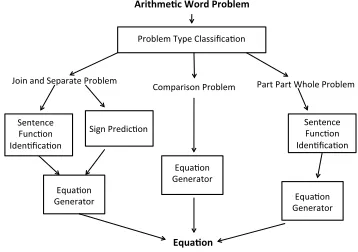
The first stage is problem type classification. Prob-lem type classification takes as input the entire prob-lem divided into sentences and assigns it to one of Join-Separate, Part-Part-Whole or Compare type. Depending on the problem type, the necessary classifiers are cas-caded. We divide the problem solution into a maximum of three stages depending on the problem type with a clas-sifier for each stage, described as follows. A schematic representation of the solver is given in Figure 1.
Problem(Type(Classifica2on(
Join(and(Separate(Problem( Comparison(Problem( Part(Part(Whole(Problem(
Sentence( Func2on( Iden2fica2on(
Sign(Predic2on( Sentence(Func2on( Iden2fica2on(
Equa2on( Generator( Equa2on(
Generator( Equa2on(
Generator(
Equa%on( Arithme%c(Word(Problem(
Figure 1: Flow chart for the system.
3.2.1 Join and separate problems (JS)
Join and separate problems are the most versatile of problems because the problem’s discourse structure af-fords phrasing of its constituent sentences in many ways. The constituent sentences can either be separate, joined using a conjunction or could be formed as a complex sen-tence with the use of conditionals.
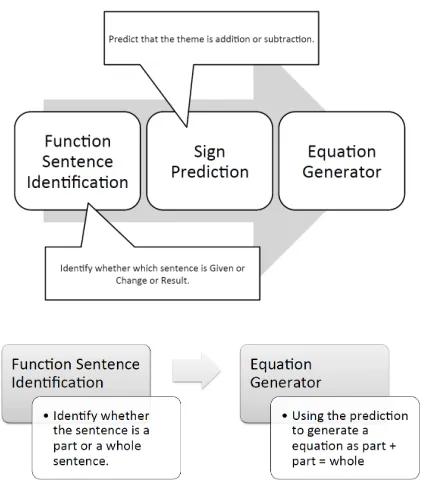
Figure 2 shows a step-by-step approach to solving problems of this type. First, we classify the sentence functional typefor each sentence (whether it is Given or Change or Result sentence). Then, we perform asign prediction(whether the problem calls for addition or sub-traction). The pivot sentence for this task is theChange sentence because it indicates the direction of change of the quantity in theGivensentence in terms of an effec-tive increase or decrease.The last task is to combine the results of the first two stages and generate the correspond-ing equation.
! !
! Figure 2: Top: Flow chart for Join and Separate Problem. Bottom: part part whole Problem.
whether the sentence is apart sentence or awhole
sen-tence. We then use the information from this
classifica-tion to generate the equaclassifica-tion. The flowchart of the prob-lem is displayed in figure 2.
3.2.2 Compare problems
Comparison problems focus on similarities or differ-ences between sets. By nature of its type, the problem’s discourse structure is limited. This means we can gener-ate a set of rules to convert a question to its correspond-ing equation. Once a problem is classified as belongcorrespond-ing to this type in the problem type identification stage, the problem is then processed by a rule-based classifier lead-ing to its equation.
3.2.3 Equation generation
Once the component sentence types comprising the discourse structure of the problem are identified the in-formation in each sentence is extracted. We note that the sentence type (and hence discourse structure) plays a cru-cial role in this stage of information extraction. We use the NLTK toolkit (Loper and Bird, 2002) to extract the numerical quantity from each sentence.
In the J-S equation generator, we construct an equation of the form (quantity inGiven) + (quantity inChange) =
Result. The quantity in the Change sentence bears the
sign of the question (depending on whether it is addition or subtraction). If a sentence with no numerical informa-tion is classified asGiven, ChangeorResult, we assign an
Xto that sentence and the information is excluded from the equation (a potential source of error).
The analog holds for the PPW equation generator. With its sentences classified asPartorWholewe proceed to the equation generation as follows. When thePart sen-tence has more than one numerical quantity, we assign the first number asPart1and the other numbers asPart2(or into more buckets as the case may be). Then, we arrange them into the corresponding equation as: Part1 + Part2 = Whole.
In both these equation generators, when the equation has insufficient information owing to errors from previ-ous stages (we will defer discussing some scenarios to Section 6), a solution is not generated. The generated equation is solved using Numpy (Oliphant, 2006).
3.3 Implementation
For the tasks of problem type classification, sentence type classification and sign prediction, we use the en-semble method of inductive classifier - Random Forest. The equation generation stage is a rule-based deductive learner that combines the result of sentence type classifi-cation (and sign prediction for the J-S problems) to derive the numerical quantities needed for the equation. We use the scikit implementation of Random Forest (Pedregosa et al., 2011).
3.4 Evaluation
We evaluate the performance of the classifiers on prob-lem type classification, sentence type, sign prediction and overall solution generation by the level of accuracy (how exact the classification is) calculated using 5-fold cross validation. In addition to evaluating a classifier’s perfor-mance on each task, we also evaluate the contribution of each feature class to the classification by noting the accu-racy of the classifier when that feature class is excluded.
4 Experiment
We first consider the preprocessing steps and the fea-tures considered before delving into the models by type of mathematical word problem being solved.
4.1 Preprocessing
We employed Python NLTK (Loper and Bird, 2002) to segment the problems into sentences, perform tokeniza-tion, convert words into lower case, tag the words with their Penn treebank part-of-speech tags and lemmatize all the verbs and nouns. We also obtain the depen-dency parse of the sentences using the Stanford parser (De Marneffe et al., 2006).
4.2 Features
Problem-level features:
• The features in this class are length-related and document-related. The length of the problem in number of sentences is a feature that we consider at the problem level, noticing that on an average, J-S problems tend to have more sentences per prob-lem than those of the C type, which in turn have more sentences than those of the PPW type (refer Table 1).
• Structure that is specific for problem of type C which is the binary valued feature indicating the presence ofcomparative adjective and “than”. • Keywords (with binary values) extracted using
tf-idf constitute another type of problem-level fea-tures. To avoid overfitting, we consider only those keywords that occur at least five times in the cor-pus of problems. We exclude verbs and prepositions from this list. The intuition here is that keywords such asaltogethercharacterize PPW problems. Sentence-level features: Mainly used for sentence-level classification into types, the features in this class are positional, structural or semantic.
• Sentence position in the problem tends to be an in-dicator of the sentence type for PPW and JS prob-lems. For instance, a majority of the JS sentences have the first sentence of the typeGiven, as a man-ner of discourse structure.
• Structural features essentially capture shared rela-tionships between entities in a sentence, such as that between the subject and object in a sentence ob-tained in the form of dependency relations. Other structural features are verb phrase (binary valued) such asto start with, comparative structure such as more than(binary valued) and prepositions such as on(binary valued).
Action-related features: We observe that problems of the J-S type are characterized by significant action lan-guage that describe changes in the possession or condi-tion of objects. Thus, we posit that the count of unique verb lemmas will serve as a discriminating feature. Con-sider for instance a J-S problem,Grandma had 5 straw-berries. Grandpa gave her 8 more strawstraw-berries. How many strawberries does Grandma have now? The verb from the Given sentence Grandma had 5 strawberries has changed in theChangesentenceGrandpa gave her 8 more strawberriesand thus the problem has 2 verb lem-mas (haveandgive).
Entity-related features:An example of this feature is the number of unique noun phrases. Since problems of type PPW involve static descriptions of two or more dis-joint subsets in thePartsentence and the union of those
sets (or the super category of the entities in thePart sen-tence) in theWhilesentence, a characteristic of problems of this type is the variety of noun phrases. For instance, Jarron has 5 red triangles and 10 blue squares. How many shapes does he have altogether?The first sentence which corresponds to Part sentence contains two noun phrases: red trianglesandblue squares. The other sen-tences is whole sentence. It has only one noun which isshapes. Here red triangles and blue squares are sub-categories of shapes and so the number of unique noun phrases is 3.
4.3 Parameter tuning
The hyperparameters of the Random Forest classifier were tuned as follows. The corpus of problem types and sentence types were split into a training and test set via a random 80-20 split. The parameters of the random forest classifiers at the problem type, sentence type and sign prediction stages were independently tuned by 5-fold cross validation on the training data set choosing the set that achieves the highest cross-validation accuracy.
As a result, with n as the number of total available features the problem type prediction classifier was set to have a maximum ofpnfeatures and allowed to reach a maximum depth of 15 nodes. The sentence type classifier for J-S was set to have a maximum ofnfeatures and al-lowed to reach a depth of 25 nodes, whereas that for PPW had the parameters set tonand 10 respectively. The cor-responding parameters for sign prediction module were log2nand 50.
5 Experimental Results
We report results of using the inductive classification in the first few stages followed by the results of the deduc-tive classification in the equation generation stage.
5.1 Problem type classification
The majority baseline is the proportion of the largest problem class in the corpus which is about 44% We ob-serve that problem type classification using Random For-est yielded an accuracy of 93.47% The performance of Random Forest is justified considering that many of our features are correlated. Additionally, our data falls in the realm of the ‘small n, large p’ scenario where Random Forest is known to perform best. We thus use only Ran-dom Forest for classification in the following stages.
5.2 Sentence-type classification
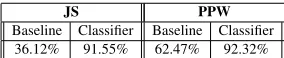
JS PPW
Baseline Classifier Baseline Classifier 36.12% 91.55% 62.47% 92.32%
Table 2: Performance of the Random Forest classifier for sentence type classification. The improvement over the baseline is significant.
From Table 2 we notice that the ensemble classifier out-performs the baseline by a wide margin in both J-S and PPW solvers. The performance of the classifier on sen-tence type prediction for both types seems comparable even though one involves a 3-way classification (for J-S) and the other only two-way (for PPW).
For sign prediction, we note that the module is used only to solve problems of type J-S. Hence, the baseline is the majority class which in our case is 50% owing to the equal number of addition and subtraction problems. The accuracy of the classifier that performs sign predic-tion is 84.33%. This renders the sign-predicpredic-tion stage a bottleneck for solving J-S problems.
JS PPW C Overall
78.67% 87.33% 94.92% 85.64%
Table 3: Comparison of the accuracy of the solvers for each problem type.
5.3 Overall Solution
The overall solution is obtained by combining the result of the individual stages as per problem type to generate the corresponding equation. The accuracies of the solvers for each problem type are compared in Table 3.
We prepare a simple rule-based baseline with which we compare the results of the equation generation. First, if there is more than one numerical quantity in a sen-tence, they are all summed up. Any sentence without a numerical quantity is ignored and the question sentence is mapped to the variable. Second, if the number in the first sentence is larger than the number in the second sentence, the first number will be subtracted by the second number; otherwise the two numbers are added. With these two rules, we disregard the type of MWP and generate the equation. The baseline accuracy becomes 59.58% (J-S accuracy is 48%, C accuracy is 55.69%, and PPW accu-racy is 87.5%). We would like to point out that a plausible reason that the baseline for PPW is higher than that of the stage-wise approach is because PPW problems’ structure coincides with our rules.
This baseline is to be interpreted with some caution, however. Recalling that the purpose of the study is to guide the learner through the stages leading to generating the equation, a comparison of the results of the equation generation stage with the baseline alone is misguided. The final accuracy for solving problems of type
Join-Separate is 78.67%. For problems of the PPW type, the accuracy of problem solution after the equation genera-tion stage is 87.33% and that for the class of Compare problems is 94.92%. Based on this we remark that for the automatic solver, problems of the J-S type are the hardest to solve, and those of the Compare type are the easiest. This is justified here by noting that the sign-prediction module is a bottleneck for the J-S solver, as well as an ad-ditional classification stage compared to the other prob-lem types.
Pooling the results of each problem type together, we arrive at the overall accuracy of our solver to be 85.64%.
5.4 Comparison with the state-of-the-art
A general purpose MWP solver is available via the pub-licly available WolframAlpha engine. The details of its implementation were unavailable, but we believe it to be operational from its associated blog post that elaborates its functionality and the diagrammatic solution feature of this solver) (Barendse, 2012). We compare the accuracy of our solver with that of the solver provided by Wolfra-mAlpha1in the absence of other published MWP solvers for arithmetic problems that we study. Since the details of the solution process employed by WolframAlpha are not available we are only able to compare the respective performances at the level of equation generation.
For the purpose of this comparison, we choose the test set (20% of our corpus) compare the accuracy of solu-tions produced by the solvers. While our MWP solver had an accuracy of 86% on the sample, the performance of Wolfram Alpha is remarkably poor. In particular, barely 9% of the problems were answered correctly, of which about 4% had an incorrect diagram associated with the solution. The vast majority of the MWPs are not solved and the results come back with the error “Wol-framAlpha doesn’t understand your query”. Surprisingly, the Wolfram Alpha system performed quite poorly on our dataset. Without the details of the WolframAlpha ap-proach, we are unable to point to the advantages of our approach over that of the state-of-the-art.
5.5 Ablation Analysis
Task Accuracy Problem Sentence Action Entity level level related related Prob. type 93.47 77.29 92.17 75.10 81.26
Sign 84.33 61.33 60.33 61.67 65.33 JS sent 91.55 89.48 54.93 87.02 90.63 PPW sent 92.32 81.82 68.05 90.68 92.02
Table 4: Comparison of the accuracy results (in %) with different feature classes ablated for each classification task with the accuracy where no features were excluded.
Table 4 summarizes the results of the ablation study
conducted for each task by removing each class of tures. For problem type prediction, the action-related fea-tures constitute the most important set of feafea-tures (most likely influenced by the predominance of J-S problems) followed by the problem-level features. The sentence level features seem to have little impact on the over-all accuracy. Even though the entity-related features do not have an effect on PPW sentence type classification, it contributes substantially to question type classification (most likely by way of characterizing PPW). Sign predic-tion depends primarily on the sentence-level features but is about equally dependent on the other sets of features.
6 Discussion
The higher the accuracy of classification is, the better the outcome in generating equations will be. In this section, we consider some of the issues that negatively impact the classification process. The first issue involves the prepro-cessing steps that a MWP has to go through before pass-ing through our analysis. This happens when the problem relates to time, money, and distance and needs quantity conversions before the arithmetic calculations (e.g.Josie has 7 pennies and 5 nickels. How much money does she
have?). Another obvious class is when the problem
re-quires world knowledge for its solution (e.g.Today is
Oc-tober 25th. How many days are there until Halloween?).
The other case where our program fails is when a
ques-tion has a complex sentence structure. e.gHow many
Yo-das flew away from the planet in the space shuttle if 23 Yodas stayed on the planet of 30 Yodas in all?
Focusing on the errors of the J-S problem solver, the majority of errors result from incorrect sign prediction, explained by the fact that this module is the bottleneck in our J-S automatic solver. The overall accuracy is slightly higher than we expect because the error from sign predic-tion and sentence type classificapredic-tion overlap. It is also the case that even though the classifier misclassifiesChange
andGivensentences, if the sign is correctly assigned as
‘+’, the final equation is still correct i.e. 3 +x = 4is
the same asx+ 3 = 4. Finally, the main source of
er-ror for problems of PPW type is that the problem type classifier misclassifies PPW to be JS, which leads to an incorrect solution. JS and PPW are very similar but they focus on different aspects. JS focuses on the dynamic ac-tion, while PPW captures the relationship between nouns in each sentence.
For problems of the Compare type, there are two sources of error. First, the rule-based classifier itself pro-vides 94.92% because some questions need quantity con-version before being processed. For example,Joel started the paper route at 7:05. He worked for 25 minutes. When
did he finish? The other is that the comparison problem
is misclassified as J-S or PPW at the problem type
clas-sification stage. Accounting for these errors would entail working with better classifiers that handle inter-sentence semantics.
To get a feel for the model’s generalizability we tested on a set of problems not of the CGI type from Dadswork-sheets.com2. On this set of 400 addition and subtraction word problems our model yielded an overall accuracy of 87%, suggesting that our method is not restricted to solv-ing problems of the CGI type alone. Looksolv-ing ahead, we are working to solve more complicated MWPs of upper elementary grades.
It is conceivable that a multi-stage approach such as the one considered here can constitute one of the key de-sign factors in applications involving intelligent tutoring systems for elementary mathematics education. The goal of guiding the learner to understand the steps involved in solving the problem can be met via our approach of identifying the problem types, highlighting the discourse elements (sentence types) while simultaneously helping arrive at the answer.
7 Conclusion
We present a multi-stage text-classification approach to solve arithmetic problems of elementary level automati-cally. Our approach recognizes the problem type, identi-fies the discourse structure and generates the correspond-ing equation to eventually solve the problem. This is in line with results from cognitive psychology studies in children learning to solve MWPs. With accuracies sub-stantially higher than the baseline, we also observe that the performance gains of our solver compared with the state-of-the-art MWP solvers such as WolframAlpha are also substantial.
References
Peter Barendse. 2012. Solving word
prob-lems with wolfram—alpha@ONLINE, October. http://blog.wolframalpha.com/2012/10/04/solving-word-problems-with-wolframalpha/.
Daniel G. Bobrow. 1964. A question-answering system
for high school algebra word problems. In
Proceed-ings of the October 27-29, 1964, Fall Joint Computer
Conference, Part I, AFIPS ’64 (Fall, part I), pages
591–614, New York, NY, USA. ACM.
Thomas P Carpenter, Elizabeth Fennema, Megan Loef Franke, Linda Levi, and Susan B Empson. 2000. Cognitively guided instruction: A research-based teacher professional development program for elemen-tary school mathematics. research report.
2http://www.dadsworksheets.com/ accessed on March 20th,
Suleyman Cetintas, Luo Si, Yan Ping Xin, Dake Zhang, and Joo Young Park. 2009. Automatic text
catego-rization of mathematical word problems. InFLAIRS
Conference.
Suleyman Cetintas, Luo Si, Yan Ping Xin, Dake Zhang, Joo Young Park, and Ron Tzur. 2010. A joint proba-bilistic classification model of relevant and irrelevant
sentences in mathematical word problems.
JEDM-Journal of Educational Data Mining, 2(1):83–101. Arun Chaganty, Akash Lal, Aditya V Nori, and Sriram K
Rajamani. 2013. Combining relational learning with
smt solvers using cegar. InComputer Aided
Verifica-tion, pages 447–462. Springer.
Denise Dellarosa Cummins. 1991. Children’s
interpre-tations of arithmetic word problems. Cognition and
Instruction, 8(3):pp. 261–289.
Erik De Corte and Lieven Verschaffel. 1987. The ef-fect of semantic structure on first graders’ strategies for solving addition and subtraction word problems. Journal for Research in Mathematics Education, pages 363–381.
Marie-Catherine De Marneffe, Bill MacCartney, Christo-pher D Manning, et al. 2006. Generating typed
de-pendency parses from phrase structure parses. In
Pro-ceedings of LREC, volume 6, pages 449–454.
Denise Dellarosa. 1985. Solution: A computer sim-ulation of childrens recall of arithmetic word
prob-lem solving. University of Colorado Technical Report,
pages 85–148.
Denise Dellarosa. 1986. A computer simulation of
chil-dren’s arithmetic word-problem solving. Behavior
Re-search Methods, 18:147–154, March.
Kerianne Ebner. 2011. Cognitively guided instruction (cgi) problem types @ONLINE, July.
Charles R. Fletcher. 1985. Understanding and solv-ing arithmetic word problems: A computer simulation. Behavior Research Methods, 17(5):565–571.
Yufan Guo, Anna Korhonen, Maria Liakata, Ilona Silins Karolinska, Lin Sun, and Ulla Stenius. 2010. Identi-fying the information structure of scientific abstracts:
An investigation of three different schemes. In
Pro-ceedings of the 2010 Workshop on Biomedical Natu-ral Language Processing, BioNLP ’10, pages 99–107, Stroudsburg, PA, USA. Association for Computational Linguistics.
Nate Kushman, Yoav Artzi, Luke Zettlemoyer, and Regina Barzilay. 2014. Learning to automatically
solve algebra word problems. In Proceedings of the
52nd Annual Meeting of the Association for Compu-tational Linguistics (Volume 1: Long Papers), pages 271–281, Baltimore, Maryland, June. Association for Computational Linguistics.
Mark D LeBlanc and Sylvia Weber-Russell. 1996. Text integration and mathematical connections: a computer
model of arithmetic word problem solving. Cognitive
Science, 20(3):357–407.
Christian Liguda and Thies Pfeiffer. 2011. A question answer system for math word problems. First Interna-tional Workshop on Algorithmic Intelligence.
Christian Liguda and Thies Pfeiffer. 2012. Modeling math word problems with augmented semantic net-works. In Gosse Bouma, Ashwin Ittoo, Elisabeth
Mtais, and Hans Wortmann, editors, Natural
Lan-guage Processing and Information Systems, volume
7337 of Lecture Notes in Computer Science, pages
247–252. Springer Berlin Heidelberg.
Lingyi Liu, Chen-Hsuan Lin, and Shobha Vasudevan. 2012. Word level feature discovery to enhance
qual-ity of assertion mining. InICCAD, pages 210–217.
Edward Loper and Steven Bird. 2002. Nltk: The natural
language toolkit. InProceedings of the ACL-02
Work-shop on Effective Tools and Methodologies for Teach-ing Natural Language ProcessTeach-ing and Computational Linguistics - Volume 1, ETMTNLP ’02, pages 63–70, Stroudsburg, PA, USA. Association for Computational Linguistics.
Takuya Matsuzaki, Hidenao Iwane, Hirokazu Anai, and Noriko Arai. 2013. The complexity of math problems
– linguistic, or computational? InProceedings of the
Sixth International Joint Conference on Natural Lan-guage Processing, pages 73–81, Nagoya, Japan, Octo-ber. Asian Federation of Natural Language Processing.
Travis E. Oliphant, 2006. Guide to NumPy. Provo, UT,
March.
Shawn Olson, Natalie Musser, Sue McAdaragh, Roxane Dyk, Jonath Weber, Tracy Mittleider, Lucy Atwood, and Marcia Torgrude. 2008. South dakota counts: Cgi problems created by south dakota math teacher leaders @ONLINE, January.
F. Pedregosa, G. Varoquaux, A. Gramfort, V. Michel, B. Thirion, O. Grisel, M. Blondel, P. Prettenhofer, R. Weiss, V. Dubourg, J. Vanderplas, A. Passos, D. Cournapeau, M. Brucher, M. Perrot, and E. Duches-nay. 2011. Scikit-learn: Machine learning in Python. Journal of Machine Learning Research, 12:2825– 2830.
Wanintorn Supap, Kanlaya Naruedomkul, and Nick Cer-cone. 2013. Mathmaster: an alternative math word
problems translation. Computational Approaches to
Assistive Technologies for People with Disabilities, 253:109.
Lieven Verschaffel, Brian Greer, and Erik De Corte.
2000.Making sense of word problems. Lisse.
Yiming Yang and Xin Liu. 1999. A re-examination of
text categorization methods. In Proceedings of the