Developing Guidelines and Ensuring Consistency for Chinese Text Annotation
Fei Xia
, Martha Palmer
, Nianwen Xue
x, Mary Ellen Okurowski
{, John Kovarik
{,
Fu-Dong Chiou
y, Shizhe Huang
z, Tony Kroch
y, Mitch Marcus
Department of Computer and Information Science University of Pennsylvania
Philadelphia, PA 19104, USA
ffxia,mpalmer,[email protected]
y
Linguistics Department University of Pennsylvania Philadelphia, PA 19104, USA
fchioufd,[email protected]
x
Linguistics Department University of Delaware Newark, DE 19716, USA
{
US Department of Defense Ft. Meade, MD 20755, USA
[email protected], [email protected]
z
East Asian Studies Program Haverford College Haverford, PA 19041, USA
Abstract
With growing interest in Chinese Language Processing, numerous NLP tools (e.g. word segmenters, part-of-speech taggers, and parsers) for Chinese have been developed all over the world. However, since no large-scale bracketed corpora are available to the public, these tools are trained on the corpora with different segmentation criteria, part-of-speech tagsets and bracketing guidelines, and therefore, comparisons are difficult. As a first step towards addressing this issue, we have been preparing a 100-thousand-word bracketed corpus since late 1998 and plan to release it to the public summer 2000. In this paper, we will address several challenges in building the corpus, namely, creating annotation guidelines, ensuring annotation accuracy and maintaining a high level of community involvement.
1.
Introduction
With growing interest in Chinese Language Processing, numerous NLP tools (e.g. word segmenters, part-of-speech taggers, and parsers) for Chinese have been developed all over the world. However, since there are no standard ref-erence treebank corpora of hand-parsed sentences for Chi-nese, it is difficult to compare results and gauge progress in the field. As a first step towards addressing this issue, we have been preparing a 100-thousand-word bracketed cor-pus since late 1998 and plan to release it to the public in the summer of 2000.
In this paper, we will describe several challenges in cre-ating a Chinese treebank and our response to them.
guideline preparation: preparing good guidelines for
word segmentation, part-of-speech tagging and brack-eting.
quality control: ensuring inter-annotator consistency
and adherence to the guidelines.
community involvement: maintaining a high level of
community involvement in the project so that the final guidelines and annotated corpora are as widely useful as possible.
We begin with a discussion of community involvement because of its importance at all stages to the creation of a shareable resource. We then overview the project (Section 3), outline our methodology for guideline preparation (Sec-tion 4), and detail the word segmenta(Sec-tion and POS tagging phase (Sections 5) and the bracketing phase (Sections 6-7).
2.
Project Inception
work-shop on issues in Chinese language processing and transla-tion which was held at Penn. The aim of this workshop was to bring together influential researchers from Taiwan, Sin-gapore, Hong Kong, China and the United States in a move towards consensus building with respect to word segmen-tation, part-of-speech (POS) tagging, syntactic bracketing and other areas. The American groups included the Insti-tute for Research in Cognitive Science and the Linguistics Data Consortium (which distributes the English Treebank) at the University of Pennsylvania, the University of Mary-land, Queens College, the University of Kansas, the Univer-sity of Delaware, Johns Hopkins UniverUniver-sity, Systran, BBN, ATT, Xerox, West, Unisys and the US Department of De-fense. We also invited representatives of ROCLING in Tai-wan and Hong Kong Science and Technology University. The workshop included presentations of guidelines being used in mainland China, Taiwan, and Hong Kong, as well as segmenters, part-of-speech taggers and parsers. There were also several working groups that discussed specific issues in segmentation, POS tagging and the syntactic an-notation of newswire text.1
There was general consensus at this workshop that a large-scale effort to create a Chinese Treebank would be well received, and that linguistics expertise was a neces-sary prerequisite to successful completion of such a project. The workshop made considerable progress in defining cri-teria for segmentation guidelines as well as addressing the issues of part-of-speech tagging and syntactic bracketing. The Penn Chinese Treebank project began shortly after the workshop was held.2
3.
Project Overview
Our goal is the creation of a 100,000 word corpus of Chinese with syntactic bracketing. The corpus includes 329 articles from the Xinhua newswire. The majority of these documents (a total of 291) focus on economic develop-ments during April, August, and September of 1994 (121), February through April of 1996 (40), March, April, and De-cember of 1997 (76), and January of 1998 (54), while in an attempt to broaden coverage an additional 38 documents across the same period were annotated which describe gen-eral political and cultural topics. Our relatively small cor-pus contains 173,981 hanzi (or 100,996 words after word segmentation). The corpus has 3,289 sentences,3averaging 47 hanzi (or 27 words after segmentation) per sentence.
The project has two phases: the first phase is word seg-mentation and part-of-speech (POS) tagging and the second
1The workshop was a small-scale version of the 1992 UPenn
meeting of the 35 designers of English-language grammatical an-alyzers from the United States, Great Britain, and the European continent (Black et al., 1993).
2
Our Penn Chinese Treebank website, http://www.ldc.upenn.edu/ctb , includes segmentation, POS tagging and bracketing guidelines, as well as sample files, information on our first workshop and much more.
3
A sentence is anything that ends with a period, a exclama-tion mark or a quesexclama-tion mark, therefore, it does not include the headline at the beginning of each article.
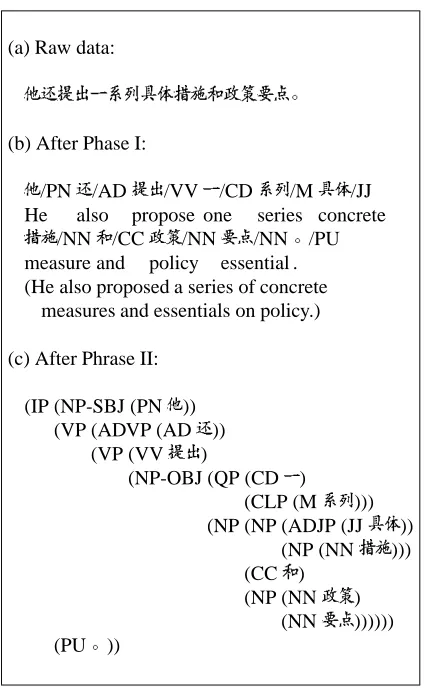
(a) Raw data:
(b) After Phase I:
/PN /AD /VV /CD /M /JJ
He also propose one series concrete
/NN /CC /NN /NN /PU
measure and policy essential .
(He also proposed a series of concrete measures and essentials on policy.)
(c) After Phrase II:
(IP (NP-SBJ (PN ))
(VP (ADVP (AD ))
(VP (VV )
(NP-OBJ (QP (CD )
(CLP (M )))
(NP (NP (ADJP (JJ ))
(NP (NN )))
(CC )
(NP (NN )
(NN ))))))
(PU ))
Table 1: A sample sentence from the corpus
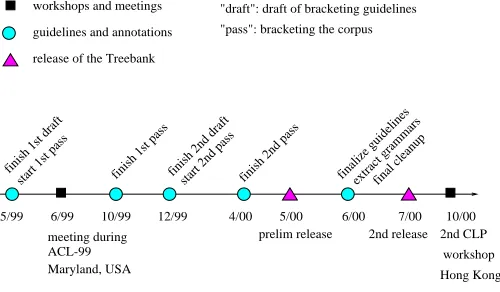
phase is syntactic bracketing. Table 1 shows an example and what it looks like after each phase.4 At each phase, all the data are annotated at least twice with a second an-notator correcting the output of the first anan-notator. Dur-ing the process, we have held several meetDur-ings to get feed-back from the Chinese NLP community and have revised our guidelines accordingly. Figures 1 and 2 summarize the milestones of the project.
workshops and meetings
guidelines and annotations
6/98 8/98 9/98 11/98 1/99 3/99
finish 1st draft
Beijing, China ICCIP-98 meeting during
Canada Montreal ACL-98 meeting during
USA Philadelphia workshop 3-day CLP
start 1st pass
finish 2nd draft finish 1st pass
start 2nd pass finish 2nd passcompile lexicon and clean the corpus
"draft": draft of word segmentation and POS tagging guidelines
"pass": segmenting and POS tagging the corpus
Figure 1: The first phase: segmentation and POS tagging
4
final cleanup finish 1st draft
start 1st pass finish 1st pass finish 2nd draftstart 2nd pass
4/00
finish 2nd pass
5/00
finalize guidelinesextract grammars
workshops and meetings
prelim release 5/99 6/99 10/99 12/99
2nd CLP 10/00 2nd release guidelines and annotations
release of the Treebank
6/00 7/00
ACL-99 meeting during
Maryland, USA
workshop Hong Kong "draft": draft of bracketing guidelines
"pass": bracketing the corpus
Figure 2: The second phase: bracketing and data release
Our team includes two linguists, three computational linguists, two annotators and several external consultants.
4.
Methodology for Guideline Preparation
To create a treebank for Chinese we need to create three sets of guidelines — segmentation, part-speech tagging and bracketing guidelines. Making these guidelines is espe-cially challenging because:
Unlike Western writing systems, Chinese writing does
not have a natural delimiter between words, and the notion of word is very hard to define.
Chinese has very little, if any, inflectional morphology.
Words are not inflected with number, gender, case, or
tense. For example, a word such as in Chinese
corresponds to destroy/destroys/destroyed/destruction in English. This fuels the discussion on whether the POS tags should be based on meaning or on syntactic distribution in Chinese NLP communities. If only the
meaning is used, should be a verb all the time. If
syntactic distribution is used, the word is a verb or a noun depending on the context.
There are many open questions in Chinese syntax.
To further complicate the situation, Chinese, like any other language, is under constant change. With its long history, a seemingly homogeneous phenomenon in Chinese (such as long and short bei-construction) may be, in fact, a set of historically related but syntac-tically independent constructions (Feng, 1998).
Chinese is widely spoken in areas as diverse as China,
Hong Kong, Taiwan, and Singapore. There is a grow-ing body of research in Chinese natural language pro-cessing, but little consensus on linguistic standards along the lines of the EAGLES initiative in Europe.5
To tackle these issues, we adopted the following ap-proach:
5
EAGLES stands for the Expert Advisory Group on Language Engineering Standards. For more information, please check out
its website at http://www.ilc.pi.cnr.it/EAGLES/home.html.
In addition to studying the literature on Chinese
mor-phology and syntax, we collaborate closely with our linguistics experts to work out plausible analyses for syntactic constructions.
When there are no clear winners among several
alter-natives, we choose one, and annotate the corpus in a way that our annotation can be easily converted to ac-commodate other alternatives when needed.
We study other groups’ guidelines, such as the
Seg-mentation Standard in China (Liu et al., 1993) and the one in Taiwan (Chinese Knowledge Information Pro-cessing Group, 1996), and accommodate them in our guidelines if possible.
We organize regular workshops and meetings and
in-vite experts from the United States and abroad (e.g. Academic Sinica in Taiwan and Hong Kong Science and Technology University) to discuss open questions, share resources and seek consensus. We also visited China and Taiwan to present our work and ask for feedback.
Annotators are encouraged to ask questions during the
annotation process and in the second pass of bracket-ing randomly selected files are re-annotated by both annotators to evaluate their consistency and accuracy. Annotation errors and inter-annotation inconsistencies can reveal places in the guidelines that need revision.
In an ideal situation, guidelines would be available be-fore annotation begins. However, real data from a corpus are far more complicated and subtle than examples dis-cussed in the linguistics literature and many problems do not surface until sufficient data have been annotated. In this project, we divided each phase of the annotation and guide-line development into three stages:
1. Our original guideline drafts are based on corpus anal-ysis, review of the literature, and consultation with ex-perts in treebanking and Chinese linguistics. As we begin the first pass of the annotation process, these guidelines evolve gradually through the resolution of annotation difficulties and annotator inconsistencies.
2. After the first pass, the guidelines are partially final-ized and when possible the corpus is automatically converted to be consistent with the new guidelines be-fore the second pass begins;
3. In the second pass our quality control method (Section 7) is designed to strengthen the guidelines by reveal-ing annotation procedures that require elaboration for more consistent bracketing. Fortunately, our neces-sary elaborations at this stage have been very few.
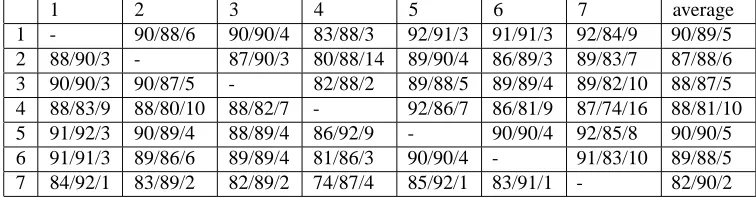
1 2 3 4 5 6 7 average
1 - 90/88/6 90/90/4 83/88/3 92/91/3 91/91/3 92/84/9 90/89/5
2 88/90/3 - 87/90/3 80/88/14 89/90/4 86/89/3 89/83/7 87/88/6
3 90/90/3 90/87/5 - 82/88/2 89/88/5 89/89/4 89/82/10 88/87/5
4 88/83/9 88/80/10 88/82/7 - 92/86/7 86/81/9 87/74/16 88/81/10
5 91/92/3 90/89/4 88/89/4 86/92/9 - 90/90/4 92/85/8 90/90/5
6 91/91/3 89/86/6 89/89/4 81/86/3 90/90/4 - 91/83/10 89/88/5
7 84/92/1 83/89/2 82/89/2 74/87/4 85/92/1 83/91/1 - 82/90/2
Table 2: Comparison of word segmentation results from seven groups
man errors. This implies that much of the disagreement is not critical and if native speakers are given good segmenta-tion guidelines, the agreement between them will improve greatly.
So what is a word? The following tests for establishing word boundaries have been proposed by various authors: (Without loss of generalization, we assume the string that we are trying to segment is X-Y, where X and Y are two morphemes)
bound morpheme: a bound morpheme should be
at-tached to its neighboring morpheme to form a word when possible.
productivity: if a rule that combines the expression
X-Y does not apply generally, i.e., it is not productive, then X-Y is likely to be a word.
frequency of co-occurrence: if the expression X-Y
oc-curs very often, it is likely to be a word.
complex internal structure: strings with complex
in-ternal structures should be segmented when possible.
compositionality: if the meaning of X-Y is not
com-positional, it is likely to be a word.
insertion: if another morpheme can be inserted
be-tween X and Y, then X-Y is unlikely to be a word.
XP-substitution: if a morpheme can not be replaced
by a phrase of the same type, then it is likely to be part of a word.
the number of syllables: several guidelines (Liu et al.,
1993; Chinese Knowledge Information Processing Group, 1996) have used syllable numbers on certain
cases. For example, in (Liu et al., 1993), a
verb-resultative compound is treated as one word if the re-sultative part is monosyllabic, and it is treated as two words if the resultative part has more than one sylla-ble.
All of these tests are very useful. However, none of them is sufficient by itself for covering the entire range of difficult cases. Either the test is applicable only to limited cases (e.g. the XP-substitution test) or there is no objec-tive way to perform the test as the test refers to vaguely defined properties (e.g. in the productive test, it is not clear
where to draw the line between a productive rule and a non-productive rule). For more discussion on this topic from the linguistics point of view, please refer to (Packard, 1998; Sciullo and Williams, 1987).
Since no single test is sufficient, we chose a set of tests for our segmentation guidelines which includes all of the ones mentioned except for the productivity test and the fre-quency test. Rather than have the annotators try to memo-rize the entire set and make each decision from these prin-ciples, in the guidelines we spell out what the results of applying the tests would be for all of the relevant phenom-ena. For example, for the treatment of verb-resultative com-pounds, we select the relevant tests, in this case the number of syllables, the insertion test, and the XP-substitution test, and give several examples of the results of applying these tests to verb-resultative compounds. This makes it straight-forward, and thus efficient, for the annotators to follow the guidelines.
The guidelines are organized according to the internal structure of the corresponding expressions (e.g. a resultative compound is represented as V+V, while a verb-object expression is as V+N), so it is easy for the annotators to search the guidelines for needed references. The seg-mentation guidelines, including the comparisons between our guidelines and the ones used in China and Taiwan, can be found on our website.
5.2. Issues in POS Tagging Guidelines
Since Chinese words are not marked with respect to tense, case, and number, the central issue in POS tag-ging is whether the definitions of POS tags should be based on meaning or on syntactic distribution. This issue has been debated since the 1950s (Gong, 1997) and there are still two totally different viewpoints. For example, a
word such as in Chinese can be translated into
de-stroy/destroys/destroyed/destroying/destruction in English and it is used the same way as its translations in English. According to the first view, POS tags should be based solely on meaning. Since the meaning of the word remains roughly the same across all of these usages, it should al-ways be tagged as a verb. The second view says POS tags should be determined by the syntactic distribution of the
word. When is the head of a noun phrase, it should be
tagged as a noun in that context. Similarly, when it is the head of a verb phrase, it should be tagged as a verb.
the principles adopted in contemporary linguistics theories, such as the notion of head projections in X-bar theory and GB theory, and since it emphasizes the similarity between Chinese and other languages.
One argument that is often used against the second view is that since many verbs in Chinese can also occur in noun positions, thus requiring two POS tags, this increases the size of the lexicon. However, the extra POS tag allows us to distinguish between these verbs and many other verbs (such as monosyllabic verbs) which can not occur in noun posi-tions. In addition, if there are generalizations about which verbs can occur in noun positions and which can not, these can be represented as morphological rules which allow the lexicon to be expanded automatically. On the other hand, if no such generalizations exist and the nominalization pro-cess is largely idiosyncratic, it supports the view that this is a lexical phenomenon and verbs which can be nominalized should be marked by having two POS tags in the lexicon. Finally, the phenomenon that many verbs can occur in noun positions is not unique to Chinese, and the standard treat-ment in other languages is to give them both tags.
5.3. Annotation Process
Before the first pass of annotation, we finished a draft of segmentation and POS tagging guidelines. Our corpus was automatically segmented and POS tagged by the BBN/GTE integrated stochastic segmenter and part-of-speech tagger. The tagger was trained on the Academia Sinica Balanced Corpus (ASBC). Since the ASBC guidelines and our guide-lines have some differences (cf. our website), we wrote tools to convert the ASBC tags into our tags automatically. Although the mapping was not one-to-one and introduced some errors, this process greatly accelerated annotation.
The first pass (including the time spent on training an-notators) took roughly four months to complete. After the first pass, the guidelines were revised and the second pass began, where one annotator double-checked the files anno-tated by the other annotator. The second pass took less than two months because the annotators were well-trained by then and the input of the second pass was much better than the input of the first pass. To identify possible tagging er-rors, we compiled a list of sorted (word, POS tag) pairs and checked the list for implausible tags. The POS tagged cor-pus has 100,991 word tokens and 10829 word types. The number of unique (word, POS tag) pairs is 11960. There-fore the average number of POS tags per word is only 1.10 (11960 divided by 10829). Counting only the words that occur more than once, the number increases from 1.10 to 1.21.
Our tagset with 33 POS tags enabled us to capture syn-tactic structure with minimal tagging complexity. Analysis reveals that our corpus approaches lexical-semantic closure at a rate which can be favorably compared with the Chinese newspaper sub-corpus in the ASBC. By the time 99,000 to-kens of our corpus are tagged, only 23 new token+tag com-binations were observed in the last 1,000 tokens and half (12) of those are new proper nouns. In comparison, 57 new token+tag combinations were observed in the last thousand
of 99,000 tokens in the ASBC ”A*” newspaper sub-corpus and 37 of those were new nouns.
6.
Syntactic Bracketing
The second phase of corpus annotation is syntactic bracketing.
6.1. Issues in Guideline Preparation
This section discusses three issues we addressed when creating our bracketing guidelines. The first issue is the choice of a representation scheme. Given that the sentences in the corpus are very long and complex, the representation scheme needs to be robust enough to be able to represent all the important grammatical relations and at the same time be sufficiently simple so that the annotators can follow it eas-ily and consistently. An overly complicated scheme will slow down productivity and jeopardize consistency and ac-curacy. In our representation scheme, each bracket has a syntactic label and zero or more functional tags. The la-bel indicates the syntactic category of the phrase, while the function tags provide additional information. For example,
when a noun phrase such as /yesterday modifies a verb
phrase, its syntactic label will be NP (for noun phrase) and it is given a function tag -TMP, indicating that theNP is a
temporal phrase and its function is similar to that of an ad-verbial phrase. We also use reference indices to mark syn-tactic movement. Our scheme is similar to the one adopted in the Penn English Treebank (Marcus et al., 1994).
The second issue is the treatment of various
syn-tactic constructions. Many of them, such as the
ba-construction and the bei-ba-construction, have been investi-gated for decades, but there is still no consensus on how they should be analyzed. To tackle this issue, we: (1) stud-ied the linguistics literature, (2) attended Chinese linguis-tics conferences, (3) had discussions with our linguistic col-leagues, (4) studied and tested our analyses on the relevant sentences in our corpus, and (5) used special tags to mark crucial elements in these constructions. For example, the word in the ba-construction has been argued to be a case marker, a secondary topic marker, a preposition, a verb, and so on in the literature. Clearly, the word is different from other prepositions and other verbs and there is no strong evidence to support Chinese having overt case markers or topic markers. We believe the word is more like a verb than a preposition, but to distinguish it from other verbs, we assign it a unique POS tag BA and in the bracketing guidelines we give detailed instructions on how to annotate the construction. If some users of our corpus prefer to treat it as a preposition, it is easy to convert our annotation to accommodate that approach.
the adverb or after it without much difference in meaning and there is no syntactic evidence to favor one analysis over another. If nothing is specified in the guidelines and the an-notator is allowed to mark the empty subject in either place, there will be inconsistency, even though both analyses are plausible. In this case we specify a ”default” position for the subject and require that the empty subject be put before the adverb. By doing so we avoid the need for annotators to make individual choices, which is a potential cause of inconsistency.
6.2. Annotation Process
The first pass of bracketing started once we had finished a preliminary draft of the bracketing guidelines and it took two annotators four months. The primary goal of this pass was to identify the problems in the draft guidelines such as certain constructions that were not covered or analyses that could not be extended to account for new data. Having a corpus bracketed, albeit coarsely, also made it possible for us to use a corpus search tool that operates on bracketed sentences. With this tool we were able to pull out all the sentences in the corpus relevant to a particular construction and come up with better generalizations that are more ro-bust in accommodating new data.
After the first pass, we did an extensive revision of the bracketing guidelines based on the problems we had col-lected and solved during the first pass. After training the annotators on the revisions the second pass began. The em-phasis of the second pass was quality control, i.e. to en-sure inter-annotator consistency and annotators’ adherence to the guidelines as discussed in the next section. After the second pass, we plan to run the corpus search tool and a grammar extraction tool (Xia, 1999). Both tools are able to identify certain types of annotation errors which will facili-tate our final cleanup of the corpus and final revisions of the three sets of guidelines. Following the completion of the bracketing annotation and guidelines, we will release the corpus and guidelines to the public and organize a second Chinese Language Processing (CLP) workshop in conjunc-tion with ACL’00.
7.
Quality Control
A major challenge in providing syntactic annotation of
corpora is ensuring consistency and accuracy. The
ap-proach that we take is a pragmatic one and is derived from the constraints imposed in building a Chinese Treebank without any access to a reference grammar (Black et al., 1993), or any existing parsing support tools (Marcus et al., 1993; Black et al., 1996; Chen and Shaw, 1998; Kurohashi and Nagao, 1998; Skut et al., 1998). However, the con-sistency we have attained as described below validates our manual method with automatic evaluation.
Carefully documented guidelines, linguistically trained annotators, and annotator support tools are pre-requisites to creating a high quality corpus with acceptable produc-tion rates. Secproduc-tion 4 above describes our methodology for creating the guidelines. Both of our annotators are linguis-tics graduate students, one of whom authored the
Brack-eting Guidelines and regularly participated in the meBrack-etings on Chinese syntax. Their knowledge of linguistics, in gen-eral, and syntax, in particular, is crucial for the success of the project. To support bracketing, our annotators use the bracketing interface described in Marcus et al.(1993) and a corpus search tool for linguistic investigation and compari-son of annotations.
With the first pass complete and the annotation guide-lines researched and documented as much as possible, we adopted a quality control method. Our goal was to acceler-ate the annotation of consistent and accuracceler-ate data by elim-inating the need for blind double re-annotation9of the en-tire corpus, yet account for annotator consistency and ad-herence to guidelines throughout the second pass. A sec-ondary goal is to create a subset of data for testing (20% of the corpus) that had double re-annotation and could serve as a Gold Standard.
Our primary tool for evaluating consistency is the Par-seval software that produces three metrics — precision, re-call and numbers of crossing brackets (Black et al., 1991), which we extended to process Chinese. Our process of evaluating consistency is as follows: first, some files from the output of the first pass are randomly selected for dou-ble re-annotation. Next, Parseval is used to compare the two independent re-annotations, and any discrepancies are carefully examined and the annotation is revised. This may in turn lead to revisions of the guidelines to prevent a re-currence of similar inconsistencies. Then, the corrected, reconciled annotation is considered the Gold Standard, and each of the two original re-annotations is then run against it and against each other, again using Parseval, to pro-vide a measure of individual annotator accuracy and inter-annotator consistency. Although the Parseval scheme may not be ideal for evaluating a diverse range of parsers at vari-ance with the reference corpus (Gaizauskas et al., 1998), for our purposes the scheme quantifies and evaluates the two annotators’ parses and allows us to track accuracy and consistency.
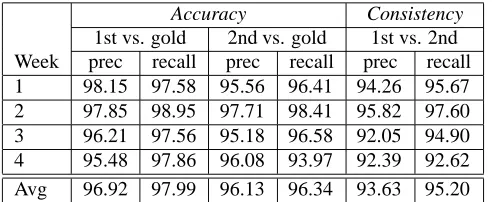
We first used this method to re-train annotators at the beginning of the second pass, when forty files from the out-put of the first pass were randomly selected for double re-annotation. After that, the annotators continued to correct first pass data and each week two files were randomly se-lected and double re-annotated and the re-annotations were compared with Parseval software. In this way, we continue to monitor our consistency and accuracy and to enhance guidelines. Table 3 shows the accuracy of each annotator (denoted by 1st and 2nd in the table) compared to the Gold Standard and the inter-annotator consistency in the first four weeks after the re-training period. The table shows both measures are in the high 90% range, which is more than satisfactory.
In addition to the Parseval software, we also use a cor-pus search tool and a grammar extraction tool to extract patterns which can be inspected to pinpoint certain types of
9
Accuracy Consistency
1st vs. gold 2nd vs. gold 1st vs. 2nd
Week prec recall prec recall prec recall
1 98.15 97.58 95.56 96.41 94.26 95.67
2 97.85 98.95 97.71 98.41 95.82 97.60
3 96.21 97.56 95.18 96.58 92.05 94.90
4 95.48 97.86 96.08 93.97 92.39 92.62
Avg 96.92 97.99 96.13 96.34 93.63 95.20
Table 3: Accuracy and inter-annotator consistency for the first four weeks after the re-training period
annotation errors.
Our method is a new position along the scale of human-to-automatic processing described in (Bateman et al., 1997). We begin with human analysis and input, conduct human analysis enhanced by an available editor, and apply automatic evaluation and human analysis with correction and completion by human post-editors.
8.
Conclusion
We have discussed in detail the approach we have used to create a 100K word Chinese Treebank, including the development of the guidelines for segmentation, POS tag-ging and syntactic bracketing, as well as our methodology for ensuring inter-annotator consistency and community in-volvement. We look forward to distributing our annotated corpus and getting feedback from the community on its use-fulness. We think our methodology for guideline develop-ment and consistency checking will be applicable to mono-lingual text annotation for other languages as well, and will be testing this hypothesis.
9.
Acknowledgement
We gratefully acknowledge the invaluable assistance of BBN, ROCLING, and Hong Kong Science and Technology University in the guideline preparation and annotation. We thank Zhibiao Wu for porting our treebanking tools to Chi-nese and assisting with encoding issues and Ann Taylor for her extremely pertinent treebanking advice. We also thank Andi Wu and Zixin Jiang from Microsoft, Jin Yang from Systran, Shiwen Yu and Hui Wang from Peking University, Changning Huang from Tsinghua University, and our many linguistics consultants including Peter Cole, Shengli Feng, James Huang and Aravind Joshi. Finally we thank all of the participants at our meetings and workshops.
10.
References
Bateman, J., J. Forrest, and T. Willis, 1997. The use of syn-tactic annotaion tools: partial and full parsing. In R. Gar-side, G. Leech, and A. McEnery (eds.), Corpus Annota-tion. London: Longman.
Black, E., S. Abney, D. Flickinger, C. Gdaniec, and et. al., 1991. A procedure for quantitatively comparing the syn-tactic coverage of English grammars. In Proceedings of the DARPA Speech and Natural Language Workshop.
Black, E., S. Eubank, H. Kashioka, D. Magerman, R. Gar-side, and G. Leech, 1996. Beyond skeletal parsing: pro-ducing a comprehensive large-scale general English tree-bank with full grammatical analysis. In Proceedings of COLING. Copenhagen, Denmark.
Black, E., R. Garside, and G. Leech, 1993. Statistically-Driven Grammars of English IBM/Lancaster Approach. Rodopi Editions:Amsterdam.
Chen, H-H and M-S Shaw, 1998. A treebank development tool. In A. Rubio, N. Gallardo, R. Castro, and A. Te-jada (eds.), First International Conference on Language Resource and Evaluation.
Chinese Knowledge Information Processing Group, 1996. Shouwen Jiezi - A study of Chinese Word Boundaries and Segmentation Standard for Information Processing (In Chinese). Technical report, Taipei: Academia Sinica. Feng, Shengli, 1998. Short Passives in Modern and Clas-sical Chinese. In The 1998 Yearbook of the Linguistic Association of Finland (41-68).
Gaizauskas, R., M. Hepple, and C. Huyck, 1998. A scheme for comparative evaluation of diverse parsing systems. In A. Rubio, N. Gallardo, R. Castro, and A. Tejada (eds.), First International Conference on Language Resource and Evaluation.
Gong, Qianyan, 1997. zhongguo yufaxue shi (The history of Chinese syntax). Yuwen Press.
Kurohashi, S. and M. Nagao, 1998. Building a Japanese parse corpus while improving the parsing system. In A. Rubio, N. Gallardo, R. Castro, and A. Tejada (eds.), First International Conference on Language Resource and Evaluation.
Liu, Y., Q. Tan, and X. Shen, 1993. Segmentation Standard for Modern Chinese Information Processing and Auto-matic Segmentation Methodology.
Marcus, M., B. Santorini, and M. A. Marcinkiewicz, 1993. Building a large annotated corpus of English: the Penn Treebank. Computational Lingustics.
Marcus, Mitchell, Grace Kim, Mary Ann Marcinkiewicz, et al., 1994. The Penn Treebank: annotating predicate argument structure. In In Proc of ARPA speech and Nat-ural language workshop.
Packard, Jerome L. (ed.), 1998. New Approaches to Chi-nese Word Formation. Mouton de Gruyter.
Sciullo, Anna Maria Di and Edwin Williams, 1987. On the definition of word. The MIT Press.
Skut, W., T. Brants, B. Krenn, and H. Uskarect, 1998. A linguistically intepreted corpus of German newspaper text. In A. Rubio, N. Gallardo, R. Castro, and A. Tejada (eds.), First International Conference on Language Re-source and Evaluation.
Sproat, R., W. Gale, C. Shih, and N. Chang, 1996. A Stochastic Finite-state Word Segmentation Algorithm for Chinese. Computational Linguistics.