A Software Toolkit for Sharing and Accessing Corpora Over the Internet
Saturnino Luz
Natural Interactive Systems Laboratory University of Southern Denmark
Forskerparken 10 5000 Odense, Denmark
Abstract
This paper describes the Translational English Corpus (TEC) and the software tools developed in order to enable the use of the corpus remotely, over the internet. The model underlying these tools is based on an extensible client-server architecture implemented in Java. We discuss the data and processing constraints which motivated the TEC architecture design and its impact on the efficiency and scalability of the system. We also suggest that the kind of distributed processing model adopted in TEC could play a role in fostering the availability of corpus linguistic resources to the research community.
1.
Background
Corpus linguistics has gained increasing importance in both theoretical and computational linguistics. Witness the considerable volume of corpora and software tools for cor-pus processing currently on offer from linguistic data asso-ciations in Europe and the US.
Very large corpora such as the Bank of English have been used for some time in the area of lexicography for analysing collocation patterns (Clear, 1993), normally in conjunction with computational and statistical methods1 .
More recently, there has been a tendency towards the ap-plication of similar corpus analysis techniques to smaller corpora in order to study language use in more specialised domains.
Whatever the domain, corpus research requires effi-cient access to large volumes of linguistic data, imposing strict data and processing constraints to the supporting soft-ware. Traditionally, corpus undertakings have focused on building large, centralised repositories of text accessed via corpus-specific tools. Both data and tools are normally distributed to the public through physical media such as CDROM’s, or made available by granting users access to machines where the corpus is physically stored. In this pa-per we argue that useful and efficient access to considerable amounts of (written) linguistic data does not necessarily en-tail accessing vast, centralised repositories. We present a software architecture for corpus maintenance and use set on a highly distributed environment which aims at allowing uniform and seamless access of language resources to large user groups. The architecture is illustrated by the imple-mentation of TEC (the Translational English Corpus) soft-ware toolkit.
TEC is a corpus of contemporary translational English: it consists of written texts translated into English from a va-riety of source languages. The corpus is designed to allow researchers to study the distinctive nature of translated text. About 80%of TEC consists of translated fiction. Most of
1
See, for instance, (Mason, 1997) for a description of a toolkit used in the analysis of the Bank of English, a corpus of over 400 million words.
it is copyrighted, which rules out its distribution through physical medium as well as direct access to the text. The scenario to be discussed in this paper assumes that a number of medium-sized corpora such as TEC, located at different sites, possibly maintained by different organisations, is to be made available for analysis to the research community in a way that satisfies copyright constraints.
The underlying processing model of the TEC toolkit comprises an extensible client-server architecture which supports the several corpus analysis functions across a vari-ety of platforms. The basic functionality for corpus index-ing and access is handled at the server side while the client handles not integral texts directly but the concordances gen-erated by the server, thus respecting copyright restrictions. The client itself is implemented in a modular architecture which enables new functionality to be incorporated seam-lessly.
2.
The Translational English Corpus
The basic structure of TEC was first proposed in (Baker, 1995) but the design principles have since been elaborated in greater detail in (Laviosa-Braithwaite, 1996; Laviosa, 1997; Laviosa, 1999; Baker, in press). The cor-pus is currently held at the Department of Language Engi-neering, University of Manchester Institute of Science and Technology (UMIST).
The corpus consists of unabridged, published transla-tions into English from European and non-European source languages. Four text categories are currently represented in TEC: biography, fiction, newspapers and inflight maga-zines. The current size of the corpus nears 6 million tokens. New data is being added to the corpus on a regular basis, so this figure and the size of the corpus will continue to grow in the next few years.
the presence of a fully articulated text in another language; this is not true of original text production.
Moreover, translators are likely to respond, consciously or subconsciously, to the perceived social status of the text they are producing (Baker, 1995; Baker, in press). They know that translations are not normally received in the same way as original texts in most contemporary societies, though this perception of course differs from one social and historical context to another. Their awareness of this spe-cial context of reception may explain a feature which is as-sociated in the literature with translated text, namely that it tends to conform to, and even exaggerate, typical patterns of the target language.
Constraints of this type then must leave traces in the lan-guage that translators produce, the analysis of which should give us some insight into the processes that shape transla-tional output. This issue is not of concern only to trans-lation scholars: all linguists must sooner or later come to terms with the fact that much of the language we all con-sume on a regular basis now is translational in essence, and it is imperative therefore for anyone with an interest in lan-guage to study the lanlan-guage of translation in its own terms.
3.
The TEC software tools
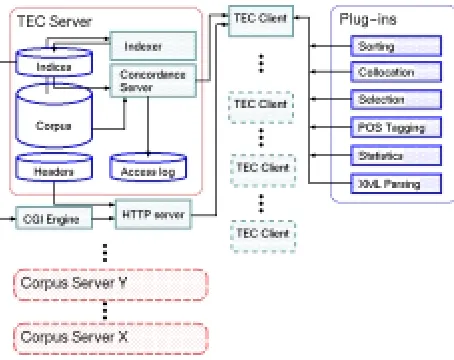
The software components of TEC were designed to en-able multiple users to access a common corpus, retrieve concordance sets and perform operations on these sets such as sorting, collocation, tagging, and statistical analysis. The architecture chosen to implement this functionality follows the client-server model depicted in Figure 1. The basic functionality for corpus indexing and access is handled at the server side while the client handles not the original texts directly but the concordances generated by the server.
Figure 1: TEC Architecture
The client itself is implemented in a modular (“plug-in”) architecture which enables new functionality to be in-corporated seamlessly. The core function of the client is to manage user requests and the communication with the server. Once the data has arrived at the client end the ap-propriate plug-ins take over the processing of the request.
The TEC client may also communicate with a standard HTTP server for requests which involve non-indexed text
about the corpus. This kind of text will possibly con-tain mark-up tags which need to be parsed appropriately. The reason for splitting the server function between a spe-cialised concordance retrieval and a generic content server is twofold. Since media access is clearly a bottleneck in corpus processing, the concordance server can perform more efficiently if it is dedicated to retrieving concordance data. Furthermore, TEC is largely a corpus of copyrighted material, therefore unrestricted access to the texts cannot be allowed.
These and other data and processing constraints are spelled out in the next sections.
3.1. Constraints on data storage and indexing
As mention above, 80%of TEC consists of translated fiction (including bibliography). All this material is subject to copyright restrictions. In order to be able to make the corpus accessible as a resource for researchers and transla-tors while abiding by the copyright law it was necessary to protect the original texts. This was done by allowing only indirect access to the texts, via the concordance server and browsers. The system architecture described above satis-fies this constraint nicely, since the clients only receive lists of words drawn from a variety of texts and their immediate contexts.
Given the size of the corpus, efficient access to concor-dance data necessarily implies indexing. The TEC indices are pre-compiled and updated every time text is added to the corpus. The server accesses the indices directly, upon request from a client. The current implementation of the server stores large chunks of index tables in memory to minimise disk access. However, we intend to replace this lookup strategy by one based on hash tables tied to disk which will enable us to update the indices without having to restart the server as well as spare more working mem-ory for multi-threaded processing. Hash table lookup can be made quite efficient and many compression techniques exist which can be used to reduce index space requirements (usually quite high) and minimise the physical media ac-cess bottleneck.
<omit desc="caption">
Chancellor Kohl . . . through all the embarassing twists, still the dominant player
</omit> <p>
<omit desc="title">KING MAKING</omit> <p>
<omit desc="synopsis">
Will Chancellor Kohl’s vision of democracy prevail in united Germany’s first presidential election? Robert Leicht argues that the liberals’ time has come
</omit> <p> Die Zeit
<p> THE GERMAN head of state has no power. But a
presidential election tells us much about power in this land - and the health of its political culture. On Monday the first president of a reunited Gemany will be elected - but the heavily symbolic aspect of this no longer plays a role in the outcome. For the second time in the history
[...]
Table 1: Excerpt of a TEC text file
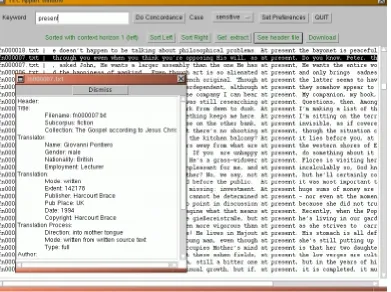
sepa-Figure 2: The TEC Corpus Browser
Ideally, to make the best use of TEC, the researcher should also have access to a general monolingual corpus of English, such as the British National Corpus. The only way to establish whether a particular pattern is specific to translated text is to check it against the patterning of non-translated text in the same language. Perhaps in a not so distant future this kind of research may be facilitated by a “world wide web of corpora” in which browsing through different corpora sitting in in different parts of the world will be just a click away.
6.
References
Baker, Mona, 1995. Corpora in translation studies: An overview and some suggestions for future research.
Tar-get, 7(2):223–243.
Baker, Mona, forthcoming. Do literary translators have style. Style.
Baker, Mona, in press. The role of corpora in investigat-ing the linvestigat-inguistic behaviour of professional translators.
International Journal of Corpus Linguistics.
Bray, Tim, Jean Paoli, and C. M. Sperberg-McQueen, 1998. Extensible markup language (XML) 1.0.
Technical Report REC-xml-19980210, W3C.
http://www.w3.org/TR/REC-xml.
Clear, J., 1993. From firth principles: Computational tools for the study of collocation. In M. Baker, G. Francis, and E. Tognini-Bonelli (eds.), Text and Technology: In
honour of John Sinclair. Amsterdam: John Benjamins,
pages 271–292.
Kenny, Dorothy, 1999. Norms and Creativity: Lexis in
Translated Text. Ph.D. thesis, Centre for Translation
Studies, Department of Language Engineering, UMIST. Lamport, L. and N. Lynch, 1990. Distributed computing: Models and methods. In Handbook of theoretical
com-puter science, volume Vol.B Formal models and
seman-tics, chapter 18. The MIT Press: Cambridge, MA, pages 1159–1199.
Laviosa, Sara, 1997. How comparable can comparable cor-pora be? Target, 9(2):289–319.
Laviosa, Sara, 1999. The english comparable corpus: A re-source and a methodology. In L. Bowker, M. Cronin, D. Kenny, and J. Pearson (eds.), Unity in Diversity:
Current Trends in Translation Studies. Manchester: St.
Jerome Publishing.
Laviosa-Braithwaite, Sara, 1996. The English Comparable
Corpus (ECC): A Resource and a Methodology for the Empirical Study of Translation. Ph.D. thesis, UMIST,
Manchester, UK.