Lexicalized Semi-Incremental Dependency Parsing
Hany Hassan
Khalil Sima’an
Andy Way
Cairo TDC
Language and Computation
School of Computing
IBM
University of Amsterdam
Dublin City University
Cairo, Egypt
Amsterdam, The Netherlands
Dublin, Ireland
[email protected]
[email protected]
[email protected]
Abstract
Even leaving aside concerns of cognitive plausibil-ity, incremental parsing is appealing for applications such as speech recognition and machine translation be-cause it could allow the incorporation of syntactic fea-tures into the decoding process without blowing up the search space. Nevertheless, incremental parsing is of-ten associated with greedy parsing decisions and intol-erable loss of accuracy. Would the use of lexicalized grammars provide a new perspective on incremental parsing?
In this paper we explore incremental left-to-right de-pendency parsing using a lexicalized grammatical for-malism that works with lexical categories (supertags) and a small set of combinatory operators. A strictly incremental parser would conduct only a single pass over the input, use no lookahead and make only local decisions at every word. We show that such a parser suffers heavy loss of accuracy. Instead, we explore the utility of a two-pass approach that incrementally builds a dependency structure by first assigning a su-pertag to every input word and then selecting an incre-mental operator that allows assembling every supertag with the dependency structure built thus far to its left. We instantiate this idea in different models that al-low a trade-off between aspects of full incrementality and performance, and explore the differences between these models empirically. Our exploration shows that a semi-incremental (two-pass), linear-time parser that employs fixed and limited look-ahead exhibits an ap-pealing balance between the efficiency advantages of incrementality and the achieved accuracy. Surpris-ingly, taking local or global decisions matters very lit-tle for the accuracy of this linear-time parser. Such a parser fits seamlessly with the currently dominant finite-state decoders for machine translation.
1
Introduction
As it processes an input sentence word-by-word in some order (e.g., left-to-right for a language like English), an
in-cremental parser builds for each prefix of the input sentence
a partial parse that is a subgraph of the partial parse that it builds for a longer prefix. An incremental parser may have access only to a fixed, limited window of lookahead words. The lookahead is equivalent to buffering a number of words before processing them; as stated by [Marcus et. al., 1983], a deterministic parser can buffer and examine a small num-ber of words before adding them to the existing structure. A parser might also make multiple incremental passes over the input sentence where decisions made in an earlier pass are refined in a subsequent pass. In this paper we refer to
an incremental, left-to-right parser without lookahead formation taking a single pass over the input as a fully
in-cremental parser. We refer to an inin-cremental left-to-right
parser with limited lookahead capability as a weakly in-cremental parser. And when the inin-cremental parser makes two passes over the input, we refer to it by the term
semi-incremental.
Besides being cognitively plausible, an incremental parser is more appealing for applications if its time and space (worst-case) complexities are close to lin-ear in input length. For example, an incremental, linear-time parser should constitute a natural match for the word-by-word decoding and pruning schemes used within phrase-based statistical machine translation (PB-SMT) and speech recognition. It is worth noting that fully incremental parsers are cognitively plausi-ble [Marslen-Wilson, 1973, Sturt & Lombardo, 2004], while weakly incremental parsers can serve well for syntax-based language modeling where a local context of the word is usually provided for scoring.
The degree of possible incrementality in parsing depends largely on the syntactic formalism underpinning the pars-ing process. In this work, we adopt Combinatory Catego-rial Grammar (CCG) [Steedman, 2000], which would ap-pear to represent an appealing grammatical representation for incremental parsing due to two main reasons. Firstly, as highlighted in [Steedman, 2000], CCG can represent every leftmost string as a constituent even if it is not a syntactic constituent. This enables any left branching (left-to-right) parser to work fully incrementally. Secondly, a fully in-cremental dependency parser is only possible if the left-most graph is fully connected at each parse state, which was highlighted in [Nivre, 2004]. This is especially pos-sible with grammars like CCG where the type raising and compositional capabilities can be utilized to keep the graph connected even when not resolving a dependency relation. In this paper we present a new approach to linear-time, semi-incremental CCG parsing and explore the trade-off between the degree of incrementality and parse accuracy. On the one hand, it turns out to be not so easy to obtain a fully incremental parser that maintains the same level of accuracy as a parser that explores the full parse-forest without worries about incrementality or linear-time pro-cessing. On the other hand, we show that reasonable levels of accuracy can be achieved when the requirements of in-crementality are somewhat relaxed: allowing a two-pass classification approach (a supertagger followed by an op-erator tagger) and a limited use of look-ahead. Further-more, when allowing for global search (as opposed to lo-cal classification) during both supertagging and
tagging (thereby sacrificing a major aspect of incremental-ity), small improvements in accuracy can be obtained. The best performing models would fit seamlessly with linear-time, finite state decoders used in MT and speech recog-nition because they predict a single partial parse at every word position in the input.
The structure of this paper is as follows. In section 2, we discuss related work on incremental parsing, and in-troduce our model of incremental CCG parsing in section 3. We then detail our method for transforming the canoni-cal derivations in the CCGbank into left-to-right, incremen-tal derivations (section 4). Given this incremenincremen-tal version of the CCGbank, we study in section 5 a range of linear-time parsing models, with varying degrees of incremental-ity, and provide the results of a number of experiments in section 6. We discuss our findings, and offer some conclu-sions and avenues for further research in section 7.
2
Related Work
While there exist numerous recent efforts at (deter-ministic) incremental (shallow) dependency parsing (e.g. [Nivre, 2004, Shen & Joshi, 2005]), most current con-stituency parsers are hard to classify as incremental. State-of-the-art parsers (e.g. [Collins, 1999, Charniak, 2000]) se-lect the Viterbi parse only when the parse-space has been spanned for the whole sentence; the Viterbi parse may change as the prefix grows, violating incrementality. In contrast, partial parsers such as [Abney, 1991] by default do not output a full sequence of connected phrases, which causes the constraint of incrementality to fail for a quite different reason.
Among the many attempts at efficient (often determin-istic) and incremental (dependency) parsing, we concen-trate on the quite small number of research papers which are most similar to our work [Yamada & Matsumoto, 2003, Nivre, 2004, Shen & Joshi, 2005, Sagae & Lavie, 2006]. [Nivre, 2004] suggests that deterministic dependency pars-ing (e.g. [Yamada & Matsumoto, 2003]) is a halfway house between full and partial parsing, in that the build-ing of a full parse of the input strbuild-ing is the aim, whilst at the same time remaining robust, efficient and determinis-tic. [Nivre, 2004] then describes his own approach to in-cremental deterministic dependency parsing. While strict incrementality was not possible using his framework, as far as well-formed utterances are concerned, the degree of incrementality achievable approaches 90%. In a sim-ilar manner, [Sagae & Lavie, 2006] introduce a statistical shift-reduce parser that uses a probabilistic framework to determine the shift/reduce actions. Multiple possible parse decisions are handled by a beam strategy.
[Shen & Joshi, 2005] use the term ‘semi-incremental’ to refer to parsers (both left-corner [Collins & Roark, 2004] and head-corner [Yamada & Matsumoto, 2003]) which permit multiple iterations of left-to-right scans, rather than just one. In contrast to these models, [Shen & Joshi, 2005] introduce an approach for incremental parsing of spinal Lexicalized Tree Adjoining Grammar, which supports full adjunction, a dynamic treatment of coordination, as well as non-projective dependencies. This can be seen as an incre-mental version of Supertagging [Bangalore & Joshi, 1999]. Incremental dependency parsing of Categorial Grammar was attempted in [Milward, 1995] using a state-transition (or dynamic) processing model, where each state consists
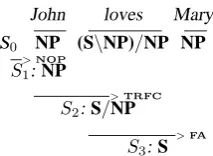
John loves Mary
S0 NP (S\NP)/NP NP
>NOP
S1: NP
>TRFC
S2: S/NP
>FA
S3: S
Fig. 1: A sentence and possible supertag-, operator- and
state-sequences. NOP: No Operation; TRFC: Type Raising follwed by Forward Composition.
of a syntactic type together with an associated semantic value. The model of incremental parsing for CCG that we propose here is largely inspired by ideas presented in the latter two papers.
3
Semi-Incremental CCG Parsing
As it processes the sentence left-to-right, word-by-word, our parser specifies for every word a supertag and a com-binatory operator, and maintains a parse-state (henceforth ‘state’). Each state is represented by a composite CCG cat-egory. Apart from the first word in the sentence, this com-posite CCG category is the result of applying the combi-natory operator to the preceding state and current supertag; at the first word in the sentence, the state consists solely of the supertag of that word. In terms of CCG represen-tations, a CCG composite category specifies a functor and the arguments that are expected to the right of the current word. Crucially, given a sentence and its state sequence, the dependency structure can be retrieved unambiguously. At each state the partial dependency structure can be rep-resented as a directed graph with nodes representing words and arcs representing dependency relations. Figure 1 illus-trates the workings of this incremental parser, where the sequence of supertags is shown, then the operators that ap-ply from left-to-right in order to build the state sequence incrementaly.
From the description above it is conceptually appealing to describe our parser in two parts: (i) a Supertag-Operator Tagger which proposes a supertag–operator pair for the current word, and (ii) a State-Realizer, which realizes the current state by applying the current operator to the previ-ous state and the current supertag. In this work, the State-Realizer is a deterministic function, whereas the supertag-operator tagger is a statistical one trained on our own in-cremental version of the CCGbank. While this concep-tual view describes a baseline, fully incremental version, in what follows we will consider refinements that trade off some aspects of incrementality for accuracy (i) by employ-ing lookahead in predictemploy-ing supertag–operator pairs, (ii) by predicting the supertag and using that for predicting the operator (a cascade of per-word classifiers possibly with lookahead), and (iii) by using a two-pass, semi-incremental approach where supertags and operators are chosen glob-ally using Viterbi decoding (rather than per-word by means of classifiers). All these versions remain linear-time and space (worst-case complexity).
CCG-bank. In the next section we present our transformation technique developed to obtain the appropriate training data.
4
Transforming the CCGbank into
left-to-right derivations
The goal of the transformation is to obtain training data for our incremental parsing approach. The result of the transform is an incremental CCGbank where sentences are annotated with supertags as well as combinatory opera-tors that allow left-to-right, incremental building of a parse while satisfying the dependencies specified in the CCG-bank.
For each sentence in the CCGbank, we apply the follow-ing procedure:
• Initialize empty operator sequence and empty unsatisfied dependencies;
• For each word:
1. Add current dependencies to unsatisfied dependen-cies.
2. Check unsatisfied dependencies:
(a) If adjacent dependency with simple categories, assign application operators;
(b) If adjacent dependency with complex categories, assign composition operators;
(c) If long-range dependency, apply Type Raising followed by Forward Composition.
3. Handle special cases if any: (a) Coordination (section 4.1),
(b) Apposition & Interruptions (section 4.2), (c) WH-movement (section 4.3),
4. Update Current state;
5. Assign selected operator to the operator sequence; 6. Update the dependencies by removing satisfied
de-pendencies.
This procedure deploys the dependencies available in the CCGbank in order to assign the simplest possible operator sequence that is able to satisfy, and reproduce, the depen-dency structure of the sentence under investigation.
Figure 2 illustrates the transformation process, step-by-step, on a sentence of the CCGbank. At the beginning of the process, we start with the words, the associated su-pertags and the dependency relations, indicated by curved dotted arrows in the figure. The purpose of the transforma-tion process is to induce the state sequence and the operator sequence. These sequences should be able to reproduce the given dependency relations.
The transformation process proceeds word-by-word, and at each word position we check all previous and current unsatisfied dependencies. The transformation proceeds as follows:
1. State S1 being an initial state, it is associated with operator
NOP.
2. Moving to State S2, there is a dependency between the pre-vious word Mr. and the current word Warren. As this de-pendency relation is adjacent and in the forward direction, the FA operator is associated and so the state is transferred to S2 with category NP.
3. Moving to State S3 is triggered by the word will, which has both backward and forward dependencies. Thus the opera-tor TRFC is applied.
4. Moving to State S4 is triggered by the word remain, which being linked with the word will by a forward dependency relation, causes the FC operator to be assigned. The state becomes (S/PP), indicating that a prepositional phrase is re-quired to the right.
5. Moving to State S5 is triggered by the word on which is linked to the previous verb remain, and so the FC operator is assigned.
6. Moving to State S6 is triggered by the word the, which has neither backward nor forward dependencies; however, it is linked through a chain of dependencies with a future word
board. Thus we apply the composite TRFC operator to type
raise the current word to the required dependency category and then perform forward composition.
7. Moving to State S7 is triggered by the word company, which has a forward dependency with the previous position, and so the FA operator is applied.
8. Moving to State S8 is triggered by the word ’s which has ad-jacent forward and backward dependencies, so the FC oper-ator is applied. This changes the state to (S/NP).
9. Finally, state S9 is triggered by the word board. The FA operator is finally applied to construct the complete category
S.
This detailed illustration shows how the CCGbank is trans-formed. We started with a supertag sequence and a depen-dency graph, and ended with the corresponding operator and state sequences. However, the same procedure applies during parsing, i.e. if we have the supertag and the operator sequences, then we are able to construct both the incremen-tal states and the dependency graph. As an indication of the performance of our transformation process, on section 00 of the WSJ—our dev data (see section 6)—we managed to successfully extract 97% of the CCGbank dependencies, with the incremental approach failing to restore just 3% of the dependencies. This defines the upper bound of the ac-curacy expected from this incremental representation.
In the next three sections we describe the special oper-ators we added for cases of coordination, apposition and interruptions, and WH-movement.
4.1
Coordination
Cognitive studies [Sturt & Lombardo, 2004] view coor-dination as an incremental operation. Unfortunately, the CCGbank uses a simple category conj for coordi-nation instead of the more elaborate category (X\X)/X,
which was originally defined for coordination in CCG [Steedman, 2000]. The atomic conj operator is not effi-cient for incremental parsing, because it does not provide information on the coordinated elements. Therefore, we use the dependency information to assign more elaborate coordination categories. For example, if coordination is performed between two noun phrases, the appropriate cat-egory is (NP\NP)/NP. Furthermore, we added a new
Mr. Warren will remain on the company 's board
S1 S2 S3 S4 S5 S6 S7 S8 S9
S (S/NP) (S/(NP
\NP)) (S/(NP\NP))
/NP (S/NP)
(S/PP) S/(S\NP)
NP NP/NP State
Cat.
FA FC
FA TRFC
FC FC
TRFC FA
NOP Operator
NP (NP/NP)
\NP NP
NP/NP PP/NP
(S\NP) /PP (S\NP)/ (S\NP) NP
NP/NP Supertag
Fig. 2: Illustration of the CCGbank transformation process into incremental derivations.
He plays football and tennis S1:NP (S\NP)/NP NP (NP\NP)/NP NP
>TRFC
S2: S/NP
>FA
S3: S
>COORD
S4: S/NP
>FA
S5: S
Fig. 3: Coordination Handling.
nearest previous state that is able to satisfy the coordina-tion is retrieved from the state stack to become the current state.1
The example shown in Figure 3 illustrates the handling of coordination. At the transition from S3 to S4 a coordi-nation operator COORD is encountered, which causes the current state S4 to ‘go back’ to state S2 with structure S/NP, i.e. expecting an NP to the right.
4.2
Apposition and Interruptions
Neither the CCGbank nor the WSJ treebank distin-guish between the appositive and coordination commas [Hockenmaier & Steedman, 2007]. The comma mostly has a single supertag in the CCGbank that does not in-dicate its actual role in the syntactic structure of the sentence at hand. We adopted the syntactic patterns in [Bayraktar et al., 1998] as a means of identifying the comma’s different possible syntactic categories. Based on these syntactic patterns, we enriched the supertags associ-ated with the comma to indicate the correct syntactic role. Furthermore, we added a new operator INTR for handling cases of both apposition and interruptions.
4.3
WH-movement
A new operator is added to handle cases of WH-movement where a syntactic category is required on the right but, hav-ing moved, is available only on the left. Consider the sen-tence He believes in what he plays. Here plays is of cate-gory (S\NP)/NP, i.e. it is a transitive verb, where if it finds
1This retrieval action of a previous state remains incremental because
the previous state sequence is not altered, and the retrieved state is always an extension of the last state (it always adds arguments to a given category rather than changing it to a different one).
an object NP to its right, and a subject NP to its left, a sen-tence will have been formed. The NP what is expected as the object somewhere to the right of plays, but has already moved to an appropriate position somewhere to its left. Ac-cordingly, we added a new operator WHMV to handle such cases in our framework.
5
Implementation Detail
After POS tagging, the parser works its way through the sentence, left-to-right, assigning for every word a supertag–operator pair, and deciding on a state using the deterministic state-realizer. We describe the state-realizer before delving into the implementation of different ver-sions of the supertag-operator tagger.
Parse-State Realizer After assigning supertag–operator pairs for the words of the input sentence (described in the next section), the state-realizer deterministically realizes the parse-states as well as the intermediate dependency graphs between words using the CCG incremental oper-ators (as defined in our incremental version of the CCG-bank). Starting at the first word with (obviously) a null previous state, the realizer performs the following steps for each word in turn: (i) set the current supertag and operator to those of the current word; (ii) at the current state apply the current operator to the previous state and current su-pertag; (iii) add edges to the dependency graphs between words that are linked as CCG arguments; and (iv) if not at the end of the sentence, set the previous state to the current one, then set the current word to the next one, and iterate from (i).
John likes Mary NP (S\NP)/NP NP NOP T RF C F A GFED
@ABCS0 //GFED@ABCS1 //GFED@ABCS2 //GFED@ABCS3
NP S/NP S
S1 ONMLHIJKJohn
S2 ONMLHIJKJohn // ONMLHIJKlikes
S3 ONMLHIJKJohn // ONMLHIJKlikes oo WVUTPQRSMary
Fig. 4: Illustration of the operation of the incremental
parse-state realizer and the associated intermediate depen-dency graphs at each state.
Maximum Entropy Taggers We build different linear-time models for assigning supertag–operator pairs to words in order to explore the effect of the different grada-tions of incrementality on parsing accuracy. All mod-els present in this paper are based on MaxEnt classifiers [Berger et al., 1996]. A MaxEnt classifier selects the class that gives the highest conditional probability of any class given a set of features of the input, where the probabil-ity is expressed as a log-linear interpolation of weights of features. The weights are trained in order to maximize the likelihood of the given training data. In this work we use sequential conditional generalized iterative scaling [Goodman, 2002].
In building classifiers for sequence-tagging, as in the present case, choices arise regarding the search strategy as well as regarding the use of lookahead features:
• Search (GLOBAL/LOCAL): A MaxEnt model can be used for sequence classification, either as a classifier (LOCAL) or by converting the classification scores into probabilities and then using standard dynamic programming (Viterbi search, GLOBAL). Naturally, per-word (left-to-right) LOCAL clas-sifiers facilitate a more incremental parser than GLOBAL classifiers; in the latter case, the state-realizer has to wait till the end of the sentence before it can realize the states.
• Lookahead: (Y-LH/N-LH): For training the classifiers, lookahead features could either be included (Y-LH) or not (N-LH). When lookahead is used, it refers to the lexical and POS features from a window of two words two words to the right of the focus word. Note that those features to the left are always included in all models as history.
Crucially, the choice for a global search procedure is or-thogonal to using a lookahead. This is because in a global search the disambiguation weights are the accumulation (assuming independence given the overlapping features) of the weights of local classification decisions (per word) for the whole input sentence, whereas the lookahead af-fects the features used to estimate the local weights them-selves. Hence, when assuming independence (multiplying) between the local decisions, global search cannot substitute for the use of lookahead.
Furthermore, given any choice of search strategy and lookahead, there are two different architectures for assign-ing supertag–operator pairs to words:
• Joint: We train a MaxEnt module to assign supertag– operator pairs (as a single class) to words.
• Cascaded: We train two MaxEnt modules, one for su-pertags, and one for operators, and use them in a cascade. We limit the options here such that both classifiers (supertag and operator) either use lookahead or not, i.e. we do not ex-plore a mixed situation where one does and the other does not. For the version that does use lookahead, while the su-pertagger is trained using the standard feature set, the oper-ator tagger is trained with the same window but with POS and supertag features coming from the supertagger (no lex-ical features).
As a baseline we start out from the Joint classifier, without lookahead (N-LH) and with LOCAL search. We choose this as a baseline as it is the most straightforward imple-mentation of an incremental, linear-time CCG parser with-out making any extra assumptions. The Cascaded architec-ture with LOCAL search and without lookahead (N-LH) might be seen as incremental but it embodies an extra set of independence assumptions (i.e. different choices of fea-tures for supertag and operator classifiers). Similarly, any model using look-ahead and LOCAL search is slightly less incremental since it employs still more resources than the preceding models. If we move one further step away from full to semi-incremental parsing, we arrive at models which employ GLOBAL search (since the supertag–operator se-quences are assigned only after the whole sentence has been processed).
6
Experiments and Results
This section details a number of experiments carried out to test the effectiveness of the supertagger, the operator tag-ger, and our ability to capture the necessary dependencies using a range of incremental parsers. We used the same data split of the WSJ as in [Clark & Curran, 2007]. Sec-tions 02–21 were used for training, section 00 for dev-testing of intermediate taggers, and section 23 for dev-testing dependencies.
6.1
Supertagging Results
Given our introduction of new supertags for coordination, apposition, interruption, and WH-movement, we used sec-tion 00 to evaluate our supertagger’s accuracy compared to the standard CCGbank set. Although our supertags are more complex, we obtain an F-score of 91.7 (cf. Ta-ble 1, last row, ‘Supertagging’ column), which compares favourably with the supertagger of [Clark & Curran, 2007], which scores 92.39 on the same dataset. While we have not carried out significance testing at this stage, it is clear that there is little difference between the two sets of scores, indi-cating that our supertagger is robust as well as accurate. As will be seen for all experiments in this section, this is only true when lookahead is utilised; note that our best score of 91.7 dips to 68.62—an absolute drop of 23.08 points, or a 33.6% relative decrease in performance—when lookahead is turned off.
6.2
Operator Tagging Results
Architecture Lookahead Search Dependency Supertagging Operator Tagging Incremental Accuracy Accuracy Accuracy
Joint NO LOCAL 56.02 67.47 Incr.
NO GLOBAL 56.13 68.31 Semi
YES LOCAL 82.17 84.34 Incr.+LH
YES GLOBAL 83.20 85.02 Semi+LH
Cascaded NO LOCAL 59.01 68.11 76.19 Incr.
NO GLOBAL 59.30 68.62 76.53 Semi
YES LOCAL 86.31 91.62 90.76 Incr.+LH
YES GLOBAL 86.70 91.70 90.90 Semi+LH
Table 1: All results (F-Score) of systems applied to input with POS tags output by POS tagger trained using Maxent with
feature window (+/-2) on the CCGbank POS data. The results with no lookahead use only left window features.
row, ‘Operator Tagging’ column) even when no lexical fea-tures are used. We also contemplated a hypothetical situa-tion in which we feed the correct (gold standard) previous syntactic state as a feature to the system. In this scenario an operator tagging score of 99.22% (8.32% absolute im-provement, or 9.15% relative) was obtained, indicating that a high gain is to be expected if this state were to be made available to the operators classifier.
6.3
Dependency Results
In Table 1 we also present the results for unlabeled de-pendency accuracy using our method. We use the same evaluation criteria as [Clark & Curran, 2007] by comparing the dependency output of the incremental parser with the predicate-argument dependencies in the CCGbank. Test-ing on section 23 of the WSJ, we obtain an F-score of 86.7 (last row, ‘Dependency’ column). The score with the gold standard POS and supertags in the input is 87.5, 0.8% ab-solute (or 0.92% relative) higher than the result when us-ing the POS, supertags and operators hypothesized by the system, but not by much. While this result is consider-ably below the best known result for a non-incremental, bottom-up chart parser [Clark & Curran, 2007]), we think that our result is reasonably good for an extremely efficient, semi-incremental parser. To put the efficiency gains in per-spective, the parsers of [Collins, 1999], [Charniak, 2000] and [Clark & Curran, 2007] take respectively 45, 28 and 1.9 mins to parse section 23 of the WSJ. By contrast, our parser takes only 11 seconds, a speed-up of around ten times relative to the fastest among these parsers [Clark & Curran, 2007] (parsing times are measured on a machine with the same specifications).
6.4
Cascaded vs. Joint Approach
The results reported above demonstrate the accuracy of the cascaded approach using two cascaded taggers: the first for supertags, and the second the operator tagger followed by the deterministic state- realizer. In this section we compare the cascaded model with a joint model, where we train a single classifier that produces the supertags and operators simultaneously in the same step. In Table 1 we give the unlabeled dependency results for section 23 for the cas-caded and joint models side-by-side for comparative pur-poses. The cascaded model significantly outperforms the joint model (by 3.5% absolute, or 4.2% relative; this rises to 4.3% absolute, or 5.17% relative, if we compare the joint model with the dependency score using the gold standard POS and supertags, as described in the previous section).
Besides data sparseness, the joint model makes the choice of an operator at a certain position in the sentence based on supertag information only to the left of the current position because the joint model must guess supertag–operator pairs at once.
Note that our Cascaded version with lookahead and GLOBAL search is the semi-incremental model of [Shen & Joshi, 2005]. They report an F-score of 89.3 on section 23 using a semi-incremental approach. While not directly comparable, we consider our performance to be on a par with theirs, with a considerable improvement in pars-ing time (they report a speed of 0.37 sent./sec.).
6.5
Effect of Lookahead
The present parser is just two words of lookahead away from being fully incremental. Here, we examine the ef-fect of lookahead features on the supertagger, operator tag-ger and dependency results. We examine two versions of a supertag- and operator-classifier, namely a weakly mental and a fully incremental version. The weakly incre-mental version deploys features in a window of two words to the left and two words to the right of the focus word. The fully incremental parser deploys features in a window of two words to the left only.
Looking at all the results in Table 1, the scores for the weakly (semi-)incremental versions of the parser barely differ from their fully incremental counterparts, whether we are concerned with dependency, supertagging or oper-ator accuracy; the scores are higher, on the whole, but not by much.
By contrast, what is extremely significant is the ex-tent to which lookahead is utilised. For all accuracy measures—dependency, supertagging or operator—huge improvements are to be seen when the parser avails of lookahead. Clearly, full incrementality at this stage comes at a high cost in accuracy, relative to the weakly incremen-tal version, without any benefit in efficiency.
7
Conclusions and Future work
tag-ger, even without lexical features, performs well on our ex-tended operator set.
Our empirical results show three main findings. Firstly, despite being just two words of lookahead away from be-ing fully incremental, our proposed cascaded weakly mental parser outperforms both the joint and fully incre-mental approaches. Nevertheless, there is perhaps less of a performance difference between the joint and cascaded architectures on the one hand, and between global search or local classification on the other. The fact that the lo-cal search performs almost as well as global search for this model implies that at least the local search could be eas-ily integrated within speech-recognition or machine trans-lation decoders.
Secondly, with respect to dependency parsing, while our overall result is below the result reported in [Clark & Curran, 2007] using a non-incremental bottom-up parser, it is far more efficient being (weakly) incremental. This speedup is, we feel, particularly attractive for applications that incorporate in the de-coder a word-prediction (or language) model, since this semi-incremental parser works in a fashion similar to such language models, i.e. the possible states are built on-the-fly from the training data, just like any other non-parametric method.
Thirdly, our results, using a state-of-the-art classifier, highlight the fact that incremental parsing using CCG is attainable at some tolerable cost in accuracy. Perhaps most importantly, incremental parsing for CCG as suggested here gives acceptable levels of accuracy only when looka-head is used. Nevertheless, since our approach to parsing is left-to-right and makes decisions at every word in the in-put, one might actually question the effectiveness of taking decisions at every word. It might turn out, for example, that when the decision points are selected carefully, the need for lookahead can be less crucial. This conjecture is left for the future.
As for other avenues of future research, work on an im-proved, fully incremental version is ongoing as well as an investigation of the effect of incremental parsing in ma-chine translation.
References
[Abney, 1991] Abney, S. 1991. Parsing By Chunks. In R. Berwick, S. Abney and C. Tenny (eds.) Principle-Based
Parsing. Kluwer, Dordrecht, pp.257–278.
[Bangalore & Joshi, 1999] Bangalore, S. and A. Joshi. 1999. Su-pertagging: An Approach to Almost Parsing.
Computa-tional Linguistics 25(2):237–265.
[Bayraktar et al., 1998] Bayraktar, M., B. Say and V. Akman. 1998. An Analysis of English punctuation: The Spe-cial Case of Comma. International Journal of Corpus
Linguistics 3(1):33–58, .
[Berger et al., 1996] Berger, A., V. Della Pietra, and S. Della Pietra. 1996. A maximum entropy approach to nat-ural language processing. Computational Linguistics 22(1):39–71.
[Charniak, 2000] Charniak, E. 2000. A Maximum-Entropy-Inspired Parser. In 1st Annual Meeting of the North
American Association for Computational Linguistics, Proceedings (NAACL 2000), Seattle, WA., pp.132–139.
[Clark & Curran, 2004] Clark, S. and J. Curran. 2004. The Im-portance of Supertagging for Wide-Coverage CCG Pars-ing. In Proceedings of the 20th International Conference
on Computational Linguistics (COLING’04), Geneva,
Switzerland, pp.282–288.
[Clark & Curran, 2007] Clark, S. and J. Curran. 2007. Wide-Coverage Efficient Statistical Parsing with CCG and Log-Linear Models. Computational Linguistics 33(4):493–552.
[Collins, 1999] Collins, M. 1999. Head-Driven Statistical
Mod-els for Natural Language Parsing. PhD Thesis,
Univer-sity of Pennsylvania, Philadelphia, PA.
[Collins & Roark, 2004] Collins, M. and B. Roark. 2004. Incre-mental Parsing with the Perceptron Algorithm. In 42nd
Annual Meeting of the Association for Computational Linguistics (ACL-04), Barcelona, Spain, pp.111-118.
[Doran and Bangalore, 1994] Doran, C. and S. Bangalore. 1994. Bootstrapping a Wide-coverage CCG from FB-LTAG. In
Proceedings of Third International Workshop on Tree-Adjoining Grammars (TAG+3), Paris, France [no page
numbers].
[Goodman, 2002] Goodman, J. 2002. Sequential Conditional Generalized Iterative Scaling. In 40th Annual Meeting of
the Association for Computational Linguistics,
Philadel-phia, PA., pp.9–16.
[Hockenmaier & Steedman, 2007] Hockenmaier, J. and M. Steedman. 2007. CCGbank: a corpus of CCG deriva-tions and dependency structures extracted from the Penn Treebank. Computational Linguistics 33(3):355–396. [Marslen-Wilson, 1973] Marslen-Wilson, W. 1973. Linguistic
structure and speech shadowing at very short latencies.
Nature 244:522–533.
[Milward, 1995] Milward, D. 1995. Incremental Interpretation of Categorial Grammar. In Proceedings of 7th
Con-ference of the European Chapter of the Association for Computational Linguistics (EACL-95), Dublin, Ireland,
pp.119–126.
[Nivre, 2004] Nivre, J. 2004. Incrementality in Deterministic Dependency Parsing. In Proceedings of the ACL
Work-shop on Incremental Parsing: Bringing Engineering and Cognition Together, Barcelona, Spain, pp.50–57.
[Sturt & Lombardo, 2004] Sturt, P. and V. Lombardo. 2004. Pro-cessing coordinated structures: Incrementality and con-nectedness. Cognitive Science 29(2):291–305.
[Sagae & Lavie, 2006] Sagae, K. and A. Lavie. 2006. A best-first probabilistic shift-reduce parser. In Proceedings of
the 21st International Conference on Computational Lin-guistics and 44th Annual Meeting of the Association for Computational Linguistics–Posters, Sydney, Australia,
pp.691–698.
[Shen & Joshi, 2005] Shen, L. and A. Joshi. 2005. Incremen-tal LTAG Parsing. In Proceedings of the Conference on
Human Language Technology and Empirical Methods in Natural Language Processing (HLT/EMNLP 2005),
Vancouver, Canada, pp.811–818.
[Steedman, 2000] Steedman, M. 2000. The Syntactic Process. MIT Press, Cambridge, MA.
[Yamada & Matsumoto, 2003] Yamada, H. and Y. Matsumoto. 2003. Statistical dependency Analysis with Support Vec-tor Machines. In Proceedings of 8th International
Work-shop on Parsing Technologies (IWPT-2003), Nancy,
France, pp.195–206.
[Marcus et. al., 1983] Mitchell Marcus and Donald Hindle and Margaret Fleck. 1983. D-theory: talking about talking about trees. In Proceedings of the 21st Annual
Meet-ing on Association for Computational LMeet-inguistics (1983),