Multilingual Entity-Centered Sentiment Analysis
Evaluated by Parallel Corpora
Josef Steinberger and Polina Lenkova and Mijail Kabadjov Ralf Steinberger and Erik van der Goot
EC Joint Research Centre 21027, Ispra (VA), Italy
{Josef.Steinberger, Polina.Lenkova, Ralf.Steinberger
Mijail.Kabadjov, Erik.van-der-Goot}
@jrc.ec.europa.eu
Abstract
We propose the creation and use of a mul-tilingual parallel news corpus annotated with opinion towards entities, produced by projecting sentiment annotation from one language to several others. The objective is to save annotation time for development and evaluation purposes, and to guarantee comparability of opinion mining evalua-tion results across languages. By creating this resource, we answered the question whether sentiment is consistently trans-lated across languages so that projection can actually be an option. We describe our approach to multilingual sentiment anal-ysis and show its performance in 7 lan-guages of the parallel corpus.
1 Introduction
In sentiment analysis the goal is to detect and clas-sify subjective content of a text. The text can be classified as a whole such as in product reviews, in which an overall judgment is assigned to the prod-uct. If we move to the news domain, the overall sentiment score of an article can be used for de-tecting bad or good news. It can be used also for detecting the changes in sentiment in a particular topic. However, if the goal is to detect sentiment expressed towards entities, the aggregated senti-ment of the articles, in which the entity appears, need not to correspond to opinions expressed to-wards the entity. The entity can be mentioned pos-itively in a very negative article. We have to go down and analyze each entity mention based on the surrounding context.
Solving the problem in multilingual environ-ment and gathering large amounts of articles from many sources give advantage to detect news opin-ions expressed in different countries towards same persons. Also, it eliminates the biased news. How-ever, multilinguality brings another challenge. For
instance, it is not easy to develop NLP tools like parsers or taggers in many languages, also using them can cause computational problems when ap-plied on large amounts of articles every day. An-other difficulty comes with resources. Sentiment-annotated data are not usually available for other types of texts then reviews, or they are almost ex-clusively available for English. Sentiment dictio-naries are also mostly available for English only or, if they exist for other languages, they are not comparable, in the sense that they have been developed for different purposes, have different sizes, are based on different definitions of what sentiment or opinion means.
We addressed the resource bottleneck for senti-ment dictionaries, by developing highly multilin-gual and comparable sentiment dictionaries hav-ing similar sizes and based on a common specifi-cation (Steinberger et al., 2011).
Our sentiment system is simply based on counting subjective terms around entity mentions (mainly persons and organizations). Evaluating its performance in more languages would multiply the annotation efforts. In this paper we propose using parallel corpora to automatically project an-notations from English. We study the subjectiv-ity of the entsubjectiv-ity-centered sentiment annotation and evaluate our sentiment system in seven languages (English, Spanish, French, German, Czech, Italian and Hungarian). As a side effect this evaluation serves as a task-based evaluation of the quality of the sentiment dictionaries.
Firstly, we discuss related work in Section 2. Next, we shortly mention the development of sen-timent dictionaries and briefly discuss our senti-ment system (Section 3). Then we focus on the annotation of the parallel corpus in Section 4. We show the figures of inter-annotator agreement. Be-fore we conclude all, we discuss evaluation results of our system run on the parallel corpus (Section 5).
2 Related work
The substantial growth in subjective information on the world wide web in the past years has made sentiment analysis a task on which con-stantly growing efforts have been concentrated. Subjectivity in natural language refers to aspects of language used to express opinions, evaluations, and speculations (Wiebe et al., 2005). To clas-sify statements (as traditionally to positive, neu-tral (objective) and negative) is not a trivial task, as many expressions carry in themselves a certain subjectivity and many expressions are used both in a subjective (even both positive and negative), as well as objective manner.
Sentiment analysis has been done at a document level, the most often for review texts, starting from the assumption that each document focuses on a single object and contains opinion from a single opinion holder. There were numerous approaches dealing with document level sentiment classifica-tion (Pang et al., 2002; Dave et al., 2003). The approaches are usually evaluated by comparing the outcome of the analysis against the number of stars given to the review.
The document level assumptions do not hold for newspaper articles or blog posts where each sen-tence expresses one single opinion (sensen-tence level approaches) about a target. (Hatzivassiloglou and Wiebe, 2000; Wiebe and Mihalcea, 2006; Wil-son et al., 2004) use subjectivity analysis to de-tect sentences from which patterns can be deduced for sentiment analysis, based on a subjectivity lex-icon. Kim and Hovy (2004) try to find, given a cer-tain topic, the positive, negative and neutral senti-ments express on it and the source of opinions (the opinion holder). The authors computed the senti-ment of the sentence in a window of different sizes around target.
Most of the work in obtaining subjectivity lex-icons was done for English. However, there were some authors who developed methods for the mapping of subjectivity lexicons to other lan-guages. Kim and Hovy (2006) use a machine translation system and subsequently use a subjec-tivity analysis system that was developed for En-glish. Mihalcea et al. (2007) propose a method to learn multilingual subjective language via cross-language projections. Another approaches in ob-taining subjectivity lexicons for other languages than English were explored in Banea et al. (2008) or Wan (2008).
In the effort to guarantee comparability of re-sults across languages, various authors have sug-gested using multilingual parallel corpora. For in-stance, Koehn (2002) used the multilingual paral-lel corpus EuroParl to evaluate Machine Transla-tion performance across language pairs. Zaanen et al. (2004) propose to use a multilingual par-allel parsed corpus as the best and fairest gold standard for grammatical inference evaluation, be-cause parallel documents can be assumed to have the same degree of language complexity. Turchi et al. (2010) use parallel corpora for the evaluation of multilingual multi-document summarisation, in which the annotation is very expensive. It also makes the evaluation results across languages di-rectly comparable.
3 Method for multilingual sentiment analysis
The objective of this paper is to focus on the cre-ation and use of the sentiment-annotated parallel corpus. Our sentiment analysis tools will there-fore only be described briefly. Any other senti-ment analysis tool could be applied to this parallel corpus instead.
Our objective is to detect positive or negative opinions expressed towards entities in the news across different languages and to follow trends over time. Entities of interest are mostly persons and organisations, but also concepts such as the ’7th Framework Program’ or ’European Constitu-tion’. Entities can be mentioned positively in neg-ative news context, and vice versa, so that docu-ment level analysis is not sufficient (Balahur et al., 2010), but opinions expressed towards the specific entity mention must be detected. As we do not have access to parsers or even part-of-speech tag-gers for the range of languages we intend to anal-yse, we chose to use an extremely simple method that does not require language-specific tools be-sides NER software and language-specific senti-ment dictionaries: we add up positive and negative sentiment scores in six-word windows around the entities, distinguishing two positive and two neg-ative levels of sentiment words (having values of -4, -2, 2 and 4 points, respectively). Enhancers and diminishers add or remove 1 point, negation inverts the value, except for negated high positive (‘not very good’ is not equivalent to ‘very bad’).
triangu-lation method, which was described in detail in (Steinberger et al., 2011). In a nutshell: carefully elaborated English and Spanish sentiment word lists were translated into third languages. The in-troduction of errors through word sense ambiguity was limited by taking the intersection of both tar-get language word lists. According to our eval-uation, approximately 90% of these intersection words were correct, while only about 50% of those words were correct that were translations from ei-ther English or Spanish, but not from both. For Arabic, Czech, French, German, Italian and Rus-sian, these word lists were manually checked and enhanced, while for Bulgarian, Dutch, Hungarian, Polish, Portuguese, Slovak and Turkish we sim-ply used the intersecting word list. For a subset of languages (Czech, English and Russian), wild cards were manually added to the sentiment word lists in order to capture morphological variants. For the other languages, the same will be done in the future. The results in section 5 differ heavily depending on whether morphological variants are dealt with.
4 Building a sentiment-annotated parallel corpus
In this section we give details about the parallel corpus, sentiment annotation and inter-annotator agreement.
4.1 Named entity-annotated parallel corpus
We worked with data from Workshops on Sta-tistical Machine Translation (2008, 2009, 2010)1 which provide parallel corpora of news stories in 7 European languages: English, Spanish, French, German, Czech, Italian (only 2009) and Hungar-ian (only 2008 and 2009). Putting together the data from the three years resulted in 7 065 par-allel sentences in five languages, and a subset in Italian and Hungarian. We ran our in-house en-tity recognition on the data. Only known entities (entities present in our database) were marked in the data. It gave us enough samples to run sen-timent experiments although guessing other enti-ties (and considering coreference mentions) would considerably increase the pool of samples. For En-glish we received 1 274 entity mentions, resulting in the same number of sentence-target (S-T) pairs for testing sentiment analysis. We built golden standard annotations and projected them to other
1http://www.statmt.org/wmt10/translation-task.html.
languages. Because of different performance of entity recognition we obtained fewer S-T pairs in other languages than in English.
4.2 Sentiment annotation and inter-annotator agreement
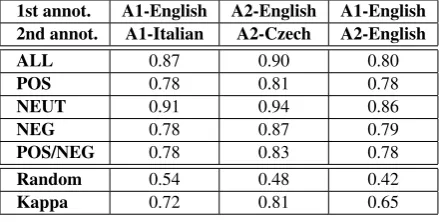
Annotating sentiment in news is clearly a subjec-tive task. Even the same person can assign dif-ferent values to the same entity mention when re-viewing it in a different time. Also, we were not sure whether there is the same sentiment in all language variants of the same sentence. If so we could project it automatically after annotat-ing the S-T pairs only in one language. We had two annotators to judge the cases. The first one, native Russian speaker with advanced knowledge of English and Italian, and the second one, a na-tive Czech speaker with advanced knowledge of English. Each of the annotators were asked to judge randomly-ordered S-T pairs. The first an-notator in both English and Italian languages and the second one in both English and Czech lan-guages. We could thus measure the agreement on how the same annotator judged the same sentences in different languages at a different time. Also, we could see the agreement between the annota-tors. The results in Table 1 show that there were cases considered differently by the same annota-tor while reviewing them in different languages. When analyzing the disagreed cases we have not found any example in which the reason of attach-ing different polarity would be that the sentiment was not correctly translated with the sentence. The agreement was 87%, resp. 90%, far above random agreement which results in high Kappa. We mea-sured 80% agreement between annotators with fair Kappa (0.65). The first annotator assigned POS to 16% of the cases, NEG to 17% and NEUT to 67%. The second one assigned non-neutral po-larity more often: POS – 26%, NEG – 24% and NEUT – 50%.
Because we wanted to obtain golden standard annotations the disagreed cases were judged by the third (super-)annotator.
1st annot. A1-English A2-English A1-English 2nd annot. A1-Italian A2-Czech A2-English
ALL 0.87 0.90 0.80
POS 0.78 0.81 0.78
NEUT 0.91 0.94 0.86
NEG 0.78 0.87 0.79
POS/NEG 0.78 0.83 0.78
Random 0.54 0.48 0.42
Kappa 0.72 0.81 0.65
Table 1: Inter-annotator agreement. A1/A2 = An-notator 1/2.
1. Positive and negative aspects of an event/entity
Britain’s building societies could face a bill of more than 80m after the rescue of the
Bradford & Bingley bank.
The above statement seems to be quite bal-anced, in the sense it presents both nega-tive and posinega-tive characteristics, which do not contradict one another. Following our guide-lines, POS/NEG cases are considered to be neutral.
2. Polarized opinions about the same entity:
According to Russian observers, the reasons for this are the welfare and stability in the country led byAlexander Lukashenko, while Organization for Security and Co-operation in Europe (OSCE) explains it as vote count-ing frauds.
This sentence might seem a bit more contro-versial than the previous one, as the author presents two different opinions, and we could expect that he supports one of them. By ex-amining this sentence in isolation, we cannot say which side the journalist takes. Therefore we mark it as a neutral statement.
3. One sentiment value is stronger than the other. As an illustration consider the follow-ing example:
It’s almost funny to see howBarack Obama, reputedly the wisest president, is trying so hard in the matter of the Afghan war to re-peat the strategy of his predecessor, having himself considered him to be the most fool-ish.
In this sentence, we have a reference to Barack Obama as the wisest president, which
is obviously a positive statement about him. On the other hand, the journalist claims that the president tries to follow his predecessor, whom he strongly criticizes, which reveals a stark inconsistency in the president’s policy. Therefore the overall sentiment about him is negative.
4. Sometimes, sentiment towards one entity im-plicates the same sentiment towards another entity
“We are satisfied with what we have reached during the night and we highly appreciate the efforts of the two parties in order to stabilize our financial markets and protect our econ-omy”, declaredTony Fratto, spokesman of the White House.
The sentence describes an achievement reached in the White House, which positively characterizes the entity, but also its speaker Tony Fratto, as being representative of the White House.
In the example below, there is a positive sentiment expressed towards Krugman, and since this positive sentiment is linked to the fact that he is a leader writer of New York Times, we conclude that New York Times as well bears positive characteristics.
55 year old Krugman is a neo-Keynesian that teaches at Princeton University and he is a well-known leader writer of theNew York Times.
5. Another, probably less obvious example of the sentiment transferred from one entity to another:
A new case of positive testing during the last
Tour de France: it is the Austrian Bernhard Kohl, of the team Gerolsteiner, third in clas-sification and winner of the best grimpeur shirt.
It is evident that positive testing characterizes negatively Bernhard Kohl, but also brings a bad reputation to the Tour de France, which has been affected by a few cases of positive testing.
However, in spite of all these arguments, the winning trumf for the Democrats isGeorge Bush.
The sentence sounds positively, however, cosidering the fact that George Bush is Re-publican inverts the polarity.
5 Evaluation
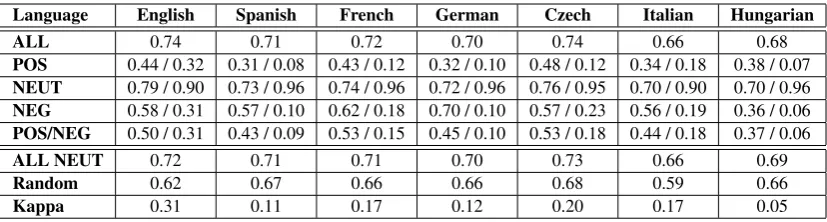
We projected the sentiment polarities in golden standard data to other languages and we ran the sentiment system. Table 2 compares the system results for each language with Random baseline. Another baseline is when all cases are attached to the most frequent neutral class (All NEUT), even if this baseline is not that valuable (no sentiment analysis at all). We can see that the overall agree-ment with golden standard was from 66% (Italian) to 74% (English and Czech). The best two per-forming languages are the ones with all steps of dictionary creation finished. In all languages the system performed better than the Random line and on the same level as the ALL NEUT base-line. Kappa shows the difference to random agree-ment. It uncovers the poorest performing language - Hungarian, for which we currently have only raw triangulated dictionaries. Thus this evaluation can serve as a task-based evaluation of the quality of sentiment dictionaries: best performing English and Czech (the most advanced dictionaries) are followed by French, Italian, German and Spanish, in which the lack of all morphological variants re-sults in lower recall, with Hungarian at the end of the list. The cases on which the system fails to capture the right polarity can be found in the pre-vious section. Consider the subjective terms like rescue,positive testingorwinning trumf.
Another observation is that the system performs better on negative statements than on positive ones. We think that the reason is that the gap be-tween the negative and the neutral class is larger than the gap between the positive and the neutral class.
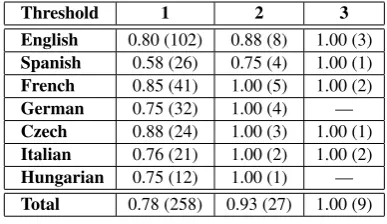
The per-case sentiment assignment works at the 70% level. However, it goes down if we do not consider the neutral cases - around 50%. And this is exactly what we are interested in and these are the cases that we are going to summarise and show in the news monitoring system. The question is: Is this performance good enough to assess sentiment expressed in news towards an entity? We try to answer it by the following experiment. We
gath-Threshold 1 2 3
English 0.80 (102) 0.88 (8) 1.00 (3) Spanish 0.58 (26) 0.75 (4) 1.00 (1) French 0.85 (41) 1.00 (5) 1.00 (2)
German 0.75 (32) 1.00 (4) —
Czech 0.88 (24) 1.00 (3) 1.00 (1) Italian 0.76 (21) 1.00 (2) 1.00 (2) Hungarian 0.75 (12) 1.00 (1) — Total 0.78 (258) 0.93 (27) 1.00 (9)
Table 3: Precision of aggregated sentiment for each entity across the corpus for three different thresholds which divide POS/NEG sentiment from NEUT.precision(No. of entities)
ered all mentions of an entity in the corpus, em-ulating the time period. We computed how many times the entity was mentioned positively and neg-ative in the golden standard. The difference would be its aggregated score (e.g. -2 means there were two more negative mentions than positive). We do the same with the system annotations. If both the golden standard and the system attached the same polarity to the entity we consider it as a correct answer. Because we process large amounts of ar-ticles every day, precision is more important than recall. Also, aggregated values close to zero are the most dangerous. One mistake in polarity as-signment can invert the polarity of the whole en-tity within the time period. Thus, we experimented with different thresholds. For example threshold 2 means that we need the aggregated value to be at least 2 to consider the entity positive, resp. -2 to consider it negative. We report only the cases in which both the system the golden standard re-ported a non-neutral value to remove the border-line unreliable cases (Table 3). We can observe that with the basic threshold (1) we correctly clas-sified 78% entities and by lifting the threshold up to 2 the system reached the performance of 93%. The only wrongly classified entity for English was al-Qaeda. While annotators assigned to this en-tity clearly negative overall sentiment (-5), many difficult cases led the system to a positive overall sentiment (+2). We did not find any wrong case in which the system did not agree on polarity with the golden standard with threshold 3. Testing higher thresholds would require analyzing a larger set.
6 Conclusion
con-Language English Spanish French German Czech Italian Hungarian
ALL 0.74 0.71 0.72 0.70 0.74 0.66 0.68
POS 0.44 / 0.32 0.31 / 0.08 0.43 / 0.12 0.32 / 0.10 0.48 / 0.12 0.34 / 0.18 0.38 / 0.07 NEUT 0.79 / 0.90 0.73 / 0.96 0.74 / 0.96 0.72 / 0.96 0.76 / 0.95 0.70 / 0.90 0.70 / 0.96 NEG 0.58 / 0.31 0.57 / 0.10 0.62 / 0.18 0.70 / 0.10 0.57 / 0.23 0.56 / 0.19 0.36 / 0.06 POS/NEG 0.50 / 0.31 0.43 / 0.09 0.53 / 0.15 0.45 / 0.10 0.53 / 0.18 0.44 / 0.18 0.37 / 0.06
ALL NEUT 0.72 0.71 0.71 0.70 0.73 0.66 0.69
Random 0.62 0.67 0.66 0.66 0.68 0.59 0.66
Kappa 0.31 0.11 0.17 0.12 0.20 0.17 0.05
Table 2: System’s results on the parallel corpus. The cells that correspond to POS, NEUT, NEG and POS/NEG rows contain precision/recall figures.
tributed to resources of the sentiment community by building the multilingual sentiment dictionar-ies and annotating the parallel corpus. Working on parallel data enabled to evaluate such a system in many languages with a little annotation effort and, also, the results are comparable across the languages. The evaluation also serves as a task-based evaluation for sentiment dictionaries.
Our system is language-independent, although it needs to be fed by sentiment dictionaries for each language. So far, we created dictionaries for 15 languages with varied quality, however, we have capabilities to further improve the resources. The final goal is to feed the output of the sentiment analysis into the news monitoring system in all the 50 languages it supports.
Even if discovering the right polarity of senti-ment towards an entity in a sentence is a difficult task and the system’s results for non-neutral cases are modest, per-entity sentiment aggregation leads to precise conclusions when used carefully.
References
A. Balahur, R. Steinberger, M. Kabadjov, V. Zavarella, E. van der Goot, M. Halkia, B. Pouliquen, and J. Belyaeva. 2010. Sentiment analysis in the news.
InProceedings of LREC.
C. Banea, R. Mihalcea, and J. Wiebe. 2008. A boot-strapping method for building subjectivity lexicons for languages with scarce resources. InProceedings
of LREC.
K. Dave, S. Lawrence, and D. Pennock. 2003. Mining the peanut gallery: Opinion extraction and semantic classification of product reviews. In Proceeding of
WWW.
V. Hatzivassiloglou and J. Wiebe. 2000. Effects of ad-jective orientation and gradability on sentence sub-jectivity. InProceedings of COLING.
S.M. Kim and E. Hovy. 2004. Determining the senti-ment of opinions. InProceedings of COLING.
S.M. Kim and E. Hovy. 2006. Extracting opinions, opinion holders, and topics expressed in online news media text. InProceedings of the ACL Workshop on Sentiment and Subjectivity in Text.
P. Koehn. 2002. Europarl: A multilingual corpus for evaluation of machine translation. In Unpublished draft.
R. Mihalcea, C. Banea, and J. Wiebe. 2007. Learning multilingual subjective language via cross-lingual projections. InProceedings of ACL.
B. Pang, L. Lee, and S. Vaithyanathan. 2002. Thumbs up? sentiment classification using machine learning techniques. InProceeding of EMNLP.
J. Steinberger, P. Lenkova, M. Ebrahim, M. Ehrman, A. Hurriyetoglu, M. Kabadjov, R. Steinberger, H. Tanev, V. Zavarella, and S. Vazquez. 2011. Cre-ating sentiment dictionaries via triangulation. In
Proceedings of the ACL’s WASSA Workshop.
M. Turchi, J. Steinberger, M. Kabadjov, and R. Stein-berger. 2010. Using parallel corpora for multilin-gual (multi-document) summarisation evaluation. In
Proceedings of CLEF.
X. Wan. 2008. Co-training for cross-lingual sentiment classification. InProceedings of ACL.
J. Wiebe and R. Mihalcea. 2006. Word sense and sub-jectivity. InProceedings of COLING-ACL.
J. Wiebe, T. Wilson, and C. Cardie. 2005. Annotating expressions of opinions and emotions in language.
Language Resources and Evaluation, 39(2-3).
T. Wilson, J. Wiebe, and R. Hwa. 2004. Just how mad are you? finding strong and weak opinion clauses. InProceeding of AI.
M. Van Zaanen, A. Roberts, and E. Atwell. 2004. A multilingual parallel parsed corpus as gold standard for grammatical inference evaluation. In Proceed-ings of The Amazing Utility of Parallel and