Learning Subjectivity Phrases missing from Resources
through a Large Set of Semantic Tests
Matthieu Vernier, Laura Monceaux, Béatrice Daille
LINA - CNRS UMR 6241 – University of Nantes
2, rue de la Houssinière BP 92208, 44322 NANTES CEDEX 03, France
[email protected], [email protected], Bé[email protected]
Abstract
In recent years, blogs and social networks have particularly boosted interests for opinion mining research. In order to satisfy real-scale applicative needs, a main task is to create or to enhance lexical and semantic resources on evaluative language. Classical resources of the area are mostly built for english, they contain simple opinion word markers and are far to cover the lexical richness of this linguistic phenomenon. We propose a new method, applied on french, to enhance automatically an opinion word lexicon. This learning method relies on linguistic uses of internet users and on semantic tests to infer the degree of subjectivity of many new adjectives, nouns, verbs, noun phrases, verbal phrases which are usually forgotten by other resources.
1.
Introduction
Web 2.0 as a free expression area has literally boosted interests for opinion mining research. Through blogs and social networks (Twitter, Facebook), users share their sentiments and give media coverage to their points of view to influence their communities. In computational linguistic, blogs are more often used as a support study for opinion mining (Mishne and Glance, 2006) (Conrad and Schilder, 2007) (Kessler and Nicolov, 2009) but are more complex to process than text reviews according to (Liu, 2009). Like in the recent text mining challenge (DEFT’09), a current problem is to annotate fine-grained subjective segments (Wilson, 2008) instead of classifying text, then to categorize different semantic aspects of these segments and to detect evaluated targets (Stoyanov and Cardie, 2008) (Ruppenhofer and al., 2008).
In this context, Apopsis (Vernier and al., 2009b) is a tool for fine-grained subjective segments detection and categorization : axiological polarity, discursive role (assessment, judgement, agreement, disagreement, etc.), enunciative strategy, speaker engagement (does he assume his subjectivity or does he try to hide it ?). This tool is based on a french lexico-semantic resource built manually (982 entries). It was evaluated qualitatively and quantitatively on a corpus of 100 blogs and during the DEFT’091evaluation campaign (Vernier and al., 2009a) where it obtained the best results. These tests show a good precision (from 0.80 to 0.90) but average quality on the quantitative aspect (recall is around 0.50). The resource coverage is the main factor explaining undetected opinions.
In this article, we focus specifically on this issue by presenting a learning method, applied on french, to learn automatically new words and phrases of subjectivity. We attach a particular importance to not bring down the quality of the initial manually-built resource. The learning method relies on document contents indexing by a search engine and results given in response to a large set of queries. The construction of these queries, linguistically motivated,
1http://deft09.limsi.fr/
can infer the subjective degree of many new adjectives, nouns, verbs, noun phrases, verbal phrases. In particular, we argue that this method is able to learn less frequent but meaningful words and phrases of subjectivity which are usually forgotten by other resources and which can be relevant for real applicative tasks.
Several important works in opinion mining have led to create rich lexical ressources manually or semi-automatically : WordNet-Affect (Strapparava and Valitutti, 2004), SentiWordNet (Esuli and Sebastiani, 2006). As noticed by (Banea and al., 2008), these resources are only available for a handful of languages and especially for english. In order to get round the cost of manual creation of such resources, some promising approaches try to determine automatically word’s degree of subjectivity (Banea and al., 2008) or word’s polarity (Turney, 2002) with the idea that word’s polarity can be identified by measuring its co-occurrence with some words whose polarity is known in advance, if a given word occurs with a high probability with a positive (negative) words it can be considered subjective and positive (negative). Results obtained by these methods are interesting but are not able to cover and detect all subjective segments in texts. In particular, these methods are not made for learning infrequent words, subjective phrases or subjective collocations built with objective words : bol d’oxygène(≈ a breath of fresh air),bourreau de travail(≈work-a-holic). However, some infrequent words or subjectives phrases are particularly meaningful in appraisal language. The purpose of our work is to take account of these points to enhance the initial french opinion word lexicon.
2.
Opinion Word Lexicon
2.1. Linguistic definitions of subjectivity andevaluation
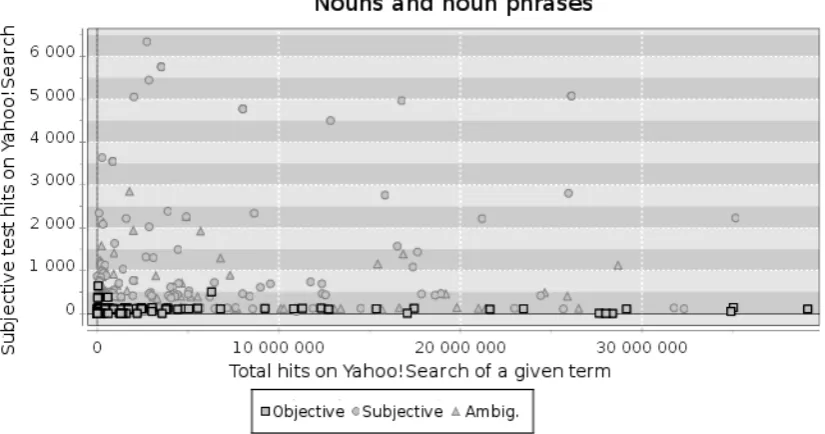
Figure 1: Nouns and noun phrases distributions (with human-judge categorizations) along two axes : number of hits of a given noun (X) and number of hits of the given noun with an intensity marker (Y) in Yahoo!Search Index.
phrases. For each term, human-judges have to decide if the candidate is : subjective(S),objective (O) orambiguous without context(A). The agreement (0.70) is measured with Fleiss Kappa (Fleiss, 1971). Table 2 shows examples of words classified by human-judges.
In the training dataset, several attributes are automatically added to each candidate : we mesure pointwise mutual information between each intensity marker (x) and each candidate (y) considering number of hits given by Yahoo!Search.
SI(x, y) =log hit(x, y) hit(x)hit(y)
As an example, the adjective anglais (english) can be subjective : the value ofhit(x, anglais) is more than 500, buthit(anglais)is more than 300.000.000, so this adjective might not be a good candidate for the lexical resource.
4.3. Supervised classification of new terms
In a two-dimensional representation, figure 1 shows distributions of nouns and noun phrases classified by human-judges along two axes :
• Y : number of hits of an intensity marker followed by a given term (semantic test of subjectivity) (ex : littéralement pété les plombs (1 330 hits) (literally flip my lid(70 hits))
• X: number of hits only for the given term (ex :péter les plombs(78 700)) (flip my lid(23,700 hits))
Two-dimensional representations of verbs/verbal phrases and adjectives are equivalent to figure 1. From the training dataset and for each grammatical category, we trained a Support Vector Machine (Joachims, 1997) classifier to search for an optimal hyperplan. Then, we apply the
classification function to separate subjective and objective candidates in the initial list of 24,500 terms.
5.
Evaluation
type number examples (random selection)
Adject. 596 larmoyant (whining), exorbitant (exorbitant), opiniâtre (≈ obstinate, bulldog), lunatique (moody person), incestueux (incestuous), cocace (comical), famélique (scrawny), infantile (childish), subversif (subversive)
Nouns, noun phrases
1,390 régal (delight), fléau (plague), plébiscite (plebiscite), camouflet (poking), marée humaine (≈ human tide), descente aux enfers (descent into hell), gain de temps (time-savings), cacaphonie (cacophony), bouffée d’air frais (breath of fresh air), capharnaüm (≈shambles, souk)
Verbs, verbal phrases
488 jouer un rôle décisif (≈to play a decisive role), faire basculer le match (≈to change the momentum of a game)), subjuguer (to subjugate), voler la vedette (≈ to steal the show), toucher le fond (to plomb the depths), ovationner (≈to greet somebody with wild applause)
Table 3: Examples of terms added to lexicon (ramdom selection).
mixte symbolique et statistique. InActes de l’atelier de clôture du 5ème Défi Fouille de Textes (DEFT’09), pages 101–112, Paris, France, June.
Matthieu Vernier, Laura Monceaux, Béatrice Daille, and Estelle Dubreil. 2009b. Catégorisation des évaluations dans un corpus de blogs multi-domaine. In Numéro spécial de la revue RNTI (Revue des Nouvelles Technologies de l’Information) - fouille de données d’opinion.