Classifying Action Items for Semantic Email
Simon Scerri
1, Gerhard Gossen
1, Brian Davis
1, Siegfried Handschuh
1 1Digital Enterprise Research Institute, National University of Ireland Galway IDA Business Park, Galway, Ireland.
E-mail: [email protected], [email protected], [email protected], [email protected]
Abstract
Email can be considered as a virtual working environment in which users are constantly struggling to manage the vast amount of exchanged data. Although most of this data belongs to well-defined workflows, these are implicit and largely unsupported by existing email clients. Semanta provides this support by enabling Semantic Email – email enhanced with machine-processable metadata about specific types of email Action Items (e.g. Task Assignment, Meeting Proposal). In the larger picture, these items form part of ad-hoc workflows (e.g. Task Delegation, Meeting Scheduling). Semanta is faced with a knowledge-acquisition bottleneck, as users cannot be expected to annotate each action item, and their automatic recognition proves difficult. This paper focuses on applying computationally treatable aspects of speech act theory for the classification of email action items. A rule-based classification model is employed, based on the presence or form of a number of linguistic features. The technology’s evaluation suggests that whereas full automation is not feasible, the results are good enough to be presented as suggestions for the user to review. In addition the rule-based system will bootstrap a machine learning system that is currently in development, to generate the initial training sets which are then improved through the user’s reviewing.
1.
Introduction
A lot of work in today’s business environments depends on online communication. Tasks are created, managed and delegated; meetings requested and scheduled; important data exchanged – all via online communication media and on a daily basis. Communication media like email and instant messaging (IM) have become essential virtual working environments wherein people manage large amounts of data within a multitude of implicit workflows. Keeping track of these workflows is not easy, and frequently people become inundated with too much data than they can possibly handle – a problem termed as information overload (Whittaker & Sidner, 1996). As a result, questions get ignored, commitments forgotten and in general, collaboration and ultimately productivity suffer. There have been numerous attempts at automatically extracting action items, to-do’s and general commitments from text pertaining to electronic conversations, especially with regards to ones taking place over email. In particular we have worked on models (Scerri & Handschuh & Decker, 2008) that conceptualise these items and outline their expected workflows. These models were implemented within Semanta – extensions to popular email clients which strive to support the user with the management of email workflows (Scerri et al., 2009). However, from a practical point of view Semanta cannot rely on the end-user to recognize, classify and annotate each single email action item. Therefore at the least, partial automation is required. In this paper we introduce a rule-based classification model that classifies email segments into a predetermined set of action items, and discuss the results of its evaluation.
2.
Background
The set of action items used for the classification of email text1are instances of the Speech Act Model provided in the sMail Framework – a conceptual framework for semantic email, and presented in earlier work (Scerri et al., 2008). This model is based on aspects of the Speech Act Theory (Searle, 1969), which states that every utterance implies an action by the speaker with varying effects on both the speaker and the hearer. When applied to electronic conversations, the sender and the recipient perform the roles of the speaker/hearer whereas textual phrases function as utterances. Action items in the model consist of three parameters:
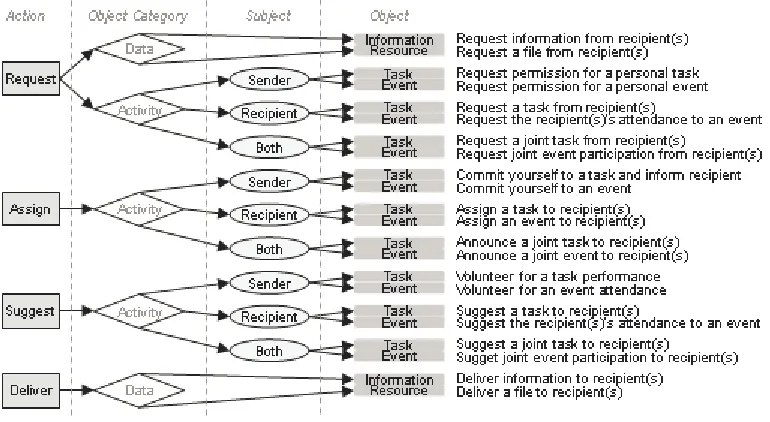
Action – what is being performed e.g. a request, a notification or an assignment Object – the object of the action e.g. a request for a meeting Subject – the subject/agent of the object if applicable e.g. who will/would attend the meetingActions consist of Request – an action requiring a reply from the recipient (e.g. a question); Assign – an action requiring an activity but no reply (e.g. an order or a commitment); Suggest – an action involving an optional activity; and Deliver – the action of delivering data. Objects are categorised into Activities (Task and Event) and Data (Information and Resource). The subject parameter is only applicable to activities (being the task performer(s) or the event participant(s) – i.e. Sender, Recipient, Both). Thus, a request for permission to attend
1
an event is represented as a (Request, Event, Sender), an order to perform a joint task as an (Assign, Task, Both), and a request for information can be represented as a (Request, Information, Ø). The basic 22 combinations of these parameters (i.e. the email action items) together with a brief description are shown in Fig. 1.
When applied in practice the model can generate more combinations, as in reality the subject will be a member of the power set of the sender and all recipients e.g. (Request, Event, {Sender, Recipient1, Recipient2,...,
Recipientn}) for a joint event request involving the
sender and two other contacts. The model in question was evaluated in an experiment which measured the inter-annotator agreement between human annotators (Scerri et al., 2008). The annotators had the task of identifying instances of the 22 action items within email from an email corpus. The resulting agreement rate, at 0.811, proved that our model was more appropriate for the task in hand than earlier speech act theory-inspired models, such as Carvalho & Cohen (2006). However, the result indicates the difficulty of the classification task, even when performed by humans.
3.
Classification Model
The implemented technology for the automatic classification of email action items is based on a classification model that considers the following 5 linguistic, grammatical and syntactical features:
Modality – Sentence modality deals with different phrase types, of which we consider the following three: Declaratives, Imperatives and Interrogatives. Whereas most interrogative sentences/clauses are easily recognised by the presence of a question mark at the end, to differ between the two remaining types our classification model considers modal verbs (e.g. must,
will), especially those expressing the concepts of Possibility and Necessity, which are roughly equal to our ‘Suggest’ and ‘Assign’ actions respectively.
Verb Category – Verbs are used to express an Action, an Occurrence or a State of being. Since we attempt to recognise action items, our main interest is action verbs. Our model differs between the following two categories of action verbs, which we refer to as Activity Verbs - representing events and tasks (e.g. go, prepare); and Communicative Verbs - implying actions specific to electronic communication (e.g. send, forward, attach).
Grammatical Tense – The tense morpheme specifies the time at/during which the descriptive content of the sentence in question holds (Ogihara, 2007). There are different opinions when it comes to categorizing tenses in the English language (Comrie, 1985). We adhere to the two-tense approach – Past and non-Past, as we are mostly interested in actions that occur in the non-past.
Negation – From a pragmatic point of view, negation usually expresses the exact opposite of what otherwise the statement would convey, i.e. impossibility instead of possibility, prohibition instead of permissibility (Moeschler, 1992). Both nouns and verbs can be negated via the use of a negative adjective, a negative pronoun or a negative adverb.
Semantic Role – When dealing with action verbs we are interested in the subject of that action. We are concerned with the semantic rather than grammatical roles, i.e. the Agent and the Patient. The grammatical person for both roles - First, First Plural, Second or Third Person has also a bearing on the classification task.
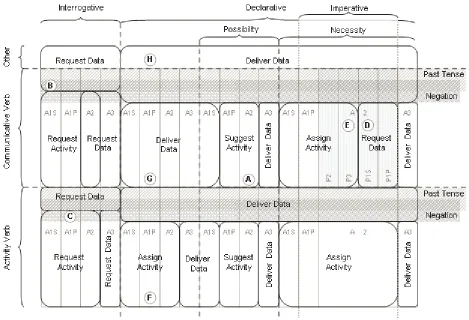
The model as depicted in Fig. 2. is only meant to provide an insight of how all the previous features can all be factored in to attempt a decision on what action item best represents a piece of text. The illustration breaks down the linguistic space into a number of dimensions, given the presence/form of the above features. Grammatical clauses are classified into exactly one of the resulting classification classes (action items). For simplification purposes, we do not include all 22 classes in the figure, but instead abstract over five broad categories which disregard the different object types and the subject parameter entirely. The resulting five categories are thus equivalent to the five pairs of ‘action - object category’ in Fig. 1, i.e. Request Data, Request Activity, Suggest Activity, Assign Activity and Deliver Data.
Modality splits the space vertically into interrogatives and declaratives. We further differentiate between declarative statements having a possibility modal, those having a necessity modal (which subsume imperative statements) and the rest. The space is split horizontally between communicative verbs, activity verbs and their complement. Statements having activity or communicative verbs are segmented given the agent semantic role where A1S stands for Agent 1st Person Singular; A1P for Agent 1st Person Plural; and A2, A3 for Agent 2nd and 3rd Person respectively. In order to keep the figure as simple as possible the patient role (similarly P1S, P1P, P2, P3) only features in one quadrant , in order to provide adequate examples in the
next section. Negation and Grammatical Tense (past tense) are represented as (overlapping) horizontal shades of grey across statements with communicative and activity verbs.
In the following two subsections we will first demonstrate how the classification model can in theory be employed to classify textual clauses into a specific action item, followed by a description of its practical implementation.
3.1 Classification Examples
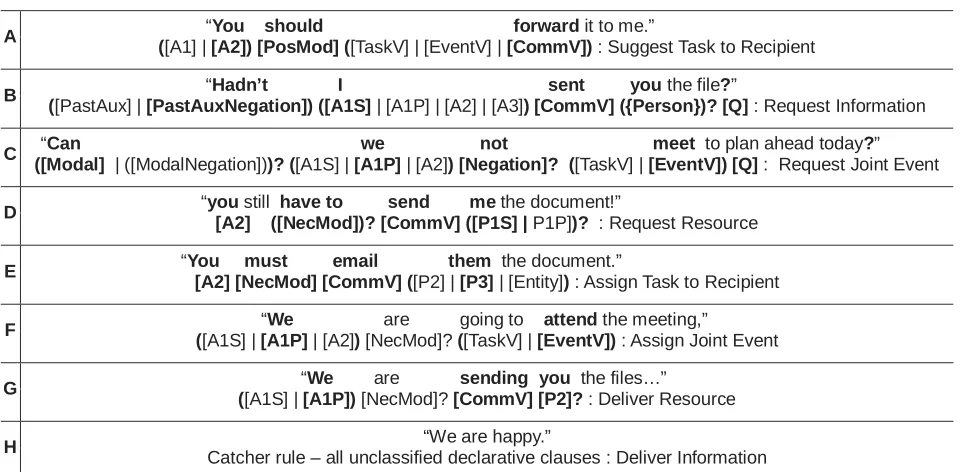
Table 1 demonstrates how the classification model can be employed via eight practical examples. The examples are matched against one of the implemented pattern rules (in BNF style2) as introduced in the next subsection. The bold tokens in example A are matched against the LHS of the rule below to classify as a task suggestion action item (Suggest, Task, Recipient); were “You” is recognised as a second person agent, “should” as a possibility modal, and “forward” as an (electronic) communicative verb. The classification can be mapped to Fig. 2 by focusing on the intersection between the horizontal communicative verb segment and the vertical declarative/possibility modal segment. The presence of a second person agent in the text places it in its shown position in Fig. 2-Ex. A. As the action item categories in the figure disregard the subject parameter, the statement
2
http://foldoc.org/?Backus-Naur+Form
is shown as a Suggest Activity.
The question mark at the end of example B indicates an interrogative statement. The “sent” verb being of type communicative, preceded by a first person agent would have placed the sentence in the Request Activity quadrant in Fig. 2-B. However the question's past tense, identified by the verb and the past auxiliary “Hadn't” reduces it to a simple information request action item (Request, Information, Ø) within the Request Data category. Although the past auxiliary is negated, negation alone would not have effected the statement. Thus “Won't I send you the file?” or “Will I not send you the file” would still have classified as a personal task request action item.
Example C is similar to B, with the difference that the verb “meet” is recognised as a non-past activity verb. Being an interrogative, this places the statement in the lower horizontal segment. Although “Can” is recognised as a modal verb, these verbs only effect non-interrogative statement. Once again, negation does not effect the classification in this case, and the presence of the first person plural agent “we” results in a joint event request action item (Request, Event, Both) shown as a Request Activity in Fig.2-C.
Examples D and E are both declarative statements with a necessity modal, and they differ only with respect to the patient role. Whereas D is a request for the recipient (second person agent - “you”) to perform a communicative action verb (“send”) to the sender (first person singular patient - “me”), E is a request for the recipient to perform a communicative action (“email”) to a third party (third person patient - “them”). Whereas D is classified as a resource request (Request, Resource, Ø), E is classified as a task assignment action item (Assign, Task, Recipient). The resulting difference in classification is also illustrated in Fig. 2, mapped to the
broader categories of Request Data (Fig.2-D) and Assign Activity (Fig.2-E).
Example F and G differ mostly due to the verb type. The presence of a first person plural agent (“We”) followed by a non-past activity verb (“attend”) classifies as a joint event assignment (Assign, Event, Both) as shown by Fig.2-F. Instead, G includes a non-past communicative verb (“sending”) followed by a second person patient (“you”). This classifies the statement as a resource delivery action item (Deliver, Resource, Ø), shown in Fig.2-G as an instance of the Deliver Data category. All non-interrogative clauses which remain unclassified by the implemented pattern rules, e.g. example H, are classified as an information delivery (Deliver, Information, Ø), also shown as a Deliver Data in Fig.2-H. However, as any non-action item would be classified as an information delivery, instances of this class are not returned to the user for review.
3.2 Implementation
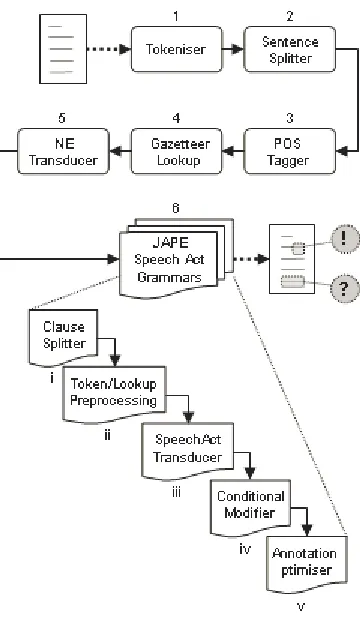
The classification model has been implemented as a rule-based classifier in GATE (Cunningham et al., 2002). The classifier consists of an ANNIE Corpus IE Pipeline. The pipeline (Fig. 3) consists of a:
1) Standard GATE English Tokeniser
2) Standard Sentence Splitter
3) Standard Hepple POS Tagger
4) ANNIE Gazetteer Lookup
5) Standard Named Entity Transducer
6) JAPE Speech Act Grammars Set Table 1: Examples of text as classified by rules based on the classification model
A “You should forward it to me.”
([A1] | [A2]) [PosMod] ([TaskV] | [EventV] | [CommV]) : Suggest Task to Recipient
B “Hadn’t I sent you the file?”
([PastAux] | [PastAuxNegation]) ([A1S] | [A1P] | [A2] | [A3]) [CommV] ({Person})? [Q] : Request Information
C “Can we not meet to plan ahead today?” ([Modal] | ([ModalNegation]))? ([A1S] | [A1P] | [A2]) [Negation]? ([TaskV] | [EventV]) [Q] : Request Joint Event
D “you still have to send me the document!”
[A2] ([NecMod])? [CommV] ([P1S] | P1P])? : Request Resource
E “You must email them the document.”
[A2] [NecMod] [CommV] ([P2] | [P3] | [Entity]) : Assign Task to Recipient
F “We are going to attend the meeting,”
([A1S] | [A1P] | [A2]) [NecMod]? ([TaskV] | [EventV]) : Assign Joint Event
G “We are sending you the files…”
([A1S] | [A1P]) [NecMod]? [CommV] [P2]? : Deliver Resource
H “We are happy.”
Catcher rule – all unclassified declarative clauses : Deliver Information
After the text is tokenised and split into sentences, it is forwarded to the POS tagger, which assigns a part of
speech category to each token. In particular, the POS tagger recognises past tense verb inflections. The gazetteer lookup performs customised finite state lookup for key-phrases, including trigger words/phrases for linguistic features such as negation, modal verbs, grammatical person and our two different verb categories. The Named Entity Transducer performs named entity identification and is particularly useful in the recognition of person references in the text.
The set of hand-coded Java Annotation Patterns Engine (JAPE) (Cunningham & Maynard & Tablan, 2000) grammars is the most important component in the pipeline. The grammars provide pattern rules such as the ones provided for the examples in Table 1. The rules match combinations of the linguistic/semantic annotations output by the previous components in the pipeline, to classify clauses into one of our action items. The grammars themselves constitute a cascade of finite state transducers over patterns of annotations, such that the output of one transducer becomes the input of the next, as follows:
i.
The Clause Splitter is a personal modification of the sentence splitter that splits sentences into individual clauses on which we perform classification.ii.
The Clause Splitter is a custom modification of thesentence splitter that splits sentences into individual clauses – upon which we want to perform classification our classification.
iii.
Token and Lookup Preprocessor binds special kinds of tokens/gazetteer entries to intermediate annotations (e.g. groups modal verbs, grammatical persons by category)iv.
The Speech Act Transducer matches combinations of intermediate annotations to a one of the model’s speech act class. This is were most of the pattern matching is performed.v.
The Conditional Modifier changes some of the identified action items based on preceeding/succeeding conditional modifiers, e.g. the presence of an ‘if-then’ clause before an identified task assignment, changes the classification to a task suggestion or a task request, depending on the context.vi.
The Annotation Optimiser extends action items to cover whole sentences, and to group together consecutive identical items.Each JAPE transducer consists of a collection of phases which in turn contain pattern/action rules. The left hand side (LHS) of the rule is written in BNF style, similar to the examples in Table 1, whereas the right hand side (RHS) consists of annotation-binding variables within a block of JAVA code, which can subsequently be manipulated as desired. JAPE rules can fire in various ways depending on the desired behavior e.g., based on textual ordering, priority or longest match. The Speech Act Transducer alone consists of 58 rules within 14 different phases, such that text matched in the initial phases may not be considered later.
4.
Evaluation
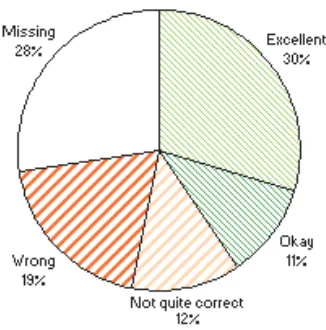
To evaluate our classification rules, we wanted to compare automatically- to manually-generated annotations. We employed twelve people to review automatic annotations generated for at least 8 email messages. The evaluators were introduced to the available classification classes (Fig. 1) prior to the task. The evaluation page, with a link to the active web service is available online3.The reviewing consisted of rating the classified action items, and annotating the missing action items manually. Each action item returned could be rated using a 4-point Likert scale, two for correct annotations and two for false positives. The reason for multiple positive and negative ratings is that the classes for the classification task are not always
3
Applications. In Proceedings of ACL’02. Philadelphia, USA.
Cunningham, H., Maynard, D., Tablan, K. (2000). JAPE: a Java Annotation Patterns Engine (2nd ed.). Technical Report CS, pp. 00--10. University of Sheffield, UK. Fišel, M. (2007). Machine learning techniques in
dialogue act recognition. Estonian Papers Applied Linguistics.
Forsythand, E.N., Martell, C.H. (2007). Lexical and Discourse Analysis of Online Chat Dialog. In Proceedings of ICSC’07. pp.19—26.
Li, Y., Zaragoza, H., Herbrich, R., Shawe-Taylor, J, Kandola, J. (2002). The Perceptron Algorithm with Uneven Margins. In Proceedings of the 9th International Conference on Machine Learning. pp. 379--386.
Moeschler, J. (1992). The pragmatic aspects of linguistic negation: Speech act, argumentation and pragmatic inference. Argumentation, 6(1), pp. 51—76.
Ogihara, T. (2007). Tense and Aspect in Truth-conditional Semantics. Lingua, 117(2), pp. 392--418. Scerri, S., Davis, B., Handschuh, S., Hauswirth, M.
(2009). Semanta – Semantic Email made easy. In Proceedings of ESWC’09. Crete, Greece.
Scerri, S., Handschuh, S., Decker, S. (2008). Semantic Email as a Communication Medium for the Social Semantic Desktop. In Proceedings of ESWC’08. Tenerife, Spain.
Scerri, S., Mencke, M., Davis, B., Handschuh, S. (2008). Evaluating the Ontology underlying sMail - the Conceptual Framework for Semantic Email Communication. In Proceedings of LREC’08. Marrakech, Morocco.
Searle, J. (1969) Speech Acts. Cambridge University Press.
Whittaker, S., Sidner, C. (1996). Email overload: exploring personal information management of email. In Proceedings of CHI’96.Vancouver, BC Canada, pp. 276--283.