Surgery Scheduling with Limited
Physical Resources
Master’s thesis
D. Buitelaar
November 2007
Surgery Scheduling with Limited
Physical Resources
D. Buitelaar
University of Twente
November 16, 2007
Master’s thesis
Industrial Engineering & Management
Production & Logistics Management
University of Twente, Enschede, The Netherlands
Supervisors:
Dr. ir. E.W. Hans, University of Twente, Enschede, The Netherlands
Dr. J.L. Hurink, University of Twente, Enschede, The Netherlands
Voorwoord
Na zeven jaren studeren is het zover: Dennis wordt burger. De studiecombinatie van Technische Natuurkunde met Technische Bedrijfskunde is misschien niet de meest voor de hand liggende, maar voor mij wel één die prima bevallen is! De techniek en wiskunde op een begrijpelijke manier in de praktijk brengen heb ik altijd een mooie uitdaging gevonden. Voor mijn afstudeeropdracht wilde ik dan ook graag in een ziekenhuis aan de slag, omdat dit nog een andere invalshoek oplevert: de zorg.
De inhoud van mijn onderzoek staat beschreven in dit verslag. Een onderzoek en verslag waar ik behoorlijk trots op ben! Hard werken, veel meemaken en leren. Natuurlijk heb ik bij het neerzetten van dit resultaat veel hulp gehad van de mensen om mij heen. Deze mensen wil ik nu graag even bedanken.
Zonder Erwin Hans en Johann Hurink had ik natuurlijk nooit in deze korte tijd zoveel resultaten kunnen boeken. Aanwijzingen over systematisch werken, zaken duidelijk beschrijven en wiskundige methoden en notaties hebben mij enorm geholpen. Ook in mijn toekomstige werk zal ik nog veel terugdenken aan de aanwijzingen en opbouwende kritieken.
In het ziekenhuis hebben Kars Tolsma en Günter Fürst mij aan de gang geholpen en richting gegeven. Zij hebben mij verteld waar het ziekenhuis mee worstelde, en hoe ik daarbij kon helpen. De mensen op de OK wil ik bedanken voor hun uitleg over alles wat er op de OK gebeurt, en voor de mooie dingen die ik heb mogen zien tijdens operaties. In het bijzonder wil ik Martin van Veen bedanken voor zijn tijd en “inside information” over planning op de OK. Jessey en Ria, Nanda, Claudia, Marion en Sylvia bedankt voor alle ondersteuning en de gezellige lunches! Alle getallen die ik in mijn onderzoek gebruik, komen bij Niels vandaan: bedankt voor je tijd en doelgerichte aanpak. Mijn buurman Bernd wil ik bedanken voor alle goede ideeën en suggesties, zowel voor mijn onderzoek als op persoonlijk gebied.
In Enschede heb ik een geweldige studententijd gehad, dankzij de mensen om me heen: studiegenoten waar ik terecht kon om eens te vragen hoe het er bij andere afstudeeropdrachten aan toe ging en natuurlijk Piranha, waar ik mij ’s avonds en in de weekenden lekker kon uitleven (op de tegenstander en op onze eigen keepers). Mijn ouders wil ik graag bedanken omdat zij me de kans hebben gegeven in mijn eigen tempo te studeren en op mijn eigen manier te leven. Tot slot wil ik mijn lieve vriendin Gillian bedanken voor alle ontspannende filmavondjes, ontnuchterende aanwijzingen voor mijn verslag en haar geduld bij het luisteren naar mijn (vele) oefenpresentaties.
Table of Contents
1 Introduction ... 2
2 Context and position of this research in the literature ... 4
2.1 Management levels ... 5
2.1.1 Strategic management level ... 6
2.1.2 Tactical management level ... 7
2.1.3 Operational offline management level ... 7
2.1.4 Operational online management level ... 8
2.2 Resource capacity planning at the operational offline level ... 9
2.2.1 Performance ... 9
2.2.2 Planning processes ... 11
2.2.3 Possibilities of the planner ... 12
2.2.4 Constraints on the surgery schedule ... 15
2.2.5 ICT at the hospital ... 19
3 Problem Description ... 20
3.1 Creating the Surgery Schedule ... 20
3.2 Formal Problem Description ... 21
4 Solution Description ... 23
4.1 General solution description ... 23
4.2 Phase 1: level the load of the resources over the days of a week ... 24
4.2.1 Algorithm 1 (level the load) ... 25
4.2.2 Algorithm 2 (level the load, single OR days first) ... 26
4.3 Phase 2: schedule surgeries on a day ... 27
4.3.1 Algorithm 3 (schedule X-ray surgeries as early as possible) ... 28
4.3.2 Algorithm 4 (schedule “trains” of X-rays) ... 30
4.3.3 Algorithm 5 (schedule “trains” of X-rays without scheduling in overtime) ... 32
5 Numerical Experiments ... 35
5.1 Numerical data ... 35
5.2 Experiments ... 37
5.3 Results ... 39
5.4 Sensitivity analysis ... 40
Surgery Scheduling with Limited
Physical Resources
November 2007
Abstract
Limited availability of physical resources at the Operating Room (OR) department
results in waiting times between surgeries. We develop elective surgery scheduling algorithms
to increase efficiency of the OR department by reducing the waiting time.
The two most influential performance indicators that the management of the OR
department uses, are utilization and the amount of overtime in the ORs. The objective is to
increase utilization and to decrease the amount of overtime. We propose multiple algorithms
to schedule surgeries that require a physical resource, either as early as possible, or clustered
together as much as possible.
We demonstrate that our approach reduces the amount of waiting time between
surgeries, increasing efficiency of the OR department. This outcome results from
computational experiments performed in collaboration with Isala klinieken Zwolle, the largest
non-academic hospital in the Netherlands. This hospital provided us with historical data.
1
Introduction
This research was initiated by the management of the Operation Room and Intensive Care
department (OR/IC) of the hospital Isala klinieken Zwolle. OR/IC management is confronted
with the problem of a low efficiency of their OR departments causing high expenditure in
terms of employee salary, material costs and vacancy costs. In today’s setting of a new social
health care system, ageing society, long waiting lists and increasing competition between
healthcare institutions [Hans, 2007], efficiency becomes more and more important. In this
research we focus on the operating department of location Sophia to find ways to improve this
In 1998, Isala klinieken was formed by the merger of two hospitals: the hospital “Sophia”
(SZ) and the hospital “De Weezenlanden” (WL). Isala klinieken is the largest, non-academic
hospital in the Netherlands with 5,900 employees and 1,000 beds. Each year, Isala klinieken
attends to more than 475,000 outpatient visits and almost 40,000 admissions. Besides the base
care the hospital provides, Isala klinieken is also a top clinical hospital and an educational
hospital [Isala, 2007]. Isala klinieken and the individual departments are constantly looking
for ways to improve their efficiency to be able to deliver top quality cure and care, at an
acceptable price.
Availability of personnel and material resources is one of the many constraints the surgery
schedule has to comply with. At location SZ, the main difficulty in creating a surgery
schedule is the availability of resources. To investigate the effect new methods of surgery
scheduling have on the efficiency of the OR department, we develop scheduling algorithms
that create surgery schedules specifically optimized to the availability of the most critical of
the physical resources: the X-ray machine.
Unexpected events such as the arrival of emergency patients and surgeries that take longer
than expected lead to delays and, as a consequence, personnel has to wait for resources to
become available. The goal of this research is to increase efficiency of the OR department
Therefore, we define the following problem statement:
“How can the OR department’s efficiency be improved?”
To find ways to improve the OR department’s efficiency, we pose the following research
questions:
1. How does the management of the OR department define and measure efficiency? 2. What is the OR department’s efficiency at this moment?
3. How are the planning processes at the OR department currently organized? 4. How can we efficiently schedule surgeries and surgery resources?
a. What are the possibilities to adjust the surgery schedule?
To determine how management of the OR department defines and measures efficiency, we
give corresponding results answering question (1) in the first part of Section 2.2.1. To
compare the results of our research with the actual performance indicators, we determine the
current levels of performance of the OR department. Investigations to question (2) are
presented in the last part of Section 2.2.1. Furthermore, we need to determine how we can
influence the performance indicators. The answer to research sub question (3) we give in
Section 2.2.2 leads us to focus the research on planning and scheduling of surgeries and
resources at the operational offline level. We focus on this level in research sub question (4).
We determine the possibilities of the surgery planner to change the surgery schedule and
describe these possibilities in Section 2.2.3. We also determine the constraints the surgery
schedule has to comply with. We describe these constraints in Section 2.2.4. In Section 3.1 we
restate the processes, possibilities and constraints we take into account in this research,
leading to a formal problem description in Section 3.2. Section 4 describes various solution
approaches. To test the performance of these solution approaches, we perform discrete event
simulations. Section 5 presents the results of these simulations. Section 6 gives the
conclusions based on the results of the simulations and reflections on the results.
2
Context and position of this research in the literature
In this section we describe the context of our research at Isala klinieken, and the position this
research takes in the relevant literature. Hans, Van Houdenhoven, and Wullink (2006)
propose a hospital planning and control framework. The framework consists of four
managerial areas and four hierarchical levels. Figure 1 gives a graphical representation of this
Strategic
Figure 1: Framework for Hospital Planning and Control [Hans et al., 2006]
At Isala klinieken, the same levels and areas are distinguished. Therefore, we describe the
context of this research in terms of this framework. To clarify the position of this research in
the framework, we briefly describe all hierarchical management levels proposed by [Hans et al., 2006] in Section 2.1. For each level, we give a short description of the four managerial areas. The descriptions of the four levels at Isala klinieken have been written in collaboration with hospital employees (e.g. surgery planners and OR management). From this collaboration,
it became clear the surgical schedule has to comply with a large number of resource
constraints: at least 35 have been identified by the surgery planners. As the surgery schedule
has to comply with this large number of constraints, creating a surgery schedule poses a
complex challenge. Therefore, we focus our research on Resource Capacity Planning at the
Operational Offline level. Figure 1 highlights this level in red. We describe this level in more
detail in Section 2.2.
2.1 Management levels
The framework proposed by [Hans et al., 2006] describes the interaction between four levels of control within the hospital. To position our research in the framework, we briefly describe
the four hierarchical levels in this section. To clarify the position of the OR department within
the hospital, the OR department is highlighted in red in the organizational chart of the hospital
Counsil of Supervisors
* This structure is the same for the other care groups
CT = Care Teams
OC = Enterprise Counsil
OC
Figure 2: Organizational chart of Isala klinieken, Zwolle [Isala, 2007]
We describe the highest level, strategic planning, in Section 2.1.1. The next level translates
the mission determined at the strategic level into medium-term objectives. We describe this
level in Section 2.1.2. The third level is the operational offline level. This level creates
detailed plans and schedules to control day-to-day activities. We describe this level in Section
2.1.3. The fourth level is the operational online level. This level monitors and reacts to
disturbances to the offline schedule. We describe this level in Section 2.1.4.
2.1.1 Strategic management level
The highest managerial level aims at the hospital’s long term goals. At this level, the mission
of the hospital is determined. At Isala klinieken, managers at the strategic level decide about:
• Medical planning: e.g. the decision to educate and train medical students at Isala
klinieken.
• Resource capacity planning: capacity dimensioning. For example the patient mix at
Isala klinieken is a strategic decision: a large number of relatively standard
procedures, in combination with complicated, non-standard, top clinical procedures.
surgery duration and surgery duration variability. For example Kerkkamp (2006)
suggests splitting up different patient-flows throughout the hospital can improve the
hospital performance.
• Material coordination (e.g. decisions on whether or not to outsource ICT)
• Financial planning (e.g. agreements with insurance companies and investing in a new building)
2.1.2 Tactical management level
The tactical management level defines medium-term objectives, based on the decisions made
at the strategic level. Examples of decisions taken at this level at the managerial areas defined
by [Hans et al., 2006] are:
• Medical planning: determining protocols for the process before the surgery can take place.
• Resource capacity planning: capacity allocation. The time available at the OR
department to perform surgeries is assigned to the surgical specialties according to the
“closed block” method described by [Hans, 2007]. This results in a “Room Opening
Plan” (ROP). The ROP is a weekly schedule that defines per OR on a daily basis, the
specialty that is scheduled to perform surgeries in that OR. We present the ROP for
location SZ of Isala klinieken in Section 5.1.
• Material coordination: selecting a supplier for medical equipment.
• Financial planning: determining and allocating budgets to departments within the
hospital.
2.1.3 Operational offline management level
Managers at the operational offline level create detailed plans and schedules for resources and
materials for a time horizon of typically 1 to 2 weeks. The adjective “offline” means the plans
and schedules are created before actually executing them. Examples of activities at this level
• Medical planning: diagnosing a broken leg and planning of an orthopedic surgery.
• Resource capacity planning: capacity assignment. Assign material and personnel
resources (e.g. IC beds, surgery assistants and X-ray machines) needed to perform
surgeries. Research by [Hans, 2006] suggests the performance at the OR department
can be improved by taking the portfolio effect into account during the creation of a
surgery schedule at the operational offline level. This means scheduling surgeries with
highly variable surgery durations together in one OR as well as scheduling surgeries
with less variable surgery durations together.
• Material coordination: purchasing prostheses for orthopedic surgeries.
• Financial planning: billing the costs of an X-ray used during an orthopedic surgery.
This research focuses on resource capacity planning in particular at the operational offline
level. In Section 2.2 we describe for this level the planning process, the constraints on the
surgery schedule, the possibilities to change the schedule, the current performance of the OR,
and the way information regarding patients and surgeries is handled.
2.1.4 Operational online management level
This level deals with monitoring and reacting to unforeseen or unanticipated events. This
means that during the execution of the plans and schedules created in the operational offline
phase, disturbances such as emergency surgeries can occur. The 4 managerial areas of [Hans,
2006] at this level deal with:
• Medical planning: diagnosing an emergency patient that has just arrived at the
hospital.
• Resource capacity planning: monitoring and changing the surgery schedule because an
emergency patient has to be operated immediately.
• Material coordination: rush ordering of cleaned materials at the Central Sterilization Department (CSD).
• Financial planning: changing the bill for a surgery if complications arise during
Summary of the Management levels
In the previous subsections we discussed management in the hospital at four different levels
of control. The highest level describes the hospital at the strategic level. The second level
describes the decisions that influence the OR department at a tactical level. The third level
describes the way plans and schedules are created for the OR department at an operational
offline level. At the fourth level the plans and schedules created at the Offline level are
monitored and adjusted during execution.
2.2 Resource capacity planning at the operational offline level
Creating a surgery schedule at the operational offline level is complex due to the many
constraints the surgery schedule has to comply with. In this section, we therefore describe the
current surgery planning processes, the constraints that apply to the surgery schedule, the
possibilities to change the surgery schedule, the current performance of the OR and the way
information regarding patients and surgeries is currently handled. This information is used in
Section 3 and 4 to respectively formulate a formal problem description and to propose
algorithms to create surgery schedules.
To allow us to compare the performance of the proposed algorithms, we describe the current
performance of the OR in Section 2.2.1. To determine what we can change to improve the
performance of the OR department, we describe the constraints the surgery schedule has to
comply and the possibilities to change the surgery schedule in respectively Section 2.2.2 and
2.2.3. We describe the surgery planning process in Section 2.2.4 and the way information
regarding patients and surgeries is handled in Section 2.2.5.
2.2.1 Performance
The performance of the OR department is measured by performance criteria such as the
utilization of the ORs, and the amount of overtime. As we want to compare the performance
of the algorithms we propose in Section 4, we first describe how the performance of the OR
department is measured. Second, we describe how performance is influenced by changing the
Performance measurement
Management of the OR department uses three performance indicators: utilization of the
operating rooms, amount of overtime, and the number of cancelled elective surgeries. In the
following the former two indicators are specified formally:
[
B,E]
: time interval each OR is openedK : set of all elective surgeries in a year
{
}
overtime is not counted
B E
h= − : total regular time per day the OR department is opened
D : set of days in a week the OR department is carrying out elective surgeries
U = : utilization of the operating rooms
dj
The total actual duration of all surgeries in a year is calculated by calculating the difference
between the completion time and the start time of each surgery performed and adding these
individual durations. However, if the completion time of a surgery is outside regular opening
of the utilization U. This means that the part of the surgery that is performed outside regular
opening hours is not taken into account as surgery time. Changeover times between surgeries
are also not taken into account as surgery time. This also means that U >1can never occur in
practice. The maximum value for U therefore depends on the number of changes that occur
between surgeries. Each time a changeover occurs, the OR is unavailable for surgeries, and so
U decreases. Overtime occurs when surgeries finish after the planned closing hour E for the
ORs. Reasons that overtime occurs may be that surgeries take longer than expected or
emergency surgeries arrive. If at some point of the day it is expected that a next surgery may
lead to overtime, it may be decided to cancel the surgery. This decision to cancel a surgery is
left to the surgery planner and medical personnel.
Influence of the schedule on the performance
The two performance indicators valued most by the management of the OR department are
utilization and overtime. Optimizing both utilization and overtime however leads to a
trade-off. For example, optimizing the surgery schedule just to maximize the utilization leads to
completely filling the OR day with surgeries and planning surgeries in overtime to make sure
the OR performs as many surgeries as possible on a day, thus maximizing the utilization and
at the same time creating a surgery schedule that leads to a large amount of overtime.
Minimizing the amount of overtime and maximizing the utilization are opposing goals:
increasing the utilization by scheduling more surgeries increases the risk on overtime, and
decreasing the risk on overtime by scheduling fewer surgeries will decrease the utilization. As
it adds to the risk of overtime and cancelled surgeries, scheduling surgeries in overtime is not
allowed. We explain the current practice of creating the surgery schedule in more detail in
Section 2.2.2.
2.2.2 Planning processes
In this section we describe the process of creating a surgery schedule. This process start at the
moment a specialist decides a patient needs surgery, and stops at the moment the surgery
finishes.
When a specialist decides a patient needs surgery, the outpatient clinic of the specialty this
specialist belongs to puts this patient on a surgery list. The administration department of this
specialty has to make a provisional surgery schedule based on this list; this means creating a
the specialty. Hereby the following is taken into account: are all the urgent, unscheduled
patients on the list, does the total expected duration of the surgeries on the list fit within the
surgical time available to the specialty, and are the surgeons (of that specialty) available for
the surgery. After making this provisional surgery schedule, the administration department
sends it to the central planner of the OR department. When the central planner has obtained all
the provisional schedules from the specialties, he performs further feasibility checks
considering materials and personnel, time limits and constraints specific for a certain type of
surgery such as the type of anesthetic that has to be used. If the surgery schedule complies
with all constraints, the central planner approves this schedule. If one or more constraints are
violated, he tries to change the schedule in such a way that the schedule becomes feasible.
After the central planner has made the adjustments, he sends the schedule back to the
specialties so the administration departments can inform the specialists and the patients. From
that moment on, the schedule is final. Adjustments can now only be made due to unexpected
circumstances such as emergency patients, patients that do not show up, or surgeries that are
cancelled.
Summary of the processes
The administration departments of the specialties create a provisional surgery schedule and
deliver this schedule to the central planner. The central planner then checks the schedule for
feasibility together with the schedules of the other specialties. If necessary, the central planner
changes the schedule until it complies with the constraints.
2.2.3 Possibilities of the planner
In order to create a feasible surgery schedule, the OR planner has multiple possibilities to
adjust the schedule, e.g. a surgery can be scheduled in another OR, or the sequence of
surgeries in an OR can be altered. The exact degrees of freedom available to the OR planner
are discussed in this section
As described in Section 2.2.2, the surgery schedule is created in different phases. First, the
central planner receives the schedules from the specialties and tries to create a complete,
feasible schedule out of these partial schedules. In [Hans et al., 2006] this phase is part of the operational offline scheduling. Changes made to the schedule during the offline phase do not
affect the patients personally, as the patients are not yet informed about the day and time of
scheduling. Changes can also be made during execution of the schedule. The schedule is
adjusted due to the arrival of emergency patients, surgeries that take less or more time than
expected, and other unexpected circumstances. The patient knows the approximate time he is
scheduled for surgery. Changes to the schedule made during this phase can therefore directly
affect the patient. This occurs for example when a surgery takes longer than expected.
Patients scheduled after this surgery potentially have to wait for their surgery to start.
There are three options to change the surgery schedule if it is not feasible:
1. Exchange surgeries within an OR-day. This option only changes the sequence of the
surgeries that are performed in one OR on one day. It is mainly used to solve problems
with availability of personnel and materials.
Example:
At location SZ, two X-ray machines are available to the OR department. In the current
surgery schedule, three surgeries need an X-ray machine at the same time. In some cases
this can be solved by changing the sequence in one or more ORs in such a way that the
surgeries that need an X-ray machine are spread more evenly over the day. When this
option is used during the online planning, it can have rather large effects on the patient’s
surgery experience. Suppose a surgery is scheduled at 9:00, but due to an exchange this
surgery is delayed until 16:00, this will cause a lot of discomfort to the patient.
Furthermore, as time progresses, fewer possibilities remain to exchange surgeries, as
many of the surgeries have already been performed. At 9:00, surgeries during the whole
day can be exchanged, but at 15:00, only a few surgeries still have to be performed.
Hence, fewer possibilities remain to make changes. Therefore, the number of possibilities
to resolve conflicts decreases as the day progresses.
2. Schedule the surgery in another OR. A surgery is moved to another OR, or two surgeries
are exchanged across two ORs. This again can solve problems such as availability of
personnel and materials if the surgery times change as well. Moreover it can solve
problems involving the combination of two surgeries in ORs next to each other.
Example:
One anesthetist can handle two surgeries at a time in adjacent ORs. When a surgery is
very intense, such as most child surgeries, an anesthetist can only assist at one surgery at a
OR or the second OR has to remain empty during the intense surgery. Changing between
ORs does not have a large effect on the patient’s experience, if the scheduled surgery time
does not change too much. If the start time of the procedure does change, it has the same
effect on the patients experience as in the first option.
3. The third option is to cancel the surgery. If no other way can be found to make the
schedule feasible, a surgery has to be cancelled. This is not the preferred way to solve a
problem, as it creates many other problems. When a surgery is cancelled during the
operational offline phase, the surgery has to be scheduled for another day and usually the
administration department can schedule another surgery instead of the original one. When
the surgery is cancelled during the operational on-line period the surgery also has to be
scheduled for another day, and on top of that the patient has to be informed that his
surgery will not take place that day. No matter what the reason for the cancellation is, the
patient will dislike it.
One or more possibilities to change the schedule can also be combined. This occurs for
example when two surgeries in one OR are exchanged as the surgery schedule does not
comply with the constraint of X-ray machines. The schedule resulting from this exchange can
contain a combination of surgeries in two ORs next to each other that are not acceptable to the
anesthetist: Therefore, two surgeries can be exchanged between different ORs to comply with
the wishes of the anesthetist.
Summary of the possibilities
We distinguish three possibilities to adjust the surgery schedule. First, the sequence of the
surgeries that are performed within one OR on one day can be changed. Second, the surgeries
can be exchanged across ORs. Third, a surgery can be removed from the schedule, i.e.
cancelling the surgery. During operational offline planning, changes to the schedule and even
cancelled surgeries will not be noticed by the patients, as the patients do not know yet when
they are scheduled for surgery. The changes made during the operational online planning
however directly influence the patient’s experience in the hospital. Therefore, the number of
2.2.4 Constraints on the surgery schedule
The dependencies within the OR department and between the OR department and other
departments lead to many constraints on the surgery schedule. We describe the following
types of constraints: time, material, personnel, and the types of ORs available.
Time constraints
Time constraints have multiple causes and effects on the surgery schedule. First, we describe
restrictions to the time available in an OR during one OR day. Second, we describe
restrictions to the moment a surgery starts or completes.
Available time
The OR department opens every morning at 8:00 and the patient scheduled for the last surgery
that day has to arrive at the recovery ward before 16:45. The expected duration of surgeries at
Isala klinieken is based on the average surgery duration of the last 10 surgeries of that type
performed, calculated per surgeon. The surgeries with the shortest and longest duration are
left out, so effectively the average of 8 surgeries performed by the surgeon involved is
calculated. The surgery planning system used at Isala klinieken, MCC, adds 10 minutes
changeover time for each surgery. If the central planner deems it necessary, he will add
another 15 minutes changeover time. This is done for example when very young children are
involved. These patients need extra care during begin and end of the surgery. In terms of time
constraints, a schedule is feasible as long as the total expected duration of the surgeries
planned in any OR does not exceed the available time in that OR.
Start and completion time of surgical procedures
This type of constraint is mostly caused by connections between the OR and other
departments of the hospital. For some surgeries, another department has to perform certain
actions prior to the operation, or another department is needed after surgery. E.g. for oncology
operations, the pathologist-anatomist (PA) is often needed directly after surgery to examine
the tissue that has been removed. The tissue has to be delivered to the pathologist-anatomist
before 16:30; otherwise he does not have enough time left that day to examine it. For the OR
this means that this type of surgery cannot start after 14:30: it has to be scheduled earlier.
Other examples include surgeries that require nuclear research, and surgeries performed on
Resource constraints
Similar to the time constraints we described in the previous section, resource constraints have
multiple causes and effects. To explain why we focus this research on X-ray machines, we
first describe two types of resources. In Section 4 we propose a solution that specifically aims
to tackle the “Oil Stain effect” for the X-ray machines. Therefore, we also give a brief
description of the “Oil Stain effect”.
Different types of surgery resources
Different types of resources are needed before, during and after the surgery. The first type of
resource we describe includes for example an Intensive Care bed. This is usually reserved
prior to surgery if the surgeon expects his patient to go to Intensive Care after this type of
surgery. Therefore, the IC bed has to be ready before the patient comes out of surgery and the
bed can be in use for days after the surgery. This means one surgery can influence the surgery
schedule of the next day. The second type of resource we describe includes the X-ray
machine. This machine is needed strictly during surgery, so this resource only has to be
available from the moment the surgery starts until the moment it ends. We also assume that
whether an X-ray machine is needed during surgery is known before the surgery starts.
Therefore, while creating the surgery schedule, the surgeries that require an X-ray machine
are known. Taking into account resources that can be in use before and after the surgery itself,
makes the problem more complex as surgeries then can influence the surgery schedule on
other days as well. Therefore, in this research we only take into account the type of resource
that is in use only during the surgery (e.g. an X-ray machine).
Oil Stain effect
One specific difficulty with resources such as X-ray machines is that problems in one OR can
lead to delays in other ORs.
Example:
An X-ray machine is in use during a surgery in OR 1. This surgery is expected to finish at
11:00. At 11:00, another surgery has to start in OR 1, and the X-ray machine is needed for a
surgery in OR 2. During the surgery in OR 1 however, complications arise and these lead to a
longer surgery duration. The surgery now finishes at 12:30. The delay of one surgery affects
two other surgeries: the next surgery in OR 1 has to wait until the OR becomes available, and
If a surgery that uses the X-ray machine takes longer than expected to finish, the effect of this
can spread through the OR department like an oil stain. This is particularly difficult to cope
with for the people who are waiting for the X-ray machine, but are unable to influence the
surgery causing the delay. Therefore, we propose algorithms that aim to minimize the “Oil
Stain effect” in Section 4.
Personnel Constraints
Personnel at the OR all have specific competences and authorizations. Therefore, each task
has a limited number of people able and authorized to perform this task. This limits the
possibilities of deploying personnel. Besides obvious limitations concerning medical
personnel (e.g. surgeons and nurses) there are limitations to other types of personnel as well.
For example, operating the X-ray machine requires personnel with a radiation certificate.
During regular opening hours of the OR department, sufficient personnel to operate two X-ray
machines is available. When surgeries that require an X-ray machine run late and have to be
performed in overtime, this means personnel operating the X-ray machine have to work
overtime as well. For each specialty, a percentage of the surgeries requires an X-ray machine.
In Section 5.1 we discuss these percentages.
At location SZ, surgeries that require an X-ray machine are hard to schedule as there are only
two X-ray machines available, and many surgeries performed at SZ require an X-ray machine.
In some cases this problem can be easily solved by changing the sequence of the surgeries on
one day such that no more than two sessions that require an X-ray machine are scheduled at
the same time. When this is not possible, there are other possibilities to try and solve this
problem. The planner can try to arrange for extra personnel to operate an X-ray machine. In
some cases, the surgeon performing the surgery has the radiation certificate needed to operate
the X-ray machine. In that case, the surgeon can take over the tasks of the radiation personnel.
Taking this into account would increase the complexity of the problem. For our research, we
assume a fixed capacity of the X-ray machines.
Usually, one anesthetist assists at two surgeries at the same time (two-room system).
However, if the anesthetist indicates a surgery as very intense, the anesthetist has to be fully
available for that surgery alone. This means that during this surgery, the anesthetist is not
available for a second operating room and this room is unavailable for surgeries during that
time. For example surgeries performed on children often require more attention from the
scheduled in a room next to an emergency room as that would mean that during the child
surgery, the emergency OR is unavailable for surgeries.
OR constraints
At the clinical OR department at location SZ, seven elective ORs and one emergency OR are
available. Each specialty operating at SZ receives a fraction of the total elective OR time
available, according to the “closed block” method [Hans, 2007]. The amount of time a
specialty gets depends on the amount and length of the surgeries it expects to perform during
the planning horizon. After the amount of OR time per specialty has been determined, it is
divided over the seven elective ORs available. The seven elective ORs are largely identical
and can be used interchangeably if needed. However, there are some differences (e.g. size,
equipment) that make some ORs preferable to certain surgeries. For example an orthopedic
surgery during which a hipbone is replaced is preferably done in a large OR, because of the
large and heavy equipment needed during surgery. Such preferences are taken into account
during the assignment of ORs to specialties to create a ROP. In case of emergency surgeries,
the surgery planner can deviate from the ROP. This complicates the problem of scheduling
surgeries. Therefore, we assume the ROP to be binding during our research. This means that
all OR-days in the ROP are dedicated to one specialty. Surgeries of a specialty can only be
performed during an OR-day of that specialty.
Handling of emergency patients
The two locations of Isala klinieken differ in the way emergency patients are handled. As
most of the emergency surgeries are performed at location SZ, a dedicated emergency OR is
available at this location. At location WL such a dedicated emergency OR is not available:
emergency procedures are performed in the same ORs as elective surgeries. As this research
focuses on location SZ, in this section we describe how the arrival of semi-urgent surgeries
influences the elective surgery schedule. To describe the influence of emergency surgeries,
we distinguish two types of emergency surgeries, i.e. emergency and semi-urgent surgeries.
Emergency surgeries have to be performed at the moment of arrival. For example a ruptured
aorta has to be treated immediately because it is a life threatening condition. When an
emergency surgery arrives, the impact on the elective surgery schedule of the day of the
arrival is large as the emergency has precedence over all other surgeries scheduled that day
emergency surgery. However, this type of surgery is very rare. Therefore, we do not include
the effect of emergency surgeries on the surgery schedule in this research.
Semi-urgent surgeries have to be performed within 24 hours after arrival. This type of surgery
does not have precedence over elective surgeries. Semi-urgent surgeries are started when all
resources needed for the surgery are available. If during regular opening hours of the OR
department the resources needed for the semi-urgent surgery are unavailable, it is performed
after opening hours by a team available during the night. A semi-urgent surgery therefore only
influences the elective surgery schedule if an elective surgery later during the day needs a
resource in use for the semi-urgent surgery.
2.2.5 ICT at the hospital
The surgery schedule is monitored by a planning system called MCC. This system graphically
displays the surgery schedule in a Gantt-chart. The information needed to schedule the
surgeries is gathered from various other departments. We describe the process of scheduling
the surgeries in the Section 2.2.2. In this chapter we separately describe the ICT related parts
of the process and possible difficulties occurring during this part of the process.
Information regarding the surgeries that are to be scheduled has to be available to schedule
surgeries. This information includes the expected duration of the surgeries, name of the
patient, name of the surgeon, and the type of surgery to be performed. The information is
available from different information systems in use at Isala klinieken. We describe the 6
information systems used most frequently at the OR department in Table 1.
Table 1. ICT systems in use at Isala klinieken
Information system Function Developed by
MCC Surgery planning and
database system
Meierhofer (Germany)
EriDanos Electronic Patient Record Isala klinieken, in-house IZIS Waiting list data and patient
demographic information
Isala klinieken, in-house
Mediscore Scores the ICU patients health
Itémedical
Ultragenda Agenda for specialists Ultragenda IVAS Financial registration of
Diagnostic-Related Group (DRG)
Each of these information systems contain and collect data regarding patients and surgical
procedures. They are all suitable to perform tasks specific to the department using it. The OR
department requires specific information regarding patients and the surgical procedures that
have to be performed. The required information has to be gathered by the OR department
from the other information systems in use. Some of the information systems are linked, so the
information is transferred automatically from one information system to another, however, not
all information systems are. The information from the information systems that are not linked
has to be manually transferred to the OR department to create the surgery schedule. During
the process of transferring data manually, errors can easily be made. Information can be
inaccurately copied, or overlooked. This causes difficulties creating a surgery schedule. The
surgical schedule is based on the data available to the planner, so any incomplete or incorrect
data can lead to conflicts when the surgical schedule is executed.
Summary of ICT
The surgery schedule is based on information gathered from various ICT systems in use at the
hospital. The information has to be transferred from the different information systems to the
OR department. Inconsistencies may occur during this process, leading to a schedule based on
incomplete, incorrect or inaccurate data. The resulting schedule can be optimal or near
optimal but during execution of the schedule conflicts may arise because of differences
between the schedule and reality.
3
Problem Description
In this section we describe how surgeries are loaded and scheduled in the current practice of
location SZ of hospital Isala klinieken. This is done by creating surgical schedules per
specialty based on the information locally available to the administration departments of the
specialties, and then merging these local schedules into one central surgical schedule. In
Section 3.1 we describe the process of scheduling the surgeries, taking into account that a part
of these surgeries requires an X-ray machine. In Section 3.2 we give a formal description of
this problem.
3.1 Creating the Surgery Schedule
Surgery schedules are created one week in advance. The administration departments of the
schedule contains the surgeries that have to be performed during the next week by the
specialty. The administration department only takes into account the information available at
the administration department locally. The administration department schedules as many
surgeries as possible, within the surgical time available to the specialty. As information about
general OR department resources (e.g. X-ray machines, OR personnel) is unavailable to the
administration departments, these provisional schedules can cause problems when the central
surgery planner merges them into one surgery schedule. The central planner tries to create a
schedule that contains all the surgeries in the provisional schedules. However, if for example
availability of the X-ray machines prohibits this (e.g. because it leads to scheduling surgeries
outside the surgical time available to the specialty performing the surgery) surgeries can be
removed from the schedule. As the decision to remove a surgery from the schedule is taken by
the planner in collaboration with medical personnel, we assume for our model that all
surgeries in the provisional schedule have to be scheduled in the central surgery schedule. In
Section 4 we propose algorithms that create a surgery schedule centrally to avoid problems
with availability of the X-ray machine.
As the availability of the X-ray machine can also cause problems during the execution of the
surgery schedule (e.g. the oil stain effect, explained in Section 2.2.4) we propose algorithms
in Section 4 to create surgery schedules aimed at avoiding these problems.
3.2 Formal Problem Description
The problem consists of scheduling a given set of K
(
k =1KK)
surgeries, in J(
j =1KJ)
operating rooms, over a fixed time horizon, discretized into W
(
w=1KW)
weeks. As eachweek poses an independent problem, we describe the problem for one week.
The set Kw ⊂K denotes the surgeries that have to be carried out in week w. Each week W
w∈ consists of D
(
d =1KD)
days. The set of ORs available on day d is de noted by Jd. We refer to a combination of a day d and an OR j as an OR day, i.e. {(j,d)| j∈Jd}. The set(
s S)
S =1K consists of the surgical specialties. For each surgery k it is given by which
specialty sk ∈
{
1,K,S}
this surgery has to be performed. For each OR day( )
j,d it is specified to which surgical specialty s∈{
1,K,S}
the OR j is entirely dedicated on day d ofdenotes the ORs on day d available to specialty s (where ORDay Jd d
s
d
s = ∀
∑
, , ). The ORdays are assigned to the specialties according to a schedule: the Room Opening Plan (ROP).
For each surgery k∈K the expected total surgery duration μk is given. Some surgeries require an additional resource R from the hospital (e.g. an X-ray machine during surgery).
Therefore, let subset KR,w ⊂ Kw contain all surgeries that require resource R in week
W
w∈ . Resource R has to be available from the start of the surgery until the end of the surgery. There are CR units of resource R available.
Each regular OR day starts at B and ends at E. If surgeries are performed after the end time of
OR j on day d, we refer to this time as overtime Oj,d. In practice, the OR planner of Isala klinieken in coordination with medical personnel can decide to cancel surgeries if overtime is
expected to occur. In our research however, as cancelling a surgery is only done in
collaboration with medical personnel, we assume each surgery k∈K has to be performed.
The problem now is to decide for each surgery on which OR day and at what time it is to be
performed in order to minimize the expected total overtime
∑
d
encompasses both the surgery loading and scheduling problem.
A surgery schedule is feasible if the following constraints are satisfied:
• Surgeries can only be scheduled in an OR day dedicated to the specialty that performs
those surgeries.
• Surgeries can only be scheduled to start in an OR day in the interval
[
B,E]
, i.e. thesurgeries have to start during regular opening hours of the OR department.
• For surgeries that require an X-ray machine it holds that: the surgery can only be
scheduled if an X-ray machine is available for this surgery, i.e. the number of X-ray
machines in use at the same time does not exceed the number of available X-ray
machines.
Summarizing, for each week w, we create a surgery schedule for the surgeries in Kw. The surgery schedule for week w gives for each surgery k∈Kw in which OR j and on which day d the surgery has to be performed, and at what time the surgery is scheduled to start. For each
surgery in the schedule the resource requirement is given.
4
Solution Description
In this section we propose solution algorithms for the loading and scheduling of surgeries at
the hospital operating room department. In Section 4.1 we describe the general ideas behind
the solutions and why we split the solution in two phases. In Section 4.2 and 4.3 we
subsequently describe the two phases of the solution approach.
4.1 General solution description
As the X-ray machines often cause capacity problems during the execution of the surgery
schedule, we propose scheduling algorithms that take this resource into account while loading
and scheduling the surgeries. The surgery schedule is created one week in advance. For each
surgery, we have to determine on which day and in which OR it will be performed. Therefore,
we divide the problem into two phases. In Phase 1, we divide surgeries k∈Kw over the days
in that week, keeping in mind the ROP, such that the load of the X-ray machines is leveled
during the days of that week. The outcome of this phase is that for each surgery, the day of the
week the surgery will be performed is determined, and that the load of the X-ray machines is
leveled. In Phase 2, it remains to assign the surgeries to an OR on the day they are performed
and to schedule the surgeries in the OR (i.e., determine a start time for the surgeries).
For both phases, we explore multiple solution approaches. For each approach, we propose
algorithms and we compare the performance of these algorithms in Section 5. The resource
we include in our research is the X-ray machine. However, the algorithms we propose are
generic and can be applied to any resource that is use during the surgery. For Phase 1, we
develop two algorithms to assign the surgeries to a day of the week. For Phase 2, we propose
three algorithms. These algorithms aim to solve difficulties associated with the X-ray
machines. In Section 4.2 we describe the two algorithms for Phase 1. In Section 4.3 we
4.2 Phase 1: level the load of the resources over the days of a week
This section describes the first phase of the loading and scheduling problem. For every
independent sub problem (i.e. every week) the surgeries that have to be performed are given.
The characteristics of these surgeries include surgical specialty, expected duration and
whether or not the surgery needs an X-ray machine during surgery. The goal of this phase is
to assign a day to each surgery, in compliance with the ROP, such that the use of the X-ray
machines during the week is leveled. To level the load of the X-ray machines during the
week, we want to achieve a load per day that is close to the average load per day in the week.
This average load per day in week w is given by:
w
machines are in use on day d. This is calculated by adding the total surgery durations of all
surgeries k assigned to day d requiring an X-ray machine:
∑
To achieve a leveled load per day, we first assign the surgeries that require X-ray to the OR
days in the week, such that the difference between the average load during that week and the
actual load that day is minimized. Hence, the goal function of the first phase is:
∑
To minimize the effect on (3) caused by surgeries with a long duration, we load the surgeries
according to LPT (Longest Processing Time). When all surgeries that require the X-ray
machine are loaded, the surgeries that do not require the X-ray machine are loaded to the OR
days. We describe this algorithm in Section 4.2.1. However, if a specialty has only one OR
day available for surgeries during a week, the surgeries of that specialty can only be loaded on
that OR day. If the surgeries of this specialty are the last surgeries that are loaded, this can
have a negative effect on the goal function (i.e. the surgeries have to be loaded on that day, no
phase. The second algorithm first schedules the surgeries of specialties that have only one OR
day available per week. We describe this algorithm in Section 4.2.2.
4.2.1 Algorithm 1 (level the load)
To avoid peak resource loads on certain days of the week, while other days in that week have
a much lower load, this algorithm loads surgeries in one week on the days in the week,
minimizing the difference between the average load that week and the load per day.
The first algorithm for this phase can be summarized as follows:
Step 1.
Group the surgeries based on whether or not they need an X-ray machine: group 1 contains all surgeries that require an X-ray machine, group 2 contains all surgeries that do not require an X-ray machine.
Step 2.
Sort the surgeries in each group based on non-increasing expected total surgery duration.
k := the first surgery in group 1. Step 3.
Calculate (1). Step 4.
Load k on the day (in compliance with the ROP) which has the lowest resource load so far. Remove this surgery from group 1.
Step 5.
If group 1 still contains surgeries:
k := the first surgery in group 1, continue with step 4
Otherwise: k := the first surgery in group 2, continue with step 6. Step 6.
Step 7.
If group 2 still contains surgeries:
k := the first surgery in group 2, continue with step 6. Otherwise: STOP.
As a result, for every week all surgeries are now allocated to a day and an OR. It remains to
schedule the loaded surgeries in such a way that the capacity restrictions are satisfied. This is
done in Phase 2.
4.2.2 Algorithm 2 (level the load, single OR days first)
This algorithm resembles Algorithm 1, with the addition that Algorithm 2 takes into account
the possibility that specialties have only one OR day available during the week. The surgeries
of a specialty with only one OR day available this week have to be loaded on that OR day.
Loading the surgeries of this specialty later during the algorithm can have a large impact on
the X-ray load on that day. If this occurs on a later stage of the algorithm, the possibilities to
level the load over the remaining days are limited. To avoid this effect, Algorithm 2 first loads
the surgeries of any specialty with only one OR day available. The remaining surgeries that
require an X-ray machine are then loaded to level the load during the week. Algorithm 2 can
be summarized as follows:
Step 1.
Group the surgeries, based on whether or not they need an X-ray machine: group 1 contains all surgeries that require an X-ray machine, group 2 contains all surgeries that do not require an X-ray machine.
Step 2.
Sort the surgeries in each group based on non-increasing expected total surgery duration.
Step 3.
Step 4.
Calculate (1).
k := the first surgery in group 1. Step 5.
Load k on the OR day (with OR days available to the specialty that performs k) which has the lowest resource load so far. Remove this surgery from group 1.
Step 6.
If group 1 still contains surgeries: k := the first surgery in group 1, continue with step 4. Otherwise: k := the first surgery in group 2, continue with step 7.
Step 7.
Load k on the day (with OR days available to the specialty that performs k), according to “best fit”. Remove k from group 2.
Step 8.
If group 2 still contains surgeries: k := the first surgery in group 2, continue with step 7.
Otherwise: STOP.
4.3 Phase 2: schedule surgeries on a day
The result of Phase 1 is that each surgery is assigned to an OR day. In the second phase, we
continue with this solution, but we release the OR assignment. The surgeries remain assigned
to the day they were assigned to in Phase 1, and we reschedule the surgeries on each day to
maximize utilization and to minimize overtime while complying with X-ray capacity
constraints. We propose three scheduling algorithms for this phase. The first algorithm
schedules the surgeries that require an X-ray machine as early on the day as possible,
minimizing the risk of capacity problems with the X-ray machine at the end of the day. We
describe this algorithm in Section 4.3.1. The second and third algorithm both aim at
minimizing the oil stain effect (we described this effect in Section 2.2.4). The second
algorithm schedules the surgeries of a specialty that require the X-ray machine front-to-back
in one OR, forming a sort of “train” of surgeries that require the X-ray machine. We described
require an X-ray machine. However, this algorithm does not allow scheduling surgeries in
overtime. If a “train” of surgeries is too long to fit in one OR day, the surgeries that do not fit
are scheduled in another OR day if another OR day is available. We describe this algorithm in
Section 4.3.3.
4.3.1 Algorithm 3 (schedule X-ray surgeries as early as possible)
Overtime can occur when resource availability problems arise near the end of the day.
Algorithm 3 aims to minimize this effect by scheduling the surgeries that require an X-ray
machine as early on the day as possible. This way, when surgeries that require an X-ray
machine run late, or semi-urgent surgeries that require an X-ray machine come in during the
day, the effect should be minimal. The steps in the algorithm are as follows:
Step 1.
Group the surgeries loaded on this day, based on whether or not they need an X-ray machine: group 1 contains all surgeries that require an X-ray machine, group 2 contains all surgeries that do not require an X-ray machine.
Step 2.
Sort the surgeries in each group based on non-increasing expected total surgery duration.
Step 3.
Set Delta := opening time of the OR department. k := the first surgery in group 1. Step 4.
Schedule k as early as possible, in a suitable OR. Remove k from group 1. Step 5.
If surgery k uses the last X-ray machine available:
Delta := the first time an X-ray machine becomes available. k := the first surgery in group 2. Continue with step 6.
Step 6.
If k can be scheduled such that the expected completion time of k is before Delta: schedule the surgery as early as possible, in a suitable OR. Remove k from group 2. k := the first surgery in group 2. Repeat step 6.
Otherwise, k := the first surgery in group 1. Continue with step 4. Step 7.
If k can be scheduled such that the expected completion time of k is before Delta: schedule the surgery as early as possible, in a suitable OR. Remove k from group 2. k := the first surgery in group 2. Repeat step 7.
If no surgeries are in group 2: STOP.
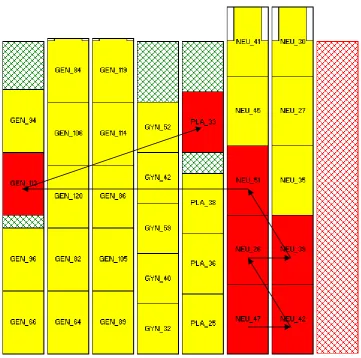
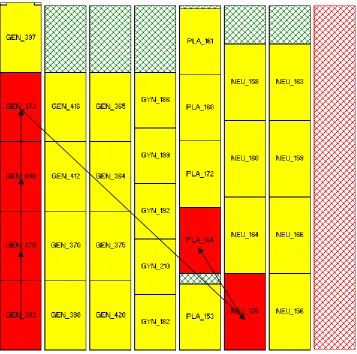
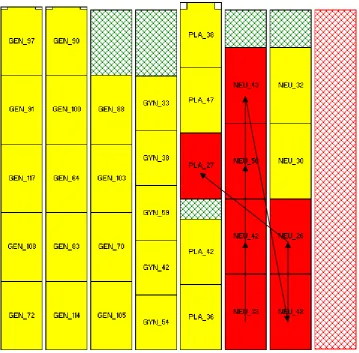
To illustrate the effect of this algorithm, Figure 3 shows an example of a surgery schedule for
one day, created according to Algorithm 3. Each column corresponds to an OR. The columns
with green backgrounds are elective ORs, while the red background indicates an emergency
OR. Columns with a grey background (for example in Figure 4) indicate ORs that are closed
for the day. The bottom of the column corresponds to the opening time of the OR (i.e. 8:00),
whereas the top of the column indicates the closing time of the OR (i.e. 17:00). Surgeries that
end after the closing time are indicated by white bars along the side of the surgery. The
coloring of the individual surgeries indicate whether or not that particular surgery requires an
X-ray machine: red surgeries require an X-ray machine, yellow ones do not. The planning
Figure 3: Example of a surgery schedule, created by applying Algorithm 3
4.3.2 Algorithm 4 (schedule “trains” of X-rays)
In Section 2.2.4 we described the “oil stain” effect: unexpected events in one OR can
influence surgeries in other ORs. For example an X-ray machine is in use during a surgery in
OR 1. If this surgery takes longer than expected, this can have to consequences. First, the
surgery scheduled next in this OR has to wait. Second, the surgery that also requires the X-ray
machine, scheduled in another OR, has to wait until the X-ray machine becomes available.
Algorithm 4 aims to minimize this effect by forming a sort of “trains” of surgeries that require
an X-ray machine. This way, when a surgery that requires X-ray takes longer than expected,
only the surgery in the same OR is delayed. This algorithm can be summarized as follows:
Step 1.
Step 2.
Sort the surgeries in each group based on non-increasing expected total surgery duration.
Step 3.
Set Delta := opening time of the OR department. k := the first surgery in group 1. Step 4.
Schedule k as early as possible, after Delta, in a suitable OR. Remove k from group 1. Schedule the surgeries of the same specialty in group 1 in the same OR. Remove them from group 1.
Step 5.
Delta := the first time an X-ray machine becomes available. k := the first surgery in group 1. Continue with step 4.
If no surgeries are in group 1: k := the first surgery in group 2. Continue with step 6. Step 6.
Schedule k as early as possible, in a suitable OR. Remove k from group 2. k := the first surgery in group 2. Repeat step 6.
If no surgeries are in group 2: STOP.
Figure 4: Example of a surgery schedule, created by applying Algorithm 4
4.3.3 Algorithm 5 (schedule “trains” of X-rays without scheduling in overtime)
The approach of Algorithm 5 is similar to that of Algorithm 4, with one addition. In
Algorithm 4, it can occur that the surgeries in the “train” are scheduled in overtime, as the
surgeries that require an X-ray machine are all scheduled back-to-front in one OR. To
determine the effects of allowing the “trains” to be scheduled in overtime, this algorithm
allows no scheduling in overtime. The steps in Algorithm 5 can be summarized as follows:
Step 1.
Step 2.
Sort the surgeries in each group based on non-increasing expected total surgery duration.
Step 3.
k := the first surgery in group 1. Step 4.
Schedule k, as early as possible after Delta, in a suitable OR. Remove k from group 1.k:= the next surgery of the same specialty in group 1. If k fits in the same OR without creating overtime: schedule k in the same OR. Otherwise, schedule k in another suitable OR day, as early as possible. Remove k from group 1. Repeat step 4. If no surgeries are in group 1: continue with step 5.
Step 5.
k := the first surgery in group 2. Step 6.
Schedule k as early as possible, in a suitable OR. Remove k from group 2. Continue with step 5.
If no surgeries are in group 2: STOP.
Figure 5: Example of a surgery schedule, created by applying Algorithm 5
Summary of the solution algorithms
Scheduling surgeries per week at location SZ of hospital Isala klinieken is decomposed into
two phases. In Phase 1 we level the load of the X-ray over the days of the week. For this
phase we developed two algorithms. Both Phase 1 algorithms aim to achieve a load per day as
close as possible to the average load per day. In Phase 2 the surgeries are scheduled per day.
For this phase we developed 3 algorithms, aimed at minimizing overtime and maximizing the
utilization of the OR department. Table 2 summarizes the phases, corresponding algorithms
and a short description of the algorithms.
Table 2. Overview of the phases and algorithms
Phase Algorithm Description
1 1 level the load
1 2 level the load, single OR days first
2 3 schedule X-ray surgeries as early as possible 2 4 schedule “trains” of X-rays
5
Numerical Experiments
This section describes the numerical experiments we perform to test the solutions we propose
in Section 4. We describe how we gathered and analyzed the data from Isala klinieken in
Section 5.1. We describe how we use these data to test the proposed solutions in Section 5.2.
In Section 5.3 we give the results of the tests. To determine the behavior of the algorithms
under varying circumstances (e.g. more semi-urgent surgeries arrive or the duration of the
surgeries is determined per surgery type instead of per specialty) we perform simulations
based on multiple fictional data instances in Section 5.4.
5.1 Numerical data
The surgeries in the surgery schedule are generated based on characteristics of actual
surgeries performed at location SZ in the period 01-2006 until 07-2007. In this section, we
determine the characteristics of the elective surgeries: mean μ, standard deviation σ , and the percentage of surgeries per specialty of the total number of surgeries. We present the results
of the analysis in Table 3.
Table 3. Mean and Standard Deviation of the Total Surgery Duration per Specialty
Specialty Number of
procedures (%)
Appendix A gives the exact calculations and analyses that result in these numbers. As the
mean of the total surgery duration is based on the actual surgery duration from start to end, it
does not include changeover time. The hospital planning information system plans 10 minutes
of changeover time after each surgery. For the simulations, we therefore add 10 minutes to the
expected total surgery duration of each surgery. To compare the utilization calculated in the
simulation with the utilization as it is used in the hospital, the changeover times of each
surgery has to be subtracted from the total surgery time performed within regular opening
The number of specialties and the descriptives can be adjusted in the software. This way, for
example the effect of changing surgery times and new specialties can be explored easily.
Also, the total number of surgeries can be adjusted and the effects of an increasing patient
volume can be investigated.
At location SZ, two identical parallel X-ray machines are available on each day. For each
surgery, we determine whether this surgery requires an X-ray machine, based on the
percentage of the specialty surgery volume that requires an X-ray machine. We determined
this percentage per specialty in collaboration with the hospital’s OR planner. Table 4 presents
the percentage for all specialties s∈S and the semi-urgent surgeries.
Table 4. X-ray probabilities per Specialty
X-ray surgeries (%) General Surgery 15
Gynecology 1 Plastic Surgery 11
Neurosurgery 50 Orthopedic Surgery 95
Children Surgery 1 Semi-urgent Surgery 40
In this research, we focus on one resource: X-ray machines. The solution algorithms and
simulation however are set up in such a way that surgery schedules can be optimized based on
other resources (e.g. surgery personnel and recovery beds) as well. The percentages can be
changed as well, for example to explore the effects of changing surgery characteristics (e.g.
medical specialists expect to perform more surgeries that require an X-ray machine).
Surgeries can only be performed in an OR assigned to the specialty that performs the surgery.
ORs are assigned to specialties per day. The division of ORs per specialty s∈S on each day
(
d D)
D =1K is given by Table 5.
Table 5. Room Opening Plan at location SZ of Isala klinieken
Monday Tuesday Wednesday Thursday Fri