2.1. A View of Concept Coded Content
The following two figures show possible views of a short concept coded English text. It's displayed with two different settings for language and symbol preferences, in the SYMBERED-Papunet web content environment:
Each main word in the sentence has been annotated with a concept code. Each concept code is linked to a range of alternative representations for the underlying concept. A complementary original symbol representation is selected for each original word/concept during edit-time. When the reader views the content, an alternative symbol representation may be chosen in the preferences. An additional alternative text representation may also be selected. As in the figures 2 and 3 above, words and symbols may be re-represented :
The selected text and symbol representations for each concept are vertically aligned using the recommended w3c Ruby Annotation (2001) standard format.
2.2. A view of the SYMBERED-Papunet Editor for Concept Coded Stories
The following sequence of images show how a short text sentence is annotated with concept codes in the SYMBERED-Papunet Story Editor, and then presented with PCS symbol and a second language support:
Fig. 3: The same text displayed with a selected preference of Blissymbols and additional Swedish text
Fig. 2: English text + PCS symbol representation – the original format in which it has been created.
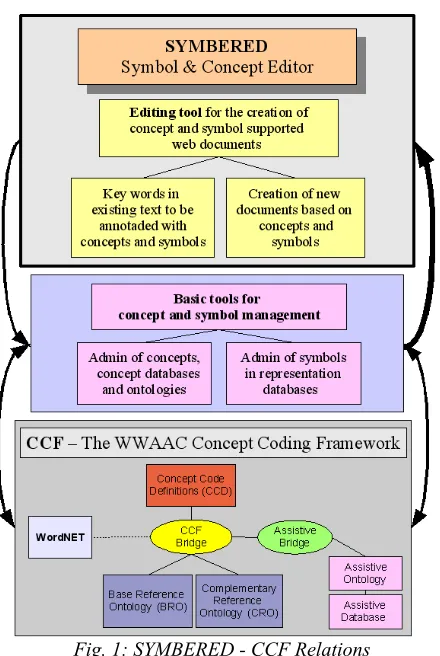
Fig. 1: SYMBERED - CCF Relations
Fig. 4: Detail - re-representation of content
Fig. 5: First a New Story entry of the "Concept Story" type is created ...
Fig. 6: Then the firs part of the story text is entered ...
As there is no direct match for the word “books” (in Fig.7above) this entry is selected for editing via the Editor Concept Browser:
After some minor additional editing the resulting story may appear like this to the reader (depending on pref:s) :
3. SYMBERED-CCF Technology & Tools
We'll take a somewhat closer look at the technologies and tools behind the above examples: first the underpinning technologies from the SemanticWeb, the CCF, the Java Plugin Framework (JPF), and the Papunet CMS environment; then we'll present the different CCF and SYMBERED tools a bit more in detail.3.1. Underpinning Technologies
A central ambition for the current SYMBERED development, as well as for the preceding CCF work, within and ouutside of the WWAAC project, has been to adhere to existing and emerging open standards. We have set out to develop concept coded language and symbol support for AAC users and others as applications of, and extensions to, these standard technologies. We have tried to avoid separate and isolated solution as far as possible.
3.1.1. Semantic Web Technologies
The Semantic Web initiative offers a set of standards (RDF, RDFS and OWL) for the representation and exchange of information. The primary strength of OWL/RDF is support for inference and classification, flexibility of representation, handling of semi-structured data, and support for information integration and reuse.
The CCF and SYMBERED builds heavily on the Semantic Web initiative, and uses OWL, RDF, XML, XHML, and Ruby annotations to both define the datasets for the content and to present the content with as much compatibility as possible with existing and emerging Internet technologies (web browsers, mail systems etc.).
3.1.2. CCF – The Concept Coding Framework CCF is an openly defined structure to handle concept based language material in a standardised way. It has been designed with a special focus on representing language concepts in parallel with text (in many different languages), graphic symbols (from several different systems) and other alternative representations.
The main purpose of the CCF is to maintain a published restrictive vocabulary for AAC users that can act as a common base for communication between different systems – openly defined or proprietary.
The CCF was designed as an Semantic Web application. It is based on two (or more) so called Reference Ontologies in OWL/RDF to be able to infer meanings with proper search modules. The BRO (Base Reference Ontology) is derived from WordNet. It is complemented by the CRO (Complementary Reference Ontology), mainly for function words not contained in WordNet. (Fig. 10 above and Fig. 11 below)
The CCF API allows applications to encode or convert words into semantically enhanced content. It provides a central bridging functionality that connects the different ontologies with each other. This enables other developers to link up their ontologies to be accessible through the CCF.
The structure of the CCF is outlined in Fig. 10 above. For more details, refer to the Concept Coding Framework & Interest Group (2004-2006) and to Judson, A. Hine, N. Lundälv, M. Farre, B. (2005)
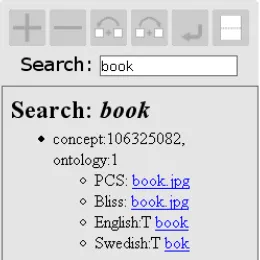
Fig. 8: The word "books" is transferred to the browser, and when the plural 's' is removed matches are found ...
Fig. 9: English text with PCS symbols and additional Swedish text
Fig. 11: The Concept Coding Framework CCF and its ontologies
The following Fig. 12 depicts a component of the open CCF plugin framework that is under development, and in which the SYMBERED editing components will slot in.
The plugin framework is currently based on the JPF opensource resource (JPF – a Java Plugin Framework).
The core CCF algorithms are based heavily on the abilities of Jena, which is a Java framework for building Semantic Web applications (Jena – A Semantic Web Framework for Java). Jena provides a programmatic environment for RDF, RDFS and OWL, including a rule-based inference engine.
The CCF core plugin is an adapter to Jena, which implements the CCF OWL/RDF transformations.
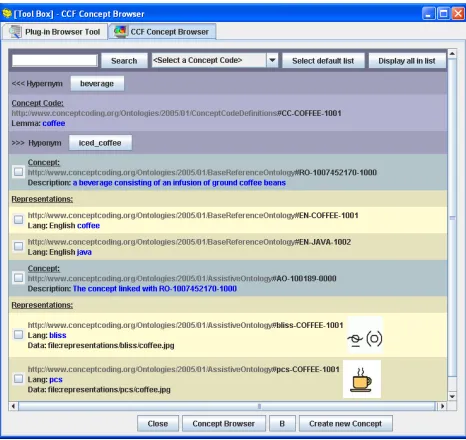
The CCF Concept Browser (Fig. 13 below) uses the plugins to discover the ontologies that are available and makes them available for searches and inferences.
4. Limitations and Future Tasks
• The CCF still lacks a well balanced corevocabulary of reasonable size. This means that the SYMBERED project will have to build up the concept code databases ad hoc according to the need of the concrete content that is produced. Future task: To complement the CCF with a CCD database of 5000-12000 concept codes including the necessary reference ontologies for this.
• The range of alternative representation types is currently limited to a couple of symbol systems and a few languages.
Future task: To incrementally integrate more symbol systems, sign languages (supportive signing) and natural languages.
• The semi-manual word-concept look-up of THE SYMBERED editor is now relying on manual disambiguation.
Future task: To add gradually more sofisticated automatic disambiguation functionality to minimise the need of manual processing for correct word-concept binding.
• The first plugin tools for building up and managing the content of the reference ontologies and the conceptcode definitions repository are still under development and primitive. Future task: To complement and further refine the range of CCF based plugin tools. This should eventually also include facilities for linguistic support and multimodal representation of the full range of educational material, including E-books etc.
Research tasks:
• To investigate optimal levels of concept-symbol refinement for different user needs: Symbol concepts are often used in a way reflecting rather coarse or fuzzy concept definitions (implicitly or explicitly). This is generally functional, as symbol users usually have access to a quite limited set of symbols, which may in this way be used to a wider range of meanings depending on the context.
How may this be reflected in the CCF in terms of semantic links between a concept code and a range of more or less related fine grained concepts and concept definitions?
Fig. 13: The SYMBERED - CCF Concept Browser – a JPF plugin component
Fig. 12: CCF-SYMBERED Java Plugin Components
• How may links to research and development results in relation to the EuroWordnet, GlobalWordnet, Parole and other initiatives be establish to greatly enhance the multi-lingual aspects of the CCF work?
• How may other linguistic research initiatives benefit from the multi-modal potential of the CCF technologies and resources?
5. Summary
The SYMBERED project will result in a first full-scale CCF based application in the form of a web content autoring tool and environment for more flexible language and symbol support.
The impact of these will initially be limited by the still fairly rudimentary ontology and representational resources within the CCF itself.
However, a first set of CCF plugin components and tools are now being developed alongside with the SYMBERED project. These will provide a first platform for starting a gradually speeded up formation of a more substantial infrastructure for the provision of concept coded multi-modal language support for a range of user needs.
6. References
WWAAC - World Wide Augmentative and Alternative Communication (2001-2004), a European Union IST-project. Website: www.wwaac.org
Concept Coding Framework & Interest Group (2004-2006). Website: http://www.conceptcoding.org
Widgit Communicate: Webwide (2005-2006). Website: http://www.widgit.com/products/webwide/index.htm The Finnish Papunet website (2001-2006) - with lots of
symbol supported and plain text content. Website: http://www.papunet.net
The Italian Navigabile project (2003-2006). Website: http://www.navigabile.it/NavigAbileSP/English.aspx The Nordic SYMBERED project and demo website
(2005-2006). Website: http://www.symbolnet.org Judson, A. Hine, N. Lundälv, M. Farre, B. (2005)
Empowering Disabled Users through the Semantic Web - The Concept Coding Framework an application of the Semantic Web, WEBIST, Miami, Florida, May, 2005 Ruby Annotation, W3C Recommendation (31 May 2001).
Website: http://www.w3.org/TR/ruby/
Miller, G.A. Et al (2005). WordNet, a lexical database for the English language, Princeton Univ. Website:
http://wordnet.princeton.edu
JPF – a Java Plugin Framework. Website: http://jpf.sourceforge.net
The Berkeley FrameNet project (2004-2006). Website: http://wordnet.princeton.edu