Word-Formation Network for Czech
Magda ˇSevˇc´ıkov´a, Zdenˇek ˇ
Zabokrtsk´y
Charles University in Prague, Faculty of Mathematics and Physics Institute of Formal and Applied Linguistics
Malostransk´e n´amˇest´ı 25, 118 00 Prague 1, Czech Republic [email protected], [email protected]
Abstract
In the present paper, we describe the development of the lexical network DeriNet, which captures core word-formation relations on the set of around 266 thousand Czech lexemes. The network is currently limited to derivational relations because derivation is the most frequent and most productive word-formation process in Czech. This limitation is reflected in the architecture of the network: each lexeme is allowed to be linked up with just a single base word; composition as well as combined processes (composition with derivation) are thus not included. After a brief summarization of theoretical descriptions of Czech derivation and the state of the art of NLP approaches to Czech derivation, we discuss the linguistic background of the network and introduce the formal structure of the network and the semi-automatic annotation procedure. The network was initialized with a set of lexemes whose existence was supported by corpus evidence. Derivational links were created using three sources of information: links delivered by a tool for morphological analysis, links based on an automatically discovered set of derivation rules, and on a grammar-based set of rules. Finally, we propose some research topics which could profit from the existence of such lexical network.
Keywords:word-formation, derivation, derivational morphology, lexical network
1.
Introduction
In Natural Language Processing, considerable effort has been invested in the development of resources of morpho-logical data (lemmatization, morphomorpho-logical analysis / syn-thesis, tagging). Nevertheless, the main focus has been laid on inflectional morphology while derivational morphology is underresourced in most languages; cf. (Zeller et al., 2013). Derivational data seem to have an application po-tential in Machine Translation (Weller et al., 2013), para-phrasing etc. on the one hand, and are highly required for theoretical research into word-formation on the other. In the present paper, we describe the development of the lexical network DeriNet which includes the derivational re-lations in Czech. After a summarization of the state of the art of theoretical research and NLP approaches to Czech derivation (Sect. 2.), we introduce the theoretical back-ground and formal structure of the network and the semi-automatic annotation procedure in Sections 3. and 4. Fi-nally, we propose some research topics which could profit from the existence of such lexical network in Sect. 5.
2.
Related work
2.1. Linguistic descriptionsCzech is a Slavic language with both rich inflectional and derivational morphology. Derivation is the most frequent and the most productive word-formation process in Czech. Other word-formation processes (conversion, compound-ing, and reflexivization of verbs (Dokulil et al., 1986)) cor-respond to a minor part of new word coinages in Czech. An elaborate theoretical approach to derivation in Czech was carried out by (Dokulil, 1962). Dokulil discerned four onomasiological categories according to how the extra-linguistic content is organized in language: category of substance (typically corresponding to the part of speech of nouns), quality (corresponding to adjectives), circumstance
(corresponding to adverbs) and action (corresponding to verbs). Three types of shifts between and within these highly abstract categories were identified: (i) so-called transposition1 is understood just as a change of the ono-masiological category, without any accompanying shifts in meaning (for instance, a quality “being objective” is ex-pressed as a substance by the nounobjectivity), (ii) mod-ification covers semantic shifts within an onomasiological category (cf. diminution ofˇzidle‘chair’ toˇzidliˇcka‘small chair’), (iii) mutation is a shift across boundaries of ono-masiological categories or within an onoono-masiological cate-gory, always accompanied with a change in meaning (e.g. bloudit‘stray’ –bludiˇstˇe‘labyrinth’,galerie‘gallery’ – ga-lerista‘gallerist’).
Onomasiological categories are subdivided into word-formation categories, which include words with the same categorical meaning that are derived from the same part of speech; in Czech, for instance, there is a numerous category of deadjectival names with the meaning of a quality. Within word-formation categories, word-formation types are fur-ther distinguished according to affixes used in the deriva-tives; e.g. deadjectival names of quality with the suffix-ost (roughly corresponding to English ‘-ness’ or ‘-ity’) consti-tute a word-formation type, another word-formation type includes deadjectival names of quality with the suffix-stv´ı (‘-ship’ or ‘-ness’ in English, according to the particular word) etc.
Dokulil’s approach has become a widely respected and, in fact, the only common ground of word-formation de-scriptions in Czech linguistics during the last 50 years, cf. (Daneˇs et al., 1967), ( ˇSmilauer, 1971), (Hauser, 1986), (Dokulil et al., 1986), (Karl´ık et al., 2000), ( ˇCerm´ak, 2012). Derivational affixes are usually listed according to
1
redun-tive from the noundlaˇzdice‘paving tile’, or a female variant of the male profession namedlaˇzdiˇc‘paver’, or
• two senses of the lemma lead to different (sets of) de-rived words.
3.4. Treatment of orthographic variants
In Czech, there are vowel and consonant alternations in words of Czech as well as foreign origin, which can be traced back to various factors such as dialects, differences in style, variability of the language in time etc. These alter-nations lead to different types of orthographic variants; for instance,vynd´avat/vyndavat‘to take out’,diskuze/diskuse ‘discussion’, citron/citr´on ‘lemon’. All types of ortho-graphic variants are handled as single lexemes within the network and coupled with the base words in accordance with the particular variation, i.e,vynd´avat–vynd´av´an´ıvs. vyndavat–vyndav´an´ı(‘to take out’ – ‘taking out’),diskuze –diskuzn´ıvs.diskuse–diskusn´ı(‘discussion’ – ‘discussion (group)’).
However, if the variation arises just in the particular word (and is not present in the base words), both orthographic variants are linked up with the same base word as being two different derivatives of it; cf. bothnakladaˇc/nakl´adaˇc ‘loader’ are linked up with the verbnakl´adat‘to load’.
4.
Building the network
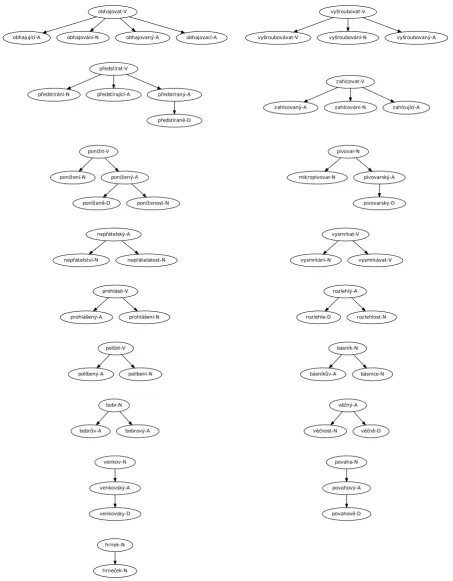
4.1. Network representationIn our approach, the relations between derived words and their base words are modeled as an oriented graph. Nodes of the graph correspond to lexemes (a lexeme represents a lemma, possibly only with a subset of its senses, as discussed above). Edges represent derivational steps be-tween lexemes. The orientation of edges reflect the word-formative process: the edge points from a base lexeme to a derived lexeme. Each lexeme can have at most one base lexeme. Therefore the whole derivations graph is a forest composed of tree-shaped clusters consisting of derivation-ally related lexemes, see Figure 1.
4.2. Annotation process
When filling the derivation network with actual lexemes (nodes) and derivational relations (edges) between them, we combine three sources of information: existing data re-sources (corpora and lexical rere-sources), linguistically moti-vated heuristics, and manually written rules. We try to au-tomatize the process as much as possible; however, as we prefer precision to coverage, candidate pairs of a derivative and its base word were checked manually before creating an edge in the network, unless they came from a highly re-liable resource. The main steps of the network construction are addressed in the following paragraphs.
4.3. Network initialization
At the beginning, the network is initialized with a set of lex-emes, without any mutual connections. Given that some of the derivational processes in Czech are extremely produc-tive, it was hard to find any linguistically justified bound-ary for the amount of lexemes to include. As already ex-plained, we decided to use only lexemes whose existence is
supported by corpus evidence. We extracted all noun, ad-jective, verb and adverb lemmas from the SYN subcorpus of the Czech National Corpus (CNC, 2014), which contains around 2.7 billion tokens. We used only lemmas that ful-filled the following conditions: they occurred at least twice in the corpus, they don’t contain any digit or punctuation symbol, they contain at least two letters and at least one of them is lowercased (to suppress abbreviations). This filter led to around 260,000 lexemes inserted into the network.
4.4. Derivational links delivered by the tool for morphological analysis
The lemmatization and morphological tags which we rely on were described in (Hajiˇc, 2004); the corpus texts were tagged using the Morce tagger (Spoustov´a et al., 2007). Some of the lemmas contain so called technical suffixes, which might—among other things—contain an information about the derivation of the current lemma (the technical suf-fix sometimes encodes the stringwise difference with re-spect to the original lemma). Using this information led to around 46,015 derivational links.
4.5. Specialized rules
We employed the fact that there are some highly regular derivational relations in Czech which can be described by simple rules. For instance, adverbs derived from adjectives can be often obtained by a very simple suffix substitution. In this way we obtained 5,586 derivational links from ad-jectives to adverbs. Similarly, we generated 5,863 nouns derived from adjectives by the suffix-ost, and 930 deriva-tional links that are based on a Latin or Greek prefix, such as super-ormeta-. However, in all the cases hand-coded lists of exceptions were needed.
4.6. Automatically discovered set of derivation rules
As it was already mentioned, there are literally hundreds of derivation types in Czech. We tried to extract some of the transformation rules automatically. The procedure was based on the assumption that if two words share a suffi-ciently long sequence of characters, they are more likely to be derivationally related. Instances of such pairs were ex-tracted from the list of lemmas and used for acquiring more general suffix substitution rules. 35 most reliable rules were selected manually out of around 400 automatically inferred derivation rules, equipped with lists of exceptions and ap-plied on the network.
This round was limited only to replacing suffixes, while consonant and vowel changes, vowel insertion/deletion and decaptalization were not included. Thus, only regularly de-rived words of very frequent word-formation types were covered; for instance, regularly derived deverbal nouns with the suffix-n´ı/-t´ı, possessive adjectives, or female vari-ants of surnames (suffix-ov´ain Czech).
This approach proved to be very efficient, as it brought 13,957 new derivational links.
4.7. Grammar-based set of derivation rules
description is organized, as a first-level criterion, accord-ing to the part of speech of the derivatives (nouns, adjec-tives, verbs, pronouns, and adverbs), followed by the part of speech of the base words (nouns from nouns, nouns from adjectives etc.) and, finally, by the meaning of the deriva-tives (i.e. in accordance with Dokulil’s concept of word-formation types); within each word-word-formation type, indi-vidual affixes were listed from the most productive to pe-ripheral ones. In the grammar book, base words for each affix were delimited by general semantic features (and/or morphological and/or phonological features) and exempli-fied with several examples, which were the only source of specific information on changes between the base and de-rived word in many cases.
Thus, on the one hand, the original grammatical descrip-tion seems to be rather overspecified since some affixes are described several times due to semantic nuances that do not mirror in formal changes during the derivation (for in-stance, the suffix-´akis listed twice as a means of deverbal derivation: among agent nouns, as inhon´ak‘cattle drover’ derived fromhonit‘to drive’, and among instruments of ac-tivities, e.g. suˇs´ak ‘dryer’ fromsuˇsit ‘to dry’), and rather underspecified on the other hand, especially with regard to coinages that undergo individual changes with regard to the base word (e.g. the suffix -enkais recorded as deriv-ing denominal names of various cards and permits, cf. the changes inj´ızda‘driving’ –j´ızdenka’ticket‘,m´ısto‘seat’ – m´ıstenka‘seat reservation ticket’, ´uˇcet‘invoice’– ´uˇctenka ‘bill’,povolen´ı‘permission’ –povolenka‘permit’ etc. that all must be formalized as separate substitution rules in or-der to find the corresponding candidate pairs).
In this round, vowel insertion/deletion (eis mostly inserted as inl´eˇcba‘treatment’–l´eˇcebna‘sanatorium’;kis deleted during the derivation of the adjective vimpersk´y from the town nameVimperk), decaptalization (cf. the adjective vim-persk´y) and vowel and consonant changes were involved. There were 18 vowel changes (mostly vowel lengthen-ing/shortening, e.g. ˇz´ıt ‘to live’ – ˇzit´ı ‘living’, list ‘leaf’ – l´ıstek‘leaflet’) and 11 consonant changes (mostly into palatal counterparts, e.g.stuha‘ribbon’ –stuˇzka‘small rib-bon’) integrated into the process of generation of the base-target pairs. Vowel changes typically occur within the stem of the word whereas consonant changes mostly appear on the stem-suffix boundary. Those changes that affect very frequent word-formation types were specified within sub-stitution rules so that, for instance, specialized rules such asV-at→N-´an´ı(adaptovat‘adapt’ –adaptov´an´ı‘adapting’) andV-´at→N-an´ı(br´at‘to take’ –bran´ı‘taking’) were pre-ferred to a general ruleV-t→N-n´ı.
4.8. Application of the grammar-based rules
The compiled list of substitution rules was checked for uniqueness; for instance, nearly 50 rules (that occur more than once in the grammatical description since they be-long to several word-formation types) were deleted from the starting list of more than 500 substitution rules describ-ing derivation of nouns. The resultdescrib-ing list of rules was au-tomatically mapped on the lexemes of the network. Though a careful inclusion of vowel and consonant changes, it was necessary to attach a list of irregularly derived words.
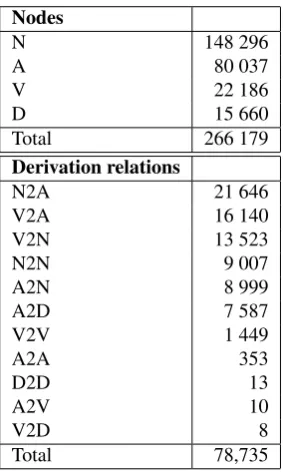
Nodes
N 148 296
A 80 037
V 22 186
D 15 660
Total 266 179
Derivation relations
N2A 21 646
V2A 16 140
V2N 13 523
N2N 9 007
A2N 8 999
A2D 7 587
V2V 1 449
A2A 353
D2D 13
A2V 10
V2D 8
Total 78,735
Table 1: Distribution of nodes according to the part of speech of lexemes (N - noun, A - adjective, V - verbs, D - adverb), and distribution of derivational links according to the part of speech of base and derived lexemes.
The generated output data (base-target pairs) was divided into two lists. The first of them contained derivatives for which a single base word was suggested. The second list contained derivatives for which more than one base word was generated. Both lists were manually checked; in the first of them, the base-target pairs were either confirmed or rejected, in the second list incorrect pairs were marked. The manual process resulted in a new (shorter) list of rules and exceptions.
The application of the hand-coded derivation rules led to 4,253 derivational links.
4.9. Increasing inter-cluster consistency
Having gathered a sufficiently large amount of derivational links, we could have started exploring some regular patterns frequently appearing in derivation clusters. For instance, if two clusters contain two sets of lexemes derived by the same set of affixes, then the clusters are likely to have the same internal structure. This observation does not bring new derivational links, but makes the network more con-sistent, not only in the sense of removing errors, but also in systematizing the annotation in places in which linguis-tic intuition allows multiple interpretations of the derivation process. Using this approach, 760 clusters were internally restructured.
4.10. Statistical properties of the network
prohlásit-V
prohlášený-A prohlášení-N
rozlehlý-A
rozlehle-D rozlehlost-N zahlcovat-V
zahlcovaný-A zahlcování-N zahlcující-A
povaha-N
povahový-A
povahově-D obhajovat-V
obhajující-A obhajování-N obhajovaný-A obhajovací-A
věčný-A
věčnost-N věčně-D vyšroubovat-V
vyšroubovávat-V vyšroubování-N vyšroubovaný-A
ponížit-V
ponížení-N ponížený-A
poníženě-D poníženost-N
políbit-V
políbený-A políbení-N
bobr-N
bobrův-A bobrový-A
pivovar-N
mikropivovar-N pivovarský-A
pivovarsky-D
nepřátelský-A
nepřátelství-N nepřátelskost-N
hrnek-N
hrneček-N
vysmrkat-V
vysmrkání-N vysmrkávat-V předstírat-V
předstírání-N předstírající-A předstíraný-A
předstíraně-D
básník-N
básníkův-A básnice-N
venkov-N
venkovský-A
venkovsky-D
Figure 1: Examples of diverse shapes of derivation clusters. Nodes in the clusters are labeled with their lemmas and parts of speech.
find clusters containing more than 20 lexemes. The same hold for internal structure of clusters in the sense of cluster depth and width: there are many clusters containing five or more derived lexemes on the same level, while chains with
depth of five or more can be found too. The diversity of cluster shapes is illustrated by Figure 1.
network rather than characteristics of Czech lexicon. There are many types of derivational relations which we have not captured in the network so far, and thus it is very likely that the network will become more densely connected in the fu-ture. For example, verb prefixation and aspectual pairs are expected to govern tens of thousands of derivational links which are not yet covered in the current version of the net-work.
4.11. Data distribution
DeriNet Version 0.5 is publicly available on the Inter-net at http://ufal.mff.cuni.cz/derinet. It can be used under the terms of the Creative Commons Attribution-NonCommercial-ShareAlike 3.0 License (CC-BY-NC-SA). The data is available in a simple line-oriented format as well as in a self-documenting XML-based format.
5.
Envisaged usage of the network
5.1. Derivational information within MachineTranslation
The primary motivation of our effort lies in NLP applica-tions. Let us illustrate it on two potential usages of the net-work in Machine Translation.
First, in syntactically informed Machine Translation sys-tems (such as TectoMT, (Popel and ˇZabokrtsk´y, 2010)), sometimes part of speech of available translation equiva-lents does not fit the target sentence syntactic context. For instance, an adjectival attribute of an English gerund is usu-ally translated as a Czech adverb if the gerund phrase is translated as a subordinating clause. If the adjective-adverb pair is not available in the translation component (which happens often for rare words, no matter how large the train-ing parallel corpus is), then our network can come to help. In other words, the network can be used for adding previ-ously unseen translation pairs.2
Second, partitioning of the lexical space induced by the transitive closure of the derivational relation can be used for generating less sparse lexical features for discrimina-tive translation models, such as for the one described in (Mareˇcek et al., 2010).
5.2. Linguistic research in productivity in word-formation
As already mentioned, the network is expected to be a reliable resource of data for theoretical research into word-formation, in particular for research into productiv-ity, which has become one of the central issues of word-formation research at least in the last three decades. Besides the quantitative features of derivatives with a cer-tain affix, which can be extracted from a corpus (number of hapax legomena, token and type frequency of the deriva-tives), information on base words is required in many ap-proaches in order to obtain a more complex picture of pro-ductivity of an affix (cf. Aronoff’s concept of possible words (Aronoff, 1976), systemic productivity in (Dokulil,
2Of course, such translation pairs are not fully equivalent to
those seen in the parallel data, as they come without any statistics; the needed redistribution of probability mass can be only approx-imated.
1962) or qualitative productivity in (L¨udeling and Evert, 2005)). Such information can be acquired neither from cor-pora nor from dictionaries since the base words of a partic-ular suffix cannot be delimited without a specialized lexical resource.
Using the word-formation network, the following (linguis-tic) questions can be easily answered for Czech derived words:
• What are the base words of words with a particular affix? (Which part of speech do the base words be-long to? Are they non-derived (primary) vs. derived words?)
• What are the derivatives of a word / of a group of words? (Are there any at all? – e.g. possessive ad-jectives are terminal nodes in the network. Which part of speech do the derived words belong to? Are they derived by suffixes, prefixes?)
• What is the type frequency of derivatives of a certain type?
6.
Conclusion
In this paper, we have introduced a new language data re-source focused on derivational morphology in Czech. The DeriNet network subsumes many different types of deriva-tional relations and is being further extended.
Besides many “standard” lexicographic problems (such as the question which words should be included into the net-work, how polysemy and existence of orthographic variants should be captured, what should be done with word capital-ization), we were facing several derivation-specific design questions, too. For instance, in some cases it was hard to choose derivation direction for a pair of related words (even worse, sometimes there is no correct answer, e.g., if they both are created from a base word that does not exist in the contemporary language any more).
Another question arises whether and how the current net-work model could be extended to combined or compound-ing word-formation, in which a new word is created from two or more words.
7.
Acknowledgements
This research has been supported by GA ˇCR P406/12/P175. The work has been using language resources developed and/or stored and/or distributed by the LINDAT-Clarin project of the Ministry of Education of the Czech Republic (project LM2010013).
8.
References
Mark Aronoff. 1976. Word Formation in Generative Grammar. The MIT Press, Massachussetts.
Harald Baayen. 1992. Quantitative aspects of morphologi-cal productivity. In G. Booij and J. van Marle, editors, Yearbook of Morphology 1991, pages 109–149, Dor-drecht. Kluwer.
CNC. 2000. Czech National Corpus – SYN2000, Institute of Czech National Corpus, Faculty of Arts, Charles Uni-versity in Prague.
CNC. 2010. Czech National Corpus – SYN2010, Institute of Czech National Corpus, Faculty of Arts, Charles Uni-versity in Prague.
CNC. 2014. Czech National Corpus – SYN, Institute of Czech National Corpus, Faculty of Arts, Charles Univer-sity in Prague.
Frantiˇsek Daneˇs, Miloˇs Dokulil, and Jaroslav Kuchaˇr. 1967.Tvoˇren´ı slov v ˇceˇstinˇe 2: Odvozov´an´ı podstatn´ych jmen. Academia, Prague.
Miloˇs Dokulil, Karel Hor´alek, Jiˇrina H˚urkov´a, Miloslava Knappov´a, and Jan Petr. 1986. Mluvnice ˇceˇstiny 1. Academia, Prague.
Miloˇs Dokulil. 1962. Tvoˇren´ı slov v ˇceˇstinˇe 1: Teorie odvozov´an´ı slov. Academia, Prague.
Jan Hajiˇc, Jarmila Panevov´a, Eva Hajiˇcov´a, Petr Sgall, Petr Pajas, Jan ˇStˇep´anek, Jiˇr´ı Havelka, Marie Mikulov´a, Zdenˇek ˇZabokrtsk´y, and Magda ˇSevˇc´ıkov´a-Raz´ımov´a. 2006. Prague Dependency Treebank 2.0. CD-ROM, Linguistic Data Consortium, LDC Catalog No.: LDC2006T01, Philadelphia.
Jan Hajiˇc. 2004. Disambiguation of Rich Inflection: Com-putational Morphology of Czech. Karolinum, Prague. Pˇremysl Hauser. 1986. Nauka o slovn´ı z´asobˇe. SPN,
Prague.
Petr Karl´ık, Marek Nekula, and Zdeˇnka Rus´ınov´a. 2000. Pˇr´ıruˇcn´ı mluvnice ˇceˇstiny. NLN, Prague.
Jerzy Kuryłowicz. 1936. D´erivation lexicale et d´erivation syntaxique. Bulletin de la Soci´et´e de linguistique de Paris, 37:79–92.
A. L¨udeling and S. Evert. 2005. The emergence of pro-ductive non-medical-itis. Corpus evidence and qualita-tive analysis. In S. Kepser and M. Reis, editors, Linguis-tic Evidence. Empirical, TheoreLinguis-tical and Computational Perspectives, pages 351–370, Mouton De Gruyter. Berlin – Boston.
David Mareˇcek, Martin Popel, and Zdenˇek ˇZabokrtsk´y. 2010. Maximum entropy translation model in dependency-based MT framework. In Proceedings of the Joint Fifth Workshop on Statistical Machine Translation and MetricsMATR, pages 201–201, Up-psala, Sweden. Uppsala Universitet, Association for Computational Linguistics.
Karel Pala and Dana Hlav´aˇckov´a. 2007. Derivational Re-lations in Czech WordNet. InProceedings of the 2007 ACL Workshop on Balto-Slavonic Natural Language Processing, pages 75–81, Prague.
Karel Pala and Pavel Smrˇz. 2004. Building Czech Word-net. Romanian Journal of Information Science and Tech-nology, 7:79–88.
Karel Pala, Radek Sedl´aˇcek, and Marek Veber. 2003. Re-lations between inflectional and derivation patterns. In Proceedings of the 2003 EACL Workshop on Morpholog-ical Parsing of Slavic Languages, pages 1–8, Budapest. Martin Popel and Zdenˇek ˇZabokrtsk´y. 2010. TectoMT:
Modular NLP framework. In Hrafn Loftsson, Eirikur R¨ognvaldsson, and Sigrun Helgadottir, editors,Lecture
Notes in Artificial Intelligence, Proceedings of the 7th International Conference on Advances in Natural Lan-guage Processing (IceTAL 2010), volume 6233 of Lec-ture Notes in Computer Science, pages 293–304, Berlin / Heidelberg. Iceland Centre for Language Technology (ICLT), Springer.
Magda Raz´ımov´a and Zdenˇek ˇZabokrtsk´y. 2006. Annota-tion of Grammatemes in the Prague Dependency Tree-bank 2.0. InProceedings of the LREC 2006 Workshop on Annotation Science, pages 12–19.
Radek Sedl´aˇcek and Pavel Smrˇz. 2001. A New Czech Morphological Analyzer ajka. In Proceedings of the 4th International Conference Text, Speech and Dialogue (TSD 2001), pages 100–107, ˇZelezn´a Ruda.
Drahom´ıra Spoustov´a, Jan Hajiˇc, Jan Votrubec, Pavel Krbec, and Pavel Kvˇetoˇn. 2007. The Best of Two Worlds: Cooperation of Statistical and Rule-Based Taggers for Czech. In Proceedings of the Workshop on Balto-Slavonic Natural Language Processing, ACL 2007, pages 67–74, Praha.
Frantiˇsek ˇCerm´ak. 2012. Morf´ematika a slovotvorba ˇceˇstiny. NLN, Prague.
Vladim´ır ˇSmilauer. 1971. Novoˇcesk´e tvoˇrn´ı slov. SPN, Prague.
Frantiˇsek ˇSt´ıcha. 2012. Miloˇs Dokulil and his theory of productivity in word-formation. Korpus – gramatika – axiologie, 6:3–9.
Marion Weller, Max Kisselew, Svetlana Smekalova, Alexander Fraser, Helmut Schmid, Nadir Durrani, Hassan Sajjad, and Richrd Farkas. 2013. Munich-Edinburgh-Stuttgart Submissions at WMT13: Morpho-logical and Syntactic Processing for SMT. In Proceed-ings of the Eighth Workshop on Statistical Machine Translation, pages 232–239, Sofia, Bulgaria.