Towards Linked Hypernyms Dataset 2.0: Complementing DBpedia with
Hypernym Discovery and Statistical Type Inference
Tom´aˇs Kliegr, Ondˇrej Zamazal
Department of Information and Knowledge Engineering, Faculty of Informatics and Statistics, University of Economics W. Churchill Sq. 4, 130 67 Prague 3, Czech Republic
[email protected], [email protected]
Abstract
This paper presents a statistical type inference algorithm for ontology alignment, which assigns DBpedia entities with a new type (class). To infer types for a specific entity, the algorithm first identifies types that co-occur with the type the entity already has, and subsequently prunes the set of candidates for the most confident one. The algorithm has one parameter for balancing specificity/reliability of the resulting type selection. The proposed algorithm is used to complement the types in the LHD dataset, which is RDF knowledge base populated by identifying hypernyms from the free text of Wikipedia articles. The majority of types assigned to entities in LHD 1.0 are DBpedia resources. Through the statistical type inference, the number of entities with a type from DBpedia Ontology is increased significantly: by 750 thousand entities for the English dataset, 200.000 for Dutch and 440.000 for German. The accuracy of the inferred types is at 0.65 for English (as compared to 0.86 for LHD 1.0 types). A byproduct of the mapping process is a set of 11.000 mappings from DBpedia resources to DBpedia Ontology classes with associated confidence values. The number of the resulting mappings is an order of magnitude larger than what can be achieved with standard ontology alignment algorithms (Falcon, LogMapLt and YAM++), which do not utilize the type co-occurrence information. The presented algorithm is not restricted to the LHD dataset, it can be used to address generic type inference problems in presence of class membership information for a large number of instances.
Keywords:type inference, ontology alignment, DBpedia, entity classification
1.
Introduction
The Linked Hypernyms Dataset (LHD) provides entities described by Dutch, English and German Wikipedia arti-cles with types taken from the DBpedia namespace. It con-tains 2.8 million entity-type assignments.
The LHD follows the same data modelling approach as the well-known DBpedia (Bizer et al., 2009) and YAGO (Hof-fart et al., 2013) knowledge bases. While DBpedia and YAGO are populated from the structured and semistruc-tured information in Wikipedia (article categories and in-foboxes), the entries in LHD were extracted using lexico-syntactic patterns from the text of the first sentences of the respective Wikipedia articles. It thus provides a com-plementary source of type information. For many entities in DBpedia, LHD provides the only type. The dataset is downloadable in the n-triples format, with both the entity and the type from the DBpedia namespace. The raw (plain text) hypernyms are also downloadable.
A certain limitation of the LHD 1.0 dataset is that it is not well connected to Linked Open Data (LOD) cloud, since majority of its types are DBpedia resources. In this paper, we introduce a statistical type inference algorithm for cre-ation of the next version of the dataset, dubbed LHD 2.0, which significantly increases coverage by DBpedia Ontol-ogy classes.
The paper is organized as follows. Section 2. describes the LHD extraction framework. Section 3. presents the pro-posed algorithm for statistical type inference. Section 4. introduces LHD 2.0-draft as the output of this algorithm. Section 5. presents dataset evaluation. Section 6. describes a preliminary attempt to address the mapping problem with sample of standard ontology alignment algorithms. The conclusions point at limitations of the approach in addition to presenting the dataset license and availability. Sketch of future work is also included.
2.
LHD 1.0 Extraction Framework
Linked Hypernym Dataset (Kliegr, 2013) associates DBpe-dia resources (corresponding to WikipeDBpe-dia articles) with a type which is obtained by parsing the first sentences of the respective Wikipedia article. The type is initially a plain text string, which is further disambiguated to a DBpedia resource creating a “linked hypernym”. The LHD 1.0 ex-traction framework also makes a naive attempt to associate the linked hypernym with a DBpedia Ontology class, which increases the semantic interoperability of the dataset. The remainder of this section briefly describes the indi-vidual steps of the LHD 1.0 extraction framework. An overview of the resulting LHD 1.0 dataset in terms of size and accuracy is given in Table 1. A more detailed descrip-tion the framework as well as addidescrip-tional size and evaluadescrip-tion metrics are available in (Kliegr, 2013).
2.1. Hypernym Discovery
The extraction framework is implemented on top of GATE.1 The core of the system is a JAPE transducer (a GATE component) which applies lexico-syntactic patterns encoded as grammar in the JAPE language on the first sen-tence of Wikipedia articles. The extraction grammars re-quire that the input text is tokenized and assigned part-of-speech (POS) tags. For English, the framework relies on the ANNIE POS Tagger, available in GATE, for German and Dutch on TreeTagger.2 Extraction grammars were hand-coded using a development set of 600 manually annotated articles per language. The evaluation of the extraction accu-racy was performed on a different set of manually annotated articles as reported in Section 5.
1http://gate.ac.uk 2
Example 1.
An example input for this phase is the first sentence of Wikipedia article on V´aclav Havel: Havel was a Czech playwright, essayist, poet, dissident and politician.The output is the word “playwright”, the first hypernym in the sentence.
The output of the hypernym discovery phase is provided as a separate dataset providing plain text, not disambiguated hypernyms. The accuracy for this dataset (denoted as “plain”) is reported in Table 1.
2.2. Linking Hypernyms to DBpedia Instances
Once the hypernym has been extracted from the article, it is disambiguated to a DBpedia identifier. The disambiguation algorithm relies on the Wikipedia Search API to resolve the string to a Wikipedia article.
Example 2.
Picking up on the V´aclav Havel entity, the word “playwright” is used as a query, which returns the Wikipedia article http://en.wikipedia.org/ wiki/Playwright. This is then translated to the DBpedia URIhttp://dbpedia.org/resource/ Playwright.
While this disambiguation approach is simple, it is effec-tive as confirmed both by our evaluation reported in Sec-tion 6 and by the recent results of the NIST TAC 2013 (Do-jchinovski et al., 2013). In the TACEnglish Entity Link-ing Evaluationtask this algorithm performed at median F1 measure (overall).
2.3. Alignment with the DBpedia Ontology
While formally, the output of the linking phase is al-ready a LOD identifier, the fact that the type is in the
http://dbpedia.org/resource/ namespace (further referenced by prefixdbpedia) is not ideal. Concepts from this namespace are typically instances, while this term is used as a class within the LHD dataset:
dbpedia:V´aclav Havel rdf:type
dbpedia:Playwright.
DBpedia already contains a predefined set of classes within the DBpedia Ontology namespace
http://dbpedia.org/ontology/ (further abbre-viated asdbo) such asdbo:Person or dbo:Work. The focus of the alignment phase is to map the original type, which is in the dbpedia namespace, to the dbo
namespace.
The mappings are generated using a simple string match-ing algorithm, which requires total match in concept name (dbpedia:Person → dbo:Person). For these exact matchmappings, only thedbo: type is output by the gen-eration process.
Additional mappings are generated using substring match (dbpedia:Catfish → dbo:Fish). These approximate mappings were subject to manual verification. The origi-nal (dbpedia:) type is preserved on the output, with the
classes mapping (dbpedia:→dbo: ) available in a sep-arate file.
This simple mapping approach provides a mapping to the DBpedia Ontology for a large number of entities across all three languages. However, in relative terms, this is less than 50% for each language in LHD 1.0. Table 1 gives an overview of LHD 1.0 dataset in terms of size and accuracy for individual languages.
3.
Statistical Type Inference (STI)
The STI algorithm provides mapping from most DBpedia resources used as types in LHD 1.0 to classes in the DBpe-dia Ontology namespace.
Example 3.
Entity V´aclav Havel has typehttp://dbpedia.org/ resource/Playwrightin LHD 1.0. STI assigns this entity with additional type http://dbpedia.org/ ontology/Writer.
It should be noted that the result of type inference is not always a superclass of the original query hypernym hypRas in this example.
The inference algorithm builds upon the fact that for many entities with LHD 1.0 types a set of types in the DBpe-dia Ontology namespace can be obtained from DBpeDBpe-dia (sourced from the infoboxes).
The intuition is that for a specific LHD 1.0 typehypR, we identify DBpedia-assigned types that are co-occurring with hypR and we note the number of entities on which each of these types co-occurs with hypR. The challenge is to identify out of the pool of the correlated types the best one: the type which is the most specific true type for entities assigned withhypRas a type.
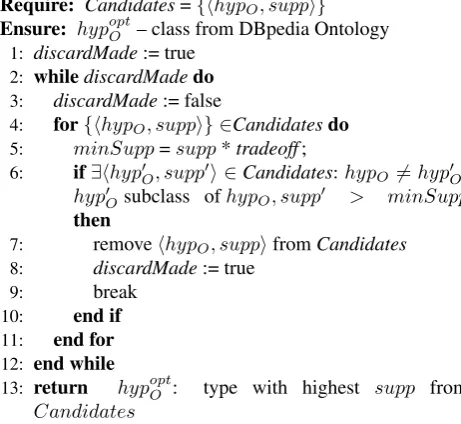
Our attempt to address this challenge is comprised by two successive algorithms. Candidate Generation (Alg. 1) gen-erates a set ofCandidates(DBpedia Ontology classes) for the hypernym hypR (DBpedia resource). Candidatesare then pruned by removing classes for which a more specific one exists, and from the remainder the class with the high-est number of supporting entities is selected. The candidate pruning and the selection of the best candidate is performed according to Alg. 2.
Table 1: LHD 1.0 size and accuracy. Thedbocolumn indicates the portion of entities in LHD with type from the DBpedia Ontology namespace.
language linked (total) linkeddbo acc linked acc plain German 825,111 171,847 0.773 0.948 English 1,305,111 513,538 0.857 0.951 Dutch 664,045 78,778 0.884 0.933
Example 4. For entity V´aclav Havel, the set Elhd h contains 961 entities with dbpedia:Playwright as a type in LHD 1.0. Skipping entities without any type in DBpedia 3.8 or with a type not in the DB-pedia Ontology namespace, the list of the following types associated with these entities (and associated num-bers of supporting entities) is obtained from DBpe-dia 3.8 instance file: MusicalArtist:5, Politician:1, Of-ficeHolder:4, Writer:150, Scientist:1, Agent:277, Mil-itaryPerson:1, MemberOfParliament:1, Artist:157, Per-son:277.
The selection process is two stage. First, the algorithm it-erates through the candidates removing those which are, as indicated by the numbers of supporting instances, only a su-perclass of a more specific type on the list ofCandidates. Higher number of supporting entities implies reliability, however, the specific types tend not to have the highest val-ues. The compromise between specificity and reliability is reflected by the value of the tradeoff constant used in Alg. 2. TypehypOis removed if there is its subclasshyp0O inCandidates, which has at leasttradeoff *supp support-ing entities, wheresupprefers to the support ofhypO.
Algorithm 1Candidate Generation
Require: hypR - a linked hypernym (DBpedia resource) to be mapped,LHD= {hentity, typei},DBpedia =
{hentity, typei}
Ensure: Candidates = {hhypO, suppi} – set of candi-date mappings forhypR:hypOis a DBpedia Ontology class,suppis the number of supporting entities 1: Candidates:=∅
2: Elhd:= set of entities fromLHDwithhyp
Ras type 3: forentity∈Elhd
h do
4: types:= set of typesentityhas inDBpedia 5: fortype∈typesdo
6: iftypeis not DBpedia ontology classthen 7: continue
8: end if
9: iftype∈/Candidatesthen 10: addhtype, 1itoCandidates 11: else
12: increment support oftypeby 1 inCandidates 13: end if
14: end for 15: end for
16: return Candidates
Example 5.
Candidate pruning removes Politician, Agent, Artist and Person from the list of candidates. Politician is removed in favour of its subclass MemberOfParliament, which has the same number of supporting entities (one). The latter three types are removed in favour of Writer. While Writer has less supporting entities than Artist, the drop in support is within tolerance of thetradeoffconstant set at 0.2.
The following types survive pruning: OfficeHolder, Sci-entist, MemberOfParliament, Writer, MusicalArtist. Fi-nally, the algorithm selectshypoptO =Writer as the type with the highest number of supporting instances. The value ofsupp=150 is the confidence value for this map-ping.
4.
Generating LHD 2.0 with STI
The mappings to DBpedia ontology in LHD 1.0 were achieved by a naive ontology mapping algorithm. For each entity-linked hypernym pair, the algorithm tries to find a DBpedia Ontology concept based on a textual match. As seen from Table 1 this approach did not yield a match for a substantial number of entities, which were left with DBpe-dia resources as their types. The STI algorithm is used to assign additional type to these entities.
The LHD 2.0-draft is the result of the execution of the STI algorithm on all 791,573 entities in LHD 1.0 with type in
Algorithm 2Candidate Pruning and Selection Require: Candidates={hhypO, suppi} Ensure: hypoptO – class from DBpedia Ontology
1: discardMade:= true 2: whilediscardMadedo 3: discardMade:= false
4: for{hhypO, suppi} ∈Candidatesdo 5: minSupp=supp*tradeoff; 6: if∃hhyp0
O, supp0i ∈Candidates:hypO 6=hyp0O, hyp0
Osubclass ofhypO, supp0 > minSupp then
7: removehhypO, suppifromCandidates 8: discardMade:= true
9: break 10: end if 11: end for 12: end while
Table 2: LHD 2.0 Generation Overview
Input Output (mapped) entities 791,573 755,319 distinct classes 20,474 11,117
the dbpedia namespace.3 Out of 20,474 distinct classes these entities had, the STI algorithm generated 11,117 map-pings to DBpedia ontology classes. These mapmap-pings were used to assign a DBpedia ontology type to 755,319 entities. The STI execution in terms of input and output is summa-rized by Table 2.
Comparison of LHD 1.0 and LHD 2.0 is described by Ta-ble 4. In LHD 2.0, a large part of the types in thedbpedia
namespace is replaced by types in thedbonamespace. It should be emphasized that LHD 1.0 and LHD 2.0 types are complementary. E.g. for V´aclav Havel, the LHD 1.0 type is dbpedia:Playwright and the LHD 2.0 type is
dbo:Writer.
The selection of the best type, as performed by the STI al-gorithm, aims at balancing the specificity and reliability of the inferred type. In order to obtain high coverage with spe-cific types, relatively low value of the tradeoff parameter (0.2) was used to generate the LHD 2.0-draft dataset.
As seen in Table 3, the mappings with high support val-ues are all correct, while the quality of the mappings de-teriorates with decreasing support. The specificity of the mapped types is satisfactory.
The LHD 2.0 dataset associates the type directly with the entity withrdf:typerelation. The reasons for this model-ing choice are as follows. The type inference task is aimed at assigning types to entities that have hypR as a type, which is not necessarily the same task as retrieving the most specific true supertype forhypR. The role ofhypRin the STI algorithm is limited to a feature, shared by similar en-tities, which is used to identify the correlated type. This difference can be illustrated on the following special cases:
STI returns more precise type. LHD associates entities with types based on one-word hypernyms obtained from article free text. If this word is discriminative, i.e. specific to entities of a certain more specific type, the roles in the STI generated mapping, hypR → hyp
opt
O , are effectively reversed:hypRis subclass ofhypoptO .
3
This implies that entities with a DBpedia ontology type found with LHD 1.0 exact match (cf. Subsection 2.2.) were excluded from the STI mapping process.
Table 3: Inferred MappingshypR →hypoptO (DBpedia re-source→DBpedia ontology class). Sample from 11,117 mappings sorted by support.
rank support dbpedia dbo
1 16876 Commune Settlement 2 13640 Footballer SoccerPlayer 3 8370 Actress Person 4 7077 District Settlement
5 6037 Club SoccerClub
6 5132 Television program
TelevisionShow
7 4982 Highway Road
8 4629 Settlement Settlement
9 4292 Frog Amphibian
10 4246 Township Town 11 4038 Singer MusicalArtist 12 3478 Episode TelevisionEpisode 13 3236 Townships Town
14 3155 Suburb Settlement 15 2869 Musician MusicalArtist 16 2790 County AdministrativeRegion 17 2595 Pitcher BaseballPlayer 18 2472 Character
(arts)
ComicsCharacter
19 2467 EP Album
20 2024 Director Person
... ... ... ...
1000 21 Contractor Company 1001 21 Minority EthnicGroup 1002 21 Peoples EthnicGroup
1003 21 Cat Mammal
1004 21 Rail Station
1005 21 Reggae MusicalArtist
1006 21 Punk Band
1007 21 Disney Film
1008 21 Ray Fish
1009 21 Rugby RugbyPlayer 1010 21 Glands AnatomicalStructure 1011 21 Complication Disease
1012 21 Superheroes ComicsCharacter 1013 21 Emcee MusicalArtist 1014 21 Tortoise Reptile 1015 21 Communes Settlement 1016 21 Cutters Ship
1017 21 Wasp Insect
1018 21 Passerine Bird 1019 21 Flycatcher Bird 1020 20 Garden Park
... ... ... ...
11111 1 Acetophenone ChemicalCompound 11112 1 Acetal ChemicalCompound
11113 1 Absurd Album
11114 1 Abrams Album
11115 1 Abizaid Album
11116 1 Abdul Album
Example 6. Consider entity Diego Maradona. The cor-responding entry in LHD 1.0 is
dbpedia:Diego Maradona rdf:type
dbpedia:Manager
The STI algorithm yields type dbo:SoccerManager. The corresponding LHD 2.0 statement is:
dbpedia:Diego Maradona rdf:type
dbo:SoccerManager
The explanation is that entities with the “manager” hy-pernym (disambiguated to dbpedia:Manager linked hypernym) tend to be soccer managers.
STI corrects LHD 1.0 error. The fact that LHD is based on one word hypernyms causes LHD to assign incorrect type if the modifiers before the hypernym alter the meaning. If the LHD 1.0 hypernym is sufficiently discriminative, the STI inferred typehypoptO is actually a correct type for most entities with the original linked hypernymhypR, although the mappinghypR→hypoptO is incorrect.
Example 7.
STI outputs mapping dbpedia:Processor →
dbo:Software. While this mapping is obviously incorrect, assigning dbo:Software to entities with originallydbpedia:Processoras a type is correct in many cases. This is due to the fact that a substantial number of entities withdbpedia:Processortype are wordprocessors.
5.
Dataset Quality
Human evaluation of the correctness was performed sep-arately for the entire English, German and Dutch datasets each represented by a randomly drawn 1,000 articles. The evaluation for English were done by three annotators. The evaluation for German and Dutch were done by the best performing annotator from the English evaluation. It can be seen that for LHD 1.0 the accuracy for “plain text” hy-pernyms exceeds0.9for all languages, while the accuracy of the disambiguated linked hypernyms (a mix of concepts
indbpediaanddbonamespaces) is in the0.77−0.88
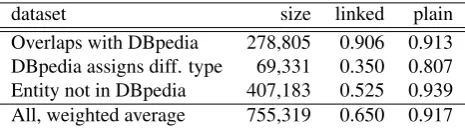
range (Table 1). The English dataset was subject to fur-ther analysis, with evaluation results reported for its twelve interesting partitions. The results, guidelines and raw as well as aggregated evaluation data can be found athttp: //ner.vse.cz/datasets/linkedhypernyms/. LHD 2.0-draft places all types into thedbonamespace (ref. to Table 4) for English and a substantial number for German and Dutch. The impact of the mapping algorithm on the accuracy was measured on samples taken from all 755,319 English Wikipedia entities for which STI algorithm output a mapping. These entities were divided to three partitions depending on whether for the given entity the linked hyper-nym assigned is the same as the type assigned to this entity in DBpedia.
From each partition a sample of 1,000 entities was drawn and manually evaluated by one annotator (a graduate stu-dent). The annotation guidelines were the same, which were used for the evaluation for the LHD dataset (Kliegr,
Table 4: LHD 2.0 vs LHD 1.0 DBpedia Ontology coverage comparison
language size dbo(1.0) dbo(2.0) German 825,111 171,847 615,801 English 1,305,111 513,538 1,268,857 Dutch 664,045 78,778 283,626
Table 5: LHD 2.0 Accuracy for English
dataset size linked plain
Overlaps with DBpedia 278,805 0.906 0.913 DBpedia assigns diff. type 69,331 0.350 0.807 Entity not in DBpedia 407,183 0.525 0.939 All, weighted average 755,319 0.650 0.917
2013). The guidelines, as well as the annotation results, are available on the dataset website.
Example.
V´aclav Havel falls into the “DBpedia assigns different type” partition, since dbo:Writer is not among the types assigned to this entity in DBpedia.
The resulting accuracy (Table 5) significantly varies by partition. The worst result – accuracy of only 0.35 – is partly due to the fact that already the plain text hyper-nym extracted by the lexico-syntactic patterns was incor-rect. It should be noted that the partition with best accuracy (“Overlaps with DBpedia”) does not contribute new infor-mation, since therdf:typetriples in this partition are al-ready present in DBpedia.
6.
Preliminary Comparison with Standard
Matching Approaches
Prior to designing the presented STI algorithm, we have attempted to solve the problem with standard ontology matching tools.
As an input, the same set of entities as for LHD 2.0 gener-ation was used: LHD 1.0 entities with type in thedbpedia
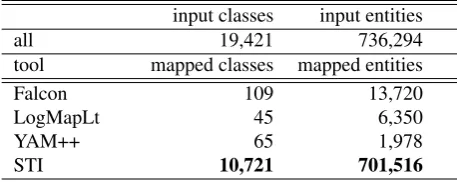
namespace, for which no (even approximate) mapping to DBpedia Ontology was found in LHD 1.0. These 736,000 entities had more than 19,000 distinct types. In order to en-able applying ontology matching tools we built simple flat ontology, where each distinct type is a subclass of the most general class owl:Thing. Next, DBpedia ontology 3.8 was used as the target ontology for mapping.4
We applied several ontology matching tools which par-ticipated in the Ontology Alignment Evaluation Initiative (OAEI).5However, some matchers had problems to match those two ontologies. Mostly because of a large size of the
4Mappings to schema.org classes, which are also present in the
DBpedia ontology, were ignored.
matching tools/techniques.
In this paper, we focused on evaluation of LHD 2.0-draft in terms of its possible use for enrichment of the DBpe-dia knowledge-base. As a future work, it would be inter-esting to investigate the complementarity of the dataset, as well as of the algorithmic approach, with Babelnet (Navigli and Ponzetto, 2012). Babelnet is a large semantic knowl-edge base, which integrates lexicographic and encyclopedic knowledge from WordNet and Wikipedia.
The Linked Hypernyms dataset (both LHD 1.0 and LHD 2.0-drat) is downloadable from http://ner.vse.cz/ datasets/linkedhypernyms/. The dataset is released under the Creative Commons license. Additionally, the set of 11.000 mappings from DBpedia resources to DBpedia Ontology classes (as exemplified by Table 3) with associ-ated confidence values was also made available.
The LHD 1.0 and 2.0-draft were generated from the following Wikipedia snapshots: December 1st, 2012 (German), October 11th, 2012 (Dutch), September 18th, 2012 (English). The LHD dataset is used by the Entityclassifier.eu wikifier (Dojchinovski and Kliegr, 2013).
Acknowledgements
This research was supported by the European Union’s 7th Framework Programme via the LinkedTV project (FP7-287911).
8.
References
Christian Bizer, Jens Lehmann, Georgi Kobilarov, S¨oren Auer, Christian Becker, Richard Cyganiak, and Sebas-tian Hellmann. 2009. Dbpedia-a crystallization point for the web of data. Web Semantics: Science, Services and Agents on the World Wide Web, 7(3):154–165.
Milan Dojchinovski and Tomas Kliegr. 2013. Entityclas-sifier.eu: Real-time classification of entities in text with Wikipedia. InProceedings of the European Conference on Machine Learning and Principles and Practice of Knowledge Discovery in Databases, ECMLPKDD’13, pages 654–658. Springer-Verlag.
Milan Dojchinovski, Tom´aˇs Kliegr, Ivo Laˇsek, and Ondˇrej Zamazal. 2013. Wikipedia search as effective entity linking algorithm. In Text Analysis Conference (TAC) 2013 Proceedings. NIST. To appear.
Johannes Hoffart, Fabian M Suchanek, Klaus Berberich, and Gerhard Weikum. 2013. YAGO2: A spatially and temporally enhanced knowledge base from Wikipedia. Artificial Intelligence, 194:28–61.
Wei Hu and Yuzhong Qu. 2008. Falcon-AO: A practi-cal ontology matching system. Web Semantics: Science, Services and Agents on the World Wide Web, 6(3):237– 239.
Ernesto Jim´enez-Ruiz, Bernardo Cuenca Grau, and Ian Horrocks. 2013. LogMap and LogMapLt results for OAEI 2013.Ontology Matching.
Tom´aˇs Kliegr. 2013. Linked hypernyms: Enriching DBpe-dia with Targeted Hypernym Discovery. Submitted. Roberto Navigli and Simone Paolo Ponzetto. 2012.
Babel-net: The automatic construction, evaluation and
applica-tion of a wide-coverage multilingual semantic network. Artificial Intelligence, 193(0):217 – 250.