Improving Event Detection with Active Learning
Kai Cao† Xiang Li† Miao Fan‡ Ralph Grishman† †New York University,‡Tsinghua University
{kcao, xiangli, grishman}@cs.nyu.edu
Abstract
Event Detection (ED), one aspect of In-formation Extraction, involves identifying instances of specified types of events in text. Much of the research on ED has been based on the specifications of the 2005 ACE [Automatic Content Extrac-tion] event task1, and the associated
an-notated corpus. However, as the event in-stances in the ACE corpus are not evenly distributed, some frequent expressions in-volving ACE events do not appear in the training data, adversely affecting perfor-mance. In this paper, we demonstrate the effectiveness of aPattern Expansion tech-nique to import frequent patterns extracted from external corpora to boost ED per-formance. The experimental results show that our pattern-based system with the ex-panded patterns can achieve70.4%(with
1.6% absolute improvement) F-measure over the baseline, an advance over current state-of-the-art systems.
1 Introduction
Event Extraction involves the extraction of partic-ular types of events along with their arguments. In this paper we shall focus on a subproblem, that of Event Detection (ED) – identifying instances of specified types of events in text. In keeping with the design of the ACE [Automatic Content Extrac-tion] Event task, we will associate each event men-tion with atrigger, which is a word or a sequence of words (most often a single verb or nominaliza-tion) that expresses that event. More precisely, our task involves identifying event triggers and classi-fying them into specific types. For instance,
ac-1http://www.itl.nist.gov/iad/mig/ tests/ace/
cording to the ACE 2005 annotation guidelines2,
in the sentence “She was killed in an automo-bile accident yesterday”, an event detection sys-tem should be able to recognize the word “killed” as a trigger for the event DIE. This task is quite challenging, as the same event might appear in the form of various trigger expressions and an expres-sion might represent different events in different contexts. ED is a crucial component in the overall Event Extraction task, which also requires event argument identification and argument role label-ing.
Most recent research work on the ACE Event Detection task relies on pattern-based or feature-based approaches, creating classifiers for trigger labeling. Since the distribution of ACE event types in the corpus is skewed, the test data in-cludes some relatively common event expressions that do not occur in the training data. To over-come this problem, we propose to use active learn-ing to help include more patterns for boostlearn-ing ED performance. These patterns will be extracted from external corpora, such as the EnglishGiga-Word corpus, labeled, and added to the training data. The experimental results demonstrate that our pattern-based system with the expanded pat-terns can achieve 70.4% (with 1.6% absolute im-provement) F-measure over the baseline, an ad-vance over the state-of-the-art systems.
The paper is organized as follows: In Section 2, we will introduce how to apply pattern expansion inside an active learning framework to improve ED performance. We will describe our ED sys-tems including the baseline and enhanced system utilizing pattern expansion in Section 3, and exper-imental results as well as detailed discussion and comparison will be presented in Section 4. We will compare our approach with related work in
2https://www.ldc.upenn.edu/ sites/www.ldc.upenn.edu/files/
english-events-guidelines-v5.4.3.pdf
At test time, to classify a candidate trigger (any word which has appeared at least once as a trig-ger in the training corpus) the tagtrig-ger finds the best match between an event pattern and the input sen-tence and computes an event score. This score, along with other features, serves as input to the maximum entropy model to make the final ED pre-diction. (This brief description omits the classi-fiers for event arguments and argument roles.)
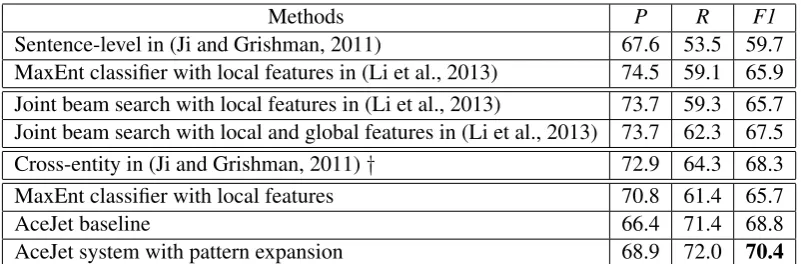
We can see from Table 1 that the resulting sys-tem performance is competitive with other recent system results, such as the joint beam search de-scribed in (Li et al., 2013).
4 Experiments
In this section, we will introduce the evaluation dataset, compare the performance of applying pat-tern expansion with other state-of-the-art systems, and discuss the contribution of pattern expansion.
4.1 Data
We used the ACE 2005 corpus as our testbed. For comparison, we used the same test set with 40 newswire articles (672 sentences) as in (Ji and Gr-ishman, 2008; Liao and GrGr-ishman, 2010) for the experiments, and randomly selected 30 other doc-uments (863 sentences) from different genres as the development set. The remaining 529 docu-ments (14,840 sentences) are used for training.
Regarding the correctness criteria, following the previous work (Ji and Grishman, 2008; Liao and Grishman, 2010; Ji and Grishman, 2011; Li et al., 2013), a trigger candidate is counted as correct if its event subtype and offsets match those of a ref-erence trigger. The ACE 2005 corpus has 33 event subtypes that, along with one class “None” for the non-trigger tokens, constitutes a 34-class classifi-cation problem in this work.
Finally we usePrecision(P),Recall(R), and F-measure(F1) to evaluate the overall performance.
4.2 Performance Comparison
Table 1 presents the overall performance of the systems with gold-standard entity mention and type information. We can see that our system with active learning can improve the performance over our baseline, and also advances the current state-of-the-art systems. In the test sentence, “The pres-ident is totake officetomorrow”, for instance, the system with expanded patterns can correctly iden-tify the Personnel:Start-Position event, whereas
the AceJet baseline even failed to recognize it as an event instance. Another example is, “... the anti-communist Gen. Suharto seized power
in 1965”, where the expanded pattern success-fully detects the event trigger with the correct type
Personnel:Start-Position.
4.3 Discussion
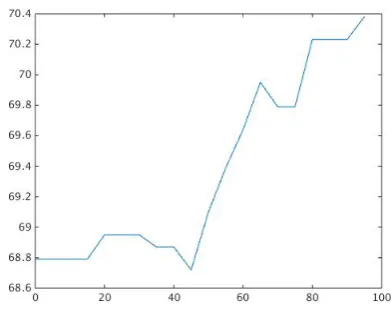
Figure 1: Semi-supervised pattern expansion per-formance (% inF-Measure)
In Figure 1, the x-axis is the number of in-stances added to the training data, while the y-axis is the corresponding F-measure. We can see from Figure 1 that the pattern expansion helps im-prove the performance; however the imim-provement is only modest. This is mainly because the fre-quent dependency pairs may not be closely related to events and not all dependency pairs align with ACE event patterns very well. Since the pattern-based framework is pattern-based on matching depen-dency relation types and named entity types, noun groups play a central role to identify the events. Therefore, we focus on two types of frequent de-pendency relations:
• direct object
The object of a verb plays a significant role in understanding the phrase. For example, the phrase “take office” means that a duty or title is assumed while other phrases like “take an apple” would not trigger an ACE event. • preposition and object
Methods P R F1
Sentence-level in (Ji and Grishman, 2011) 67.6 53.5 59.7
MaxEnt classifier with local features in (Li et al., 2013) 74.5 59.1 65.9 Joint beam search with local features in (Li et al., 2013) 73.7 59.3 65.7 Joint beam search with local and global features in (Li et al., 2013) 73.7 62.3 67.5
Cross-entity in (Ji and Grishman, 2011)† 72.9 64.3 68.3
MaxEnt classifier with local features 70.8 61.4 65.7
AceJet baseline 66.4 71.4 68.8
AceJet system with pattern expansion 68.9 72.0 70.4
Table 1: Performance comparison (%) with the state-of-the-art systems.†beyond sentence level.
In contrast, there are three main classes of de-pendency relations which generally are not helpful in improving ED performance:
1. Time Patterns
Time expressions generally do not help iden-tify the event type. For example, the phrase “tell Michael on Tuesday’ contains a time-modifying prepositional phrase “on Tues-day”, but this time modifier plays little role in determining the type of the event. The verb “tell” is by itself a strong indicator of a Con-tactevent, with the object also playing some role in the classification.
2. Sports Patterns
Since ACE events are mainly about com-mercial and security-related news, patterns related to sports should be removed. For example, “win a title” is one of the top 5 high-frequency dependency pairs in the En-glishGigaWordcorpus. This pattern appears mostly in a sports-related sentence or arti-cle. To remove the sports-related patterns, we plan to build a text classifier and exclude arti-cles classified as sports-related from our fre-quency counts and as sources of examples. 3. Redundant Patterns
Some verbs strongly favor a single event type. For example, “die in hospital” is a high-frequency pattern inEnglishGigaWord, how-ever the verb “die” is sufficient to identify the
Dieevent, whether a man dies in hospital, a room or on the road. Even if this pattern did not appear in the training data, adding it dur-ing pattern expansion will do little to improve event classifier accuracy because there are many Dieevents in the training data whose trigger is the verb “die”. Other information
from context will have minimal effect com-pared to the contribution of the verb “die” it-self. We believe that such cases can be iden-tified as patterns with triggers a large frac-tion of whose training examples represent the same event type.
Of the 100 examples tagged, 28 were positive (event triggers); of the 28, we considered 14 to be redundant (not helpful).
5 Related Work
Although there have been quite a few distinct designs for event extraction systems, most are loosely based on using patterns to detect instances of events, where the patterns consist of a predicate,
event trigger, and constraints on its local syntactic context. The constraints may involve specific lex-ical items or semantic classes.
Saeed Majidi and Gregory Crane. 2013. Active learning for dependency parsing by a committee of parsers. IWPT-2013.
Mstislav Maslennikov and Tat-Seng Chua. 2007. A multi-resolution framework for information extrac-tion from free text. InProceedings of ACL.
Siddharth Patwardhan and Ellen Riloff. 2007. Ef-fective information extraction with semantic affin-ity patterns and relevant regions. InProceedings of EMNLP.
Ellen Riloff. 1996. Automatically generating extrac-tion patterns from untagged text. InProceedings of AAAI.
Mark Stevenson and Mark Greenwood. 2005. A se-mantic approach to ie pattern induction. In Proceed-ings of ACL.
Kiyoshi Sudo, Satoshi Sekine, and Ralph Grishman. 2003. An improved extraction pattern representa-tion model for automatic ie pattern acquisirepresenta-tion. In
Proceedings of ACL.
Mihai Surdeanu, Jordi Turmo, and Alicia Ageno. 2006. Counter-training in discovery of semantic pat-tern. In Proceedings of EACL 2006 Workshop on Adaptive Text Extraction and Mining (ATEM 2006). Roman Yangarber, Ralph Grishman, Pasi Tapanainen, and Silja Huttunen. 2000. Automatic acquisition of domain knowledge for information extraction. In
Proceedings of Coling.