Creating a Data Collection for Evaluating Rich Speech Retrieval
Maria Eskevich
1, Gareth J. F. Jones
1, Martha Larson
2, Roeland Ordelman
31Centre for Digital Video Processing, School of Computing, Dublin City University, Dublin 9, Ireland 2Delft University of Technology, Delft, The Netherlands
3University of Twente, The Netherlands
{meskevich, gjones}@computing.dcu.ie, [email protected], [email protected]
Abstract
We describe the development of a test collection for the investigation of speech retrieval beyond identification of relevant content. This collection focuses on satisfying user information needs for queries associated with specific types of speech acts. The collection is based on an archive of the Internet video from Internet video sharing platform (blip.tv), and was provided by the MediaEval benchmarking initiative. A crowdsourcing approach was used to identify segments in the video data which contain speech acts, to create a description of the video containing the act and to generate search queries designed to refind this speech act. We describe and reflect on our experiences with crowdsourcing this test collection using the Amazon Mechanical Turk platform. We highlight the challenges of constructing this dataset, including the selection of the data source, design of the crowdsouring task and the specification of queries and relevant items.
Keywords:Speech Search, Speech Collection Creation, Speech Retrieval, Crowdsourcing
1.
Introduction
The increasing capacity of digital storage media and ad-vances in networking technologies for content delivery are resulting in an ever increasing expansion in the volume of audio and video data accumulated on the web and in offline archives. The nature of this data can vary sig-nificantly, from broadcast news and lectures to informal videos recorded for Internet TV channels by semi- and non-professionals. Whatever the form of the data, its poten-tial can only be realised if users can locate relevant ctent in a timely and efficient manner. The diversity in on-line archives content potentially gives rise to multiple possi-ble information needs and resulting formulations of search queries. Conventional research on speech retrieval has fo-cused on locating content containing information relevant to a specific information need expressed in a text search query (Garofolo et al., 2000) (Pecina et al., 2008).
In this paper, we describe the design and construction of a speech search benchmarking collection that extends this goal to one when users are considered to be interested in not only informational content, but also in the speaker’s inten-tion while uttering their speech. The focus on speaker in-tention is motivated by the observation that the same words pronounced in different ways can have have different il-locutionary meaning - one can promise or warn the lis-tener. We describe our methodology for developing our test collection for investigating search involving speaker inten-tion and our approach to preparing our ground truth. The test collection includes audio-visual spoken content, search queries and corresponding identified relevant data,
Developing meaningful queries and determining relevant segments in videos expressing speaker intention in an un-biased way is particularly challenging. One possible solu-tion for this lies in crowdsourcing, the disseminasolu-tion of a task to large numbers of human annotators, referred to as workers through an Internet platform (Surowiecki, 2004). This technique permits researchers to gather data from a
di-verse community of workers in return for micro-payments for their contributions. The potential of crowdsourcing has already been explored in a number of other speech and language applications, e.g. (Snow et al., 2008), (Callison-Burch and Dredze, 2010). Creating a test collection of the type we planned to develop is though muc more demand-ing of the crowdsource workers than the tasks undertaken in these previous studies.
The test collection described in this paper was developed for use in the Rich Speech Retrieval (RSR) task which formed part of the MediaEval 2011 Benckmark1. This RSR
task is based on the observation that utterances are actually ‘illocutionary speech acts’2carried out by speakers (Larson
et al., 2011a). The queries are thus designed to search for instances of these speech acts which have been identified in our selected corpus of Internet video.
The paper is structured as follows: Section 2. describes the development of the RSR task we used as an example of dataset construction, Section 3. overviews relevant previous work in crowdsouring for collection of speech and language resources, Section 4. describes the preparation of the data and search collection creation, Section 5. describes task re-ward issues, Section 6. gives details of the results of the collection exercise, and Section 7. concludes and outlines directions for our future work.
2.
Rich Speech Retrieval Task Data
Preparation using Crowdsourcing
The focus of the MediaEval 2011 RSR task was to explore the effectiveness with which different types of ‘illocution-ary speech acts’ can be located within audio-visual spoken data. For this we used the ME10WWW archive of semi-professional user generated video downloaded from the In-ternet video sharing platform blip.tv. The videos for this collection were collected for shows for which the link to1
http://www.multimediaeval.org/ 2
so-Table 1: Number of collected queries per speech act for MediaEval 2011 development and test sets
Speech act type Total
Apology Definition Opinion Promise Warning
Development Set 1 8 17 1 3 30
Test Set 1 17 21 5 6 50
transcribing or uttering some speech. There is no personal creativity required to perform any of these tasks. General factors include, the common observation that here is a per-sistent problem of some workers trying to cheat to receive payment without completing work properly. Also there are interesting questions requiring further exploration relating to the levels of pay offered for tasks, and the potential im-pact of bonus payments on loyalty and quality of work.
3.2. Amazon Mechanical Turk
Currently, the most widely-used platform for crowdsourc-ing is Amazon Mechanical Turk3. In the Mechanical Turk
(MTurk) setting tasks are referred to as ‘Human Intelli-gence Tasks’ or HITs. To initiate a task, the requester up-loads a HIT consisting of relevant instructions, questions, files, etc to be used by the workers while completing the HIT. When the workers have carried out HIT, the requester reviews the completed work and confirms payment to the worker with a previously set payment. If the requester is not satisfied with the work carried out, they can opt not to the worker. Potentially, the requester can also give the worker a bonus, as discussed previously, in order to both express appreciation for the quality of the work and to motivate the worker to continue.
4.
Development of an Effective HIT
While we had a clear specification of the test collection that we wished to develop using MTurk, as highlighted in the previous section, earlier work using crowdsouring for the development of speech and language resources set workers much less complex tasks than we wished them to under-take. In many cases deliberately designing the task to be as simple as possible to reduce the effort involved for the worker, to maximise the potential number of workers inter-ested and qualified to undertake the task and to minmise the chance of them making mistakes. Thus the creation of our test collection was actually exploring the research question of whether untrained MTurk workers can undertaken ex-tended tasks which require them to be more creative than those examined previously.For each HIT we required the worker to carry out the fol-lowing activities:
• View an assigned video to attempt to locate the pres-ence of speech act.
• Label the specific time at which the speech act begins and ends in the video.
• Accurately transcribe the words spoken within the time limits of the labeled speech act.
3
https://www.mturk.com/mturk/welcome
• Write a full sentence query which they believed would be able to refind this speech act, and write a short web style query to refind the speech act.
The task is thus much longer and more complex than tasks typically offered to workers, since it requires them to carry out multiple activities and also to be creative since they are asked to develop their own search queries as part of the HIT. While assigning the HIT to a worker we did not require them to have any specific knowledge or experience of work with audio and video data. However we used internal Ama-zon MTurk platform information about the previous perfor-mance of this registered user in order to select those that are familiar with the system itself, and whose previous re-sults satisfied other requesters. This measure is called HIT Approval Rate, and is a simple ratio of how many HITs submitted by each worker have been approved by the re-questers. For our HIT we allowed only the workers with HIT Approval Rate greater than or equal to 90 to undertake the task.
4.1. Data Management
The videos in the blip TV dataset vary in length. We felt it unrealistic to expect workers to view extended videos while looking for speech acts. Also we observed a bias in our ini-tial crowdsourcing trials with this data that workers tend to identify noteworthy segments in the first few minutes of a video. This may be caused by the fact that they are paid for each HIT, and are therefore interested in complet-ing more HITs in time they have available. Thus for the original 247 and 1727 videos in the ME10WWW for de-velopment and test set respectively, we prepared 562 and 3278 starting points for longer videos at a distance of ap-proximately 7 minutes apart. These starting points were then randomly allocated by the Amazon MTurk platform to be presented to the workers in each HIT. Even after pre-segmenting the videos into shorter parts, the workers rarely found noteworthy content later than the third minute from the start of playback point in the video.
The main technical challenge was that since MTurk does not support playback of multimedia files, the workers needed to watch videos stored on an external server. The path to the remote file was embedded within the html-code of the HIT page. Thus the video player used had to be com-patible with different operating systems and browsers. Re-strictions on this issue had to be made clear to workers in the general description of the task.
4.2. Data Collection Procedure
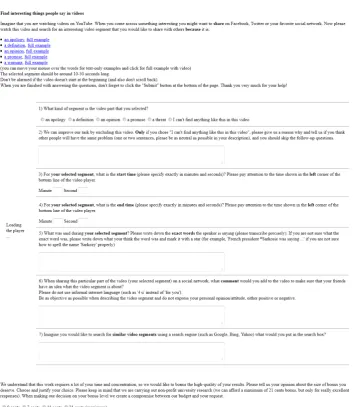
Figure 1: Amazon MTurk HIT example that was used to gather long and short queries (Questions 6 and 7) associated with certain speech acts (Question 1), time stamps (Questions 3 and 4) and transcript (Question 5) of the relevant content
These answers were not included in the final set, but pro-vided us with valuable feedback to refine our HIT.
The initial HIT was found to contain too many concepts that workers did not understand clearly. The revised HIT thus avoided words such as ‘transcripts’, ‘quote’, ‘categories’ etc. The request to find the segment with a certain speech act was expressed indirectly, and was hard to understand. Initially the description of the task was: “Please watch the video and find a short portion of the video (a segment) that contains an interesting quote. The quote must fall into one of these six categories”. Analysis of the results showed that workers were confused with the type of phrases they had to find, the concept of transcription was mixed with the general description of what was said during the video, the workers who were probably not familiar with the video player gave wrong time onsets and offsets for identified rel-evant speech events.
In our revised HIT, we attempted to make use of a concept with which general workers will be more familiar when
working with the videos – sharing. The concept of shar-ing seemed to us to be part of the everyday experience of people who work with the Internet and would provoke a more natural human response setting. The new phrase of the HIT became: “Imagine that you are watching videos on YouTube. When you come across something interesting you might want to share it on Facebook, Twitter or your favorite social network. Now please watch this video and search for an interesting video segment that you would like to share with others because it is (an apology, a definition, an opinion, a promise, a warning)”.
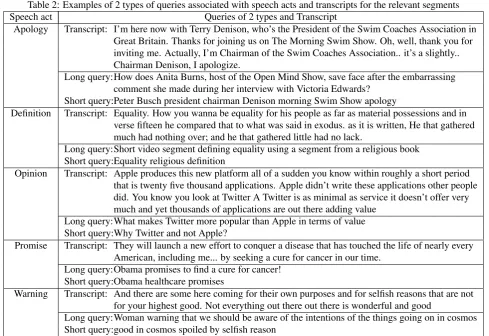
The other way to make the workers more familiar with the task was to provide full examples of how all the questions in one HIT can be answered for each speech act type. At the head of each HIT page we put a link to a webpage with an example video with all fields filled in and a dropout window on the page of the HIT itself with only the textual answers.
Table 2: Examples of 2 types of queries associated with speech acts and transcripts for the relevant segments
Speech act Queries of 2 types and Transcript
Apology Transcript: I’m here now with Terry Denison, who’s the President of the Swim Coaches Association in Great Britain. Thanks for joining us on The Morning Swim Show. Oh, well, thank you for inviting me. Actually, I’m Chairman of the Swim Coaches Association.. it’s a slightly.. Chairman Denison, I apologize.
Long query:How does Anita Burns, host of the Open Mind Show, save face after the embarrassing comment she made during her interview with Victoria Edwards?
Short query:Peter Busch president chairman Denison morning Swim Show apology
Definition Transcript: Equality. How you wanna be equality for his people as far as material possessions and in verse fifteen he compared that to what was said in exodus. as it is written, He that gathered much had nothing over; and he that gathered little had no lack.
Long query:Short video segment defining equality using a segment from a religious book Short query:Equality religious definition
Opinion Transcript: Apple produces this new platform all of a sudden you know within roughly a short period that is twenty five thousand applications. Apple didn’t write these applications other people did. You know you look at Twitter A Twitter is as minimal as service it doesn’t offer very much and yet thousands of applications are out there adding value
Long query:What makes Twitter more popular than Apple in terms of value Short query:Why Twitter and not Apple?
Promise Transcript: They will launch a new effort to conquer a disease that has touched the life of nearly every American, including me... by seeking a cure for cancer in our time.
Long query:Obama promises to find a cure for cancer! Short query:Obama healthcare promises
Warning Transcript: And there are some here coming for their own purposes and for selfish reasons that are not for your highest good. Not everything out there out there is wonderful and good
Long query:Woman warning that we should be aware of the intentions of the things going on in cosmos Short query:good in cosmos spoiled by selfish reason
We had several workers who completed several HITs for the development set, but did not participate in the HIT for the collection of the test set. This lack of overlap might cause certain differences in the way people formulated their queries and chose relevant segments.
In general, for the test set the number of accepted HITs with the speech act chosen was 58.1%, where 39.5% were suitable for use in the dataset and 18.6% were accepted, but not included (either some of the fields were missing or there were some issues with the work of the video). For the remaining 41.9% of HITs the worker indicated that they were unable to find an instance of any of the illocutionary acts, we found that 35% of these responses were reason-able, while the other 6.9% were disputable.
It is worth commenting that the data provided by the work-ers required an additional manual assessment by the re-quester because there were a number of spam entries. Some types of spam were easy to capture, even automatically, for example when all fields for the HIT were empty or con-tained the same word. However some spam workers were more creative and copied field by field the example we have provided in the HIT heading. In our HIT formulation there was the possibility to state that there is no speech segment that can be associated with any of listed speech acts and still get the basic reward. During the collection for the test set, only 16% of these answers seemed to be disputable, and thus could be classified as spam or improper work. In these cases the workers were not paid. This problem was also ob-served for confirmation of translations in (Callison-Burch
and Dredze, 2010), an effective solution was to use images of the text which could not be copied, rather than using text itself. While manual checking by the requestor of the claim that there was no speech act present in the video shown for the HIT was practical for the small scale data collection undertaken here, it would quickly become prohibitive for larger collections. In these cases passing these video play-back points to a second round of crowdsourcing might offer a means to check the judgement of the first worker.
Martha Larson, Maria Eskevich, Roeland Ordelman, Christoph Kofler, Sebastian Schmiedeke, and Gareth J. F. Jones. 2011a. Overview of Mediaeval 2011 Rich Speech Retrieval task and genre tagging task. In Martha Larson, Adam Rae, Claire-H´el`ene Demarty, Christoph Kofler, Florian Metze, Rapha¨el Troncy, Vasileios Mezaris, and Gareth J. F. Jones, editors,Proceedings of the
MediaE-val 2011 Workshop, volume 807. CEUR-WS.org.
Martha Larson, Mohammad Soleymani, Pavel Serdyukov, Stevan Rudinac, Christian Wartena, Vanessa Murdock, Gerald Friedland, Roeland Ordelman, and Gareth J. F. Jones. 2011b. Automatic tagging and geotagging in video collections and communities. In Proceedings of the 1st ACM International Conference on Multimedia
Retrieval (ICMR 2011), pages 51:1–51:8. ACM.
Matthew Marge, Satanjeev Banerjee, and Alexander I. Rud-nicky. 2010. Using the Amazon Mechanical Turk for transcription of spoken language. InProceedings of the IEEE International Conference on Acoustics, Speech,
and Signal Processing (ICASSP 2010), pages 5270–
5273. IEEE.
Pavel Pecina, Petra Hoffmannov´a, Gareth Jones, Ying Zhang, and Douglas Oard. 2008. Overview of the CLEF 2007 Cross-Language Speech Retrieval Track. In Carol Peters, Valentin Jijkoun, Thomas Mandl, Hen-ning M¨uller, Douglas Oard, Anselmo Pe˜nas, Vivien Pe-tras, and Diana Santos, editors,Advances in Multilingual
and Multimodal Information Retrieval, Lecture Notes
in Computer Science, pages 674–686. Springer Berlin / Heidelberg.
Rion Snow, Brendan O’Connor, Daniel Jurafsky, and An-drew Y. Ng. 2008. Cheap and fast—but is it good?: eval-uating non-expert annotations for natural language tasks.
InProceedings of the Conference on Empirical Methods
in Natural Language Processing (EMNLP 2008), pages
254–263, Stroudsburg, PA, USA. Association for Com-putational Linguistics.