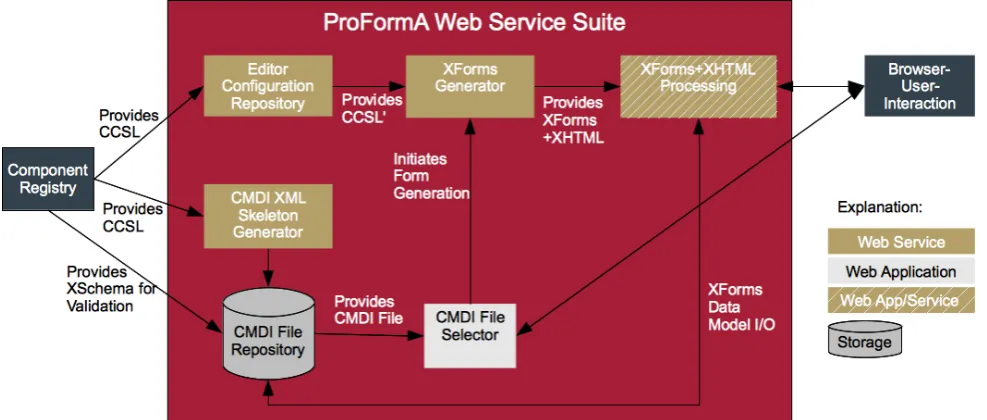
Figure 1: ProFormA CMDI editor suite of web services.
These values can include static information on the provider such as the provider’s name and affiliation. The instances are either created by the skeleton generator or by another CMDI instance producing process, such as the transforma-tion from other metadata formats.
Changes to the default profile descriptions (i.e. the CCSL) are made to a copy of the CCSL. These changes, if wanted, are applied to the configuration file manually, creating an extension to the CCSL, here written as CCSL’. The editor configuration repository is a system with two functions (cf. Figure 1): If the further processes request an unknown pro-file, it serves as a proxy to retrieve the profile’s CCSL file from the Component Registry. But if the processes try to gain access to known profiles, the local copy is distributed. These local copies may contain the following modifica-tions:
• Groupingof metadata fields in the editor’s display de-viating from the default grouping which is based on the underlying CMDI component structure. Thus, the form specification may produce a layout structure that is different from the order of elements in the CMDI profile. For example, it can be advisable to group a person and its institution together, though this might not be reflected in the CMDI components.
• An editing priority for each metadata field indicat-ing if this field is required, recommended or optional.
• Adisplay priorityfor each metadata field specifying if it should be displayed withhigh,mediumorlow priority. This option can be applied, for instance, to display different amounts of data or to hide empty fields that have a low priority.
• Complimentary help textfor field elements. Some def-initions for the intended use of the fields are already available by integrating the definitions both of the data
categories in ISOcat and the components in the Com-ponent Registry. However, if additional hints should be provided, this can also be included in the configu-ration files.
4.4 XForms Generator
The metadata editor is entirely based on XForms (Boyer, 2009), a W3C standard for the definition and management of web-based forms. The XForms generator is a web ser-vice creating an XForms instance embedded into HTML. XForms’ Model-View-Controller (MVC) approach takes the XML structure (such as a document instance of a CMDI profile) as its data model. The view part of the MVC ap-proach transforms the XML document into HTML/CSS. All control elements, in particular for saving the docu-ment’s content, are also provided. The forms are defined in a declarative manner.
The described metadata editor is generated using a CMDI profile and its corresponding configuration file. The XForms technology then allows users to edit metadata files with standard browser technologies. When the users complete fields of the form in the browser, they fill in a CMDI document instance which serves as the data model in XForms’ MVC approach. XForms technology generates a metadata file, which is saved in the CMDI file repository on the server (see Figure 1). This can be, for instance, the primary data repository containing the metadata file for de-scriptive purposes.
4.5 XForms + XHTML Processing
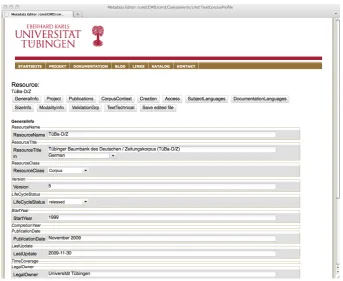
Figure 2: Metadata editor displaying a part of the metadata for the resource T¨uBaD/Z, a treebank for German.
Additionally, the editor is intended to access data avail-able from the Linked Data Initiative. When users en-ter the names of persons, institutions or locations, auto-completion should be used to access information stored in databases such as the authority files of the German National Library (see http://www.dnb.de) or geo-graphical databases (such ashttp://www.geonames. org). This also involves linking to material made avail-able by the Linked Open Data Community (see http: //linkeddata.org/) in the future.
Another prospective development is the integration of the editor into the workflow of archiving resources in a pri-mary research data repository. As the components of the ProFormA suite are available as services, all prerequisites for integration are fulfilled (see (Dima et al., 2012)).
6
Acknowledgements
The editor presented in this paper includes com-ponents and services developed by different projects. Their implementation was made possi-ble by funding within the CLARIN-D (Common Language Resources and Technology Infrastructure, http://clarin-d.net/index.php/en/) project of the BMBF (Federal Ministry of Education and Research, http://www.bmbf.de/en), the SFB 833 (Collabora-tive Research Center 833: The Construction of Meaning - the Dynamics and Adaptivity of Linguistic Structures, http://www.sfb833.uni-tuebingen.de/) funding by the DFG (German Research Founda-tion, http://www.dfg.de/en) and the NaLiDa project (Sustainability of Linguistic Data, http: //www.sfs.uni-tuebingen.de/nalida/en/) grant by the DFG in the LIS program (Scientific Library
Services and Information Systems, http://www. dfg.de/en/research_funding/programmes/ infrastructure/lis/index.html).
7
References
R. Barkey, E. Hinrichs, C. Hoppermann, T. Trippel, and C. Zinn. 2011a. Komponenten-basierte Metadaten-schemata und Facetten-basierte Suche: Ein flexibler und universeller Ansatz. In J. Griesbaum, T. Mandl, and C. Womser-Hacker, editors, Information und Wissen: global, sozial und frei? Proceedings des 12. Interna-tionalen Symposiums f¨ur Informationswissenschaft (ISI 2011), pages 62 – 73, Boizenburg. Hochschulverband f¨ur Informationswissenschaft, Verlag Werner H¨ulsbusch. R. Barkey, E. Hinrichs, C. Hoppermann, T. Trippel, and
C. Zinn. 2011b. Trailblazing through forests of re-sources in linguistics. InDigital Humanities, Stanford: Stanford University, June.
J. M. Boyer. 2009. XForms 1.1. W3C Recommenda-tion 20 October 2009, See http://www.w3.org/ TR/2009/REC-xforms-20091020/.
D. Broeder, M. Kemps-Snijders, D. Van Uytvanck, M. Windhouwer, P. Withers, P. Wittenburg, and C. Zinn. 2010. A data category registry- and component-based metadata framework. InProceedings of the 7th Confer-ence on International Language Resources and Evalua-tion (LREC 2010), Malta.
E. Dima, V. Henrich, E. Hinrichs, M. Hinrichs, C. Hop-permann, T. Trippel, T. Zastrow, and C. Zinn. 2012. A repository for the sustainable management of research data. In Proceedings of the 8th Conference on Inter-national Language Resources and Evaluation (LREC 2012), Istanbul.
IMDI. 2001. Metadata elements for session descrip-tions, draft proposal version 2.5, June. http: //www.mpi.nl/world/ISLE/documents/ draft/ISLE_MetaData_2.5.pdf.
ISO 12620:2009. 2009. Terminology and other language and content resources – specification of data categories and management of a data category registry for language resource. Technical report, ISO.
G. Simons and S. Bird. 2008. OLAC metadata. Technical report, Open Language Archive Commu-nity. http://www.language-archives.org/ OLAC/metadata-20080531.html.