Corpus Annotation as a Scientific Task
Donia Scott, Rossano Barone, Rob Koeling
Department of Informatics, University of Sussex Brighton, UK. {D.R.Scott, R.Barone, R.Koeling}@sussex.ac.uk
Abstract
Annotation studies in CL are generally unscientific: they are mostly not reproducible, make use of too few (and often non-independent) annotators and use guidelines that are often something of a moving target. Additionally, the notion of ‘expert annotators’ invariably means only that the annotators have linguistic training. While this can be acceptable in some special contexts, it is often far from ideal. This is particularly the case when subtle judgements are required or when, as increasingly, one is making use of corpora originating from technical texts that have been produced by, and intended to be consumed by, an audience of technical experts in the field. We outline a more rigorous approach to collecting human annotations, using as our example a study designed to capture judgements on the meaning of hedge words in medical records.
Keywords:annotation, hedges, electronic patient records
1.
Introduction
Even when undertaken with the aid of one of the many excellent annotation toolkits available, human corpus an-notation is a time-consuming and cognitively loaded task. It also typically requires a lot of training, with carefully-constructed guidelines and regular monitoring. Most hu-man annotation tasks thus involve a small number of anno-tators, and although the standard is moving towards triple-annotated documents, many studies still include a num-ber of single annotated documents (see, e.g., Thompson (2008)). This scenario (even with triple-annotations) is not ideal in that it is unlikely to lead to robust models1, es-pecially in cases where the annotation task requires subtle judgements for which there is no established gold standard. Such cases instead require careful analysis of a represen-tative set of language samples in a highly controlled labo-ratory study involving a substantial number of annotators. This is the purview of experimental psycholinguistics.
We describe here our use of standard techniques from experimental psycholinguistics (and more generally, exper-imental psychology) for gathering human judgements of linguistic data from an established corpus. We ground our description in an annotation study we have conducted on the use of linguistic hedges in medical communication, as a preliminary to applying machine-learning techniques for information extraction of medical decisions/opinions in a large corpus of electronic patient records.
2.
Vagueness in medical communication
“Medical vagueness refers to the inherent and irreducible uncertainty that occurs when clinical knowledge is applied to specific pa-tients”(Emanuel and Emanuel, 1989)
This vagueness is mostly expressed in medical documents through the use of linguistic hedges – i.e., modifiers such as
1See Krippendorff (2004) for an extended discussion of this
point.)
“possibly<diabetes>”,“probably<diabetes>”, “consis-tent with<diabetes>” etc. (see, e.g., Hyland (2006)). Con-sider for example these fairly typical excerpts taken from radiology reports:
Possible early pneumonia involving the lingual and possibly the right middle lobe.
Mild perihilar bronchial wall thickening may rep-resent either viral infection or reactive airways disease.
Subtle ill defined opacity in the left lower lobe could represent pneumonia in the appropriate clinical setting.
Left posterior lung base opacity which appears somewhat homogeneous which is somewhat atyp-ical for consolidation.
The issue for us, is to understand the level of (un)certainty of the state of affairs that these various hedges are intended to convey, especially in a medical setting. More specifi-cally, faced with the task of extracting information about diagnoses, symptoms etc. from electronic patient records, how should we treat information that is couched in spec-ulative language? To achieve a robust model of the map-pings between specific hedges and levels of (un)certainty, we need to attend to a number of methodological factors.
3.
Methodological requirements
3.1. Variability between and within annotators
therefore to design a study that will control for unwanted variability and allow us to derive statistical idealisations that account for such effects.
3.2. Method of data collection
For good quality annotations theres an obvious requirement that the annotators themselves are well qualified to make the judgements. In a case such as ours, we need to make sure that the annotators are very experienced in the lan-guage of medical records as regular authors and/or read-ers of such documents. Additionally, the study requires a large sample of such time-committed individuals who will be prepared to engage fully in the task and to carry it out to completion. It is difficult to get professional medics to devote the time required for annotation. The challenge is therefore to employ an alternative method of data collection that will be effective in recruiting a large sample of appro-priately trained annotators whilst providing reliable data.
3.3. Efficacy of the annotation task
In order to ensure that all annotators are applying the same criteria for any given judgement, the standard procedure in corpus linguistics is to develop annotation guidelines that provide clear criteria for each tag in the annotation set. This of course requires some a priori understanding of meaning of the elements in the tagset (e.g., named entities, confer-ence, parts of speech, diagnoses/symptoms etc.). Another important challenge for any annotation task is to make it efficient in terms of both the required time and cognitive effort needed to perform the task, and also its capacity to be correctly understood and followed. Ideally, the task should minimise opportunities for errors and unconscien-tious judgments, thus improving overall data quality. There are a range of task-design features that are critical to meet-ing these challenges, includmeet-ing ensurmeet-ing that the scheme and instructions are simple, intuitive and unambiguous, and presenting the test materials in ways that facilitate correct comprehension.
3.4. Assessing the validity of annotations
An important requirement for determining data quality is to eliminate data resulting from participants who do not adhere to the task instructions. A critical methodological challenge is therefore to design methods for identifying in-valid data resulting from non-compliance of task instruc-tions.
4.
Solution methodology
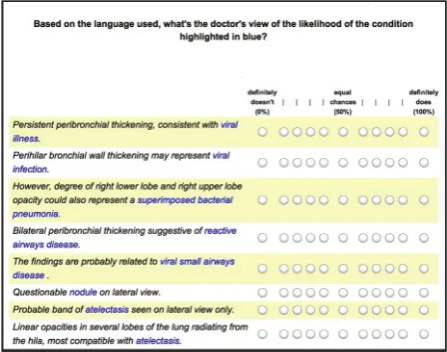
We designed our annotation study as a web-based psy-cholinguistic experiment that required a forced-choice re-sponse to hedged sentences taken from a corpus of medical records. Figure 1 shows a snapshot of what participants saw. With each response they make, subjects in the study are effectively annotating the hedge that appears in the sen-tence under consideration.
4.1. Corpus
We made use of the BioScope corpus of electronic medical records, which contains 855 sentences already tagged for speculative language (i.e., hedges and their scope) (Vincze
Figure 1: Snapshot of an example of participants’ view of the study
et al., 2008). We manually cleaned up the corpus to re-move obvious annotation errors and to eliminate ambiguous or semantically complex cases, involving e.g., alternatives, coordination, or multiple hedges. This left us with a pool of 313 sentences. The distribution of hedges in the corpus followed the typical Zipf profile: ranging from 108 tokens of “may” (e.g., “Mild perihilar bronchial wall thickening may represent reactive airways disease.”) to many cases for which there were only a few, or even only one, token. Of these we selected the top most frequent hedges types with the cutoff point being ones for which there were six of more tokens; this gave us 18 types of hedges. Finally, we ran-domly selected six tokens of each type2. This provided 108 (6 x 18) hedged sentences for our study.
For each of the selected sentences, we highlighted the scope of the hedge (in blue, as shown in Figure 1). The highlighting feature was aimed at facilitating task consis-tency by ensuring that the object (i.e., scope) of the hedge was clearly signalled. Highlighting only the scope rather than the hedge itself was intended to make it more difficult for participants to simply work through the sentences with-out reading them fully, making decisions by looking at the hedge word(s) only.
4.2. Variability between and within annotators
To address this issue, we chose to collect data from a large sample of subjects/annotators and, from each a sample of responses to the same hedge. This approach to providing estimates of the central tendency of values and dispersion (as normally employed in psychology experiments) will al-low us to identify and account for the variability effects de-scribed above, and provide an approximate measure of the nature of such variability within the population.
4.3. Annotation task
Tags were selected through an answer to the question: Based on the language used, what’s the doctor’s view of the likelihood of the condition highlighted in blue?
2
K. Krippendorff. 2004. Content Analysis: An Introduction to Its Methodology. Sage, Thousand Oaks, CA, 2nd edi-tion.
A. Roberts, R. Gaizauskas, M. Hepple, N. Davis, G. Demetriou, Y. Guo, J. Kola, I. Roberts, A. Setzer, A. Tapuria, and B. Wheeldin. 2007. The CLEF corpus: Semantic annotation of clinical text. InProceedings of the Annual Symposium of the American Medical Infor-matics Association (AMIA, 2007), pages 625 – 629. R. Snow, B. OConnor, D. Jurafsky, and A.Y. Ng. 2008.
Cheap and fast but is it good? evaluating non-expert annotations for natural language tasks. InProceedings of the 2008 Conference on Empirical Methods in Natural Language Processing, pages 254 – 263.
P. Thompson. 2008. Building a bio-event annotated cor-pus for the acquisition of semantic frames from biomed-ical corpora. In Proceedings of the Sixth International Conference on Language Resources and Evaluation (LREC’08), Marrakech, Morocco, may. European Lan-guage Resources Association (ELRA).