CSEIT1725115 | Received : 25 Sep 2017 | Accepted : 07 Oct 2017 | September-October-2017 [(2)5: 579-583]
International Journal of Scientific Research in Computer Science, Engineering and Information Technology © 2017 IJSRCSEIT | Volume 2 | Issue 5 | ISSN : 2456-3307
579
Review of Various Load Balancing Methods for
Cloud Computing
Nikhit Pawar
1, Prof. Umesh Kumar Lilhore
2, Prof. Nitin Agrawal
3 M. Tech. Research Scholar1, Head PG2, Assistant Professor3NRI Institute of Information Science & Technology Bhopal, Madhya Pradesh, India
ABSTRACT
Cloud computing is an innovative technology which is based on virtualization. It is a new name of existing technology. Cloud computing mainly serves computing resources as a service to cloud users. This Computing is not only about the hard drives were storing and accessing can be done but it is latest computing paradigm and it offers tremendous opportunities to solve the large-scale scientific problem. To fully exploit the applications of cloud, various challenges need to be addressed where scheduling is one among them. In cloud computing, optimum utilization of computing resources are always challenging. A cloud service provider ensures to serve computing resources efficiently to cloud user at optimum cost. Load balancing methods play a vital role in the efficient utilization of computing resources. A load balancing algorithm migrates an overloaded VMs task to an under the loaded machine, with disturbing the existing environment. Different load balancing methods are suggested by cloud researchers. Still, an efficient load balancing method is required. This research paper presents a review of various load balancing method in cloud computing. Also, a comparative analysis has been presented based on various performance measuring parameters.
Keywords : Cloud computing, Load balancing, Virtualization, Virtual Machine, Load Balancer
I.
INTRODUCTION
Cloud Computing is the future of technology said by various CEO of IT industry. It works on the principle that the user must pay according to the time for which it is using the resources from various cloud providers. It is well known that it is not easy to handle large resources. It is very costly in terms of money as well. So Cloud Computing is the best answer to these challenging problems [7]. Cloud Computing is the answer to almost every problem faced by many Industries which are directly or indirectly related to the Information Technology. This field is growing very fastly as many of the big players in the Information Technology field like Microsoft, Google, Amazon, SAP are investing a lot of money to get improved results. They feel that it is the future of technology.
Cloud computing is a model for enabling on-demand network access to a shared pool of configurable computing machines, which can be provisioned and
released with minimal management effort or service provider interaction. In cloud computing, one can store data on remotely placed servers accessible through the internet. It can offer utility-oriented IT services to users based on a pay-as-you-go model [9]. One of its major advantages is that it offers QoS, high computational power, and storage capacity at low cost. According to technology experts, cloud computing can be seen as a game-changing technology that can change the way we access technology.
II.
CLOUD COMPUTING & LOAD BALANCING
the cloud system [3]. Using virtualization technique, cloud computing virtualized a single system into a number of virtual systems. Basically, a virtual machine is a software implementation of the physical resource. A hypervisor (a firmware or low-level program) also called virtual machine monitor is responsible for sharing of a single physical instance of cloud resources among various tenants [5].
Figure 1. Cloud Computing
The goal of cloud computing is to improve the performance of the system and to achieve optimal resource utilization, maximum throughput, maximum response time, and avoiding overload [7].
2.2 Load Balancing : Cloud computing could be a model for enabling appropriate, on-demand network access to a joint pool of configurable computing resources that may be quickly provisioned and discharged with least management effort. The underlying plan of cloud computing is that the separation of applications from the in operating systems and therefore the hardware on that they run [8,11].
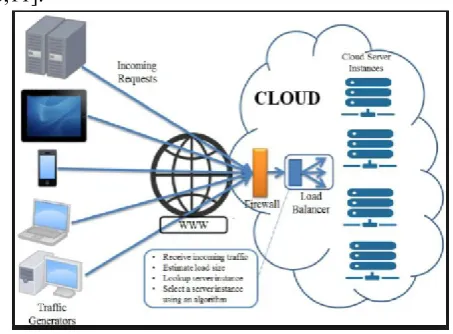
Figure 2. Load Balancing in Cloud
Load balancing is the process of apportioning the load among various working nodes of a distributed system to improve both resource utilization and job response time while avoiding a situation where some of the nodes are heavily loaded while others are underloaded. Load balancing ensures that every node in the system does the approximately equal amount of work as per their capacity at any instant of time [6].
2.2.1 Advantages of Load Balancing
To expand the performance significantly.
To have a backup plan in case the system fails even partially.
To keep the framework stable.
To give future improvement in the framework
To distribute the workload fairly.
2.2.2 Need of Load Balancing [3]
To improve the performance substantially.
To have a backup plan in case the system fails even partially.
To maintain the system stability.
To accommodate future modification in the system.
III. Related work in Load Balancing
Load Balancing is a necessary task in Cloud Computing environment to attain maximum use of resources. If we talk about different load balancing methods, everyone having some pros and cons. Static load balancing method provides simplest simulation and check of the environment but not succeed to the model heterogeneous character of the cloud. Where dynamic load balancing algorithms are hard to simulate but are most excellently suited in a heterogeneous environment of cloud computing.
Throttled Load Balancing Algorithm : It is a dynamic approach. In this, the user submits its request to the Data Center Controller (DCC). Data Center Controller asks the VM Load Balancer to determine the appropriate virtual machine that can handle that much workload easily. Throttled VM Load Balancer keeps a virtual machine list and their status (available/busy). If a suitable VM is found on memory space, cores or availability basis, then throttled VM Load Balancer accept the cloudlet request and allow the cloudlet request over that virtual machine. Otherwise, the client has to wait in the waiting queue until a suitable VM becomes available [11].
FCFS : FCFS (First come back 1st Served), employed in parallel task process, is that the simplest task ordering strategy. It chooses and processes them in keeping with the proper order of jobs moving into the system. With this theme, the user request that comes 1st to the data center controller is allotted the virtual machine for execution 1st. The implementation of FCFS policy is definitely managed with first in first out queue. The data center controller searches for virtual machine that is in idle state or underloaded [9].
ESCE VM load Balancing Algorithm : ESCE stands for Equally Spread Current Execution. It is also called Active VM Load Balancing algorithm. This algorithm is based on spread spectrum technique. As the name indicates, it equally distributes the workload on each VM in the data center [7]. A job queue keeps all the cloudlet requests that need the VM for their execution. ESCE VM Load Balancer (VMLB) also maintains a list of virtual machines. The VM Load Balancer continuously checks the job queue and VM list. If a VM is found free, then cloudlet request will be allotted over that VM.
Ant Colony Optimization : The algorithm works based on the heuristic approach. Whenever a request is initiated, the ants and pheromones are initiated [1, 3]. The ants move towards the head node. The forward movement indicates the ant is moving from the overloaded node to the other by verifying whether the other node is overloaded or not. If the Ant finds under the loaded node, it will continue the forward movement towards the head, else it will take a backward movement to get to the previous node. The Ant commits suicide when it reaches the Target node to avoid further backward movements.
Opportunistic Load Balancing Algorithm : It is also one of the static load balancing algorithms, which do not consider the present workload of the VM. It usually keeps each and every node busy [3, 15]. This deals with the unexecuted tasks quickly and in random order to the current node, where each one of the task is assigned to the node randomly. This algorithm provides a load balancing schedule but does not produce a good result. The tasks are processed in a slow manner, where the current execution time of the node is not calculated.
Honeybee Foraging Load Balancing Algorithm : It is one of the dynamic load balancing algorithms, where they are designed based on the behavior of honey bees. Honey bees have been classified into two types. They are finders and reapers. The finder honeybee helps in finding the honey source. Once the honey source is found, they do the waggle dance to indicate the quality and quantity of available honey. After that, the reapers gather the honey from the sources. Then, again they go for the waggle dance to specify the honey that is left [10].
Greedy Algorithm : The Greedy algorithm is the default algorithm used for scheduling of Virtual Machines in Eucalyptus. The Greedy algorithm [3] is very simple and straightforward. As a matter of fact, it was the only scheduling policy which was in use for a long time. Only after the cloud started evolving, more complex scheduling policies came into effect. The greedy algorithm uses the first node that it finds with suitable resources for running the VM that is to be allocated. The first node that is identified is allocated the VM. This means that the greedy algorithm exhausts a node before it goes on to the next node.
Advantage* The main advantage of the Greedy algorithm is its simplicity.
Comparison of Existing Load balancing method-
IV. Conclusions and Future works
Load Balancing is an essential task in Cloud Computing environment to achieve maximum utilization of resources. Cloud Computing is a huge concept and load balancing plays a very important role in Clouds. We have discussed and compared various load balancing algorithms, other load balancing algorithms can also be applied. Balancing the network load equally is one of the significant tasks in cloud computing. The ant colony optimization works better and distributes the workload in an efficient manner when compared to other algorithms. In Future work,
we will develop an efficient load balancing method for cloud computing and will compare this proposed with various existing load balancing methods.
V.
REFERENCES
[1]. NIE Qingbin, LI Pinghua,” An Improved Ant Colony Optimization Algorithm for Improving Cloud Resource Utilization”, 2016 International Conference on Cyber-Enabled Distributed Computing and Knowledge Discovery, IEEE 2016, PP 311-316
Dynamic
Job Allocation
Advantage
Disadvantage
[4]
Round-Robin Static
Selects the First Node in Random Manner, and allocates other nodes in Round Robin Method
Balancing Algorithm Static Identifies and completes the job waiting in queue. Performs better small execution time. Leads Starvation. to [13]
Max-Min Load Balancing Algorithm Static
Finding the minimum execution time and deals with the maximum execution time.
Dynamic Based on Random Sampling Method.
Load balancing is achieved through all the nodes in the
Dynamic Grouping nodes together. Similar nodes are grouped together.
[2]. Qiang Guo, “Task scheduling based on ant colony optimization in cloud environment”, 2017 5th International Conference on Computer-Aided Design, Manufacturing, Modeling and Simulation (CDMMS 2017), PP 40039 1- 10 [3]. Weifeng Sun, Zhenxing Ji, Jianli Sun, Ning
Zhang, Yan Hu, “SAACO: A Self-Adaptive Ant Colony Optimization in Cloud Computing”, IEEE 2015, PP 148-153.
[4]. Hongyan Cui,1,2 Xiaofei Liu,1 Tao Yu,3 Honggang Zhang,4 Yajun Fang,5 and Zhongguo Xia, “Cloud Service Scheduling Algorithm Research and Optimization”, Hindawi Security and Communication Networks Volume 2017, Article ID 2503153, PP 1-7
[5]. Akash Dave, Prof Bhargesh Patel, Prof. Gopi Bhatt,” Load Balancing In Cloud Computing Using Optimization Techniques: A Study”, IEEE 2016, 114-120
[6]. Achar R, Thilagam Ps, Soans N, Vikyath Pv, Rao S, Vijeth Am. Load Balancing In Cloud Based On Live Migration Of Virtual Machines. In 2013 Annual IEEE India Conference (Indian) 2013 Dec 13 (Pp. 1-5). IEEE.
[7]. Dam S, Mandal G, Dasgupta K, Dutta P. Genetic Algorithm And Gravitational Emulation Based Hybrid Load Balancing Strategy In Cloud Computing. In Computer, Communication, Control and Information Technology (C3it), 2015 Third International
[8]. Conference on 2015 Feb 7 (Pp. 1-7). IEEE. [9]. Zhao Y, Huang W. Adaptive Distributed Load
Balancing Algorithm Based On Live Migration Of Virtual Machines In Cloud. In Inc, Ims and Idc, 2009. Ncm'09. Fifth International Joint Conference On 2009 Aug 25 (Pp. 170-175). IEEE.
[10]. Ashwin Ts, Domanal Sg, Guddeti Rm. A Novel Bio-Inspired Load Balancing Of Virtual Machines In Cloud Environment. In Cloud Computing In Emerging Markets (Ccem), 2014 IEEE International Conference On 2014 Oct 15 (Pp. 1-4). IEEE.
[11]. Zhang Z, Zhang X. A Load Balancing Mechanism Based On Ant Colony And Complex Network Theory In Open Cloud Computing Federation. In Industrial Mechatronics And Automation (Lima), 2010 2nd International Conference On 2010 May 30 (Vol. 2, Pp. 240-243). IEEE
[12]. Zhu K, Song H, Liu L, Gao J, Cheng G. Hybrid Genetic Algorithm For Cloud Computing Applications. In Services Computing Conference (Apc), 2011 IEEE Asia-Pacific 2011 Dec 12 (Pp. 182-187). IEEE.
[13]. Nishant K, Sharma P, Krishna V, Gupta C, Singh Kp, Rastogi R. Load Balancing Of Nodes In Cloud Using Ant Colony Optimization. In Computer Modeling And Simulation (Taksim), 2012 Maksim 14th International Conference On 2012 Mar 28 (Pp.3-8). IEEE.
[14]. Yao J, He JH. Load Balancing Strategy Of Cloud Computing Based On Artificial Bee Algorithm. In Computing Technology And Information Management (CCM), 2012 8th International Conference On 2012 Apr 24 (Vol. 1, Pp. 185-189). IEEE.
[15]. Aslanzadeh S, Chaczko Z. Load Balancing Optimization In Cloud Computing: Applying Endocrine-Particle Swarm Optimization. In2015 IEEE International Conference On Electro/Information Technology (Eit) 2015 May 21 (Pp. 165- 169). IEEE.