Statistical Process Control at the Compound plant of
DSM Engineering Plastics B.V. Emmen
A Theoretical and Practical Feasibility Study
Master thesis for the study Industrial Engineering and
Management at the University of Twente, Enschede
Student:
R.E. van den Hoek
University supervisors:
Ir. W. Bandsma
Dr. Ir. H.G.A. Middel
DSM supervisor:
Ir. H. van de Rijt
Date:
6 September 2008
P
Preface
This report was written as the conclusion of the master study Industrial Engineering and Management at the University of Twente, Enschede. Three years ago, I decided to add a new dimension to my study by not choosing one of the ‘standard’ master tracks after completing my bachelor study. I wanted to increase the difficulty and technical component of my study; therefore, I decided to further explore (chemical) process technology during my master study Industrial Engineering and Management. During the first year of the master study, I seriously considered not finishing this track as courses like Chemical Reactor Engineering proved to be difficult obstacles. However, after a first success with such a difficult course, I was convinced that I could complete this master track and would amaze myself if I would do so. Now, in 2008, I can sincerely state that I am proud that I continued my efforts, and studied and mastered more difficult subjects than I could have imagined when I started at the University of Twente in 2002.
I conducted my master thesis at DSM Engineering Plastics B.V., Emmen. This company provides the ideal combination of management and technology that was needed for this thesis. Due to the complexity and abstractness of the assignment, I had a very hard time dealing with it. However, I can truly state that this thesis was a boost for my personal development and an instructive experience.
This paper is not the original report; my DSM supervisor marked the original paper as ‘confidential’. Therefore, this public paper includes a summary of the most important findings and advices that came forth from the research. Furthermore, a personal reflection of the assignment was added.
3
Public Summary
Statistical Process Control (SPC) is a methodology using statistical techniques to reduce process variability. The use of SPC can yield a more reproducible production process and thus a more consistent product quality. DSM Engineering Plastics B.V. Emmen has to use SPC in its Compound plant. First, SPC is regarded as a ‘best practice’ by DSM; its use is a corporate requirement. Second, currently, in the Compound plant, the most important process characteristics are not used to control quality; processes are mainly controlled based on outputs and product characteristics. Therefore, the following research problem was posed:
To what extent can Statistical Process Control be implemented to change from product quality control to process control in the Compound plant at DSM Engineering Plastics B.V. Emmen?
The main conclusion from the research is that, from the viewpoint of the technical conditions of SPC (process knowledge, measuring systems, control charts, decision rules & OCAPs), the extrusion and packaging operations are ready to implement and use SPC as a tool for the continuous monitoring and control of the processes. At drying, the needed technical improvements to become ‘ready for SPC’ are known by DEP Emmen. It can thus be said that the technical conditions for SPC will not be the limiting factor in SPC efforts. It are the organizational conditions (education, commitment, teamwork) that will be problematic; if both operators and staff personnel are fully committed to the efforts and a sense of urgency is present, it should be possible to implement and use SPC in all parts of the Compound plant. In time, when the SPC project is properly started and the organization is prepared for its use, the focus will more and more shift from the organizational aspects to the technical side concerning the implementation and use of sophisticated control tools.
It became clear, based upon pilot projects, that the applicability of SPC is not the same for the three production stages at DEP Emmen.
At extrusion, for the investigated products, the quality of the process was increased when increasing control of the most important KOP. This eventually resulted in a higher viscosity quality. It seems reasonable to expect that increased process (and as a result increased product) quality can also be achieved for other products, when increasing the level of control of their most important process parameter. These results can be achieved using the current equipment. However, for products of which the most determining KOP is the polymer melt temperature, a system for continuous monitoring of this KOP has to be installed first. The following can be concluded for the future course of the extruder pilot:
• The extruder pilot can be successfully continued and upgraded when considering the seven points of attention discussed in section 6.7.1 of the original report;
• After a period of successful SPC use on extruder E12, similar SPC concepts can be used for all extruders and eventually, other KOPs can also be added to the SPC efforts.
and process stability is increased, the application of offline or even online SPC might be possible.
At packaging, an offline SPC tool can be used to study problem like e.g. contamination. However, the level of education / training and commitment of employees is an inhibiting factor. If the operators can be clearly instructed and perform their SPC duty, offline SPC can be successfully used at packaging. Results can be expected on the long run, after recording on contamination and cleaning procedures for several months. The following advises are given:
• Use the ideas of the existing format and integrate the SPC chart into the shift report. The current tool can be used as a ‘transition tool’;
• Check on the completeness of the SPC charts on a daily basis, as operators tend to forget their SPC activities. This is of essential importance to keep the efforts going;
• The Chief P&S should do the data collection for packaging and ‘pull’ the integration process. The Plant Performance Team of packaging is an ideal team for evaluating the efforts and proposing improvements;
• It is advised to use the first month(s) to familiarize operators with the concept, with only line 2 as subject. After that, full-scale SPC can be launched for all lines.
The pilot projects make use of relatively simple tools and did not require the operators to continuously monitor the processes. However, it was addressed that a situation of continuous monitoring of the process is desirable. The following points of attention should be taken into account or actions have to be conducted to prepare DEP Emmen for this more sophisticated form of SPC. A more detailed description can be found in table 6.2 of the original report:
• SPC efforts should be perceivably beneficial for the operator, which is currently not the case for all production stages. A performance indicator is needed to stimulate commitment and clearly visualize this benefit;
• An initial meeting with the SPC project team should be conducted to enhance the fundament of SPC and to create a sense of urgency for the team members;
• SPC has to become a part of the regular jobs, e.g. by putting it on the daily agenda of the ‘morning club’;
• The team structure has to be altered by creating a difference between control room and field operators and as a consequence a central control room at extrusion is needed;
• AspenTech training is needed for all operators and introductory courses in SPC and process control.
5
this and other beneficial effects that SPC might have for the company. Other future research by DEP Emmen was already mentioned in this report. The extrusion KOPs should be determined and for all essential parameters at all production stages, the operating windows should be evaluated and determined. Within the DSM research department, models on this topic already exist.
Personal reflection
In this appendix, the assignment and my own work will be reflected shortly. During the assignment, several problems with my work were encountered:
• Abstract character of the assignment: The concept SPC was an intangible subject in multidisciplinary character of my master, expectations of the company did not always harmonize with my competences and own insights concerning the assignment. DEP Emmen treated me as a process engineer, which I am not. I should have been more decisive early in the assignment to prevent problems, as this issue kept following me during the whole course of the thesis;
• Pilot design: Where my opinion was to use the pilot to tests the ‘methodology’ SPC and investigate which implementation problems will be encountered, DEP Emmen staff wanted a large accent on the subject of the pilot as well. However, investigating ‘which KOP is most important during extrusion of TV4 260 SF’ is the job of a process engineer and not of a student Industrial Engineering and Management. It was a hard battle to convince people that this was out of the scope of my thesis. However, during the thesis, I became more decisive;
• Consensus: The controversy described in Chapter 4 of the original report was clearly noticed during the assignment and (the design of) the pilots. I was a ‘member’ of the department T&O, which explicitly mentioned that my assignment had to confirm with the wishes of “customer” Operations. However, no consensus concerning many subjects was reached between people of the two departments during meetings and other conversations on my thesis. This was every confusing and has a negative impact on my assignment. I should have been more decisive, but this was very difficult as many “customers” had to be served.
• Report structure: Due to the problems with defining a clear-cut assignment, the structuring of this report was a tough process. Selecting the proper literature was problematic as the subject of the assignment was ambiguous and thus a proper framework used to structure the report was unavailable. Furthermore, during the first few months, I used all available information in my report and “forgot” to select the essential points. I should have done better; nevertheless, the problems are useful as they give an indication for needed personal improvements;
7
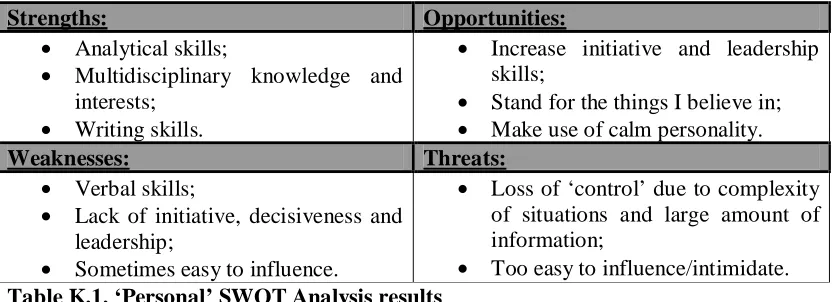
A SWOT analysis was conducted to find subjects for personal improvement:
Strengths: Opportunities:
• Analytical skills;
• Multidisciplinary knowledge and interests;
• Writing skills.
• Increase initiative and leadership skills;
• Stand for the things I believe in;
• Make use of calm personality.
Weaknesses: Threats:
• Verbal skills;
• Lack of initiative, decisiveness and leadership;
• Sometimes easy to influence.
• Loss of ‘control’ due to complexity of situations and large amount of information;
• Too easy to influence/intimidate. Table K.1. ‘Personal’ SWOT Analysis results
The weaknesses have already been improved over the years and during the execution of this master thesis. However, further development of a stronger personality and related management skills will be needed in the future. Of course, these issues are difficult to measure. However, the following efforts contributed to improving verbal skills, initiative and so forth:
• At least 17 instruction sessions on the SPC pilots in the plant;
• 3 visits to team leader meetings to discuss SPC, its potential and the pilots;
• 5 larger meetings with staff personnel on (the progress of) the assignment;
• Visit to a DEP Europe meeting on SPC efforts;
• Execution of implementation trajectory of four personally developed SPC pilot projects.