International Journal of Scientific Research in Computer Science, Engineering and Information Technology © 2018 IJSRCSEIT | Volume 3 | Issue 4 | ISSN : 2456-3307
MQTT-Message Queuing Telemetry Transport protocol
S Ramya1 , E Sreedevi2
1MCA VIth semester student, Department of MCA, Sree Vidyanikethan Institute of Management, Sri Venkateswara University, A.Rangampeta, Tirupati, Andhra Pradesh, India
2Assistant Professor, Department of MCA, Sree Vidyanikethan Institute of Management, A.Rangampeta, Tirupati, Andhra Pradesh, India
ABSTRACT
Internet of things refers to exceptionally identifiable articles and the portrayal of these physical questions in a virtual shape in an Internet like structure. The quantities of things that get added to the system are expanding step by step. These associated gadgets will undoubtedly achieve 50 billion by 2020. MQTT or Message Queue Telemetry Transport is an Internet of Things convention for machine to machine communication. The convention was developed by Andy Stanford-Clark of IBM, and Arlen Nipper of Cirrus Link Solution. MQTT is a Client Server distribute/buy in informing transport convention. It is light weight, open, straightforward, and planned to be anything but difficult to actualize. This paper is intended to present the basic data about MQTT convention. It speaks to a diagram of MQTT from beginning history till the present improvement.
Keywords- MQTT, IoT, MQTTSN, publish/subscribe.
I.
INTRODUCTION
MQTT is a Client Server distribute/buy in informing transport convention. It is light weight, open, straightforward, and outlined in order to be anything but difficult to actualize. These qualities make it perfect for use much of the time, including obliged conditions, for example, for communication in Machine to Machine (M2M) and Internet of Things (IoT) settings where a little code impression is required and additionally arrange transmission capacity is at a premium. The convention keeps running over TCP/IP, or over other system conventions that give requested, lossless, bi-directional associations. According to MQTT V3.1 Protocol Specification,"MQ Telemetry Transport (MQTT) is a lightweight dealer based distribute/buy in informing convention intended to be open, basic, lightweight and simple to actualize." MQTT keeps running over TCP/IP. It empowers exchange of telemetry style information which is only sensor and
actuator information. The sensors and actuators speak with applications through MQTT message specialist. It is valuable for associations with wireless areas where a little code impression is required as well as system data transmission is at a premium. For instance: Usage in wellbeing centers where specialists can wirelessly screen patients at their home
II.
RELATED WORK
MQTT center segments comprise of customers, servers or intermediaries, sessions, memberships and point. The informing model consists of various distributers and endorsers associated with a specialist. Distributers send (distribute) messages to the representative on a particular "theme". Endorsers enroll (buy in) their enthusiasm for specific points with the merchant. The representative deals with the associations with the distributers and endorsers and circulates the messages it gets from the distributers to the supporters as per their bought in points. Therefore the distributers and endorsers are only the customers. Themes enable customers to trade data with characterized semantics. All communication between a server and customers occurs through a session. The spec likewise characterizes the messages and their structures. MQTT keeps running over TCP/IP. Notwithstanding TCP/IP's ensured conveyance, MQTT includes 3 more QoS layers best of TCP, at-most once conveyance, at any rate once conveyance and precisely once conveyance. HTTP convention is a demand – reaction convention and isn't reasonable for telemetry compose communication.
Features:
Use of the distribute/buy in message design which gives one-to-numerous message appropriation and decoupling of utilizations
Ainforming transport that is rationalist to the substance of the payload.
Three qualities of service for message delivery: 1) "And no more once", where messages are conveyed by the best endeavors of the working condition. Message misfortune can happen. This level could be utilized, for instance, with surrounding sensor information where it doesn't make a difference if an individual perusing is lost as the following one will be distributed before long. 2) "In any event once", where messages are guaranteed to arrive however copies can happen.
3) "Precisely once", where message are guaranteed to arrive precisely once. This level could be utilized, for instance, with charging frameworks where copy or
Asynchronous communication model withmessages (events)
Low overhead (2 bytes header) for low network bandwidth applications
Publish / Subscribe (PubSub) model
Decoupling of data producer (publisher) anddata consumer (subscriber) through topics(message queues)
Simple protocol, aimed at low complexity, lowpower and low footprint implementations(e.g. WSN - Wireless SensorNetworks)
Runs on connection-oriented transport (TCP).To be used in conjunction with 6LoWPAN
(TCP header compression)
MQTT caters for (wireless) networkdisruptions.
III.
MQTT
MQTT client A MQTT customer is any gadget from a smaller scale controller up to a full-fledged server stack and speaks MQTT over it. The customer usage of the MQTT convention is straight-forward and extremely lessened to the quintessence.
MQTT Broker:
JoramMQ, Mosquitto, RabbitMQ, and Solace Message Routers. They change in their list of capabilities and some of them actualize extra highlights over the standard MQTT usefulness.
MQTT Connection
The MQTT convention depends over TCP/IP and both customer and representative need a TCP/IP stack.
Figure2. MQTT connection
The MQTT association itself is dependably one customer; no customer is associated with another customer straightforwardly. The association is started through a customer sending a CONNECT message to the dealer. The representative reactions with a CONNACK and a status code. Once the association is built up, the agent will keep it open as long as the customer doesn't send a distinction summon or it loses the association.
Figure 3. MQTT association
IV.
MQTT METHODS
MQTT characterizes strategies (here and there alluded to as verbs) to demonstrate the coveted activity to be performed on the recognized asset. What this asset speaks to, regardless of whether previous information or information that is produced progressively, relies upon the usage of the server. Regularly, the asset compares to a document or the yield of an executable living on the server.
1) Connect: Waits for an association with be set up with the server.
2) Disconnect: Waits for the MQTT customer to complete any work it must do, and for the TCP/IP session to separate.
3) Subscribe: Waits for fulfillment of the Subscribe or Unsubscribe technique.
4) Unsubscribe: Requests the server withdraw the customer from at least one points.
5) Publish: Returns quickly to the application string in the wake of passing the demand to the MQTT customer.
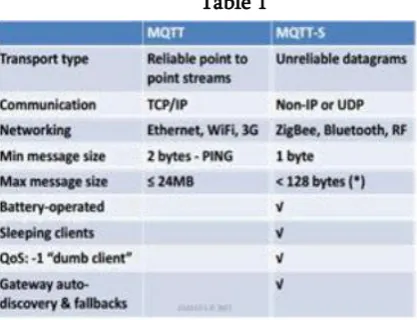
MQTT vs MQTT-SN - MQTT-SN is intended to be as close as conceivable to MQTT, however is adjusted to the quirks of a wireless communication condition.
1. Associate message, isolated in three sections (Will Topic – Will Message);
2. Point and Procedure to acquire the ID for a specific Topic Name;
3. Pre-characterized Topic ID and Short Topic ID (2byteslong), for which no enrollment procedure is important;
4. Disclosure Procedure to acquire the MQTT-SN Gateway IP Address;
5. Client's memberships are industrious (RETAIN=1), as well as Will theme and Will message.
Table 1
V.
REAL WORLD APPLICATION OF MQTT
Applications of MQTT
1. It is utilized as a part of Facebook ambassador application. The organization utilized MQTT on account of its particular plan for applications like sending telemetry information to and from space tests, and thus utilizes less data transfer capacity and battery. By looking after MQTT, the organization could accomplish telephone to-telephone conveyance in the many milliseconds.
2. Land Aware Messaging for Accessibility (LAMA) is a framework for making data accessible to individuals applicable to their interests and area. The framework utilizes Smart Phones, MQTT and Internet SphereMessage Broker and some sharp application programming.
3. GAIAN Database-An appropriated combined database utilizing an organically motivated self-association rule to limit administration and it was composed in Java. GaianDB has just been utilized as a part of mind boggling, dispersed, semantic join inquiries for content investigation applications and has drawn the consideration of noteworthy clients in the military
Advantages of MQTT include:
1. Fast throughput and response time. 2. Less usage of bandwidth.
3. Multiple message subscription multiplexed over asingle connection etc.
Limitations of MQTT include:
1) No queues - The convention just talks with points. The particular doesn't say any line idea. A theme makes an impression on every present supporter. A theme doesn't store message itself.
2)No TTL (“time-to-live”) on message - The convention does not permit including a TTL property for every message. So on the off chance that you utilize the "spotless session" Parameter the message will be held inconclusively in the intermediary.
VI.
CONCLUSION
This area of the paper manages the outcomes that urge engineers to utilize MQTT as an informing convention in their applications. The area gives near outcomes to MQTT and HTTP for the field's transmission efficiency, delay. MQTT seems powerless in security. It does best as a communication transport for live information. Customers make extensive active TCP connection to an intermediary. Desert spring standard rendition of the MQTT convention particular is focused for culmination inside a year of first gathering. Follow-on adaptatiFollow-ons of the standard to address extra in scope capacities might be created on a calendar to be characterized by the TC.
VII.
REFERENCES
[1]. MQTT V3.1 Protocol Specification http://public.dhe.ibm.com/software/dw/interne t service’s/ws-mqtt/mqtt-v3r1.html
[2]. MQTT supplemental publication, MQTT and theNIST Framework for Improving Critical Infrastructure Cyber securityhttp://docs.oasis-open.org/mqtt /mqttnist-cybersecurity/v1.0/mqtt-nist -cybersecurityv1.0.html
resources in ETSI standards based M2M platform
[4]. Soma Bandyopadhyay & Abhijan Bhattacharyya :Lightweight Internet Protocols for Internet Enablement of Sensors using Constrained Gateway devices
[5]. Zhiqiang Wei &YaqingSong : The Research and Implementation of GPS Intelligent Transmission Strategy Based on on-board Android Smartphones
[6]. Seong-Min Kim, Hoan-Suk Choi, Woo-SeopRhee : IoT Home Gateway for Auto-Configuration and Management of MQTT Devices
[7]. Kannan Govindan : End-to-end service assurance in IoT MQTT-SN
[8]. MQTT 3.1.1 specification
[9]. "OASIS Message Queuing Telemetry Transport(MQTT) Technical Committee". OASIS. Retrieved 9May 2014.
[10]. Andy, Stephen Clark. "MQTT For SensorNetworks (MQTT-SN) Protocol Specification Version1.2" (PDF). Retrieved 9 May 2014.
[11]. "Building Facebook Messenger". Retrieved 15October 2015.
[12]. Christian Lesjak , Design Center Graz : Hardware-security and TLS for MQTT
[13]. Mohsen HallajAsghar : Design and simulation of energy efficiency in node based on MQTT protocol in Internet of Thing
[14]. Seong-Min Kim : IoT home gateway for auto-configuration and management of MQTT devices
[15]. YimingXu : Towards SDN-based fog computing: MQTT broker virtualization for effective and reliable delivery
[16]. Jorge E. Luzuriaga: Handling mobility in IoT applications using the MQTT protocol
[17]. AleksandarAntonić :Comparison of the CUPUS middleware and MQTT protocol for smart city services.
[18]. Hyun-Chul Jo: Adaptive Periodic Communication over MQTT for Large-Scale Cyber-Physical Systems.
ABOUT AUTHORS:
Ms S.Ramya is currently pursuing her Master of Computer Applications, Sree Vidyanikethan Institute of Management, Tirupati, A.P. She received her Master of Computer Applications from Sri Venkateswara University, Tirupati.
Mrs. E.Sreedevi is currently working as an Assistant Professor in Master of
Computer Applications Department, Sree Vidyanikethan
Institute of