Article
1
Characterization of phosphorus in a toposequence of subtropical perhumid forest soils facing a
2
subalpine lake
3
Yo-Jin Shiau1, Chung-Wen Pai2, Jeng-Wei Tsai3,Wen-Cheng Liu4, Rita S.W. Yam5,
4
Shih-Chieh Chang6,Sen-Lin Tang7, and Chih-Yu Chiu7,*
5
1 Department of Safety, Health and Environmental Engineering, National Kaohsiung University
6
of Science and Technology, Kaohsiung 81164, Taiwan
7
2 The Experimental Forest, College of Bio-Resource and Agriculture, National Taiwan University,
8
Nantou 55743, Taiwan
9
3 Department of Biological Science and Technology, China Medical University, Taichung 40402,
10
Taiwan
11
4 Department of Civil and Disaster Prevention Engineering, National United University, Miaoli
12
36063, Taiwan5 Department of Bioenvironmental Systems Engineering, National Taiwan
13
University, Taipei 10617, Taiwan
14
6 Department of Natural Resources and Environmental Studies, National Dong Hwa University,
15
Hualien 97401, Taiwan
16
7 Biodiversity Research Center, Academia Sinica, Nangang, Taipei 11529, Taiwan;
17
18
* Correspondence: [email protected]; Tel.: +886-2-2787-1180
19
20
21
Abstract: The productivity of forests is often considered to be limited by the availability of
22
phosphorus (P). Knowledge of the role of organic and inorganic P in humid subtropical forest soils is
23
lacking. In this study, we used chemical fractionation and 31P nuclear magnetic resonance (NMR)
24
spectroscopy to characterize the form of P and its distribution in undisturbed perhumid
25
Chamaecyparis forest soils. The toposequence of transects was investigated for the humic layer
26
from summit to footslope and lakeshore. The clay layer combined with a placic-like horizon in the
27
subsoil may affect the distribution of soil P because both total P and organic P (Po) contents in all
28
studied soils decreased with soil depth. In addition, Po content was negatively correlated with soil
29
crystalline Fe oxide content, whereas inorganic P (Pi) content was positively correlated with soil
30
crystalline Fe oxide content and slightly increased with soil depth. Thus, Pi may be mostly adsorbed
31
by soil crystalline Fe oxides in the soils. Among all extractable P fractions, the NaOH-Po fraction
32
appeared to be the major component, followed by NaHCO3-Po; the resin-P and HCl-Pi fractions
33
were lowest. In addition, we found no typical trend for Pi and Po contents in soils with topographical
34
change among the three sites. From the 31P-NMR spectra, the dominant P
o form in soils from all
35
study sites was monoesters with similar spectra. The 31P-NMR findings were basically consistent
36
with those from chemical extraction. Soil formation processes may be the critical factor affecting the
37
distribution of soil P. High precipitation and year-round high humidity may be important in the
38
differentiation of the P species in this landscape.
39
Keywords: Chamaecyparis forest; humic substances, 31P nuclear magnetic resonance spectroscopy
40
(31P NMR); P species; topography
41
1. Introduction
1
In terrestrial environments, mountainous forest is one of the canonical ecosystems that contain
2
abundant biodiversity and is a vulnerable ecosystem [1]. Thus, understanding the soil nutrient
3
distributions in a forest ecosystem is vital to maintain ecosystem functions and productivity [2]. In
4
such ecosystems, phosphorus (P) can be a limiting element because unlike nitrogen (N), which is
5
mainly deposited from the atmosphere [3], P is mostly acquired from weathering soil parent material
6
and is continuously lost due to soil erosion [4-6]. The bioavailability of P in soils further relies on the
7
chemical/physical conditions that fractionate the total P into different species [7,8]. Understanding P
8
availability and its transformation among each fraction will help assess the P supply capacity of the
9
soil over the long term and to adapt management practices [9].
10
Some isolated P fractionation pools have key functions in the P cycle and plant nutrition [9-13].
11
The organic and inorganic forms of P are usually separated and quantified by their plant availability.
12
The mineralization of organic P is generally responsible for most of the P supply to plants [14,15],
13
especially in mountain forest ecosystems [2,9,16]. Actually, the sequential fraction can provide a
14
general indicator of how biological and geochemical forms of P change during soil weathering in
15
mountain forest ecosystems. In general, organic P was found the dominant fraction of total P (TP) in
16
these forest ecosystems, and available P content was determined by the mineralization processes of
17
organic P [9,17]. Productivity, including plant growth and biomass production of trees in afforested
18
mountain areas, is largely influenced by mineralization and microbial processes of organic P as well
19
as soil organic matter.
20
However, identifying different fractions of P and evaluating their bioavailability are difficult
21
because of spatial inconsistency and the complexity of geochemical properties. Several wet-chemical
22
methods for determining P fractionations have been established and used in various ecosystems
23
[18-21]. Also, 31P-nuclear magnetic resonance (NMR) spectroscopy has been used for determining
24
the composition of soil P [22-24]. De Feudis et al. [25] determined the P availability in subalpine
25
forest soils in Italy and found organic P, bioavailable P contents and alkaline mono-phosphatase
26
activity were all increased with altitude. Similarly, Doolette et al. [26] analyzed P composition in five
27
alpine and subalpine forest soils and found that 54% to 66% of extractable P was contributed by
28
organic P such as phosphomonoesters and inositol phosphonates, and the organic P composition was
29
affected by temperature and soil moisture.
30
To our knowledge, studies of P fractionation in forests were mostly performed in temperate
31
ecosystems [8,27,28], with relatively fewer studies from subtropical and tropical alpine forests.
32
Understanding the biogeochemistry of subalpine/alpine forest soils in tropical/subtropical areas may
33
help explain the transition phenomenon between temperate and subtropical/tropical ecosystems and
34
could well link pedogenic processes or nutrient cycles along a climosequence. In this study, to
35
evaluate the pedogenetic effects on the forms of P, we determined the composition of soil P with both
36
chemical extraction and 31P-NMR methods along a toposequence in a pristine subtropical subalpine
forest. Because the changes in soil oxidation–reduction status affect the formation of iron (Fe) and
1
consequently the P status in such humid forest soils, we hypothesized that the content of labile P
2
associated with Fe oxides increases with changing topographic sequence from the summit to
3
lakeshore because of leaching and soil erosion, whereas recalcitrant organic P, which is more
4
complex formed, will remain in the summit.
5
2. Materials and Methods
6
2.1. Study sites
7
This study was conducted in the Yuanyang Lake forest ecosystem (24˚35′N, 121˚24′E) in
8
northeastern Taiwan. The study sites covered an elevation of 1,700 to 2,000 m a.s.l., with an average
9
annual temperature of 12.5˚C and a mean annual precipitation of more than 4,000 mm. The ecosystem
10
consists of a primary forest dominated by Taiwan false cypress (Chamaecyparis obtusa var.
11
formosana) and an evergreen broadleaf shrub (Rhododendron formosanum). The bedrock of the
12
study sites is composed of interbedded Tertiary shale and sandstone [29]. This locality can be
13
described as a temperate, very wet and mountainous ecosystem. It has been established as a Nature
14
Reserve and selected as one of the long-term ecological research sites in Taiwan. The forest soils are
15
divided into three main groups, which are closely related to the topography. The soil at the summit,
16
with a slope of about 15˚, is classified as Typic Hapludult [30], which is relatively well drained and
17
develops clear eluvial and illuvial boundaries. The footslope, with a slope of about 28˚, is dominated
18
by Typic Dystrochrept, where poor drainage caused by the clay and silty clay mineral horizon beneath
19
the organic layer limits the downward movement of soluble compounds and thus hampers the soil
20
profile development. Lithic Medihemist stretches from the lakeshore to the toeslope, about 1.5 m
21
above the lake and with a slope of about 10˚, which is inundated by occasional storms. Details of the
22
environment of this ecosystem are described elsewhere [31].
23
2.2. Soil sampling
24
A pedon sample was collected from each site to the bedrock. However, the pedon sample in the
25
lakeshore was limited to the O horizon because no mineral layers were developed on the bedrock.
26
Each horizon in the pedon was collected separately to determine the basic soil physiochemical
27
properties.
28
To further determine the P fractionation along the topography, soil samples were collected from
29
three selected sites along a topographic sequence in the forest that covered the summit, footslope and
30
lakeshore. At each sampling site, three composite samples, each containing five subsamples, were
31
collected with a soil auger with 8 cm in diameter and 10 cm in depth (Oe and Oa horizons).
32
Visible coarse organic materials, such as roots and litter were manually removed before sieving.
33
2.3. General soil chemical properties
1
Soil pH was measured at a soil:water ratio of 1:1. Total organic C (TOC) and total N (TN)
2
contents in the soil were determined with an NCS Elemental Analyzer (Model NA1500 Fisons, Italy).
3
Cation-exchange capacity was determined by the NH4/Na exchange method [32]. Crystalline Fe (Fed)
4
and Al (Ald) oxide contents were determined by the dithionite-citrate-bicarbonate extraction method
5
[33]. Amorphous Fe (Feo) and Al (Alo) oxide contents were measured by an ammonium oxalate
6
extraction method [34].
7
2.4. Sequential fractionation of P
8
Sequential fractionation was performed as described in [35]. The sequential fractionation
9
procedure removes progressively less available P with each subsequent soil extraction [36]. The
10
fractionation started with 0.5 g dried sieve soil. An anion exchange resin was used first to extract
11
plant-available inorganic P (Pi) [37]. Then, the other Pi content was determined directly in 0.5 M
12
NaHCO3, 0.1 M NaOH, 1M HCl and concentrated HCl extractions. The extracted solutions were then
13
digested with H2SO4 (97%) and H2O2 (30%) at 300 °C to determine the total dissolved P (Pd) content
14
of each fraction. The organic P (Po) content was calculated by subtracting Pi content from Pd content
15
in each fraction (Po = Pd - Pi). The remaining soil was digested with H2SO4 (97%) and H2O2 (30%) at
16
300 °C to determine the residual P content. All extracts and digestions obtained were measured
17
colourimetrically by the malachite green procedure [38].
18
Summed Pi content was calculated as the sum of all analyzed Pi fractions including resin-Pi,
19
NaHCO3-Pi, NaOH-Pi, HCl-Pi and cHCl-Pi. Summed Po content was calculated as the sum of all
20
analyzed Po fractions including NaHCO3-Po, NaOH-Po and cHCl-Po. Summed P content was
21
calculated as the sum of Pi, Po and residual P content. Total P content of the soil samples was
22
determined by digestion with H2SO4 (97%) and H2O2 (30%) at 300 °C.
23
2.5. 31P-NMR measurements
24
Air-dried soil (5 g) was dispersed in 20 mL of 0.25 M NaOH-0.05 M EDTA for 2 h, and the
25
suspension was centrifuged at 12,100 × g for 30 min. The extractant was then reacted with chelating
26
resin for 6 h at room temperature to reduce the paramagnetic interference of iron and other metals in
27
the NMR spectra. After being stirred, the resin was separated by filtration through Whatman 42 filter
28
paper. The extract was freeze-dried for storage. A freeze-dried sample (0.1 g) of NaOH-EDTA
29
extractant was dissolved in 0.5 mL of 0.5 M NaOH, then 0.1 mL D2O was added and the solution was
30
transferred to a 5-mm NMR tube for 31P-NMR analysis [39]. The 31P-NMR spectra were obtained at
31
242.86 MHz and 25 ˚C on a Bruker-600 NMR spectrometer with 60˚ pulse, 3.5-s delay and 0.33-s
32
acquisition time. The 31P-NMR spectra were proton-decoupled by using an inverse-gated pulse
33
sequence to overcome the nuclear Overhauser enhancement and for quantification [40,41].
34
signal-to-noise ratio. Spectra were recorded with a line-broadening of 20 Hz. The chemical shift was
1
measured relative to an external 85% H3PO4/D2O standard. The assignment of signals was based on
2
Newman and Tate [40], Dai et al. [42], Condron et al. [22], and Robinson et al. [39]. Contents of the
3
various P components (phosphonate, inorganic orthophosphate, orthophosphate monoesters,
4
orthophosphate diesters, pyrophosphate, polyphosphates) were determined according to relative
5
resonance areas obtained by electronic integration. Inorganic orthophosphates and orthophosphate
6
monoesters signals were separated by using a boundary determined from the valley between the two
7
signals to the baseline [42].
8
2.6. Statistical analyses
9
All extraction experiments were carried out in triplicate. Simple linear regression was used to
10
compare the relation between soil P and soil Fed, Feo Ald and Alo concentrations. Differences in the P
11
factions among the three sites were analyzed using one-way analysis of varience (One-Way
12
ANOVA) and Tukey’s honestly significant difference (HSD) test. JMP 11.0 (SAS Inc., Cary, NC,
13
USA) was used for these statistical analyses. P < 0.05 was considered as statistically significant.
14
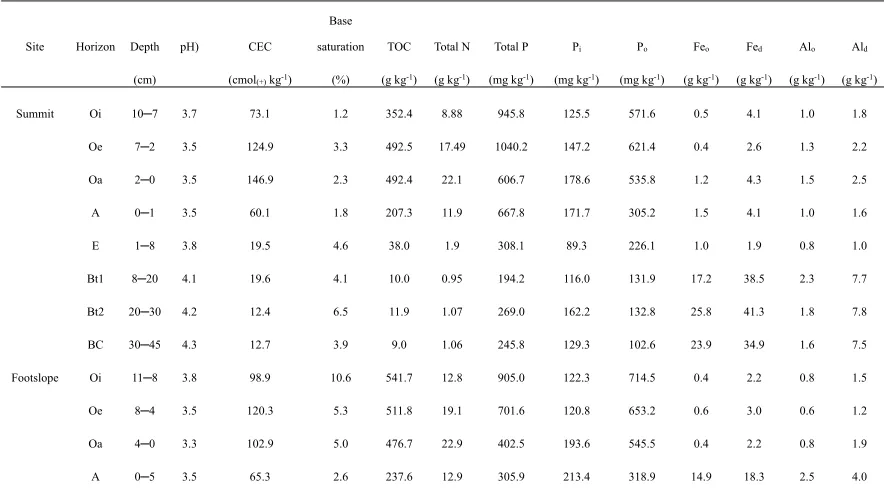
3. Results
15
The basic chemical properties of the studied soils are in Table 1. The soils were strongly acidic;
16
pH values ranged from 3.3 to 4.5 in the three sampling sites. Both TOC and TN contents were high
17
in the O horizon and decreased from the surface to the low horizons. Cation-exchange capacity
18
basically coincided with TOC content, decreasing from the surface to the low horizons. Total P
19
content also decreased from the surface to the low horizons, but the difference was much less than
20
for TOC and TN contents.
21
Table 1. General chemical properties of soils studied
22
Site Horizon Depth pH) CEC
Base
saturation TOC Total N Total P Pi Po Feo Fed Alo Ald
(cm) (cmol(+) kg-1) (%) (g kg-1) (g kg-1) (mg kg-1) (mg kg-1) (mg kg-1) (g kg-1) (g kg-1) (g kg-1) (g kg-1)
Summit Oi 10─7 3.7 73.1 1.2 352.4 8.88 945.8 125.5 571.6 0.5 4.1 1.0 1.8
Oe 7─2 3.5 124.9 3.3 492.5 17.49 1040.2 147.2 621.4 0.4 2.6 1.3 2.2
Oa 2─0 3.5 146.9 2.3 492.4 22.1 606.7 178.6 535.8 1.2 4.3 1.5 2.5
A 0─1 3.5 60.1 1.8 207.3 11.9 667.8 171.7 305.2 1.5 4.1 1.0 1.6
E 1─8 3.8 19.5 4.6 38.0 1.9 308.1 89.3 226.1 1.0 1.9 0.8 1.0
Bt1 8─20 4.1 19.6 4.1 10.0 0.95 194.2 116.0 131.9 17.2 38.5 2.3 7.7
Bt2 20─30 4.2 12.4 6.5 11.9 1.07 269.0 162.2 132.8 25.8 41.3 1.8 7.8
BC 30─45 4.3 12.7 3.9 9.0 1.06 245.8 129.3 102.6 23.9 34.9 1.6 7.5
Footslope Oi 11─8 3.8 98.9 10.6 541.7 12.8 905.0 122.3 714.5 0.4 2.2 0.8 1.5
Oe 8─4 3.5 120.3 5.3 511.8 19.1 701.6 120.8 653.2 0.6 3.0 0.6 1.2
Oa 4─0 3.3 102.9 5.0 476.7 22.9 402.5 193.6 545.5 0.4 2.2 0.8 1.9
E 5─10 4 11.5 7.8 7.0 0.7 171.7 139.7 78.7 1.3 5.2 0.4 0.8
Bw1 10─23 4.1 16.6 2.4 10.0 1.1 283.8 239.7 82.0 18.1 35.9 1.6 4.5
Bw2 23─42 4.5 17.6 4.5 19.9 1.5 928.3 258.9 125.1 18.3 47.0 2.2 7.9
Lakeshore Oi 33─22 3.5 36.3 5.7 363.1 12.7 934.1 103.0 561.8 0.7 1.9 0.5 0.9
Oe 22─9 3.4 18.7 8 186.7 8.7 563.4 107.9 431.7 1.1 3.7 0.6 0.8
Oa 9─0 3.5 17.7 7.3 176.9 7.4 945.8 124.6 417.3 0.4 1.4 0.3 1.3
CEC: cation-exchange capacity; TOC: total organic C; Feo, Alo: iron and aluminum extracted by the
1
ammonium oxalate method; Fed, Ald: iron and aluminum extracted by the
2
citrate-bicarbonate-dithionite method.
3
4
The Feo, Fed, Alo and Ald contents peaked in the Bt2 horizon at the summit site and in the Bw2
5
horizon at the footslope site. Pi content was associated with amorphous (Feo and Alo) and crystalline
6
(Fed and Ald) Al and Fe oxide contents and migrated vertically through the horizons with illuviation.
7
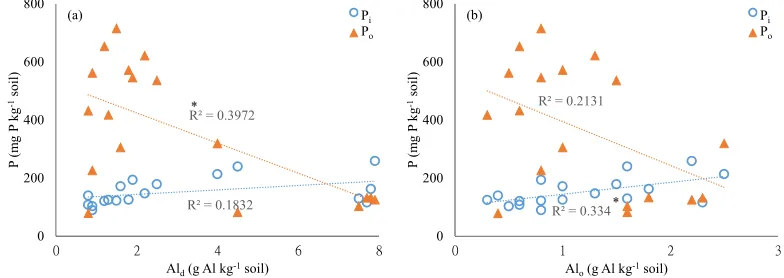
Moreover, Pi and Fed contents were positively correlated and Po and Fed as well as Po and Feo
8
contents were negatively correlated in the soil samples (Fig. 1a). However, the relation between Pi
9
and Feo contents was not statistically significant (Fig. 1b). In addition, only Pi and Alo contents were
10
positively correlated and Po and Ald contents were negatively correlated but not Pi and Ald nor Po
11
and Alo contents (Fig. 2a; Fig. 2b).
12
13
Figure 1. Correlations of contents of Pi and Po with Fed (a) and Feo (b) in the pedon samples
14
collected from the three sampling sites. * Statistically significant at P<0.05.
15
16
Figure 2. Correlations of contents of Pi and Po with Ald (a) and Alo (b) in the pedon samples
17
collected from the three sampling sites. * Statistically significant at P<0.05.
18
R² = 0.255 R² = 0.5393
0 200 400 600 800
0 10 20 30 40 50
P( m g P kg -1so il)
Fed(g Fe kg-1soil)
Pi Po Pi Po * * (a)
R² = 0.1891 R² = 0.5251
0 200 400 600 800
0 10 20 30
P( m g P kg -1so il )
Feo(g Fe kg-1soil)
Pi Po Pi Po * (b)
R² = 0.1832 R² = 0.3972
0 200 400 600 800
0 2 4 6 8
P( m g P kg -1soil)
Ald(g Al kg-1soil)
Pi Po Pi Po * (a)
R² = 0.334 R² = 0.2131
0 200 400 600 800
0 1 2 3
P( m g P kg -1so il)
Alo(g Al kg-1soil)
Contents of total P and summed P and Pi in the O/A horizons were greater at the footslope than
1
the lakeshore, whereas the values in the summit site were in between those at the footslope and
2
lakeshore. In addition, summed Po and residual P contents were similar among the three sites (Table
3
2). HCl-Pi and cHCl-Pi contents were similar among the three sites, whereas cHCl-Po content in the
4
footslope soil was similar to that at the lakeshore but higher than that at the summit. NaOH-Pi
5
content was higher at the footslope than the summit and lakeshore. In addition, NaOH-Po content
6
was higher at the summit than the footslope and lakeshore. NaHCO3 extracted Pi content was higher
7
at the summit than the footslope and lakeshore, whereas NaHCO3-Po content was the highest at the
8
footslope and was similar at the summit and lakeshore. Resin-Pi content was higher at the lakeshore
9
than the footslope, and resin-Pi content at the summit was in between that at the other two sites.
10
Table 2. The fractionation of P (mg kg-1) in humic soil samples (O/A horizon) in different
11
topographic sites (sequential extraction)
12
Site
Inorganic P in extracts Summed inorganic P
(Pi)
Organic P in extracts Summed organic P (Po)
Residual-P Summed P Total P Resin-Pi NaHCO3-Pi NaOH-Pi HCl-Pi1 cHCl-Pi NaHCO3-Po NaOH-Po cHCl-Po
Summit 4.8ab 61.2a 46.4b 2.3 9.4 124.1ab 124.4b 415.6a 20.6b 560.6ab 38.0 722.7ab 757.0ab
Footslope 2.4b 35.3b 83.3a 4.4 4.7 130.1a 272.7a 335.3ab 31.6a 639.6a 29.4 799.0a 828.3a
Lakeshore 7.3a 25.4b 36.4b 5.9 9.9 84.8b 177.5b 306.5b 27.6ab 511.5b 34.9 631.2b 668.2b
HCl-Pi: inorganic P extracted by 1.0 M HCl; cHCl-Pi: inorganic P extracted by concentrated HCl;
13
cHCl-Po: organic P extracted by concentrated HCl; Summed inorganic P: Resin-Pi+NaHCO3-Pi+
14
NaOH-Pi+HCl-Pi+cHCl-Pi; Summed organic P: NaHCO3-Po+NaOH-Po+cHCl-Po; Summed P:
15
sum of Pi + Po + residual P. Means followed by the same letters in the same column are not
16
significantly different (p > 0.05) by Tukey’s honestly significant difference test.
17
Organic P was the dominant P fraction in the mountain forest soils of the three sites (Table 3).
18
Moreover, NaOH-Po represented the major P fraction and contributed to more than 40% of the
19
summed P content in the three sampling sites (Fig. 3). NaHCO3-Po was the second most abundant P
20
fraction among the three sites and contributed more than 20% of the summed P content. Summed Pi
21
content (resin-Pi+NaHCO3-Pi+NaOH-Pi+HCl-Pi+cHCl-Pi) in surface soils of all study sites
22
contained less than 18% of summed P, and NaOH-Pi was the major Pi fraction in total Pi.
23
Table 3. Relative proportions of total P extracted for inorganic (Pi) and organic (Po) forms
24
in NaOH-EDTA extracts from humic soil samples (O/A horizon) determined by chemical
25
extraction and 31P-NMR spectroscopy.
26
Pi Po
Soil Chemical§ NMR Chemical§ NMR
§ P
i: sum of resin-Pi+NaHCO3-Pi+NaOH-Pi+HCl-Pi+cHCl-Pi. Po: sum of NaHCO3-Po+NaOH-Po
1
+cHCl-Po.
2
3
P extractants
Re sin-Pi
NaHCO3 Pi
NaHCO 3 Po
NaOH Pi
NaOH Po
HCl-Pi
cHCl -Pi
cHCl -Po
resi dual
-P
P
ro
por
tio
n
o
f P
ex
tr
ac
te
d
(%
)
0 10 20 30 40 50 60
Summit Footslope Lakeshore
4
Figure 3. Proportion of P fractions in humic samples at different sites determined by
5
chemical extraction.
6
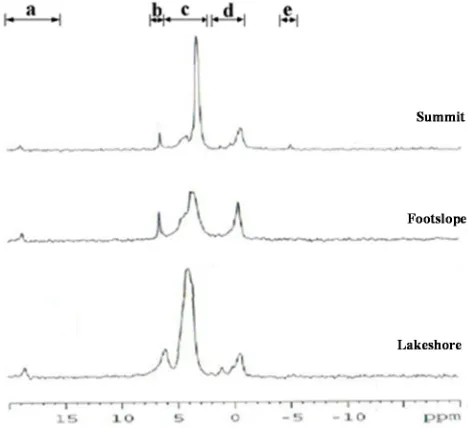
Spectra obtained from 31P-NMR analysis of NaOH-EDTA extracts revealed inorganic
7
orthophosphate, orthophosphate monoesters, orthophosphate diesters, pyrophosphates, and
8
phosphonates in the soil extracts (Fig. 4).
9
10
Figure 4. 31P-NMR spectra for NaOH-EDTA extracts from soils at different sites. a:
11
phosphonate, b: inorganic orthophosphate, c: orthophosphate monoesters, d:
12
orthophosphate diesters, e: pyrophosphate
13
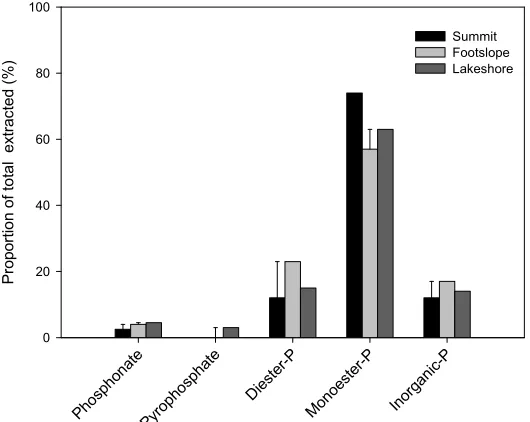
Organic P compounds identified in the NaOH-EDTA extracts included orthophosphate
14
predominant species of extracted organic P in soil from all sites and contributed to more than 60% of
1
the total P fractions (Fig. 3; Fig. 5). The proportion of orthophosphate diesters was much lower than
2
that of orthophosphate monoesters and only contributed 15% to 20% of the total P pools. Content of
3
phosphonates (18.7 ppm) ranged from only 2.2% to 4.0%of extracted P from the three sites, and the
4
highest content was found at lakeshore, with waterlogged conditions.
5
Pho sphon
ate
Pyrop hosp
hate Dieste
r-P
Mon oeste
r-P
Inorg an
ic-P
Pr
opor
tio
n of to
ta
l extrac
ted (%)
0 20 40 60 80 100
Summit Footslope Lakeshore
6
Figure 5. Proportion of extracted P in various classes from humic samples at different sites
7
determined by 31P-NMR spectroscopy.
8
Inorganic P compounds identified in the NaOH-EDTA extracts included orthophosphate and
9
pyrophosphates. Inorganic orthophosphate signals at 6.1-6.3 ppm ranged from 11.6% to 17.3% of the
10
spectral area for all study sites (Table 3). The highest inorganic P content was found at the footslope.
11
In addition, small additional pyrophosphate resonance (-4.3 ppm) was observed only at the summit
12
site.
13
4. Discussion
14
4.1. Soil physiochemical properties and chemical extractable P
15
The soil in this study site contains high moisture because of the year-round high precipitation
16
[43]. High soil moisture in mountainous forests retards decomposition of soil organic matter, and high
17
precipitation increases the loss of cations, thereby resulting in decreased soil pH and Eh [36,44,45].
18
This well explains our observations of low soil pH in the studied sites. Moreover, our previous study
19
at the same sites revealed a clay and silt-clay layer under the organic layer [43]. This clay layer may
20
retard the percolation [46] and therefore result in reduced soil TOC, TN and TP contents with
21
increasing soil depth.
22
The high Feo, Fed, Alo and Ald contents in the B horizons implied that iron moved downwards
23
redox potential in the surface layer, reduced Fe and Al ions moving from surface to the bottom layer
1
were re-oxidized in the B horizons [47,48]. This formation of accumulated Fe, which may due to the
2
redoximorphic process [49,50], created a placic-like horizon and resulted in slow permeability of P in
3
such perhumid forest soil [47].
4
The positive correlations between Pi and Fed but not Pi and Feo contents implied that most
5
inorganic P may be adsorbed by crystalline Fe oxides in soils, whereas the negative correlation
6
between Po and Fed as well as Po and Feo contents implied that organic P was in a complex formation
7
in the soils. In addition, the vertical increase in Pi content, with an opposite trend to Po content, in each
8
soil profile was significantly related to the content of amorphous and crystalline Fe oxides but not
9
crystalline Al oxides. This observation implied that Fe oxides rather than Al oxides may chemically
10
bind with Pi, and the accumulation of Pi in the subsoils could relate to the downward percolation and
11
reoxidation of Fe. Sollins et al. [51] found that soil with high Fe hydrous oxides content tends to
12
irreversibly fix polyvalent oxyanions such as phosphate because of chemosorption and occlusion.A
13
similar trend was found in our previous study of subalpine forest soils [52], in which significant
14
sorption of Pi to sesquioxides was via downward migration.
15
In addition, acidic soil conditions (pH<4) typically facilitate Fe oxides reduction (i.e., Fe2+),
16
which may help the mobility of Fe in soil [53]. The acidic soils in this study site may further affect the
17
mobility of Pi, thereby resulting in low Pi content in the three study sites.
18
The depth of O horizons increased from the summit to the lakeshore, which suggests a process of
19
erosion–deposition. In addition, because the mineral clay layer and placic-like horizon reduced
20
vertical percolation, most of the soil organic matter in the water flow is transported laterally [31,43].
21
This can help the downhill movement of soil nutrients in the O horizon [43,47] and may explain the
22
increased soil TOC and TN contents from the summit to the footslope.
23
4.2. Chemical extraction of soil P
24
Because of the low overall Pi concentrations in the three study sites, the different chemical
25
extractable Pi contents increased downhill but not significantly. In addition, the low labile P fractions,
26
NaHCO3-Pi and NaOH-Pi, in the lakeshore may also be due to the vigorous fluctuation of the water
27
level of the lake after showers or storms, which could remove the suspended particles or detritus of
28
litter with the flooding and reduce the accumulation of P in the soil near the lakeshore [28]. This was
29
indirectly supported by the elevated TP concentration in the epilimnion of lake after medium
30
rainfall events (256-620mm) [54].
31
Po appeared to be the predominant fraction in the perhumid forest and was mostly non-acid
32
extractable. Because the soil is acidic in the study sites, most Po fractions may not be labile and
33
remained at higher values at the summit than at the lakeshore. The increase in total Po content in the
34
surface horizon has been attributed to the input and accumulation of organic matter [55] and factors
35
Extracted soil P compounds showed that the contents of highly labile (NaHCO3-Po), long-term P
1
transformation (NaOH-Po) and stable residual pool (cHCl-Po) fractions changed between different
2
sites, which showed that slope position affects the various P pools [57]. As shown in Figure 3, the sum
3
of the highly labile Po fraction (NaHCO3-Po) and long-term P transformation (NaOH-Po) contributed
4
more than 75% of the total extractable P in soils at all study sites, so organic P was the major P source
5
in these soils. The Po accumulation in soil surfaces resulted from the biological cycling of P through
6
the plant litter to the soil surface.
7
The cHCl-Pi extract has recalcitrant P forms associated with mainly Fe oxides and/or P derived
8
from non-alkaline extractable debris, whereas cHCl-Po may include both stable, little and/or
9
bioavailable (non-alkaline extractable) P forms. However, the proportions of cHCl-extractable Pi and
10
Po were only about 4.5% to 7.5% of sequentially extracted total P in soils of all study sites. The
11
residual P is associated with highly organic materials such as lignin and organometallic complexes
12
[58], but we have no information on the composition of organic matter in this fraction.
13
4.3. Spectra of31P-NMR analyses
14
Orthophosphate monoesters are the most common forms of organic Po in soils [59-61].
15
Monoester P includes high proportions of inositol phosphate, sugar phosphate and choline phosphate
16
primarily derived from plant, animal and microbial residues [62].
17
Depending on the soil types, inositol phosphates are reported to be the predominant organic P
18
forms in Podosols [26], whereas α- and β-glycerophosphate are the predominant organic P forms in
19
Vertosols [63]. In addition, high inositol phosphate contents were reported from several studies with
20
cold and wet climates [64-66].
21
Inositol phosphates are typically considered of limited bioavailability because of the complex
22
structure with soil minerals, clays, and humic compounds [60,67]. Although 31P-NMR analysis in our
23
study had limited resolution to identify the inositol phosphates content, the low temperature and high
24
precipitation of the study site may likely result in high inositol phosphates content in the soil.
25
Orthophosphate diesters at about 0 ppm [40] can be further classified into nucleic acids (-1–0
26
ppm) and phospholipids (0–2 ppm) [60]. Orthophosphate diesters, including nucleic and
27
phospholipids, frequently accumulate in cool and moist acidic forest soils with low microbial
28
activities than in agricultural soils [68-70]. In acidic or wet soils, diester P proportion is between 10%
29
and 36% of extracted P [70-72]. Our findings are consistent with previous studies because the diester
30
P proportion was between 15% and 20% of extracted P in the study sites.
31
A higher proportion of diester P providing a labile source for available P [70] was found at the
32
footslope site, with poor drainage, than at the other sites. The lower orthophosphate diesters than
33
monoesters content in the three study sites may contribute to the complexity of the chemical
34
compounds. Orthophosphate diesters are more rapidly mineralizable than monoesters because they
35
The content of phosphonates in soil are due to bacteria such as Bacillus cereus, which has a
1
phosphonatase enzyme that produces phosphonates, but the bacteria are less prevalent in acidic soil
2
[42,72,75]. This observation may explain the low phosphonates concentrations observed in the study
3
sites.
4
A small amount of pyrophosphate resonance (-4.3 ppm) was observed in spectra of soils at the
5
three sites. Pyrophosphate is believed to be involved in biological P cycling in the soils and may be
6
present in relatively well-drained soil that provides a proper environment for microbial activity and
7
fungus [76]. In addition, pyrophosphate is contributed by fungal P compounds [77]. Because the
8
surface soil of the three sites contained high soil organic matter and high soil moisture, it may provide
9
a less favorable environment for microbial and fungal activities, resulting in low pyrophosphate
10
concentrations.
11
Organic P represented between 82-88% and77-81% of total P extracted by NaOH-EDTA and by
12
chemical extraction from all sites studied, respectively. This result is similar to Cade-Menun and
13
Preston [78], who found 77% to 83% of Po in a low-pH forest perhaps because of the low
14
decomposition of Po compounds in acidic forest soils that reduced the Pi concentrations [42].
15
The signal intensity of 31P-NMR spectra caused by paramagnetic Al, Fe and Mn in soils may
16
reduce the spectra quality [45,79,80]. Moreover, chemical hydrolysis of Po to Pi may occur during
17
alkaline extractions [78,81]. However, in general, the results from NMR analysis were consistent
18
with those of chemical fractionation in this study and other alpine and subalpine forest soils
19
[26,47,52,66].
20
5. Conclusions
21
This study demonstrated that soil chemical extractable Pi and Po can be vertically affected by the
22
formation of Fe oxides in soils. Because of a clay layer combined with a placic-like horizon in the
23
subsoil in our test site, both total P and Po contents were decreased with increasing soil depth, with Pi
24
content slightly increased in different soil horizons. The low permeable soil layer also favored
25
downhill run-off, however, because Pi contents were relatively low as compared with Po contents, the
26
contents did not significantly differ among the three study sites. Because most of the P was in organic
27
forms, a negligible amount of Pi may be released to the lake along the slope. Therefore, although
28
topography and soil formation processes affect the distribution of soil P, high precipitation and
29
year-round high humidity might be important for differentiation of the P species in this landscape.
30
Moreover, the similarity of the 31P-NMR spectra among the three sampling sites supports the
31
alleviated differentiation of the P species in this landscape.
32
Author Contributions: C.-Y.C. conceived the methodology and experimental design; J.-W.T.,
33
W.-C.L., R.S.W.Y., S.-C.C. and C.-Y.C. performed the experiments and analyzed the data; Y.-J.S.
34
and C.-W.P. wrote the original draft; C.-Y.C. reviewed and edited the discussions from all
35
co-authors to the manuscript.
36
Acknowledgement: The study was granted by Academia Sinica (AS-103-TP-B15) and Ministry of
1
Sciences and Technology (MOST 106-2621-M-239-001), Taiwan
2
References
3
1. Wu, Y.H.; Zhou, J.; Yu, D.; Sun, S.Q.; Luo, J.; Bing, H.J.; Sun, H.Y. Phosphorus
4
biogeochemical cycle research in mountainous ecosystems. Journal of Mountain Science 2013,
5
10, 43-53.
6
2. Cassagne, N.; Remaury, M.; Gauquelin, T.; Fabre, A. Forms and profile distribution of soil
7
phosphorus in alpine Inceptisols and Spodosols (Pyrenees, France). Geoderma 2000, 95,
8
161-172.
9
3. Galloway, J.N.; Dentener, F.J.; Capone, D.G.; Boyer, E.W.; Howarth, R.W.; Seitzinger, S.P.;
10
Asner, G.P.; Cleveland, C.C.; Green, P.A.; Holland, E.A., et al. Nitrogen cycles: Past, present,
11
and future. Biogeochemistry 2004, 70, 153-226.
12
4. Amundson, R.; Jenny, H. On a state factor model of ecosystems. BioScience 1997, 47, 536-543.
13
5. Vitousek, P.M.; Porder, S.; Houlton, B.Z.; Chadwick, O.A. Terrestrial phosphorus limitation:
14
Mechanisms, implications, and nitrogen–phosphorus interactions. Ecological Applications
15
2010, 20, 5-15.
16
6. Walker, T.W.; Syers, J.K. The fate of phosphorus during pedogenesis. Geoderma 1976, 15, 1-19.
17
7. Chapin, F.I.; Mooney, H.; Chapin, M.; Matson, P. Principles of terrestrial ecosystem ecology.
18
Springer: New York, NY, USA, 2002.
19
8. Egli, M.; Filip, D.; Mavris, C.; Fischer, B.; Götze, J.; Raimondi, S.; Seibert, J. Rapid
20
transformation of inorganic to organic and plant-available phosphorous in soils of a glacier
21
forefield. Geoderma 2012, 189-190, 215-226.
22
9. Achat, D.L.; Bakker, M.R.; Zeller, B.; Pellerin, S.; Bienaimé, S.; Morel, C. Long-term organic
23
phosphorus mineralization in Spodosols under forests and its relation to carbon and nitrogen
24
mineralization. Soil Biology and Biochemistry 2010, 42, 1479-1490.
25
10. Araújo, M.S.B.; Schaefer, C.E.R.; Sampaio, E.V.S.B. Soil phosphorus fractions from
26
toposequences of semi-arid Latosols and Luvisols in northeastern Brazil. Geoderma 2004, 119,
27
309-321.
28
11. Ciampitti, I.A.; García, F.O.; Picone, L.I.; Rubio, G. Phosphorus budget and soil extractable
29
dynamics in field crop rotations in Mollisols. Soil Science Society of America Journal 2011, 75,
30
131.
31
12. Zamuner, E.C.; Picone, L.I.; Echeverria, H.E. Organic and inorganic phosphorus in Mollisol soil
32
under different tillage practices. Soil and Tillage Research 2008, 99, 131-138.
33
13. Zhu, H.-J.; Sun, L.-F.; Zhang, Y.-F.; Zhang, X.-L.; Qiao, J.-J. Conversion of spent mushroom
34
substrate to biofertilizer using a stress-tolerant phosphate-solubilizing Pichia farinose fl7.
35
Bioresource Technology 2012, 111, 410-416.
36
14. Cardoso, I.M.; Van der Meer, P.; Oenema, O.; Janssen, B.H.; Kuyper, T.W. Analysis of
37
phosphorus by 31P NMR in Oxisols under agroforestry and conventional coffee systems in
38
Brazil. Geoderma 2003, 112, 51-70.
39
15. Vu, D.T.; Tang, C.; Armstrong, R.D. Transformations and availability of phosphorus in three
40
contrasting soil types from native and farming systems: A study using fractionation and isotopic
41
labeling techniques. Journal of Soils and Sediments 2009, 10, 18-29.
42
16. Achat, D.L.; Augusto, L.; Bakker, M.R.; Gallet-Budynek, A.; Morel, C. Microbial processes
43
controlling P availability in forest Spodosols as affected by soil depth and soil properties. Soil
44
Biology and Biochemistry 2012, 44, 39-48.
45
17. Zhang, Q.; Wang, Y.P.; Pitman, A.J.; Dai, Y.J. Limitations of nitrogen and phosphorous on the
46
terrestrial carbon uptake in the 20th century. Geophysical Research Letters 2011, 38, n/a-n/a.
47
18. Oberson, A.; Fardeau, J.C.; Besson, J.M.; Sticher, H. Soil phosphorus dynamics in cropping
48
systems managed according to conventional and biological agricultural methods. Biology and
49
Fertility of Soils 1993, 16, 111-117.
50
19. Potter, R.L.; Jordan, C.F.; Guedes, R.M.; Batmanian, G.J.; Han, X.G. Assessment of a
51
phosphorus fractionation method for soils: Problems for further investigation. Agriculture,
52
20. Ruttenberg, K.C. Development of a sequential extraction method for different forms of
1
phosphorus in marine sediments. Limnology and Oceanography 1992, 37, 1460-1482.
2
21. Tiessen, H.; Moir, J.O. Characterisation of available P by sequential extraction. In Soil sampling
3
and methods of analysis, M.R., C., Ed. Lewis Publisher: Boca Raton, FL,, 1993; pp 75-86.
4
22. Condron, L.M.; Frossard, E.; Tiessen, H.; Newmans, R.H.; Stewart, J.W.B. Chemical nature of
5
organic phosphorus in cultivated and uncultivated soils under different environmental
6
conditions. Journal of Soil Science 1990, 41, 41-50.
7
23. Kizewski, F.; Liu, Y.-T.; Morris, A.; Hesterberg, D. Spectroscopic approaches for phosphorus
8
speciation in soils and other environmental systems. Journal of Environment Quality 2011, 40,
9
751.
10
24. Preston, C.M. Applications of NMR to soil organic matter analysis: History and prospects. Soil
11
Science 1996, 161, 144-166.
12
25. De Feudis, M.; Cardelli, V.; Massaccesi, L.; Bol, R.; Willbold, S.; Cocco, S.; Corti, G.; Agnelli,
13
A. Effect of beech (Fagus sylvatica L.) rhizosphere on phosphorous availability in soils at
14
different altitudes (central Italy). Geoderma 2016, 276, 53-63.
15
26. Doolette, A.L.; Smernik, R.J.; McLaren, T.I. The composition of organic phosphorus in soils of
16
the Snowy Mountains region of south-eastern Australia. Soil Research 2017, 55, 10-18.
17
27. Huang, W.; Liu, J.; Wang, Y.P.; Zhou, G.; Han, T.; Li, Y. Increasing phosphorus limitation
18
along three successional forests in southern China. Plant and Soil 2012, 364, 181-191.
19
28. Xiao, R.; Bai, J.; Gao, H.; Huang, L.; Deng, W. Spatial distribution of phosphorus in marsh soils
20
of a typical land/inland water ecotone along a hydrological gradient. CATENA 2012, 98,
21
96-103.
22
29. Ho, C.S. An introduction to the geology of Taiwan: Explanatory text of the geologic map of
23
Taiwan. 2nd ed.; Central Geological Survey: Taipei, Taiwan, 1988.
24
30. Soil Survey Staff. Keys to soil taxonomy. Agricultural handbook no 436. 12 ed. ed.; United
25
States Department of Agriculture: Washington, DC, USA, 2014.
26
31. Chiu, C.-Y.; Lai, S.-Y.; Lin, Y.-M.; Chiang, H.-C. Distribution of the radionuclide 137Cs in the
27
soils of a wet mountainous forest in Taiwan. Applied Radiation and Isotopes 1999, 50,
28
1097-1103.
29
32. Rhoades, J.D. Soluble salts. In Methods of soil analysis part 2, chemical and microbiological
30
properties, Page, A.L.; Miller, R.H.; Kenney, D.R., Eds. Agronomy Monograph: 1982; Vol. 9.
31
33. Mehra, O.P.; Jackson, M.L. Iron oxide removal from soils and clays by a dithionite–citrate
32
system buffered with sodium bicarbonate. In Clays and Clay Minerals, Elsevier: 2013; pp
33
317-327.
34
34. McKeague, J.A.; Day, J.H. Dithionite- and oxalate-extractable Fe and Al as aids in
35
differentiating various classes of soils. Canadian Journal of Soil Science 1966, 46, 13-22.
36
35. Hedley, M.J.; Stewart, J.W.B.; Chauhan, B.S. Changes in inorganic and organic soil phosphorus
37
fractions induced by cultivation practices and by laboratory incubations. Soil Science Society of
38
America Journal 1982, 46, 970.
39
36. Richter, D.D.; Allen, H.L.; Li, J.; Markewitz, D.; Raikes, J. Bioavailability of slowly cycling soil
40
phosphorus: Major restructuring of soil P fractions over four decades in an aggrading forest.
41
Oecologia 2006, 150, 259-271.
42
37. Rheinheimer, D.S.; Anghinoni, I.; Flores, A.F. Organic and inorganic phosphorus as
43
characterized by phosphorus-31 nuclear magnetic resonance in subtropical soils under
44
management systems. Communications in Soil Science and Plant Analysis 2002, 33, 1853-1871.
45
38. Lajtha, K.; Driscoll, C.; Jarrell, W.; Elliott, E. Soil phosphorous: Characterization and total
46
element analysis. In Standard soil methods for long-term ecological research, Roberston, G.;
47
Coleman, D.; Bledsoe, C.; Sollins, P., Eds. Oxford University Press: UK, 1999.
48
39. Robinson, J.S.; Johnston, C.T.; Reddy, K.R. Combined chemical and 31P-NMR spectroscopic
49
analysis of phosphorus in wetland organic soils. Soil Science 1998, 163, 705-713.
50
40. Newman, R.H.; Tate, K.R. Soil phosphorus characterisation by 31P nuclear magnetic resonance.
51
Communications in Soil Science and Plant Analysis 1980, 11, 835-842.
52
41. Preston, C.M. Review of solution NMR of humic substances. In NMR of Humic Substances and
53
42. Dai, K.o.H.; David, M.B.; Vance, G.F.; Krzyszowska, A.J. Characterization of phosphorus in a
1
spruce-fir Spodosol by phosphorus-31 nuclear magnetic resonance spectroscopy. Soil Science
2
Society of America Journal 1996, 60, 1943.
3
43. Chen, J.-S.; Chiu, C.-Y. Effect of topography on the composition of soil organic substances in a
4
perhumid sub-tropical montane forest ecosystem in taiwan. Geoderma 2000, 96, 19-30.
5
44. Ohno, T.; Fernandez, I.J.; Hiradate, S.; Sherman, J.F. Effects of soil acidification and forest type
6
on water soluble soil organic matter properties. Geoderma 2007, 140, 176-187.
7
45. Prietzel, J.; Dümig, A.; Wu, Y.; Zhou, J.; Klysubun, W. Synchrotron-based P k-edge XANES
8
spectroscopy reveals rapid changes of phosphorus speciation in the topsoil of two glacier
9
foreland chronosequences. Geochimica et Cosmochimica Acta 2013, 108, 154-171.
10
46. Candler, R.; Zech, W.; Alt, H.G. A comparison of water soluble organic substances in acid soils
11
under beech and spruce in NE-Bavaria. Zeitschrift für Pflanzenernährung und Bodenkunde
12
1989, 152, 61-65.
13
47. Jien, S.H.; Baillie, I.; Hu, C.-C.; Chen, T.-H.; Iizuka, Y.; Chiu, C.-Y. Forms and distribution of
14
phosphorus in a placic podzolic toposequence in a subtropical subalpine forest, Taiwan.
15
CATENA 2016, 140, 145-154.
16
48. Jien, S.H.; Hseu, Z.Y.; Iizuka, Y.; Chen, T.H.; Chiu, C.Y. Geochemical characterization of
17
placic horizons in subtropical montane forest soils, northeastern Taiwan. European Journal of
18
Soil Science 2010, 61, 319-332.
19
49. Hseu, Z.-Y.; Chen, Z.-S.; Wu, Z.-D. Characterization of placic horizons in two subalpine forest
20
Inceptisols. Soil Science Society of America Journal 1999, 63, 941.
21
50. Wu, S.P.; Chen, Z.S. Characteristics and genesis of Inceptisols with placic horizons in the
22
subalpine forest soils of Taiwan. Geoderma 2005, 125, 331-341.
23
51. Sollins, P.; Robertson, G.P.; Uehara, G. Nutrient mobility in variable- and permanent-charge
24
soils. Biogeochemistry 1988, 6, 181-199.
25
52. Chiu, C.-Y.; Pai, C.-W.; Yang, K.-L. Characterization of phosphorus in sub-alpine forest and
26
adjacent grassland soils by chemical extraction and phosphorus-31 nuclear magnetic resonance
27
spectroscopy. Pedobiologia 2005, 49, 655-663.
28
53. Spark, D.L. Environmental soil chemistry. Academic Press: MA, United States, 1995.
29
54. Tsai, J.-W.; Kratz, T.K.; Hanson, P.C.; Kimura, N.; Liu, W.-C.; Lin, F.-P.; Chou, H.-M.; Wu,
30
J.-T.; Chiu, C.-Y. Metabolic changes and the resistance and resilience of a subtropical
31
heterotrophic lake to typhoon disturbance. Canadian Journal of Fisheries and Aquatic Sciences
32
2011, 68, 768-780.
33
55. Smeck, N.E. Phosphorus. Soil Science 1973, 115, 199-206.
34
56. Smeck, N.E. Phosphorus dynamics in soils and landscapes. Geoderma 1985, 36, 185-199.
35
57. Agbenin, J.O.; Tiessen, H. Phosphorus forms in particle-size fractions of a toposequence from
36
northeast Brazil. Soil Science Society of America Journal 1995, 59, 1687.
37
58. Schlichting, A.; Leinweber, P.; Meissner, R.; Altermann, M. Sequentially extracted phosphorus
38
fractions in peat-derived soils. Journal of Plant Nutrition and Soil Science 2002, 165, 290-298.
39
59. Fox, T.R.; Miller, B.W.; Rubilar, R.; Stape, J.L.; Albaugh, T.J. Phosphorus nutrition of forest
40
plantations: The role of inorganic and organic phosphorus. In Soil Biology, Springer Berlin
41
Heidelberg: 2010; pp 317-338.
42
60. Turner, B.L.; Mahieu, N.; Condron, L.M. Quantification of myo-inositol hexakisphosphate in
43
alkaline soil extracts by solution 31P NMR spectroscopy and spectral deconvolution. Soil
44
Science 2003, 168, 469-478.
45
61. Turner, B.L.; Mahieu, N.; Condron, L.M.; Chen, C.R. Quantification and bioavailability of
46
scyllo-inositol hexakisphosphate in pasture soils. Soil Biology and Biochemistry 2005, 37,
47
2155-2158.
48
62. Magid, J.; Tiessen, H.; Condron, L.M. Dynamics of organic phosphorus in soils under natural
49
and agricultural ecosystems. In Humic Substances in Terrestrial Ecosystems, Elsevier: 1996; pp
50
429-466.
51
63. McLaren, T.I.; Smernik, R.J.; Guppy, C.N.; Bell, M.J.; Tighe, M.K. The organic P composition
52
of Vertisols as determined by 31P NMR spectroscopy. Soil Science Society of America Journal
53
64. Ahlgren, J.; Djodjic, F.; Börjesson, G.; Mattsson, L. Identification and quantification of organic
1
phosphorus forms in soils from fertility experiments. Soil Use and Management 2013, 29, 24-35.
2
65. Turner, B.L.; Cheesman, A.W.; Godage, H.Y.; Riley, A.M.; Potter, B.V.L. Determination of
3
neo- and D-chiro-inositol hexakisphosphate in soils by solution 31P NMR spectroscopy.
4
Environmental Science & Technology 2012, 46, 4994-5002.
5
66. Vincent, A.G.; Vestergren, J.; Gröbner, G.; Persson, P.; Schleucher, J.; Giesler, R. Soil organic
6
phosphorus transformations in a boreal forest chronosequence. Plant and Soil 2013, 367,
7
149-162.
8
67. Turner, B.L.; Newman, S.; Cheesman, A.W.; Reddy, K.R. Sample pretreatment and phosphorus
9
speciation in wetland soils. Soil Science Society of America Journal 2007, 71, 1538.
10
68. Cade-Menun, B.J. Characterizing phosphorus in environmental and agricultural samples by 31P
11
nuclear magnetic resonance spectroscopy. Talanta 2005, 66, 359-371.
12
69. Cade-Menun, B.J.; Berch, S.M.; Preston, C.M.; Lavkulich, L.M. Phosphorus forms and related
13
soil chemistry of podzolic soils on northern Vancouver Island. I. A comparison of two forest
14
types. Canadian Journal of Forest Research 2000, 30, 1714-1725.
15
70. Makarov, M.I.; Guggenberger, G.; Zech, W.; Alt, H.G. Organic phosphorus species in humic
16
acids of mountain soils along a toposequence in the northern Caucasus. Zeitschrift für
17
Pflanzenernährung und Bodenkunde 1996, 159, 467-470.
18
71. Forster, J.C.; Zech, W. Phosphorus status of a soil catena under liberian evergreen rain forest:
19
Results of 31P NMR spectroscopy and phosphorus adsorption experiments. Zeitschrift für
20
Pflanzenernährung und Bodenkunde 1993, 156, 61-66.
21
72. Zech, W.; Alt, H.G.; Haumaier, L.; Blasek, R. Characterization of phosphorus fractions in
22
mountain soils of the Bavarian Alps by 31P NMR spectroscopy. Zeitschrift für
23
Pflanzenernährung und Bodenkunde 1987, 150, 119-123.
24
73. Miltner, A.; Haumaier, L.; Zech, W. Transformations of phosphorus during incubation of beech
25
leaf litter in the presence of oxides. European Journal of Soil Science 1998, 49, 471-475.
26
74. Condorn, L.; Frossard, E.; Newman, R.H.; Tekely, P.; J.L., M. Use of 31P NMR in the study of
27
soils and the environment. In Nuclear magnetic resonance spectroscopy in environmental
28
chemistry, A., N.M., Ed. Oxford University Press: New York, USA, 1997; pp 247-271.
29
75. Tate, K.R.; Newman, R.H. Phosphorus fractions of a climosequence of soils in New Zealand
30
tussock grassland. Soil Biology and Biochemistry 1982, 14, 191-196.
31
76. Rousk, J.; Brookes, P.C.; Baath, E. Contrasting soil ph effects on fungal and bacterial growth
32
suggest functional redundancy in carbon mineralization. Applied and Environmental
33
Microbiology 2009, 75, 1589-1596.
34
77. Makarov, M.I.; Haumaier, L.; Zech, W.; Marfenina, O.E.; Lysak, L.V. Can 31P NMR
35
spectroscopy be used to indicate the origins of soil organic phosphates? Soil Biology and
36
Biochemistry 2005, 37, 15-25.
37
78. Cade-Menun, B.J.; Preston, C.M. A comparison of soil extraction procedures for 31P NMR
38
spectroscopy. Soil Science 1996, 161, 770-785.
39
79. Bol, R.; Amelung, W.; Haumaier, L. Phosphorus-31–nuclear magnetic–resonance spectroscopy
40
to trace organic dung phosphorus in a temperate grassland soil. Journal of Plant Nutrition and
41
Soil Science 2006, 169, 69-75.
42
80. Hedges, J.I.; Oades, J.M. Comparative organic geochemistries of soils and marine sediments.
43
Organic Geochemistry 1997, 27, 319-361.
44
81. Leinweber, P.; Haumaier, L.; Zech, W. Sequential extractions and 31P-NMR spectroscopy of
45
phosphorus forms in animal manures, whole soils and particle-size separates from a densely
46
populated livestock area in northwest Germany. Biology and Fertility of Soils 1997, 25, 89-94.