ISSN 2286-4822 www.euacademic.org
Impact Factor: 3.1 (UIF) DRJI Value: 5.9 (B+)
The Amazon Workers: Their Ecological Working
Relations with the Amazon Nature
IRAILDES CALDAS TORRES1
Federal University of Amazonas – UFAM Brazil
Abstract:
This study is an examination of the concept of work and workers in the Brazilian Amazon" by calling attention to the singularity of labor relations imbricated with the elements of nature land, forest and river, a synergic action installed in human life Amazon. It offers the prospect of worlds of work as nodal and hegemonic in the Amazon deep, which does not always follow the rule of capital, even if it cannot be ignored. Discusses the relationship of workers with nature, respect for natural laws, whose rule determines the condition of life in the region. This is a comparison of data that is anchor in empirical research carried out by the author, and the bibliography. It is, finally, to discuss a new system of values at work that combines human development with nature, which values the traditional workers (farmers, fishermen, the woodsman, extractive among others) and their local communities, their knowledge, potential cognitive and environmental sustainability by way of social constructos.
Key words: Work, Workers, Amazon
1 Professor at the Federal University of Amazonas – UFAM (Brazil). PhD in
The social history of the Amazon is interwoven with the construction of the traditional and the modern from the threshold of colonization to the present day. The mercantilist relations were already present in exploratory activities of drugs calls hinterland whose trade reached Europe in great profusion. The collection activity of salsaparilla, pepper, lard of turtle, pau-brasil and similar roots lie in traditional work with rudimentary techniques. Already your processing and the relationship established with the trade of spices takes modern features.
The traditional is taken in the context of this analysis to designate "a way of life based primarily on social structure and family in a subsistence economy of poor integration Mercantil" (STOCKINGER, 2001, p, 105). The concept of modern, in turn, is used to refer to the social structure which capitalist feature occurs in the urban fabric and underground.
The emergence of capitalism is associated with the three aspects of ontogeneses development or of western history: the science coupled with technology, the art and the State. In a reading Weber one could ask about what is the key to discovery since rationalism that takes root in the West since the 17th century. The key, say Weber (1996) is not the work itself, but the religion that praises the work as a vocation. This is the capitalist ethic, spirit, from which emanate from the rationality of conceptual movement of lights, the natural explanation of the origin of the phenomena that gives strength to the economic conditions and the organization of work, finally, that weaves and elaborates the 2 cultural ethos of capitalism. This prevents the full advantage of this mode of production, in accordance
2 This discussion Weber gives account of that science and technology are
with the own Weber (1996), is the cultural resistance that exposes the contradictions of the system and the bitterness of the exploitation of the worker.3
The modern capitalism, in line with the science and technology, contribute greatly to what Weber called disenchantment of the world to the extent that framed other fields of society to the standards of rationalization, causing the law legitimises the domination. There is, then, the desertification of the public sphere, a species of arid technicalities that guides the pace of life.
The modernity has engendered the idea of freedom, but there are no indications that men and women have become free. Cioram (1994) teaches us that the paradox between freedom and bondage is difficult to resolve. The utopia, at the same time that it is necessary, it is also an illusion. This is a desire that is not fulfilled because if you come to be held in question disenchantment.
One of the artifacts originated with the technology was the clock, which strongly impacted the world of life. Thompson (1998) discusses this theme in their researches carried out in Great Britain, pointing out that until approximately 1650 the form of understanding the weather was directly associated with the phenomena of nature. In other words, the time natural looked at the pace of life of the people. This guidance is based on the cock and the duration of domestic activities. For example the author cites that a fried egg is equivalent to a hail-mary,
3 Marx (1984) developed their critical building on the capitalist society
but also the event of an earthquake is the recitation of two faiths.
With the appearance of the clock the time natural will, gradually losing strength. The pace of life becomes autômato, determined by the clock. This breakneck pace - it is fragmenting and esfacela the domestic relationships/family and neighborhood, reaching the subjectivities and the expressions of affection of subject - has its high point in symbolic dimension and control productive in the context of the completion of the work.4
The event clock is decisive in determining whether the gradual dispensing time in hour, minute, second. The time is to be measured by the clock. In other words it can be said that the time as epistemological category explanatory of the realisation of the human, in its multiple dimensions in the present life and the future history, is now confiscated to a utilitarian perspective of the system. AND, worst of all, it is assigned to time pressure load that is not their own, it is the relations of exploitation of capital. Seems to be the time the regulatory structure and disciplinary procedures of factory work, assigning to it an end in itself, when in fact he possess a teleological perspective that connects with the historicity and the humanity. In his study on the workers of the Industrial Pole of Manaus, Torres (2005, p. 173), assimilates that,
Men and women are entering a pace dude, marked by the discipline of the clock and the movement of the machine, readapting oneself; the rhythm of the body with the balance and quick handling of parts; and reeducating my previous eating habits the physiological needs rigor of the manufacturing discipline.
Thompson (1998) draws attention to the fact that, from the Industrial Revolution, the time becomes essential reference
4 The passage of time natural to the time measured by the clock is connected
to production. The most prevalent of which is not the job, it is the "value of time when reduced to money" (THOMPSON, 1998, p.270 ). The time becomes, then, a tool of the rationalization of Industrial capitalism. He is the one who dictates the speed of the factories to normalize the production or put it in a cadence of balance incremented, sometimes with the use of music, whose pace and speed was determined by the need for production. In some companies in the Industrial Pole of Manaus and CCE, Sharp, gradient and Philips music Dominique, nique, nique was touched on the production line to accelerate the manufacture of products (TORRES, 2005).
The bourgeoisie uses the time as a means to maximize their profits by manipulating them as their interests, fleeces the workers by imposing on them a day of strenuous work. But, this process has not occurred without counting with the resistance of the workers. They understood that the capitalist time interfered in their union and began to form committees in favor of shorter working hours, making strike by overtime, by the payment of an additional percentage of hours worked outside of normal business hours (THOMPSON, 1998).
Resuming the thread of our initial speech about what we appoint traditional work must be considered, ready, that the relations of work cannot be analyzed only under the canons of rationalization industrial capitalist, which is a modality strongly triggered in the region with the project Manaus Free Trade Zone in the second half of the 20th century.
participation of traditional peoples in various occupational activities.
What we need to ask ourselves is the fact that many of these occupations are not recognized by the Brazilian State. It is very recent recognition of the profession of red brocket, and there is, therefore, to tender for the employment of this professional. however, "occupancies as capinador, roçador, piaçabeiro, among many others, does not appear in the canon of occupational offenses" (TORRES, 2005, p. 60). This situation is implicated in a kind of conception of economic science that only tends to appreciate and recognize the work mediated by market forces, which passes off the traditional activities of the Amazon deep, which is of low commercial relations.
In the Amazon the traditional activities are responsible for a considerable share of subsistence farming in the context of the domestic economy , and perhaps the family farming can also reach the produce on a large scale for outside the home, reaching the market widely. The term economics comes with Aristotle who5 used it for the first time to talk about the domestic life, its administration and organization. Oikonomia means in Greek administration of oikoq, out of the house , or the management of the house, to use a term that is in fashion. It is, as Agamben (2009, Although he )" not a paradigm epistemic subject / knowing conscience, but of a praxis, of a practical activity that should from time to time to deal with a problem and a particular situation"
With the passing of time the economy began to match the science of wealth created by man, acquiring not only the social function and technique, but also scientific status. Exceeded the threshold of the house to put yourself as explanatory science of economic relations in the context of the State and the capitalist mode of production in hegemonic societies worldwide. More often, the capitalist economy is informative also for relations involving the traditional work as
regards the production of food in the context of subsistence economy and the domestic work among other issues.
In the case of the Amazon it is essential to think of an economy of nature that engenders forms not the predatory ecosystem, taking into account the life of traditional peoples and the complex system of production and use of resources, while at the same time ensuring the development and maintenance of the many and varied forms of life existing in the region. These are the challenges not only for the economy, but to all the sciences, public authorities, institutions, media and society in general.
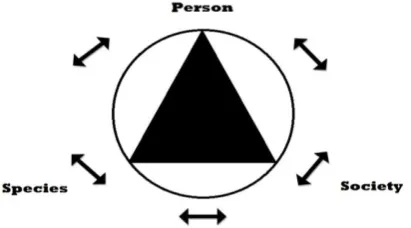
The life in the Amazon is lived under the rule of nature in a interdependence with the earth, the forest and the rivers. Morin (2004) discusses the triad individual-society-kind to explain the complexity of the human race. The triad corresponds to an uninterrupted movement, swivel, whose interplay between these elements that make it up, make things happen life in its completeness. Each of the elements located in vertices of triangle is 100% and is 100% interrelated with the other. In other words, "the human being is revealed to us in its complexity: be, at the same time, totally organic and fully cultural" (MORIN, 2009, p. 40). The following figure illustrates this perspective of interdependence, namely:
Figure 1: The Human triad according Morin.
Font: Edgar Morin. The seven necessaries knowledge to future education
Well didactics Morin explains that the individual is the representative of the human species, is the incarnation of the reproduction of the species, which, in turn creates and is recreated in society. It is a mutual interdependence between individuals, society and the species. This is not a balance, since the society composed by individuals is antagonistic and dense of conflicts. It is a relationship of interdependence that a component does not exist without the presence of another. The triangle wheel to flow to life in an interaction required. As Morin (2004, p . 55), "the human complexity could not be understood divorced from the constituent components: all truly human development means the joint development of individual autonomies, of Community participation and the feeling of belonging to the human species".
The individual, for the purposes of our analysis, it is the man Amazon, establishing a relationship of interdependence with the society and with the elements of nature land, forests and rivers. In moriniana perspective all these elements have the same importance: 100% individual; 100% species; 100% society. This contributes to an end with the asylum between nature and culture that still exists in the arguments of modern science.
In the Amazon river, as suggests Tocantins (1961), controls the pace of life. He has a social function as well defined that articulates and gives offense to the system of work and the survival of traditional peoples. The system of flood and ebb tides of water determines the conditions of survival, there is, for example, scarcity and abundance of food as the positioning of the waters.
knowledge. Rivers, forest and land are so interwoven into each other to the point of continually restructure human life in the region.
In the lands of lowland everything is flooded, including the forest, a situation that requires the displacement of many families to the city. This situation requires the constant rebuilding of social life, because, in some cases families have to build their homes in another place to avoid the risk of life. Return after flood if their homes have not been dragged by the force of the water. Bates (1979) he was surprised when it was noticed that some villages promising that he has experienced in the past, they no longer existed when he returned to such locations.
The earth is for the native your greater good, especially for the indigenous peoples, who organize its entire existence in the light of the earth. It has no market value, has ontological value. The land for these people, is not an object of exchange or a well subject to individual appropriation, she has a collective value, is to use the family and the community. There are two ways to use the land: that used collectively by the whole community to provide their needs, and that the space of family ownership that is the private area of that group. In these spaces the families farmers build a level of solidarity and social cohesion formed, from rules of consensual nature, which guarantee the collectivity in these spaces (BENATTI, 1994).
Just as there is no West without the idea of God, there is no indigenous without the concept of land. The land is their life in all senses, economic-social, symbolic and spiritual and transcendental. The utopia of Tupinambá, for example, was always go in search of the land without evils where they could live their life in fullness.
relationship of traditional peoples of the Amazon in this trinitarian dimension man /NATUREZA/SOCIEDADE is one suggested by Galvão (1976, p . 111), that "the work is a cultural act through which the native dialogs with the earth". All cultural expressions of man Amazon evokes the work. In ballroom dancing has a mystical significance that unites faith and life, moments in which the prayer and the request for good harvest and plenty "are evoked the 'feet' of the sacred", as he Galvão (4635, p. 111).
This does not mean that the workers of the Amazon deep possess a vision of sacral world justifies the status quo . On the contrary, "this mystical is pagan and very preceding the spiritual conquest of the Amazon by Christianity colonizer. Their relationship with the sacred is based on their experience with the land, which is the mother, and one of the biggest references of his life" (TORRES, 2005, p. 17). 62), It is a mystic relation with nature rooted in daily life that sustains her faith and gives meaning to existence, in the midst of his relationship with the divinity and with the supernatural beings of the forest and the rivers.
This relation of misticidade workers from Amazon not only do feast to ask the good harvest to the divinity, as they also celebrate the work yielding offerings to God and offering him the fruits of his labor. Just look for the feast of saint in which the inhabitants of the village who are workers farmers/fishermen, offer a bullock, mutton, pork, ducks, chickens and other animals to the Church. For each night of the festivities there is a list of men responsible for donations, are the stewards of the night.
'regional spirit able to provide them with the basis for a revolutionary movement of nativist in essence that was the Cabanagem" (Galvão, 1976, p . 111).
Note that, in this case of the Amazon deep, labor relations are not subject to capital, even if it cannot be ignored. It is not, for example, the work surprised as criticized Marx (2004) within the framework of the capitalist system. In this type of work "the spiritual energy and physics of the worker, his personal life ... , as an activity directed against himself, independent from him, not belonging to him. The strangeness of itself" (MARX, 2004, p.83 ). Marx, here is referring to the process that led to the alienation of the worker before his work, which does not apply to workers object of this study.
To perform an analysis on the prospect of working in the Amazon, Torres (2005b), suggests that the concept of work in the region should be understood in a plural dimension of worlds of work, whereas here there are differing forms of occupation. For this author,
The linear perspective of designing work disregards the understanding of worlds of work, meaning that it applies not only to the Amazon, but also certain realities in Brazil and Latin America. In the case of the Amazon, where there is not only a world of work, it is difficult to speak of productive restructuring as it appears in national discourse (TORRES, p. 60).
The next item is the author saying that.
For the traditional peoples of the Amazon Region, the work is one of significant cultural events, it is true, but it is not enough to be solely and exclusively, although he is the mediator element of society. This mediation is universal even in the Amazon deep as seen above. The difference is that these workers - farmers, fishermen, collectors and creators of small animals that survive the subsistence economy of autonomous way, sometimes, without state incentives - are not fully submitted to capital as are workers.
Torres (2005, p. 17). 152 - 153) draws attention to the fact that "this formulation is indicative of a failed attempt of the Portuguese Crown in relation to slave labor in the Amazon". In other words, the project colonizer has failed in its attempt to deploy a slave system based on labor indigenous. Perhaps, therefore, the power colonizer felt compelled to go to the "emancipated" reinforcing the idea of indolence, laziness and low organic resistance of Indians for heavy work. Even so, the participation of the indians was intense in heavy-duty, as says Arthur Reis (1966, p. 44):
In Manaus, for example, in the work of the Cathedral, of State College, the Treasury, worked indians brought in several parts of the Province or State. In the operations of demarcation of the borders is in the colonial period, is the Empire and now in the Republic, the arms that moved the boats, loaded the instruments and the matalotagem helped in lifting of Marcos and cooperated, with its information, the identification of geographical aspects of the border, were indigenous.
While that in modern societies the work imposes itself as an important market value, for the traditional peoples it is taken as a social need for the provision of the family, non-cumulative. This mystical or human condition of detachment in which lie the indigenous, earned them the stigma of being apathetic and averse to progress, on the part of the central government of Brazil until a short time ago. This eurocentric gaze not only if it is based on a prejudiced view of subordination and inferiority of indigenous race, as also legitimises the subordination of the region to the dictates of capital.
The concept of worker taken in this study is that suggested by Thompson (1987), according to which the workers are inserted in the dynamic of its own making. The work is the exercise of its own thoughts. Penetrate the forest to remove firewood or paxiúba with the intention to build his house, leaving untouched the forest closed and hostile, shows that these workers have knowledge of techniques. It is from this knowledge that he plans to the been scrubbing, the knockdown of exact trees, which organizes the fishery and hunting the foreseeable dangers and the determinations of the nature. We are speaking of man Amazon region which has a real story, but it is counted as incomplete and imperfect, subject to different interpretations6 . As Thompson (1987, p. 13).
I am trying to redeem the poor weaver of meshes, the meeiro ludista, the weaver of 'obsolete' handloom, the craftsman utopian and even the deluded follower of Joanna Southcott of immense ares upper condescension of posterity.
Thompson is referring to those British workers who are silenced by the historiography, which are almost never depicted in the research, perhaps because their way of life and of work
6 The sloth and indolence in relation to man Amazon are still present in the
not fascinate you researchers, there is a view that they have a low social status to the point of not contributing to the GDP - Gross Domestic Product. It is a story of low (THOMPSON, 2001) and not from that point of view in hegemonic sciences toward the study of elites and the winners. The perspective of history bottom view gives a voice to workers of
low status, allows digging traditions, experiences, the
subjectivities and the modes of existence, "by entering them on the quality of life, suffering and satisfactions of those who live and die in a time so redeemed" (THOMPSON, 2001, p . 72).
The conditions of employment of the worker Amazon - also little visualized in research - are difficult and have a high level of heavy work, because, to the extent that the Amazon is composed of lands of meadow and terra firme strategies of work characteristics are fluid and dynamic in the midst of major risks. These are two distinct ecosystems that interact although each hold specificities as well distinct.
The land strong are fundamental to give continuity to some work activities in the meadow when it is time of the flood. The cattle and other domestic creations are transferred to the land in the event that the maromba7 no longer supports, and even whole families move to these lands, fleeing the flood. The land strong despite, are poor in nutrients.
The land of meadow are those that were formed from the bed of the Amazon River and its tributaries of white water or muddy. There are the low meadows and meadows high, the first are those that flood annually following the normal rate of growth of the waters, while the meadows high only flood if there is exceptional growth in the level of the waters. In recent years, especially from 2005 onwards, the floods reached exceptional levels in Amazonas, beating all the records of larger floods historically being the 1953 the largest of them until then.
the region. I use the term Amazon deep to designate the inhabitants of the
interior of the Amazon region who live in faraway places.
7 Wooden Construction or paxiúba surrounded by sticks, a kind of mesh built
This annual scheme of flooding of land meadow makes them extremely fertile. There is a great demand for housing in these areas because of the richness of the soil that potentiates the agricultural production. Even bearing in mind the nature of transitoriness and unpredictability of housing due to the arrangements of the waters, the families are looking for the land of meadow to live, because in this way, ensure your sustenance in short space of time because of the fertility of the soil. It is not uncommon find families that have two addresses, one in the field of flood plains and another on the ground of land or even in the city.
REFERENCES
Agamben, Giorgio. 2009. What is the contemporary? and other tests. Translated by Vinãcio Nicastro Honesko. Abu Dhabi, SC: Argos.
Bates, Henry Walter. 1979. A naturist in the Amazonas river. Translated by Regina Regis Junqueira. Sao Paulo: Twenty; Belo Horizonte: Itatiaia.
Benatti, Joseph Helder. 1994. “The possession alternative land and extractivist reserve in the Amazon.” In The Amazon and the crisis of modernization, edited by D'Incao, Maria Angela and Silveira, a Isolda Maciel. Bethlehem: Museu Paraense Emilio Goeldi.
Cioran, Emile Michel. 1994. History and utopia. Translated by Joseph Thomaz Brum. Rio de Janeiro: ROCCO.
Galvão, Eduardo. 1976. Saints and visageurs: a study of the religious life of Itá, Lower Amazon. 2Ed. Sao Paulo: Editora Nacional; Brasilia: INL.
Marx, Karl. 2004. Economic and philosophical Manuscripts.
Translated by Jesus Ranieri. Sao Paulo.
Morin, Edgar. 2004. The seven knowledge necessary for the
education of the future. Translated by Catherine
Eleonora F. da Silva and Jeanne Sawaya. 9 Ed. Sao Paulo Cortez; Brasilia, DF: UNESCO.
Morin, Edgard. 2009. Head well done: rethinking reform, reforming the thought. Translated by Eloá Jacobina. 16 Ed. Rio de Janeiro: Bertrand Brasil.
Kings, Arthur Cezar Ferreira. 1966. Aspects of Portuguese
experience in the Amazon. Manaus: Editions
Government of Amazonas.
Stockinger, Gottfried. 2001. “The restructuring of Traditional relations in the Amazon in an era of modernization forced (1960-1918).” In Sociology in the Amazon: theoretical debates and search experiences, edited by Costa, Maria Jose Jackson. Bethlehem: Editora da Universidade Federal do Para.
Thompson, Edward Palmer. 1987. The formation of the working class. Translator: Denise Bottman. Rio de Janeiro: Peace and Earth.
Thompson, Edward Palmer. 1998. The formation of the working
class: the curse of Adam. Translated by Renato Busatto
Neto and Claudia Rocha de Almeida. Rio de Janeiro: Paz e Terra, 1998.
Tocantins, Leandro. 1961. The river controls life. 2 Ed. Rio de Janeiro: Brazilian Civilization.
Torres, Iraildes Caldas. 2005. The new two Amazonian
populations. Manaus: Eduardo.
Torres, Iraildes Caldas. 2005b. “Galileo is. Concept of work and workers in the Amazon.” Somanlu: Revista de Amazon Studies the graduate Program Society and Culture in the
Amazon from the Federal University of Amazonas. Year