Performance Analysis of Reactive and Hybrid
Routing Protocols in Ad Hoc Networks
Pooja Mangla#1, Rajneesh Gujral*2, Manpreet Singh#3
#
CSE Department, Maharishi Markandeshwar University Mullana, Haryana, India
*Maharishi Markandeshwar University, Mullana, Haryana, India
Abstract:- Ad hoc Networks are basically peer-to-peer,
multihop, mobile wireless networks in which information packets are transmitted in a store-and-forward manner from a source to an arbitrary destination, via intermediate nodes. Infrastructureless networks have no fixed routers; all nodes are capable of movement and can be connected dynamically in an arbitrary manner. In our dissertation, we have analyzed the Reactive (AODV and TORA) and Hybrid (ZRP) routing protocols by simulating these protocols in Networks Simulator NS-2.33. After successful simulation, we have analyzed the result of simulation for these routing protocols over the different performance metrics. Performance Metrics will contain some parameters such as End-to-End delay, Throughput, Routing Overhead, Packet Delivery Ratio, Reliability, Scalability, Mobility, etc., out of which we have chosen Throughput, Packet Delivery Ratio and End-to-End Delay.
Keywords: MANET, AODV, TORA, ZRP.
I. INTRODUCTION
A wireless ad hoc network [1] is a collection of mobile/semi-mobile nodes with no pre-established infrastructure, forming a temporary network. Each of the nodes has a wireless interface [2] and communicates with each other over either radio or infrared.
A. Classification of Wireless Networks
Wireless networks [3] [4] can be classified in two types: - 1) Infrastructure networks [4,2]:
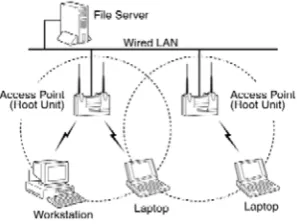
Infrastructure network consists of a network with fixed and wired gateways. A mobile host communicates with a bridge in the network (called base station) within its communication radius. The mobile unit can move geographically while it is communicating. When it goes out of range of one base station, it connects with new base station and starts communicating through it. This is called handoff. In this approach the base stations are fixed.
Fig. 1 Infrastructure Networks
2) Infrastructureless (Ad hoc) networks [4, 2]: In ad hoc networks all nodes are mobile and can be connected dynamically in an arbitrary manner. All nodes of these networks behave as routers and take part in discovery and maintenance of routes to other nodes in the network. Ad hoc networks are very useful in emergency search-and-rescue operations, meetings or conventions in which persons wish to quickly share information, and data acquisition operations in inhospitable terrain.
Fig. 2 Infrastructureless Networks
The characteristics of these networks are summarized as follows:
Autonomous and infrastructure-less: It is self-organized and independent of any established infrastructure and centralized network administration. Each node runs as a router and operates in distributed manner.
Multihop routing: As there is no dedicated router, every node functions as a router and aids in forwarding each others’ packets to intend destination. Hence, information sharing among mobile nodes is made available.
Dynamic network topology: Since ad hoc network nodes move randomly in the network, the topology changes frequently, leading to regular route changes, network partitions, and possibly packet loss.
Variation on link and node capabilities: Each participating node may be equipped with different type of radio devices that have varying transmission and receiving capabilities. Thus, designing and standardization of ad hoc network protocols and algorithms for this heterogeneous network are complicated as dynamic adaptation is required.
Network Scalability: Many applications may involve large networks with tens of thousands of nodes especially that can be found in tactical networks. Scalability is crucial to the successful deployment.
Limited Physical Security.
Nodes can perform the roles of both hosts and routers.
Frequent routing updates.
Bandwidth-constrained, variable capacity links.
The other factors which need to be considered while choosing a protocol for MANETs are as follows: [6]
Multicasting: This is the ability to send packets to multiple nodes at once. This is similar to broadcasting except the fact that the broadcasting is done to all the nodes in the network. This is important as it takes less time to transfer data to multiple nodes.
Loop Free: A path taken by a packet never transits the same intermediate node twice before it arrives at the destination. To improve the overall, we want the routing protocol to guarantee that the routes supplied are loop-free. This avoids any waste of bandwidth or CPU consumption.
Multiple routes: If one route gets broken due to some disaster, then the data could be sent through some other route. Thus the protocol should allow creating multiple routes.
Distributed Operation: The protocol should of course be distributed. It should not be dependent on a centralized node.
Reactive: It means that the routes are discovered between a source and destination only when the need arises to send data. Some protocols are reactive while others are proactive which means that the route is discovered to various nodes without waiting for the need.
Unidirectional Link Support: The radio environment can cause the formation of unidirectional links. Utilization of these links and not only the bi-directional links improves the routing protocol performance.
Power Conservation: The nodes in an ad-hoc network can be laptops and thin clients, such as PDAs that are very limited in battery power and therefore use some sort of stand-by mode to save power. It is therefore important that the routing protocol has support for these sleep-modes [7] [8].
B. Applications of Ad hoc networks
There are many applications of ad hoc networks: [4]
Military battlefield: The modern digital battlefield demands robust and reliable communication in many forms. Most communication devices are installed in mobile vehicles, tank, trucks etc. also soldiers could carry telecom devices that could talk to a wireless base stationer directly to other telecom devices if they are within the radio range. However, these forms of communication are considered to be primitive. At times when wireless base station is destroyed by enemy, a soldier will be prohibited from communicating with other soldier if the called party is not within the radio range. This is the scenario where ad hoc networks come into play. Ad hoc networks are well known as self organizing networks since they are robust when nodes disappear due to destruction or mobility. Through multi-hop communication, soldiers can communicate to remote soldiers via data hoping and data forwarding from one radio device to another.
Sensor Networks: This technology is a network composed of a very large no. of small sensors. These can be used to detect any number of properties of an area. Examples include temperature, pressure, toxins, pollutions, etc. applications are the measurement of ground humidity for agriculture, forecast of earthquakes. The capabilities of each sensor are very limited and each must rely on others in order to forward data to a central computer. Individual sensors are limited in their computing capability and are prone to failure and loss. Ad hoc networks could be the key to future homeland security.
Automotive Applications: Cars should be enabled to talk to the road, to traffic lights and to each other, forming ad hoc networks of various sizes. The network will provide the drivers with information about road conditions, congestions and accident-ahead warnings, helping to optimize traffic flow.
Commercial Sector: Ad hoc can be used in emergency/rescue operations must take place where non-existing or damaged communications infrastructure and rapid deployment of a communication network is needed. Information is relayed from one rescue team member to another over a small handheld. Other commercial scenarios include e.g. ship-to ship ad hoc mobile communication, law enforcement, etc.
is the concept of ubiquitous/ pervasive computing where people, noticeable or transparently will be in close a dynamic interaction with devices in their surroundings.
C. Classification of Ad hoc networks
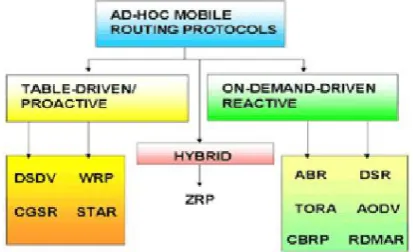
Routing protocols for ad hoc wireless networks can be classified into several types based on different criteria. A classification tree is shown below: [1]
Fig. 3 Classification of Routing Protocols
The classification is mutually exclusive and some protocols fall in more than one class. The deviation from the traditional routing metrics and path-finding process that are employed in wired networks makes it worth further exploration in this direction. The routing protocols for ad hoc networks can be broadly classified into four categories based on:
Routing information update mechanism
Use of temporal information for routing
Routing topology
Utilization of specific resources
1) Based on the Routing Information Update Mechanism
Proactive or Table-driven routing protocols: In table-driven routing protocols, every node maintains the network topology information in the form of routing tables by periodically exchanging routing information. Routing information is generally flooded in the whole network. Whenever a node requires a path to a destination, it runs an appropriate path-finding algorithm on the topology information it maintains.
Reactive or On-demand routing protocols: Protocols that fall under this category do not maintain the network topology information. They obtain the necessary path when it is required, by using a connection establishment process. Hence, these protocols do not exchange routing information periodically.
Hybrid routing protocols: Protocols belonging to this category combine the best features of the above two categories. Nodes within a certain distance from the node concerned, or within a particular geographical region, are said to be within the routing zone of the given node. For
routing within this zone, a table-driven approach is used. For nodes that are located beyond this zone, an on-demand approach is used.
2) Based on the use of temporal information for Routing
Routing protocols using past temporal information: These routing protocols use information about the past status of the links or the status of links at the time of routing to make routing decisions. For example, the routing metric based on the availability of wireless links along with a shortest path-finding algorithm, provides a path that may be efficient and stable at the time of path-finding. The topological changes may immediately break the path, making the path undergo a resource-wise expensive path reconfiguration process.
Routing protocols that use future temporal information: Protocols belonging to this category use information about the expected future status of the wireless links to make approximate routing decisions. Apart from the lifetime of wireless links, the future status information also includes information regarding the lifetime of the node, prediction of location and prediction of link availability.
3) Based on the Routing Topology
Routing Topology being used in the Internet is hierarchical in order to reduce the state information maintained at the core routers. Ad hoc wireless networks, due to their relatively smaller number of nodes, can make use of either a flat topology or a hierarchical topology for routing.
Flat Topology routing protocols: Protocols that fall under this category make use of a flat addressing scheme similar to the one used in IEEE 802.3 LANs. It assumes the presence of a globally unique addressing mechanism for nodes in an ad hoc wireless network.
Hierarchical topology routing protocol: Protocols belonging to this category make use of a logical hierarchy in the network and an associated addressing scheme. The hierarchy could be based on geographical information or it could be based on hop distance.
4) Based on the Utilization of Specific Resources
Power-aware routing: This category of routing protocols aims at minimizing the consumption of a very important resource in the ad hoc wireless networks: the battery power. The routing decisions are based on minimizing the power consumption either locally or globally in the network.
II. PRELIMINARIES A. AODV
AODV stands for Ad-Hoc On-Demand Distance Vector and is, as the name already says, a reactive protocol, even though it still uses characteristics of a proactive protocol. Routes in AODV are discovered, established, and maintained only when and as long as needed. To ensure loop freedom sequence numbers, which are created and updated by each node itself, are used. These allow also the nodes to select the most recent route to a given destination node. AODV takes advantage of route tables. In these, it stores routing information as destination and next hop addresses as well as the sequence number of a destination. Next to that, a node also keeps a list of the precursor nodes, which route through it, to make route maintenance easier after link breakage. To prevent storing information and maintenance of routes that are not used anymore each route table entry has a lifetime. If during this time the route has not been used, the entry is discarded.
B. TORA
Temporally Ordered Routing Algorithm (TORA) is a distributed routing protocol based on a "link reversal" algorithm. It is designed to discover routes on demand, provide multiple routes to a destination, establish routes quickly, and minimize communication overhead by localizing the reaction to topological changes when possible. Route optimality (shortest-path routing) is considered of secondary importance, and longer routes are often used to avoid the overhead of discovering newer routes. It is also not necessary (nor desirable) to maintain routes between every source/destination pair at all times. The actions taken by TORA can be described in terms of water flowing downhill towards a destination node through a network of tubes that model the routing state of the network. The tubes represent links between nodes in the network, the junctions of the tubes represent the nodes, and the water in the tubes represents the packets flowing towards the destination. Each node has a height with respect to the destination that is computed by the routing protocol. If a tube between two nodes becomes blocked such that water can no longer flow through it, the height of the nodes are set to a height greater than that of any neighboring nodes, such that water will now flow back out of the blocked tube and find an alternate path to the destination.[11] [15]
C. ZRP
The Zone Routing Protocol (ZRP) is a hybrid reactive/proactive routing protocol which minimizes the wastage associated with pure proactive schemes by limiting the scope of the proactive procedure to a node’s local neighborhood. It searches through the whole network more efficiently by querying only selected nodes in the network reactively, rather than flooding all the network nodes. Another appealing feature is that its behavior is adaptive. It can dynamically adjust itself to operational conditions based on the current configuration of network and users’ behavior by sizing a single network parameter – its zone radius. Routing is flat rather than hierarchical, thus reducing
overhead, allowing optimal routes to be discovered and reducing the threat of network congestion. With multiple loop-free routes to the destination identified, its reliability and performance are increased too. The placement of ZRP in the OSI protocol stack is shown in Fig 2.5. Proactive maintenance of the routing zone topology in ZRP is performed through exchanging of update packets by a protocol called IntrAzone Routing Protocol (IARP). Such updates can be triggered by MAC-level Neighbor Discovery Protocol (NDP) which aids in informing IARP when a link to a neighbor is established or broken. Reactive routing to nodes beyond the routing zone by a query-reply mechanism is implemented by another protocol called IntErzone Routing Protocol (IERP). The following sections will further illustrate the algorithm of these protocols.
III. PERFORMANCE EVALUATION
Various performance metrics that can be used to evaluate performance are:
Packet delivery ratio: Packet delivery ratio is calculated by dividing the number of packets received by the destination by the number of packets originated by the application layer of the source (i.e. CBR source). It specifies the packet loss rate, which limits the maximum throughput of the network. The better the delivery ratio, the more complete and correct is the routing protocol.
100 *
1 1
n
n
CBRsent CBRrece PDR
Rate of Forwarded/Sent packets (Routing Overhead): In Routing Overhead the packet must be reach the exact destination node which will be mentioned in routing table. If packet goes to another node, which is not the correct destination, increases the routing over head. Hence the no of nodes can be counted as routing overhead. Our objective is to minimize the overheads as much as possible.
CBRrece RTRPacket Load
Routing _
Average End-to-end delay: End-to-end delay indicates how long it took for a packet to travel from the CBR source to the application layer of the destination. It represents the average data delay an application or a user experiences when transmitting data.
100 * ) (
_ _ _ _
1 1
n
n
CBRrece e CBRsenttim e
CBRrecetim Delay
End to End Avg
nodes that the ad-hoc network can scale to and reliably preserve communication.
Throughput: Throughput is the ratio of total number of delivered or received data packets to the total duration of simulation time. Like, we start the packet sending at time 1 and finish at time 10, so total duration of simulation is 9 (10-1). Throughput depends upon number of active nodes that are interfering with the data transmission. This is calculated by calculating total number of received packets divided by 9 (Simulation Time).
time simulation
CBRrece Throughput
n
1
Route Acquisition Time: This, measures the time required to establish routes. It is an end-to-end measurement. Route acquisition time is concerned especially with on-demand routing approaches.
Efficiency: This refers to internal effectiveness of a routing policy. Thus, to achieve a certain externally evaluated data routing efficiency, two policies may consume different amounts of overhead since their internal efficiencies differ. If control and data traffic use the same transmission channel, then excessive control traffic will probably affect the internal efficiency of a policy.
Network size: It determines the number of nodes and size of area that nodes are moving within. Network size basically determines the connectivity. Fewer nodes in the same area mean fewer neighbors to send request to, but also smaller probability of collision.
Pause time: Nodes will stop a “pause time” amount before moving to another destination point.
TABLE 1
SIMULATION ENVIRONMENT
S No. Parameter Values
1 Number Of Nodes 10, 20, 30, 50 2 Topology Dimension 1200 m x 1200 m
3 Traffic Type CBR
4 Radio Propagation Model
Two-Ray Ground Model
5 Packet Size 512 bytes
6 Mobility Model Random Way Point
7 MAC Type 802.11 Mac Layer
8 Simulation Time 10
9 Antenna Type Omni Antenna
IV. RESULTS AND DISCUSSIONS
Throughput: Throughput is the ratio of total number of delivered or received data packets to the total duration of simulation time. Like, we start the packet sending at time 1 and finish at time 10, so total duration of simulation is 9 (10-1). Throughput depends upon number of active nodes that are interfering with the data transmission. This
is calculated by calculating total number of received packets divided by 9 (Simulation Time).
time simulation
CBRrece Throughput
n
1
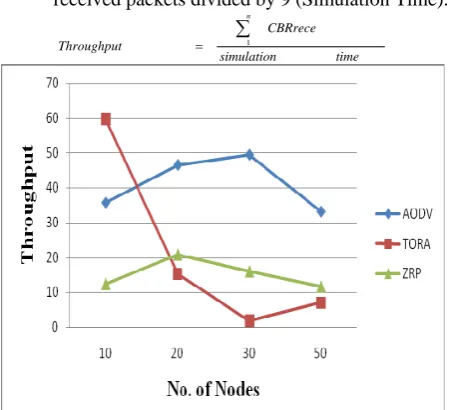
Fig. 4 Throughput of AODV, TORA and ZRP
TABLE II
CALCULATED THROUGHPUT VALUES WITH DIFFERENT NO. OF NODES
No. of Nodes AODV TORA ZRP
10 35.7778 59.75 12.4444
20 46.5556 15.22222 20.7778
30 49.4444 1.77778 16
50 33.22222 7 11.667
Packet Delivery Ratio (PDR): PDR also known as the ratio of the data packets delivered to the destinations to those generated by the CBR sources. This metric characterizes both the completeness and correctness of the routing protocol.
100 *
1 1
n
n
CBRsent CBRrece PDR
TABLE III
CALCULATED PDR VALUES FOR COMPARED PROTOCOLS
WITH DIFFERENT NO.OF NODES
No. of Nodes AODV TORA ZRP
10 53.67 1.17 18.67
20 69.83 22.83 31.17
30 74.17 2.67 24
50 49.83 10.5 17.5
Average End-to-End Delay: Average End to End delay is the average time taken by a data packet to reach from source node to destination node. It is ratio of total delay to the number of packets received.
100 * ) (
_ _ _ _
1 1
n
n
CBRrece
e CBRsenttim e
CBRrecetim Delay
End to End Avg
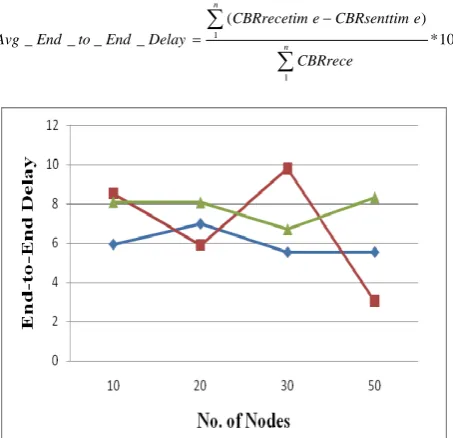
Fig. 6 Average End-to-End Delay of AODV, TORA and ZRP
TABLE IV
CALCULATED AVERAGE E2E DELAY VALUES FOR
DIFFERENT NO.OF NODES
No. of Nodes AODV TORA ZRP
10 5.93736 8.53515 8.09797
20 6.97675 5.89051 8.07064
30 5.53426 9.813778 6.69358
50 5.54241 3.0345 8.3292
V. CONCLUSION
We have analyzed AODV, TORA and ZRP routing protocols and designed the performance metrics of these routing protocols at different number of nodes. From the above analysis, we can conclude that AODV performs better than ZRP and ZRP is better than TORA when there is less number of nodes. Performance of ZRP becomes better than TORA and AODV as the number of nodes increases due to the advantageous nature of nodes in ZRP behaving like that in proactive routing protocols when destination node is in its own zone and like reactive routing protocols when the destination node is in some other zone. Also, the performance of TORA is better than that of AODV as the number of nodes increases.
REFERENCES
[1] Charles E. Perkins, Ad hoc Networking, Addison-Wesley, 2001. [2] Theodre S. Rappaport, “Wireless Communication: Principles and
Practice”, New Jersey, Prentice Hall, ISBN 0-13-375536-3. [3] Dimitri Bertsekas and Robert Gallager, “Data Networks – 2nd
Edition”, Prentice Hall, New Jersey, ISBN 0-13-200916-1.
[4] Mobile Ad hoc Networks (MANET), URL:
http://www.ietf.org/html.charters/manet-charter.html (1998-11-29). [5] S.Corson, J.Macker. MANET: Routing Protocol Performance Issues
and Evaluation Considerations RFC 2501, IETF Network Working Group January1999, http://www.ietf.org/ rfc/ rfc2501.txt cited 15.02.2004.
[6] V. Ramesh, Dr. P. Subbaiah, N. Koteswar Rao, M. Janardhana Raju, “Performance Comparison and Analysis of DSDV and AODV for MANET”, (IJCSE) International Journal on Computer Science and Engineering Vol. 02, No. 02, 2010, 183-188.
[7] Ahmed Al-Maashri and Mohamed Ould-Khaoua, “Performance
Analysis of MANET Routing Protocols in the Presence of Self-Similar Traffic”. IEEE, ISSN- 0742-1303, First published in Proc. of the 31st IEEE Conference on Local Computer Networks, 2006.
[8] Elizabeth M. Royer and C-K Toh. “A Review of current Routing Protocols for Ad-hoc Mobile Wireless Networks”, IEEE Personal Communications, Vol. 6, No. 2, pp. 46-55, April 1999.
[9] D. Johnson et al., Dynamic Source Routing for mobile Ad-hoc Networks, IETF MANET Draft, April2003.
[10] Charles E.Perkins, Elzizabeth M.Belding-Royer, Samir R.Das, Ad-hoc On-demand Distance Vector Routing, IETF MANET Draft, February 2003. http://www.ietf.org/rfc/rfc3561 .txt cited 01.03.2004. [11] Vincent D.Park, M.scott Corson, A highly Adaptive Distributed
Routing Algorithm for Mobile wireless Networks, http://www.cs.odu.edu/skovvuri/tora.pdf cited 10.04.2004.
[12] T.Clausen and P.Jacquent Optimized Link State Routing Protocol (OLSR). RFC3626, IETF Network Work Group, October2003. [13] Zj.Haas and M.R Pearlman, The Zone Routing Protocol (ZRP), for
Ad-hoc Networks, IETF Internet Draft, draft-ietf-manet-zone-zrp-04.txt, July 2002.
[14] J.Moy OSPF version2 RFC 1247, July1991.