
Decoupled Control Of an Inter Acting Three
Tank System
A.Aruna B, Manu Francis
P G Scholar, Dept. of EIE, Vimal Jyothy Engineering College, Kannur, Kerala, India1 Assistant Professor Dept. of EIE, Vimal Jyothy Engineering College, Kannur, Kerala, India1
ABSTRACT: The three tank plant is a bench mark widely used for demonstration purposes in control engineering. It is
a highly nonlinear system. In this paper, an attempt is made to model the system in state space and then linearise the model using small signal linearization and Taylor series expansion. Since this is a multiple input multiple output system ,decoupling of control loops is done in order to cancel the effect of inter action between control loops. Then PI and PID controllers are designed to control the levels of tanks and comparison of their performances are done. Results of comparison show that PID controllers performs better than PID for three tank system.
KEYWORDS: Three tank system, Inter acting systems, Decoupler, PI, PID.
I.INTRODUCTION
Liquid level control has a very large application domain in industry, three-tank (3T) system is the most representative didactical equipment widely used as a benchmark system for system modeling, identification, control, fault detection and diagnosis, as well as for fault-tolerant control. The system exhibits typical characteristics of a strong nonlinearity with different possibilities of disturbance, which makes the system useful to serve as a test environment for algorithms concerning state estimation, parameter identification, and control of hybrid systems[1,2]. This is a multi input multi output system. It is similar to many plants in industry, such as waste. water treatment plants or refineries. In this paper, a linear model of the non linear three tank bench mark system is proposed[3]. The non linear.model is analytically linearised using perturbation theory[4]. Then the obtained linear state space model is converted into transfer matrix using MATLAB[5]. The control objective is to keep the levels of two tanks T1 and T2 at the desired set points by
adjusting the flow rates of pumps(u1 and u2) to the tanks. Before designing the controllers, decoupling of the inter
acting three tank system is performed[6,7]. Decoupling makes set point changes to affect only the desired controlled variables in an interacting system, where there are more than one controlled and manipulated variables.. Firstly, a classical PI controller is implemented in the feedback control loop so as to achieve the control objectives[8]. PI controller exhibits larger overshoot and higher error coefficients. Then a PID controller is designed and the response exhibits lesser over shoot and lesser error coefficients compared to PI controller. Even though the servo response of both the controllers are good , regulatory responses of both the controllers are poor, and have a high settling time.
II. DESCRIPTION OF THE PLANT
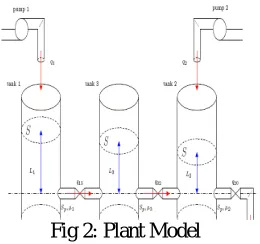
The three-tank plant consists of three cylindersT1, T2, and T3 with the same cross-section A. These cylinders are connected serially to each other by cross-section Sn pipes. Figure 2 shows the plant’s full structure. The right-hand side of tank T2 has a single outflow valve (through which Q20 flows) that also has a circular cross-section Sn. The liquid flowing out from the system is collected in areservoir located under the three tanks—this reservoir supplies pumps 1 and 2 with liquid, which eventually returns to the system (pumps 1 and 2 represent the input flows of tanks T1 and T2)[5].In this closed system, the liquid that enters the reservoir from the tanks returns to the tanks via the pumps. However, these pumps switch off automatically when the liquid level of T1 or T2 exceeds a given upper limit. In addition to the outflow valve at T2, the system has five more valves. Two of them connect two consecutive tanks (one for the T1 to T3 connection, through which Q13 flows, and the other for the T3 to T2 connection, corresponding to the
of each tank that can be used to manually drain the tanks. Pump flow rates correspond to process input signals; the liquid levels in tanks T1 and T2 are the output signals. System users can manage all these signals for control purposes
Fig. 1. Description of the plant
III. MATHEMATICAL MODELLING OF THE PRACTICAL SYSTEM
Fig 2: Plant Model
Applying the Mass balance equation[3] , the Three tank system can be represented as
S = -q (1)
S = + - (2)
S = - (3)
Where , qij represents the water flow rate from tank I to tank j
. i=1,2,3
According to Torricelli’s rule
qij = i Sp sign(Li – Lj) 2 I i−LjI
The outflow rate,
= 2
The full system model is obtained as,
̇ =− sign( −x ) − + (4) ̇ = sign( −x ) − – C sign(x ) +
(5)
̇ = sign( −x ) − −C sign(x −x ) − (6)
Xi(t) is the liquid level in tank i.
Ci = (1/S) iSp 2
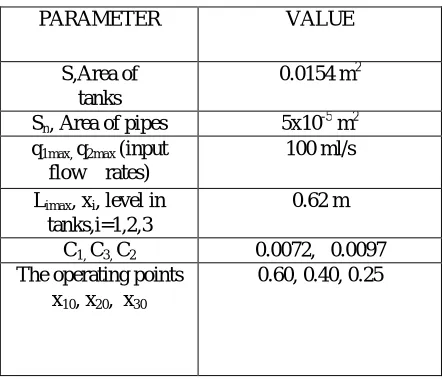
TABLE I: PARAMETERS USED FOR SIMULATION
PARAMETER VALUE
S,Area of tanks
0.0154 m2 Sn, Area of pipes 5x10⁻⁵ m2
q1max, q2max (input
flow rates)
100 ml/s
Limax, xi, level in
tanks,i=1,2,3
0.62 m
C1, C3, C2 0.0072, 0.0097
The operating points x10, x20, x30
0.60, 0.40, 0.25
After performing small signal linearization and substituting the parameter values, the transfer matrix of the mathematical model is obtained as,
The transfer function from input 1 to output 1: H11
2: H2 1
The transfer function from input 2 to output 1: H12
2: H22
IV. INTER ACTION AND DECOUPLING OF CONTROL LOOPS
One of the most challenging aspects of the control of MIMO systems is the inter action between different inputs and outputs. Each input will have an effect on every output of the system. ie, the outputs are coupled. When the MIMO system is such that each input only affects one particular output, the system is decoupled. When there are strongly inter acting loops, special new elements called decouplers are introduced in the control system to cancel the inter action effects between inter acting control loops[9].
Fig.3:Block Diagram of a Process with inter action
In order to keep y1 constant, we introduce a dynamic element with a transfer function =−
( ) ( )
Substituting the values of H11, H12, H21, H22 for three tank system, we get D1 and D2.
V.DESIGN OF PI CONTROLLER FOR THREE TANK SYSTEM
This control mode results from the combination of proportional mode and integral mode.The main advantage of this composite control mode is that the one-to-one correspondence of proportional control mode is available and the integral mode eliminates the inherent offset.The analytic expression for PI controller is
=
+
∫+
p(0)VI. DESIGN OF PID CONTROLLER FOR THREE TANK SYSTEM
The PID control algorithm remains the most popular approach for industrial process control despite continual advances in control theory. This is not only due to the simple structure which is conceptually easy to understand and, which makes manual tuning possible, but also to the fact that the algorithm provides adequate performance in the vast majority of applications. The equations of proportional mode, integral mode and derivative mode are combined to have an analytic expression for PID mode[11].
=
+
∫+
+p(0)VII. RESULTS AND DISCUSSION
The response of the system to closed loop tuned PI controller is shown below.
Fig.4: Response Of PI controller
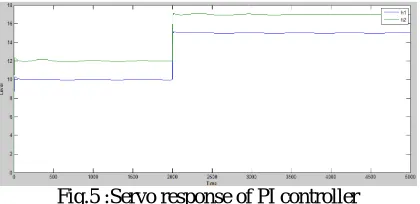
Figure 5& 6 show the servo and regulatory responses of three tank system with PI controller tuned using Zeigler Nichols closed loop tuning method
.
Fig 6 :Regulatory response of PI controller
The responses show that the system effectively tracks the set point changes. when a disturbance is applied to the system it rejects the disturbance and come back to the set point after some delay. But the over shoot in the system under such situations is very high
The
response of three tank system with PID controller tuned using Zeigler Nichols closed loop tuning method is given below in figure 7Fig.7 :Response of the system to PID controller
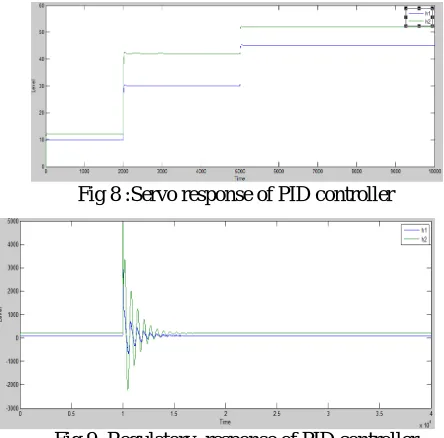
The servo and regulatory responses of closed loop tuned PID controllers are shown below which indicates that the system tracks the set point changes accurately .But the settling time is high. The regulatory response shows that the system rejects the disturbance effectively but,the over shoot is very high
Fig 8 :Servo response of PID controller
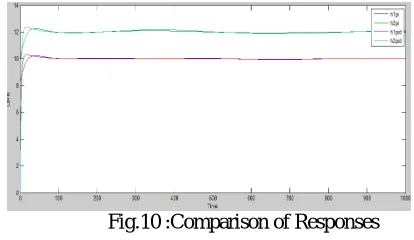
The comparison of responses of PI and PID controllers for a three tank system which are tuned using Zeigler Nichols closed loop tuning method is shown below.
Fig.10 :Comparison of Responses
TABLE II: PERFORMANCE COMPARISON FOR LEVEL h1
Sl No. Controller ISE IAE
1 PI 125.5 61.24
2 PID 17.85 48.97
TABLE III: TIME DOMAIN PERFORMANCE COMPARISON
Sl No. Controller ISE IAE
1 PI 185 112.7
2 PID 28.07 99
The responses indicate that both the PI and PID controllers track the set point accurately with some delay. But the over shoot in the case of PID is less than that in PI.
The tables IIand III shows the performance indices of the controllers for the 3 tank system.
The table shows that the values of error coefficients are lesser for PID than PI. From the above time domain analysis and performance indices comparison, we came to know that PID is a better controller for the three tank system than PI.
VII. CONCLUSION
This paper evaluates the performance of a conventional PI and PID with decouplers to control the levels of two tanks in a coupled three tank system.. After comparing the results, we conclude that, PID controller is the one which gives quick response with lesser overshoot than PI controller.But disturbance rejuction is slow in both controllers.
REFERENCES
[1]. Amira (2000). DTS200 – laboratory setup three tank system. Duisburg, Germany:Amira GmbH
[2]. R. Dormido, H. Vargas,et.al., “Development of a Web-Based Control Laboratory for Automation Technicians: The Three-Tank System”, IEEE Transactions on education, vol. 51, no. 1, February 2008
[3]. Mohammad Iqbal, Aamer Iqbal Bhatti , “Linear Model Based Diagnostic Framework of Three Tank System.”, Proceedings of the 11th WSEAS International Conference on SYSTEMS, Agios Nikolaos, Crete Island, Greece, July 23-25, 2007
[4]. D T Pham* and D Li, “ Fuzzy control of a three-tank system”, Fast-track communication
[5]. Radu-Emil Precup , Marius L. Tomescu et.al. “ Iterative performance improvement of fuzzy control systems for three tank systems”, Elsevier, Expert Systems with Applications 39 (2012) 8288–8299
[6]. Adel Abdurahman, “ Three Tank System Control Using Neuro - Fuzzy Model Predictive Control”, International Journal of Computer Science and Business Informatics .
[7]. L.F. Mendonc¸a, J. M. C. Sousa, “Fault Accommodation of an Experimental Three Tank System Using Fuzzy Predictive Control”
[8]. Goncalo Vinagre a, Duarte Valério et.al., “Laboratory software for the three-tank benchmark system:from PID to multi-agent fault-tolerant fractional control”,
ELSEVIER, Procedia - Social and Behavioral Sciences 46 ( 2012 ) 1919 – 1923
[9]. George Stephanopoulose, “Chemical process control, an introduction to theory and practice”. [10]. Dr. M.Chidambaram, “ Introduction to Control of Multivariable Systems”.
![Dichlorido[N,N diethyl N′ (2 pyridylmethylene)ethane 1,2 diamine]mercury(II)](data:image/gif;base64,R0lGODlhAQABAIAAAP///wAAACH5BAEAAAAALAAAAAABAAEAAAICRAEAOw==)