Depending against Web server Compromise Attacks through DWA-IV
1Puligoru Mrudula, 2Prathap Sathyavedu
1
Dept. of CSE, J.N.T.U Anantapur, Tirupathi, Andhra Pradesh, India, Email- [email protected]
2
Dept. of CSE, Anna University, Andhra Pradesh, India
Abstract
We portray a case-control study to distinguish hazard calculates that are connected with higher rates of web server trade off. Weinspect an irregular example of around 200 000 web servers and naturally distinguish ascribes speculated to influence the vulnerability to compromise, outstandingly content administration framework (CMS) and web server sort. We then cross-list this data with information on web servers hacked to serve phishing pages or divert to unlicensed online drug stores. We observe that web servers running WordPressand Joomla will probably be hacked than those not running any CMS, and that servers running Apache and Nginx are more likely to be hacked than those running Microsoft IIS. We additionally distinguish a few Word Press modules and Joomla expansions that related with compromise. Besides, utilizing a progression of logistic relapses, we find that a CMS's piece of the pie is absolutely corresponded with website trade off. Shockingly, we observe that web servers running obsolete programming are less inclined to be bargained than those running cutting-edge programming. We display prove this is valid for center Word Press programming (the most well known CMS stage) andmany related modules. At long last, we look at what happens to web servers taking after trade off. We find that under 5% of hacked Word Press sites are in this way upgraded, however those that do are recompromised about half as frequently as those that don't overhaul.
Keywords: Digest, SSPA, DSSA, DWA, CMS, Case Control.
1. Introduction
Every month numerous a great many sites are bargained by lawbreakers and repurposed to have phishing sites, convey malware, and sell fake products. In spite of the significant damage forced, the quantity of contaminated sites has remained resolutely high. While numerous concur that the present level of Internet security is unsuitably low, there is no agreement on what countermeasures ought to be embraced to enhance security or where constrained assets ought to be engaged. One key reason we are in such a heartbroken state is, to the point that measuring security results (and what components drive them) is hard. To some extent, this is on the grounds that the individuals who succumb to cybercrime frequently favor not to stand up. Be that as it may, it is additionally in light of the fact that security components are conveyed in the wild, where it can be difficult to plan a randomized controlled examination
disconnecting the impact of a specific countermeasure to assess effectiveness. However, notwithstanding when controlled analyses are not doable, different strategies might even now be helpfully connected. In this paper, we apply a broadly utilized technique from the study of disease transmission, called a case control study, to better comprehend the variables driving web server unreliability. Working in reverse from information on security episodes and a control test, we can recognize chance variables connected with bargain. This thus can offer shields some assistance with bettering assign rare guarded assets to do the most great.
1.1Existig System
servers mishandled for phishing and find that assailants utilizing focused on, "wickedness" Google look questions to find the web server is a positive danger variable for reinfection .The main drawbacks are:
Data will be altered by programmers or unapproved persons in pages on the web.
We may not get precision information from the web servers.
In existing framework, it is some hard to recognize the alterations for the Administrator
2. Proposed System
We propose a SSPA (Server based SHA-1 Page Digest Algorithm) to confirm the uprightness of web substance before the server issues a HTTP reaction to a client request. In expansion to standard efforts to establish safety, our Java usage of the SSPA, which is known as the Dynamic Security Surveillance Agent (DSSA), gives further security as far as substance respectability to Web-based systems. Its capacity is to keep the presentation of Web substance that has been adjusted through the malignant demonstrations of assailants and gatecrashers on Client machines.
2.1 Advantages
Trustworthiness of information will be kept up. We can get exactness information from the web
servers on web situations.
In proposed framework, changes effectively recognized by the Administrator
3. System Architecture
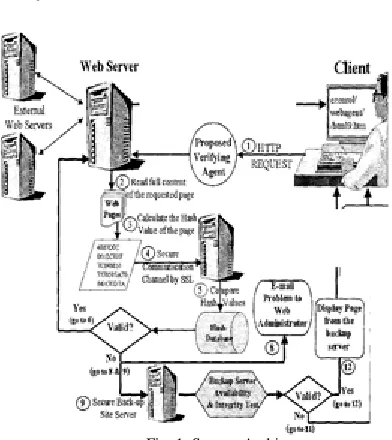
Fig. 1. System Architecture
Fig.1 shows cloud System Architecture. And this architecture contains number of modules. They are Digestgen, DWAVarifier, and Page filter.
3.1
Digestgen Digest Generator class recognizes the solicitation from the client, figures the summary, and overhauls the database with the URL asked for and digests estimation of the solicitation and the head personality that transferred the page to the Server.
To ascertain the review esteem it takes the assistance of the class DWA_SHA.
This module gives back the overview worth and which is further utilized for checking the honesty of the site page.
3.2 DWAVarifier
This verifier module gives back a Boolean esteem contingent on the Comparison of the old and present of review qualities. For this reason it makes utilization of two different classes DigestGen and DwaConnection.
Using DWAConnection class And gets an association String and utilizing this it recovers a database digest quality.
Using Digestgen it gets review esteem, this is the present quality.
Now the Verifier checks the old quality and the present esteem and returns a Boolean esteem based upon the aftereffect of examination.
3.3
Page filter
The Page channel module relies on upon DWAVerifier.
The DWAVerifier returns a Boolean esteem and relying on this Boolean esteem the channel sends a reaction to the customer.
If the Boolean esteem returned by the Verifier is TRUE then the asked for page is sent to Client, else a blunder note is sent to Client and mistake mail is sent to Administrator.
4. System Overview
framework shortcomings, are prime worries of the association, proprietors of the locales, and clients who access them. To reinforce the security of web frameworks we have created and executed a Server side web content checking specialists, which consequently and powerfully block and procedures the clients demand before the web server reacts to the customer. In this situation the associations running web servers are essential gatherings inspired by the uprightness of there their destinations substance.
Our Algorithm running at the server anticipates showcase of the site page which has been changed by pernicious assaults. This is finished by blocking material that doesn't match its actual unique finger impression (Page digest). By presenting the confirmation specialists, our point is to advance secure web frameworks in co-agent web processing and other electronic situations, where still customers can check digitally marked site pages through different techniques for their certainty to lead online exchanges.
Proposing web substance honesty confirming agent: Web servers are open by any customer who has admittance to the web. Despite the fact that this all inclusive openness is exceptionally appealing for a wide range of E-business applications, it opens the servers to aggressors who might adjust web content. The adjustments might extend from amusing increments or changes, which are normally simple to spot, to viler messing around with site page content giving false or harming information. Information showed by web servers should be secured against illicit Modifications, which generally would harm the notoriety of webpage proprietors.
To fortify the security of web frameworks, our proposition recommends a Server based SHA-1 Page digest Algorithm (SSPA) for confirming the uprightness of web substance before server issues a HTTP (Hyper Text Transfer Protocol) reaction to clients demand for a web asset. Its JAVA execution, which is called Dynamic Security Surveillance Agent (DSSA), gives further security regarding content honesty to online frameworks. It consequently captures the clients demand and on the fly checks the uprightness of the asked for page before the web server reacts to the customer. This is to guarantee that clients would discover access to discover the accurately gave data and administrations, furthermore to shield the notoriety of associations from harms, which could some way or another happen as a result of showcase of illicitly changed material on programs.
Hash capacities:
A hash capacity is a type of encryption that takes some plaintext includes and changes it into a settled length scrambled yield called the message digest. The overview is
an altered size arrangement of bits that serves as a remarkable "advanced unique mark" for the first message. On the off chance that the first message is modified and hashed once more, it will create an alternate mark. Therefore, hash capacities can be utilized to identify modified and fashioned records. They give message honesty, guaranteeing beneficiaries that the substance of a message have not been adjusted or ruined.
Fig.2.Using the SHA-1 with the DSA
Hash capacities are restricted, implying that it is anything but difficult to register the message process yet exceptionally hard to return the message digest back to the first plaintext (e.g., envision attempting to put a crushed pumpkin back to precisely the way it was).
Hash capacity components are recorded here:
5. Literature Survey
5.1
Studies
about
Automatically Detecting
Vulnerable Websites Before They Turn Malicious
Huge late research progresses have made it conceivable to outline frameworks that can consequently decide with high precision the perniciousness of an objective site. While exceptionally valuable, such frameworks are receptive by nature. In this paper, we take a corresponding approach, and endeavor to plan, execute, and assess a novel order framework which predicts, whether a given, not yet traded off site will get to be pernicious later on. We adjust a few systems from information mining and machine realizing which are especially appropriate for this issue. A key part of our framework is that the arrangement of components it depends on is consequently extricated from the information it obtains; this permits us to have the capacity to recognize new assault drifts moderately rapidly. We assess our execution on a corpus of 444,519 sites, containing a sum of 4,916,203 pages, and demonstrate that we figure out how to accomplish great recognition exactness over a one-year skyline; that is, we by and large figure out how to effectively foresee that at present favorable sites will get to be traded off inside of a year.
5.2 Studies about Identifying Vulnerable Websites
by Analysis of Common Strings in Phishing URLs
It has been demonstrated that most phishing locales are made by method for a powerless web server being re-purposed by a phisher to have a fake site without the learning of the server's proprietor. In this paper, we look at basic vulnerabilities which permit these phishing destinations to be made and recommend a strategy for recognizing regular assault strategies, and in addition, educate website admins and their facilitating organizations in ways that help them to shield their servers. Our technique includes applying a Longest Common Substring calculation to known phishing URLs, and exploring the consequences of that string to recognize basic vulnerabilities, endeavors, and assault instruments which might be pervasive among the individuals who hack servers for phishing. Taking after a Case Study approach, we then select four pervasive assaults that are proposed by our technique, and utilize our discoveries to distinguish the fundamental defenselessness, and report measurements demonstrating that these vulnerabilities are in charge of the production of phishing sites. Burrowing further, we recognize assault apparatuses made to abuse these vulnerabilities and how they are identified by current interruption location marks. We propose a methods by which this work could be incorporated with Intrusion
Detection Systems to permit website admins or facilitating suppliers to diminish their powerlessness to facilitating phishing sites.
6. Simulated Result
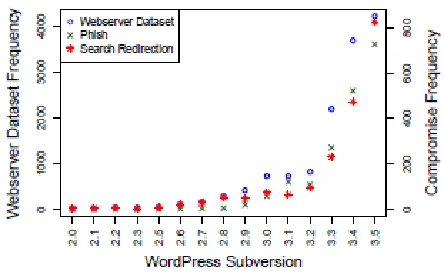
Fig. 3. Incidence of compromise by Word Press version, along with The popularity of Word Press version.
The chances proportions just talked about offer starting proof that being obsolete lessens the danger of disease for web servers running Word Press, at any rate when looking at significant variants. We now bore down and research contrasts crosswise over Word Press subversions. Figure 3 plots the relative recurrence of servers in our web server and trade off datasets running each Word Press subversion. Note the distinctive scales to the vertical tomahawks the left hub tracks the recurrence in the web server dataset while the right pivot is utilized for the two trades off datasets. We first watch that more obsolete subversions are in reality fewer mainstreams contrasted with the latest subversions. We additionally see that the trade off rate generally takes after the fame of the subversion, but with significant variety and lower bargain rates for more obsolete renditions.
7. Conclusion
security levels. By contemplating trade off information, we have investigated what components influence the probability of really being hacked, not only has what made a framework helpless.
References
[1] N. Leontiadis, T. Moore, and N. Christin, “Measuring and analyzing search-redirection attacks in the illicit online prescription drug trade,” in Proceedings of USENIX Security 2011, San Francisco, CA, Aug. 2011. [2] N. Nikiforakis, L. Invernizzi, A. Kapravelos, S. V. Acker, W. Joosen,C. Kruegel, F. Piessens, and G. Vigna, “You are what you include: Large scale evaluation of remote JavaScript inclusions,” in ACM Conference on Computer and Communications Security, 2012, pp. 736–747.
[3] J. Schlesselman, Case-control studies: design, conduct, analysis. Oxford University Press, USA, 1982, no. 2.
[4] R. Doll and A. Hill, “Lung cancer and other cuases of death in relation Nto smoking; a second report on the mortality of british doctors,” British Medical Journal, vol. 2, pp. 1071–1081, Nov. 1956. [5] Verisign, “The domain name industry brief,” Apr. 2013, https://www.\verisigninc.com/assets/domain-name-brief
april2013.pdf. Last accessed May 1, 2013. [6] “PhishTank,” https://www.phishtank.com/.
[7] “Anti-Phishing Working Group,” http://www.antiphishing.org/. [8] APWG, “Global phishing survey: Trends and domain nameuse in 2H2012,” 2013, http://docs.apwg.org/reports/APWG
GlobalPhishingSurvey 2H2012.pdf. Last accessed May 5, 2013. [9] N. Leontiadis, T. Moore, and N. Christin, “Pick your poison: pricing and inventories at unlicensed online pharmacies,” in ACM Conference on Electronic Commerce, 2013.
[10] W3techs, “Market share trends for content management systems,” http:// w3techs.com/technologies/history overview/content management/. Last accessed May 3, 2013
Puligoru Mrudula received the B.Tech Degree in Computer Science and Engineering from Siddhartha Institute of Engineering and Technology, University of JNTUA in 2014.She is currently working towards the Master’s Degree in Computer Science, in AITS University of JNTUA. She interest lies in the areas of Web Development Platforms, SQL, and Cloud Computing Technology.