ISSN 2286-4822 www.euacademic.org
Impact Factor: 3.4546 (UIF) DRJI Value: 5.9 (B+)
A Study on Financial Indicators’ Reliability in
Technical Analysis
SUBRAMANIAM A/L PONNUSAMY Faculty of Accounting and Finance Asia Pacific University of Technology and Innovation, Malaysia
VIKNESWARAN S/O MANUAL Academic Leader Asia Pacific University of Technology and Innovation, Malaysia
Abstract:
applying few indicators together to make their decision whether to buy or sell in the market.
Key words: financial indicators, technical analysis
1.0 INTRODUCTION OF STUDY
In this research paper, the researcher will be studying about the reliability of using technical indicators in the technical analysis using the foreign currency trading. Technical analysis is also known to be bottom to top analysis used in investments and trading as according to Lo, A. W (2000). For many decades, technical analysis has been used for the purpose of investing and trading. There is another investment analysis which is totally the opposite of bottom to top investment and it is known to be top to bottom or fundamental analysis. Fundamental analysis is a type of an analysis that are performed in a way that the interested party would get to know about the selected company, does some background checks in the company and monitors the performance of the company. This process is done by studying and analysing the financial statement and annual reports of the company in details and this analysis relates for a longer term of investment.
1.1 Technical Analysis
from the market and response of people where they react in similar way towards the same situations before and uses it to make decisions”. In simple words, a user of technical analysis tries to adapt to the change in the market and grabs that opportunity to invest. “Technical analysis is a more simplified version of what is happening to the price” as said by Suresh, A.S (2013). Kahn, M (2007) has also said that “bottom to top analysis assist investors to evaluate risk and rewards and thus allows them to place their resources”. Suresh, A.S (2013) mentioned that “prices from technical analysis are dependent on the demand and supply of the market and it is the study of the market only and what is expected from it”.
Bottom to top investment strategy also contains some principle of its own. This has also been supported by Murphy, J.J (1999) and the author have mentioned that “the essential principles followed by the investors using technical analysis are market action discounts everything, prices move in trends and finally history repeats itself”.
What does the first principle that says market action discounts everything? Murphy, J.J (1999) and Neely, C.J et al. (2011) has said that “the price movements reflected in the market is just a reflection of all the factors that could affect the movements of the price and the technical analyst don‟t bother with all that but all their concerns are on price movements and not the reasons for the movement”. The factors that cause the movement in the price in technical analysis are such as political factor, economical factor, supply and demand and many more which are fundamental. Neely, C.J and Weller, P.A (2011) has also emphasized that “a bottom to top analysis user ignores fundamentals at all cost unless they go through prism of prices”. Prism of prices is when the fundamental comes into play before the price reacts in the market.
is used to capture the pattern of trend to predict and allows the traders to make decision whether to buy or sell”. Investor believes that the movement of the prices will be significant and they will predict it in the early stage to make their trading. Neely, C.J et al. (2011), “this principle is such as a „mantra‟ as the saying goes the trend is your friend”.
The third essential principle is history repeats itself and according to Murphy, J.J (1999) and Neely, C.J et al. (2011) this is where “it is a study of the future with the believes that the past would be repeated in the exact similar way and also have concluded that human behavior or psychology doesn‟t differ much over time”. The traders use the charts from the analysis to analyze the movement of the market from the past where the patterns indicating a rise or fall in the past would move in the exact same way in the future as the human psychology is very stable.
1.2 Forex Market
Forex market is a market of foreign currency exchange market. A study has been done by Buenrostro, E., Mateo, A. and Ramirez, A. (2012) on FOREX Investment and Trading where the researcher has defined on how did the foreign exchange market was emerged. Foreign exchange markets have been around for thousands of years till date and have been evolving by time.
As said by Buenrostro, E., Mateo, A. and Ramirez, A. (2012), “Forex Market is to be known as the world‟s largest financial market because it is estimated of at least $1.5 - $4 trillion in currencies is traded on daily basis.‟ To have a comparison of a stock exchange market and forex exchange market, it would take three months for a stock exchange market to reach what forex exchange market does in a day. This is due to reasons such as the market is open for 24 hours which means there is time restriction for investors to trade but due to time zones, the currencies being traded would differ as some currencies might not be active. In forex trading, the currencies have base currencies and supporting currencies as for example is EURUSD where EUR would be the base currency and USD would be the supporting currency. In forex market, it involves two different types of markets which is Bullish and Bearish Market. Forex market is used in two different forms which are technical analysis or fundamental or both. Forex trading is practiced in Malaysia using many different platforms such as ForexTime, Trade360, Plus500, FxPro, HyMarkets, AxiaTrade, HotForex platforms and many other platforms. Researcher have chosen Axiatrade platform to perform the technical analysis.
2.0 PROBLEM STATEMENT
was some profitability by using bottom to top investment analysis strategy but it was limited by the reliability on the trading signals” according to Papadamou, S (2001) and thus weakened the researcher‟s conclusions. 1/3 of the researches that was done, the profitability was on spot by using the technical analysis strategy. This might have been caused many issues such as indicators, misconceptions, lack of knowledge, greed, fear, behavior and so on.
It was identified that the certainty level via technical indicators of a bottom to top investment analysis strategy is not reliable. Many methods have been used to identify the prediction power of technical analysis strategy. Putting the predictive power of this analysis aside, the persistence of the results from technical analysis is also questioned. Levish, R and Thomas, L (1991) have stated that “when technical analysis users use this trading technique for a very long period it would result in high profitability but it will eventually decline”.
From the past researcher, it was found that the technical analysis indicators may not be as powerful as it is being claimed. According to Larsen, J.I (2010), “moving average indicator is very volatile as the only factor taken into account is the difference to fluctuate by time period‟. The author also stated that using these indicators in a large application would be problematic. Murphy, J.J (1999) has stated that technical analysis indicators do not go by the rules. Following the rules would help the investors to eventually reduce the chance of poor decision making. Researcher also said that data such as price, volume and interest are the primary data considered rather than the indicators which is secondary to them”. Keene, A (2014) has said that “almost all technical indicators have problems as they are not future based due to the development of lag where it leads the investors to makes decision too early or too late”.
Indicator‟s most fundamental use is to read signals and make decision. Out of many indicators that have been listed in the background of study, the chosen indicators in this study are only the Moving Average Convergence Divergence (MACD) Indicator, Relative Strength Index (RSI) Indicator and lastly Stochastic Oscillator indicator. These indicators are chosen specifically because these indicators are claimed to be famous, reliable and mostly used indicators.
According to Larsen, J.I (2010), “Relative Strength Index indicator leaves out the price patterns and thus it is too volatile”. Meanwhile, Gold, S (2015) has said that RSI is the most reliable and profitable indicator that is available for investors to use. For MACD indicator on the other hand, Rosillo, R. et. al (2013) has said that out of 4 top indicators used to test the profitability, MACD has scored the lowest profitability. Contrary from the study of Eric, D. (2009), MACD is the best indicator and increases profitability. Muranaka, K (2000) have wrote an article stating that Stochastic Oscillator increases the accuracy of predicting the future movement of price. Thorp, W.A (2000) mentioned that due to the market volatility, it is difficult for an investor to take a decision via signals given out by the stochastic oscillator indicator which are said to be noisy.
3.0 RESEARCH OBJECTIVE
The main objective of this research paper is to study the reliability of using each one of these indicators in the bottom to top decision analysis in making profit during trading using the standard rules;
To examine the reliability of using the relative strength index indicator in technical analysis using the standard rules.
To examine the reliability of using the Stochastic oscillator indicator in technical analysis using the standard rules.
4.0 RESEARCH QUESTION
The main research question in this research paper is;
To study about the reliability of using financial indicators in bottom to top investment strategy analysis in currency market to make profit
Other research questions are as follows:
To what extend does Moving Average
Convergence/Divergence (MACD) indicator is useful n effective as a tool to be used in technical analysis by the investors to make profit
To what extend does the relative strength index (RSI) indicator is effective in the decisions made by the investor to make profit
To what extend does Stochastic Oscillator indicator is effective and useful in the technical analysis strategy to make profit in the market
5.0 LITERATURE REVIEW
5.1 Technical Analysis (DV)
introduced in the 1900‟s and it was developed by Charles Dow through the Dow Theory. From the Dow Theory, principles such as price trending, charting, support level and resistance levels were derived. Technical analysis is an analysis used to analyze and predict the future movement of assets or currency from the past which is supported by the technical analysis philosophies. There are three philosophies that are involved in technical analysis which are market action discounts everything, price moves in trends and history repeats itself.
Since technical analysis is made up of charts, it is a graphical representation of price movement over a certain time period that was chosen by the investor. Each one of the chart has a different type of phycology impact for investors when it is in use and it‟s very subjective depending on the convenient of the investor but the purpose of the charts is still the same which is to ease the predicament of the market movement by investors. The three main types of charts found are the line chart, bar chart and candlestick chart.
5.2 Hypothesis Formulation
From the above literature review, the following hypotheses can be generated.
H0 = The Moving Average Convergence/Divergence (MACD), a financial indicator which uses the standard preset rules in showing a reliable trading signals for generating profit is unreliable.
H1 = The Moving Average Convergence/Divergence (MACD), a financial indicator which uses the standard preset rules in showing a reliable trading signals for generating profit is reliable.
H1 = The Relative Strength Index (RSI), a financial indicator which uses the standard preset rules in showing a reliable trading signals for generating profit is reliable
H0 = The Stochastic Oscillator, a financial indicator which uses the standard preset rules in showing a reliable trading signals for generating profit is unreliable.
H1 = The Stochastic Oscillator, a financial indicator which uses the standard preset rules in showing a reliable trading signals for generating profit is reliable.
6.0 METHODOLOGY
In this research study, the researcher will be examining the reliability of the three chosen financial indicators that are commonly used by investors in Malaysia to make investment through bottom to top investment strategy analysis in different markets such as Forex, Options, Stocks and so on. The three chosen financial indicators are Moving Average Convergence/Divergence (MACD) indicator, Relative Strength Index (RSI) indicator and lastly the Stochastic Oscillator indicator. These three indicators would be the Independent Variable (IV) in this research paper, whereas the reliability of these indicators in bottom to top or also known as technical analysis would be the Dependent Variable (DV).
This chapter is comprised of how the research is designed in this study, what are the 3 different financial indicators used, how these indicator variables are measured, sampling design, data collection method and finally the data analysis procedure.
6.1 Research Design
analyzed using mathematically based method. This research methodology would be able to provide a better analytical research and results for the investors when they use financial indicators for bottom to top investment strategy analysis. Researcher also believes that qualitative research method would be able to provide more reliable research results. Researcher will be using primary data and also self-reviewing assessment for further clarification. Researcher will be trading using forex trading platform to obtain results.
7.0 DATA ANALYSIS
8.0 FINDINGS AND INTERPRETATION
8.1 Percentage of Profit and loss
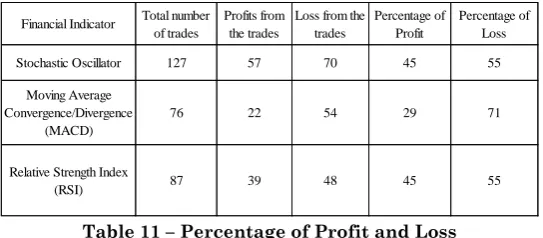
Table 11 – Percentage of Profit and Loss
From the Table 11 above, the percentage of profit for Moving Average Convergence/Divergence (MACD Indicator, Relative Strength Index and Stochastic Oscillator Indicator is 29%, 45% and 45% respectively while the percentage of loss is 71%, 55% and 55% respectively. The percentage of profit was calculated by taking the number of profit trades divided by the total number of trades placed during the two weeks of trading period while the percentage of loss was calculated by taking the number of loss trades divided by the total number of trades placed during the two weeks of trading period. For an indicator to be reliable to be used by investors should at least be valued at 50% to be considered that the indicator is reliable and the indicator could be used by investor to generate profit. Any percentage below 50% would be considered as unreliable as the risk taken by the investor by relying on the indicator is too high compared to the rewards expected by the investors.
From the result obtained in the above table, Stochastic Oscillator Indicator and Relative Strength Index Indicator have obtained the highest percentage of profit trades which is valued at 45% while Moving Average Convergence/Divergence Indicator scored lower with 29%. From this result, the researcher can conclude that all three financial indicators are
Financial Indicator Total number of trades
Profits from the trades
Loss from the trades
Percentage of Profit
Percentage of Loss
Stochastic Oscillator 127 57 70 45 55
Moving Average Convergence/Divergence
(MACD)
76 22 54 29 71
Relative Strength Index
not reliable but Stochastic Oscillator and Relative Strength Index Indicator has performed better than Moving Average Convergence/Divergence Indicator. To obtain a more accurate result between the chosen financial indicators, researcher have performed other test to confirm this result as it will be described and shown below.
8.2 Total Net Profit or Net Loss
Moving Average Convergence / Divergence (MACD)
Relative Strength Index (RSI)
Stochastic Oscillator
Total Net Loss or
Net Profit ($2,059) ($948) ($1,400) Table 12 – Net Profit or Net Loss
Table 12 above shows the total net loss that was made by each one of the indicator from the trades placed by trading signals released by them. Researcher had an opening balance of $100,000 USD before the 29th August 2016. Researcher had a balance of $95,593 USD after the 14th September 2016 which shows the trading account was on the net loss. The net loss was contributed by the three indicators. The net loss or net profit was calculated by taking all the end result whether profit or loss in dollars and totaled up for every one of the financial indicator.
8.3 Average Net Profit or Net Loss
Moving Convergence/Divergence (MACD) Average Relative Strength Index (RSI) Stochastic Oscillator
Time Series Graph
AverageProfit Average Loss Average Profit Average Loss Average Profit Average Loss $11 ($302) $57 ($171) $8 ($132) Average
Net Profit or Net Loss
($291) ($114) ($124)
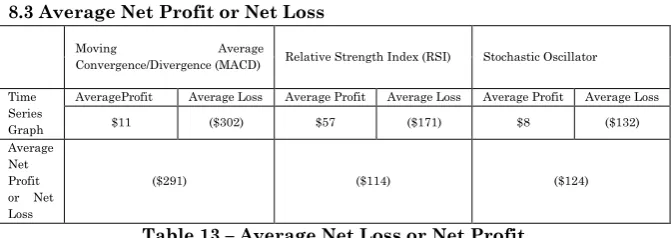
Table 13 – Average Net Loss or Net Profit
Table 13 above displays the average earning and losses for the three financial indicators daily and the average net loss for each indicator. The average net profit and net loss was derived by adding up the average profit and average loss. The average profit for the indicator should be high while the average loss for indicator should be as low as possible and the average net loss should be also in the lowest value to obtain the best financial indicator among these three indicators.
8.4 Descriptive Statistic
Moving Average Convergence/Divergence
(MACD)
Relative Strength Index (RSI)
Stochastic Oscillator
Descriptive Statistic
Max $107 $147 $76
Min ($179) ($192) ($153)
Mean ($27) ($11) ($11)
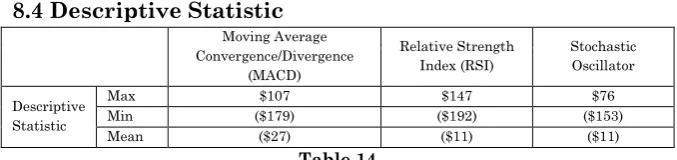
Table 14
From the Table 14 above, the researcher has divided the descriptive statistic test into three sub test which are the Max, Min and the Mean value. Under the Max row, the higher the value the better the performance of the indicator while for the Min value, the lower the value the better the performance is but since this is profit and loss, the higher the value is the better the performance. The mean value should have the highest value as possible to be indicated as a better financial indicator.
The indicator Moving Average Convergence/Divergence (MACD), Relative Strength Index (RSI), Stochastic Oscillator Indicators have recorded a value of $107 USD, $147 USD and $76 USD respectively in the Max row. The indicator Moving Average Convergence/Divergence (MACD), Relative Strength Index (RSI), Stochastic Oscillator Indicators have recorded a value of -$179 USD, -$192 USD and -$153 USD respectively in the Min row while in the Mean row, the Moving Average Convergence/Divergence (MACD) indicator have obtained -$27 USD but Relative Strength Index and Stochastic Oscillator Indicator have both recorded -$11 USD. It could be said that under Max row, RSI have outperformed the other two financial indicators but Stochastic Oscillator Indicator have performed better than RSI and MACD Indicator in the Min row. In the Mean row, RSI and Stochastic Oscillator have equally performed better than MACD Indicator.
reliable trading signals for investors to generate profit using the standard preset rules. Among these three financial indicators, Relative Strength Index (RSI) Indicator was found to be performing better than the other two financial indicators tested. Relative Strength Index (RSI) Indicator has performed well in keeping the lowest loss value throughout the whole two trading week, the maximum profit hit was also higher and finally the average earning of using this indicator was also higher than Moving Average Convergence/Divergence (MACD) and Stochastic Oscillator Indicator.
9.0 HYPOTHESIS AND OBJECTIVE TESTING
9.1 Moving Average Convergence/Divergence (MACD) Indicator
The hypothesis developed for this indicator is as follows;
H0 = The Moving Average Convergence/Divergence (MACD), a financial indicator which uses the standard pre-set rules in showing a reliable trading signals for generating profit is unreliable
H1 = The Moving Average Convergence/Divergence (MACD), a financial indicator which uses the standard pre-set rules in showing a reliable trading signals for generating profit is reliable
The objective developed for this indicator is as follows;
To what extend does Moving Average
Convergence/Divergence (MACD) indicator is useful n effective as a tool to be used in technical analysis by the investors to make profit
indicator to be reliable in releasing a reliable trading signals
must score at least 50%. Moving Average
Convergence/Divergence (MACD) financial indicator have achieved an overall profit percentage of 29% and thus it could be concluded that the research has accepted the null or H0 hypothesis of the Moving Average Convergence/Divergence (MACD), a financial indicator which uses the standard pre-set rules in showing a reliable trading signals for generating profit is unreliable. Researcher was also able to achieve the objective of this research of studying the indicator and got to know how effective is the indicator as tool to be used in technical analysis to generate profit.
9.2 Relative Strength Index (RSI) Indicator
The hypothesis developed for this indicator is as follows;
H0 = The Relative Strength Index (RSI), a financial indicator which uses the standard preset rules in showing a reliable trading signals for generating profit is unreliable
H1 = The Relative Strength Index (RSI), a financial indicator which uses the standard preset rules in showing a reliable trading signals for generating profit is reliable
The objective developed for this indicator is as follows;
To what extend does the relative strength index (RSI) indicator is effective in the decisions made by the investor to make profit
The instrument used to measure the hypothesis and to determine where the researcher achieved the objective of this research study is by using the overall percentage of profit made by the indicator throughout the two weeks of trading period. An indicator to be reliable in releasing a reliable trading signals must score at least 50%. Relative Strength Index (RSI) financial indicator have achieved an overall profit percentage of 45% and thus it could be concluded that the research has accepted the null or H0 hypothesis of the Relative Strength Index (RSI), a financial indicator which uses the standard pre-set rules in showing a reliable trading signals for generating profit is unreliable. Researcher was also able to achieve the objective of this research of studying the indicator and got to know how effective is the indicator as tool to be used in technical analysis to generate profit.
indicator is not constant for buy action and sell action. The study proved that the indicator was giving out more buy signals rather than sell signals and this study was conducted for 10 years long. Senft, E (2016) have released a secial report on RSI mentioning that RSI Indicator are not dependable due to the signals released. The signals released by the indicator is said to be too early which causes the traders to lose money in trades or investment rather than generating profit and the author also mentioned that traders shall not follow the standard pre-set rules where overbought area should be sold and oversold area should be bought.
9.3 Stochastic Oscillator Indicator
The hypothesis developed for this indicator is as follows;
H0 = The Stochastic Oscillator, a financial indicator which uses the standard preset rules in showing a reliable trading signals for generating profit is unreliable
H1 = The Stochastic Oscillator, a financial indicator which uses the standard preset rules in showing a reliable trading signals for generating profit is reliable
The objective developed for this indicator is as follows;
To what extend does Stochastic Oscillator indicator is effective and useful in the technical analysis strategy to make profit in the market
null or H0 hypothesis of the Stochastic Oscillator, a financial indicator which uses the standard pre-set rules in showing a reliable trading signals for generating profit is unreliable. Researcher was also able to achieve the objective of this research of studying the indicator and got to know how effective is the indicator as tool to be used in technical analysis to generate profit.
This finding was supported by (Grue and Øksendal, 1997) on a journal titled as A stochastic oscillator with time-dependent damping where the results of the research showed the Stochastic Oscillator Indictor does not provide a viable signal due to the noises created by the indicator itself. Moreover, Ni, Y. et al., (2015) conducted a research titled Momentum Indicators in the Chinese Market and used Stochastic Oscillator to run the study. The researcher has stated that Stochastic Oscillator Indicator provide very reliable signals and performs very well in the prediction of share market price movement of companies in China.
indicator to be used to receive a reliable trading signal, the indicator should be integrated with other indicators. This is because one indicator could only be one form of energy in the financial market thus the probability of generating profit making is low. The main objectives of this research were to study the reliability of the three indicators in the technical analysis in generating profit using the standard pre-set rules. This study is very important because amateur and scalping traders who have recently joined trading or even into investing would blindly belief that these indicators would be able to generate them profit because the theories that was used to develop these indicators have strongly suggested them this idea. It is very important for traders to take note that these indicators would only be following these beliefs when there are certain criteria that must be fulfilled as for example, having a perfect economic condition. It is also essential for the academician to mention this issue to their students so that the newer generation would have a smoother learning curve in trading and investing.
Recommendation for Further Research
research to be conducted for at least 1 year to obtain a more reliable set of data‟s. Further research should also be able to explore many other indicators to check on the reliability of those indicators by stand-alone and by integration. Researcher would also like to address that a further research could be done using other currency pair as this research was restricted to EUR/USD currency pair only. Lastly, further research should be done in a way that the research paper would be beneficial for the academician and would give a positive impact on the economic growth.
10.0 RECOMMENDATIONS AND CONCLUSION
In the effort of traders or investors to generate profit in the financial market such as forex, index, stock market, commodities and so on, the traders need to understand that trading and investing both have so many criteria to be fulfilled in order to generate consistent profit. First and most important rule that must fulfilled by traders is controlling their phycological mind games by acting discipline in their trading strategies and sticking to one reliable technique. Traders should also prepare money and risk management strategy before entering a trade and this is to make sure the trader keeps a detailed record of cash flow. The risk management allows the trader to set a stop loss order where it is the maximum amount the trader is willing to loss for that specific trade.
The financial market that was chosen for the testing was the forex market where it is the foreign currency exchange market using the Meta Trader 4 platform and the platform provider is the AxiaTrade.co. This study has chosen Moving Average Convergence/Divergence (MACD) Indicator, Relative Strength Index Indicator and Stochastic Oscillator Indicator as the independent variable. From the test that was performed to measure the independent variable, it was identified that none of the chosen indicator that were reliable due to score of below 50%. Even though all the chosen indicators were found to be unreliable, Relative Strength Index (RSI) Indicator could still be said as a better indicator compared to the other two after pursuing further test. Indicator was found not reliable due to few misconceptions, lagging, economic problem, news announcement and so on.
REFERENCE
1. Amadeo, K. (2016) 3 lagging indicators to watch right now. Available at: https://www.thebalance.com/lagging-economic-indicators-list-index-and-top-3-3305860 (Accessed: 24 October 2016).
2. Andrew, K. (2014). The World’s Best Technical Indicator:
The Ichimoku Cloud. Available:
http://www.alphashark.com/wp-content/uploads/2014/02/Ichimoku-Cloud-E-Book.pdf. Last accessed 5th June 2016.
3. Appel, G. (2003). Become you own technical analyst: How to identify significant market turning points using MACD Indicator or MACD.Summer. 1 (1), p27-p36.
5. Bowley, T. (2015). The Power Of The MACD. Available: https://stockcharts.com/articles/tradingplaces/2015/07/the-power-of-the-macd.html. Last accessed 5th June 2016. 6. Brown, S.J. et al. (1998). The Dow Theory: William Peter
Hamilton's Track Record Reconsidered. The Journal of
Financial Research. 53 (4), p1311-p1333.
7. Buenrostro, B. et al. (2012). FOREX Investment and
Trading. Available:
https://www.wpi.edu/Pubs/E-
project/Available/E-project-100412-095613/unrestricted/Group8.IQP.10.1.pdf. Last accessed 7th June 2016.
8. Chakrabarty, A., De, A. and Dubey, R. (2014) „A flexible approach towards multi-frequency re-engineering of the moving average Convergence divergence indicator‟, Global
Journal of Flexible Systems Management, 15(3), pp. 219–
234. doi: 10.1007/s40171-014-0068-7.
9. Chong, T.T.L et al.. (2008). Technical analysis and the London stock exchange: testing the MACD and RSI rules using the FT30. Applied Economies Letters. 1 (15), p1111– p1114.
10.Clements, M. (2010) RELATIVE STRENGTH INDEX
Measuring the speed of the market. Available at:
http://www.technicalanalyst.co.uk/wp-content/uploads/2014/02/TTAJAN2010_7063.pdf (Accessed: 14 October 2016).
11.Credit Suisse. (2010). Technical Analysis -
Explained. Available:
https://www.credit-suisse.com/pwp/pb/pb_research/technical_tutorial_de.pdf. Last accessed 7th June 2016.
13.Deng, S. S. (2014). Integrated model of multiple kernel learning and differential evolution for EUR/USD trading. TheScientificWorld. 14 (12), p1-p12.
14.Dolvin, S.D.. (2014). THE EFFICACY OF TRADING BASEÍJ ON MOVING AVERAGE INDICATORS: AN EXTENSION. Summer. 1 (1), p52-p57.
15.DowTheoryForecasts. (2015). THE DOW THEORY: More
than 100 years of practical guidance to stock investors.
Indiana: Horizon Publishing Company. p46-p81.
16.Elmerraji, J. (2015) Does technical trading really work?
Technical analysis 101. Available at:
https://www.thestreet.com/story/11089457/1/does-technical-trading-really-work.html (Accessed: 24 October 2016). 17.Eric, D. et al.. (2009). Application of MACD and RVI
indicators as functions of investment strategy optimization on the fi nancial market.ZbradEkonfakRij.. 27 (1), p171-p194.
18.Evens, S. (1999) „Momentum And Relative Strength Index‟, Stock And Commodities, 17(8), pp. 1–6.
19.FADLALLA, A. et al.. (2014). Predicting Next Trading Day Closing Price of Qatar Exchange Index Using Technical Indicators and Artificial Neural Networks. Intelligent
Systems in Accounting, Finance and Management. 21 (1),
p209–p223.
20.Folger, J.. (2015). Building a system with simple technical tools.Futures. 1 (1), p36-p40.
21.Geetha, E. and Swaaminathan, T.M. (2015) „An analysis on MACD – compatible technical indicator for stock price movements‟, Asian Journal of Research in Business
Economics and Management, 5(9), p. 38. doi:
10.5958/2249-7307.2015.00171.1.
23.González, A.R. et al.. (2011). CAST: Using neural networks to improve trading systems based on technical analysis by means of the RSI financial indicator. Expert Systems with
Applications. 38 (1), p11489–p11500.
24.Grue, J. and Øksendal, B. (1997) „A stochastic oscillator with time-dependent damping‟, Stochastic Processes and
their Applications, 68(1), pp. 113–131. doi:
10.1016/s0304-4149(97)83373-x.
25.Jawade, A.A. et al.. (2015). Performance of Oscillators: Index Futures. SCMS Journal of Indian Management. 1 (1), p51-p61.
26.John Wiley and Sons. (2016). Foundations of Technical Analysis: Computational Algorithms, Statistical Inference,
and Empirical Implementation. Available:
http://onlinelibrary.wiley.com/doi/10.1111/0022-1082.00265/abstract. Last accessed 7th June 2016.
27.Krivo, R. (2012) The Benefits of Using a Lagging Indicator.
Available at:
https://www.dailyfx.com/forex/education/trading_tips/post_o f_the_day/2012/02/17/The_Benefits_of_Using_a_Lagging_In dicator.html (Accessed: 24 October 2016).
28.Larsen, J.I. (2010). Predicting Stock Prices Using Technical
Analysis and Machine Learning. Available:
http://www.diva-portal.org/smash/get/diva2:354463/FULLTEXT01.pdf. Last accessed 7th June 2016.
29.Lo, A.W. et al. (2000). Foundations of Technical Analysis: Computational Algorithms, Statistical Inference, and Empirical Implementation. The Journal of Finance. 4 (4), p1707- p1716.
30.LuckScout. (2016). Pros and Cons of Using Stochastic
Indicator in Forex Trading. Available:
http://www.luckscout.com/stochastic-indicator-in-forex-trading/. Last accessed 5th June 2016.
https://www.dukascopy.com/fxcomm/fx-article-contest/?Has-Macd-Always-Been-A=&action=read&id=997 (Accessed: 24 October 2016).
32.Michael, K. (2007). A Beginner’s Guide to Charting
Financial Markets. London: Harriman House. p1-p69.
33.Monica, G. (2010). Drawbacks Of Relative Strength Index
(RSI).Available:
http://www.benzinga.com/forex/forex-101/114675/drawbacks-of-relative-strength-index. Last accessed 7th June 2016.
34.Murphy, J.J. (1999). Technical Analysis Financial Markets A Comprehensive Guide To Trading Methods And
Applications. New York: New York Institute of Finance. p6
– p387.
35.Neely, C.J. and Weller, P.A.(2011). Technical Analysis in the
Foreign Exchange Market. Available:
https://research.stlouisfed.org/wp/2011/2011-001.pdf. Last accessed 7th June 2016.
36.Neftci, S.N. (1991). Naive Trading Rules in Financial Markets and Wiener-Kolmogorov Prediction Theory: A Study of "Technical Analysis”. The Journal of Business. 64 (4), p549-p571.
37.Ni, Y. et al.. (2015). Momentum in the Chinese Stock Market: Evidence from Stochastic Oscillator Indicators. Emerging Markets Finance & Trade. 51 (1), p99-p110.
38.Papadamou, S. and Tsopoglou, S.(2001). Investigating the profitability of technical analysis systems on foreign exchange markets", Managerial Finance. University of
Macedonia. 27 (8), p63 - p78
39.Penn, D. (2009) The Three Secrets to Trading Momentum
Indicators. United States: Marketplace Books Inc.
congress control number: 2011916105‟, Corporate
Governance: The international journal of business in society,
13(2), pp. 218–219. doi: 10.1108/14720701311316698.
41.Pinoy Investor. (2016). Technical Analysis (Part 1):
Introduction.Available:
http://www.pinoyinvestor.com/smartinvestor/technical-analysis-part-1-introduction/. Last accessed 7th June 2016 42.Porfiri, M. et al.. (2008). Master-Slave Global Stochastic
Synchronization of Chaotic Oscillators. Applied Dynamical
Systems. 7 (3), p825–p842.
43.Pradipbhai, N.P. (2012) „Comparison between exponential moving average based MACD with simple moving average based MACD of technical analysis‟, International Journal of
Scientific Research, 2(12), pp. 189–197. doi:
10.15373/22778179/dec2013/60.
44.Quigley, C.M. (2015). The Key To Understanding Stock
Market Movement .Available:
http://www.financialsense.com/sites/default/files/users/u111/ pdfs/2015/dow-theory-the-key-to-stock-market.pdf. Last accessed 7th June 2016.
45.Rockefeller, B. (2011). Technical Analysis For Dummies. 2nd ed. Indiana: Wiley Publishing Inc.. p46-p81.
46.Rosillo, R. et al.. (2013). Technical analysis and the Spanish stock exchange: testing the RSI, MACD, momentum and stochastic rules using Spanish market companies. Applied
Economics. 45 (1), p1541–p1550.
47.Rudik, N.I. (2013) „The encyclopedia of the indicator RSI (relative strength index)20131By Kirill Perchanok and Iryna Hrytsyuk.The encyclopedia of the indicator RSI (relative strength index). 2011. Library of congress control number: 2011916105‟, Corporate Governance: The
international journal of business in society, 13(2), pp. 218–
219. doi: 10.1108/14720701311316698.
49.Siligardos, G.E (2008). Leader Of The MACD. Available: http://traders.com/Documentation/FEEDbk_docs/2008/07/Ab stracts_new/Siligardos/siligardos.html. Last accessed 2nd June 2016.
50.StockCharts. (2016). What is Technical Analysis?. Available: http://stockcharts.com/school/doku.php?id=chart_school:over view:technical_analysis. Last accessed 7th June 2016. 51.Suresh A.S. (2013). A Study on Fundamental and Technical
Analysis. International Journal of Marketing, Financial
Services & Management Research. 2 (5), p15 17..
52.Thorp, W.A. (2016). ID'ing When to Buy and Sell Using the
Stochastic Oscillator. Available:
http://www.aaii.com/journal/article/id-ing-when-to-buy-and-sell-using-the-stochastic-oscillator. Last accessed 7th June 2016.
53.Thorp, W.A. (2016). Measuring Internal Strength: Wilder's
RSI Indicator. Available:
http://finance.wharton.upenn.edu/~bodnarg/courses/nbae/re adings/Forex%20forecasting.pdf. Last accessed 7th June 2016.
54.Tradeciety. (2016). MACD – How To Use The MACD
Correctly.Available:
http://www.tradeciety.com/tips-how-to-use-the-macd/. Last accessed 6th June 2016.
55.YAZDI, S.H.M., LASHKARY, Z.H. and ISMAIL, I. (no date) Technical analysis of FOREX by RSI Indicator.
Available at:
file:///C:/Users/User/Downloads/Technical_analysis_of_FOR EX_by_RSI_Indic.pdf (Accessed: 22 October 2016).
56.Yell, T. (2015) Deciding Which Currency Pair to Trade When
Big News Hits. Available at: