IRREGULAR NO. 1+8 October A 972
(An irregular publication for the Townplanning Research Group,not for publication or republication)
This issue:
6 "Objectors" to the Melbourne regional T)lan on general grounds "Big Brother"MMBW plays its cards to its chest
According to MMBW "newsletter" of 1h/7/!72,there are about 3500
objections. A press item of 23/8/f72 reports Mr A.H.Croxford chairman of the MMBW as stating that "the mammoth task of hearing the 3900 objections to the scheme would begin in six weeks.It could take 3 years or more"
Now of COUTSE,there are objections and objections.
For the convenience of "Irregular" readers,we bring to their notice here six known to the editors which take an overall view of Melbourne as a whole from one angle or another•
It is our belief that all objections of this character,as a matter of public interest,should be given the widest publicity and the mass media should endeavour to institute a serious and sustained public
discussion on such matters wherever different value judgments of a major character are obviously involved.
However,indications are that the MMBW has not the slightest intent-ion of doing any such thing:which is just another proof (if proof were ^jleeded) that Croxford's claim that the Board's aim is to "stimulate
public dialogue" is mostly hot air. The "dialogue" is intended,apparently, to be carefully confitod/fco public-relations type seminars 4n o w completed^ One "objector" is to have no idea of the nature of the other "objections" and the public will be ignorant of then all except to the restricted
extent that the objectors themselves can spread their own cases.
MMBW still wants to cast Itself as Big Brother:all~wise because it ••I'S'the only one to be in the position of all-seeing. Unfortunately
genuine planning wisdom and Big Brother psychology do not mix. The Big Five and a little Sixth.
1o-! .R.A.C.V (Royal Automobile Club of Victoria) 2a V.C.O.S.S (Victorian Council of Social Service)
3. T.C.P.A0 (Town and Country Planning Association) k» R.A.P.I (Royal Australian Planning Institute)
5. R.A.I.A (Royal Australian Institute of Architects) 6. R & MeC (Ruth and Maurie Crow)
R.A.C.V
""Main issues:
1. fundamental strategy and forms of growth of MMBW adopted.
2 planning to bring about viable forms of community life in corridors 3„ co-ordinated planning at all levels of government without overlapping h„ planning procedures more efficient and simple in operation.
5. adequate planning and finance for both private and public transport. 6» adequate implementation of the proposals of the planning scheme
thraagh deliberate policies of budgeting and construction. Formal objections:
* lack of co-ordination at different levels of government.
* lack of provision of viable and distinct communities in corridor. * some growth corridors in doubtful sectors of the region.
* aids and abets continuous population growth within region.
* decision on corridor growth should have been made following satisfactory public and professional participation.
* "cart before horse" policy on public participation.
* freeway network of MTC capable of extension to accomodate corridor concept,but based on land-use plans now obsolete and network needs re-working.
2. * no consideration to sensitive combination of accesibility and
environment needed for roads in inner suburbs„
(Note above precis and excerpts onl#,hut all points covered) (RACV subcommittee included Dr J.Paterson,economist,Mr Brindie,traffic
engineer, Prof Hammond,Dept. Psychology Uni.og Melb.,Dr,Moya Radford, psychiatrist,MrB.Opie,townplanner,MrsM.Nicholls public relations,and G.Riley,I6Russell and S.Carpenter of RACV)
Source: "Royalauto" July i972 p.6 V.C.O.S.S
Guidelines upon which VCOSS based its submissions
$. Melbourn'i growth must be drastically curbed for the social well-being of present and future citizens; and that
2. In order to do this it is essential that alternative growth centres be promoted on a regional basis by a co-erdinated state planning programme which is empowered to direct public investment and provide development in centres;and that
3. The aim of the MMBW to obtain a balanced growth around the Central
Business District should be supported (within the context of drastically curbed metropolitan growth)because it will lead to a more balanced
metropolitan structure in socio-economic terms,thereby creating a greater equality of opportunity in the northern and western suburbs than currently occurs within the predominance of people of power,socio-economic status in these suburbs;an& that ..
ko Whatever pattern of population distribution is planned,the type of
social amenity provisions at the regional,municipal and community iy^ levels advocated in the VCOSS submission to the Design Team for the
ease study of a New Town at Sunbury should be a minimum requirement for
planning and development0 " fail
Part A Broad objections / 1»—preoccupation with the physical aspects of planning and completely'
r
to put forward policy proposals relating to social amenity planning 2.--no provision for any strategy by which social planning can be
effectively integrated with the physical plans outlined in MMBW*Report 3. —whilst recognising need to provide means for encoraging growth to the
north and west in order to obtain balanced aerreircrpred: development the proposals do not include any strategy for doing soe
lu —whilst carrying out a series of public education seminars no proposals are included for public participation as advocated in the Skeffington Report,and subsequent debate especially in relation to the vital issue of planning policies and their periodic review
(Part B specific objections simply formally objected to certain zaings as inadequate to "ensure social amenity provisions") (VCOSS special committee comprised Mrs J.O'Neill,Dr Faith Thompson,Mr,G.
Bemjamin,Mr D.Glasson)
Source: "Position paper on comments & objections to the regional ply-ing policies of the MMBW,June 1972
T.C.P.A
"-—Details of the Association's objection are being discussed by a special committee of the Council and will be concerned with extensive variations in the corridor system of development proposed in the scheme.
" The Council decided that an alternative which proposed that future metropolitan development should be channelled into a Gippsland corridor,extehding eastwards from the existing planning boundary near Berwick was favoured. The preference would entail the deletion of other proposed corridors and maximum support for the building of new cities as a means of limiting Melbourne population."
(Details .of the amplification of the objection are not known) Source: "Plan News Review", June 1972 p.1
R.A.P.I -. R.A.I.A
The introduction to the objection which has been jointly lodged by these two professional organisations stated:-"The Institutes support,in general,the most important objectives of defining those areas w,ithin which future development may be permitted and of conserving the natural or rural character of the balance of the region and the resources it contains0 Nevertheless,they are concerned that the
R.C & M.C
The Crows (Ruth and Maurie) have lodged an objection (formally in the name of "M.Crow"),copies of which they have asked us to reproduce,which we have done.
They have also,since June,when the objection was lodged, written and produced a book in support of their alternative to
the regional plan entitled "Plan for Melbourne,Part 3"—"one corridor of participants,—not seven corridors of power".
At their request we enclose a dodger advertising how the book can be obtained.
The formal official objection is as
follows:-M.M.B.W. Regional Planning Scheme Proposals. Objections lodged by M.S. Crow.
1. Nature of Objection. The proposed amendments to the
Planning Scheme should be modified by the provision for the major part of all future outward urban growth to be contained in a "Gippaland corridor" as amplified below.
2. Reasons for Objection. The reasons for the proposed
modifications are on conservation, sociological and other grounds as set out in the attached sheets.
AMPLIFICATION OF-OBJECTIONS TO AI-IEEDLIENTS NO. 3 AND NO. 21 I10DIFIED AMENDMENTS TO THE PROPOSES SCHEIE
1, The proposed Y/erribee Melton Sunbury Merri Plenty and Lilydale corridors to be deleted.
2. All future outward urban growth anyv^here to the
south-west, south-west, north-south-west, north, north-east or east of the city to be contained by limiting it to urban zones contained in the present MMBW planning scheme, and all urban zoning within the extended area now under the Board's planning control area to be reviewed with a view to permitting only such very limited future grov/th as is. provided by already-serviced subdivisions or which is required to "round off" and existing urban development, \ 3. Melbourne's future outward urban growth to be in a linear
corridor, called the "Gippsland corridor", the first
segment of which is the proposed Berwick corridor (and the balance of the Gippsland corridor to be in the same general south-easterly direction as far as Y/arragul or thereabouts)*
4^ A rapid transit railway service of the type that attains a speed of at least 150 mph. to be planned as centred in the Gippsland corridor, alongside the existing Melbourne-Dandenong-Gippsland railv/ay tracks which should be retained to enable the continuation of the present electrified rail service gradually beyond Dandenong to keep pace with outward growth, and. the contin-uation of a service to intermediate country stations in the
Gippsland corridor not served by rapid-transit stations. 5* All major centres for industrial, retail, commercial or
administrative employment and for education, recreation, health or culture, together with medium and high density housing zones to be grouped in "metro-towns" located on the Gippsland rail line, the biggest of such centres on the few rapid-rail stations with-smaller ones at selected' intervening stations; and all planning techniques possible, including strong home-to stations public
transport and mixed zoning in metro-town centres, be utilised to
6. All non-urban areas in the planning region, especially the conservation and landscape interest zones to be
retained as proposed by the MMBW amendments, but all corridors except the Berwick corridor 10 be re-zoned for appropriate non-urban uses.
* NOTE:
It is appreciated. tha~ thnt part of item 3 above as is contemned in brackets is now in an area that lies beyond the planning powers of the MMBW; but it is proposed that the Board should ask the Government to extend the planning- boudaries of the region by an area taking in shire council areas surrounding the proposed Gippsland corridor at least as far as Y/arragul. following remarks will, unavoidably, be referring to the whole proposed Gippsland corridor, although they will affect equally that part of it now called ~he Berwick corridor, and even, by way of redevelopment, in the present built-up metropolitan area
between the CBD and Dan&enong, following the same direction as the principles outlined in p:int 5 above.
-lYU'LIEICATION OE REASONS POP. OBJECTIONS 1. Survival Conservation Reasons
The transcending reason for a linear Gippsland corridor is to conserve energy. The radial corridor pattern of growth maxim-ises the use of the motor vehicle for commuting, for transport of goods, and for all other transport purposes. The further apart the radial corridors grow, ~;he greater would be the necessity to use the motor vehicle, the further would become the distances needed to be covered, and. the more energy, both in the form of renewal of the vehicles, and the use of fuel, would be wasted.
During the main period of preparation of the Board's report, the scientists and conservationists appeared mainly to be warning
about the effects of pollution and the need to conserve areas of bushiand. The. Board's report and proposed amendments in fact
correctly take into account such considerations, and constitute in this^respect a big advance on earlier planning e.g. in the proposed provision of sewerage, in the provision of "green wedges" between the corridors, and "landscape interest" and "conservation" zones within the green wedges, in the warnings against motor vehicle
emissions etc.
Only quite recently has there appeared an accumulation of scient-ific weight warning of conservation problems of a far graver
character.
One aspect has to do with exhaustion of material resources, and another and related aspect has to do with the rate at which energy is used, the consequent rate of heat radiation, and the world's thermal balance which can have a devastating effect on ecological systems as we now know them.
",/hilst there appears to be ample room for argument amongst the scientists as to the probable effects of continuing with present population and production growth patterns, enough eminent men have issued, warnings strong enough to indicate that the ecological
balance of the biosphere is in danger of acute damage. The
objector has no pretences to be an expert on such matters, and is not critical that the Board's proposals do not deal with them , because the Board's plan had to be worked out a few years too
3
-within the constraint of announced Government policy as long ago as 1968 on so-called "balanced" growth patterns for Melbourne.
However, confronted with a set of alarming and hitherto unsuspected facts about conditions of survival of future generations, it is submitted that the Board's planners should re-think the regional planning problems, and approach the planning problem much as an
engineer v/ould do in designing a bridge, that is, leave a greater margin of safety than may seem necessary, rather than take a
chance. In the context of the world's ecology, predictions about which are far more unreliable than bridge-building, this means to
do everything possible to conserve resources, and especially energy. The Gippsland corridor concept coupled with rapid-rail transit and
the other measures calculated to assist in changing life-styles back towards strong reliance on public transport and simpler but more satisfying social enjoyment of urban-type activities (as
distinct from long trips by ca.r as a form of relaxation), could minimise car commuting and car use generally, and in the process make a very marked saving in total energy expended.
^* Other Conservation Reascms
One advantage of the MMBW proposed radial corridor pattern is the "green wedge" conservation areas deliberatly protected between the corridors, both because it conserves such areas from uncontrolled peripheral growth and because it provides open country not too far away from anyone living in the corridors.
The Gippsland corridor concept retains both aspects of this advant-age. It is not uncontrolled peripheral growth into areas that
should be conserved, and people within the corridor v/ould have just as ready an access to the "green" country on either side of the
elongated corridor, as if they lived in one of the radial corridors.
There are possibly some difficult pollution considerations to be solved in connection with the Gippsland corridor, for example, the protection of Y/esternport from pollution. But, on balance, this would seem not more difficult to achieve than the extra pollution
to the Yarra both directly and indirectly through its tributaries which, it is explained by the MMBW report, would result inevitably from urbanisation of the northern and eastern corridors.
Problems such as the ultimately expensive flood mitigation works mentioned in the MMBW report as a result of further urbanisation
in the catchments areas of the Yarra and its tributaries would not seem to arise in the same degree from the Gippsland corridor
proposals.
3. Sociological Reasons
The western suburbs and to an extent the northern suburbs have a much greater complement of residents who are industrial workers and who regard themselves as "deprived", and in fact are relatively deprived in relation to education, health, child care and other services and amenities, as compared to areas in the south and east.
The M.M.B.W's 1954- report gave all the reasons why-people preferred to live to the south and east of Melbourne.6 higher rainfall, better soil, undulating country, nearer to the more popular seaside and mountain resorts, and cheaper for any undergrounded services such
as water or sewerage and for house foundations and road construction.
There is nothing to indicate that these same factors do not still operate. To pay a subsidy for forced development to the west will
4
-not basically change the socio-economic composition of the
nopulation living there, no matter how it is zoned or what the
corridor pattern is, nor overcome the deprivations of the existing communities which require social remedies outside the scope of the present planning powers of the Board.
The recent strong challenge of the south-east to attract industrial development and industrial workers, as well as all other types of
socio-economic groups, indicates that the Gippsland corridor could far more easily be planned, as Canberra is planned, to ensure that all income-groups are mined in each neighbourhood in such a way that all support and enjoy the same schools, shopping centres, hospitals, child care facilities and other services.
Also the Gippsland corridor plan would greatly strengthen the CBD despite the deliberate creation of Lietro-towns, because, being
based far more firmly on public transport than the radial corridor pattern would permit, it could attract far more people into the
central area than could be accommodated when a high proportion comes, as now, by car. It would also slow down the destructive effects of a too-rapid redevelopment in the CBD and inner areas caused by attempts (ultimately self-defeating) to accommodate the ever-increasing influx of cars. In turn the retention of a suff-icient stock of relatively low-rent space in the city and inner areas encourages the optimum conditions for small and medium sized. enterprises, both commercial and voluntary which combined supply such a large element of diversity, character and liveliness to the life of the city and inner areas.
Even the concept of a "balanced" Melbourne would be observed by the Gippsland corridor plan. Instead of equal growth in every direction based on transport travelling at certain speeds of the same order, the rapid-transit speed along the longex distances of the Gi/psland corridor, v/ould equalise in terms of time the slower speeds along the shorter distances of the present built-up areas of Melbourne.
Above all, however, the Gippsland corridor could be used as an experiment in restructuring the relatively unstructured car-based outer suburbs and re-establishing various concourses of citizens around the metrotowns involving gradually increasing interest and participation in their own common affairs at these focal points, and similar focal points.
Y/ithout a blossoming of public participation facilitated in every way, including the deliberate design of the regional plan, the
awakening in time by the public to the moral and practical measures necessary for survival, may come too late.
1, Other Advantages
(i) Economic considerations
It could be objected that the Gippsland corridor proposal has the disadvantage of the cost of an expensive rapid-transit system. It would seem likely, however, that the economic benefits would far outweigh this cost, quite apart from the conserv-ation and sociological benefits.
i'lie extension of Melbourne in a Gippsland corridor would mean that the reticulation of the major basic resources of water, electric
newer and natural gas would be much cheaper.
5
-A minor, but not unimportant economic advantage could be that the unexpected direction and rapidity of urban growth in one direction would mean that the Government could be asked to acquire develop-ment rights in the Gippsland corridor at relatively low prices due
to the unexpected direction of urban growth. Authorities
estab-lished for the purpose could acquire, plan and resell thus avoiding the onerous burden of speculation-profit inevitably accompanying the long-anticipated radial-type corridor development in a radial pattern and within the Board's new regional planning area.
(ii) Bee entrallsat ion
A linear corrid.or. growth such as an elongated Gippsland corridor should be regarded as a modern form of decentralisation. The metro-town structure proposed for the Gippsland corridor could have all the advantages claimed for the more traditional type
concept of a separate decentralised town, namely a community of a certain size regarded as "manageable", with a certain degree of economic independence and. no~ so big that the resident feels that there is nowhere he "belongs" and yet big enough to offer a
reasonable range of employment opportunities, educational cultural and recreational specialties and other characteristics o'l modern city life.
A metre-town structure designed to heighten community concourse and therefore community identity could, along with other measures,
help to overcome much of the homogeneity, randomness of location of many community facilities, and absence of lively centres jf citizen activity associated v/ith car-based outer suburbs, no; only of Melbourne but also in the ...bigger country towns.
Eor purposes of strengthening self-identity of each metro-town and its associated community, each could be separated from its
neigh-bours by a mile or two of non-urban "green" territory, and each planned with a range of mixed employment and community facilities, thus giving as much independence as can be expected of a complex modern, society.
Farther, to the extent that there is a valid argument against conurbations because of the concentration of pollutants such as smog, the elongated Gippsland. corridor type of city growth pattern would minimise such factors and correspond to the effect of
d e c en t r a l i s at i o n .
Indeed there would seem to be no advantages claimed for the
s e p a r a t e decentralised, t o w n tfcn.t c a n n o t e q u a l l y b e c l a i m e d f o r a n e l o n g a t e d s t r u c t u r e d , m e t r o - t o w n c o r r i d o r - t y p e o f d e c e n t r a l i s a t i o n . Y e t t h e G i p p s l a n d c o r r i d o r w o u l d h a v e t r e m e n d o u s a d v a n t a g e s o v e r
the m o r e t r a d i t i o n a l t y p e o f d e c e n t r a l i s a t i o n , r e t a i n i n g r e a d y a c c e s s i b i l i t y f o r e v e r y o n e to t h e C B D by r a p i d r a i l h e l p i n g t h u s to o v e r c o m e m u c h of t h e r e s i s t a n c e of p e o p l e to s h i f t t o o f a r f r o m t h e m e t r o p o l i s .
(It should be added that the objector supports other,
traditional-t y p e d e c e n traditional-t r a l i s a traditional-t i o n e f f o r traditional-t s o f a c c e l e r a traditional-t e d d e v e l o p m e n traditional-t , i f only to g i v e t h e p e o p l e o f M e l b o u r n e a w i d e r c h o i c e o f h a b i t a t a n d c i t y -styles),,
.(.iii) Long-term advanij,ges
L o n g - t e r m p l a n n i n g b e y o n d t h e r e g i o n a l t e r r i t o r y o f bhe
hxlKJ ( e v e n a s e x t e n d e d t o W a r r a g u l a s p r o p o s e d i n t h i s o b j e c t i o n ) ,
a n d b e y o n d t h e s p a n of y e a r s e n c o m p a s s e d by the M M B W -oroposals h'-Q of ooun:je; t r e m e n d o u s u n c e r t a i n t i e s to c o n t e n d with., N o t the l e a s t
of t h e s e u n c e r t a i n t i e s is p o p u l a t i o n c o n t r o l p o s s i b i l i t i e s ,
m e n t i o n e d i n the M M B W r e p o r t , to w h i c h c c u l d b e a d d e d control! o f
-6-energy expenditure and resource utilisation in industry.
Yet it would be as v/ell to bear in mind general considerations
of a long-term nature, because it would be wrong to plan for
short-term advantages only to' find that they lead to long-term disadvantages.
As petrol and natural gas resources become exhausted, it will be necessary to turn again to coal as a major source of energy. The Latrobe Valley would then be re-established as a most significant
area economically.
Looking forward this far, the Gippsland corridor concept could then v/ell be linked with a "second Melbourne", either near Warragul
at the gateway to Gippsland, or perhaps.at a suitable location in the heartland of the Latrobe Valley towns.
The rapid transit link would then serve and be served by such New Town building.
The Gippsland corridor proposals would, on the face of it, therefore appear to have attractive long-term possibilities as well as
obvious short-term advantages.
6
Twcodlc-Dcc and Twcodle-Dum.
Radical (technologically) as the A„P.T. scheme may effect is in no way better than a freeway system.
be, its social There is
complete conservatism on the matter of social goals.
"As wealth increases" it is written,"car ownership will rise and the form and operation of our cities - largely decided by those who have cars at their disposal - will become increasingly
auto-oricntatcd, with low population densities and widely spread employment opportunities. They will become cities whose layout prohibits the economical operation of transport systems developed
to handle the high trip densities of compact pre-automobile urban areas" . (p10) .
Wealth is assumed to be personally-owned wealth and increased personally-owned wealth is identified with more cars per family, thus genuflecting to "auto-orientation". The scheme seeks to show that it is more realistically uauto-oricntatod" than the traditional freeway plans. "Resistance to the provision of now road space is increasing and this is true despite the fact that new freeways are much safer than existing streets and capable of separating through-traffic from the community. There is a good chanco that adequate freeway systems arc no longer an acceptable solution; but thCp^0US hope th*t buses and trains can
substitute for them has no foundation in a factual appraisal of community movement patterns and public transport economics". In effect, the Report is
ment a scheme which has but politically safer.
automobile corporations which for them would bo
offering the auto-oricntatcd establish-the same function as a freeway scheme The back-room statesmen of the oil and may be divided on the matter of tactics something like
this:-3 cold, double the an average car life Disadvasats
(a) Freeway System.
Advantages - Double the number of car;: petrol consumption, with
of three years.
os - Run right out of petrol in 20 years.
May engender revolt against freeway solutions leading to congestion and reduction in car use. Conclusion - The way to make the quickest buck - but
politically uncertain. (b) A.P.T. System (Lodcr Report Style)
Advantages - Publically more acceptable because it would appear to give an equal deal to those using public transport and private transport, not much acquisition of land needed and loss
traffic\congcstion.
ccs - Possil-fuol in form of brown coal used for "electric energy to convey cars for one half of
metropolitan mileage, giving cars a six year life with only half the petrol consumption per year.
Conclusion - The surest way for survival of the industry, a safer but slower buck.
It is twecdlcdcc and tweedledum choice therefore for the car and oil industry whether a freeway system or an A.P.T. system
(Lodcr Report Style) is chosen for cities of several million: both arc car-based, both maximise car-usage, both arc systems of adapting cities to cars instead of adapting cars to cities, both arc heavily pro-consumcrism. The more prudent pro-consumerism statesmen would support A.P.T. (Lodcr Style) because it gives the appearance of reform.
7
".. .pcrs mal relationships, job satisfaction, a physically
attractive environment and the lack of a feeling of deprivation relative to others arc of equal importance to the size of our house, the horsepower of our car, or the number of excess
-c*lories a day wc cat" (p1). " ... our Transportation systems do not reflect any concern for the sensible management of
resources when 3000 lbs of metal and rubber capable of over 100 mph is generally used to transport ono or two 150 lb people at an average speed of 20 mph.... wc must rapidly develop a
primary not a. secondary concern for the social network in our communities..." (p2).
But surely these laudable generalised ideals (improved
"personal relations", "job satisfaction", • "social networks" and'resource nanag n-bht" "and reduced "deprivation") °re not .'
automatically attained solely by.a •'system of person^lidoor-to-door all-Melbourne mobility?
Painting a picture of the horrible "insidious form of urban
blight" said to result from a failure to accept cither a freeway system or an A.P.T. system, the Report warns that congestion on the roads would mean that "trip distances in acceptable times arc reduced, with a consequent reduction in the choice of jobs, friends, recreation areas, sporting and cultural activities. Severe limits arc placed on the enjoyment of the major advantage possessed by large cities - variety ..." (p9) . What is true about this is that choice of activities is precisely what a city
offers. What is untrue is that the multidirectional personal mobility the car offers when used for all transport purposes is anti-city in the impact, tending to unstabilisc potential groups of people and require dispersal rather than compactness of
people-intensive centres needed to nurture such groupings. A Better Way to Use A.P.T. Technology.
The Gippsland corridor, serviced by 150 mph rapid transport (to cripple car dominance on long trips) and structured into strong
compact human-scale people-intensive car-free centres around the interchanges with all local public transport coming into these centres (to cripple car dominance for local trips), could absorb the whole of Melbourne's future population. At one stroke, therefore, this could (say) halve the number of cars needing to use the roads of Melbourne's present built-up areas for work purposes assuming the population wore to double.
The restructuring of the present suburbs with selected rail stations gradually converted to similar centres and with "transport watersheds" with mini-bus shuttle services all
converging on the selected interchanges could further eventually reduce the total number of cars at present used to get people to work and back or to shops and back in the built-up
metropolitan area. ("Plan for Melbourne Part 3 by R & M. Crow). Now Chcrmayc.!.f & Tzonio in their book '''Shape of Community"
advanced this proposal for low density areas - ...''new short-haul frequent-stop, relatively slow mini-trains may be
usefully raised to the flowcring-trcc level, allowing the
pedestrians to pass below while remaining within easy reach". These mini-trains would convey citizens to local centre which, for Chcrmaycif & Tzonis would always bo a combined commercial-social centre and an interchange. The mini-trains from
suburban residential areas could thus terminate at the inter-change to '"longer haul intra-urban transit" for those going beyond the local centre (pl66).
the A.P.T system Now following the ideas of Chcrmaycff & Tzonif/ might well bo considered in place of the shuttle mini-bus feeder service wc proposed to the interchanges in the Gippsland corridor. Wltll an A.P.T. system built-in during -stage, overlooking from the elevated gi-idcway could be ^voided the cstate design planning
8
Garbage carfe^, delivery vehicles and furniture vans would no longer be necessary in residential suburban streets since rubbish, furniture and household equipment could be carried quite well on the A.P.T, pallets. This would enable suburban streets to resemble the one-way front drive to a majestic
mansion twisting through thick avenues of trees.
In other words, an adaptation of A.P.T. technology would be to uso it so that it would not carry cars, but would largely
substitute for cars.
It is tempting to suggest the same idea to be utilised in the restructuring of present built-up areas which v/e propose.
However, the disadvantages here seem too formidable. The problems of overlooking overhead telephone and electric wires, acquisition of land for frequent stations, conversion of wide road pavements (which would then be underused) to better
purposes arc of such dimensions that it would be probably cheaper and more convenient to subsidize mini-buses or taxis instead to the rail stations selected as the local centre. Lastly, whilst wo do not agree with the proposed use of the A.P.T. technology for Melbourne, we appreciate Mr, Lodcrfs effort in travelling overseas at the behest of the Berwick Shire Council to gather the wealth of information he has on the latest overseas developments for elevated electric guide-way systems of transport. All we say
is:-"Don't be Trapt by A.P.T.
As a paokage deal Car-wrapt 11"
but let us see it like legs and lifts, and bicycles and cars, and trams, trains and rapid transit as a welcome addition to th° hierarchy of mobility for city use subjected to the human goals of satisfying,inner-human^relationships socially.
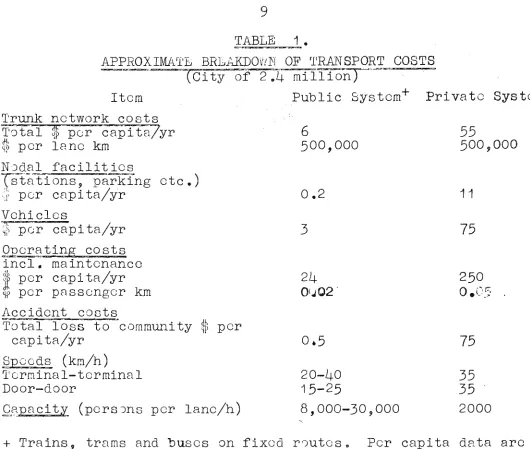
3 • LONG AWAITED COMPARATIVE COST FIGulRES_BLTj/n.;EN PUBLIC AND PRIVATE TRANSPORT FOR'MELBOURNE.
There has recently appeared a paper by Mr. J.P. Brotchie, of the Division of Building Research, CSIRO, Melbourne, entitled "Some System Concepts for Urban Planning".
This is an important paper attempting to accommodate
ecological requirements into urban systems planning, v/e re-produce here only Tabic 1. (p10), Tabic 2. (p1l) which give precious comparative figures of costs for Melbourne (including
energy costs, be it noted). Note however the warning that they arc "approximate" and sometimes based on "very rough
estimates". Those cost figures wore prepared by Mr.R.Schmidt. The paper draws some "initial observations'" from the figures and those interested may be able to obtain a copy of the Report.
Here arc two Tables from the Report -TABLE 1 .
Data for this Table arc based on information received from a variety of sources, or on very rough estimates whore
infor-mation was not available. They are introduced primarily to illustrate a technique at this stage. The data sources include the Melbourne Transportation Committee, the Commonwealth
Bureau of Roads, the Commonwealth Bureau of Census and
9
TABLE 1 .
APPROXIMATE BREAKDOWN OF TRANSPORT COSTS .City of 2.1+ milTTonT""
Item
Trunk network costs Total $ per capita/yr $> per lane km
Nodal facilities
stations, parking etc.)
) per capita/yr
Vehicles
ft per capita/yr
Operating costs incl. maintenance | per capita/yr * per passenger km
Accident costs
Total loss to community $ per capita/yr
Speeds (km/h)
Terminal-terminal Door-door
Capacity (persons per lanc/h)
Public System* Private System'
6
500,000
0.2
3
2h 0'j02
0*5
20-1+0 15-25
8,000-30,000
55
500,000
11
75
250 0.05
75
35 35
2000
+ Trains, trams and buses on fixed routes. Per capita data are based on average loadings e.g. 150 persons per train,
* Private cars, on projected freeways and arterial roads where possible. Per capita data are based on 1.1+ to 1 .5 persons • per car.
System
Trains Trams Bus c s Oars
Network
12 2 0
130
APPROXIMATE ANALYSIS 0F_^TRANSP0RTATI0N COSTS FOR A CITY OF 2.1+ MILLION PEOPLE
million/vr^
Nodcs+ Vehicles''' Operating"1"1" Accidents *+
26
2 3 2 180
30 20
a
600
180 Source of data as in Table 1 .
Networks arc the fixed tracks, rail or road
+ Nodes are stations and parking facilities, public, private
:::;:
Vehicles arc trains, trams, buses, cars
++ Operating costs include vehicle maintenance, fuel or energy and staff in the case of public systems