Structural versus Processing Accounts o f Implicit Learning
A dissertation submitted for the degree of Doctor of Philosophy
at the University of London
by
Theresa Johnstone
University College London
ProQuest Number: 10610042
All rights reserved
INFORMATION TO ALL USERS
The qu ality of this repro d u ctio n is d e p e n d e n t upon the q u ality of the copy subm itted.
In the unlikely e v e n t that the a u th o r did not send a c o m p le te m anuscript and there are missing pages, these will be note d . Also, if m aterial had to be rem oved,
a n o te will in d ica te the deletion.
uest
ProQuest 10610042
Published by ProQuest LLC(2017). C op yrig ht of the Dissertation is held by the Author.
All rights reserved.
This work is protected against unauthorized copying under Title 17, United States C o d e M icroform Edition © ProQuest LLC.
ProQuest LLC.
789 East Eisenhower Parkway P.O. Box 1346
Abstract
Artificial grammar learning (AGL) experiments are used to investigate the possibility that separate general and specific learning systems exist that store implicit, abstract rule knowledge versus specific, episodic knowledge. Chapter 1 concludes that the most urgent priority is to settle continuing debates about whether memorisation o f grammatical examples leads to rule, exemplar, or fragment knowledge. In Chapter 2, it is recommended that a biconditional grammar be used to settle the knowledge debate, as rule, exemplar, and fragment knowledge are inevitably correlated in finite- state grammar generated stimuli.
Chapters 3 and 4 present evidence that memorising grammatical training examples leads to fragment, but not rule or exemplar knowledge. In contrast, active hypothesis testing is required to gain rule knowledge. Chapters 5 and 6 demonstrate that knowledge gained by memorising training examples is explicit according to objective recognition, cued-recall, and subjective confidence tests.
Using a biconditional grammar, there is no support for a dichotomy between general and specific learning systems. The results are best explained by one episodic- processing system that records processing of specific structural aspects of
grammatical items in order to meet the demands o f the training task. During
classification, knowledge may appear to be implicit when participants are unaware of the source of fluent processing (i.e., when they unconsciously use fragment
3
Table o f Contents Page
Numbers
Preface 6
Acknowledgements 1
Chapter 1: Introduction 8
Forms of Knowledge 14
Chapter 2: Problems with Finite-state Grammars 22
Chapter 3: Rules versus Exemplar and Fragment Knowledge 3 8 Experiment 1: Rule versus Exemplar Knowledge 40 Experiment 2: Rule versus Fragment Knowledge 53
Chapter 4: Exemplar versus Fragment Knowledge 60
Experiment 3: Six Similar Training Examples 61 Experiment 4: Twenty-four Similar Training Examples 66 Chapter 5: Cued-recall and Recognition Measures o f Awareness 74 Experiment 5: Cued Recall o f Rule Knowledge 76
Experiment 6: Recognition of Fragments 86
Chapter 6: Subjective Confidence Measures o f Awareness 94
Experiment 7: Subjective Confidence 97
Chapter 7: General Discussion 105
Appendices 127
List o f Tables and Figures
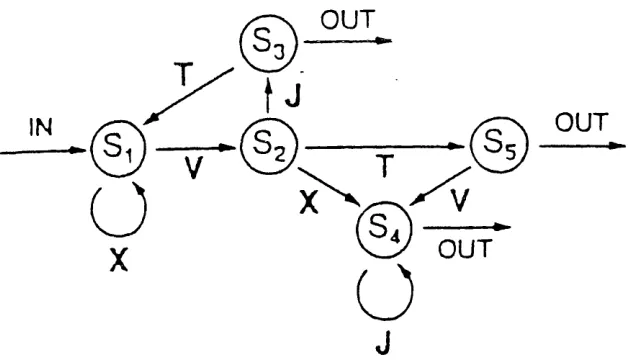
Figure 1: The artificial grammar used by Knowlton, Ramus, and Squire (1992), and originally created by Abrams and Reber (1989).
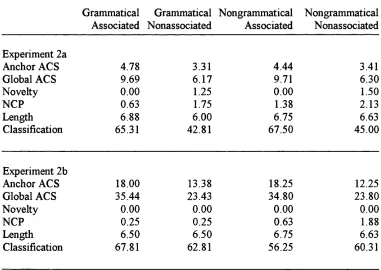
Table 1: Mean string characteristics and percentage o f test strings classified as grammatical by the experimental groups in Meulemans and Van der Linden’s (1997) Experiments 2a and 2b.
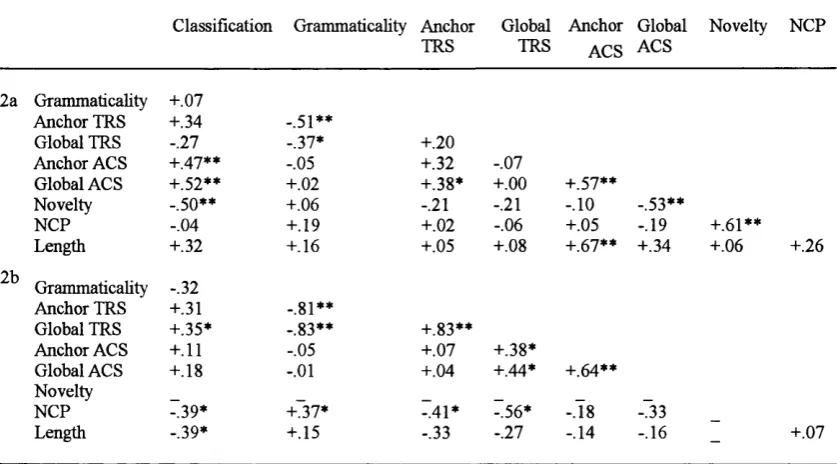
Table 2: Intercorrelations between the predictor variables in Meulemans and Van der Linden’s (1997) Experiments 2a and 2b.
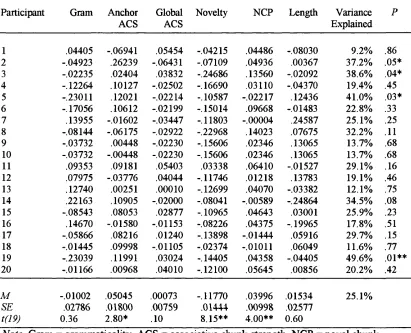
Table 3: Regression coefficients from individual analyses of participants’ data In Meulemans and Van der Linden’s Experiment 2a.
Table 4: Regression coefficients from individual analyses of participants’ data in Meulemans and Van der Linden’s Experiment 2b.
Figure 2: The artificial grammar used by Meulemans and Van der Linden (1997), and originally created by Brooks and Vokey (1991).
Table 5: Mean percentage correct training responses for Experiments 1 and 2 Table 6. Mean percentage classification responses for Experiments 1 and 2 Figure 3 Mean cP scores for grammaticality-based (cPg) and similarity-based
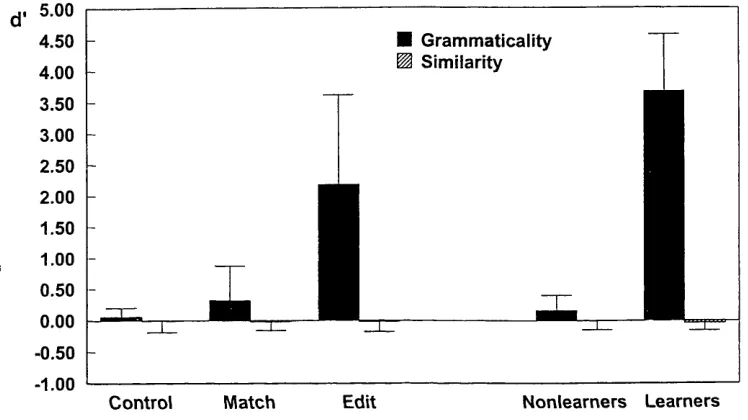
(<f s) classification in the control, match, edit, nonlearner, and learner groups of Experiment 1.
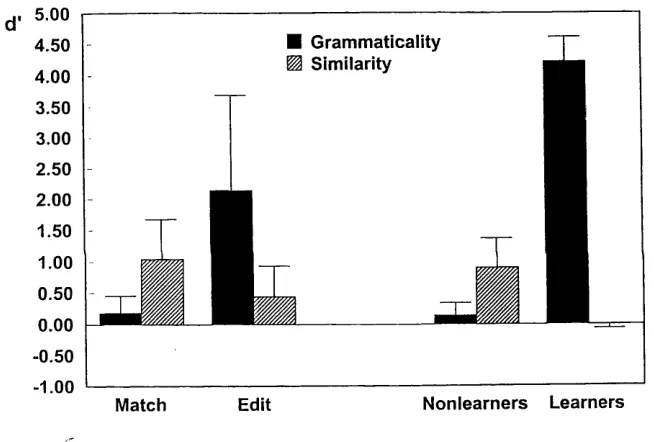
Figure 4: Mean cP scores for grammaticality-based (cPg) and similarity-based (cPs) classification in the match, edit, nonlearner, and learner groups of
Experiment 2.
Table 7: Mean percentage correct training responses for Experiments 3 and 4 Table 8: Mean percentage classification responses for Experiments 3 and 4 Table 9: Mean percentage correct training responses for Experiments 5 and 6 Table 10: Mean percentage classification responses for Experiments 5 and 6 Figure 5 Mean d’ scores for Experiment 5
Table 11: Classification scores by subjective confidence categories for Experiment 7
Appendices
A: Experiment 1 string statistics and letter strings B: Experiments 2 and 6 string statistics and letter strings C: Experiment 3 string statistics and letter strings
D: Experiment 4 string statistics and letter strings
E: Experiments 5 and 7 string statistics and letter strings F: Instructions used in Experiments 1 to 7
Preface
The work described in this dissertation was carried out in the Psychology Department at University College London, between 1996 and 1999, under the supervision of Professor David Shanks.
A cknowledgements
1
Chapter 1: Introduction
People have an impressive capacity for storing information about particular events. This "episodic" memory (Tulving, 1983) allows us to recall the context of specific experiences, such as what we did on our last holiday. We also have an ability to acquire general knowledge, that is, properties o f classes of objects or events. We can judge the grammaticality o f a novel sentence, read a word in an unfamiliar script, perform arithmetic operations, and so on. These abilities seem to require
representations o f abstract, general properties such as the rules o f a grammar that are separate from knowledge of specific objects or events.
Cognitive psychology has traditionally dealt with this distinction by assuming separate processes for acquiring specific and general knowledge. Under various terms (e.g., episodic, explicit, declarative), knowledge o f specific events is assumed to be distinct from knowledge about general properties (e.g., semantic, implicit,
procedural). A puzzle, however, is to explain how we acquire general knowledge as abstract properties themselves are never directly observed (see Whittlesea, 1997a, b). Instead, such properties must be induced from multiple experiences with specific objects or events. Hence, the separate-systems account assumes that there exists a mechanism for creating abstractions across specific experiences. Moreover, as we are not normally deliberately intending to perform such abstraction, it must be largely an incidental and unconscious process.
9 generated from the finite-state grammar shown in Figure 1. This grammar specifies rules for ordering string elements such as those that exist in natural languages. Grammatical strings are generated by entering the diagram at the leftmost node and moving along legal pathways, as indicated by the arrows, collecting letters, until an exit point is reached on the right-hand side. The letter string XXVXJJ is grammatical as it can be generated from the diagram whereas TXXXVT is ungrammatical, as strings must begin with a V or an X.
Figure 1. This artificial grammar was used by Knowlton, Ramus, and Squire (1992),
and was originally created by Abrams and Reber (1989).
Knowlton, Ramus, and Squire (1992) tested specific knowledge by asking participants to recognise which letter strings they had seen during training using a set of test strings half of which had been presented as training strings and half of which were novel. In contrast, general knowledge was tested by informing participants of the existence of a set of rules governing the structure of the training items - though they were not told what those rules are - and then asking participants to classify novel
IN O UT
letter strings as grammatical or ungrammatical depending on whether the letter
strings appeared to conform to the rules or not. The fact that the amnesic patients were selectively impaired in making judgments about specific items, while their general knowledge of the grammar was intact, seems to support the idea o f separate “implicit”, general and “explicit”, specific learning systems.
This dual systems theory o f implicit learning is based on four major claims. First, it is claimed that implicit knowledge is acquired when participants observe or memorise representative examples of a complex rule-governed concept, without being told that the examples conform to a set of rules (Knowlton & Squire, 1994, 1996; Meulemans & Van der Linden, 1997, Experiment 2b; Reber, 1967, 1989; Reber & Allen, 1978; Reber & Lewis, 1977). Secondly, in these incidental learning conditions, participants are passive "consumers" (Lewicki & Hill, 1989, p.240) of stimulus-driven knowledge (Cleeremans, 1993, p. 19). Thirdly, it is claimed that an implicit learning system creates mental representations of abstracted knowledge, in parallel with an explicit system that creates representations of specific whole or partial training items in a separate episodic memory. While the empirical work reported in later chapters focuses on the claim that we can acquire implicit rule knowledge (Knowlton & Squire, 1994, 1996; Meulemans & Van der Linden, 1997, Experiment 2b; Reber, 1967, 1989, Reber & Allen, 1978; Reber & Lewis, 1977), there are also claims that implicit knowledge is based on abstract patterns of family resemblance (Mathews, Buss, Stanley, Blanchard-Fields, Cho, & Druhan, 1989), first-order dependencies between adjacent letters (Gomez, 1997), or associative chunk strength (Servan-
Schreiber & Anderson, 1990).
11 the grammar (Reber & Lewis, 1977) and accurate performance is accompanied by a subjective experience of guessing (Dienes, Altmann, Kwan, & Goode, 1995). In contrast, because participants are aware of observing or memorizing whole or partial training examples, conscious recollection o f "old" items and a sense o f novelty for "new" items accompany recognition performance.
In contrast to the dual-system theory, exemplar and fragment accounts assume that above-chance classification performance can be explained solely on the basis of episodic knowledge. The exemplar account claims that participants encode a
collection of training examples (Brooks, 1978; Brooks & Vokey, 1991; Neal & Hesketh, 1997; Me Andrews & Moscovitch, 1985; Vokey & Brooks, 1992) and at test items that are highly similar to training items (e.g., differing by only one letter), are more likely to be called grammatical than dissimilar items. The letter-fragment account (Dulany, Carlson, & Dewey, 1984; Meulemans & Van der Linden, 1997, Experiment 2a, Perruchet, 1994; Perruchet & Pacteau, 1990; Redington & Chater,
1996; Servan-Schreiber & Anderson, 1990) suggests that participants use specific knowledge o f letter fragments seen in training strings to classify test items. In this case, participants are assumed to classify test items containing fragments seen in training as grammatical and test strings containing novel fragments as ungrammatical.
Whereas the implicit rule abstraction, exemplar, and fragment accounts share an assumption that specific aspects of the structure o f training examples (rules, exemplars, or letter-fragments) are acquired in a stimulus-driven manner, the
episodic-processing account (Whittlesea, 1997a, b; Whittlesea & Dorken, 1993, 1997; Whittlesea & Wright, 1997; Whittlesea & Williams, 1998, in press, Wright &
demands of the training task and in so doing acquire knowledge o f the specific aspects of training items (rules, exemplars, or letter fragments) necessary to meet those demands. As a result, episodic representations are created combining knowledge of both the processing carried out and the information used to satisfy the training instructions.
At test, items that overlap with training items on the structural aspects encoded during training cue prior processing episodes and as a result are processed more fluently than dissimilar test items that do not cue prior episodes. The knowledge underlying fluency is neither implicit nor explicit. Instead, when participants are unaware of the relationship between fluency and the information they acquired during training they will respond on the basis o f familiarity, whereas when they are aware of the relationship they will respond on the basis o f recollection.
The assumptions o f the episodic-processing account can be illustrated using an AGL example where a participant is asked to memorise a set of letter strings, such as MXRTMXR. In this example, the participant actively meets the demands o f the memorisation task by mentally rehearsing each training string left to right as a series of two- and three-letter fragments. Using this strategy, MXRTMXR is rehearsed for example as the three letter fragments MXR, TM and XR and the episodic-processing system is assumed to create episodic representations of the mental rehearsal process and those specific fragments. By the end o f the training phase, this participant will have acquired episodic representations of mentally rehearsing a large number o f letter fragments leading to an ability to process efficiently future letter strings containing the same letter fragments.
13 (letter fragments in this example) will cue episodic representations of processing similar training items. Cueing prior episodes will result in similar test items being processed more efficiently (fluently) than dissimilar test items. Thus, continuing with the example, a test string containing previously seen letter fragments, such as MXR, TM and XR, would cue episodic representations o f processing those fragments, whereas a test string containing only novel fragments would not retrieve any episodic representations.
Finally, the suggestion that participants will respond on the basis o f subjective feelings of familiarity if they are unaware, or on the basis of recollection if they are aware o f the relationship between the information they acquired during training and test demands can be illustrated by comparing classification and recognition test performance. When the participant, in the example, is asked to classify novel test items as grammatical or ungrammatical, he will not understand the relationship between the letter-fragment knowledge gained in training and fluency o f processing test items. Consequently, fluency in processing test items containing training
fragments will unconsciously be attributed to grammaticality and accompanied by a subjective feeling of familiarity. In contrast, when the participant is asked to
discriminate between fragments seen during training and novel fragments in a recognition test, old/new judgements will be based on conscious recollection of fragment knowledge as the test instructions draw attention to the information acquired during training. Recollection is a separate process to fluency and not simply an
attribution based on fluency.
There is therefore a similarity between the episodic-processing account
account (e.g., Reber, 1967, 1989) as both accounts predict that knowledge can be applied implicitly in a classification test. However, these two accounts disagree about the form of knowledge (processing episodes versus rules) and whether knowledge is stored in an implicit form (Reber, 1967,1989) or stored in a neutral form that can be expressed implicitly or explicitly depending on test instructions (Whittlesea & Williams, in press).
Forms o f Knowledge
The first stage in evaluating the four accounts o f implicit learning has to be identifying what knowledge is acquired during incidental memorisation conditions, as without reliable evidence about the information used to classify test items it is
impossible to test whether that knowledge is implicit or explicit (see Shanks & St. John, 1994).
Evidence fo r Rule Knowledge
Convincing evidence that participants classify on the basis of rules depends on having a clear definition of what a rule is and on unconfounding rule knowledge from other explanations of test performance. While knowledge o f what bigrams are
allowable can be a form o f rule knowledge, this thesis seeks to establish whether participants can acquire the rules of the specific biconditional grammar created by Mathews et al. (1989) by simply memorising training strings without knowing that those training strings were constructed according to a set o f rules.
15 Goode, 1995; Brooks & Vokey, 1991; Gomez & Schvaneveldt, 1994; Reber, 1969). The only common factor between training and test items is their underlying abstract structure.
For example, Altmann et al. (1995, Experiment 1) trained one group of participants on standard letter strings and a second group on sequences of tones, with both the letter strings and tone sequences conforming to the same rule structure. Thus each letter string had an equivalent tone sequence in which, for instance, the letter M was translated into a tone at the frequency o f middle C. In the test phase, participants classified strings presented in the same modality as their training strings (letters/letters or tones/tones) or in the opposite modality (letters/tones or tones/letters). There were two types of control groups who either received no training or who were trained on randomly generated sequences. The results suggested that prior exposure to the grammar led to accurate classification performance (same modality 56% correct, changed modality 54% correct), whereas control groups performed at chance levels (50%).
Evidence fo r Exemplar Knowledge
The exemplar account assumes that participants retrieve specific training examples from memory when they classify test items (Brooks, 1978; Brooks & Vokey, 1991; Neal & Hesketh, 1997; McAndrews & Moscovitch, 1985; Vokey & Brooks, 1992). For example, Vokey and Brooks (1992) trained participants on grammatical strings and tested them on novel strings, where half the test strings were grammatical and half ungrammatical. Orthogonal to grammaticality, half the test items were similar to one training item (differing by only one letter) while half were dissimilar to all training items (differing by two or more letters). Independent effects of grammaticality and similarity were found in both classification and recognition tests.
Vokey and Brooks (1992, p. 328) used instance models (e.g., Hintzman, 1986, 1988; Medin & Schaffer, 1978; Nosofsky, 1986) to argue that independent effects of grammaticality and similarity are consistent with models that rely solely on retrieval of specific items. As new grammatical test items are likely to resemble a large number of grammatical training items, the difference between classification of grammatical versus ungrammatical test items can be explained by “retrieval time averaging”. On the other hand, the difference between similar and dissimilar test items can be
17 Evidence fo r Fragment Knowledge
An opposing theory is that participants learn about the frequency of occurrence of fragments (i.e., two letter bigrams, three letter trigrams etc.) in the training strings and classify novel test strings as grammatical to the extent that test strings contains fragments that were present in the training strings (Dienes,
Broadbent, & Berry, 1991; Dulany, Carlson, & Dewey, 1984; Perruchet, 1994; Perruchet, Gallego, & Pacteau, 1992; Perruchet & Pacteau, 1990; Redington & Chater, 1996; Servan-Schreiber & Anderson, 1990). Perruchet and Pacteau (1990) compared the performance of participants trained on grammatical letter strings with those trained on the bigrams used to construct the grammatical training strings. The finding that both groups were able to classify novel test strings at above-chance levels suggests that fragment knowledge alone is sufficient to account for accurate
classification performance. In fact Perruchet (1994) was able to explain both the grammaticality and similarity effects found by Vokey and Brooks (1994) solely on the basis of trigram knowledge.
However Gomez and Schvaneveldt (1994) demonstrated that there are two types of bigram violations within ungrammatical strings and participants trained on bigrams were only sensitive to one violation type. Participants trained on grammatical strings could detect both illegal letter pairs and legal letter pairs in illegal positions within a string, while participants who memorised bigrams were only able to detect illegal letter pairs. But Redington and Chater (1996) added a further dimension to this debate by showing that Gomez and Schvaneveldt’s results can be predicted by models that call a test string grammatical if all bigrams and trigrams have been seen in
fragments. Overall, then, the evidence that grammaticality judgments are to some extent mediated by fragment knowledge is quite strong.
Evidence fo r Rule and Fragment Knowledge
Knowlton and Squire (1994, Experiment 2b) challenged the exemplar account by using test stimuli that contained the same orthogonal grammaticality and whole- item similarity manipulations as Vokey and Brooks (1992) had used, but with an added manipulation where fragment similarity was held constant across similar and dissimilar test item types. The results showed that Vokey and Brooks’ results were more likely to have been produced by rule and fragment knowledge than by rule and whole-item knowledge. However, these results leave open the debate about whether the grammaticality and fragment effects are derived from dual knowledge sources or exemplar knowledge (e.g., Hintzman, 1986; Medin & Schaffer, 1978; Nosofsky,
1986) from only one knowledge base.
Meulemans and Van der Linden (1997) have provided the most convincing rule and fragment account using test stimuli that balanced rule knowledge
19 Evidence fo r Episodic-Processing Knowledge
The episodic-processing account challenges all o f the above accounts, as those accounts focus solely on stimulus-driven acquisition of structural aspects of training items (i.e., rules, exemplars, or letter-fragments) whereas, the episodic-processing account suggests that: (1) processing knowledge is acquired in addition to structural knowledge, (2) training instructions dictate which aspects o f the structure o f training items are encoded, and (3) participants can apply the same knowledge explicitly or implicitly depending on whether or not they understand the relationship between processing fluency and the knowledge they acquired by processing training items in particular ways.
Evidence that knowledge of both structure and processing is encoded during training was provided by Whittlesea and Dorken (1993). Participants memorised items such as ENROLID that were generated from a grammar, either by pronouncing or spelling them aloud and then classified test items by pronouncing half o f them and spelling the remainder. Test performance was only reliably above chance when the study and test processes were the same. When items were spelled in training and pronounced at test or pronounced during training and spelled at test, participants classified at chance levels. Thus, the knowledge gained during training included details o f processing as well as structural aspects o f stimuli, and test performance was successful to the extent that the test instructions cued prior processing episodes.
(less than five) or high number (greater than four). For example, 1834 would be processed as “ l-low-8-high-3-low-4-low”. A second group processed each string by pronouncing the two digit pairs. In this case, 1834 would be processed by saying “eighteen thirty-four”. At test, half the strings were created by reversing the order of the two familiar digit pairs in training items (e.g., 1834 became 3418) and half the test items comprised novel digit pairs.
Although all test strings were novel, participants were asked to discriminate between “old” items seen during training and “new” items. The group who said the training items as two digit pairs were more likely than the group who read strings digit-by-digit to say that test items containing familiar digit pairs were old and test items containing unfamiliar digit pairs were new. Thus the manner in which training items were processed dictated which aspect o f the structure o f test items was encoded (single digits or digit pairs) and subsequent test performance. These results cast doubt on the idea that there is a “neutral” form of coding, whether it is of whole items, fragments, or rules. Instead, and consistent with the principles of transfer-appropriate processing (Morris, Bransford, & Franks, 1977), what is learned depends on the processing demands of the task.
Whittlesea and Williams (in press) put forward a discrepancy-attribution hypothesis which suggests that participants will apply knowledge explicitly or implicitly at test depending on whether or not they understand the relationship between processing particular test items fluently and the knowledge they acquired during training. During training, participants pronounced natural words (e.g., DAISY, DELICATE), orthographically regular easy to pronounce nonwords (e.g., BARDLE, PLEMIDON) and less regular and hence harder to pronounce nonwords (e.g.,
21 versions o f these three types o f items and to indicate whether each item had been seen during training or not.
As novel regular nonwords (e.g., HENSION) were 21% more likely to be called old than novel words (e.g., TABLE), it was suggested that participants did not expect nonwords to be processed fluently and as a result unconsciously attributed the surprising fluency of orthographically regular nonwords to those items having been pronounced during training. In contrast, there was no discrepancy between the first impression that TABLE is a word and the subsequent fluency of processing.
Participants were therefore able to discount fluency and use conscious recollection to make test responses for natural words.
Summary
Despite 30 years o f AGL research there are still debates about whether participants who memorise representative examples of a complex rule-governed concept, without knowing that those examples conform to a set o f rules, classify on the basis o f implicit or explicit knowledge. However, before we can determine v/hether knowledge acquired in incidental learning situations is implicit or explicit it is necessary to gain a better understanding of the form of knowledge (i.e., rules, exemplars, fragments, or processing episodes) used to classify test items. Chapter 2 identifies weaknesses in the standard finite-state grammars typically used to
Chapter 2: Problems with Finite-state Grammars
The AGL literature review, in Chapter 1, indicated that despite 30 years o f research there is still much debate about what participants who memorise rule-based training stimuli actually learn. In this chapter, research by Meulemans and Van der Linden (1997) is analysed to demonstrate that the standard AGL approach of using finite-state grammars is flawed because these grammars do not allow us to
unconfound the contributions of rule- and similarity- (exemplar or fragment) based knowledge in classification test performance.
23 strings. Experiments 2a and 2b differed in two respects. First, test items in
Experiment 2b contained chunks that had been seen at least once during training, whereas the test items in Experiment 2a contained some novel chunks that had not been seen during training. However, the number o f novel chunks was equivalent across grammatical and nongrammatical strings in Experiment 2a. Secondly, the two experiments differed in terms of the number of training strings (32 versus 125
respectively) and training trials (64 versus 125 respectively) experienced by participants.
Table 1
Mean String Characteristics and Percentage o f Test Strings Classified as
Grammatical by the Experimental Groups in Meulemans and Van der Linden's (1997) Experiments 2a and 2b.
Grammatical Associated
Grammatical Nongrammatical Nonassociated Associated
Nongrammatical Nonassociated Experiment 2a
Anchor ACS 4.78 3.31 4.44 3.41
Global ACS 9.69 6.17 9.71 6.30
Novelty 0.00 1.25 0.00 1.50
NCP 0.63 1.75 1.38 2.13
Length 6.88 6.00 6.75 6.63
Classification 65.31 42.81 67.50 45.00
Experiment 2b
Anchor ACS 18.00 13.38 18.25 12.25
Global ACS 35.44 23.43 34.80 23.80
Novelty 0.00 0.00 0.00 0.00
NCP 0.25 0.25 0.63 1.88
Length 6.50 6.50 6.75 6.63
Classification 67.81 62.81 56.25 60.31
Note. ACS = associative chunk strength. NCP = novel chunk position.
strings of each type classified by participants as grammatical. On the basis of
analyses o f variance (ANOVA), Meulemans and Van der Linden concluded that after the short training phase (Experiment 2a) participants classified test strings on the basis of ACS, with no reliable effect of grammaticality: The classification rates closely parallel the ACS measures. However, when participants received extended training (Experiment 2b), they classified test strings on the basis o f grammaticality, with no reliable effect of ACS. In this case the classification rates do not parallel the ACS measures, but instead tend to be higher for grammatical than nongrammatical strings. Meulemans and Van der Linden suggested that these results provide evidence o f two independent learning mechanisms, which are brought into operation depending on the number of items presented in the training phase. When fewer training strings are presented, classification judgements are based on chunk frequency and overlap with training items, whereas with longer training, performance is based on knowledge of the rules of the grammar.
The Basis fo r Reappraising Meulemans and Van der Linden ’s Conclusions
Meulemans and Van der Linden's findings were based on an assumption that the training strings only provided participants with two types o f knowledge:
grammatical rules and chunk frequency information. However, the training strings also provided information about legal locations of chunks within training strings and this finer level o f knowledge was not captured by the global ACS measure.
25 ungrammatical. For this reason, Meulemans and Van der Linden balanced the
number of novel chunks across grammatical and ungrammatical test strings in
Experiment 2a (though not between associated and nonassociated items) and ensured that test strings did not contain any novel chunks in Experiment 2b. But these models, like Meulemans and Van der Linden's ACS measures, are not sensitive to familiar training chunks in novel positions within test strings, and a number of researchers have suggested that participants may acquire knowledge of the legal positions of chunks within letter strings (e.g., Dienes, Broadbent, & Berry, 1991; Dulany, Carlson, & Dewey, 1984). So there is a possibility that participants could become sensitive to
chunks that they have seen in training being presented in novel locations in test strings. The following analyses will demonstrate that in Experiment 2b
grammaticality was confounded with positional information.
Empirical Evidence That Information about Familiar Training Chunks in Novel Test
Positions Was Confounded with Grammaticality.
violate the rules of the grammar but because they contain familiar chunks in novel locations.
A new statistic was created to measure how many times bigrams and trigrams occurred in novel chunk positions (NCP) within test items. A terminal chunk was only counted as being in a novel position when it both occupied specific letter
positions that it had not been seen in during training and had never occurred as the last chunk in any training string. This can be illustrated using the test string MVXVTRX. First NCP was set to 7 as 3 bigrams (XV, VT, and TR) and 4 trigrams (VXV, XVT, VTR, and TRX) appeared in novel positions. For example, the trigram VXV only appeared in letter positions 1-3 and 4-6 in training strings, but never in locations 2-4 as in this test string. Secondly the NCP value was reduced by 1 to 6 as the final trigram in the test string (TRX) had appeared as the final trigram in some training strings. The mean NCP statistics for each test string type are shown in Table 1, along with Meulemans and Van der Linden's anchor ACS and global ACS measures.
It can be seen that in Experiment 2a, the NCP score was somewhat lower in grammatical test strings than nongrammatical test strings (1.19 versus 1.76) and was markedly lower in associated than nonassociated strings (1.01 versus 1.94). A contrasting pattern is obtained in Experiment 2b with much lower NCP in
27 types in the two experiments. A significance level o f .05, two-tailed, is assumed for all statistical tests, unless the significance level is specifically stated. In Experiment 2a there was a significant difference in NCP scores between the associated and
nonassociated test items (U= 76.5), but the difference between grammatical and nongrammatical items was not significant (U = 87). In Experiment 2b the opposite pattern was observed with a significant difference between the grammatical and nongrammatical strings (U= 75.5), while the difference between associated and nonassociated strings was not significant (U = 122.5).
These findings indicate that the NCP characteristics o f the test strings show the same trends as the classification results found by Meulemans and Van der Linden. This suggests that the results of Meulemans and Van der Linden's two experiments can potentially be explained on the basis o f a unitary learning system that is sensitive to both chunk frequency and location within training strings. In order to identify the best predictor of classification performance multiple regression was used to examine which string characteristics account for the highest proportions of the variance in test scores.
What Is the Best Predictor o f Grammaticality Classification Rates?
Table 2
Intercorrelations Between the Predictor Variables in Meuleman's and Van der Linden's (1997) Experiments 2a and 2b.
Classification Grammaticality Anchor TRS
Global TRS
Anchor ACS
Global ACS
Novelty NCP
2a Grammaticality +.07
Anchor TRS +.34 . 5i**
Global TRS -.27 -.37* + . 2 0
Anchor ACS + 4 7** -.05 +.32 -.07
Global ACS +.52** + . 0 2 +.38* + . 0 0 +.57**
Novelty -.50** +.06 - . 2 1 - . 2 1 - . 1 0 -.53**
NCP -.04 +.19 + . 0 2 -.06 +.05 -.19 +.61**
Length +.32 +.16 +.05 +.08 +.67** +.34 +.06 +.26
2b
Grammaticality -.32
Anchor TRS +.31 -.81**
Global TRS +.35* -.83** +.83**
Anchor ACS + . 1 1 -.05 +.07 +.38*
Global ACS +.18 - . 0 1 +.04 +.44* +.64**
Novelty
NCP 739* +737* 741* 756* -.78 -733
Length -.39* +.15 -.33 -.27 -.14 -.16
- +.07
Note. Grammaticality refers to whether a string is grammatical or nongrammatical. Dashes indicate that there were no novel fragments in Experiment 2b. NCP = novel chunk position. TRS = transition rule strength. ACS = associative chunk strength. * p<05, ** p<01 (two-tailed, n = 3 2 test strings).
Multiple regression was used to assess which independent variables are the best predictors of classification performance in each o f Experiments 2a and 2b. In order to test within-participants predictors against the appropriate error term, the individual regression equation method recommended by Lorch and Myers (1990) was adopted. A separate simultaneous regression was run for each participant with
29 Table 3
Regression Coefficients from Individual Analyses o f Participants’ Data in Meulemans and Van der Linden's Experiment 2a.
Participant Gram Anchor
ACS
Global ACS
Novelty NCP Length Variance
Explained
P
1 .04405 -.06941 .05454 -.04215 .04486 -.08030 9.2% .86
2 -.04923 .26239 -.06431 -.07109 .04936 .00367 37.2% .05*
3 -.02235 .02404 .03832 -.24686 .13560 -.02092 38.6% .04*
4 -.12264 .10127 -.02502 -.16690 .03110 -.04370 19.4% .45
5 -.23011 .12021 -.02214 -.10587 -.02217 .12436 41.0% .03*
6 -.17056 .10612 -.02199 -.15014 .09668 -.01483 22.8% .33
7 .13955 -.01602 -.03447 -.11803 -.00004 .24587 25.1% .25
8 -.08144 -.06175 -.02922 -.22968 .14023 .07675 32.2% .11
9 -.03732 .00448 -.02230 -.15606 .02346 .13065 13.7% .68
10 -.03732 -.00448 -.02230 -.15606 .02346 .13065 13.7% .68
11 .09353 .09181 .05403 .03338 .06410 -.01527 29.1% .16
12 .07975 -.03776 .04044 -.11746 .01218 .13783 19.1% .46
13 .12740 .00251 .00010 -.12699 .04070 -.03382 12.1% .75
14 .22163 .10905 -.02000 -.08041 -.00589 -.24864 34.5% .08
15 -.08543 .08053 .02877 -.10965 .04643 .03001 25.9% .23
16 .14670 -.01580 -.01153 -.08226 .04375 -.19965 17.8% .51
17 -.05866 .08216 .01240 -.13898 -.01444 .05916 29.7% .15
18 -.01445 .09998 -.01105 -.02374 -.01011 .06049 11.6% .77
19 -.23039 .11991 .03024 -.14405 .04358 -.04405 49.6% .01**
20 -.01166 .00968 .04010 -.12100 .05645 .00856 20.2% .42
M -.01002 .05045 .00073 -.11770 .03996 .01534 25.1%
SE .02786 .01800 .00759 .01444 .00998 .02577
t(l9) 0.36 2.80* .10 8 is** 4.00** 0.60
Note. Gram = grammaticality, ACS = associative chunk strength, NCP = novel chunk
position. * p < .05, ** p < .01.
reliable predictor in neither experiment: the lack of a grammaticality effect in Experiment 2b critically challenges Meulemans and Van der Linden's conclusions.
Table 4
Regression Coefficients from Individual Analyses o f Participants ’ Data in Meulemans and Van der Linden’s Experiment 2b.
Participant Gram Anchor
ACS
Global ACS
NCP Length Variance
Explained P
1 .14442 -.04465 .01149 .04094 -.21039 44.8% .01**
2 .05285 .00924 .00649 .01610 .22238 14.4% .51
3 -.07260 .01628 -.00903 -.05392 .09834 20.0% .29
4 .25710 -.01576 -.01801 -.03500 .00769 28.8% .10
5 -.16949 .01879 -.01474 -.11183 -.27459 33.6% .05*
6 .09077 -.04880 .00772 -.04772 -.20284 32.6% .06
7 -.09511 .01801 -.01350 -.19245 -.11555 36.0% .03*
8 .06729 -.01448 -.00110 -.04970 -.24400 20.5% .28
9 .10819 .04678 .00822 .05853 -.11989 40.7% .01**
10 -.00121 .00921 -.02870 -.10045 -.13722 21.1% .26
11 .00202 -.02474 .00008 -.03670 -.01844 7.5% .83
12 .01367 -.00165 .00315 -.00002 .07252 1.3% 1.00
13 .16153 -.02713 .00453 -.05676 -.06243 24.1% .18
14 .19640 -.04907 .01707 .04608 -.13343 28.1% .11
15 -.02245 -.01563 .00720 -.02400 -.02287 4.3% .94
16 .06123 -.02387 .03984 .12014 .15975 40.4% .01**
17 .21029 .00654 -.00275 -.00006 -.19560 23.9% .19
18 .02794 .05347 -.00602 .06852 .07054 25.7% .15
19 -.22462 .04374 .00114 -.09754 -.24156 41.2% .01**
20 -.11286 .02123 .00006 -.02352 .07351 11.1% .67
M .03477 -.00112 .00066 -.02397 -.06370 25.0%
SE .02858 .00687 .00322 .01613 .03266
t(19) 1.22 0.16 0.20 1.49 1.95
Note. Gram = grammaticality, ACS = associative chunk strength, NCP = novel chunk position. * p < .05, ** p < .01.
31 of length 5 is unwarranted from the point of view o f the NCP model as there were only two of them. In strings of length 6, 2/9 contained chunks in novel positions while in strings of length 7, 11/21 contained chunks in novel positions. This pattern of chunks in novel positions raises the question o f whether classification rates for strings of seven letters may have been depressed by the greater number of chunks in novel positions within such strings, relative to six-letter strings.
To answer this question, a two-way ANOVA was used on the classification rates for strings of 6 and 7 letters, with length and whether strings contained chunks in novel positions or not as between-strings factors. Note that treating NCP as a binary rather than a continuous variable should make little difference as NCP had a value of 0 or 1 in all but three test strings. The analysis revealed a highly significant effect of chunks in novel positions, F (1, 26) = 17.32, M SE = 11.09, but no effect o f length, F (1, 26) = 1.96. The interaction between length and whether strings contained novel chunks was marginally significant, F (1, 26) = 3.09, M SE = 3.09,/? = .091. These results suggest that NCP is the critical predictor of classification performance and that length only appears to be a predictor because of idiosyncrasies in the distribution of chunks in novel positions across strings of different lengths.
Overall this analysis shows that in both experiments the string characteristics that Meulemans and Van der Linden believed were driving classification performance were confounded with other variables that have greater predictive power. In
Experiment 2a, anchor ACS, novelty and NCP were reliable predictors of
associative chunk strength. In Experiment 2b, using one-tailed tests, length was a reliable predictor, while grammaticality was not. These results question Meulemans and Van der Linden's conclusion that participants in Experiment 2b were classifying on the basis of grammaticality. It appears that when string length is controlled, NCP is the best predictor of performance and hence the results of Experiment 2b can also be explained on the basis of chunk information.
One final issue is that the significance levels in the final columns o f the
individual regressions in Tables 3 and 4 indicate that the classification performance of only four participants in Experiment 2a and six participants in Experiment 2b could be predicted reliably. The ranges of individual regression coefficients show the extent to which participants varied in the information they used to classify test strings. These individual participant analyses confirm the claim that grammaticality is not the basis of classification performance in Experiment 2b. The regression analyses for both experiments explained only 25% of the variance in performance. The low levels of variance accounted for also demonstrate that we are a very long way from a full understanding of what participants learn in artificial grammar learning experiments such as these.
What are the implications o f using finite-state grammars?
Meulemans and Van der Linden explained differences in performance between their Experiments 2a and 2b on the basis that shorter training led to
33 valid letter chunk locations provides the strongest explanation of performance in Experiment 2b.
As well as questioning Meulemans and Van der Linden's explanation of their findings, these analyses provide an opportunity to open up a methodological debate about why researchers continue to use artificial grammars based on finite-state transition rules to investigate implicit learning, as these grammars do not appear to provide a means of convincingly determining whether participants are classifying on the basis o f rule knowledge or of distributional statistics.
Figure 2. The artificial grammar used by Brooks and Vokey (1991).
The problem with transition-rule-based grammars is that they use a rule- structure that dictates legal consecutive letters tied to particular letter string locations. For example, all legal strings generated from the grammar used by Meulemans and Van der Linden (created by Brooks & Vokey, 1991, see Figure 2) start with MV, MX, VM, or VX. But if participants classify test strings on the basis o f knowing what letters are legal in the first two positions, it is not clear whether they are doing this on
V
OUT
OUT
OUT
the basis o f rules (i.e., all legal strings must begin with M or V; an initial M can only be followed by V or X; and an initial V can only be followed by M or X) or whether they are classifying on the basis of bigram knowledge (i.e., all the training strings began with MV, MX, VM, or VX). It is suggested that a partial solution to this problem is to develop new methods of quantifying grammaticality that can then be taken into account in selecting experimental materials. Chapter 3, identifies a more complete solution created by using a biconditional grammar in which rule-structure is unconfounded from the distributional statistics o f n-grams.
Can grammaticality be quantified?
Over the last thirty years, there have been a number o f different explanations o f what participants learn in finite-state grammar experiments (see the literature review in Chapter 1) and during this time there has been a trend to control for and quantify distributional statistics at increasing levels of detail. However, grammatical knowledge has remained a vague concept, quantified only in terms o f two distinct categories (grammatical versus ungrammatical), that are assumed to exist whenever distributional statistics do not account for all o f the variance in test performance.
Although this has not been attempted before, it is possible to quantify
In Meulemans and Van der Linden's Experiment 2a, the mean anchor TRS values for grammatical versus nongrammatical items were 9.81 versus 8.00, and for associated versus nonassociated items were 9.56 versus 8.25. A two-way ANOVA with grammaticality (as defined by Meulemans & Van der Linden) and similarity as between-string variables showed an effect o f grammaticality, F ( 1, 28) = \2.29, M SE = 2.138, and an effect of similarity, F (1, 28) = 6.45, M SE = 2.138, but no interaction o f grammaticality with similarity, F < 1. The mean global TRS values for
grammatical versus nongrammatical items were 13.02 versus 7.89, and for associated versus nonassociated items were 11.19 versus 9.73. A two-way ANOVA with
grammaticality and similarity as between-string variables, showed an effect of grammaticality, F (I, 28) = 73.98, M SE= 2.845, and an effect of similarity, F ( l , 28) = 6.00, M SE = 2.845, but no interaction of grammaticality with similarity, F < 1. This suggests that in Experiment 2a anchor and global TRS were confounded with anchor and global ACS.
37 28) = 3.58. This means that in Experiment 2b, global TRS was confounded with anchor and global ACS.
Consistent with the idea that TRS is a measure of grammaticality, its
correlation with the standard binary classification o f grammaticality, in Experiment 2b, was significant for both anchor (r = .81) and global TRS (r = .83). Moreover, consistent with the view that participants in Experiment 2b were not abstracting the rules of the grammar, when anchor and global TRS measures were used in the full regression they failed to account for significant proportions of the variance in classification rates.
It therefore appears that despite Meulemans and Van der Linden creating the best set of training and test strings that it is possible to construct with this particular grammar, it was impossible for them to have balanced test strings according to more sensitive TRS measures of grammaticality. As the transition-based rules in Brooks and Vokey’s (1991) grammar are common to all finite-state grammars, it is
recommended that different types of grammars are used in future that allow
Chapter 3: Rule versus Exemplar and Fragment Knowledge
Chapter 2 ended by suggesting that the finite-state grammars used for over 30 years to investigate the possibility that there are distinct rule-abstraction and
exemplar-based learning systems are methodologically unsound as they do not allow investigators to unconfound the contributions of rule- versus exemplar-based (letter- fragment and whole training exemplar) knowledge in classification performance. In Chapters 3 to 6, a biconditional grammar is used to demonstrate that when rule- and exemplar-based knowledge are satisfactorily unconfounded there is no evidence for a distinct rule-abstraction system.
Shanks, Johnstone, and Staggs (1997, Experiment 4) constructed letter strings from a biconditional grammar, originally designed by Mathews et al. (1989,
39 the current studies all ungrammatical test strings contain three valid rules and one illegal letter pairing.
The strings generated from this biconditional grammar allow exemplar and fragment information to be unconfounded from grammaticality more successfully than has been achieved with finite-state grammars. The first aim o f the present
research, therefore, is to re-evaluate the key assumptions of implicit learning that have driven AGL research over the last 30 years but which have yet to be settled: Do participants who memorise grammatical training strings, without knowing that these strings conform to a set of rules, acquire implicit rule knowledge? Or, is the
performance of memorisers better explained by similarity-based exemplar or letter- fragment knowledge?
Rule Learning
biconditional rules, and participants adopted a hypothesis-testing strategy to
determine the underlying rules used to generate grammatical strings. Like Mathews et al. (Experiment 4) a clear dissociation in classification test accuracy was found, with chance-level performance by some participants and almost perfect performance by others. Shanks et al. found that these latter participants showed a strong effect of grammaticality and no effect of exemplar knowledge, suggesting that the mental representations underlying their performance were the rules o f the grammar. These results suggest that, as predicted by the episodic-processing approach (Whittlesea,
1997a, b; Whittlesea & Dorken, 1993), rule abstraction does not take place under implicit learning conditions, but depends on active, conscious efforts to identify the rules of the grammar, leading to explicit knowledge. The second aim o f the seven experiments reported in Chapters 3 to 6 is to assess how well the findings fit this episodic-processing approach. Experiment 1 examines whether exemplar knowledge contributes to grammaticality decisions under explicit and implicit training conditions.
Experiment 1
41 defined as similar, whereas test items that differ by three or more letters from all training items are defined as dissimilar.
One group of participants was induced to process the surface characteristics of the training stimuli by asking them to memorise letter strings, without telling them that these strings were constructed according to the rules o f a grammar (match group). A second group was induced to process the relational properties o f the letter strings, by asking them to hypothesis test in order to discover the rules of the grammar (edit group). The results showed a clear dissociation in classification accuracy, with edit participants who learned the rules performing at near-perfect levels, while the match group performed at chance. Neither group showed an effect of whole-item similarity. Experiment 1 sought to extend the findings of Shanks et al. (1997, Experiment 4) with three major modifications. A control group was included, participants'
awareness o f the rules of the grammar was assessed, and the rule letter pairs were counterbalanced across participants. While the match and edit groups trained on the same grammatical training items, a control group was asked to memorise letter strings that contained neither rules, whole-item similarity, nor ACS relationships with the test strings. All groups classified the same set of novel test strings. A questionnaire was used fairly exhaustively to assess participants’ knowledge of the rules of the grammar. All participants in Shanks et al.’s experiment trained on strings based on the three rule pairings of D with F, G with L, and K with X. In the present experiment each
participant within each group saw a different version of the 15 possible sets of three letter pairs that can be created from the letters D, F, G, K, L, and X.
that the match group would perform at the chance level anticipated in the control group. Secondly, as the edit participants had actively sought to identify the rule structure, it was predicted that those who succeeded in identifying the rules would show an effect of grammaticality. Thirdly, based on the results of Shanks et al. (1994, Experiment 4), it was predicted that none of the groups would show an effect of whole-item similarity.
Method
Participants. 24 psychology undergraduates from University College London
(UCL) were paid £5 to take part in the experiment and were randomly assigned to a match, edit, or control group. The control and match groups were initially told that they were taking part in a short-term memory experiment, while the edit group was told that they would be taking part in a rule-discovery experiment. All three groups carried out the same classification test.
Match Task. The control and match groups were told that they were being
tested on how good their short-term memory was for strings of letters like
DFGX.FDLK. On each o f 72 trials a string appeared on the screen and the participant was asked to mentally rehearse it. The string stayed on the screen for 7 s and then the screen went blank for 2 s. Then a list of three strings was displayed and the participant was asked to type the number (1-3) of the string that matched the one they were rehearsing. The two foils were illegal versions of the correct string. The order of strings was randomised across blocks and participants.
Edit Task. The edit group was told that they would be shown strings of letters
acceptable orders. Participants were told that their task was to work out what these rules were. They would see one string at a time for each of 64 trials. Each string would have between two and four letters that violated the rules, in terms of the relationships between the letters. Participants were asked to indicate whether they felt that each letter conformed to or violated the rules by putting a Y below letters that they believed conformed to the rules and an N below letters that they believed did not. It was explained that at the beginning of the experiment the participant would not know the rules and therefore they would have to start by guessing. But on each trial they would be given feedback in the form o f the correct string of Ys and Ns, as well as the corrected string itself, and they should try to learn from this feedback in order to induce the rules.
Classification Task. Immediately before the classification task began,
participants in the control and match groups were informed that the letter strings they had been asked to memorise in the first part of the experiment were generated from a complex set of rules. They were told not to worry if they did not notice any rules, as the task that they had performed made it very unlikely that they would know them. In fact only the match group had seen rule-governed strings whereas the control group had not. Participants in the edit group were reminded that in the first part of the experiment they had used a hypothesis-testing strategy to try to learn the rules of the grammar. They were also told not to worry if they did not feel completely confident in their understanding of the rules, as the task was very difficult.
The 144 strings presented for classification comprised two blocks of the same 72 strings presented in different random orders across blocks and participants. Each string was presented in turn, and participants were asked to rate how well it
following: (1) certain, (2) fairly certain, and (3) guess that the string obeys the rules, (4) guess, (5) fairly certain, and (6) certain that the string does not obey the rules.
Questionnaire. After participants had finished the classification test, they were
asked a series of questions in order to explore how much they had learned about the letter pair rules. Participants were asked if they had adopted any particular strategy in the test phase to determine if the strings conformed to the rules or not. If this failed to elicit the rules of the grammar they were then asked if they had noticed any rules in the construction o f the training string. If this failed to elicit the rules, they were then asked if they knew the rules linking letters in the first half o f the string to
corresponding letters in the second half of the string. If this third question failed to elicit the rules of the grammar, participants were told that there were three rules that dictated which letters could appear in location 5 depending upon what letter was in location 1 and they were then asked if they could say what those rules were. This question was repeated for each pair of rule-related letter locations. The questionnaire is shown in Appendix G.
Materials. Three separate sets o f letter strings were created to train the control
group, to train the match and edit groups, and to provide a classification test for all three groups (see Appendix A). In addition, allocation o f two sets of training strings (Lists 1 and 2) were counterbalanced for participants in both the match and edit groups. Though each participant within each group saw a different example of the 15 possible sets of three letter pairs that can be created from D, F, G, K, L, and X, the examples given in Chapters 3 to 6 and the appendices were all generated from the rule-set D<->F, G<->L, and K<->X.
45 equivalent across test items. The control group training strings did not contain
biconditional rules, whereas the match and edit group training strings did. For each training string used for the match and edit groups, two ungrammatical versions were created with one or two rule violations, making them one or two letters different from the grammatical string. For each training string used for the control group, two versions were also created that differed from the original string by one or two letters.
In relation to the training strings seen by the match and edit groups, half of the test strings were grammatical and the other half ungrammatical and within each of these two categories, half of the strings were similar to training strings and the other half were dissimilar. Similar test items only differed from a specific training item by two letters, whereas dissimilar test items differed from all training items by more than two letters. This created four types of test items: grammatical and similar (GS), grammatical and dissimilar (GD), ungrammatical and similar (US), and
ungrammatical and dissimilar (UD). There were no relationships of grammaticality or similarity between the test strings and the training strings processed by the control group.
Calculation o f Associative Chunk Strength (ACS). ACS was calculated on the
basis o f the theoretical perspective on chunking presented by Servan-Schreiber and Anderson (1990) and as applied by Knowlton and Squire (1994, p. 85). The actual ACS statistics for each experiment are shown in the appendices. ACS is a measure of the frequency with which fragments of two letters (bigrams) and three letters
+ LX (1) + LFG (0) + DLX (1)) / 4 = 0.75 and in relation to List 2 training items is (LF (0) + LX (1) + LFG (0) + DLX (0)) / 4 = 0.25.
Global ACS was calculated by breaking each test string down into its
constituent bigrams and trigrams and then calculating how many times each fragment had occurred in any location within List 1 and List 2 and dividing the totals by the number of fragments (7 bigrams and 6 trigrams). For example, LFGK.GDLX can be broken down into LF, FG, GK, KG, GD, DL, LX, LFG, FGK, GKG, KGD, GDL, and DLX which when compared to the training strings contributes ((4 + 3 + 5 + 3 + 4 + 2 + 5) / 7) + ((0 + l + 0 + 0 + 0 + l ) / 6 ) / 2 = 2.02 to the List 1 similar global ACS score and (((2 + 5 + 5 + 2 + 1 + 4 + 5 ) / 7 ) + ((0 + 0 + 1 + 0 + 0 + 0 )/ 6)) / 2 — 1.80 to the List 2 dissimilar global ACS score. Appendix A shows that grammatical versus ungrammatical and similar versus dissimilar test strings did not differ in ACS.
Results
47 Table 5
Mean Percentage o f Correct Responses by Training Blocks in Experiments 1 and 2
Experiment Group Block 1 Block 2 Block 3 Block 4 Overall Accuracy
1 Control 83 83 86 92 86
Match 82 88 87 92 87
Edit 60 72 75 77 71
2 Match 93 92 97 92 94
Edit 64 77 76 79 74
The edit group was asked to indicate whether each letter in a training string was grammatical or ungrammatical by placing Y or N beneath it. The accuracy of these responses was scored at the level o f individual letters (see Table 5). A two-way ANOVA with block as a within-subjects variable and list as a between-subjects variable yielded an effect of block, F (3, 18) = 6.91, M SE = 66.37, but no effect of list, F < 1, and no Block x List interaction, F < 1. These results suggest, as predicted, that the edit group acquired new knowledge as training progressed by successfully identifying the rules o f the grammar as a result o f hypothesis testing and feedback.
Table 6 shows the mean percentage of items classified as grammatical for each group. Within each group the classification responses are shown for the four test item types. The mean percentage of correct responses for the control group was 51%. This provides a measure of chance performance that can be compared with the
M ea n Pe rcentag es of It em s C la ss if ie d as G ra m ma ti cal , ar id S ig n a l D et ec ti o n R es u lt s in E x p er im en ts 1 an d 2. 2 S3 GO cS <L>
S
•£a on >> ■t o T3ts n<£> (J
T3
(J §
• S C3 PQ
>» (J
£ 'tJ I 8 I .'® 00 ^3
n
a> v j
fc t3
a s
00 Q o CO O 2 O
CO ■ct I-H CM CO v s T f CO CM
o O r—H o o O
o ' O o o o ’1 o o ' o o '
i
oo VOf—Hr ^ CMr—t *CO On*c - VO
vo O
o ’ o o o ’ o ’ o ’ o ’ o ' o ’ + 1 +1 + 1 +1 +1
i—• CM CM i—i Tl- i ' i 1
trn
O p p o o O Os O
o1 o1 o ’1 o ’1 o1 r—Ho o ' o ’ ■
* *
p On p F—H p VOp
co CM CM CM 00 oo VO
+ 1 + 1 + 1 + 1 +1 + 1 + 1 + 1 + 1
O O o o On 00 oo o
v s v s Vs v s T f VO v s VO v s
CO CO CO C" OnO oo
o o 1 <r—Ho o O 1—H o
o o o ' o ’ o 1 o ' O o ’ o 1
* •* * IC
Vs CO o c - v s o ON
r—H v s ■p CM On CM p CM CO
o ’ o r"H o O o ’r-H o ' o ' + 1 +1 + 1 +1 +1 + 1 + 1 + 1 +1
VO <N oo VO t-* oo CM
p CO r*H i—Hp r —HCM
o ’ O CM o ’ CO o CM o ’
p 00 *
00 00 *On r—H *
p p *
cm oo VOi Hc—H l/S C-- CO r-< + 1 + 1 + 1 +1 +1 + 1+ 1 + 1 + 1 r—Hv s v s CM v s CO VS CO 00 v s Vs r - VS On VS c - VS On
t " CO CO Td" 00 I—H CM oo CO tj-Tf- CM CO P“ HCM
OnCO CM VO rH OnOnCM
CM 'c t VO CM v s
wo OO VO CO CO l-H ON
v s GO c - r f On CO VO CO On
OnCM 00C- CO c - r- On
"Ct v s t - ' rj- On r - r - VO On
I-H CM
oo oo oo VS oo oo "'fr
X o J -3 o <u g-CJ § W £ j
W
CD fi £2 CCS 0 3 03 rn *0 I
<N
03
e ‘S . .
49 was 75%, with a confidence interval o f 58% to 92% indicating above-chance
performance.
A three-way ANOVA comparing the percentage of items classified as grammatical (ratings < 3), with group (control, match, or edit) as a between-subjects variable and both grammaticality and similarity as within-subjects variables, found a significant effect of grammaticality, F ( 1, 21) = 10.43, M SE = 1015.27, and a Group x Grammaticality interaction, F (2,21) = 5.16, M SE = 1015.27. The main effects of group and similarity, and the Group x Similarity, Grammaticality x Similarity, and Group x Grammaticality x Similarity interactions were not significant, with F < 1 in each case.
Next, separate two-way ANOVAs comparing the percentage of items classified as grammatical were conducted on the data for each of the three groups, with both grammaticality and similarity as within-subjects variables. In the control
group there was no effect o f grammaticality, F < 1, or similarity, F < 1, nor a Grammaticality x Similarity interaction, F ( 1,7) = 2.03, M SE = 26.70. In the match group there was no effect of grammaticality, F (1, 7) = 1.39, M SE = 647.01, or similarity, F < 1, nor a Grammaticality x Similarity interaction, F < 1. The edit group showed an effect of grammaticality, F (1, 7) = 8.60, M SE = 2342.61, whereas the effect of similarity, F < 1, and the Grammaticality x Similarity interaction, F < 1, were not significant. This suggests that only edit group participants learned the rules o f the grammar and that they classified test items based on rules alone.