Nursing: Research and Reviews
Team learning and context; assessing
the relationship between team-learning
activities and contextual factors of team-learning
environment and team-configurations
Olaf Timmermans1 Roland Van Linge2 Peter Van Petegem3 Joke Denekens4
1Faculty of Medicine, Nursing and
Midwifery Science, University of Antwerp, Belgium; 2University Medical
Centre Utrecht, Department of Nursing Sciences, Utrecht University, The Netherlands; 3Institute of
Education and Information Sciences, University of Antwerp, Belgium;
4Department General Practice,
University of Antwerp, Belgium
Correspondence: Olaf Timmermans University of Antwerp, Faculty of Medicine, Nursing and Midwifery Science, Universiteitsplein 1, 2610 Wilrijk, Belgium Tel +32 3 266 25 04
Fax +32 3 266 25 01
Email [email protected]
Background: The prevalence of team-learning activities in nursing teams is influenced by contextual factors. Although team learning is important for nursing teams to perform, there is a paucity of research exploring the relationship between team-learning activities and contex-tual factors in nursing teams. The aim of this study was to study the relationship between team learning and contextual factors of the nursing team.
Methodology: Correlation and multiple regression analyses were used to study the relationship between team learning and five contextual variables. One contextual variable represented the overall environment for learning, and the other four contextual variables characterized basic configurations of organizational characteristics of nursing teams. An interrelation between the contextual variables was expected, so multiple regression models were tested for multicol-linearity by regression commonality analysis to detect unique and common contributions of each independent variable.
Findings: Results of this study indicate that team-learning activities in nursing teams can be enhanced by contextual factors such as: (1) strengthening stimulation of the psychological safety, (2) openness, (3) shared goals, and (4) an open, external-oriented view. Multiple regressions yielded three models that explain 76%, 81%, and 83% of the variance in team learning. Commonality analyses showed the importance of interrelationships between the contextual factors.
Practical implications: Nurses undertake team-learning activities to process information needed to perform production-oriented and innovation-oriented tasks. Contextual variables affect the prevalence of team-learning activities in nursing teams. To enhance team learning in nursing teams, management and nurses should strengthen the facilitation of a development oriented team configuration and an intense team-learning environment.
Keywords: team learning, nursing, contextual factors
Introduction
As in other businesses, nursing teams are transforming from production-oriented teams towards ambidextrous teams; teams that simultaneously produce and innovate.1–3 In
origin, health care organizations set up nursing teams because of their expected influ-ence on production-oriented processes.1,4 Nursing teams were established to produce
nursing care to a specific population, such as a clinical nursing team on a surgery ward with the function to provide nursing care to patients that undergo surgery, or to provide education in nursing schools. Currently, nursing teams are also expected to adapt to changes by modifying themselves to keep pace with the continuous changes
Dove
press
O R I G I N A L R E S E A R C h
open access to scientific and medical research
Open Access Full Text Article
Nursing: Research and Reviews downloaded from https://www.dovepress.com/ by 118.70.13.36 on 25-Aug-2020
For personal use only.
Number of times this article has been viewed
This article was published in the following Dove Press journal: Nursing: Research and Reviews
in their specific nursing care or in the structures in which they provide the care.5–7 Teams in nursing are becoming
ambi-dextrous, as they have to be productive and at the same time have to develop the nursing care or education they provide. Ambidextrous teams have the ability to simultaneously manage both production-oriented and development-oriented processes.8 This ambidextrous function causes a continuity
of different team-learning activities in the nursing team.5,6,9
In the workplace, nurses need information to execute the production-oriented as well as innovation-oriented tasks.1,3 To
process needed information, nurses in teams can undertake team-learning activities like listening to each other’s ideas, giving and taking feedback, or challenge one another for new viewpoints on specific matters in the nursing team.10
Key points
• Nurses undertake team-learning activities to gather, process, and store the information that is needed to perform production-oriented and innovation-oriented tasks.
• Different contextual variables form a specific context for nursing teams that hinders or facilitates team learning.
• Team-learning activities in nursing teams can be enhanced by strengthening stimulation of the psychological safety, openness, shared goals, and an open, external-oriented view.
Team learning in ambidextrous teams was first mentioned by Kang and Snell, who suggested that production- and development-oriented processes in teams create production-oriented and development-production-oriented team learning processes.11
Each team learning process has its own type of informa-tion, challenging nurses in teams to perform a variety of team-learning activities. In daily practice, nurses in teams simultaneously undertake team-learning activities that lead to production-oriented as well as development-oriented team learning.11–14 Production-oriented team learning is triggered
by information needed for the production processes the team stands for and results in actual production of nursing care or education.11,15 Development-oriented team learning
is rooted in the incongruence between current practice and professional or societal developments. Development-oriented team learning results in radical changes in the way the nursing teams provide their nursing care or nursing education.12,16
The concepts of production- and development-oriented team learning are in unison with the theoretical concepts of
first- and second-order learning in organizations, wherein productive and developmental learning are defined as adap-tive and transformational learning.10,15 In nursing teams,
team learning is identified in five factors that clustered team-learning activities; two factors are related to the gathering of information, one factor to the processing of information, and two factors are related to the storage and retrieval of information. The factors representing gathering information and storage of information differed on informa-tion used for producinforma-tion-oriented processes, or informainforma-tion used for developmental-oriented processes in the team which reflected today’s ambidextrous character of nursing teams.10
Nursing teams exist in a variety of settings, such as univer-sity hospitals, mental health, community hospitals, or nursing schools. They differ in function, composition, and contextual factors as team-learning environments or the teams’ culture.17
Edmondson et al18 introduced psychological safety in the
team as a contextual factor for team learning. Psychological safety was defined as the shared belief that the team is safe for interpersonal risk taking.18 Team-learning activities like
exchanging feedback and listening to each other demand an open attitude and vulnerability from the nurses in the team. Therefore, psychological safety within the team is essential to exploit team-learning activities.16,19,20 Van Wetten et al20
constructed an overall contextual factor denoted “team-learning environment.” In addition to reflecting Edmondson et al’s18 earlier work on psychological safety, the team-learning
environment concept included shared goals within the team, positive teamwork attitudes, and openness.20
In addition to the team-learning environment in the team, team learning is supported by an external focus of the nursing team: tracking information and developments from outside the team and exploring their use within the team.7,16 Van Linge7 defined such nursing teams as teams
with a development-oriented configuration. Based on the theoretical work of Scheinn,21 Van Linge delineated six team
characteristics over two different dimensions (internal vs external focus and control vs flexibility) at the operational level, the level of espoused values, and the level of basic underlying assumptions of teams.7,21,22 Consequently, four
basic team configurations for nursing teams were constructed: the regulation-oriented team configuration, which aims to formalize processes and standards; the goal-oriented team configuration, which is characterized by the formalization of goals and targets for results; the team-oriented team con-figuration, which highlights the importance of cooperation, consensus, and fine-tuning; and the development-oriented
Dovepress
Timmermans et al
Nursing: Research and Reviews downloaded from https://www.dovepress.com/ by 118.70.13.36 on 25-Aug-2020
team configuration, which focuses on flexibility, external focus, creativity, and autonomy.7
The literature does not include a study addressing team learning and contextual factors in nursing teams. Therefore, the aim was to study the relationship between team learning, team-learning environment, and the configuration of teams’ organizational characteristics in 79 nursing teams. The lit-erature on team learning and contextual factors led us to the following hypotheses:
Hypothesis 1: The contextual variables, team-learning
environment, team-oriented team configuration, and develop-ment-oriented team configuration, have a positive effect on the prevalence of team-learning activities in nursing teams.
Hypothesis 2: The contextual variables, goal-oriented
team configuration and regulation-oriented team configu-ration, have a negative effect on the prevalence of team-learning activities in nursing teams.
Methods
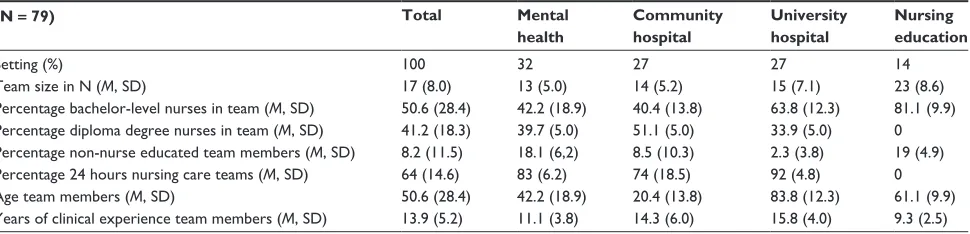
In a cross-sectional design, self-reported data were gath-ered from individual members of nursing teams. Using a structured questionnaire that included team learning and context items, data were collected between November 2008 and March 2009. In meetings with the nursing teams, the researcher or a trained research nurse distributed the questionnaire packet after explaining the rationale for the study. To increase the response rate in 24-hour nursing teams, either the nurse researcher returned frequently, or a staff nurse was instructed to distribute the questionnaire to nurses not present at the meeting. Convenience sampling yielded data from 1111 individual responders, representing 79 nursing teams from mental health facilities (32%), general hospitals (27%), university hospitals (27%), and nursing education (14%) (Table 1). All teams originated in health care organizations and Bachelor of Nursing schools in the Netherlands and Belgium, and participated in an academic service partnership on learning and innovation in nursing.
Individual team members voluntarily cooperated to support the research project and signed an informed consent form. Included were responders who were members of a nurs-ing team for 6 months or more. Excluded were students and untrained nursing staff. Included in the analysis were nursing teams wherein a minimum of 80% of the individual members were nurse educated. Excluded from analyses were individual cases with an item nonresponse rate greater than 10% (n = 1). Also, teams with a response rate of less than 60% of their members (n = 0) were excluded for analysis. Random missing data on items were replaced by the scale mean; 0.06% of the data were entered this way.23 To ensure
confidentiality, the returned questionnaires were coded before being entered into the database.24 Approval from the
research committee of the academic service partnership was obtained for the study.
Instruments
Team learning was measured using the revisited team-learning scale for nursing teams.10 This scale was developed
in Dutch and contains 26 items on team-learning activities, divided over five subscales. The subscale pertaining to pro-cessing information contains nine items (Cronbach’s alpha [α] 0.94) representing the actual interpretation and applica-tion of informaapplica-tion in the team. Two subscales containing four items refer to the gathering (α 0.86), and four items refer to the storage or reuse (α 0.87) of information used for production-oriented processes in the nursing team. In addition, two subscales with five items refer to the gather-ing (α 0.86) and four items to the storage or reuse (α 0.83) of development-oriented information. Nurses used this instrument to indicate their perception of team-learning behaviors in their team. All 26 items were rated on a Likert scale ranging from 1 (“never”) to 5 (“very often”).
In this study, context was defined as the “team-learning environment” and the “team configuration”.7,20
Team-learning environment was assessed using a twelve-item
Table 1 Descriptive statistics of the study population
(N = 79) Total Mental
health
Community hospital
University hospital
Nursing education
Setting (%) 100 32 27 27 14
Team size in N (M, SD) 17 (8.0) 13 (5.0) 14 (5.2) 15 (7.1) 23 (8.6)
Percentage bachelor-level nurses in team (M, SD) 50.6 (28.4) 42.2 (18.9) 40.4 (13.8) 63.8 (12.3) 81.1 (9.9) Percentage diploma degree nurses in team (M, SD) 41.2 (18.3) 39.7 (5.0) 51.1 (5.0) 33.9 (5.0) 0 Percentage non-nurse educated team members (M, SD) 8.2 (11.5) 18.1 (6,2) 8.5 (10.3) 2.3 (3.8) 19 (4.9) Percentage 24 hours nursing care teams (M, SD) 64 (14.6) 83 (6.2) 74 (18.5) 92 (4.8) 0 Age team members (M, SD) 50.6 (28.4) 42.2 (18.9) 20.4 (13.8) 83.8 (12.3) 61.1 (9.9) Years of clinical experience team members (M, SD) 13.9 (5.2) 11.1 (3.8) 14.3 (6.0) 15.8 (4.0) 9.3 (2.5)
Abbreviations: M, mean; SD, standard deviation.
Dovepress Team learning and context
Nursing: Research and Reviews downloaded from https://www.dovepress.com/ by 118.70.13.36 on 25-Aug-2020
questionnaire (α 0.96) constructed by Van Wetten et al.20
The questions represented were three items on shared goals, two items on positive attitude towards teamwork, four items on psychological safety, and two items on openness. Items were stated as “in my team, we share the same goals,” or “in my team, I feel safe.” All items were rated on a Likert scale ranging from 1 (“never”) to 5 (“very often”).
Team configuration was measured using the 24-item observed team configuration scale of Van Linge.7 This
instrument represents the four basic team configurations as defined by Van Linge using four subscales with six items each7,21,22: (1) the regulation-oriented team configuration (α
0.87), (2) the goal-oriented team configuration (α 0.76), (3) the team-oriented team configuration (α 0.91), and (4) the development-oriented team configuration (α 0.89). For example, an item in the regulation-oriented team configura-tion subscale was stated as “in my team, communicaconfigura-tion is based on protocols,” and an item in the development-oriented team configuration subscale was stated as “in my team, com-munication is based on general principles and norms.” All items were rated on a Likert scale ranging from 1 (“never”) to 5 (“very often”).
Data aggregation
Where the constructs of team learning and context were seen as shared team properties, data were aggregated from the individual to the team level.25 All 1111 individual cases
were aggregated to 79 teams-level cases, by taking the sum of the mean scores of all items to compute the scales and subscales.25,26 Within-group agreement and homogeneity
of individual level data were tested before aggregation.25,27
The intraclass correlation (ICC) analyses of the team learning and context variables used in this study resulted in ICC1 values between 0.11 and 0.19. Analyses of ICC2 resulted in values between 0.72 and 0.79. The results of these analyses legitimized the aggregation to team-level variables.25,28
Data analyses
Data analyses were completed using SPSS (v 16.0; SPSS Inc, Chicago, IL). Statistics were generated to summarize team-learning and team context variables. We used the subscales, as well as the overall 26-item scale of the revisited team- learning scale for nursing teams to explore relationships between team-learning and contextual variables using Pearson’s product-moment correlation coefficient.24 In congruence with
Van Woerkom and Croon,22 all hypotheses concerning the
relationship between team-learning and contextual variables
were tested simultaneously in a hierarchical multiple regres-sion model with the overall 26-item scale of the revisited team-learning scale for nursing teams as a dependent variable. Due to the theoretical interrelation between all included vari-ables, the regression models were tested for multicollinearity with the tolerance test and the variance inflation factor (VIF). Also, we added a regression commonality analysis to supply the unique and common contribution of each independent variable to the regression.29 All tests were conducted at a 5%
level of significance.
Results
Table 2 presents mean score (M), standard deviation (SD), percentage of maximum score, Pearson’s product-moment correlation coefficient, and Cronbach’s alpha (α) of the team learning and context variables. We detected high mean scores for the subscales storage and retrieval production-oriented information (M= 14.7; SD = 1.6) and for processing infor-mation (M= 29.0; SD = 3.1). In contrast, for the subscales related to gathering information, we detected low mean scores. All team learning variables showed moderate-to-strong interrelationships.
The correlation matrix in Table 2 shows moderate-to-strong relationships between all team-learning and context variables. Pearson’s product-moment correlation coefficient varied between 0.324 and 0.870. The overall 26-item team-learning scale was positively related with the development-oriented configuration, the team-development-oriented configuration, and the team-learning environment. The team-learning environ-ment was moderately positively related with the regulation-oriented and goal-regulation-oriented configuration. The team-learning environment was positively related with the team-oriented and development-oriented team configuration. Only the gath-ering professional-oriented information subscale showed low correlation coefficients with all contextual factor variables in this study. Strong relationships were detected between team-learning environment, and the team-oriented and development-oriented configurations.
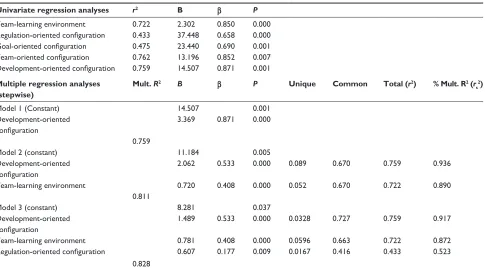
Univariate linear regression analyses with the 26-item team-learning scale team as the dependent variable showed associations with the development-oriented team configura-tion (β= 0.759; P= 0.001), the team oriented configuration (β= 0.762; P= 0.007) and the team learning environment (β= 0.722; P= 0.000).
Multiple regression analyses discriminated three models (Models 1, 2, and 3) that explain 75%, 81%, and 83%, respec-tively, of the variance in team learning. Model 1 (P= 0.001) explains 75% of the variance in team learning and includes
Dovepress
Timmermans et al
Nursing: Research and Reviews downloaded from https://www.dovepress.com/ by 118.70.13.36 on 25-Aug-2020
only the variable ‘development-oriented configuration’ (β= 0.871; P= 0.000) (Table 3).
Model 2 explains 81% (P= 0.005) of the variance in the 26-item team-learning scale and includes the development-oriented configuration (β = 0.533; P = 0.000) and team-learning environment (β = 0.408; P = 0.000) variables. Its tolerance score is 0.312, and its VIF score is 3.2. The commonality data in Table 4 indicate that the regression was influenced by interrelationships between the independent variables in this model: development-oriented configuration uniquely explained 10.9% of the regression effect (0.811). Team-learning environment explained 6.4% of the regression effect. Common variance between the two predictor variables made up the remainder of the regression effect. These findings indicate that 82.6% of the regression effect was explained by the combination of the development-oriented configuration and the team-learning environment.
Model 3 (P = 0.009) explains 83% of the variance in the 26-item team learning scale and contains the
development-oriented configuration (β= 0.533; P= 0.000), team-learning environment (β= 0.408; P= 0.000), and the regulation-oriented configuration (β = 0.177; P = 0.009) variables, which were independent variables. The com-monality matrix in Table 5 shows the unique contribution to the regression effect (%R2) of the development-oriented
configuration variable is 3.9%. The unique contribution to the %R2 of team-learning environment is 7.2%. The unique
contribution to the %R2 of regulation-oriented configuration
is 2%. The combination of the independent variables in this model explains 88.9% of the total regression effect (%R2)
on team learning. The combination of the team-learning environment and development-oriented configuration accounts for 36.5% of the regression effect. The combination of the independent variables (team-learning environment, development-oriented configuration, and regulation-oriented configuration) accounts for 44.4% of the regression effect. The commonality tables for models 2 and 3 are available from the authors upon request.
Table 2 Mean score, standard deviation, percentage of maximum score, Pearson’s product-moment correlation coefficient, and Cronbach’s α of all team-learning and context variables
1 2 3 4 5 6 7 8 9 10 11
1 Team learning 0.93a
2 Gathering
production-oriented information
0.727b 0.87a
3 Gathering
development-oriented information
0.593b 0.685** 0.86a
4 Processing information 0.743b 0.584** 0.484** 0.95a
5 Storage and retrieval of production-oriented information
0.716b 0.588** 0.464** 0.680** 0.87a
6 Storage and retrieval of development-oriented information
0.723b 0.592** 0.486** 0.679** 0.587** 0.83a
7 Team-learning environment
0.850** 0.637** 0.514** 0.886** 0.710** 0.557** 0.96a
8 Regulation-oriented configuration
0.658** 0.400** 0.346** 0.595** 0.557** 0.737** 0.499** 0.87a
9 Goal-oriented configuration
0.690** 0.537** 0.466** 0.596** 0.528** 0.694** 0.538** 0.737** 0.76a
10 Team-oriented configuration
0.852** 0.625** 0.449** 0.861** 0.769** 0.632** 0.891** 0.588** 0.630** 0.91a
11 Development-oriented configuration
0.871** 0.704** 0.557** 0.829** 0.699** 0.698** 0.829** 0.675** 0.763** 0.892** 0.89a
Possible scale score 26–130 5–30 4–20 9–45 4–20 4–20 11–55 6–30 6–30 6–30 6–30
Mean 81.2 10.7 14.6 29.0 14.7 12.1 40.5 19.4 19.1 21.6 19.8
SD 7.4 1.1 1.6 3.1 1.6 1.5 4.2 2.1 1.7 2.0 1.9
Minimum score 64.1 8.7 10.8 22.3 9.6 8.9 31.9 15.6 14.7 16.1 15.0
Maximum score 96.5 13.1 18.8 35.7 17.8 15.7 51.0 24.0 22.5 24.7 24.0
Notes:aCronbach’s α; bcorrected item total correlation; **P , 0.001.
Abbreviation: SD, standard deviation.
Dovepress Team learning and context
Nursing: Research and Reviews downloaded from https://www.dovepress.com/ by 118.70.13.36 on 25-Aug-2020
Discussion
The aim of this study was to study the relationship between team learning and the team-learning environment and con-figuration of organization characteristics of the nursing team. Conventional organizational learning literature describes production-oriented and development-oriented team learning in teams, but reports an inability to exploit both learning processes simultaneously.11,30 Nonetheless, the results of this
study underline modern theoretical insights on ambidexterity in nursing teams by revealing the simultaneous prevalence of production- and development-oriented team learning processes in nursing teams.8,10,11 The conventional theories
on learning in teams and organizations were created in an era when teams acted in a stable context in which changes and
innovation were rare.31 In contrast, the current context of
nurs-ing is characterized by an overload of operational pressure and constantly changing practices.6,32 Nowadays, nursing teams are
forced to exploit ambidextrous team learning processes.5,7,9
The existence of ambidextrous team-learning processes related positively to a supportive context in which individual team
Table 4 Commonality matrix regression model 2
Variables Coefficient % of R2
Unique to development-oriented configuration
0.089 10.9
Unique to team-learning environment 0.052 6.4 Common to development-oriented
configuration and team-learning environment
0.670 82.6
Total 0.811 100
Notes: Coefficient = variables unique regression effect; % of R2= percent of total explained variance.
Table 5 Commonality matrix regression model 3
Variables Coefficient % of R2
Unique to development-oriented configuration
0.033 3.9
Unique to team-learning environment 0.060 7.2 Unique to regulation-oriented
configuration
0.017 2.0
Common to development-oriented configuration and team-learning environment
0.303 36.5
Common to development-oriented configuration and regulation-oriented configuration
0.056 6.7
Common to team-learning environment and regulation-oriented configuration
-0.008 -0.9 Common to development-oriented
configuration, team-learning environment, and regulation-oriented configuration
0.368 44.4
Total 0.828 100.0
Notes: Coefficient = variables unique regression effect; % of R2= percent of total explained variance.
Table 3 Summary results and relationships between team-learning (dependent) and contextual factors using regression analyses
Univariate regression analyses r2 B β P
Team-learning environment 0.722 2.302 0.850 0.000 Regulation-oriented configuration 0.433 37.448 0.658 0.000 Goal-oriented configuration 0.475 23.440 0.690 0.001 Team-oriented configuration 0.762 13.196 0.852 0.007 Development-oriented configuration 0.759 14.507 0.871 0.001 Multiple regression analyses
(stepwise)
Mult. R2 B β P Unique Common Total (r2) % Mult. R2 (r s2)
Model 1 (Constant) 14.507 0.001
Development-oriented configuration
3.369 0.871 0.000 0.759
Model 2 (constant) 11.184 0.005
Development-oriented configuration
2.062 0.533 0.000 0.089 0.670 0.759 0.936
Team-learning environment 0.720 0.408 0.000 0.052 0.670 0.722 0.890
0.811
Model 3 (constant) 8.281 0.037
Development-oriented configuration
1.489 0.533 0.000 0.0328 0.727 0.759 0.917
Team-learning environment 0.781 0.408 0.000 0.0596 0.663 0.722 0.872
Regulation-oriented configuration 0.607 0.177 0.009 0.0167 0.416 0.433 0.523 0.828
Notes: Unique = x’s unique effect; Common = Σx’s common effects; Total = Unique + Common; % of R2 = Total/R2.
Dovepress
Timmermans et al
Nursing: Research and Reviews downloaded from https://www.dovepress.com/ by 118.70.13.36 on 25-Aug-2020
members modify their behavior as well as question and modify the underlying values, assumptions, and policies that led to the behavior in the first place.15,33 Regression effects in this study
were not caused by the unique contribution of the independent contextual factors, but by the commonality of their concurrent prevalence. This underlines context as a multifactorial construct wherein the independent factors interrelate and create a specific configuration that hinders or facilitates team learning.32,34 Van
Wetten et al20 and Edmondson34 identified the team-learning
environment as one of the most important contextual factors for team learning.20,34 Still, we expected a stronger impact from the
team-learning environment. Team-learning environment items such as “safety” and “shared goals” facilitated team learning, but above all, the results in this study highlighted the commonality with other contextual factors such as the development-oriented and regulation-oriented team configuration relationships.
In accordance with Edmondson et al,16 we detected
rela-tionships between team learning and a context with develop-ment-oriented organizational characteristics.35,36 In this type
of configuration, teams gather and process information on important developments outside the team and actively cross the boundaries of their own teams and professions.7,18 In
line with the first hypothesis in this study, team learning was positively associated with the team-learning environment, the team-oriented configuration, and the development-oriented team configuration.7,16 In contrast to the second hypothesis,
the results of this study also revealed a positive relationship between team learning and the regulation-oriented configu-ration on team learning. In accordance with the theoretical statements of Homan and Radstake 35 and Edmondson et al,16
team learning in a nursing team requires regulation of the team learning processes, described as structured, regular team meetings with the goal of enhancing team learning.16,35
An infrastructure in the nursing team often exists to handle production-oriented learning tasks. Examples include the handover, daily meetings, and team meetings where infor-mation about production is shared, processed, and stored in minutes or patient records. Infrastructures for handling development oriented learning tasks are rare in nursing teams. Up and coming examples are initiatives such as journal clubs and evidence-based nursing meetings in nursing teams. These meetings are structured, regular meetings designed to facili-tate developmental learning in the nursing team. Initiatives such as journal clubs only succeed if there is a supportive infrastructure on the ward that is visible as planned, regular meetings dedicated to the journal club.36
In conclusion, team learning in nursing teams was positively associated with a combination of contextual
factors: team-learning environment, development-oriented team configuration, and regulation-oriented team configu-ration. Although the contextual factors can be divided into separate theoretical constructs, in reality, these factors exist in a configuration of independent contextual factors. This study has two important implications for practice. First, transferring the literature on team learning and ambidexterity to nursing teams reveals how nursing teams learn in modern times. Nurses in teams simultaneously undertake various team-learning activities to process the production-oriented and development-oriented information. Second, linking team learning and context revealed the insights in the commonality of contextual factors in nursing teams. This study underlines the importance of building a supportive context for team learning in nursing teams.
Limitations
In this study, we used questionnaires to capture responders’ perceptions of both team-learning activities and contextual factors in their nursing teams. These perception based data could cause several limitations of this study when aggregated to team level data.25,26 The effective sample size was limited
to 79 nursing teams. In addition, measurements could be influenced by tendentious perceptions of individual respond-ers, which would also affect the aggregated scores. Statisti-cal procedures, however, showed satisfactory scores on the assumptions for aggregation.25 Also, the concepts in this study
were formulated clearly at the team level.7 In the regression
analyses, team learning was analyzed with the overall 26-item scale, which limited information on the five different team-learning factors. Consequently, analyses of the relationships between the five factors of team learning and the contextual factors were only provided as correlations.
Issues for further research
We suggest that future research uses more longitudinal designs to study team learning in relation to context over time. In addition, we suggest further research to include more in-depth analyses on the level of the five subscales of team learning. In terms of future research, one of the most interesting questions is the assumed relationship between ambidextrous team learn-ing and the implementation of innovations in nurslearn-ing teams. Therefore, we suggest studying the relationship between the five team learning factors and the implementation effect of different types of innovations in nursing teams.
Disclosure
The authors report no conflicts of interest in this work.
Dovepress Team learning and context
Nursing: Research and Reviews downloaded from https://www.dovepress.com/ by 118.70.13.36 on 25-Aug-2020
Nursing: Research and Reviews
Publish your work in this journal
Submit your manuscript here: http://www.dovepress.com/nursing-research-and-reviews-journal
Nursing: Research and Reviews is an international, peer-reviewed, open access journal publishing original research, reports, reviews and commentaries on all aspects of nursing and patient care. These include patient education and counselling, ethics, management and organizational issues, diagnostics and prescribing, economics and
resource management, health outcomes, and improving patient safety in all settings. The manuscript management system is completely online and includes a very quick and fair peer-review system. Visit http://www.dovepress.com/testimonials.php to read real quotes from published authors.
References
1. Salas E, Cooke NJ, Rosen MA. On teams, teamwork, and team performance: discoveries and developments. Hum Factors.
2008;50(3):540–547.
2. Van Achterberg T, Schoonhoven L, Grol R. Nursing implementa-tion science: how evidence-based nursing requires evidence-based implementation. J Nurs Sch. 2008;40(4):302–310.
3. Berta W, Teare GF, Gilbart E. et al. The contingencies of organizational learning in long-term care: factors that affect innovation adoption.
Health Care Manage Rev. 2005;30(4):282–292.
4. Lemieux-Charles L, McGuire WL. What do we know about health care team effectiveness? a review of the literature. Med Care Res Rev. 2006; 63(3):263–300.
5. Carman JM, Shortell SM, Foster RW. et al. Keys for successful imple-mentation of total quality management in hospitals. Health Care Man-age Rev. 2010;35(4):283–293.
6. Blakeney B, McCarthy C, Coakley E. Unlocking the power of innovation. Online J Issues Nurs. 2009;14(2). doi: 10.3912/OJIN. VOl14No02Man01.
7. Van Linge R. Innoveren in de gezondheidszorg, theorie, prak-tijk en onderzoek (Innovation in health care, theory, practice and research). Maarssen, the Netherlands; Elsevier Gezondheidszorg; 2006.
8. Raisch S, Birkinshaw J. Organizational ambidexterity: antecedents, outcomes, and moderators. J Manage. 2008;34(3):375–409. 9. Holleman G, Poot E, Mintjes-de Groot J, Van Achterberg T. The
relevance of team characteristics and team directed strategies in the implementation of nursing innovations: A literature review. Int J Nurs Stud. 2009;46(9):1256–1264.
10. Timmermans O, Van Linge R, Van Petegem P, Elseviers M, Denekens J. Team learning and team composition in Nursing. The Journal of Workplace Learning. 2011;23(4):258–275.
11. Kang SC, Snell SA. Intellectual capital architectures and ambidextrous learning: a framework for human resource management. Journal of Management Studies. 2009;46(1):65–92.
12. Sessa VL, London M. Work Group Learning: Understanding, Improv-ing and AssessImprov-ing how Groups Learn in Organizations. New York: Lawrence Erlbaum Associates; 2007.
13. Miller DA. A preliminary typology of organizational learning: synthe-sizing the literature. J Manage. 1996;22(3):485–505.
14. Erdem M. Effects of learning style profile of team on quality of materi-als developed in collaborative learning processes. Active Learning in Higher Education. 2009;10(2):154–171.
15. Argyris C. On Organizational Learning. Oxford, UK: Blackwell Publishing; 1999.
16. Edmondson AC, Dillon JR, Roloff KS. Chapter 6: Three Perspectives on Team Learning – Outcome Improvement, Task Mastery, and Group Process. Acad Manag Ann. 2007;1(1):269–314.
17. Heinemann GD, Zeiss AM. Team performance in health care: assessment and development. 1st ed. New York: Kluwer Academic/ Plenum Publishers; 2002.
18. Edmondson AC, Bohmer RM, Pisano GP. Disrupted routines: team learning and new technology implementation in hospitals. Adm Sci Q. 2001;46(4):685–716.
19. Bennett J. The relationship between team and organisational learning.
Int J Health Care Qual Assur. 2001;14(1):14–21.
20. Van Wetten H, Kok I, Wagner CG. [Measurement of Outcomes in Mental Health Care; study of implementation in mental health organizations]. Utrecht, the Netherlands: Nivell; 2005. Dutch.
21. Scheinn EH. Organizational culture and leadership. San Fransisco, CA: Jossey-Bass; 1992.
22. Quinn RE, Cameron K. Organizational life cycles and shifting criteria of effectiveness: some preliminary evidence. Manage Sci. 1983;29(1): 33–51.
23. Fox-Wasylyshyn SM, El-Masri MM. Handling missing data in self-report measures. Res Nurs Health. 2005;28(6):488–495. 24. Polit DF, Beck CT. Nursing Research:Principles and Methods. 7th
ed. Philadelphia, PA: Lippincott Williams and Wilkens; 2003. 25. Klein KJ, Kozlowski SWJ. From Micro to Meso: Critical Steps in
Conceptualizing and Conducting Multilevel Research. Organizational Research Methods. 2000;3(3):211–236.
26. Van Woerkom M, Croon M. The relationships between team learning activities and team performance. Personnel Review. 2009;38(5):560–577. 27. Van Woerkom M, van Engen ML. Learning from conflicts? The
relations between task and relationship conflicts, team learning and team performance. European Journal of Work and Organizational Psychology. 2009;18(4):381–404.
28. Bliese PD. Within-group agreement, non-independence, and reliability: Implications for data aggregation and analysis. In: Klein KJ, Kozlowski WJ, editors. Multilevel theory, research, and methods in organizations. San Francisco, CA: Jossey-Bass; 2000:349–381. 29. Nimon K, Lewis M, Kane R, Haynes RM. An R package to compute
commonality coefficients in the multiple regression case: An introduc-tion to the package and a practical example. Beha Res Methods. 2008; 40(2):457–466.
30. Argyris C. A life full of learning. Organization Studies. 2003;24(7): 1178–1192.
31. Nonaka I, Takeuchi H. The Knowledge Creating Company. New York: Oxford University Press; 1995.
32. Kalisch BJ, Lee H. Nursing teamwork, staff characteristics, work sched-ules, and staffing. Health Care Manage Rev 2009;34(4):323–333. 33. Illeris K. Contemporary theories of learning: Learning theorists … in
their own words. New York: Routledge; 2009.
34. Edmondson AC. Learning from failure in health care: frequent oppor-tunities, pervasive barriers. Qual Saf Health Care. 2004;13(Suppl 2): ii3–ii9. doi: 10.1136/qshc.2003.009597.
35. Homan T, Radstake D. Teamleren, theorie en facilitatie [Team learning: Theory and Facilitation]. Schoonhoven, the Netherlands: Academic Service; 2001. Dutch.
36. Luby M, Riley JK, Towne G. Nursing research journal clubs: bridging the gap between practice and research. Medsurg Nurs. 2006;15(2): 100–102.
Dovepress
Dove
press
Timmermans et al
Nursing: Research and Reviews downloaded from https://www.dovepress.com/ by 118.70.13.36 on 25-Aug-2020